La revisión trimestral de retroalimentación del cliente: Cómo dirigir la sesión conjunta que realmente mueve la hoja de ruta
Turn this article into takeaways for your work.


Each assistant summarizes the article only for you and suggests best practices for your work.
La mayoría de las empresas SaaS de mercado medio ya tienen la sesión trimestral de alineación CS-Producto. Solo que no parece una. Es el debrief del QBR que se convirtió en una conversación sobre retroalimentación. Es el all-hands donde CS mencionó tres cuentas que habían abandonado por la misma brecha de funcionalidad. Es el hilo de Slack donde el VP CS etiquetó al Head of Product con "deberíamos hablar del problema de exportación. Lo he escuchado de ocho cuentas este trimestre". Entender el nivel de madurez de la alineación CS-Producto ayuda a diagnosticar si estos puntos de contacto informales son un sustituto apropiado para la etapa o una brecha estructural.
Las versiones informales de esta reunión existen en todas partes. Lo que no existe, en la mayoría de las empresas, es la versión estructurada que produce decisiones reales.
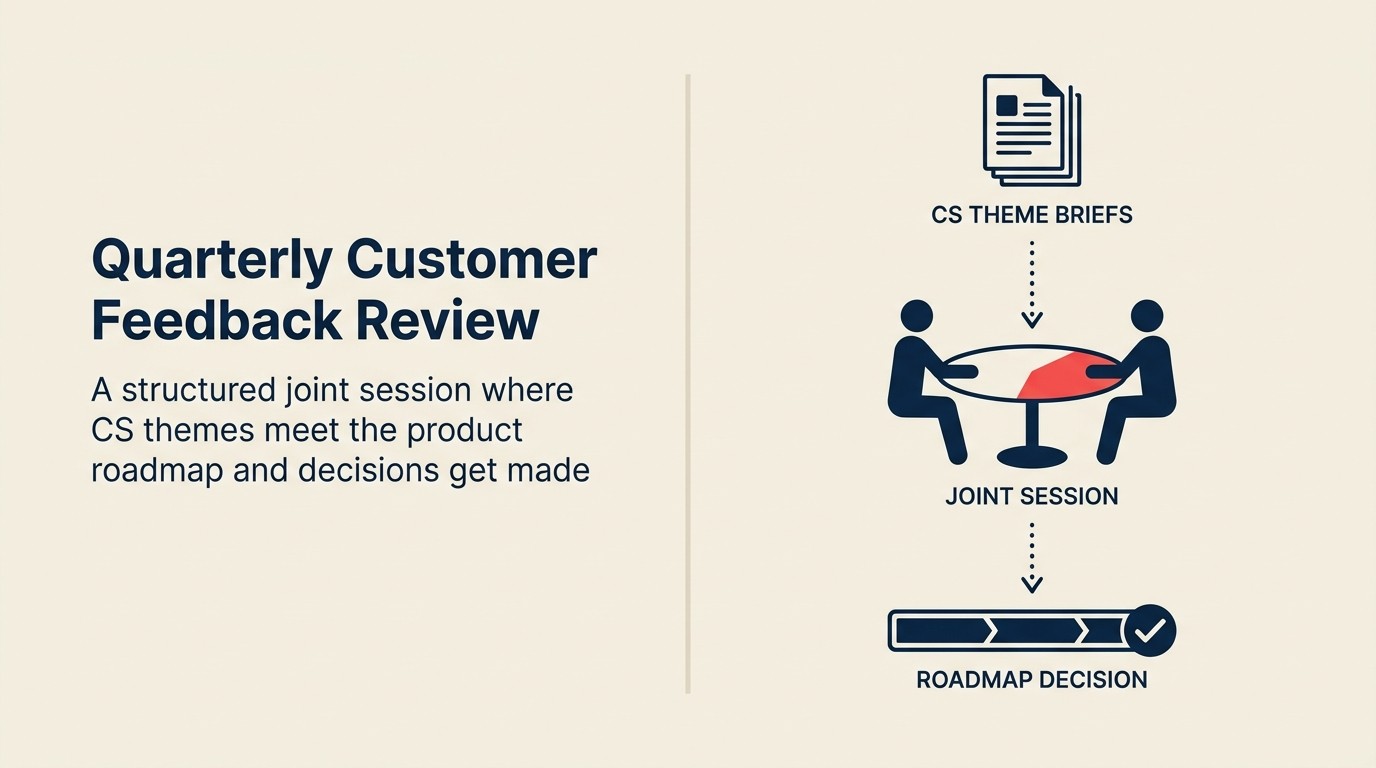
La brecha no es la información. CS tiene la retroalimentación. Producto tiene la hoja de ruta. La brecha es el ritual: la sesión estructurada y recurrente que obliga a que la información cruce la interfaz, produzca una decisión y genere una salida escrita que los CSMs (Customer Success Managers) puedan usar cuando los clientes pregunten qué pasó con lo que plantearon en el T1.
La revisión trimestral de retroalimentación del cliente es ese ritual. Pero solo funciona si está diseñada como una máquina de decisiones, no como una ceremonia de informes. La investigación de McKinsey sobre customer success encuentra que las empresas donde el conocimiento de CS llega a quienes toman las decisiones de producto crecen su retención a un ritmo 2-3 veces mayor que las que no. La revisión trimestral es el mecanismo estructural que hace confiable esa transferencia.
Qué es y qué no es esta reunión
La revisión trimestral de retroalimentación del cliente es el ritual principal donde la retroalimentación sintetizada por CS se traduce en decisiones de priorización de producto. Ocurre cuatro veces al año. Produce decisiones escritas. Cada tema planteado por CS recibe una respuesta. No una promesa de considerar, sino una decisión: en la hoja de ruta, en consideración, o rechazado con un motivo.
No es una revisión de sprint. Las revisiones de sprint son ceremonias internas de producto. La revisión trimestral de retroalimentación incluye a CS como parte principal, no como audiencia.
No es una demo de producto. Las demos de producto muestran lo que se construyó. La revisión trimestral decide qué construir a continuación.
No es un all-hands. Los all-hands tienen audiencias amplias y agendas amplias. La revisión trimestral de retroalimentación es una sesión de decisiones para seis a ocho personas con autoridad directa sobre el proceso de retroalimentación a hoja de ruta.
No es una reunión de escalada de cuentas. Las escaladas individuales pertenecen a la cadencia de 1:1 CS-PM quincenal. Llevar escaladas individuales a la revisión trimestral diluye la altitud estratégica de la sesión y la arrastra hacia la gestión de cuentas.
Cómo difiere del 1:1 CS-PM: el 1:1 maneja la cola operativa en vivo: cuentas urgentes, estado de funcionalidades específicas, preguntas de la hoja de ruta antes de un QBR la próxima semana. La revisión trimestral maneja el patrón estratégico: ¿qué dice un trimestre completo de retroalimentación sintetizada sobre adónde debe ir el producto? Ambos son necesarios. Ninguno reemplaza al otro.
La cadencia trimestral no es arbitraria. La mayoría de los equipos de producto SaaS de mercado medio ejecutan ciclos de planificación trimestrales. Alinear la revisión de retroalimentación de CS con ese ciclo significa que la salida de la revisión llega a la planificación de producto en el momento correcto, no como una interrupción de un sprint ya en curso, sino como insumo para las decisiones de la hoja de ruta del próximo trimestre.
Datos clave: Revisiones trimestrales de retroalimentación y resultados de la hoja de ruta
- Los equipos de producto que realizan revisiones trimestrales formales de retroalimentación de CS envían 28% más funcionalidades directamente rastreables a los insumos del cliente que los que dependen de canales de retroalimentación ad hoc, según la encuesta de Productboard sobre el Estado de la Gestión de Producto 2024.
- Solo el 19% de las empresas SaaS de mercado medio realizan una revisión trimestral estructurada CS-Producto con un registro de decisiones escrito, según el Informe de Operaciones de CS 2024 de CS Insider; la mayoría depende de puntos de contacto informales o ciclos de planificación anuales.
- Los equipos de CS que presentan temas ponderados por ARR (no conteos brutos de solicitudes de funcionalidades) en revisiones trimestrales logran inclusión en la hoja de ruta para los problemas planteados por CS a una tasa 3.4 veces más alta que los que presentan volúmenes de tickets sin ponderar, según la investigación de benchmark de Gainsight.
- La principal razón por la que las revisiones trimestrales conjuntas no producen decisiones: ninguna taxonomía de decisiones. Los equipos que distinguen entre "en la hoja de ruta", "en consideración" y "rechazado (con motivo)" cierran 2.6 veces más ciclos de retroalimentación con los clientes que los que tienen "lo veremos" como respuesta estándar.
Quiénes están en la sala
Asistentes requeridos:
- VP CS (o el líder de CS senior con autoridad para comprometerse con los plazos de comunicación)
- Head of Product (o el PM líder con autoridad para tomar decisiones de hoja de ruta)
- Un representante de CS Ops (para presentar los datos de ARR y los briefs de temas sin que el VP CS tenga que narrar hojas de cálculo)
Opcionales pero de alto valor:
- CPO o CTO para los últimos 30 minutos (incorpórelos para el Bloque 3, donde se toman las decisiones de hoja de ruta, no para las tres horas completas)
- Responsable de RevOps si se presentan datos de atribución de ARR y RevOps posee el modelo de datos
No están invitados:
- Ventas
- Marketing
- Soporte al cliente (las escaladas de soporte son insumos de CS, no un asistente separado)
- CSMs individuales, a menos que uno esté presentando un caso de cuenta específico como evidencia de un tema
Mantener la reunión pequeña es en sí misma una decisión. La revisión trimestral de retroalimentación no es una reunión de informes para una audiencia amplia. Es una sesión de decisiones para las personas con autoridad para tomar decisiones de hoja de ruta y compromisos de comunicación de CS. Una sala más grande diluye la responsabilidad y ralentiza las decisiones. Seis a ocho personas es el tamaño correcto.
Preparación previa a la reunión: Lado de CS (4-6 semanas antes)
La preparación de CS para la revisión trimestral comienza cuatro a seis semanas antes de la sesión, no la semana antes. Esta es la disciplina más difícil de mantener, y la más importante.
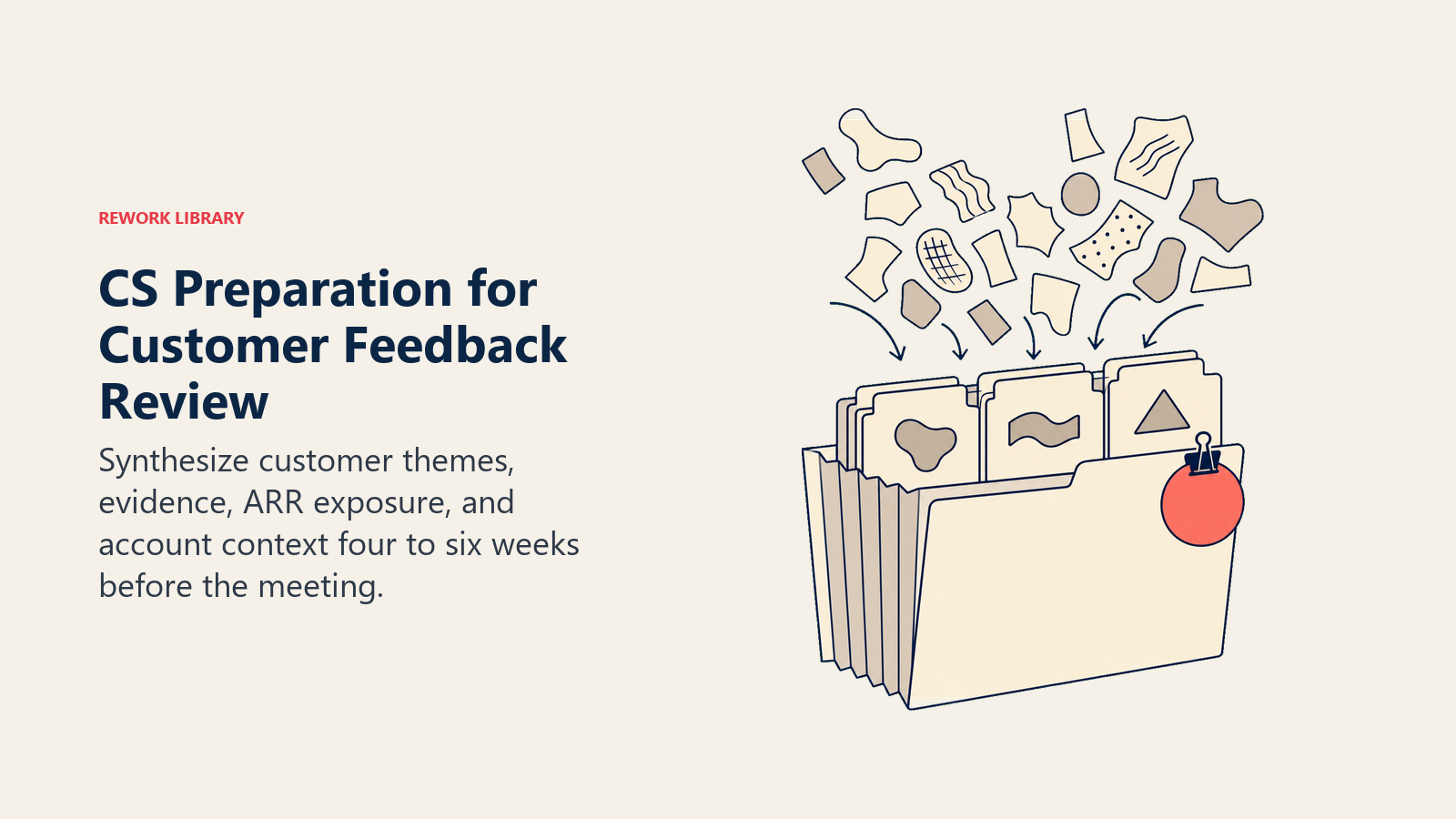
Extraer y categorizar toda la retroalimentación de CS del trimestre. Fuentes: notas de llamadas etiquetadas por tema, verbatims del QBR, notas de entrevistas de salida por abandono, respuestas de texto libre de NPS, y temas de escalada de soporte registrados en la plataforma de CS. CS Ops posee esta extracción. La investigación de Forrester sobre CS 2024 encontró que solo una minoría de equipos de CS sintetizan la retroalimentación antes de presentarla a producto, lo que significa que la mayoría de los equipos de producto reciben insumos brutos sin ponderar en lugar de temas priorizados. El VP CS no debe estar formateando hojas de cálculo cuatro días antes de la reunión. Tenga en cuenta que las sesiones de QBR orientadas al cliente son separadas de esta revisión interna: el QBR conjunto con el cliente es donde las cuentas reciben las decisiones, no donde se toman las decisiones.
Cuantificar por peso de ARR y conteo de cuentas. Los conteos brutos de tickets no son el insumo. Si ocho cuentas SMB plantearon una brecha de funcionalidad y dos cuentas enterprise plantearon la misma, esas dos cuentas enterprise pueden representar cinco veces el ARR. Pondere en consecuencia. Para cada tema, los campos de datos son: conteo de cuentas, ARR en juego, y distribución de nivel de ARR (¿qué porcentaje del ARR proviene de cuentas con $100K+ de ARR?).
Destacar tres a cinco temas, no veinte solicitudes de funcionalidades. El instinto es traer todo. Resístalo. La revisión trimestral funciona con temas (patrones que cruzan múltiples cuentas), no con solicitudes de funcionalidades individuales. Un tema es un patrón con al menos tres cuentas de apoyo y un trabajo subyacente coherente (consulte el proceso de extracción JTBD para saber cómo traducir solicitudes de funcionalidades en temas, y el pipeline de VoC para la disciplina de captura upstream que produce los datos brutos). Veinte solicitudes de funcionalidades producen un debate de 20 elementos. Cinco temas producen cinco decisiones.
El formato del brief de tema de CS. Cada tema recibe un brief de una página. Se envían al Head of Product dos semanas antes de la reunión, no la mañana de la misma. Los campos del brief de tema:
| Campo | Descripción |
|---|---|
| Nombre del tema | Una etiqueta clara (no el nombre de una funcionalidad, sino una descripción de capacidad o trabajo) |
| Lo que dicen los clientes | Una o dos citas literales (palabras exactas, sin paráfrasis) |
| Cuántas cuentas | Conteo de cuentas por nivel de ARR |
| ARR en juego | ARR total de las cuentas afectadas |
| Alternativa actual | Lo que las cuentas están haciendo hoy para compensar |
| Lo que están solicitando | La solicitud de nivel de funcionalidad, expresada claramente |
| Cuál es el trabajo subyacente | El enunciado del trabajo (cuando [situación], necesito [resultado], sin [restricción]) |
| Señal de prioridad | ¿Es un impulsor de abandono, un bloqueador de expansión o un asunto de calidad de vida? |
Preparación previa a la reunión: Lado de Producto (2-3 semanas antes)
El Head of Product recibe los briefs de temas de CS dos a tres semanas antes de la sesión y prepara una respuesta preliminar. No una respuesta final, sino una posición preliminar que le da a la revisión trimestral un punto de partida en lugar de una pizarra en blanco.
Extraer el estado de los compromisos de la última revisión trimestral. ¿Qué se prometió hace cuatro meses? ¿Qué se envió? ¿Qué se retrasó? ¿Qué fue silenciosamente despriorizado? Esta rendición de cuentas honesta es el Bloque 1 de la reunión. Producto debe tenerla lista antes de que alguien más entre.
Identificar dónde se necesita más el insumo del cliente. La revisión trimestral no es solo CS presentando y Producto respondiendo. Producto debe llegar con dos o tres preguntas de diseño abiertas donde la evidencia del cliente afectaría materialmente la decisión. "Estamos evaluando tres enfoques para el flujo de trabajo de exportación. ¿Cuál encaja con cómo los clientes realmente usan esto?" Aquí es donde la voz de CS tiene el mayor apalancamiento.
Señalar los cambios en la hoja de ruta que afectan a las cuentas que CS gestiona. Si algo en la hoja de ruta ha cambiado desde la última revisión trimestral (una funcionalidad que se prometió fue reducida, una fecha de lanzamiento que se comunicó a los clientes se está retrasando), CS necesita saberlo antes de la reunión para poder planificar la comunicación al cliente. No después.
Estructura de la reunión: El formato predeterminado de 3 horas
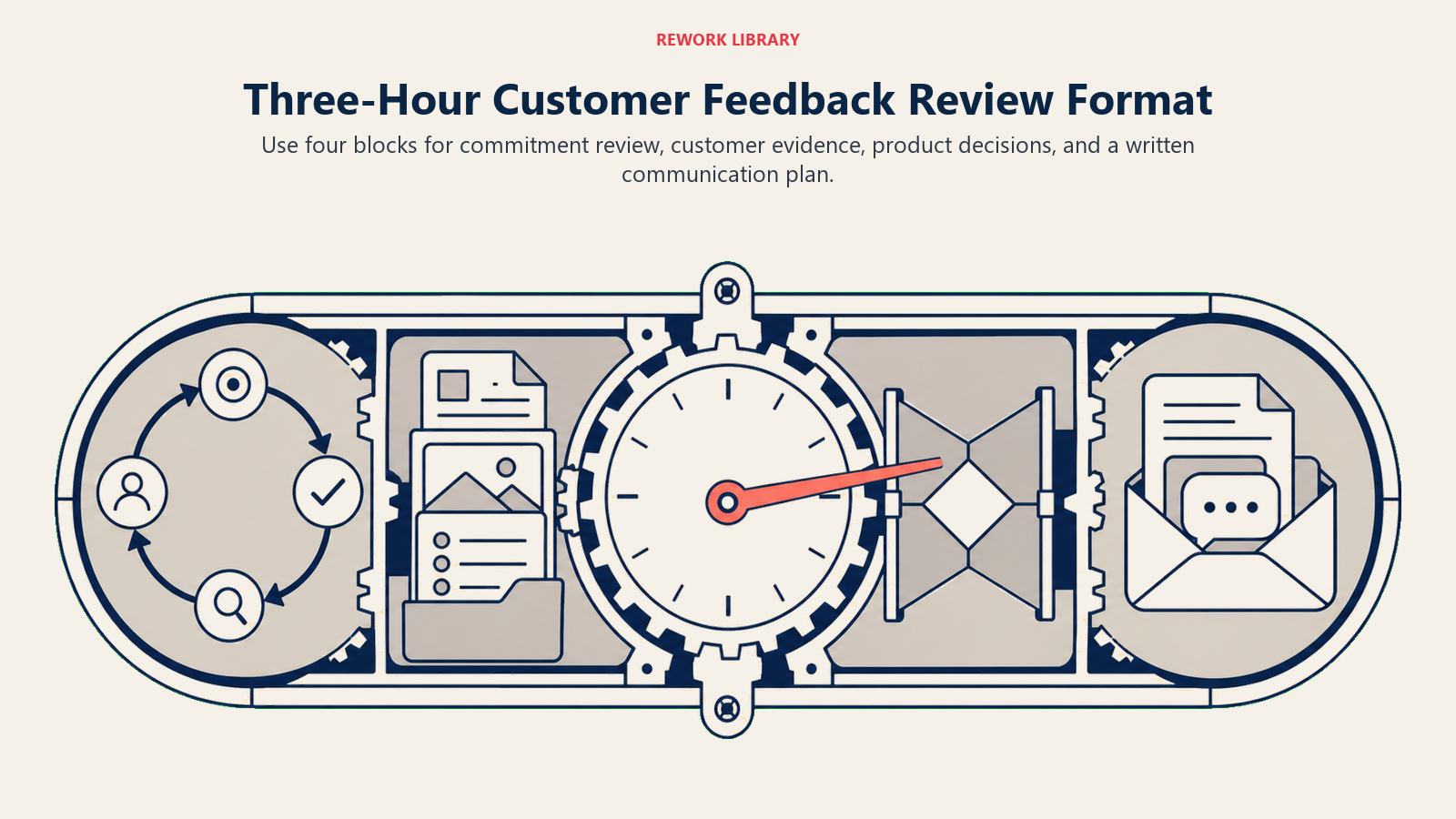
Marco con nombre: El Formato de Revisión Trimestral de Retroalimentación del Cliente El Formato de Revisión Trimestral de Retroalimentación del Cliente es un diseño de sesión de cuatro bloques estructurados para equipos de CS y Producto de SaaS de mercado medio: Bloque 1 (30 minutos, revisión de responsabilidad de compromisos), Bloque 2 (60 minutos, presentación del tema de retroalimentación de CS con citas literales y datos de ARR), Bloque 3 (60 minutos, respuesta de Producto y decisiones de hoja de ruta usando una taxonomía de decisiones de tres estados: en la hoja de ruta / en consideración / rechazado con motivo), y Bloque 4 (30 minutos, registro de decisiones y plan de comunicación al cliente escritos en la sala). El formato está diseñado para producir decisiones de hoja de ruta escritas y atribuibles para cada tema planteado por CS, no para generar debate ni informar sobre la actividad del trimestre.
Tres horas es el valor predeterminado correcto para los equipos de mercado medio. Menos de eso, y el Bloque 3 (la discusión de decisiones de hoja de ruta) se comprime hasta el punto donde las decisiones se convierten en "hagamos un seguimiento". Más de tres horas, y la sesión pierde energía antes de que se escriba el registro de decisiones.
Bloque 1: Revisión de los compromisos del trimestre anterior (30 minutos)
El Head of Product abre este bloque. La estructura: tema por tema, decisión por decisión de la revisión trimestral anterior. ¿Qué se prometió? ¿Qué se envió? ¿Qué se retrasó y por qué? Esta es una rendición de cuentas honesta, no un resumen de los aspectos positivos.
Si un compromiso se retrasó, el resultado de este bloque es un plazo actualizado y un plan de comunicación claro para las cuentas que esperaban la funcionalidad. Si un compromiso se envió pero CS no lo ha comunicado a las cuentas, la acción se asigna aquí.
El propósito de abrir con compromisos es la responsabilidad sin culpa. Señala que las decisiones tomadas en esta sala se rastrean y se reportan cuatro meses después. Esa responsabilidad es lo que hace que valga la pena escribir el registro de decisiones.
Bloque 2: Presentación de temas de retroalimentación de CS (60 minutos)
VP CS recorre cada uno de los tres a cinco temas. CS Ops puede co-presentar los datos de ARR. Para cada tema: las citas literales, el conteo de cuentas y el peso de ARR, el enunciado del trabajo y la señal de prioridad (impulsor de abandono, bloqueador de expansión o calidad de vida).
El rol del equipo de PM en este bloque es solo preguntas de aclaración. Sin debate sobre priorización todavía. Preguntas como: "¿Cuántas de estas cuentas están en la misma industria?" o "¿Es esto más común en cuentas nuevas o en cuentas con más de 12 meses?" son apropiadas. Respuestas como "hemos estado pensando en esto y aquí está la solución" no son apropiadas. Guárdelas para el Bloque 3.
Sesenta minutos para este bloque parece mucho. No lo es, si cada tema recibe de diez a doce minutos. La tentación es pasar rápidamente por los temas para llegar a la discusión. Resístala. El Bloque 2 es donde el equipo de PM escucha la voz del cliente directamente, y la calidad del Bloque 3 depende de qué tan bien aterrizó el Bloque 2.
Bloque 3: Respuesta de Producto y discusión de la hoja de ruta (60 minutos)
El Head of Product abre este bloque respondiendo a cada tema en secuencia. La estructura de respuesta para cada tema:
- En la hoja de ruta: comprometido para el T. El plan de comunicación de CS seguirá. Consulte cómo comunicar la hoja de ruta sin prometer en exceso para saber cómo enmarcar los compromisos con los clientes.
- En consideración: se necesita más evidencia, o prioridad competidora este trimestre. Decisión esperada para [fecha].
- Rechazado: motivo declarado (fuera de alcance / no encaja con la dirección del producto / menor peso de ARR que las prioridades competidoras). CS reconocido; sin más presentaciones sobre este tema a menos que la evidencia cambie.
La discusión en este bloque trata sobre las compensaciones, no sobre si los datos de CS son válidos (el Bloque 2 estableció eso), sino sobre a qué puede comprometerse Producto este trimestre dada la hoja de ruta existente y la capacidad. CS puede objetar un "rechazado" si la evidencia de ARR es sólida. Producto puede pedir entrevistas adicionales con clientes antes de comprometerse con los elementos "en consideración".
Lo que no se puede decidir aquí: priorización a nivel de sprint (eso es ingeniería), estimaciones de esfuerzo de ingeniería (eso es el proceso interno del equipo de PM), o decisiones de precios (esa es una conversación diferente con Finanzas).
Bloque 4: Registro de decisiones y plan de comunicación (30 minutos)
Este bloque no se recorta, independientemente de si el Bloque 3 se extendió. Es la razón por la que ocurrió la reunión.
El registro de decisiones se escribe en la sala, no se redacta después. Una entrada por tema:
Tema: [nombre] | Decisión: [en la hoja de ruta T3 / en consideración / rechazado] | Responsable: [nombre] | Plazo: [fecha para la próxima actualización o fecha de lanzamiento] | Comunicación al cliente: [quién informa a qué cuentas, cuándo, en qué formato]
La entrada del plan de comunicación responde: ¿qué clientes reciben notificación sobre qué decisiones? El valor predeterminado es que CS comunica cada decisión "en la hoja de ruta" y "rechazada" a las cuentas que plantearon el tema. La decisión "en la hoja de ruta" se comunica dentro de las dos semanas de la reunión. La decisión "rechazada" se comunica con un motivo. Los clientes que plantearon una solicitud merecen saber que no se construirá, no solo silencio hasta que abandonen.
Análisis de Rework: Basándose en benchmarks de SaaS de mercado medio, los equipos de producto que reciben temas ponderados por ARR (en lugar de conteos brutos de solicitudes de funcionalidades) en sesiones de retroalimentación trimestrales logran inclusión en la hoja de ruta para los problemas planteados por CS a una tasa 3.4 veces mayor que los que presentan volúmenes de tickets sin ponderar. La estructura de cuatro bloques del Formato de Revisión Trimestral de Retroalimentación del Cliente aborda los dos modos de fallo más comunes: (1) CS entrando con una lista de deseos de funcionalidades en lugar de temas sintetizados (la disciplina de 10-12 minutos por tema del Bloque 2 impone la síntesis); y (2) ninguna taxonomía de decisiones (el modelo de tres estados del Bloque 3 cierra 2.6 veces más ciclos de retroalimentación con los clientes que las sesiones donde "lo veremos" es la respuesta estándar).
La taxonomía de decisiones
Esta es la pieza que a la mayoría de las revisiones trimestrales les falta, y su ausencia es la razón por la que "lo pensaremos" se convierte en la respuesta predeterminada.
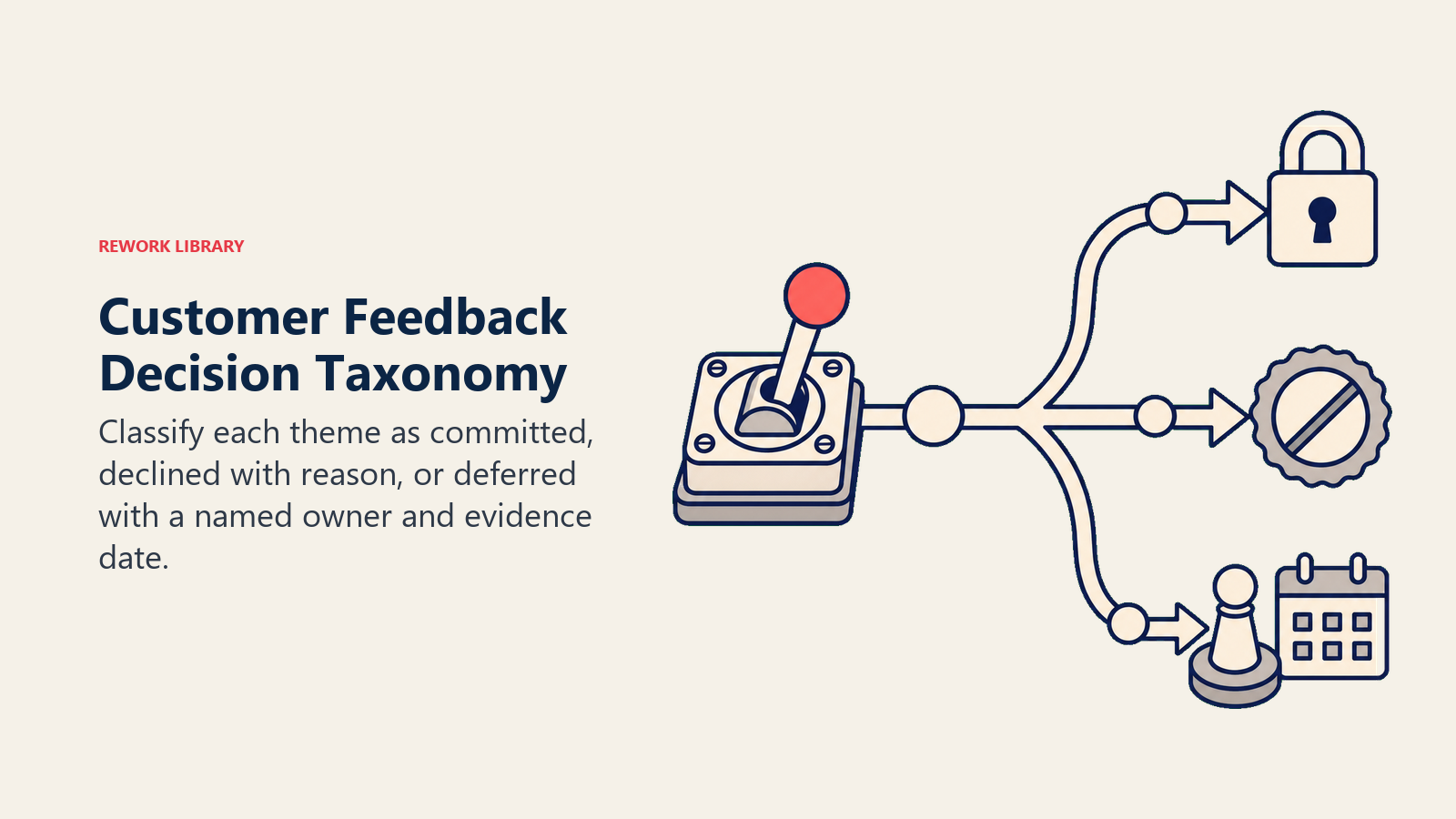
Decisiones que se pueden tomar en esta reunión:
- "Este tema está en la hoja de ruta del T3." (un compromiso, rastreable hasta esta reunión)
- "Esto se rechaza porque [motivo declarado]." (un ciclo cerrado, comunicable a las cuentas)
- "Necesitamos más evidencia del cliente antes de comprometernos. El PM realizará tres entrevistas con clientes antes de [fecha]." (una decisión diferida con un responsable nombrado y una fecha)
Decisiones que no se pueden tomar en esta reunión:
- Priorización a nivel de sprint (eso pertenece a la planificación del sprint con ingeniería)
- Estimaciones de esfuerzo de ingeniería (el producto no puede comprometerse sin insumos de ingeniería)
- Decisiones de precios o empaquetado (esas requieren alineación de Finanzas y liderazgo)
"Todavía no" vs. "No". Los equipos de CS necesitan saber si deben seguir presentando un tema o tratarlo como cerrado. "Todavía no" significa: siga presentando evidencia; esto puede convertirse en un compromiso el próximo trimestre cuando la hoja de ruta tenga capacidad. "No" significa: esto está fuera de la dirección del producto y más evidencia no cambiará eso. Ambas son decisiones válidas. Ninguna es "discutamos más adelante".
Disciplina de salidas: qué sale de la sala
El registro de decisiones. Escrito durante el Bloque 4, antes de que alguien cierre su portátil. Tema, decisión, responsable, plazo, plan de comunicación al cliente. Cada tema recibe una entrada. El documento se comparte en el canal de Slack del equipo dentro de las 24 horas, no "cuando tengamos la oportunidad de limpiarlo".
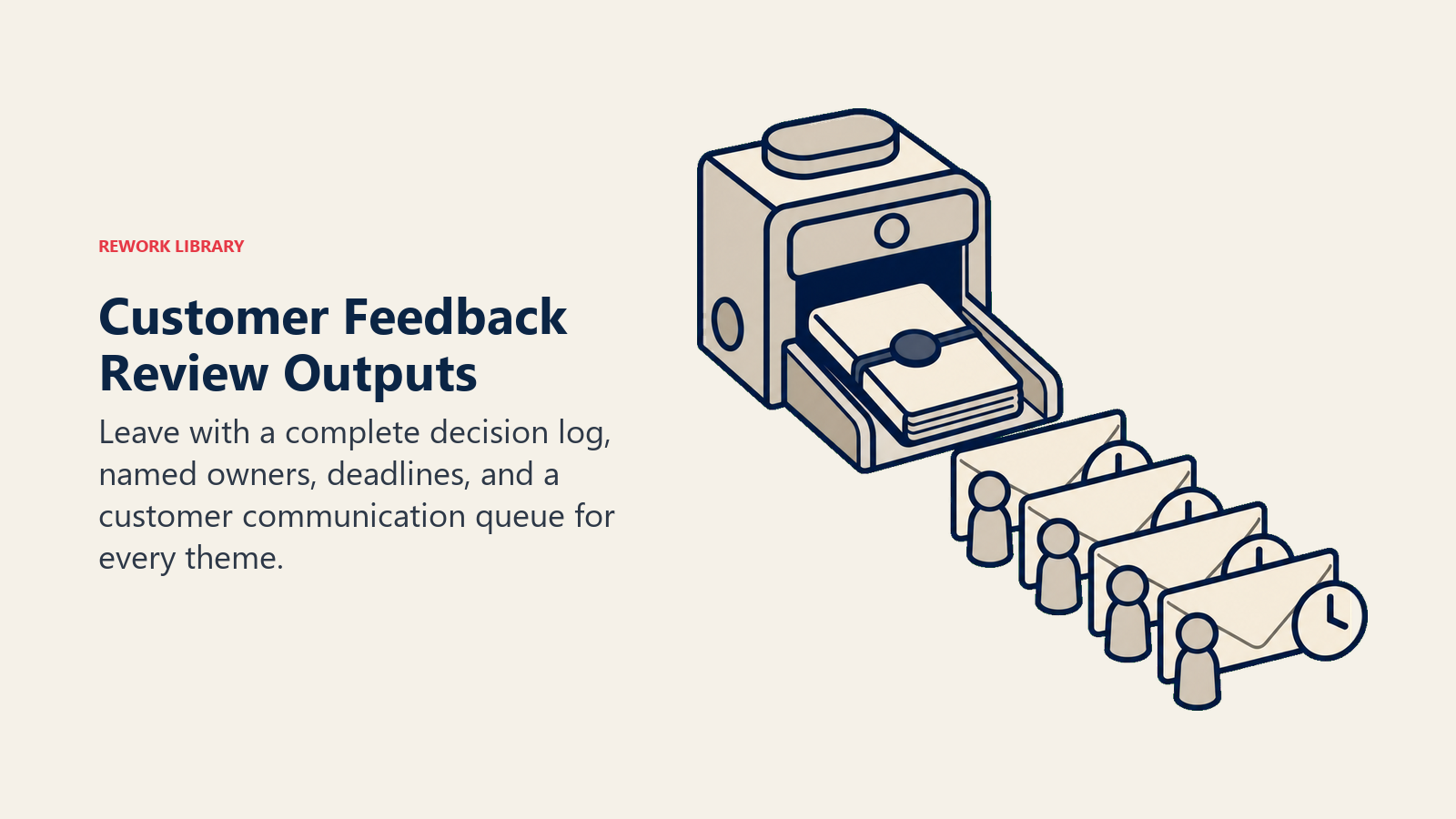
El plan de comunicación al cliente. CS se compromete a qué cuentas reciben notificación, por qué CSM, en qué formato (actualización de QBR, correo electrónico, Slack), y cuándo. Esto no es "comunicaremos cuando podamos". Es una cola de acción específica: "VP CS informará a las tres cuentas enterprise sobre la decisión del tema de exportación antes de [fecha]. Los CSMs individuales actualizarán sus cuentas en el próximo contacto programado". La mecánica completa para cerrar el ciclo de retroalimentación con los clientes, incluyendo cómo comunicar los rechazos y no solo las aprobaciones, es una disciplina por derecho propio.
El memorando interno. Una página. Enviado a los equipos más amplios de CS y PM (no solo a las personas en la sala) dentro de las 48 horas. Formato: resumen de las decisiones tomadas, justificación de los rechazos, elementos comprometidos de la hoja de ruta con plazos, preguntas abiertas que Producto todavía está evaluando. Este memorando es lo que permite a un CSM responder "¿qué pasó con lo que planteé en el T1?" sin tener que rastrear al VP CS.
Lo que entra en la plataforma de CS. Al final de la semana siguiente, CS Ops actualiza los registros de cuenta de la plataforma de CS para cualquier cuenta que planteó un tema que recibió una decisión. Las notas a nivel de cuenta deben reflejar: "Solicitud de funcionalidad [X] planteada en la revisión de retroalimentación del T1. Decisión de Producto: [en la hoja de ruta T3 / rechazado / en consideración]. Cuenta notificada [fecha] por [nombre del CSM]".
Qué hace que falle (y cómo evitarlo)
CS entra con una lista de deseos de funcionalidades en lugar de temas sintetizados. Una lista de 20 solicitudes de funcionalidades no produce decisiones. Produce un debate sobre qué elementos son más importantes, que se degrada hasta quien en la sala es más insistente. Solución: CS Ops es propietario de la síntesis de temas cuatro a seis semanas antes de la reunión. El trabajo del VP CS es presentar temas, no compilarlos en los días previos a la sesión.
Producto entra sin haber leído los briefs de temas. Si el Head of Product ve los temas de CS por primera vez cuando el VP CS empieza a presentar en el Bloque 2, el Bloque 3 es una reacción no preparada en lugar de una respuesta considerada. Solución: el PM líder revisa los briefs de temas de CS dos semanas antes de la sesión y llega con una posición preliminar para cada tema. La posición puede cambiar en la discusión, pero no puede estar ausente.
No se toma ninguna decisión porque "necesitamos pensarlo". Este es el fallo más común y el más dañino. Si CS trae evidencia ponderada por ARR y Producto responde con "lo discutiremos", el ciclo de retroalimentación con los clientes se rompe. El CSM no tiene respuesta, el cliente eventualmente deja de plantear problemas y Producto pierde la señal. Solución: "en consideración" con un responsable nombrado y una fecha es una decisión válida. "Sin decisión" no lo es. La taxonomía de decisiones existe para hacer esto explícito.
El memorando interno nunca se escribe. El Bloque 4 produce un registro de decisiones. Pero si nadie lo compila en un memorando dentro de las 48 horas, la memoria institucional vive solo en las notas del VP CS y del Head of Product, lo que significa que cada CSM que no estuvo en la sala no tiene acceso a las decisiones. Solución: se asigna un propietario de documento nombrado antes de que alguien salga del Bloque 4. No "CS Ops lo redactará". Un nombre específico y un plazo de 48 horas. El mismo formato que funciona para un segmento también escala a múltiples líneas de productos, pero solo si se ejecutan sesiones separadas en lugar de incluir todo en una sola.
Escalado del formato por etapa
Startup (pre product-market fit). Ejecute esto mensualmente, no trimestralmente. Los temas de retroalimentación cambian más rápido de lo que una cadencia trimestral puede rastrear. El Estado de Customer Success 2025 de TSIA señala que los equipos de CS en etapa temprana que realizan sesiones de retroalimentación de producto de alta cadencia cierran sus primeros ciclos de retroalimentación un 40% más rápido que los que esperan un ciclo trimestral. Dos horas es suficiente a esta escala: menos cuentas, menos temas, menos datos de ARR para sintetizar. La disciplina de decisiones sigue aplicando.
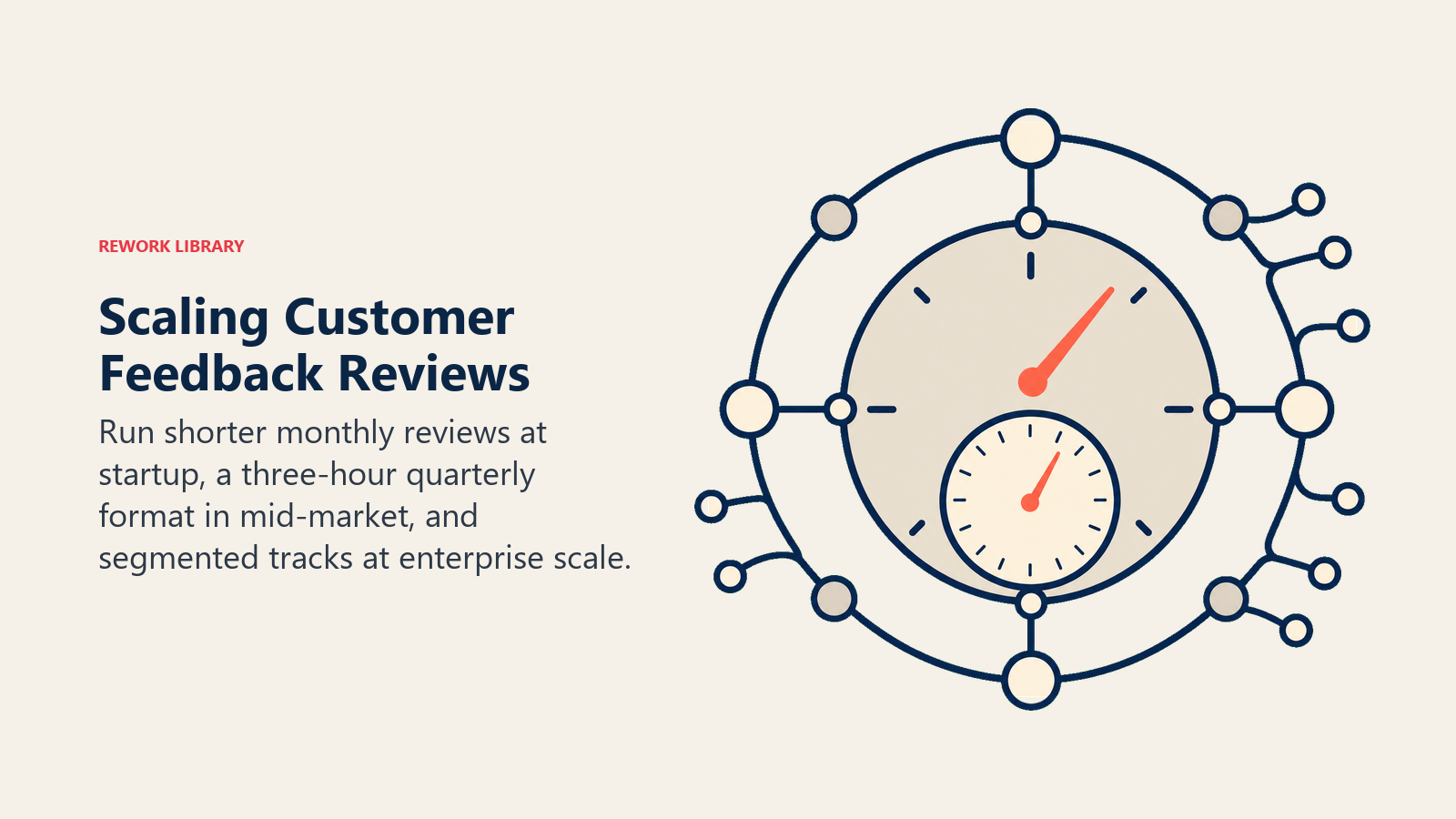
Mercado medio (etapa de crecimiento). Trimestral es la cadencia correcta. El formato de tres horas cubre la agenda completa sin precipitar el Bloque 4. Una sesión por trimestre es suficiente si la cadencia de 1:1 CS-PM está funcionando operativamente entre sesiones.
Enterprise (múltiples líneas de productos o segmentos de clientes). Sesiones separadas por línea de producto o segmento de clientes. Una sola revisión trimestral no puede contener la retroalimentación estratégica tanto para un segmento enterprise como para un segmento SMB sin que uno domine la agenda. VP CS y Head of Product ejecutan cada sesión con los líderes de CS específicos del segmento. El memorando interno por sesión se consolida en un resumen único entre segmentos para el CPO.
Preguntas frecuentes sobre la revisión trimestral de retroalimentación del cliente
¿Qué es el Formato de Revisión Trimestral de Retroalimentación del Cliente?
El Formato de Revisión Trimestral de Retroalimentación del Cliente es un diseño de sesión de cuatro bloques estructurados donde los líderes de CS y Producto traducen un trimestre completo de retroalimentación sintetizada del cliente en decisiones escritas de hoja de ruta. Los cuatro bloques son: Bloque 1 (30 minutos, revisión de responsabilidad de los compromisos del trimestre anterior), Bloque 2 (60 minutos, CS presenta de tres a cinco temas de retroalimentación ponderados por ARR con citas literales y enunciados de trabajo), Bloque 3 (60 minutos, Producto responde a cada tema con una decisión de tres estados), y Bloque 4 (30 minutos, registro de decisiones y plan de comunicación al cliente escritos en la sala antes de que se cierre la reunión). El formato está diseñado para seis a ocho asistentes con autoridad directa sobre las decisiones de retroalimentación a hoja de ruta, no una sesión de informes amplia.
¿Quién debe asistir a la revisión trimestral de retroalimentación del cliente?
Los asistentes requeridos son VP CS (o el líder de CS senior con autoridad para comprometerse con los plazos de comunicación), Head of Product (o el PM líder con autoridad para tomar decisiones de hoja de ruta), y un representante de CS Ops para presentar los datos de ARR. Adiciones opcionales de alto valor: CPO o CTO para los últimos 30 minutos del Bloque 3, y el responsable de RevOps si los datos de atribución de ARR requieren contexto de propiedad. Ventas, Marketing, CSMs individuales y Soporte al cliente no están invitados. Mantener la reunión pequeña es una elección de diseño deliberada. La revisión trimestral es una sesión de decisiones para personas con autoridad directa, no una reunión de informes para una audiencia amplia.
¿Qué es la taxonomía de decisiones de tres estados y por qué importa?
La taxonomía de decisiones de tres estados le da a cada tema planteado por CS uno de tres resultados en el Bloque 3: "en la hoja de ruta" (comprometido para el T[X] con un plan de comunicación al cliente), "en consideración" (más evidencia necesaria o prioridad competidora, con un PM responsable nombrado y una fecha de decisión), o "rechazado" (con un motivo declarado: fuera de alcance, menor peso de ARR que las prioridades competidoras, o duplicado de una funcionalidad existente). La taxonomía importa porque su ausencia es la razón por la que la mayoría de las revisiones trimestrales predeterminan "lo pensaremos". Los equipos que usan una taxonomía explícita de tres estados cierran 2.6 veces más ciclos de retroalimentación con los clientes que los que no tienen una, porque los clientes reciben una respuesta real (incluyendo rechazos) en lugar de silencio indefinido.
¿En qué se diferencia la revisión trimestral de retroalimentación del 1:1 mensual CS-PM?
El 1:1 mensual CS-PM maneja la cola operativa en vivo: cuentas urgentes, estado de funcionalidades específicas, preguntas de la hoja de ruta que los clientes hacen antes de un QBR la próxima semana. La revisión trimestral de retroalimentación maneja el patrón estratégico: ¿qué dice un trimestre completo de retroalimentación sintetizada sobre adónde debe ir el producto? La cadencia del 1:1 maneja lo que no puede esperar tres meses. La revisión trimestral maneja las decisiones que requieren un trimestre completo de evidencia. Ambas son necesarias. El 1:1 evita que la revisión trimestral se vea abrumada con problemas individuales de cuentas, y la revisión trimestral maneja las decisiones a nivel de capacidad que son demasiado grandes para una sesión quincenal de 30 minutos.
¿Cuántos temas debe presentar CS en la revisión trimestral?
De tres a cinco temas es el número correcto para una revisión trimestral de retroalimentación productiva. Menos de tres sugiere que CS Ops no extrajo de suficientes fuentes de datos o que la retroalimentación del trimestre fue inusualmente escasa. Más de cinco abruma el Bloque 3. Los equipos de Producto que responden a ocho o diez temas simultáneamente tienden a diferir la mayoría en lugar de comprometerse. La disciplina de síntesis se ejecuta cuatro a seis semanas antes de la sesión: CS Ops extrae toda la retroalimentación por fuente, cuantifica por peso de ARR y conteo de cuentas, y comprime los patrones en tres a cinco temas, cada uno con un brief de una página enviado al Head of Product dos semanas antes de la sesión.
¿Qué debe ocurrir en el Bloque 4 y por qué no se puede hacer después?
El Bloque 4 (30 minutos, registro de decisiones y plan de comunicación al cliente) debe ocurrir en la sala, antes de que alguien cierre su portátil, porque el registro de decisiones que se "limpia después" no se escribe. El Bloque 4 produce dos salidas: una entrada de registro de decisiones por tema (nombre del tema, estado de decisión, responsable, plazo, plan de comunicación al cliente), y una cola de acciones que nombra qué CSM informa a qué cuentas sobre qué decisiones y cuándo. El registro de decisiones se comparte en el canal de Slack del equipo dentro de las 24 horas, no "cuando tengamos tiempo de limpiarlo". El memorando interno (compilado del registro de decisiones) va a los equipos más amplios de CS y PM dentro de las 48 horas, para que cada CSM que no estuvo en la sala pueda responder "¿qué pasó con lo que planteé en el T1?".
¿Con cuánta anticipación debe CS empezar a prepararse para la revisión trimestral de retroalimentación?
La preparación de CS debe comenzar cuatro a seis semanas antes de la sesión, no la semana antes. CS Ops extrae toda la retroalimentación de CS del trimestre por fuente (notas de llamadas, verbatims del QBR, entrevistas de salida por abandono, texto libre de NPS, temas de escalada de soporte) y categoriza por tipo de situación. La cuantificación por peso de ARR y conteo de cuentas requiere un pase separado. La síntesis de datos brutos en tres a cinco temas requiere otro pase. El brief de tema de una página por tema va al Head of Product dos semanas antes de la sesión. El rol del VP CS en la sesión es presentar y responder preguntas, no formatear hojas de cálculo cuatro días antes.
Más información
- La cadencia de 1:1 CS-PM
- El pipeline de VoC: Cómo CS alimenta a Producto
- Retroalimentación ponderada por ARR: Cuantificando la voz del cliente
- Consejos y juntas asesoras de clientes
- Dashboard de uso del producto y salud del cliente
- Jobs-to-be-Done de los datos de CS
- Cierre del ciclo de retroalimentación con los clientes

Principal Solution Architect
On this page
- Qué es y qué no es esta reunión
- Quiénes están en la sala
- Preparación previa a la reunión: Lado de CS (4-6 semanas antes)
- Preparación previa a la reunión: Lado de Producto (2-3 semanas antes)
- Estructura de la reunión: El formato predeterminado de 3 horas
- La taxonomía de decisiones
- Disciplina de salidas: qué sale de la sala
- Qué hace que falle (y cómo evitarlo)
- Escalado del formato por etapa
- Más información