Cómo manejar "¿cuándo llega X?": marcos para la pregunta más difícil que enfrentan los CSMs
Turn this article into takeaways for your work.


Each assistant summarizes the article only for you and suggests best practices for your work.
Esta no es una pregunta difícil porque los Customer Success Managers (CSMs) no sepan la respuesta. Es difícil por la posición en la que los coloca. Un cliente que necesita suficiente certeza para tomar una decisión de planificación, y un equipo de producto que necesita suficiente flexibilidad para cambiar de rumbo cuando las condiciones cambian. El CSM se sitúa entre estas dos realidades sin una respuesta aprobada y con una conversación de renovación que empieza en cuatro minutos.
La respuesta improvisada es casi siempre peor que una respuesta honesta y estructurada. Las respuestas improvisadas derivan hacia promesas vagas, porque las promesas vagas parecen útiles en el momento. Pero "creo que eso llega en el segundo semestre", dicho sin confirmación de Producto, crea una expectativa en el cliente que ahora es propiedad del CSM. Cuando el segundo semestre llega y pasa, el cliente no se siente engañado por una decisión del producto. Se siente engañado por su CSM.
Los marcos de este artículo no harán que la pregunta sea más fácil de recibir. Pero darán a los CSMs un árbol de decisión que pueden ejecutar en tiempo real, una biblioteca de guiones para los cinco escenarios más comunes y un conjunto de principios que los líderes de CS pueden usar para construir un estándar para todo el equipo.
Por qué se hace la pregunta
Antes de ejecutar el árbol de decisión, hay que entender qué hay detrás de la pregunta. "¿Cuándo llega X?" no siempre es una solicitud de un plazo. A menudo es una de estas tres cosas:
Planificación de flujo de trabajo: El cliente tiene una dependencia operativa real de X. No puede avanzar con un proceso, integración o expansión de equipo particular hasta que X exista. Es una consulta estratégica y merece una respuesta estratégica. Las apuestas son altas: si la respuesta genera una expectativa incorrecta, el cliente planifica en torno a algo que no llega.
Leverage en la renovación: El cliente está evaluando si su compromiso con la hoja de ruta es serio. Puede que le importe más o menos X en sí, pero quiere ver si usted le dará una respuesta directa o evasivas. Una respuesta vaga señala que la dirección de su producto es incierta o que no confía en él con la verdad. La decisión sobre hoja de ruta pública, privada o con acceso controlado determina cuánto de esto es evitable. Los clientes con visibilidad de autoservicio tienen muchas menos conversaciones de leverage que aquellos sin ningún acceso a la hoja de ruta.
Comparación competitiva: El cliente ha visto una funcionalidad de un competidor o ha oído hablar de ella por un par, y trata de entender si usted también la está desarrollando. Esta consulta en realidad dice "¿está quedándose atrás en esta área?" y una respuesta directa sobre dónde se sitúa X en sus prioridades es más útil que un plazo. La investigación de McKinsey sobre compras B2B muestra que los compradores de tecnología B2B que no obtienen respuestas transparentes de su proveedor actual tienen una probabilidad significativamente mayor de iniciar una evaluación competitiva, lo que hace que la evasión sea una opción más peligrosa que una respuesta honesta y directa.
Entender la motivación cambia la respuesta. Una consulta de planificación de flujo de trabajo merece una respuesta de nivel preciso y un seguimiento sobre si existe una solución provisional. Una consulta de leverage en la renovación merece franqueza y confianza. Una consulta de comparación competitiva merece una respuesta sobre la dirección del producto, no solo un plazo. La pregunta es: una vez que se sabe con qué tipo se está tratando, ¿qué respuesta se da realmente?
Datos clave: "¿Cuándo llega X?" y la confianza del cliente
- El 67% de los clientes de B2B SaaS afirma que la capacidad de un CSM para dar respuestas honestas y precisas sobre la hoja de ruta es un factor significativo en su confianza en el proveedor, según la investigación de referencia de CS de Gainsight.
- Los clientes que reciben una respuesta vaga o evasiva a una pregunta directa sobre la hoja de ruta tienen 2,4 veces más probabilidades de escalar en la renovación, en comparación con los clientes que recibieron un "no" honesto y claro, según el análisis de retención de Totango.
- El "no" honesto, bien comunicado, aumenta la confianza del cliente más que una promesa vaga: el 71% de los compradores enterprise informan de una mayor confianza en el proveedor después de escuchar un "no" claro y explicado, frente al 29% después de escuchar una respuesta sin compromiso, según la investigación de confianza B2B de Forrester.
Los cuatro tipos de respuesta: un árbol de decisión para uso en tiempo real
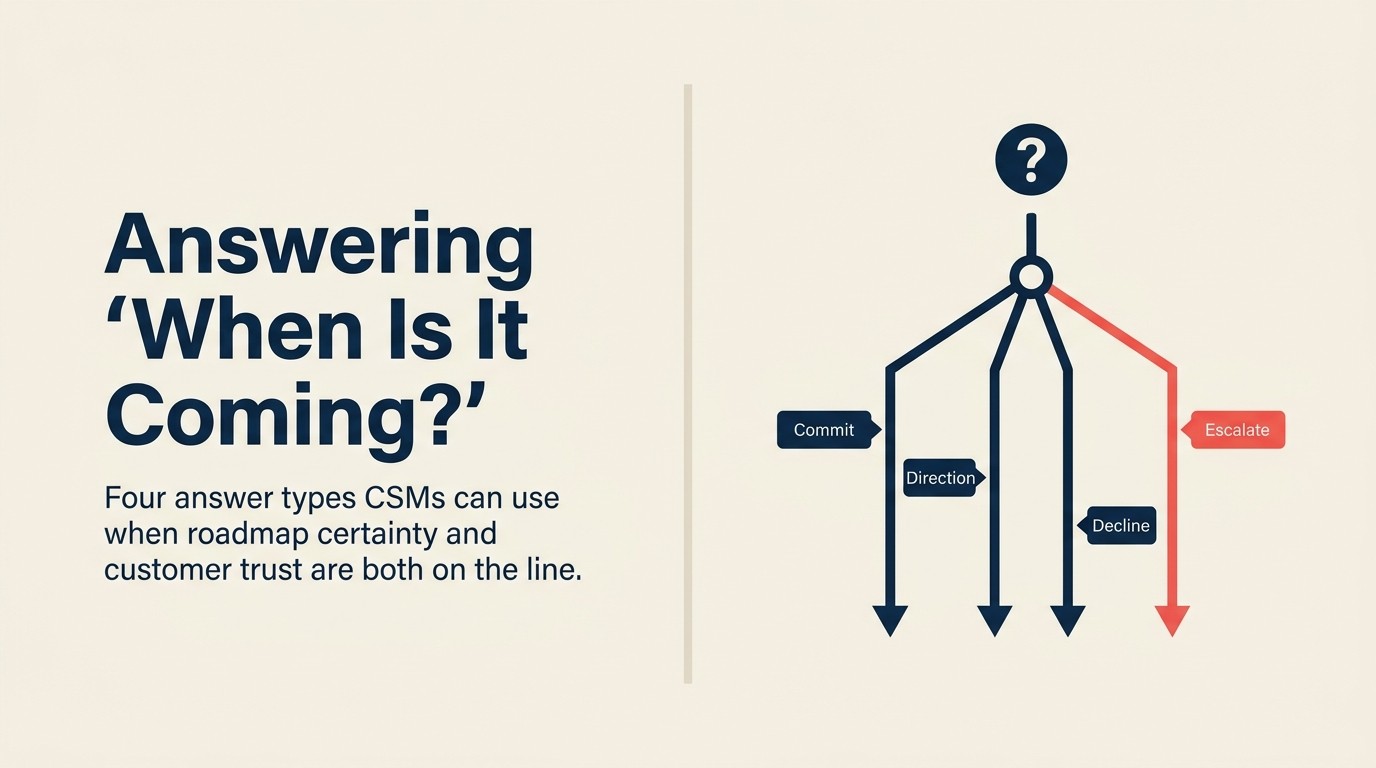
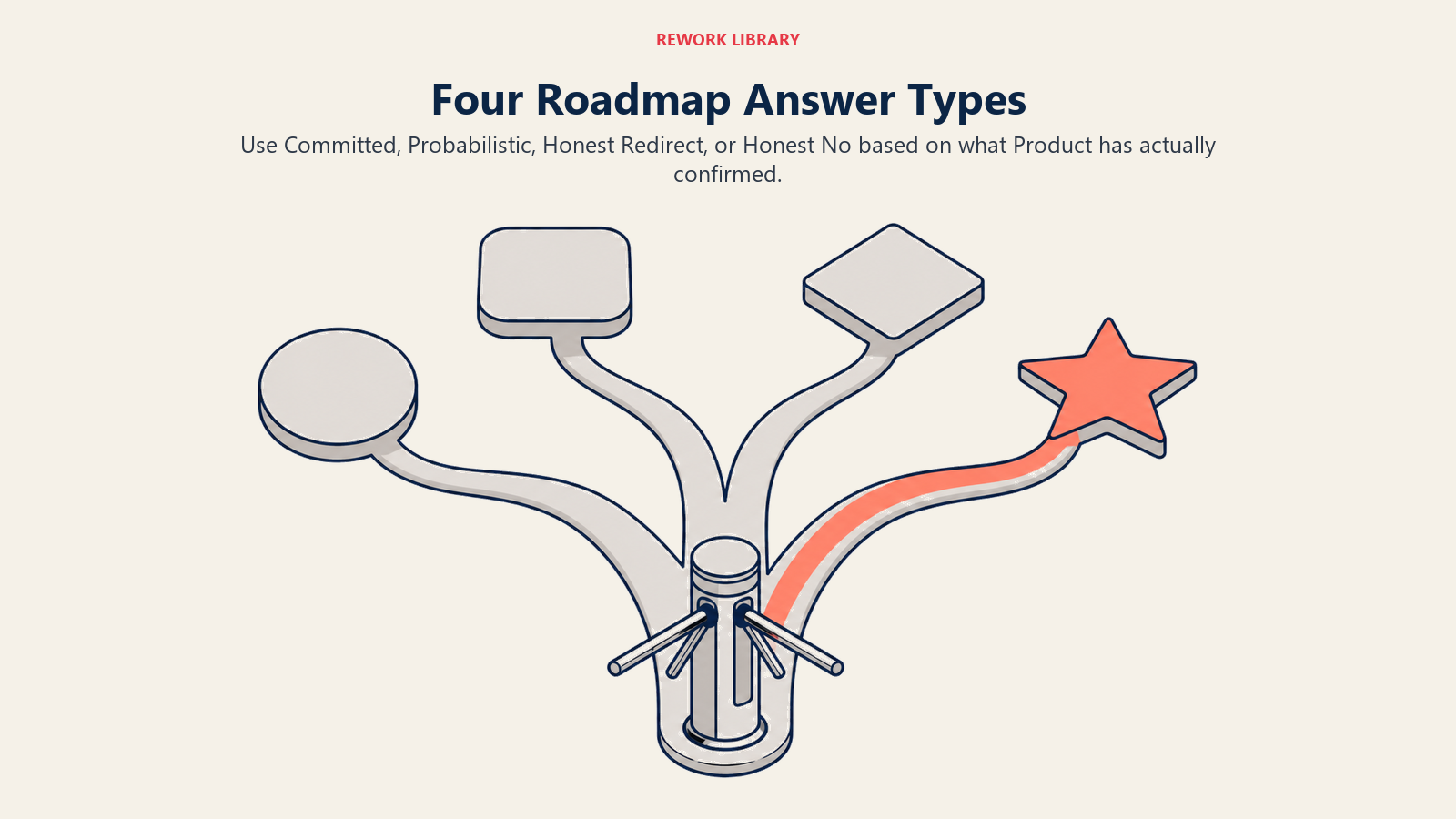
Responda estas cuatro preguntas antes de contestar. La primera pregunta que recibe un "sí" determina su tipo de respuesta.
¿Está X confirmada en el sprint actual o bloqueada para el próximo trimestre?
    → SÍ: Use la Respuesta Comprometida
    → NO: Continúe

¿Está X en la hoja de ruta con recursos asignados, aunque no esté en un sprint?
    → SÍ: Use la Respuesta Probabilística
    → NO: Continúe

¿Ha reconocido Producto la necesidad del cliente y la ha puesto en evaluación activa?
    → SÍ: Use la Redirección Honesta
    → NO: Use el No Honesto
Tipo de respuesta 1: La Respuesta Comprometida
Cuándo usarla: Producto ha confirmado que el elemento está bloqueado. Está en el sprint actual o formalmente comprometido para el próximo trimestre. Usted tiene confirmación directa del PM, no algo que escuchó de pasada o leyó en una presentación, sino confirmación explícita que puede rastrear.
Cómo suena:
"Esto está confirmado para el tercer trimestre. Puedo decirle con confianza que se va a lanzar."
"Nuestro equipo se ha comprometido con esto para el próximo trimestre. Lo tendrá antes de su renovación."
"Lo consulté específicamente con nuestro PM. Está bloqueado para el segundo trimestre."
Qué evitar: No añada "hasta donde sé" o "creo que" a un elemento comprometido. Si está verdaderamente confirmado, dígalo con confianza. El lenguaje de cobertura en un elemento comprometido genera dudas donde debería haber certeza. Y si no está seguro de que esté comprometido, ejecute el árbol de decisión de nuevo desde el principio.
Después de la llamada: Registre el compromiso en su CRM con el cliente, la funcionalidad y el plazo. Si el plazo cambia, contacte de forma proactiva. No espere a la llamada de renovación para informar del cambio.
Tipo de respuesta 2: La Respuesta Probabilística
Cuándo usarla: La funcionalidad está en la hoja de ruta con recursos asignados y prioridad, pero no se ha bloqueado a un sprint. Hay un impulso real, no pensamiento desiderativo, pero el plazo no está confirmado.
Cómo suena:
"Esto está en nuestra hoja de ruta para el segundo semestre. No le daré una fecha que no pueda respaldar, pero es un elemento priorizado con recursos detrás."
"Nuestro equipo tiene esto planificado para la segunda mitad del año. Lo que no puedo darle es un mes específico. Prefiero decirle un rango en el que tengo confianza que una fecha que tendré que retractarme después."
"Puedo confirmar que esto está planificado activamente. El plazo con el que trabajo es el segundo semestre. Si eso cambia, me pondré en contacto antes de que tenga que preguntar."
Qué evitar: No estreche una Respuesta Probabilística a un trimestre cuando un PM no le ha dado un trimestre. Decir "esperamos el tercer trimestre" cuando se quiere decir "segundo semestre" hace que la Respuesta Probabilística se comporte como una Respuesta Comprometida, y se la sostendrá a ese estándar.
Después de la llamada: Registre la expectativa del segundo semestre en el CRM. Establezca un recordatorio personal para consultar con el PM al inicio del tercer trimestre. Si el elemento se retrasa a 2027, el cliente lo escuchará de usted, no de un registro de cambios.
Tipo de respuesta 3: La Redirección Honesta
Cuándo usarla: Producto ha escuchado la necesidad del cliente. Está en evaluación activa: siendo discutida, comparada con otras prioridades, posiblemente esperando un próximo ciclo de planificación. No se ha hecho ningún compromiso de recursos. La funcionalidad puede o no llegar a la próxima hoja de ruta.
Cómo suena:
"Quiero ser transparente sobre dónde está esto. La necesidad está en nuestro radar. La escuchamos de su equipo y de otros en nuestra base de clientes. Pero aún no se ha comprometido a un lugar en la hoja de ruta. Lo que eso significa: se está considerando activamente, no archivada, pero no puedo darle un plazo ahora mismo."
"Su retroalimentación sobre esto está siendo escuchada. Estamos en modo de evaluación, lo que significa que no puedo predecir cuándo o si llegará al próximo ciclo de planificación. Lo que sí puedo hacer es asegurarme de que su caso de uso quede documentado en la conversación."
"Esto es algo que estamos mirando activamente, pero no voy a fabricar un plazo que tendría que venir a corregir. Le aviso cuando cambie el estado. ¿Puede darme más detalles sobre cómo esto le bloquea, para asegurarme de que esté frente a las personas adecuadas?"
El movimiento clave aquí: Convierta la Redirección Honesta en una captura de datos de VoC. Si el cliente pregunta por una dependencia real del flujo de trabajo, esa dependencia es información que Producto necesita. Pídala explícitamente: "Cuénteme más sobre lo que esto bloquea. Cuanto más específico pueda ser sobre el impacto en el negocio, más útil es cuando tomamos decisiones de priorización." Esto es exactamente lo que el pipeline de VoC de CS a Producto está diseñado para recibir: lo suficientemente estructurado como para que Producto pueda actuar sobre ello, no solo una nota de llamada. La disciplina de la voz del cliente formaliza esto: la información del cliente solo se convierte en inteligencia de producto cuando se captura en un formato estructurado que conecta la solicitud declarada con la necesidad operativa subyacente.
Tipo de respuesta 4: El No Honesto
Cuándo usarlo: La funcionalidad no está en la hoja de ruta actual. No en el próximo trimestre, no en el horizonte de planificación en el que Producto trabaja actualmente. Usted tiene claridad de Producto de que este elemento no está en el plan.
Esta es la respuesta que la mayoría de los CSMs evita. Es incómoda. Se siente como cerrar una puerta a la necesidad del cliente. Y en el momento, una promesa vaga parece más amable que un "no" claro.
Pero una promesa vaga no es más amable. Aplaza la decepción y la agrava. Un cliente que escucha un "no" claro puede tomar una decisión real sobre su hoja de ruta y su renovación. Un cliente que escucha "podría llegar algún día" construye un plan en torno a un "quizás", y luego se sorprende en la renovación cuando el "quizás" no ha llegado. La investigación de Forrester sobre confianza B2B concluye que la consistencia y la fiabilidad (no el optimismo) son las dimensiones de confianza que impulsan la lealtad del comprador a largo plazo, lo que significa que el "no" honesto, comunicado con confianza, genera más confianza que un "quizás" suave.
Cómo suena:
"Voy a ser directo con usted. Esto no está en nuestra hoja de ruta actual. Sé que no es lo que esperaba escuchar. ¿Podemos hablar sobre qué impulsa esta necesidad? Puede que haya una forma de abordarla de otra manera, o puede que no, pero prefiero tener esa conversación honesta a dejarle con una expectativa que no se materializará."
"Nuestro equipo ha tomado una decisión deliberada de enfocarse en otro lugar en este ciclo de planificación. Quiero decirle esto directamente en lugar de que usted planifique en torno a algo que no va a llegar a corto plazo."
"Esto no va a suceder este año. Prefiero decírselo ahora, mientras tenemos tiempo para hablar sobre lo que eso significa para su planificación, que no que lo descubra en seis meses."
Después del no honesto: Pregunte al cliente qué significa el "no" para él. ¿Es un obstáculo definitivo para la renovación? ¿Es algo con lo que puede trabajar? ¿Es algo que le gustaría escalar formalmente como una solicitud de alta prioridad? La respuesta a esas preguntas determina el siguiente paso, no el hecho de haber dicho que no.
Cómo manejar la versión de alto riesgo
"Abandonaremos si X no está lista para el tercer trimestre."
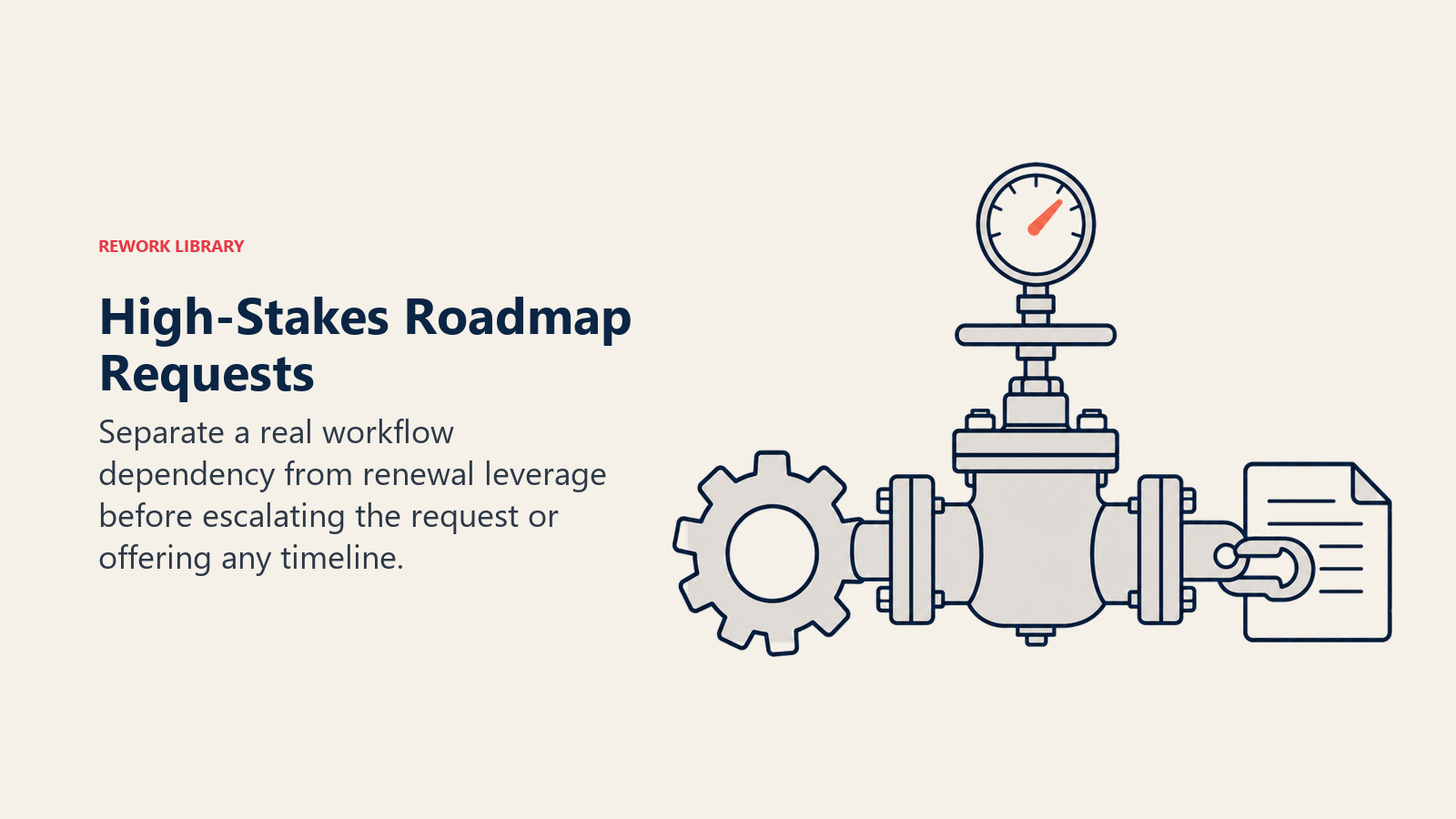
Primero, determine si esto es una restricción real o leverage de negociación. Pregunte directamente: "¿Puede ayudarme a entender qué significaría eso operativamente? ¿Hay un flujo de trabajo que se rompe, o es más bien un umbral para su decisión de renovación?" Los clientes que tienen una dependencia operativa real generalmente pueden describirla específicamente. Los clientes que lo usan como leverage a menudo no pueden.
Si es real: escale a Producto de inmediato, con especificaciones. "Tenemos una cuenta que abandonará si [funcionalidad] no está disponible para el tercer trimestre. Su dependencia es [flujo de trabajo específico]. Esta es una renovación en [ARR]." Ese es un dato de CS que Producto debería considerar en la priorización, incluso si no cambia el resultado. No escale en términos de pánico. Escale en términos de impacto en el negocio. El proceso de retroalimentación ponderada por ARR le da el formato correcto para ese escalamiento. Adjuntar ARR a la solicitud cambia la conversación dentro de Producto.
Si es leverage: reconózcalo directamente. "Le escucho. Déjeme asegurarme de que entiendo su situación con precisión. ¿Hay una razón específica de negocio por la que el tercer trimestre es el límite, o es más bien una señal de que necesita ver un mayor impulso del producto?" Nombrar la dinámica no es confrontacional. Es lo que permite una conversación honesta sobre lo que el cliente realmente necesita para renovar.
Antes de la temporada de renovación: Los líderes de CS deberían tener un FAQ preconstruido para las 10 funcionalidades más solicitadas, actualizado con la información del PM 4-6 semanas antes de los picos de renovación. Cada CSM que entre a una llamada de renovación de alto riesgo debería saber, para cada una de esas 10 funcionalidades, exactamente qué tipo de respuesta aplica y cuál es el lenguaje aprobado. Esto no es una sobrecarga opcional. Es la diferencia entre un equipo de CS que maneja la temporada de renovación con confianza y uno que improvisa hasta llegar a escalamientos. Una revisión de los hitos de realización de valor antes de la renovación es a menudo el momento adecuado para identificar qué funcionalidades siguen abiertas y cuáles se han resuelto. Enmarca la conversación sobre la hoja de ruta en términos de resultados para el cliente en lugar de una lista de verificación de funcionalidades.
La biblioteca de guiones: cinco escenarios distintos
Escenario 1: El cliente hace referencia a algo que dijo un CSM anterior
"Entiendo que lo esperaba en base a una conversación anterior. No puedo hablar de exactamente qué se dijo, pero sí puedo darle una actualización precisa de dónde están las cosas hoy. [Aplique el tipo de respuesta apropiado.] Lamento si la expectativa se estableció de otra manera. Lo que quiero hacer ahora mismo es asegurarme de que tenga la información correcta para tomar decisiones."
Escenario 2: El cliente pregunta en un QBR con varios interlocutores presentes
"Es una pregunta importante. Quiero darle la respuesta correcta en lugar de una que tenga que volver a corregir. [Si conoce el tipo de respuesta, aplíquelo ahora.] Si no estoy completamente seguro del estado actual, le seguiré en escrito en un plazo de 24 horas. Prefiero hacer eso a darle un número en la sala que resulte ser incorrecto."
No improvise en un QBR. La tentación es alta porque el silencio resulta incómodo ante un grupo. La disciplina es decir "déjeme confirmar y hacer un seguimiento" y luego hacerlo realmente.
Escenario 3: La respuesta ha cambiado desde la última conversación
Contacte de forma proactiva. No espere a que el cliente lo descubra.
"Quería anticiparme a algo antes de nuestra próxima llamada. El estado de [funcionalidad] ha cambiado desde que lo discutimos por última vez. [Use el nuevo lenguaje de nivel apropiado.] Sé que es diferente de lo que le dije el trimestre pasado, y quería que lo escuchara directamente de mí en lugar de llevarse una sorpresa. ¿Podemos hablar sobre lo que eso significa para su planificación?"
Escenario 4: Genuinamente no lo sabe y necesita averiguarlo
"No tengo la respuesta correcta sobre esto ahora mismo, y no quiero darle una que tendría que retractarme. Déjeme consultar con nuestro equipo de producto hoy y darle una actualización precisa antes del final de la semana. ¿Con qué decisión está relacionado esto? Eso me ayudará a asegurarme de que estoy haciendo la pregunta correcta de mi parte."
Luego haga el seguimiento. Antes del fin de semana. No cuando por casualidad lo recuerde.
Escenario 5: Una funcionalidad fue eliminada por completo
Este es el escenario más difícil, más difícil que un retraso en el plazo, porque no hay nada que ofrecer además de honestidad.
"Tengo novedades sobre [funcionalidad] que quería compartir directamente. Nuestro equipo ha tomado la decisión de no construirla. Ha sido formalmente eliminada de la hoja de ruta. Sé que esto es significativo para [su caso de uso]. ¿Podemos dedicar algo de tiempo a hablar sobre lo que eso significa para su situación y si hay alternativas que deberíamos explorar juntos?"
No suavice una funcionalidad eliminada con "podría volver en el futuro" a menos que tenga una razón específica para creerlo. La esperanza falsa no es útil.
Qué hacer después de la llamada
Registre la consulta "¿cuándo llega X?" como dato de VoC, no como una nota de soporte. Una nota de soporte se cierra cuando termina la llamada. Una entrada de VoC se acumula.
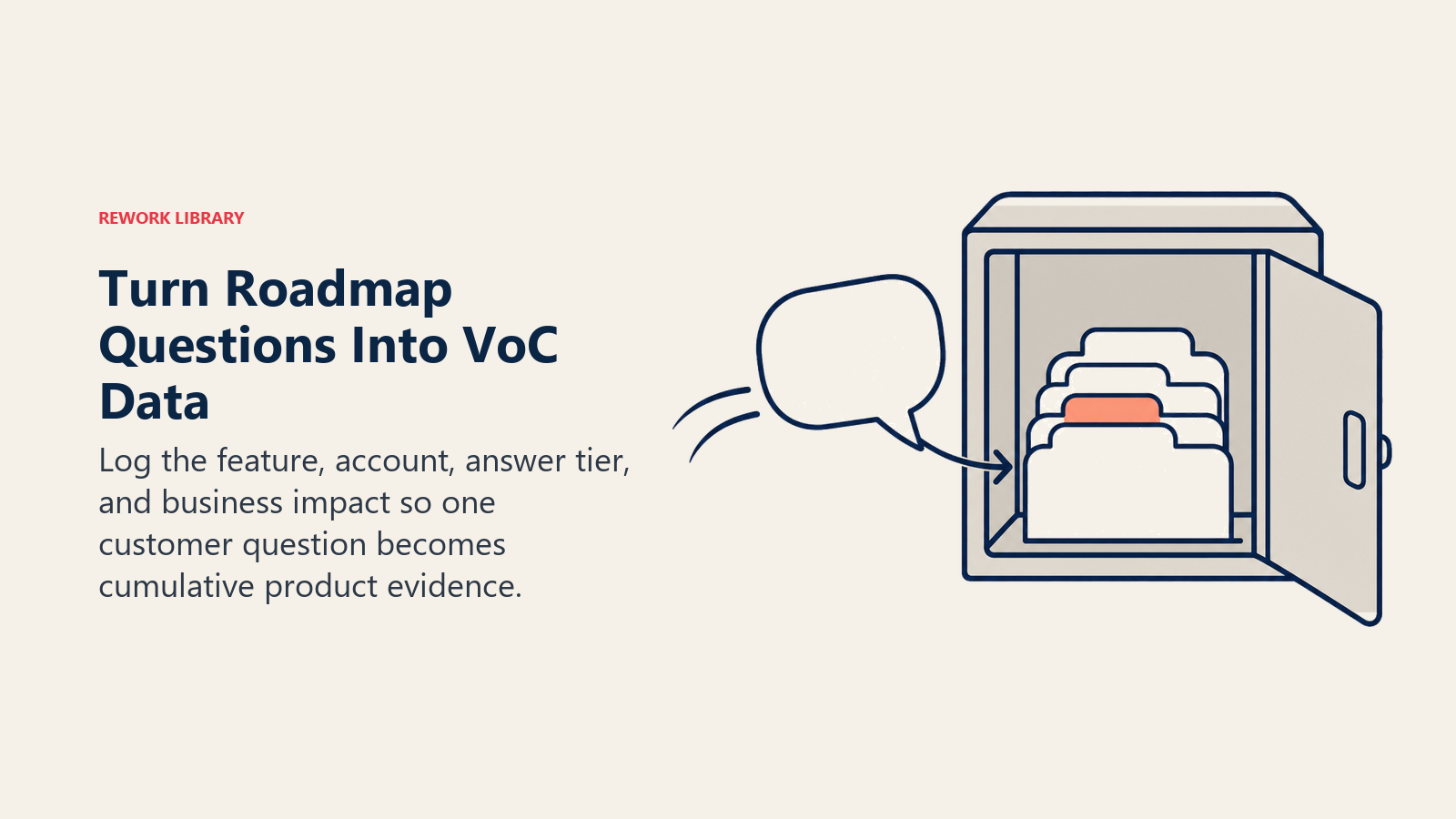
La información que importa: qué funcionalidad se preguntó, qué cuenta preguntó, qué tipo de respuesta dio el CSM y cuál fue el impacto en el negocio de la funcionalidad, si el cliente lo describió.
Cuando 30 cuentas preguntan sobre la misma funcionalidad en un trimestre, esa es una señal que Producto debería escuchar con ese número adjunto. "Múltiples clientes están preguntando sobre X" es ruido. "28 cuentas en tres segmentos de la industria preguntaron sobre X este trimestre, representando 4,2 millones de dólares en ARR" es un dato de priorización. El proceso de retroalimentación ponderada por ARR es donde estas notas de llamadas individuales se convierten en inteligencia de producto accionable.
Cierre el ciclo con los clientes cuando el estado cambie, tanto cuando sea buena noticia como cuando no lo sea. Un cliente que preguntó sobre X en el primer trimestre y escucha de usted en el tercer trimestre que se lanzó (y que usted recuerda que lo preguntó) recibe una señal de confianza que la mayoría de las empresas SaaS nunca entrega.
El playbook para líderes de CS
Sesión trimestral de claridad sobre la hoja de ruta: Cuatro a seis semanas antes de los picos de renovación, realice una sesión de 45 minutos en la que un PM guíe al equipo de CS a través de las 10 funcionalidades más preguntadas. Para cada elemento: qué tipo de respuesta aplica, cuál es el lenguaje aprobado y qué no deberían decir los CSMs. Esta sesión es más valiosa que cualquier conversación individual de entrenamiento, porque construye un estándar compartido en todo el equipo. Combínela con la revisión trimestral de retroalimentación del cliente para asegurarse de que la lista de funcionalidades refleje lo que los clientes han preguntado realmente, no lo que el equipo supone que han preguntado.
FAQ compartido con respuestas aprobadas: Construya y mantenga un documento vivo con Producto que contenga: la funcionalidad, el nivel actual, el lenguaje externo aprobado y la fecha en que fue confirmado por última vez por un PM. Actualícelo al inicio de cada trimestre. Dé acceso a los CSMs. Este documento es la diferencia entre un equipo de CS que opera con estándares compartidos y uno que opera con criterios individuales.
Auditoría de grabaciones de llamadas: Una vez al mes, revise 10-15 grabaciones de llamadas específicamente para conversaciones relacionadas con la hoja de ruta. ¿Se mantienen los CSMs dentro del marco de niveles? ¿Improvisan plazos? ¿Usan lenguaje vago cuando una respuesta de nivel sería más útil? La auditoría saca a la luz patrones que el entrenamiento individual no detecta.
Cuando todo el sistema funciona (niveles claros, sesiones previas a la renovación, un FAQ compartido y un pipeline de VoC que enruta la retroalimentación de vuelta a Producto) la frecuencia de las conversaciones de alto riesgo sobre "¿cuándo llega X?" disminuye. No a cero, porque la pregunta siempre existirá. Pero a un volumen manejable donde cada una puede ser atendida con el cuidado que merece. Un pipeline de VoC funcional y una política clara de comunicación de la hoja de ruta son las condiciones estructurales que reducen la frecuencia con la que los CSMs tienen que manejar esta pregunta bajo presión.
El árbol de decisión CPHR: un marco con nombre
El árbol de decisión de cuatro respuestas de este artículo (Comprometida, Probabilística, Redirección Honesta, No Honesto) se nombra aquí explícitamente para que los equipos de CS puedan referenciarlo de forma consistente. Llámelo el Árbol de Decisión CPHR (Committed / Probabilistic / Honest Redirect / Honest No).
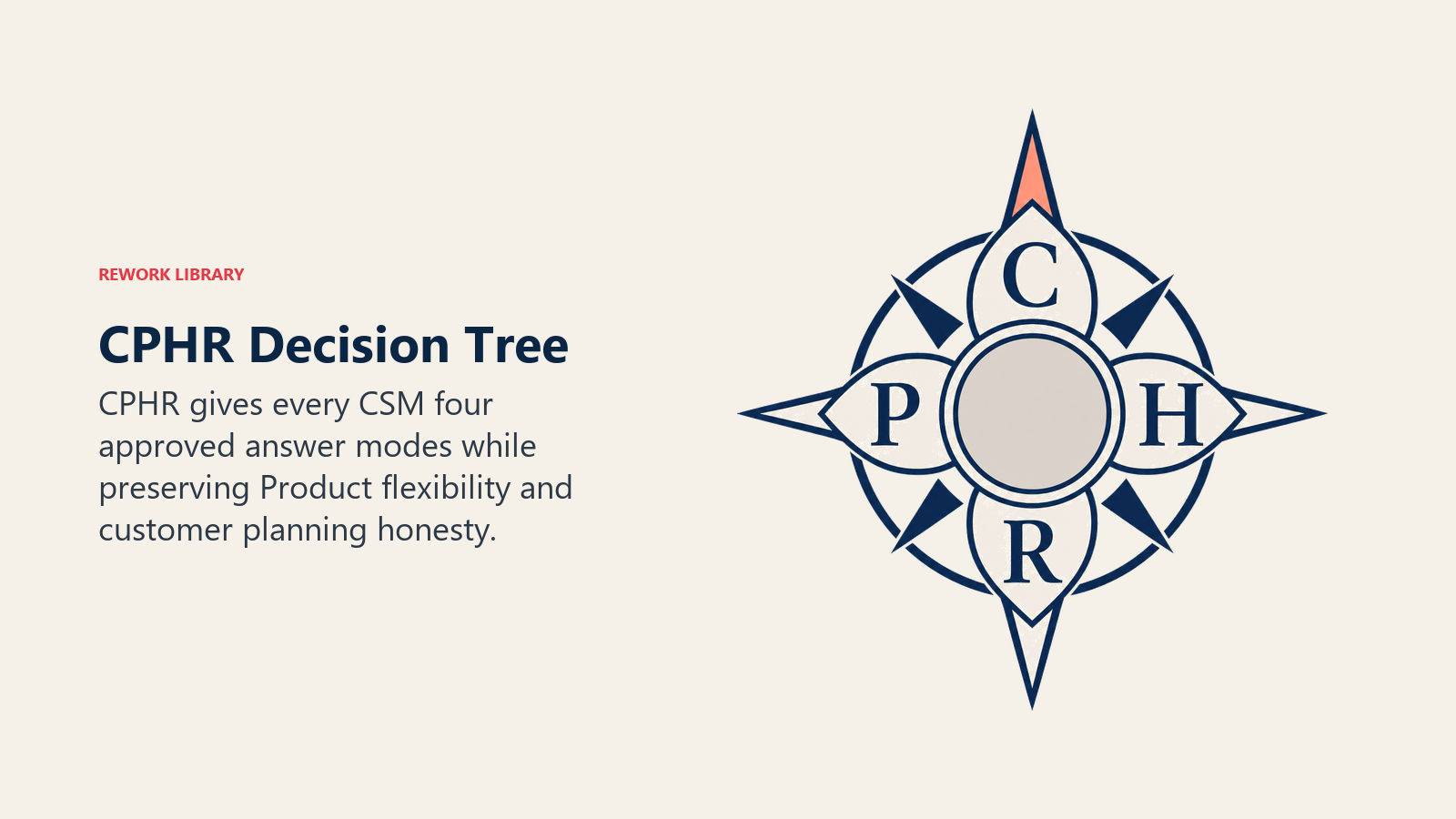
Tiene tres propiedades que lo hacen útil como estándar para todo el equipo:
Funciona en tiempo real. Las tres preguntas de sí/no pueden trabajarse en menos de 30 segundos antes de responder. No requiere preparación para una llamada específica. Se aplica a cualquier funcionalidad sobre la que pregunte cualquier cliente.
Requiere confirmación del PM para los dos niveles superiores. Este es el mecanismo que evita que la improvisación vuelva a aparecer. Un CSM solo puede dar una Respuesta Comprometida o Probabilística si tiene confirmación directa del PM. Sin ella, el valor por defecto es la Redirección Honesta, no una suposición.
Trata el No Honesto como un movimiento de generación de confianza. Esta es la propiedad del marco más contraria a los instintos de los CSMs. La investigación que lo respalda es clara: el 71% de los compradores enterprise informan de una mayor confianza en el proveedor después de escuchar un "no" claro y explicado frente al 29% después de escuchar una respuesta sin compromiso (investigación de confianza B2B de Forrester). Codificar esto como un principio con nombre da a los líderes de CS una forma de reforzarlo en el entrenamiento: el No Honesto no es un movimiento de fracaso, es un movimiento de confianza.
Análisis de Rework: Los equipos de CS que adoptan el Árbol de Decisión CPHR de forma consistente informan del mismo desafío de implementación: la Redirección Honesta (Nivel 3) colapsa hacia el lenguaje del Nivel 2 bajo la presión del cliente. Cuando un cliente objeta ante "lo estamos evaluando", el instinto del CSM es suavizar a "definitivamente está en nuestra lista para el próximo ciclo", que es lenguaje del Nivel 2 para un elemento del Nivel 3. La solución es preparar una respuesta específica a las objeciones de antemano: "Entiendo que eso es frustrante. Lo que puedo decirle es que la evaluación es real y su caso de uso está documentado. Lo que no haré es darle un plazo que no puedo respaldar." Esa frase mantiene la Redirección Honesta bajo presión sin colapsar hacia una promesa. Prepararla antes de la temporada de renovación es el trabajo del líder de CS.
Tarjeta de referencia rápida
| Tipo de respuesta | Cuándo usarla | Frase de apertura |
|---|---|---|
| Comprometida | Confirmada en el sprint o bloqueada para el próximo trimestre | "Esto está confirmado para [trimestre/fecha]." |
| Probabilística | En la hoja de ruta con recursos, aún no en un sprint | "Esto está planificado para [primer/segundo semestre]. No le daré una fecha que no pueda respaldar." |
| Redirección Honesta | Evaluada pero aún no priorizada | "Quiero ser transparente sobre dónde está esto. Se está considerando. No puedo darle un plazo todavía." |
| No Honesto | No está en la hoja de ruta actual | "Voy a ser directo con usted. Esto no está en nuestra hoja de ruta actual." |
Árbol de decisión: ¿Confirmada en el sprint? Comprometida. ¿Con recursos en la hoja de ruta? Probabilística. ¿En evaluación? Redirección Honesta. ¿Ninguna? No Honesto.
Principio central: El "no" honesto, bien ejecutado, genera más confianza que una promesa vaga. Los clientes que reciben un "no" claro pueden tomar decisiones reales. Los clientes que reciben un "quizás" están planificando en torno a algo que puede que nunca llegue.
Aprenda más
- Cómo CS comunica la hoja de ruta sin hacer promesas excesivas
- Hoja de ruta pública, privada o con acceso controlado
- El cementerio de solicitudes de funcionalidad
- Cerrar el ciclo de retroalimentación con los clientes
- Retroalimentación ponderada por ARR: cuantificando la voz del cliente
- Hitos de realización de valor
- Glosario de alineación CS-Producto

Principal Solution Architect
On this page
- Por qué se hace la pregunta
- Los cuatro tipos de respuesta: un árbol de decisión para uso en tiempo real
- Tipo de respuesta 1: La Respuesta Comprometida
- Tipo de respuesta 2: La Respuesta Probabilística
- Tipo de respuesta 3: La Redirección Honesta
- Tipo de respuesta 4: El No Honesto
- Cómo manejar la versión de alto riesgo
- La biblioteca de guiones: cinco escenarios distintos
- Qué hacer después de la llamada
- El playbook para líderes de CS
- El árbol de decisión CPHR: un marco con nombre
- Tarjeta de referencia rápida
- Aprenda más