Glosario de Alineación CS & Product: 30 Términos que Todo Equipo de CS y Producto Debe Acordar
Turn this article into takeaways for your work.


Each assistant summarizes the article only for you and suggests best practices for your work.
Este escenario se repite cada trimestre en empresas SaaS de mercado medio. Un Product Manager (PM) usa la palabra "beta" en una conversación sobre la hoja de ruta con un Customer Success Manager (CSM). El PM se refiere a una prueba interna, no a algo listo para el cliente. El CSM entiende que es una vista previa por invitación para clientes. Dos semanas después, el CSM le dice a una cuenta de alto ARR que participará en la beta. El PM queda desconcertado. El cliente se confunde cuando la funcionalidad no está disponible.
Nadie mintió. Nadie se equivocó. Ambos usaron la misma palabra para decir cosas distintas, y esa grieta absorbió el error.
Cuando la alineación CS-Producto falla, se culpa al proceso. Pero casi siempre es el vocabulario. Dos equipos pueden seguir el mismo ritual de retroalimentación y llegar a conclusiones diferentes. Para CS, "hoja de ruta" significa un cronograma comprometido; para un PM, es un documento de planificación exploratorio. "Incorporado" significa que se realizó la llamada de inicio para Ventas, pero que el cliente está ejecutando activamente su caso de uso principal para CS. "Solicitud de funcionalidad" significa necesidad urgente del cliente para un CSM, y señal no validada para un PM.
Este glosario es la capa de vocabulario canónico para toda la colección de alineación CS-producto. Cada artículo de la colección enlaza aquí cuando introduce un término por primera vez. Úselo como herramienta de trabajo. Reúna al VP CS y al Head of Product en la misma sala, abra este documento y recorra las secciones juntos. Por cada término en el que las definiciones actuales difieran, esa divergencia es trabajo de alineación disfrazado de desacuerdo de vocabulario. El costo de la desalineación CS-producto se acumula cada trimestre que se deja sin resolver.
Términos Más Citados en la Alineación CS-Producto
Los seis términos que aparecen con mayor frecuencia en las fallas de alineación CS-Producto, y donde las brechas de definición causan el mayor daño operativo:
- NRR (Net Revenue Retention): la métrica norte que CS y Producto comparten en última instancia. Cuando CS y Producto no se ponen de acuerdo sobre cómo priorizar, el impacto en NRR es el criterio decisorio que ambas partes pueden aceptar. Consulte retroalimentación ponderada por ARR para ver cómo esto se traduce en insumos de priorización.
- JTBD (Jobs-to-be-Done): el framework que convierte la solicitud de funcionalidad de un cliente en una definición de problema sobre la que un PM puede especificar. Los CSM que entienden JTBD envían mejores tickets de VoC. Los PM que lo enseñan a los CSM reciben mejores insumos. Consulte la definición completa de JTBD.
- MVP (Minimum Viable Product): el término que más probablemente los clientes malinterpretan cuando los CSM lo usan sin contexto. Un MVP es un vehículo de aprendizaje, no un producto terminado. Los clientes que participan en pruebas de MVP necesitan escuchar esa distinción de forma explícita. Consulte MVP.
- Beta: la fuente más común de expectativas rotas en la interfaz CS-Producto, con una sola palabra. "Beta" es una prueba con clientes por invitación que conlleva obligaciones de retroalimentación; no es "acceso anticipado" ni "casi listo." Consulte Beta.
- NPS (Net Promoter Score): una señal rezagada que solo se vuelve útil cuando va acompañada de seguimiento por parte del CSM. El NPS bruto sin un pipeline de ciclo cerrado es ruido. Consulte NPS.
- MoSCoW (Must / Should / Could / Won't): el framework de priorización que usan los PM para comunicar la certeza de la hoja de ruta. Los CSM que entienden MoSCoW pueden dar a los clientes respuestas honestas de "must" vs. "could" sin prometer de más. Consulte Hoja de Ruta y Backlog para el contexto de flujo de trabajo relacionado.
Cómo Usar Este Glosario
El glosario está pensado para estandarizar el lenguaje que los equipos usan en las transferencias, las conversaciones sobre la hoja de ruta y las revisiones de retroalimentación de clientes.
Esto no es un ejercicio de lectura. Es una herramienta de facilitación.
Organice una sesión de 60 minutos con el VP CS y el Head of Product. Recorran juntos cada sección. Por cada término, háganse una pregunta: "¿Tenemos una definición escrita y acordada que ambos equipos usan hoy?" Si la respuesta es sí, confirmen que coincide con lo que aparece aquí. Si la respuesta es no, o si cada equipo da una respuesta diferente, han encontrado una brecha que vale la pena cerrar antes del próximo ciclo de planificación trimestral.
Cada término tiene una definición y un ejemplo de una línea. El ejemplo muestra el término aplicado a un escenario real de B2B de mercado medio, porque las definiciones abstractas parecen idénticas hasta que se contrastan con una situación concreta de cliente. Es en el caso concreto donde emergen los desacuerdos de definición.
Enlace a grupos de términos individuales desde otros documentos usando los IDs de anclaje en cada encabezado de sección. Al incorporar a un nuevo PM o CSM, envíeles este glosario en la primera semana.
Entonces, ¿cuáles son los términos más peligrosos cuando se dejan sin definir? Comience por Producto e Ingeniería, el vocabulario donde CS tiene más probabilidad de operar desde supuestos en lugar de definiciones compartidas.
Términos de Producto e Ingeniería
Estas definiciones evitan que CS y Producto usen las mismas palabras mientras hacen promesas distintas a los clientes.
Estos son los términos que se originan en Producto e Ingeniería y deben ser comprensibles para CS. Cuando CS no comparte estas definiciones, o promete demasiado a los clientes (comprometiéndose con plazos que el PM no ha confirmado) o comunica de menos, esperando comunicados oficiales en lugar de dar información previa a las cuentas estratégicas.
PM: Product Manager
Es el propietario de la hoja de ruta, la priorización y la entrega de un área del producto. En la interfaz CS-Producto, el PM es el destinatario principal de los insumos estructurados de VoC y el tomador de decisiones sobre si una solicitud del cliente entra al backlog. El "sí" de un PM a una solicitud de funcionalidad significa que está en consideración; no significa que se vaya a implementar, ni cuándo.
Ejemplo: Un CSM escala una brecha de flujo de trabajo que afecta a cuatro cuentas. El PM revisa el ticket de VoC, lo sopesa frente a la prioridad del backlog y responde en cinco días hábiles con el estado en el backlog, no con una fecha de entrega.
PMM: Product Marketing Manager
Traduce los cambios del producto al lenguaje orientado al cliente: notas de versión, mensajes en la aplicación, habilitación de ventas. En la interfaz CS-Producto, el PMM es el puente estructural entre lo que Producto implementa y lo que CS comunica a los clientes. El PMM no es una función de comunicaciones que se activa después de que se toman las decisiones; es la capa de traducción en ambas direcciones.
Ejemplo: El PMM toma una especificación técnica de funcionalidad del PM y produce tres resultados: una información previa para CS, un anuncio en la aplicación y una nota de versión externa, cada uno calibrado para su audiencia.
Engineering Manager (EM)
Lidera el equipo de ingeniería que ejecuta la hoja de ruta del producto. Es relevante en la interfaz cuando CS escala complejidades o solicitudes que requieren la aprobación del EM antes de que un PM pueda comprometerse. El EM es el propietario de la asignación de recursos en el lado de ingeniería; un PM no puede comprometerse con un plazo de entrega sin la alineación del EM.
Ejemplo: CS escala un error de integración que bloquea a un cliente. El PM lo dirige al EM, quien confirma un ciclo de corrección de dos sprints. El PM comunica el plazo a CS el mismo día.
Product Designer
Es el propietario de la experiencia de usuario de una funcionalidad o flujo. En la interfaz, los product designers se unen a los CSM y clientes en llamadas reales para identificar brechas de flujo de trabajo que no aparecen en los datos de uso. La exposición directa al cliente moldea las decisiones de diseño con mayor anticipación, reduciendo el ciclo de retroalimentación "¿por qué funciona así?" posterior a GA.
Ejemplo: Un product designer se une a dos llamadas de incorporación lideradas por CSM para un nuevo módulo de informes. Las observaciones revelan tres puntos de fricción en la interfaz que los datos de uso no mostraban, y se incorporan antes del GA.
JTBD: Jobs-to-be-Done
Un framework que define qué intenta lograr un cliente (el "trabajo") en lugar de qué funcionalidad solicitó. Jobs-to-be-Done se basa en la idea de que los clientes "contratan" productos para realizar trabajos específicos, un concepto estrechamente ligado a la investigación de innovación de Clayton Christensen. Los datos de CS son una de las fuentes más ricas de señal JTBD en bruto en cualquier empresa B2B. Los CSM escuchan el "trabajo" cada vez que un cliente describe una solución provisional: están diciendo exactamente qué intentan hacer y qué el producto no les permite hacer. Consulte Jobs-to-be-Done desde datos de CS para conocer el enfoque operativo completo.
Ejemplo: Los clientes siguen exportando datos a hojas de cálculo y haciendo cálculos manualmente. La solicitud de funcionalidad dice "mejor exportación." El enfoque JTBD: los clientes necesitan cálculos personalizados por rango de fechas sin salir de la plataforma.
MVP: Minimum Viable Product
La versión más pequeña de una funcionalidad que se puede probar con clientes y generar aprendizaje. El concepto de MVP fue acuñado para describir una versión con las funcionalidades justas para ser usada por los primeros clientes, quienes luego proporcionan retroalimentación para el desarrollo futuro. El MVP es un vehículo de aprendizaje, no un producto terminado. En los programas beta y de acceso anticipado, CS gestiona la relación con los clientes que participan en las pruebas de MVP y es responsable de comunicar qué significa "MVP" para los participantes, específicamente qué no está incluido.
Ejemplo: Un MVP de informes se implementa con tres tipos de gráficos. CS da información previa a las cuatro cuentas del grupo MVP: la funcionalidad está activa, dos tipos de gráficos adicionales están en el próximo sprint y los comentarios deben ir al canal de retroalimentación del PMM.
GA: General Availability
El momento en que una funcionalidad se lanza por completo a todos los clientes. El GA activa las responsabilidades de comunicación de CS: capacitación, orientación en la aplicación, notas de versión y cualquier contacto proactivo del CSM con cuentas de alto ARR o en riesgo. "GA" no significa que los clientes sean conscientes de ello. Significa que el producto está listo y la responsabilidad de comunicación comienza.
Ejemplo: Una funcionalidad alcanza GA el martes. El PMM publica la nota de versión el miércoles. La información previa a CS se envía a todos los CSM el lunes. Las cuentas estratégicas reciben contacto directo del CSM el jueves.
Beta
Una etapa previa al GA en la que una funcionalidad está disponible para un grupo selecto de clientes para pruebas y retroalimentación. Los programas beta son de propiedad conjunta de Producto (preparación de la funcionalidad) y CS (selección de clientes y gestión de la relación). CS selecciona a los participantes en función del estado de la cuenta, el ARR y la probabilidad de retroalimentación productiva, no según quién pidió más alto. La guía sobre ejecución de programas beta con clientes cubre el proceso completo de selección y gestión.
Ejemplo: Ocho cuentas son seleccionadas para un programa beta. CS es el propietario de la relación y la recopilación de retroalimentación. Producto es el propietario de la funcionalidad y la respuesta a la retroalimentación. El PMM es el propietario de la plantilla de comunicación para los participantes.
Alpha
Anterior a beta, típicamente interno o con uno a tres clientes design partner. Los participantes alpha suelen ser identificados y gestionados por CS o el PMM con la participación directa del PM. La retroalimentación alpha da forma a la funcionalidad antes de que se construya para pruebas más amplias. La retroalimentación beta la moldea antes del GA.
Ejemplo: Un cliente design partner con profunda experiencia en el producto se une al alpha de un nuevo motor de automatización. El PM dirige las sesiones. CS mantiene la relación y garantiza que el cliente entienda que esto es pre-beta.
RC: Release Candidate
Una versión que está completa en cuanto a funcionalidades y se espera que pase a GA a menos que se encuentre un error bloqueante. CS puede dar información previa a las cuentas estratégicas en la etapa de RC para preparar al equipo de la cuenta para la ola de comunicación del GA. El estado de RC significa "no hay nuevas funcionalidades", no "no hay errores."
Ejemplo: El módulo de integraciones alcanza RC el viernes. CS contacta a las tres cuentas más dependientes de la funcionalidad para preparar a sus equipos. El GA se implementa el martes siguiente.
Datos Clave: El Costo de los Términos Sin Definir
- Las empresas SaaS B2B con alta alineación en términos CS-Producto reportan un 23% más de rapidez en la adopción de funcionalidades post-GA, dado que las funcionalidades se comunican de forma consistente por CSM que entienden qué se implementó y por qué, según los benchmarks de gestión de productos 2024 de ProductPlan.
- El 61% de las empresas SaaS no tienen una definición escrita compartida de qué constituye "adopción de funcionalidades", la métrica principal post-GA en la interfaz CS-Producto, según el informe State of Product Leadership de Pendo.
- El 54% de los equipos de CS de mercado medio se enteran de las nuevas funcionalidades al mismo tiempo que los clientes, a través de registros de cambios o banners en la aplicación, en lugar de recibir información previa de Producto o del PMM, según los benchmarks anuales de CS de ChurnZero.
Términos de CS y Cliente
Estos son los términos que se originan en CS y deben ser comprensibles para Producto. Cuando Producto no comparte estas definiciones, los PM priorizan sin entender qué clientes están en riesgo y por qué.
CSM: Customer Success Manager
Es el propietario de la relación post-venta con el cliente. La responsabilidad principal es la retención y el estado de la cuenta. En la interfaz CS-Producto, el CSM es el recolector de primera línea de señales cualitativas del cliente: la persona que escucha qué no pueden hacer los clientes, qué no harán o para qué han encontrado una solución provisional. La señal del CSM es la materia prima del pipeline de retroalimentación.
Ejemplo: Las cinco cuentas de una CSM en un vertical específico comparten la misma fricción de incorporación. Ella documenta el patrón, lo categoriza usando la taxonomía de retroalimentación compartida y lo dirige al PM responsable de esa área del producto.
Customer Health Score
Una señal numérica compuesta que resume el perfil de riesgo de una cuenta, combinando datos de uso, volumen de tickets de soporte, puntuaciones de NPS o CSAT, frecuencia de interacción y el criterio del CSM. Los equipos de Producto usan la puntuación de salud como un insumo de priorización: cuando un área de funcionalidades se correlaciona con puntuaciones de salud bajas, es candidata a mejora inmediata. Consulte el panel de uso del producto con estado de salud del cliente para ver cómo ambos flujos de datos se conectan operativamente.
Ejemplo: El módulo de integraciones se correlaciona sistemáticamente con puntuaciones de salud por debajo de 60. El PM revisa esta señal con CS Ops trimestralmente y la usa para ponderear la retroalimentación relacionada con integraciones por encima de otras categorías.
Promoción del Cliente
La disposición de un cliente a respaldar públicamente el producto: llamadas de referencia, casos de estudio, reseñas en G2, participación en el advisory board. Los clientes de alta promoción son desproporcionadamente valiosos para los programas beta y el codiseño porque están suficientemente comprometidos como para dar retroalimentación productiva y tolerar versiones imperfectas.
Ejemplo: Una CSM identifica tres cuentas de alta promoción para una próxima beta. Se seleccionan no porque sean el mayor ARR, sino porque han completado llamadas de referencia y enviado reseñas en G2, señales de genuino compromiso.
NPS: Net Promoter Score
Una métrica de encuesta de una sola pregunta que mide la probabilidad de que un cliente recomiende el producto. El Net Promoter Score fue desarrollado por Fred Reichheld y publicado por primera vez en un artículo de Harvard Business Review en 2003. Es útil como señal de salud rezagada e indicador de tendencia direccional; insuficiente como mecanismo de retroalimentación en tiempo real. El NPS sin un pipeline de seguimiento estructurado es ruido. El NPS con seguimiento de ciclo cerrado por parte del CSM se convierte en señal cualitativa.
Ejemplo: Un cliente envía un NPS de 5 (detractor). El CSM recibe la alerta, se comunica en un plazo de 48 horas e identifica una fricción específica en el módulo de informes. Esa fricción entra al pipeline de VoC como un elemento etiquetado y ponderado.
Advisory Board
Un pequeño grupo de partes interesadas senior del cliente, típicamente entre 8 y 15, que se reúnen trimestralmente para brindar aportes estratégicos sobre la dirección de la hoja de ruta. La membresía del advisory board es gestionada por CS; la agenda es co-propiedad de Producto y el PMM. Los advisory boards no son sesiones de soporte al cliente; son sesiones de aporte que moldean las prioridades de la hoja de ruta del próximo trimestre.
Ejemplo: El advisory board del Q2 incluye al VP Ops de ocho cuentas estratégicas. Producto presenta tres opciones de hoja de ruta. CS facilita la discusión. El PMM documenta el resultado y lo dirige a la sesión de priorización del PM la semana siguiente.
Customer Council
Una versión más amplia y operativa del advisory board, típicamente entre 20 y 50 clientes de un área del producto que revisan avances de funcionalidades y brindan retroalimentación estructurada. CS selecciona a los participantes; Producto define la agenda. Los customer councils se realizan mensualmente o por ciclo de lanzamiento, en lugar de trimestralmente.
Ejemplo: El customer council de informes revisa un prototipo de panel con 30 cuentas. El PMM documenta la retroalimentación. El PM la usa para priorizar los tres tipos de gráficos más solicitados para el próximo sprint.
Términos de Flujo de Trabajo
Estos términos describen cómo ejecuta Producto. CS debe entenderlos para establecer expectativas honestas con los clientes, dirigir la retroalimentación correctamente y programar sus comunicaciones.
Backlog
La lista priorizada de funcionalidades, mejoras y correcciones que un equipo de producto planea construir. La retroalimentación de los clientes de CS entra al backlog como insumo estructurado después de pasar por un pipeline de VoC, no directamente desde la solicitud de un CSM. Un "elemento del backlog" no es un compromiso; es una consideración registrada.
Ejemplo: Un CSM le pide al PM que agregue la solicitud de funcionalidad de un cliente al backlog. El PM confirma que ha sido registrada como elemento de VoC. El CSM comunica al cliente: "Hemos capturado esto como un insumo registrado. Aún no podemos comprometernos con un plazo."
Sprint
Un ciclo de desarrollo fijo, típicamente de dos semanas, en el que un equipo de ingeniería completa un conjunto definido de trabajo. Implicación para CS: los compromisos de sprint son la razón por la que un PM no puede prometerle a un cliente una corrección "esta semana" sin verificar primero el plan del sprint. Los cambios a mitad de sprint interrumpen la entrega de los elementos ya comprometidos.
Ejemplo: Un cliente escala un error el día ocho de un sprint de dos semanas. El PM confirma que no es un bloqueante para el sprint actual pero lo pone como primer elemento del próximo sprint. El CSM comunica una ventana de resolución de 10 días.
Hoja de Ruta
La secuencia planificada de iniciativas del equipo de producto a lo largo de un horizonte temporal, típicamente trimestral o anual. CS comunica la dirección de la hoja de ruta a los clientes; el nivel de detalle compartido depende de si la hoja de ruta es pública, privada o restringida. Una hoja de ruta es un documento de planificación, no un compromiso. Los PM necesitan que esta distinción se comparta explícitamente con los CSM antes de cualquier conversación con el cliente.
Ejemplo: La hoja de ruta del Q3 incluye tres iniciativas. Dos son compartibles a nivel de cuenta estratégica bajo NDA. Una no es compartible. CS recibe una información previa sobre lo que está y no está en discusión antes de que cualquier equipo de cuenta tenga una conversación sobre la hoja de ruta.
Release
Un conjunto versionado de cambios implementados para los clientes. Los releases activan una secuencia de comunicación coordinada entre Producto, el PMM y CS. El release no es el fin del trabajo del PM. Es el comienzo del ciclo de adopción y comunicación.
Ejemplo: La versión 3.4 se implementa el 15 de marzo. Producto cierra el sprint. El PMM publica la nota de versión. CS distribuye la información previa a los equipos de cuenta. Los CSM con cuentas afectadas inician el contacto proactivo.
Depreciación
El proceso de anunciar que una funcionalidad o capacidad será eliminada o reemplazada en un release futuro. La depreciación requiere la participación temprana de CS. Los clientes afectados necesitan aviso previo, una ruta de migración y, en muchos casos, una conversación con su CSM antes de que el anuncio llegue a su bandeja de entrada. El modelo de propiedad para esta comunicación se define en quién es dueño de los cambios orientados al cliente.
Ejemplo: El flujo heredado de importación CSV se depreca con un aviso de 90 días. CS identifica cada cuenta que lo usa. El PMM redacta el anuncio. Los CSM contactan a todas las cuentas afectadas antes de que salga el aviso público.
Fin de Vida (Sunset)
El fin de vida de una funcionalidad deprecada: ya no está disponible. Los cierres que no tienen coordinación con CS son una causa principal de riesgo de retención y escalamientos de emergencia. El periodo entre la depreciación (el aviso) y el cierre (la eliminación) es la ventana en la que CS debe impulsar la migración.
Ejemplo: El flujo heredado de importación cierra el 30 de junio. CS realiza un seguimiento del estado de migración de cada cuenta afectada semanalmente desde el 1 de abril. Las cuentas que aún usan el flujo heredado el 1 de junio reciben contacto directo del CSM y una ruta de escalamiento.
Términos de Retroalimentación
Los términos de retroalimentación definen cómo la señal cruda del cliente se convierte en evidencia de producto sin perder el contexto del cliente que CS escuchó de primera mano.
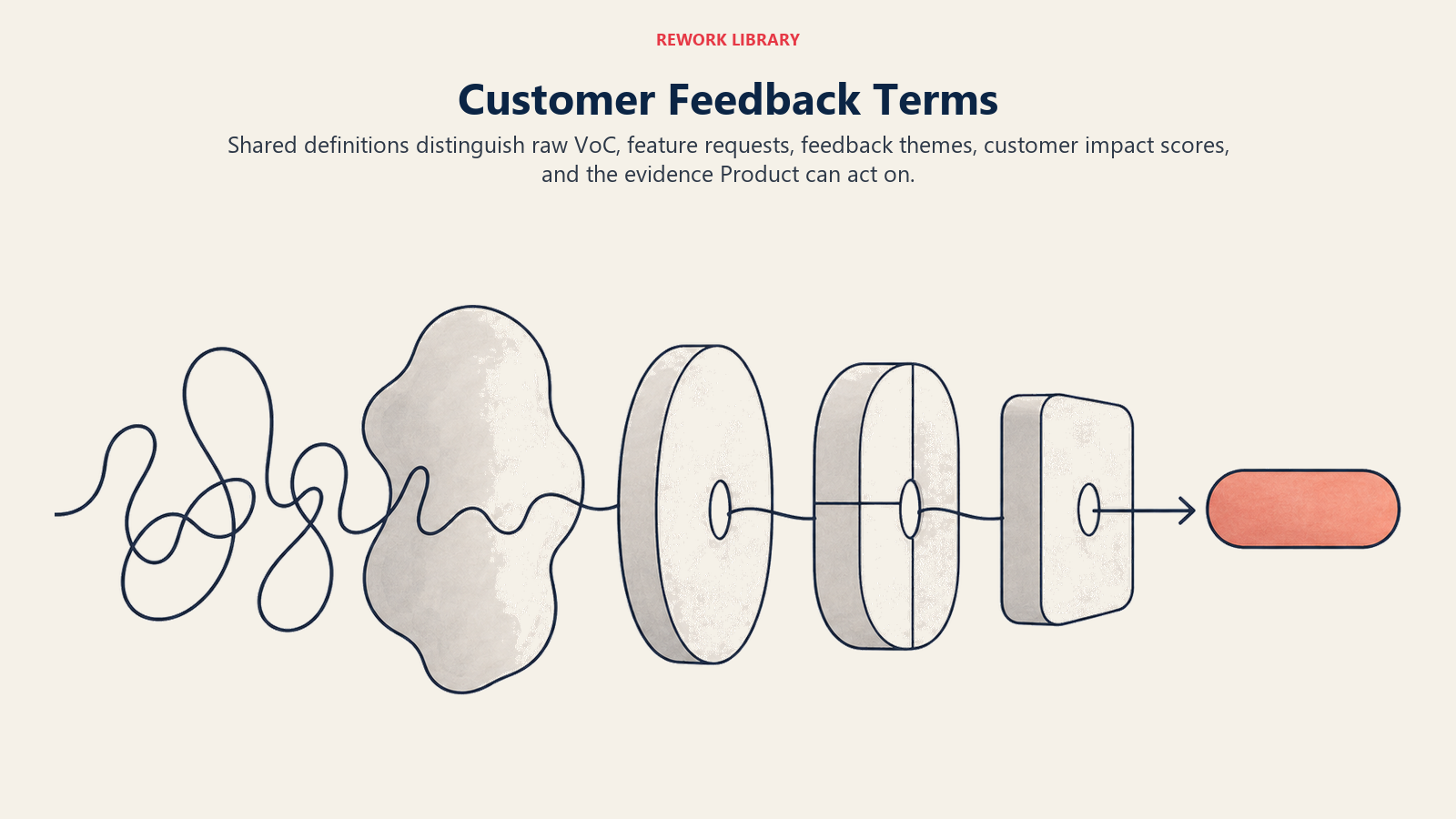
Estos términos definen cómo viaja la señal del cliente desde CS hacia Producto. Sin definiciones compartidas, la retroalimentación es demasiado cruda para que los PM la usen, o está tan desprovista de contexto que el contexto del cliente no sobrevive el proceso.
VoC: Voice of Customer
El conjunto de lo que los clientes dicen, solicitan, de lo que se quejan y lo que elogian, recopilado a través de llamadas de CSM, tickets de soporte, QBR, encuestas de NPS y sesiones del advisory board. El VoC es la materia prima del pipeline de retroalimentación CS-a-Producto. Pero el VoC sin estructura es ruido. El pipeline existe para convertir la señal en bruto en insumos ponderados y categorizados sobre los que los PM puedan actuar.
Ejemplo: Un CSM realiza un QBR y escucha al cliente describir una solución provisional. Registra el verbatim en el sistema de VoC, lo etiqueta al área del producto correspondiente y le asigna una puntuación de impacto usando el rubric de puntuación compartida.
Solicitud de Funcionalidad
La petición de un cliente para una nueva capacidad o cambio. Las solicitudes de funcionalidades no son elementos del backlog. Deben ser categorizadas, ponderadas por impacto en ARR y dirigidas a través del pipeline de VoC antes de que un PM pueda actuar sobre ellas. "¿Podemos construir esto?" es una pregunta diferente a "¿Esto ha sido ponderado y priorizado?"
Ejemplo: Tres cuentas solicitan una integración con Salesforce. El CSM registra cada solicitud en el sistema de VoC con el ARR y el contexto del caso de uso. El PMM agrupa las tres en un elemento ponderado: "Integración con Salesforce: $840K ARR afectado, 3 cuentas, urgencia alta." El PM lo revisa en la próxima sesión de priorización.
Customer Impact Score
Un peso numérico asignado a un elemento de retroalimentación que refleja cuántos clientes están afectados y cuánto ARR está en riesgo. Combina el número de cuentas con el ARR para evitar que diez cuentas pequeñas superen a un logo estratégico. La fórmula varía según la empresa, pero típicamente pondera el ARR más que el número de cuentas.
Ejemplo: Una solicitud de una cuenta con $300K ARR obtiene una puntuación más alta que la misma solicitud de cinco cuentas a $40K cada una, porque el ARR en riesgo es un 50% mayor, aunque el número de cuentas sea menor.
Retroalimentación Ponderada por ARR
Un método de priorización de solicitudes de clientes por valor total del contrato en lugar del número bruto de cuentas. Una solicitud de cuentas que representan $2M ARR se ubica por encima de la misma solicitud de cuentas que representan $200K ARR, independientemente del número de cuentas individuales que hagan la solicitud.
Ejemplo: El PM revisa la síntesis trimestral de VoC. La solicitud con mayor ponderación por ARR (exportaciones personalizadas por rango de fechas) cubre 12 cuentas y $1,8M ARR. Aparece por encima de un elemento solicitado con más frecuencia que cubre 20 cuentas pero solo $600K ARR.
Retroalimentación Cualitativa
Insumo abierto y narrativo del cliente: verbatims de llamadas, notas escritas de QBR, mensajes de Slack enviados por CSM. La retroalimentación cualitativa es alta en contexto y baja en comparabilidad. Explica por qué un cliente está frustrado, no solo que lo está.
Ejemplo: "Exportamos a Excel todos los lunes por la mañana porque no podemos construir la vista que necesitamos en el panel" es retroalimentación cualitativa. Tiene contexto, urgencia y una solución provisional específica, todo lo cual una métrica de uso pasaría por alto.
Retroalimentación Cuantitativa
Insumo estructurado y medible del cliente: puntuaciones de NPS, frecuencia de uso, tasas de adopción de funcionalidades, CSAT. La retroalimentación cuantitativa es fácil de comparar entre cuentas y de seguir en el tiempo, pero baja en contexto. Le dice qué está sucediendo, no por qué.
Ejemplo: La adopción de funcionalidades del panel al 30% en toda la base de clientes es retroalimentación cuantitativa. Le dice que la funcionalidad está poco utilizada. No le dice si los clientes no pueden encontrarla, no la entienden, o la probaron una vez y la encontraron insuficiente.
Términos de Programas
Estos términos describen programas estructurados en la interfaz CS-Producto. Sin definiciones compartidas, CS y Producto tienen expectativas diferentes sobre qué significa la participación, cuál es el compromiso y quién es el propietario de qué.
Early Access Tier
Un programa formal que otorga a un subconjunto de clientes acceso a funcionalidades antes del GA. Requiere un proceso de solicitud o invitación, un compromiso de retroalimentación de los clientes participantes, y CS como propietario de la relación. El acceso anticipado no es lo mismo que beta. Es un programa definido con criterios de selección y obligaciones.
Ejemplo: El programa de acceso anticipado para el nuevo motor de automatización tiene 20 cupos. Los solicitantes se comprometen con dos sesiones de retroalimentación y un caso de estudio si la funcionalidad se implementa en GA. CS revisa las solicitudes. Producto establece los criterios de selección.
Codiseño con Clientes
Una práctica de desarrollo en la que los clientes participan en la definición de una funcionalidad antes de que se construya, a través de entrevistas, revisiones de prototipos o sesiones de trabajo con el equipo de producto. CS selecciona a los participantes y gestiona la relación; Producto es el propietario de las decisiones de diseño. El codiseño no es un compromiso de construir lo que el cliente pide.
Ejemplo: El PM realiza cuatro sesiones de codiseño para un nuevo framework de integración. CS selecciona a los participantes con experiencia técnica relevante. El PM usa las sesiones para validar la definición del problema, no para recopilar solicitudes de funcionalidades.
Ride-Along
Una práctica en la que un PM o product designer se une a un CSM en una llamada o sesión real con el cliente, observando en lugar de liderar. Es la forma más directa para que Producto escuche el lenguaje sin filtros del cliente sobre un problema. Los ride-alongs son especialmente valiosos al inicio de la fase de definición del problema de una funcionalidad. Consulte ride-alongs del equipo de producto en llamadas de clientes para ver cómo estructurarlos y programarlos.
Ejemplo: Un PM se une a tres llamadas de incorporación lideradas por CSM en el mismo mes. Escucha a los clientes describir la misma fricción con sus propias palabras, un lenguaje que a menudo es bastante diferente de cómo se enmarcó en el ticket de VoC. La diferencia da forma a la especificación de la funcionalidad.
Términos de Métricas
Estos términos miden los resultados en la interfaz. Sin definiciones compartidas, CS y Producto rastrean los mismos conceptos con diferentes fuentes de datos y llegan a conclusiones diferentes.
Tasa de Adopción de Funcionalidades
El porcentaje de clientes elegibles que usan activamente una funcionalidad dentro de un período definido después del GA. "Uso activo" debe definirse conjuntamente antes del GA. Un inicio de sesión no cuenta; completar un flujo de trabajo principal, sí. Una adopción baja en una funcionalidad recientemente implementada es una señal tanto para CS (investigar por qué los clientes no la usan) como para Producto (investigar la experiencia de incorporación).
Ejemplo: 90 días después del GA, el 34% de las cuentas elegibles han completado al menos un informe automatizado usando la nueva funcionalidad. La definición conjunta de "adoptado" es: al menos un informe completado por semana durante dos semanas consecutivas.
Tiempo hasta la Adopción
Cuánto tiempo le toma a un cliente comenzar a usar una nueva funcionalidad después de su lanzamiento. Un tiempo largo hasta la adopción a menudo indica una brecha de comunicación o incorporación, no un problema de calidad del producto. Cuando CS informa previamente a los clientes y ejecuta campañas de activación, el tiempo hasta la adopción se reduce significativamente.
Ejemplo: El tiempo medio hasta la adopción del nuevo panel es de 22 días. Para las cuentas donde el CSM realizó una demostración de 30 minutos en la primera semana, el tiempo medio hasta la adopción es de 9 días. La diferencia es el valor de la campaña de activación.
Tasa de Retención Post-Cierre
El porcentaje de clientes que permanecen después de que una funcionalidad de la que dependían es deprecada o retirada. Una tasa de retención baja post-cierre señala que la ruta de migración fue insuficiente, el aviso previo fue demasiado corto, o ambas cosas. Hacer seguimiento de esta métrica por evento de depreciación construye un conjunto de datos para mejorar futuros cierres.
Ejemplo: Tras retirar el flujo heredado de importación CSV, el 94% de las cuentas afectadas permanecen. El 6% de abandono es revisado: tres cuentas citaron la complejidad de la migración como razón principal para irse.
Análisis de Rework: El Modelo de Costo por Brecha de Vocabulario
La mayoría de los equipos CS-Producto tratan la desalineación de vocabulario como un inconveniente de comunicación. En realidad, es un costo que se acumula. Cada trimestre que un equipo opera sin definiciones compartidas sobre VoC, adopción de funcionalidades y beta, ejecuta un pipeline de retroalimentación donde una parte significativa del insumo de CS es categorizado de manera diferente por PM y CSM, produciendo una síntesis en la que ninguno de los dos equipos confía completamente. Según los benchmarks de SaaS de mercado medio (ChurnZero 2024, Gainsight 2024), las empresas que dedican una sesión facilitada a alinear los 10 términos de mayor frecuencia en su interfaz reportan notablemente menos momentos de "¿qué quisiste decir con eso?" en las sincronías CS-PM en un plazo de 60 días. El costo de facilitación son dos horas. El beneficio acumulado es cada sesión de VoC, cada revisión de sprint y cada conversación con el cliente que sigue sin un desvío definitorio.
Índice Alfabético de Referencia Rápida
Mantenimiento del Glosario
Un glosario que nadie actualiza es un glosario en el que nadie confía. Asigne un propietario, típicamente el líder de CS Ops o quien dirija la cadencia de alineación CS-Producto, y revise las definiciones trimestralmente. La revisión trimestral no necesita ser exhaustiva. Revise los términos de alta frecuencia: VoC, adopción de funcionalidades, backlog, beta, GA. Estas son las palabras que aparecen en cada sincronía semanal, y son las que sufren una deriva silenciosa de definición cuando los equipos no las verifican.
Inicie una sesión de redefinición completa cuando: una nueva línea de productos cambie lo que "incorporado" o "adoptado" significa para un nuevo tipo de cliente; un cambio en el go-to-market modifique el ICP y, por lo tanto, qué clientes están en sus programas beta; un nuevo VP de Producto o CS se incorpore y traiga el vocabulario de su empresa anterior al lenguaje cotidiano del equipo. Las definiciones de los nuevos líderes se acumulan durante meses antes de que alguien nombre la divergencia. Una revisión del glosario en los primeros 30 días de la incorporación de un nuevo líder es la forma más eficiente de identificar y cerrar esas brechas.
Controle las versiones del documento. Cuando una definición cambie, registre la fecha y el motivo. La alineación verbal no sobrevive a los cambios de personal, pero el registro escrito sí.
¿Aún tiene preguntas sobre cómo aplicar estos términos? Las preguntas frecuentes a continuación responden las que surgen con mayor frecuencia en las revisiones de alineación CS-Producto.
Más Información
- Qué es la Alineación CS & Product
- El Pipeline de VoC: Cómo CS Alimenta a Producto
- Ejecución de Programas Beta con Clientes
- Retroalimentación Ponderada por ARR: Cuantificando la Voz del Cliente
- Customer Councils y Advisory Boards
- Glosario de Alineación Ventas-CS: vocabulario compartido para la interfaz de transferencia de ventas a CS

Principal Solution Architect
On this page
- Cómo Usar Este Glosario
- Términos de Producto e Ingeniería
- PM: Product Manager
- PMM: Product Marketing Manager
- Engineering Manager (EM)
- Product Designer
- JTBD: Jobs-to-be-Done
- MVP: Minimum Viable Product
- GA: General Availability
- Beta
- Alpha
- RC: Release Candidate
- Términos de CS y Cliente
- CSM: Customer Success Manager
- Customer Health Score
- Promoción del Cliente
- NPS: Net Promoter Score
- Advisory Board
- Customer Council
- Términos de Flujo de Trabajo
- Backlog
- Sprint
- Hoja de Ruta
- Release
- Depreciación
- Fin de Vida (Sunset)
- Términos de Retroalimentación
- VoC: Voice of Customer
- Solicitud de Funcionalidad
- Customer Impact Score
- Retroalimentación Ponderada por ARR
- Retroalimentación Cualitativa
- Retroalimentación Cuantitativa
- Términos de Programas
- Early Access Tier
- Codiseño con Clientes
- Ride-Along
- Términos de Métricas
- Tasa de Adopción de Funcionalidades
- Tiempo hasta la Adopción
- Tasa de Retención Post-Cierre
- Índice Alfabético de Referencia Rápida
- Mantenimiento del Glosario
- Más Información