More in
Playbook de Productividad del Equipo
Cómo Llevar un 1:1 Productivo que sus Colaboradores Esperen con Ganas
abr. 18, 2026
Bloques de Enfoque a Nivel de Equipo, No Solo Individual
abr. 18, 2026
Actualizaciones de Estado Semanales sin el Teatro Innecesario
abr. 18, 2026
Kickoffs de Proyecto que Previenen el Scope Creep
abr. 18, 2026
Marcos de Priorización que su Equipo Recordará
abr. 18, 2026
Gestión de Equipos Distribuidos en Más de 3 Zonas Horarias
abr. 18, 2026
Planificación de Capacidad sin Hojas de Cálculo Interminables
abr. 18, 2026 · Currently reading
La Conversación sobre Normas del Equipo que Usted Ha Estado Evitando
abr. 18, 2026
Onboarding de Nuevos Miembros del Equipo a su Forma de Trabajar
abr. 18, 2026
Auditoría de Reuniones: Cómo Eliminar las Reuniones que su Equipo Detesta
abr. 1, 2026
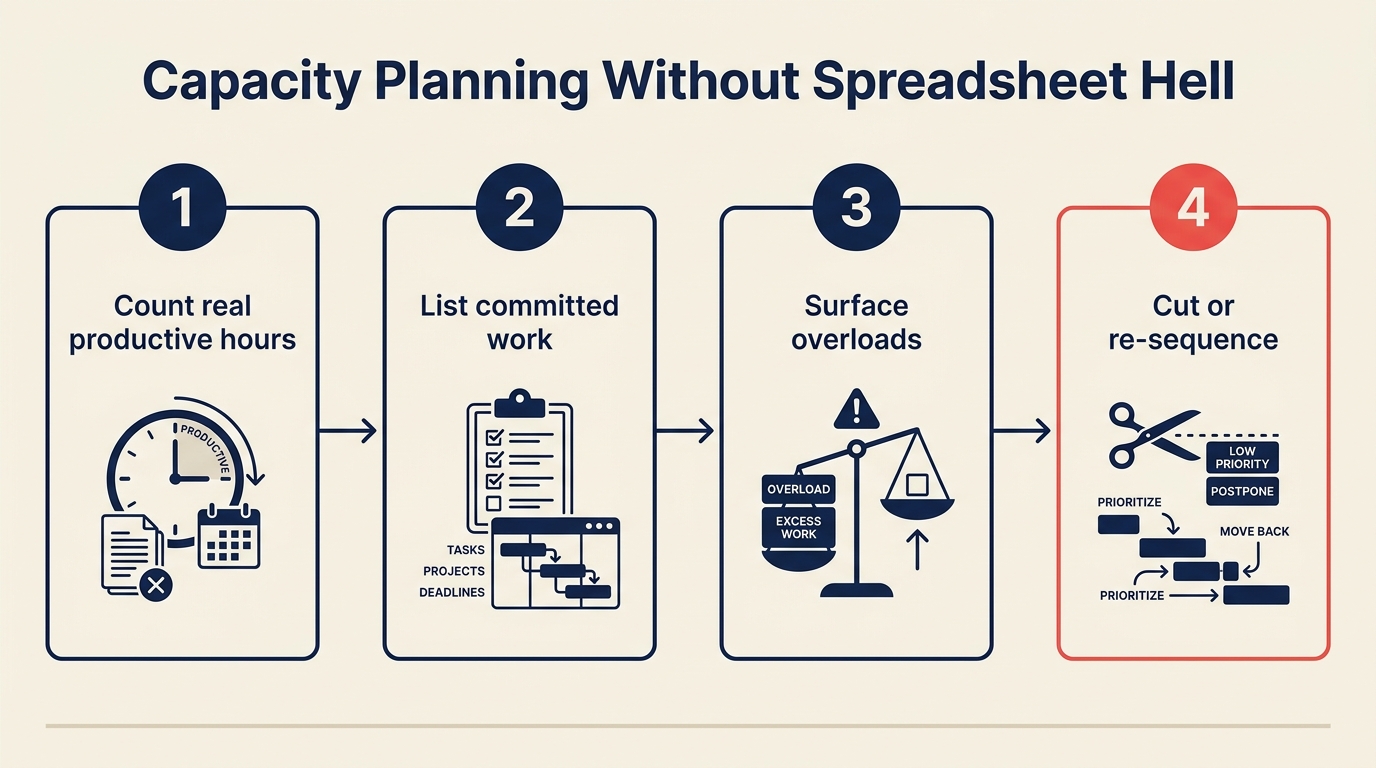
Planificación de Capacidad Sin las Hojas de Cálculo del Infierno
Turn this article into takeaways for your work.


Each assistant summarizes the article only for you and suggests best practices for your work.
La mayoría de los planes de capacidad comienzan con un conteo de personas. Seis ingenieros en el equipo. Seis ingenieros disponibles para el Sprint. Se compromete trabajo equivalente a seis ingenieros.
Luego termina el Sprint y el 40% del trabajo planificado no se entregó. Todos se encogen de hombros y hablan de "bloqueos imprevistos" y "subestimación de la complejidad". Y el siguiente Sprint comienza con los mismos seis ingenieros y el mismo compromiso optimista.
El problema real no es la calidad de las estimaciones ni la velocidad de entrega del equipo en abstracto. Es que la planificación de capacidad contó personas en lugar de horas. Y las horas reales, las disponibles, interrumpibles y llenas de reuniones, no se parecen en nada al número de personas.
Un equipo de seis ingenieros que cada uno pasa 12 horas a la semana en reuniones, 2 horas en Standups, 3 horas en revisiones y 2 horas en interrupciones inesperadas tiene aproximadamente 20 horas por persona por semana para trabajo real. No 40. Ni siquiera 30. Veinte. Y planificar al 100% de esas 20 horas ignora la varianza que hace que el trabajo real sea impredecible. La investigación State of Teams de Atlassian encontró que los trabajadores del conocimiento pasan un promedio de 31 horas por semana en reuniones improductivas, una cifra que deja mucho menos capacidad para el deep work de lo que la mayoría de los planes de Sprint asumen.
La solución no es una hoja de cálculo más sofisticada. Es una contabilidad más honesta de lo que realmente está disponible. Es la misma honestidad que una auditoría de reuniones pone de manifiesto: cuando se cuentan las horas de reunión, el tiempo restante para el trabajo real siempre es menor de lo que se suponía.
Las Horas Ocultas Que Consumen la Capacidad
Antes de poder planificar la capacidad con precisión, es necesario saber dónde van realmente las horas. La mayoría de los managers que no han realizado este ejercicio se sorprenden con los resultados.
Estas son las categorías que la mayoría de los planes de capacidad ignoran:
Reuniones recurrentes. Cuente cada reunión en el calendario de cada miembro del equipo que no sea trabajo de proyecto. Standups, sincronizaciones de equipo, all-hands, 1:1s, skip-levels, reuniones con equipos asociados, reuniones de planificación, reuniones de revisión. Para la mayoría de los trabajadores del conocimiento, esto representa entre 8 y 15 horas por semana, sin incluir ninguna reunión ad hoc que se programe durante el Sprint.
Rotaciones de guardia e interrupciones. Los equipos con responsabilidades de guardia frecuentemente descubren que incluso los Sprints "fuera de guardia" tienen una carga de interrupción de fondo. Alguien siempre revisa la cola. Alguien siempre es incluido en un análisis post-incidente.
Ciclos de revisión y feedback. Revisiones de código, revisiones de diseño, feedback sobre documentos. Este trabajo es real y toma tiempo real, pero generalmente se atribuye a "sobrecarga" en lugar de rastrearse explícitamente. Para ingenieros senior y líderes, la carga de revisión puede ser de 4 a 6 horas a la semana.
Sobrecarga administrativa. Depuración de tickets, actualizaciones de proyectos, mantenimiento de herramientas, revisiones de cumplimiento. Nadie glamoriza este trabajo, por lo que tiende a subestimarse.
Tiempo del manager. Si usted es un manager-jugador y planifica la capacidad del Sprint como si tuviera 40 horas disponibles, está sobrecomprometiendo sistemáticamente. Sus 1:1s, su trabajo de gestión del equipo y su coordinación interfuncional no son trabajo de proyecto. Pertenecen al cálculo de sobrecarga.
Miembros del equipo a tiempo parcial o con roles divididos. Si alguien pasa el 50% de su tiempo en un equipo o rol diferente, planificar su capacidad al 100% produce un Sprint que falla un 50% cada dos semanas.
Realizar esta auditoría una vez en su equipo generalmente es suficiente para cambiar cómo planifica. Los números casi siempre son más reveladores de lo esperado.
La Regla del Margen del 20%
Incluso después de contabilizar toda la sobrecarga conocida, hay una categoría predecible de trabajo que resiste la planificación: lo inesperado.
Lo inesperado se presenta de muchas formas. Un bug crítico que debe corregirse antes de que cualquier otra cosa pueda avanzar. Una pregunta de un stakeholder que se convierte en un análisis de dos horas. Un miembro del equipo enfermo el día en que debía terminar el entregable clave. Una dependencia que se resuelve de manera diferente a la esperada y requiere rehacer el trabajo.
No se puede predecir cuál de estos ocurrirá en un Sprint determinado. Pero sí se puede predecir que algo ocurrirá. A lo largo de un año de Sprints, el trabajo no planificado absorbe consistentemente entre el 15% y el 25% de la capacidad del equipo.
El margen del 20% no es pesimismo. Es empírico. Si no lo incorpora explícitamente, el trabajo no planificado ocurre de todas formas. La investigación de McKinsey sobre equipos de entrega ágil encontró que los equipos de alto rendimiento planifican consistentemente al 75-80% de la capacidad disponible y que las tasas de finalización de Sprint son entre un 35% y un 40% más altas en equipos que aplican márgenes frente a los que planifican al 100%. Simplemente reemplaza el trabajo planificado en lugar del margen. Y entonces las tasas de finalización de Sprint caen, y todos hablan del problema de velocidad del equipo, cuando el problema real es que la capacidad fue planificada al 100% sin margen para la realidad.
Prácticamente, aplicar el margen del 20% significa: después de calcular las horas reales disponibles (después de reuniones y sobrecarga), reducir el compromiso de trabajo planificado en un 20%. Si el equipo tiene 120 horas disponibles después de la sobrecarga, planifique 96 horas de trabajo comprometido. Deje las otras 24 como capacidad no planificada.
El Formato de Tres Columnas
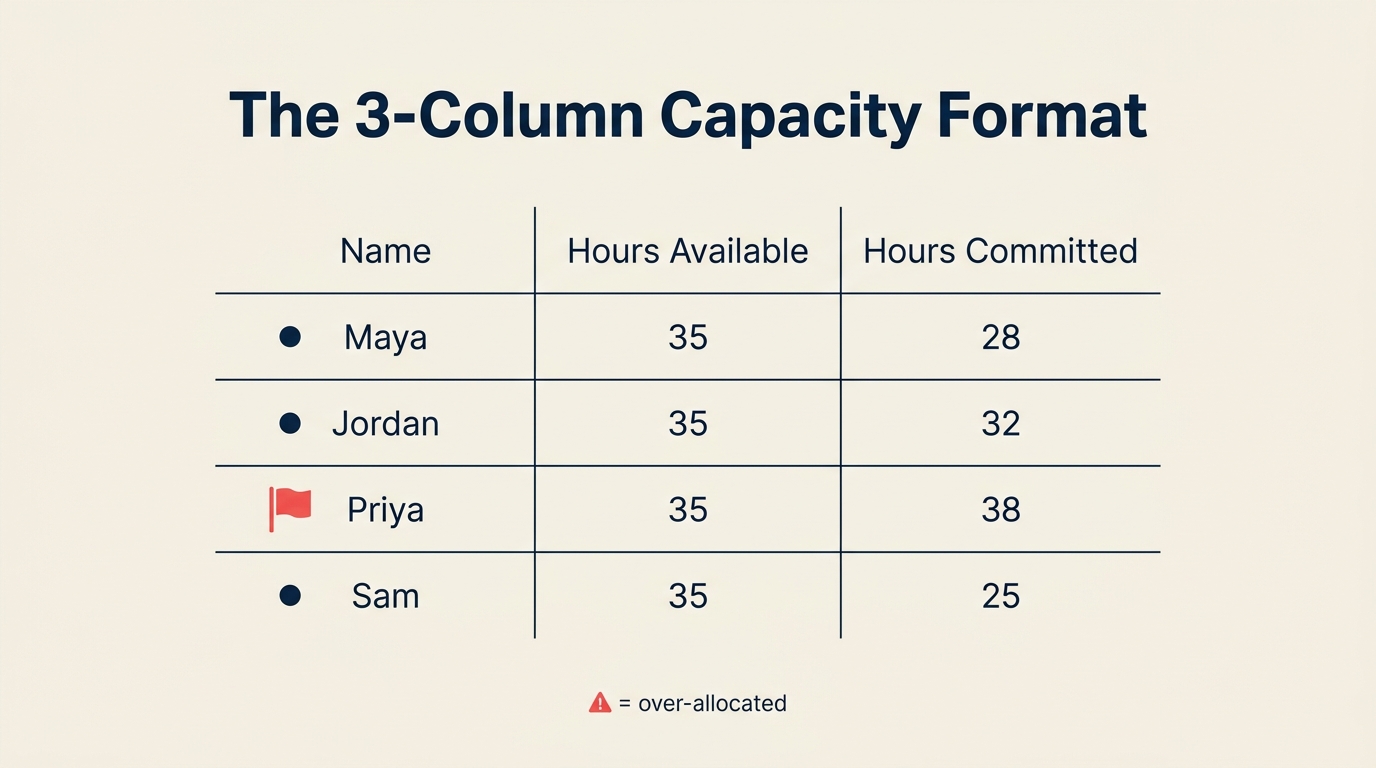
Una vez que tenga una imagen clara de la disponibilidad real de cada persona, el formato de planificación de capacidad no necesita ser complicado. Una vista de tres columnas es suficiente para la mayoría de la planificación a nivel de Sprint:
| Persona | Horas Disponibles | Trabajo Comprometido |
|---|---|---|
| [Nombre] | [Horas] | [Ítems de trabajo con horas estimadas] |
| [Nombre] | [Horas] | [Ítems de trabajo con horas estimadas] |
| [Nombre] | [Horas] | [Ítems de trabajo con horas estimadas] |
Horas Disponibles = Total de horas de trabajo en el Sprint menos sobrecarga de reuniones menos margen (20%)
Trabajo Comprometido = Los ítems específicos que esta persona lleva al Sprint, con estimaciones individuales de horas, con un total que no supere sus horas disponibles.
La comparación de columnas hace que la sobreasignación sea inmediatamente visible. Si el trabajo comprometido de alguien totaliza 40 horas y su columna de horas disponibles muestra 18, tiene una conversación pendiente antes de que comience el Sprint. No un misterio para investigar después de que termine.
Verificaciones de Capacidad al Inicio del Sprint
El lugar más común donde falla la planificación de capacidad es el momento. Los equipos hacen una revisión de capacidad en la planificación trimestral, se comprometen con un Roadmap y luego comienzan cada Sprint asignando tickets sin volver a verificar la disponibilidad.
Pero la disponibilidad cambia semana a semana. Se agregan permisos. Un equipo asociado solicita tiempo para una integración. La rotación de guardia produce más incidentes de lo habitual una semana. Un miembro del equipo se toma una licencia.
Una breve verificación de capacidad al inicio de cada Sprint (no trimestral, no mensual, sino al inicio de cada Sprint) evita la brecha entre el compromiso trimestral y lo que el equipo puede lograr realmente en las próximas dos semanas.
La verificación de capacidad al inicio del Sprint toma entre 15 y 20 minutos:
- Abra el formato de tres columnas. Complete previamente las horas disponibles basándose en las reuniones conocidas y los permisos.
- Cada miembro del equipo revisa su columna y señala cualquier cosa que afecte su disponibilidad en este Sprint (una revisión de código importante que se avecina, una certificación en la que está trabajando, una cita médica que le tomará una mañana).
- Ajuste las horas disponibles en consecuencia.
- Compare el trabajo comprometido con las horas disponibles. Si hay una brecha, renegocie antes de que comience el Sprint.
Esto no es una reunión de planificación completa. Es un punto de control de disponibilidad rápido. Aplicado de forma consistente, previene el 80% de los fallos en Sprint que se atribuyen a "estimación" pero en realidad se deben a la disponibilidad.
Hacer Visible la Sobreasignación
Uno de los elementos más importantes de un proceso de planificación de capacidad saludable es que la sobreasignación sea visible y explícita, no oculta y absorbida en silencio.
Cuando se puede ver en la tabla de capacidad que alguien tiene 42 horas de trabajo comprometido frente a 20 horas de disponibilidad, se tiene un tema concreto para discutir. O reduce su trabajo comprometido (lo que requiere reprioritizar) o acepta que cierto trabajo no se realizará y lo comunica a los stakeholders ahora, no al final del Sprint.
El peor resultado es cuando la sobreasignación no es visible. El miembro del equipo intenta hacer 42 horas de trabajo en un Sprint de 20 horas. Trabaja noches y fines de semana. La mayor parte del trabajo se realiza pero apresuradamente. Parte de él se abandona sin anuncio. El Sprint termina con una imagen poco clara de qué pasó y por qué.
La sobreasignación visible crea una negociación. La sobreasignación oculta crea un fracaso.
El Rastreador de Disponibilidad del Sprint
Aquí hay una plantilla práctica para rastrear la capacidad del Sprint que cabe en un documento o hoja de cálculo compartida:
Sprint [Número]: Resumen de Capacidad Fechas del Sprint: [Inicio] a [Fin]
Disponibilidad del Equipo
| Nombre | Días Laborables | Reuniones (horas) | PTO/OOO | Margen 20% | Horas Disponibles |
|---|---|---|---|---|---|
| [Nombre] | [Días x 8] | [Suma de reuniones recurrentes] | [Horas fuera] | [20% del resto] | [Calculado] |
Trabajo Comprometido
| Nombre | Ítem | Horas Estimadas |
|---|---|---|
| [Nombre] | [Ítem] | [Horas] |
Verificación de Sobreasignación [ ] Todo el trabajo comprometido cabe dentro de las horas disponibles [ ] Si hay sobreasignación: ítems señalados y renegociados con los stakeholders
Margen No Planificado Total de horas disponibles del equipo: [Suma] Total de horas comprometidas: [Suma] Margen restante: [Diferencia, debe ser aproximadamente el 20%]
El Guión de Escalación por Sobreasignación
Cuando la planificación de capacidad revela sobreasignación, necesita una forma de comunicarlo rápida y claramente a los stakeholders. Aquí hay un guión simple:
"Revisando la capacidad del Sprint, [Nombre] tiene [X horas] disponibles este Sprint pero [Y horas] de trabajo comprometido. Eso representa una sobreasignación de [Z horas]. Necesitamos mover [ítem específico] al próximo Sprint o agregar más capacidad. Si lo dejamos así, [ítem específico] probablemente se trasladará. ¿Cuál es la decisión de prioridad?"
Este enfoque hace tres cosas: convierte el problema en algo concreto (números, no percepciones), presenta una elección en lugar de un problema, y solicita una decisión en lugar de simpatía. Los stakeholders que reciben este enfoque generalmente responden de manera más constructiva que los que reciben "vamos a perder algunas cosas este Sprint".
Errores Comunes
Planificar al 100% de la capacidad. Este es el pecado original de la planificación de capacidad. Ninguna persona trabaja al 100% de eficiencia durante todo un Sprint. Siempre hay interrupciones, cambios de contexto y varianza. El 80% es un punto de partida para una planificación realista; muchos equipos encuentran que el 70-75% es más preciso para su entorno.
No contar el tiempo del manager. El trabajo de gestión (contratación, 1:1s, conversaciones de desempeño, coordinación entre equipos, administración) no es "sobrecarga". Es trabajo real que toma horas reales. Un manager que no tiene esto en cuenta en la planificación de capacidad sobrecompromete rutinariamente el trabajo de proyecto y luego se esfuerza por recuperar el déficit.
Ignorar a los miembros del equipo a tiempo parcial o con roles divididos. Si alguien pasa el 40% de su tiempo con otro equipo, su capacidad efectiva para su Sprint es el 60% de sus horas de trabajo, menos su sobrecarga. Planifique en consecuencia. Esto parece obvio pero se ignora consistentemente.
Construir el plan de capacidad y luego no consultarlo. El modo de fallo más común para los equipos que hacen bien la planificación de capacidad al inicio del Sprint es que nadie lo vuelve a ver hasta la retrospectiva. Consulte el plan de capacidad a mitad del Sprint. Si alguien está excediendo sus horas disponibles, quiere saberlo el martes, no el viernes.
Usar la planificación de capacidad como métrica de rendimiento. La planificación de capacidad es una herramienta de planificación, no una herramienta de responsabilidad. Si los miembros del equipo aprenden que mostrar pocas horas disponibles lleva a conversaciones de desempeño, manipularán los inputs y perderá la imagen honesta que necesita. La investigación de Deloitte sobre seguridad psicológica en la gestión del rendimiento confirma este patrón: los equipos donde las personas temen que reportar honestamente conlleve penalizaciones subreportan sistemáticamente los problemas, produciendo exactamente el punto ciego organizacional que la planificación de capacidad pretende prevenir.
Conectar la Planificación de Capacidad con su Proceso de Priorización
La planificación de capacidad y la priorización son las dos caras de la misma decisión de compromiso de Sprint. Necesita ambas para responder la pregunta: "¿Qué puede lograr realmente este equipo en este Sprint?"
Sus marcos de priorización le dicen qué ítems son más importantes. La planificación de capacidad le dice cuántos de esos ítems puede asumir el equipo. La intersección de ambas es el compromiso del Sprint.
Cuando la capacidad es menor de lo habitual (alguien ausente, una semana grande de revisión de código, un equipo asociado que necesita apoyo), la priorización se vuelve más importante, no menos. Un Sprint con capacidad reducida es exactamente cuando importa la disciplina de decir "vamos a hacer los tres ítems principales y nada más".
Y cuando ejecuta sus kickoffs de proyecto, la verificación de capacidad debe ocurrir antes del kickoff, no después. Es muy difícil acordar un cronograma y alcance si no sabe cuánta capacidad tiene el equipo disponible en los Sprints relevantes. Construya primero la imagen de capacidad, luego tenga la conversación sobre el alcance.
Las actualizaciones de estado semanales son donde las sorpresas de capacidad se comunican en tiempo real. Si el trabajo comprometido de un Sprint está en riesgo debido a una interrupción no planificada, la actualización de estado es donde eso se comunica: de forma clara y anticipada, no al final del Sprint.
Cómo Se Ve una Capacidad Honesta
Un plan de capacidad honesto no hará feliz a todos. Los stakeholders que han escuchado que el equipo puede entregar diez ítems por Sprint se sorprenderán cuando el número honesto sea seis.
Pero el número honesto también es el número real. Y los números reales, comunicados de forma consistente, generan confianza de una manera en que los números optimistas seguidos de fallos consistentes nunca pueden hacerlo.
El objetivo no es minimizar el compromiso. Es hacer compromisos que el equipo pueda realmente cumplir, con calidad, sin agotamiento, y con visibilidad sobre dónde están los límites. Cuando el equipo entrega consistentemente lo que se comprometió, los stakeholders dejan de manipular el sistema para agregar más ítems al Sprint. La investigación de Gartner sobre el rendimiento de equipos de ingeniería encontró que la predictibilidad de entrega, es decir, entregar consistentemente lo comprometido, es el comportamiento que más genera confianza entre los equipos de ingeniería y los stakeholders de negocio, superando ampliamente al volumen de producción bruto. La negociación se vuelve racional en lugar de política.
La planificación de capacidad honesta toma unos 20 minutos por Sprint una vez que tiene el formato establecido. El costo de no hacerlo (los fallos en Sprint, el agotamiento, la erosión de credibilidad, el Backlog de retrabajos) es órdenes de magnitud mayor. Para equipos distribuidos, la sobrecarga de zonas horarias añade otra capa: las horas de ventana de superposición y el tiempo de transferencia async pertenecen también al cálculo de capacidad.
Cuente las horas. Aplique el margen. Verifique al inicio del Sprint. Señale la sobreasignación abiertamente. Eso es todo.
Más información: Explore el Manual de Productividad del Equipo completo para más guías sobre cómo gestionar equipos que entregan de forma predecible y se comunican con claridad. Lecturas relacionadas: focus blocks a nivel de equipo, la conversación sobre las normas del equipo que ha estado evitando y ROI de la transformación de la fuerza laboral con IA para CFOs.

Principal Product Marketing Strategist
On this page
- Las Horas Ocultas Que Consumen la Capacidad
- La Regla del Margen del 20%
- El Formato de Tres Columnas
- Verificaciones de Capacidad al Inicio del Sprint
- Hacer Visible la Sobreasignación
- El Rastreador de Disponibilidad del Sprint
- El Guión de Escalación por Sobreasignación
- Errores Comunes
- Conectar la Planificación de Capacidad con su Proceso de Priorización
- Cómo Se Ve una Capacidad Honesta