More in
Playbook de Productividad del Equipo
Cómo Llevar un 1:1 Productivo que sus Colaboradores Esperen con Ganas
abr. 18, 2026
Bloques de Enfoque a Nivel de Equipo, No Solo Individual
abr. 18, 2026
Actualizaciones de Estado Semanales sin el Teatro Innecesario
abr. 18, 2026
Kickoffs de Proyecto que Previenen el Scope Creep
abr. 18, 2026
Marcos de Priorización que su Equipo Recordará
abr. 18, 2026
Gestión de Equipos Distribuidos en Más de 3 Zonas Horarias
abr. 18, 2026
Planificación de Capacidad sin Hojas de Cálculo Interminables
abr. 18, 2026
La Conversación sobre Normas del Equipo que Usted Ha Estado Evitando
abr. 18, 2026
Onboarding de Nuevos Miembros del Equipo a su Forma de Trabajar
abr. 18, 2026 · Currently reading
Auditoría de Reuniones: Cómo Eliminar las Reuniones que su Equipo Detesta
abr. 1, 2026
Onboarding de Nuevos Miembros a las Formas de Trabajo del Equipo
Turn this article into takeaways for your work.


Each assistant summarizes the article only for you and suggests best practices for your work.
Las nuevas incorporaciones son personas atentas. Durante sus primeras semanas, observan con cuidado: cómo se comunica el equipo, quiénes son los verdaderos tomadores de decisiones, qué se elogia y qué se ignora silenciosamente, si es seguro rebatir en las reuniones o si el desacuerdo ocurre en canales privados. Lo hacen porque intentan descubrir cómo tener éxito, y nadie les ha dado la respuesta.
La información que buscan existe. Cada equipo tiene una cultura operativa: patrones de comunicación, toma de decisiones, feedback y gestión del tiempo que definen lo que realmente significa trabajar aquí. Pero en la mayoría de las organizaciones, esa información vive en las cabezas de los miembros de mayor antigüedad y se absorbe gradualmente a través de la proximidad y la observación.
Esto es un problema cuando la proximidad es remota, cuando los ciclos de contratación son rápidos y cuando las formas de trabajo del equipo son realmente intencionales en lugar de accidentales. Las nuevas incorporaciones que tienen que inferir la cultura operativa a través de la observación se equivocan la mitad de las veces, frustran a sus colegas durante algunas semanas antes de que alguien nombre el problema, y tardan más en volverse genuinamente productivas de lo que tardarían si alguien simplemente se lo hubiera contado. La investigación de SHRM sobre productividad de nuevas incorporaciones encontró que los empleados con programas de onboarding estructurados alcanzan la plena productividad un 50% más rápido que los que tienen onboarding informal, y tienen un 58% más de probabilidades de seguir en la organización después de tres años.
La solución es intencional, diseñada y claramente responsabilidad del manager. No de RRHH. Conecta directamente con la conversación sobre normas del equipo, porque solo se puede documentar la cultura para las nuevas incorporaciones después de haberla nombrado explícitamente con el equipo existente.
La Brecha Entre el Onboarding del Rol y el Onboarding del Equipo
La mayoría de los programas de onboarding están construidos alrededor del rol: así se usan las herramientas, así es el Roadmap del producto, así es el organigrama, aquí está la formación de cumplimiento. Este es el dominio de RRHH y RRHH lo hace razonablemente bien.
Pero el onboarding del rol no responde las preguntas que determinan qué tan rápido una nueva incorporación se convierte en un miembro real del equipo. Esas preguntas son culturales:
- Cuando alguien en este equipo no está de acuerdo con una dirección, ¿cómo lo expresa?
- ¿Cuál es el tiempo de respuesta esperado para un mensaje de Slack de un manager?
- ¿Es aceptable rebatir una prioridad frente al equipo, o esa conversación debe ocurrir de forma individual?
- Cuando una tarea no va bien, ¿cuándo pronto la comunica versus trabaja en ella usted mismo?
- ¿Qué significa realmente "hecho" para el tipo de trabajo que hace este equipo?
Ninguna de estas preguntas está respondida en el paquete de bienvenida. Se responden a través de la observación: lentamente, imperfectamente y a costa de muchos errores tempranos que las nuevas incorporaciones experimentan como fracasos en lugar de aprendizaje.
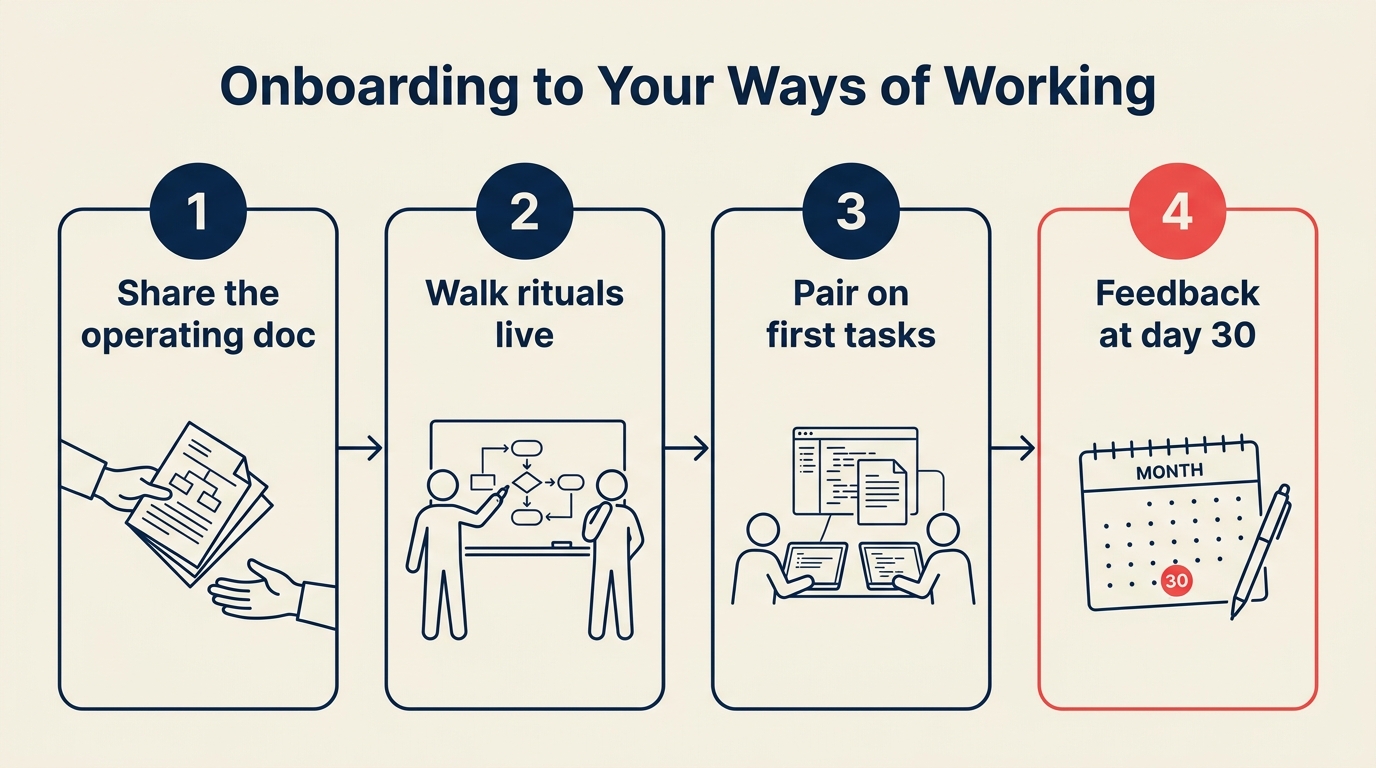
El trabajo del manager es cerrar esa brecha. No esperando que las nuevas incorporaciones absorban la cultura a través de la ósmosis, sino diseñando un track "cómo trabajamos" que corre en paralelo al onboarding del rol y cubre las preguntas que realmente determinan el éxito temprano.
Qué Contiene el Documento "Cómo Trabajamos"
La herramienta más práctica para el onboarding del equipo es un documento que captura cómo opera el equipo en lenguaje claro. No el organigrama. No la visión del producto. Las normas operativas cotidianas que son invisibles para los externos.
Un documento "cómo trabajamos" bien construido cubre:
Canales de comunicación. ¿En qué canales estamos activos? ¿Para qué sirve cada canal? ¿Cuál es el tiempo de respuesta esperado para cada uno? ¿Cuándo debe ser algo un mensaje de Slack versus un email versus un comentario en un documento versus una reunión? ¿Dónde se anuncian las decisiones importantes?
Cadencias de reuniones. ¿Cuáles son las reuniones periódicas? ¿Quién asiste? ¿Cuál es el formato y la preparación esperada? ¿Cuándo está bien saltarse o declinar una reunión, y cómo debe comunicarse eso?
Derechos de decisión. ¿Qué puede decidir cada miembro del equipo de forma independiente? ¿Qué requiere input del manager? ¿Qué requiere alineación entre equipos? ¿Cómo se designa al DRI (Directly Responsible Individual) para los proyectos?
Normas de feedback. ¿Cómo y cuándo nos damos feedback entre nosotros? ¿Es la norma el feedback directo entre pares o pasa por el manager? ¿Cómo se ve el "buen feedback" en este equipo?
Normas de protección del tiempo. ¿Cuáles son los focus blocks del equipo? ¿Cuál es la norma respecto a los mensajes fuera de horario? ¿Qué califica como una interrupción urgente versus una solicitud de "cuando tenga un momento"?
Dónde encontrar las cosas. ¿Dónde vive la documentación? ¿Cómo se rastrea el trabajo? ¿Cuál es la fuente de verdad para el estado del proyecto?
Este documento no tiene que ser largo. De dos a cuatro páginas cubre la mayoría de los equipos. Lo que importa es que sea honesto (normas reales, no las aspiracionales), específico (lo suficientemente concreto para actuar) y accesible (en un lugar que la nueva incorporación realmente visitará).
Lo importante es que este documento ya debería existir si ha hecho el trabajo de la conversación sobre normas del equipo. Si aún no existe, construirlo con el propósito del onboarding de nuevas incorporaciones es un excelente catalizador, y el equipo existente se beneficia de tenerlo escrito tanto como la nueva incorporación.
Las Tres Reuniones de Seguimiento Estructuradas
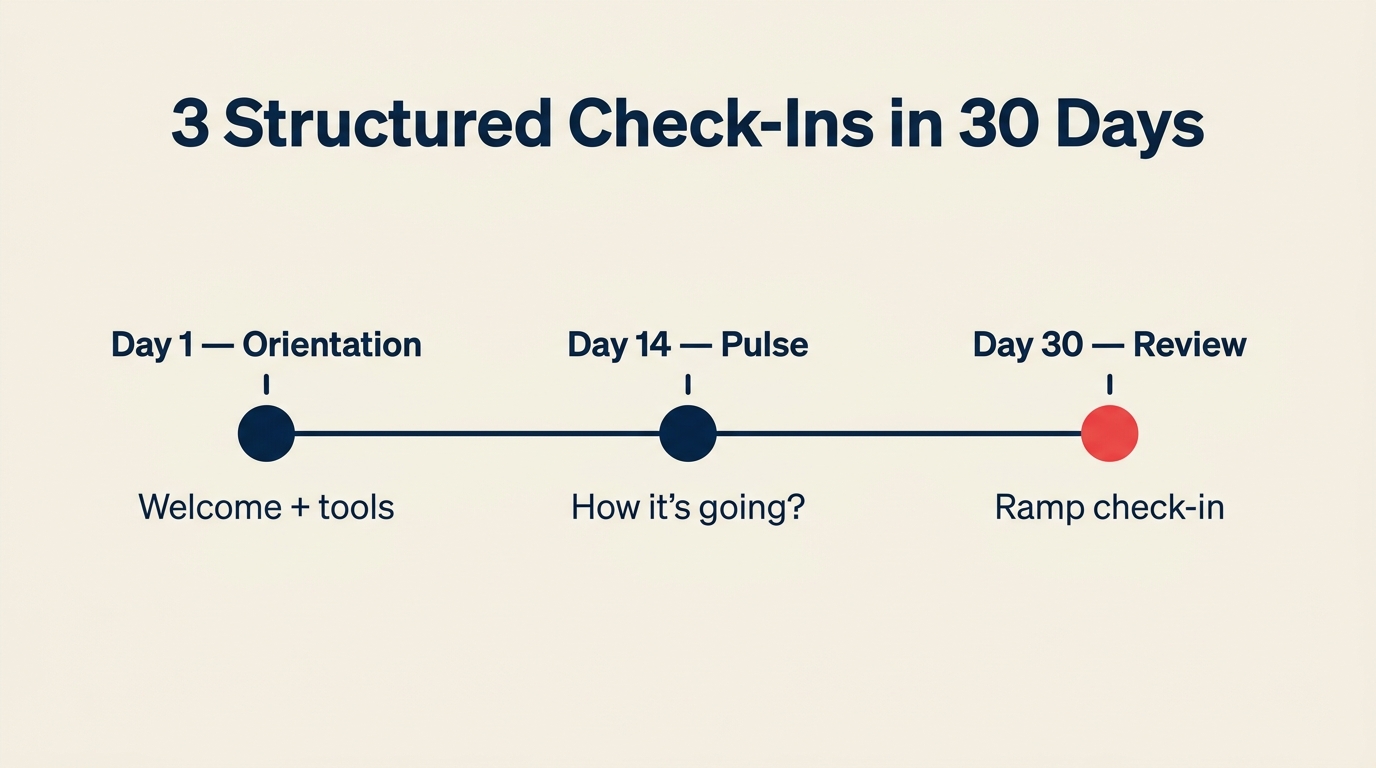
El onboarding del rol generalmente incluye una reunión de seguimiento a los 30-60-90 días centrada en el rendimiento laboral. El onboarding del equipo necesita su propia serie de seguimientos, separada y centrada específicamente en cómo la nueva incorporación está experimentando la cultura del equipo.
Reunión de la semana 1 (30 minutos): Antes de que la nueva incorporación tenga suficiente contexto para sentirse confundida sobre situaciones específicas, cubra el documento "cómo trabajamos" explícitamente. Recorra las secciones clave. Pregunte: "¿Hay algo aquí que le parezca sorprendente o poco claro?" El objetivo no es hacerle un examen. Es abrir un canal para preguntas culturales antes de que sea incómodo hacerlas.
Reunión de la semana 3 (30 minutos): Para la semana tres, la nueva incorporación ha tenido suficientes interacciones reales para haber notado patrones específicos. Pregunte: "¿Ha visto algo sobre cómo trabaja el equipo que no estaba en el documento o que le sorprendió?" Y: "¿Hay alguna situación de la que no haya estado seguro de cómo manejar? ¿Una situación de comunicación, una decisión, un conflicto?" Esta reunión es diagnóstica. Está buscando confusión antes de que se convierta en hábito.
Reunión de la semana 6 (30 minutos): Para la semana seis, la nueva incorporación tiene opiniones. Pregunte: "¿Hay algo sobre cómo trabajamos que haría de forma diferente basándose en su experiencia anterior?" Y: "¿Hay situaciones en las que aún se siente inseguro sobre el enfoque correcto?" La primera pregunta es genuinamente útil para el equipo. Las nuevas incorporaciones ven las normas de trabajo con ojos frescos y a veces nombran algo que vale la pena cambiar. La segunda detecta la confusión restante antes de que se cierre la ventana de "nueva incorporación" y estas preguntas sean más difíciles de hacer.
Estas tres reuniones de seguimiento toman 90 minutos del tiempo del manager a lo largo de seis semanas. El costo de no hacerlas (la desalineación que se acumula silenciosamente, la frustración que se construye en ambas direcciones) es significativamente mayor. La investigación de Gallup sobre el compromiso de los empleados por antigüedad muestra que el 88% de los empleados siente que su organización hace un mal trabajo de onboarding, y que el descompromiso temprano, frecuentemente enraizado en la confusión cultural más que en la dificultad del rol, impulsa la mayoría de la rotación del primer año.
El Rol del Compañero de Equipo
Cada nueva incorporación necesita un compañero de equipo designado cuyo trabajo explícito sea la traducción cultural, no la ayuda con las tareas.
Este es un rol específico, distinto de un compañero de onboarding que explica las herramientas o un mentor que guía el desarrollo de carrera. El trabajo del compañero de equipo es responder las preguntas que la nueva incorporación está demasiado nerviosa para hacerle al manager:
- "¿Es normal que el manager responda mensajes a las 10 p.m.? ¿Significa eso que yo debería hacerlo?"
- "Noté que nadie rebatió en la reunión de planificación. ¿Es esa la norma aquí o me perdí algo?"
- "¿Cuánto contexto debo proporcionar en un mensaje de Slack versus simplemente hacer la pregunta?"
- "¿Está bien enviarle un Slack al CTO directamente o debo ir a través del manager?"
Estas son preguntas pequeñas con grandes implicaciones. Un compañero de equipo que puede responderlas de manera informal y honesta, sin que la nueva incorporación se preocupe por parecer poco preparada, acorta dramáticamente el tiempo de calibración.
Elija al compañero de equipo deliberadamente. Debe ser alguien que:
- Ha estado en el equipo el tiempo suficiente para conocer la cultura real, no solo la declarada
- Esté dispuesto a ser honesto en lugar de diplomático sobre cómo funcionan realmente las cosas
- Tenga tiempo y disposición para ser interrumpido ocasionalmente con preguntas rápidas
- Modele las normas de trabajo positivas del equipo (está enviando una señal cultural con su elección)
Informe al compañero de equipo sobre su rol explícitamente: "Su trabajo no es mostrarle a [nueva incorporación] cómo hacer el trabajo. Es traducir cómo funciona este equipo, las cosas no dichas, y responder preguntas que quizás no quiera llevarme a mí. Sea honesto con ellos."
La Sesión "Pregúntame Cualquier Cosa" de la Segunda Semana
En la segunda semana de la nueva incorporación, organice una sesión de "pregúntame cualquier cosa" de 30 minutos con todo el equipo. No una presentación formal. No un discurso de bienvenida. Solo una sesión genuina con el piso abierto donde la nueva incorporación pueda preguntar cualquier cosa sobre cómo trabaja el equipo.
La mayoría de las nuevas incorporaciones no harán las preguntas más incisivas en este formato porque aún no saben lo que no saben. Está bien. El propósito de esta sesión no son las respuestas. Es la señal. Está comunicando: la curiosidad es bienvenida aquí, no hay preguntas tontas, y hemos construido un espacio para que usted pregunte.
Algunas preguntas que tienden a surgir en estas sesiones:
- "¿Cómo maneja el equipo los desacuerdos?"
- "¿Qué debo hacer si estoy bloqueado en algo?"
- "¿Cuándo es el momento correcto para escalar algo versus resolverlo yo mismo?"
- "¿Cuál es el mayor error que podría cometer en este rol?"
La última pregunta suele ser la más reveladora. Cuando el equipo está dispuesto a responderla honestamente, la nueva incorporación aprende más en cinco minutos de lo que aprendería en dos semanas de observación.
La Plantilla del Documento "Cómo Trabajamos"
Aquí hay una estructura que puede adaptar:
[Nombre del Equipo]: Cómo Trabajamos Última actualización: [Fecha] | Responsable: [Nombre del manager]
Canales de Comunicación
| Canal | Propósito | Tiempo de Respuesta Esperado |
|---|---|---|
| Slack [canal del equipo] | Comunicación diaria del equipo | Dentro de 4 horas laborables |
| Slack [canal urgente] | Bloqueos reales y emergencias | Dentro de 1 hora laboral |
| Comunicación externa, documentos async | Dentro de 24 horas laborables | |
| Comentarios en documentos | Feedback de revisión, discusión async | Dentro de 48 horas laborables |
| Invitación al calendario | Programación de reuniones | Aceptar/rechazar en 24 horas |
Reuniones Periódicas
| Reunión | Frecuencia | Propósito | Preparación Requerida |
|---|---|---|---|
| Planificación del Sprint | Cada dos semanas | Comprometer trabajo del Sprint | Revisar lista de capacidad y prioridades |
| Retrospectiva | Cada dos semanas | Aprendizaje y ajuste del equipo | Traer una cosa que funcionó y una que no |
| 1:1 con el manager | Semanal | Apoyo individual, bloqueos, carrera | Sea dueño de la agenda: traiga sus actualizaciones |
| Sincronización del equipo | Semanal | Estado y desbloqueo | Revise su sección del documento de estado |
Derechos de Decisión
- Miembros individuales del equipo: decisiones sobre su propio trabajo, proceso y orden de tareas diarias
- Líder del equipo y manager: prioridades del Sprint, compromisos de alcance, asignación de recursos
- Manager: rendimiento, contratación, compromisos entre equipos
- Decisiones entre equipos: requieren una reunión con el DRI de cada equipo afectado
Normas de Feedback
- El feedback directo entre pares está alentado y es esperado: reserve el 1:1 solo para temas sensibles
- El feedback en canales públicos de Slack debe ser apreciativo; el feedback constructivo va directo o en el 1:1
- Pedimos feedback explícitamente: "Estoy buscando feedback específico sobre X" es el prompt más efectivo
Protección del Tiempo
- Focus blocks del equipo: martes y jueves de 9 a 12 a.m., sin reuniones, Slack en DND
- Los mensajes fuera de horario están permitidos pero no conllevan expectativa de respuesta la misma noche
- Urgente = cliente caído, bloqueo que afecta la entrega hoy. Todo lo demás es async.
Dónde Viven las Cosas
- Seguimiento de proyectos: [Enlace]
- Documentación: [Enlace]
- Acuerdo de funcionamiento del equipo: [Enlace]
- Este documento: [Enlace]
Errores Comunes
Tratar el onboarding como un evento de una semana. El paquete de onboarding del rol que cubre la primera semana no es lo mismo que el onboarding del equipo que dura seis semanas. La cultura no se transfiere en una sola sesión. Las tres reuniones de seguimiento en las semanas 1, 3 y 6 no son adiciones opcionales. Son el mecanismo para hacer que la transferencia sea real y detectar las brechas antes de que se acumulen.
Asumir que el onboarding del rol cubre la cultura del equipo. No lo hace. La formación en RRHH y específica del rol es excelente para cubrir herramientas, procesos y cumplimiento. No está equipada para explicar por qué el equipo se comunica como lo hace, cuáles son las normas no dichas sobre el conflicto y el feedback, o quién tiene realmente autoridad de decisión sobre qué. Ese es el trabajo del manager.
No revisar nunca el documento "cómo trabajamos" a medida que el equipo evoluciona. Un documento escrito hace 18 meses para un equipo de cinco puede no reflejar cómo opera realmente un equipo de doce. Revíselo y actualícelo cada vez que las normas de trabajo del equipo cambien genuinamente: después de una reestructuración importante, después de incorporar a un nuevo líder de equipo, después de adoptar nuevas herramientas o procesos.
Saltarse el compañero para las incorporaciones senior. Las incorporaciones senior frecuentemente no tienen asignado un compañero de equipo porque se asume que lo descubrirán por su cuenta. Pero las incorporaciones senior traen fuertes expectativas culturales de organizaciones anteriores que pueden estar en conflicto directo con cómo funciona este equipo. Son menos propensas a hacer preguntas porque no quieren parecer poco sofisticadas. La investigación de McKinsey sobre el onboarding de ejecutivos y líderes senior encontró que aproximadamente el 40% de las incorporaciones externas senior tienen un rendimiento inferior en sus primeros 18 meses, citando el desajuste cultural más frecuentemente que las brechas de capacidad como causa raíz. Necesitan traducción cultural más que las incorporaciones junior, no menos. Esto es especialmente cierto cuando se hace el onboarding de incorporaciones remotas que no tienen señales de oficina en las que apoyarse.
Hacer la sesión de preguntas y respuestas performativa. Si la sesión "pregúntame cualquier cosa" se convierte en una presentación sobre el equipo seguida de preguntas corteses, no ha cumplido su propósito. Prepare al equipo explícitamente: "Su trabajo en esta sesión es responder honestamente, incluidas las cosas incómodas de decir. La nueva incorporación se calibrará más rápido si le damos una imagen real."
Conexión con el Sistema Operativo Más Amplio del Equipo
El onboarding del equipo conecta con varias otras piezas del sistema operativo del equipo.
La conversación sobre normas del equipo es lo que genera el documento "cómo trabajamos" en primer lugar. Si su equipo ha pasado por ese ejercicio, el track de onboarding es principalmente una cuestión de empaquetar lo que ya existe y entregarlo deliberadamente.
El acuerdo de funcionamiento del equipo es la versión formal del documento "cómo trabajamos". Cubre las decisiones de proceso con mayor profundidad y es la referencia autorizada para las normas establecidas. Oriente a las nuevas incorporaciones hacia él como complemento del resumen más ligero "cómo trabajamos".
Y la estructura de 1:1 del manager (cubierta en la guía de 1:1s productivos) es donde los seguimientos culturales de las semanas 1, 3 y 6 viven más naturalmente. Agregar una sección "formas de trabajo" al documento continuo del 1:1 durante las primeras seis semanas de la nueva incorporación mantiene la conversación visible y garantiza que no sea desplazada por temas urgentes.
La Inversión Que Se Paga de Inmediato
El tiempo total del manager para un track de onboarding del equipo bien diseñado es aproximadamente:
- 30 minutos para escribir o actualizar el documento "cómo trabajamos"
- 30 minutos para informar al compañero de equipo
- 30 minutos para ejecutar la sesión de preguntas y respuestas de la segunda semana
- 90 minutos para las tres reuniones de seguimiento estructuradas
Eso es tres horas y media a lo largo de seis semanas.
El retorno: una nueva incorporación que alcanza la plena productividad 3 a 4 semanas más rápido, que comete menos errores culturales tempranos que dañan las relaciones, y que tiene una señal clara de que este es un equipo que toma la cultura en serio. Eso es una señal de retención además de una señal de onboarding. La investigación de transformación de la fuerza laboral de PwC encontró que las empresas con prácticas de onboarding sólidas ven un crecimiento de ingresos por empleado 2,5 veces mayor que las que tienen onboarding débil, y que la participación directa del manager es el factor más predictivo del éxito de la nueva incorporación.
Tres horas y media. Esa es la inversión.
La alternativa, dejar que las nuevas incorporaciones absorban la cultura a través de la observación, cuesta más que eso cada semana en confusión, situaciones malinterpretadas y el desgaste acumulado de alguien que aún no sabe cómo trabajar bien con sus compañeros de equipo.
Diséñelo. Escríbalo. Entréguelo deliberadamente. Los primeros 90 días de la nueva incorporación serán mejores por ello, y el equipo también.
Más información: Explore el Manual de Productividad del Equipo completo para más guías sobre cómo construir equipos de alto rendimiento con formas de trabajo claras y compartidas. Lecturas relacionadas: equipos distribuidos en distintas zonas horarias, el plan de onboarding de 30-60-90 días y checklist de onboarding de IA para 2026.

Principal Product Marketing Strategist
On this page
- La Brecha Entre el Onboarding del Rol y el Onboarding del Equipo
- Qué Contiene el Documento "Cómo Trabajamos"
- Las Tres Reuniones de Seguimiento Estructuradas
- El Rol del Compañero de Equipo
- La Sesión "Pregúntame Cualquier Cosa" de la Segunda Semana
- La Plantilla del Documento "Cómo Trabajamos"
- Errores Comunes
- Conexión con el Sistema Operativo Más Amplio del Equipo
- La Inversión Que Se Paga de Inmediato