Lattice vs Leapsome: Modular Pricing or the Fuller Platform in 2026?
Turn this article into takeaways for your work.


Each assistant summarizes the article only for you and suggests best practices for your work.
If you run people operations somewhere between 50 and 2,000 employees, Lattice and Leapsome probably landed on the same shortlist for the same reason: both sell reviews, goals, engagement surveys and 1:1s, both demo well, and both show up near the top of every analyst grid in the category. Run a feature checklist and you will come away thinking this is close to a coin flip. It isn't, and the checklist is exactly why buyers get this decision wrong.
Lattice is the US category leader, the name most People Ops leads already know from LinkedIn job posts and G2 grids, and in 2024 and 2025 it made a serious run at becoming a full HRIS on top of that. Leapsome built its reputation the opposite way: European-rooted, genuinely modular from day one, and still the wider platform on learning content and HR records specifically. Both facts matter more than any single feature row, because they point to the actual decision underneath this comparison: do you want one vendor's fuller platform, or do you want to buy only the modules the job actually requires. If you have not narrowed the category yet, start with the best performance management software guide for 2026 and come back once these two are your finalists.
TL;DR
| Lattice | Leapsome | |
|---|---|---|
| Started as | A performance operating system: reviews, goals, calibration | A performance and engagement tool that grew into a modular HR suite |
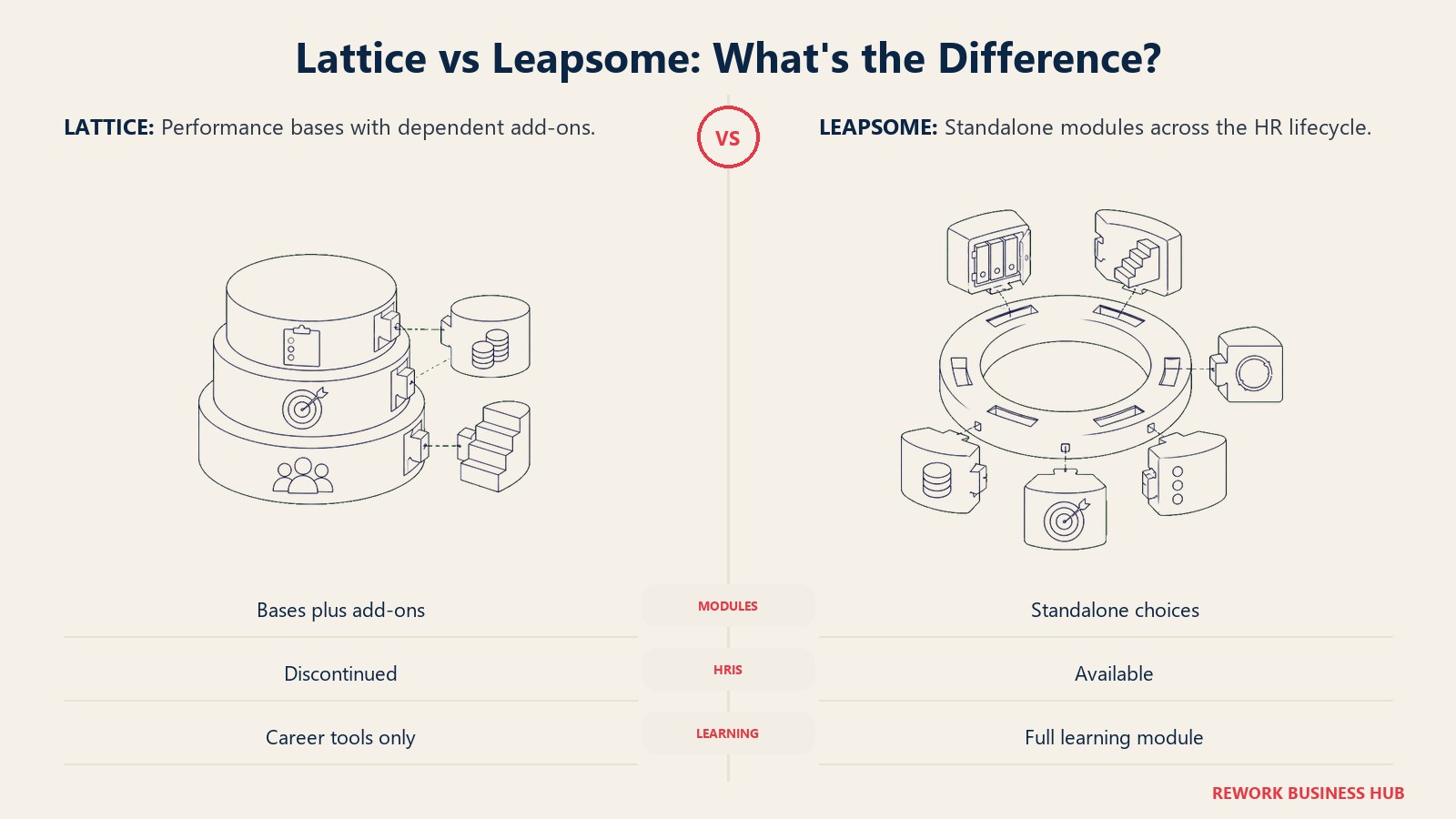
| Organizing principle | A fuller platform under one vendor: three base products plus add-ons | Buy only what you need: eight modules, each independently purchasable |
| Published pricing | Yes: $10 Performance, $8 Goals & OKRs, $4 Engagement, plus $6 Compensation, plus $4 Grow | Partially: comparison pages cite about $3 per user per month for one module, while the pricing configurator states a starting total instead |
| HRIS / employee records | Discontinued. Payroll access ended March 31, 2026, HRIS access ended July 31, 2026 | Live. HRIS is a currently sold, named module |
| Learning / LMS | Not offered. Grow covers competencies and career tracks, not course content | Live. A dedicated Learning module plus a Learning Content add-on |
| Contract floor | $4,000 minimum annual agreement, billed annually, USD only | No published dollar minimum; 1-year minimum term |
| Scale claim | "5,000+ forward-thinking teams," per Lattice's own site | "2,000+ forward-thinking organizations," per Leapsome's own site |
| Typical buyer | A US-based People Ops lead who owns formal review, calibration and comp cycles | An HR or People Ops leader consolidating several HR-tech contracts, often EU-based |
Key Facts
- Managers account for at least 70% of the variance in team engagement scores across business units, according to Gallup, which is the reason software adoption, not software features, decides most outcomes in this category.
- Only 24% of HR leaders believe their function achieves maximum value from its HR technology, and nearly half say HR technology has damaged rather than improved HR's reputation internally, per a February 2024 Gartner study reported by SHRM.
- The average HRIS is used by only 32% of employees, and nearly 1 in 4 organizations say new HR tech implementations fail to meet adoption expectations, according to Sapient Insights Group data cited by SHRM.
- Gallup's 11th-edition Q12 meta-analysis, covering 183,806 business units across 53 industries and 90 countries, found top-quartile engaged units outperform bottom-quartile units by 23% in profitability and 51% in turnover at low-turnover organizations, per Gallup.
- Fewer than one-fifth of HR leaders believe performance management is effective at achieving its primary objective, and 81% are still making changes to their performance management system, according to Gartner research.
Who Each Platform Is Actually Built For
Lattice spent 2024 and 2025 trying to become more than a performance vendor. It launched its own HRIS, then added payroll on top, betting that People teams would rather run employee records and performance in one system than stitch two vendors together. That bet did not survive to 2026: both products were discontinued, and Lattice is back to selling exactly five things, Performance, Goals & OKRs, Engagement, Compensation and Grow, all under one US-dollar price list with a single dedicated-support commitment.
Leapsome never made that detour, because HRIS was part of the architecture from the start rather than a later pivot. It sells eight modules, HRIS, Recruiting, Reviews, Surveys, Goals, Learning, Compensation and Time Tracking, and every one of them is purchasable on its own. That structure is also why Leapsome reads as the more European product: GDPR posture and EU data residency show up as procurement requirements in DACH, the UK and Benelux, not as footnotes.
| Lattice | Leapsome | |
|---|---|---|
| Company size sweet spot | Roughly 100 to 2,000 employees, strongest where a People Ops function already runs formal cycles | Vendor-stated 50 to 2,000 employees, strongest in DACH, the UK and Benelux |
| Primary budget owner | People Ops lead or HR Business Partner who owns the review and calibration calendar | HR Director or Head of People Ops consolidating several point tools into one contract |
| Team maturity assumed | A review cadence and comp bands already exist or are being formalized | People processes are scattered across several vendors and the mandate is to cut that number |
| Buying trigger | Spreadsheet review cycles, inconsistent calibration, manual comp planning | Tool sprawl, renewal fatigue, or a need for EU data residency a US vendor cannot promise |
| Product philosophy | A fuller platform: add Goals, Engagement, Compensation and Grow on top of one base | Genuinely modular: every one of the eight modules stands alone |
| Where it disappoints | Buyers who wanted Lattice to also be their HRIS. That door closed in 2026 | Buyers who want one flat seat rate instead of a per-module quote |
Neither read is a knock. A 400-person company that already has three HR business partners and a defined promotion committee wants Lattice's shape. A company juggling four vendor renewals in the same quarter wants Leapsome's shape. If you cannot tell which one you are yet, a written performance review framework is a faster diagnostic than either demo, because it forces you to write down the process you actually run today before a salesperson shows you theirs.
Platform Architecture: What "Modular" Actually Means
This is the section that decides the comparison, because it's the one axis a feature checklist cannot show you. Lattice sells three base products, Performance, Goals & OKRs and Engagement, and each stands on its own. But Compensation and Grow are true add-ons: Lattice's own pricing page prices them with a plus sign, "+$6" and "+$4," under an "Add-Ons" heading, and neither is purchasable without first owning one of the three bases. You cannot buy Lattice Compensation alone.
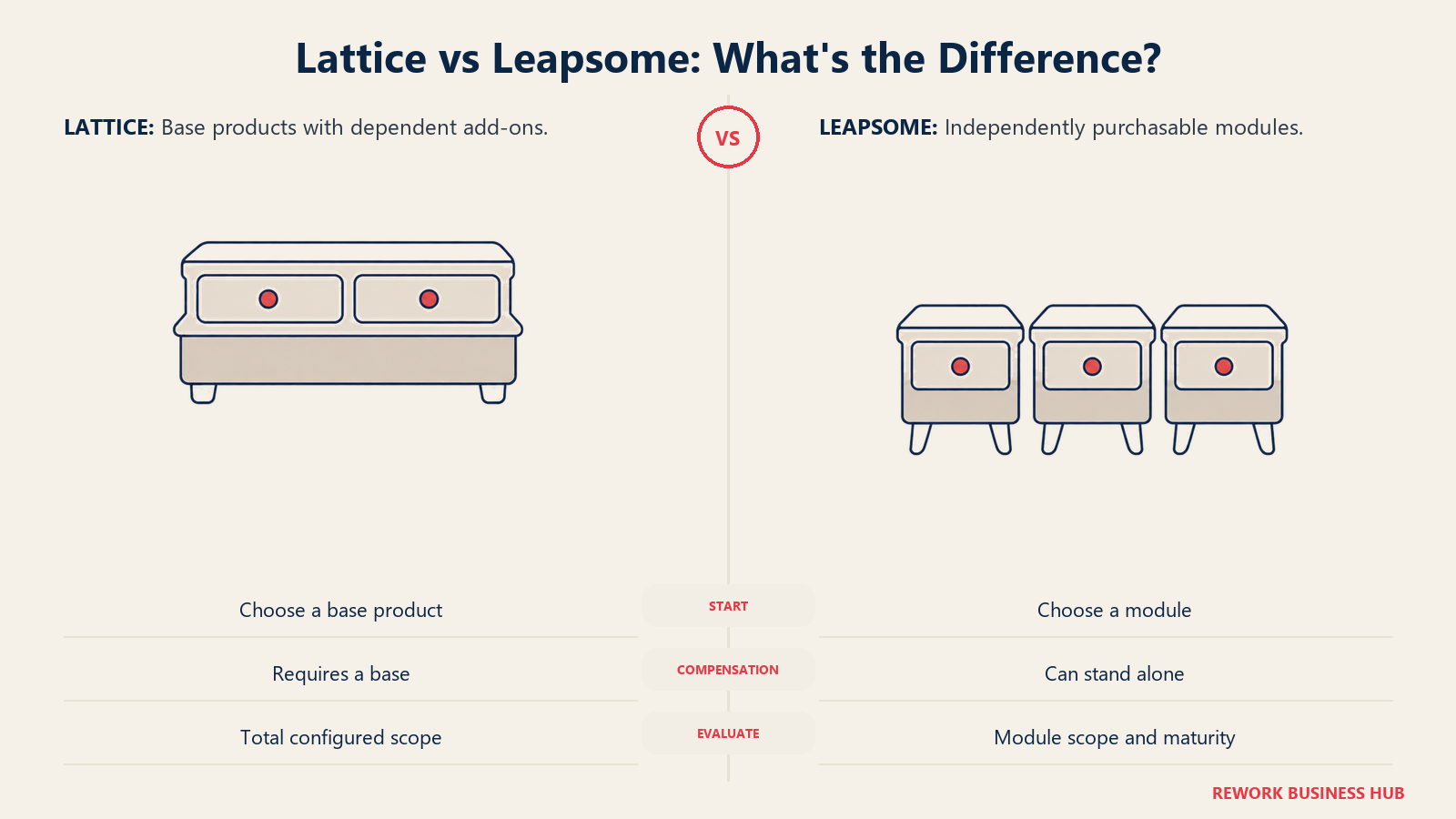
Leapsome draws no such line. HRIS, Recruiting, Reviews, Surveys, Goals, Learning, Compensation and Time Tracking are eight independently purchasable modules, and Leapsome's own pricing page states plainly that modules "can be bought individually or combined in any combination," with multi-module discounts on top. A company that wants only compensation planning can buy only Leapsome Compensation. The tradeoff is maturity: two of those eight modules, Recruiting and Time Tracking, are marked "Early Access" on Leapsome's own site, meaning neither is a mature, generally available product yet.
| Architecture factor | Lattice | Leapsome |
|---|---|---|
| Independently purchasable products | 3: Performance, Goals & OKRs, Engagement | 8: HRIS, Recruiting, Reviews, Surveys, Goals, Learning, Compensation, Time Tracking |
| Add-ons that require a base product first | Yes, Compensation (+$6) and Grow (+$4) both do | None. Every module stands alone |
| Can you buy compensation planning alone? | No | Yes |
| Can you buy an HRIS alone? | No, it was discontinued in 2026 | Yes |
| Multi-module discounts | Not stated on the pricing page | Yes, stated on the pricing page |
| Modules still in Early Access | None; all five products are generally available | Two: Recruiting and Time Tracking |
| Always-included platform features | 1:1s, Weekly Updates, Feedback and Q&A Boards ship with every base product | AI Agents, Workflows, Analytics, Q&A Boards, Meetings, Instant Feedback, Competencies, Whistleblowing and Form Builder ship with every plan |
Decision by Business Goal
| If your goal is... | Lean toward |
|---|---|
| Consolidate three or four disconnected HR-tech contracts, including HR records, into one | Leapsome |
| Keep every module on one US-dollar invoice with a single vendor's dedicated support commitment | Lattice |
| Run formal calibration, succession planning and PIPs inside the system of record from day one | Lattice |
| Stand up a real learning program without adding a separate LMS vendor | Leapsome |
| Get compensation benchmarks bundled into the add-on price, not billed as a second line item | Lattice |
| Avoid a dollar-based contract minimum entirely | Leapsome |
| Buy exactly one module today and decide on the rest once budget allows | Leapsome |
| Sync goal progress automatically from Salesforce or Jira | Lattice |
Where the Checklist Actually Ties: Reviews, Goals and Engagement
Here is the honest part: on the three things most buyers compare first, these platforms are close enough that scoring them feature by feature will not separate them. Both run real review cycles, both handle goals and OKRs, both ship engagement surveys, and both give every employee 1:1s and continuous feedback at no extra cost.
| Capability | Lattice | Leapsome |
|---|---|---|
| Performance review cycles | Yes, Performance base product ($10), with calibration, talent reviews, PIPs, succession and promotions named at that price | Yes, Reviews module, customizable templates, 360-degree feedback and competency frameworks |
| Goals and OKRs | Yes, separate base product ($8), with named Salesforce and Jira sync | Yes, separate module, individual, team and company OKRs with cascading alignment |
| Engagement and pulse surveys | Yes, Engagement base product ($4), pulse, eNPS, onboarding and exit surveys, AI trend analysis | Yes, Surveys module, pulse and lifecycle surveys, eNPS, DEI-related configuration |
| 1:1s and continuous feedback | Yes, the Habits layer ships free with every base product | Yes, Meetings and Instant Feedback ship as always-included platform features |
| Succession planning and PIPs | Named features of the base Performance tier | Not named as standalone modules on the public pricing page |
| AI assistance | AI Agent included with every base product | AI Agents listed as an always-included platform feature |
Where they genuinely part ways is everywhere else: whether the platform also runs your HR records, whether it teaches your workforce anything, and whether compensation benchmarks are bundled or billed separately. Those three differences carry more decision weight than the six rows above, and they're where the rest of this comparison spends its time.
Learning and Development: Leapsome's Clear Edge
This is the cleanest capability gap in the entire comparison, and it runs in one direction. Leapsome sells Learning as a named module: onboarding paths, personalized learning content and a separate Learning Content add-on for pre-built course libraries. Combined with Competencies as an always-included platform feature, Leapsome can run an employee's development journey from first day onward inside the same system that runs their reviews.
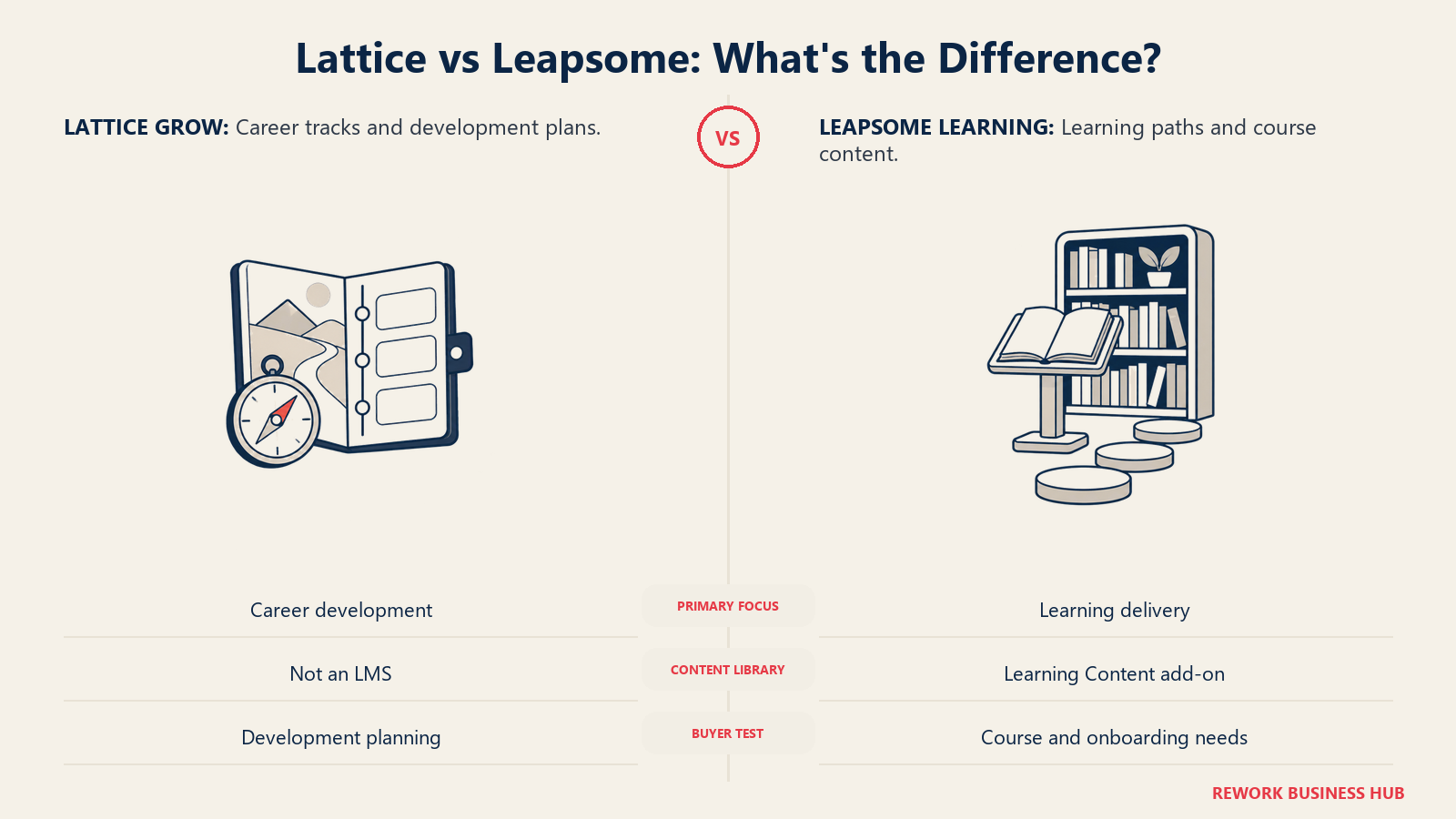
Lattice has no equivalent at any price. Grow, its +$4 add-on, covers competencies, individual development plans, career tracks and AI-powered growth areas, which is real career-development infrastructure, but it is not a course library and was never built to be one.
| Learning and development factor | Lattice | Leapsome |
|---|---|---|
| Dedicated learning module | Not offered at any price | Yes, the Learning module |
| Pre-built course content | Not offered | Learning Content add-on |
| Competency frameworks | Grow add-on, +$4 per seat/month | Named, always-included platform feature |
| Career tracks and IDPs | Grow add-on, +$4 per seat/month | Tied to the Learning and Goals modules |
| Where this shows up on the invoice | An optional $4 add-on stacked on a base product | A standalone module, purchasable without touching reviews or goals |
If learning is a near-term priority rather than a someday item, that alone is a reasonable tiebreaker toward Leapsome.
Compensation: Bundled Benchmarks or a Separate Line Item
Both vendors sell compensation planning, and both name real capability, but the packaging cuts opposite ways. Lattice's Compensation add-on is +$6 per seat per month and its pricing page names what's inside without qualification: global benchmarks, comp bands, cycle management, analytics, compensation statements and multi-chain approvals. Benchmarks are already in the price.
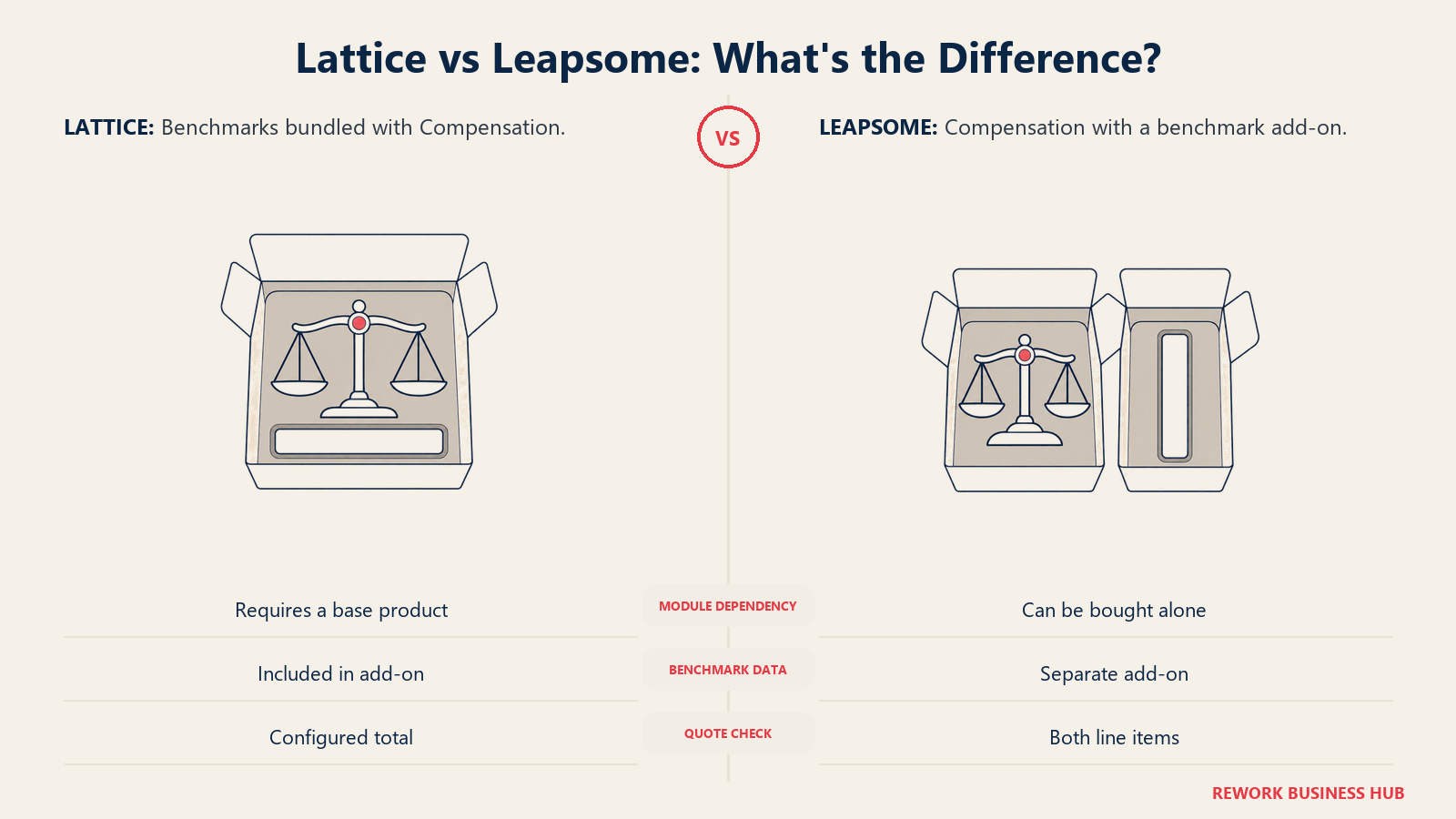
Leapsome's Compensation module covers pay reviews, budgeting and pay-gap analysis, and it stands alone, no base product required. External market-rate benchmarking is not included in that module. It's a separate add-on, Compensation Benchmarks, meaning a Leapsome buyer who wants what Lattice bundles into one $6 line item is paying for two.
| Compensation factor | Lattice (+$6/seat/month) | Leapsome (Compensation module) |
|---|---|---|
| Requires a base product first | Yes | No, purchasable alone |
| Global or market benchmarks | Included in the $6 add-on | Separate "Compensation Benchmarks" add-on, extra cost |
| Comp bands and cycle management | Named feature | Pay reviews and budgeting named |
| Pay-gap analysis | Not named on the pricing page | Named feature of the Compensation module |
| Multi-chain approval routing | Named feature | Not detailed on the public pricing page |
| Compensation statements to employees | Named feature | Not detailed on the public pricing page |
Net it out: if pay-gap analysis and buying comp planning without touching reviews matter most, Leapsome wins that trade. If a single bundled price with benchmarks and approval routing already inside it matters more, Lattice does.
The HRIS Question: One Vendor Retreated, the Other Never Left
This is where the "heavy push into HRIS territory" reputation and the current reality genuinely diverge, and it's worth being precise about the timeline. Lattice launched its own HRIS in fall 2024 and added payroll shortly after, a real, multi-quarter attempt to become the system of record for both people data and performance. It didn't stick. Lattice reversed course: payroll access ended March 31, 2026, and HRIS access ended July 31, 2026, with customers credited for subscription fees during the transition, according to Outsail's HR tech reporting. Both dates are now in the past. Lattice's pricing page today lists exactly five things, and HRIS is not one of them.
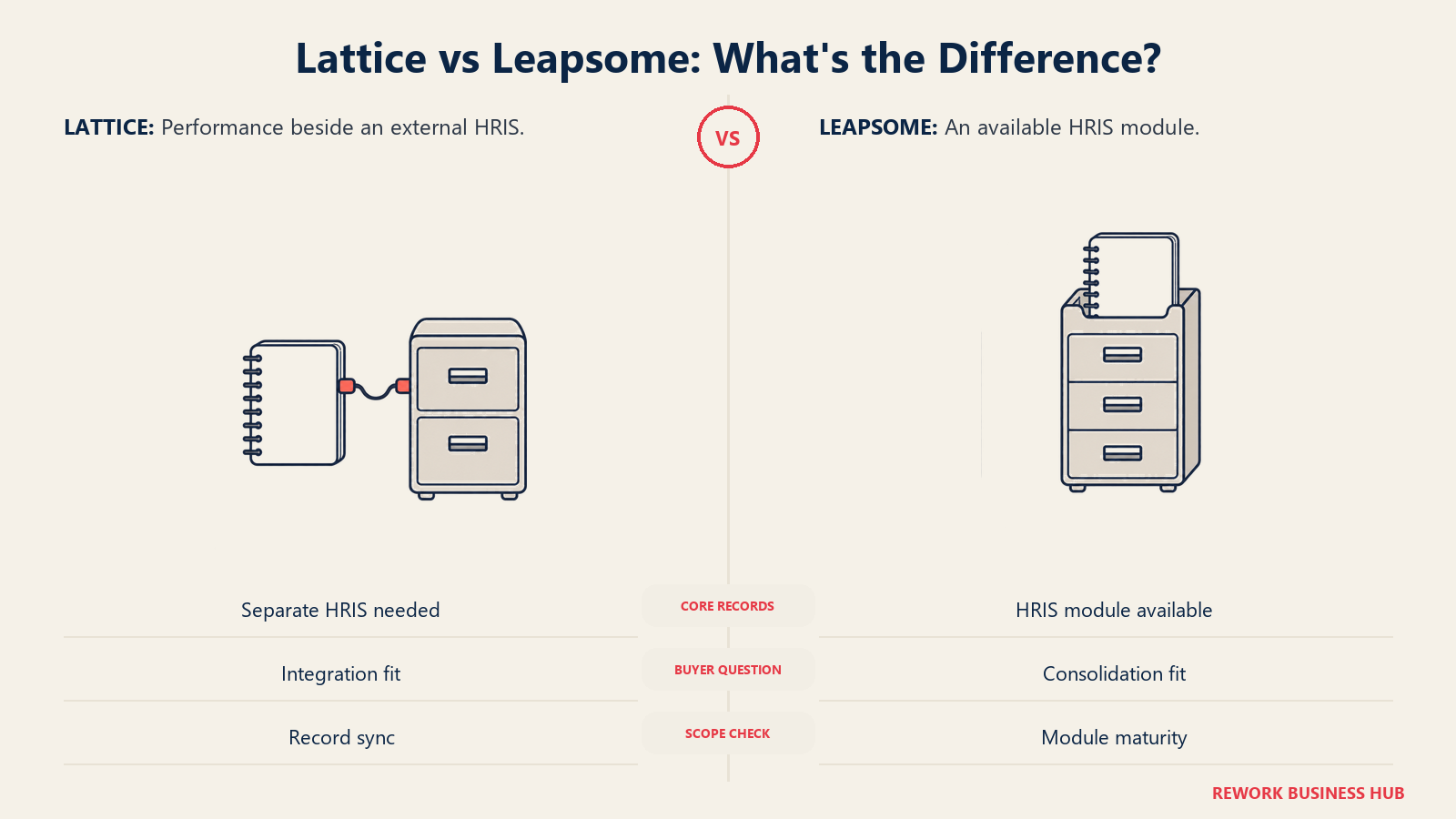
Leapsome's HRIS took a different path entirely: employee records, secure document storage with e-signature, structured onboarding, absence tracking and payroll preparation, sold as a current, generally available module rather than a recent pivot. The nuance worth flagging is that "absence tracking" lives inside the HRIS module itself, while a separate, standalone Time Tracking module, built for hourly and shift-based time-clock work, is marked Early Access alongside Recruiting. If your consolidation plan depends on either of those two specifically, get the maturity timeline in writing before you count on it for day one.
| HRIS and records factor | Lattice | Leapsome |
|---|---|---|
| Own HRIS or employee records today | No, discontinued | Yes, a named, currently sold module |
| History | Launched HRIS (2024) and payroll (2025), then reversed both in 2026 | Part of the modular architecture from the start, not a recent addition |
| Document storage and e-signature | Not applicable | Named feature of the HRIS module |
| Absence tracking | Not applicable | Included in the HRIS module |
| Standalone hourly time-clock tracking | Not applicable | Separate Time Tracking module, marked Early Access |
| Payroll preparation | Discontinued | Named feature of the HRIS module |
| Recruiting / ATS | Not offered | Early Access |
| What this means for your shortlist | You need a separate HRIS regardless of which one you pick | Leapsome can be that HRIS today, with Recruiting and Time Tracking still maturing |
The practical takeaway for a buyer choosing between just these two: if you want your performance vendor to also hold your HR records, only one of them offers that right now, and it is not the brand most People Ops leads associate with that ambition. For a wider look at dedicated systems of record, our best HR software guide for 2026 is the more direct starting point if core HR records, not performance, is the bigger unmet need.
Adoption: A Tool Managers Ignore Produces Worse Data Than None
Every number in the Key Facts section above points at the same failure mode: an average HRIS used by only 32% of employees, nearly a quarter of HR tech rollouts falling short of adoption expectations, and managers accounting for at least 70% of the variance in how engaged their teams actually are. None of that is a software problem you fix by picking the platform with more modules. A review cycle nobody takes seriously produces calibration data that looks precise and isn't, and leadership makes comp and promotion calls on it anyway, which is a worse outcome than running no formal process at all.
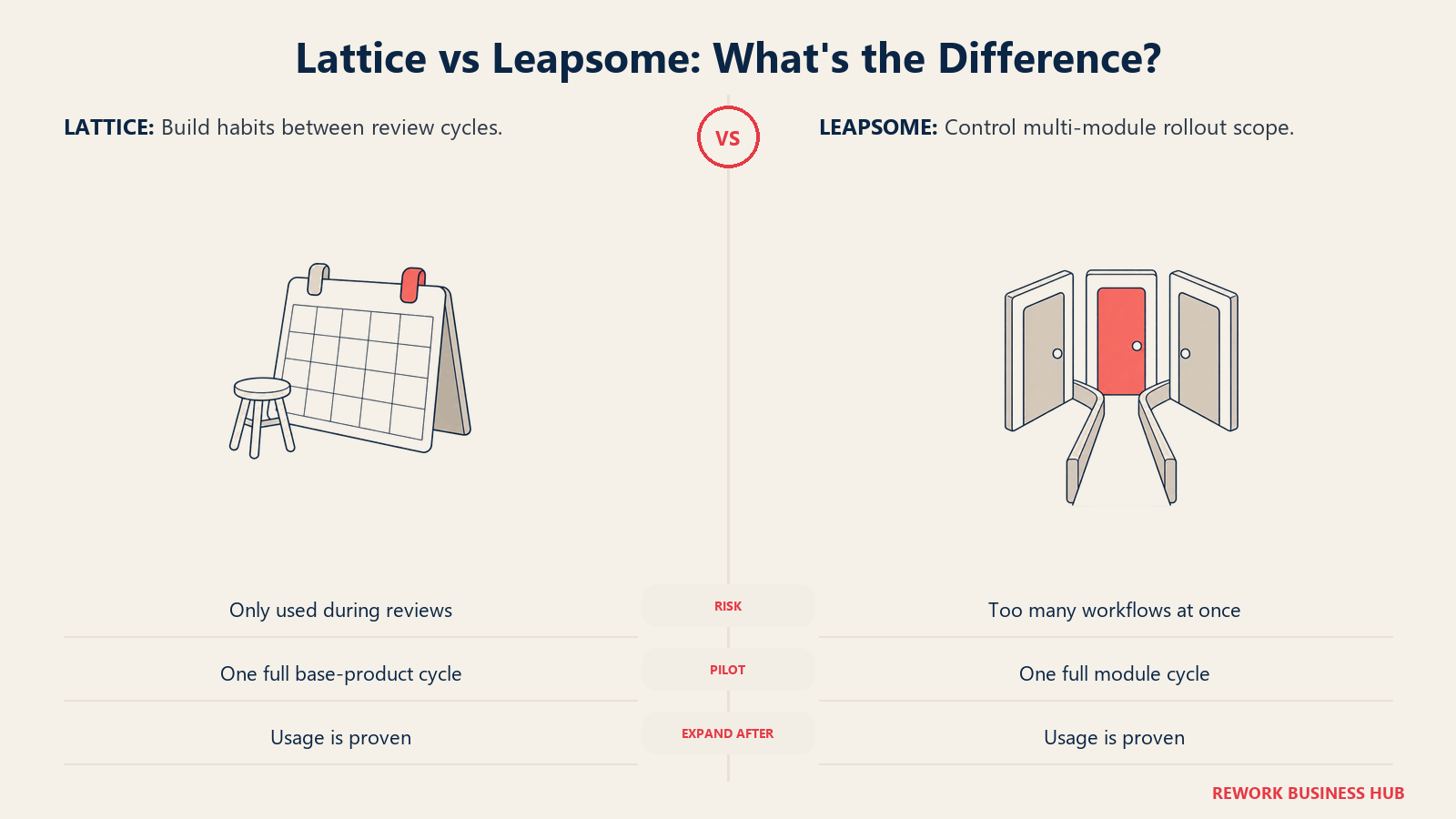
The two platforms carry that risk differently. Lattice bundles its lightweight daily-use surface, 1:1s, weekly updates, feedback and Q&A boards, free with every base product, so the habit-forming layer isn't a separate purchase decision. The risk concentrates instead in cycle windows: if nobody touches the Habits layer between formal reviews, the platform becomes something people log into twice a year. Leapsome's risk shows up at the rollout layer. Because Recruiting, HRIS, Reviews, Surveys, Goals, Learning and Compensation are separately configured modules, launching several at once multiplies the number of workflows an admin has to build and the number of new habits employees are asked to adopt simultaneously, which is the fastest way to reproduce the Sapient adoption-failure numbers, just spread across more systems.
| Adoption risk factor | Lattice | Leapsome |
|---|---|---|
| Daily-use surface bundled at entry price | Yes, 1:1s, weekly updates, feedback and Q&A boards ship free with every base product | Meetings and Instant Feedback ship as always-included platform features regardless of which modules you buy |
| Where adoption risk concentrates | Cycle windows, if the Habits layer goes unused between formal reviews | Rollout scope, if too many modules launch at the same time |
| Rollout pattern least likely to stall | One base product, proven through a full cycle, before adding Goals or Compensation | One module, proven through a full cycle, before layering in HRIS or Learning |
Pricing at 25, 100 and 250 Employees
Both vendors bill annually, and both structures hide the same lesson: the sticker rate is not the number you'll actually pay until you check what a small deal does to it. Lattice publishes USD-only pricing with a $4,000 minimum annual agreement. Neither vendor publishes a hard minimum seat count, but Lattice's dollar floor functions as one at smaller headcounts: on Performance alone, the $4,000 minimum outweighs the list price for any company under 34 seats.
That threshold matters directly at the smallest of our three sizes. At 25 employees, Performance alone lists for $3,000 a year (25 seats times $120), but the $4,000 minimum applies instead, an effective $160 per seat per year rather than the advertised $120, a detail that only shows up once you do the math rather than reading the per-seat rate off the page.
| Lattice configuration | Monthly rate | 25 employees | 100 employees | 250 employees |
|---|---|---|---|---|
| Performance only | $10/seat | $4,000 (floor applies, not the $3,000 list price) | $12,000 | $30,000 |
| Performance + Engagement | $14/seat | $4,200 | $16,800 | $42,000 |
| Performance + Goals & OKRs + Engagement | $22/seat | $6,600 | $26,400 | $66,000 |
| All five products (add Compensation + Grow) | $32/seat | $9,600 | $38,400 | $96,000 |
Leapsome publishes no single seat rate to build a table from directly. Its own comparison pages cite an entry point near $3 per user per month for one module, while its pricing calculator states pricing starts at 199 euros per month as a single total rather than a per-seat figure, and the two don't reconcile on Leapsome's own site. The table below applies Leapsome's stated $3 per-module entry point with no multi-module discount, since Leapsome states volume and multi-module discounts exist but never publishes the rate. Treat it as an illustrative floor, not a quote: real pricing should land at or below these numbers once discounts apply.
| Leapsome configuration (illustrative floor, not a quote) | PEPM, no discount applied | 25 employees | 100 employees | 250 employees |
|---|---|---|---|---|
| One module, for example Reviews only | $3 | $900 | $3,600 | $9,000 |
| Reviews + Goals + Surveys (3 modules) | $9 | $2,700 | $10,800 | $27,000 |
| Full stack: add HRIS, Learning, Compensation (6 modules) | $18 | $5,400 | $21,600 | $54,000 |
One more threshold worth flagging: Leapsome's dedicated Customer Success support and professional implementation require an annual contract of at least $6,000 (or €6,000). On the three-module basket above, a 25-employee buyer stays well under that line at $2,700 a year and gets email support only, while a 100-employee buyer clears it comfortably at $10,800. If your real quote lands near the low end of that range, confirm in writing whether dedicated support is included or a separate step up.
Implementation and Change Management
| Implementation factor | Lattice | Leapsome |
|---|---|---|
| Change management fees | None stated, per its pricing page; dedicated human support is included with every contract | Not itemized on the pricing page; support depth depends on the $6,000 Customer Success threshold |
| Heaviest configuration work | Review templates, rating scales, calibration rules, comp bands | Org data migration into HRIS, plus permissions and workflow setup per module |
| Realistic time to first value | Weeks, gated by your own review cycle calendar | Weeks per module; a full multi-module rollout stretches longer |
| Who does the work internally | People Ops, plus finance if Compensation is in scope | HR Ops, often split across separate module owners |
| Free trial | Not published | 14 days, no credit card required |
| Setup fees | Not itemized separately on the pricing page | None stated: "no setup fee and no additional or hidden costs" |
Risk and Governance
| Risk factor | Lattice | Leapsome |
|---|---|---|
| Data residency and Works Council posture | USD-only billing, enterprise security messaging, no named EU residency commitment | EU data residency and GDPR posture built for Works Council review |
| Product roadmap stability signal | Launched, then discontinued, an entire HRIS and payroll line within about 18 months | HRIS has run as a stable module; two of eight modules (Recruiting, Time Tracking) remain Early Access |
| Contract currency and minimums | USD only, $4,000 minimum annual agreement | 1-year minimum term, no published dollar floor |
| Vendor lock-in on a full-stack buy | Five products under one vendor; easier to unwind one module at a time | Up to eight modules under one vendor; unwinding HRIS specifically means a parallel HR-records migration |
| What to get in writing before signing | How the 2026 HRIS transition affects your specific quote, if you were quoted before the shutdown | The Early Access scope and timeline for any module core to your plan |
When Lattice Is the Right Call
- Your review cycle needs calibration, succession planning and PIPs in the base tier, not an upgrade conversation. Performance at $10 per seat per month names all four, no separate purchase required.
- You want compensation benchmarks bundled into one add-on, not a second line item. The +$6 Compensation add-on includes global benchmarks; Leapsome prices that data as a separate Compensation Benchmarks add-on.
- Your goals need to sync automatically from Salesforce or Jira. Lattice names both integrations on its Goals & OKRs product. Leapsome does not name an equivalent on its public pricing page.
- You'd rather manage one published US-dollar price list than a per-module quote. Every Lattice figure in this article came straight off its pricing page; most of Leapsome's required cross-checking two pages that don't fully agree.
- You don't need this vendor to be your HRIS, and never will. Lattice's 2026 retreat from HR records stops being relevant the moment that's true for you.
If Lattice fits but the modular stack adds up past what you can defend, our Lattice alternatives guide covers platforms that bundle more into a single rate, and Lattice vs 15Five covers the tradeoff against a vendor built around manager coaching instead. If Leapsome's modularity is what's actually pulling you away from Lattice rather than 15Five's coaching model, Leapsome vs 15Five runs that same manager-coaching question from Leapsome's side.
When Leapsome Is the Right Call
- You're consolidating several HR-tech contracts, including HR records, into one. Leapsome's HRIS is live and generally available. Lattice's isn't sold anymore.
- Learning and development is a near-term build priority. The Learning module and Learning Content add-on have no Lattice equivalent at any price.
- You want to buy exactly one module today and decide on the rest later. Every Leapsome module stands alone; nothing requires a base purchase first.
- You're EU-headquartered or need EU data residency and Works Council-ready configuration as a procurement gate, not a nice-to-have.
- A dollar-based contract minimum is a dealbreaker at your headcount. Leapsome publishes no equivalent to Lattice's $4,000 floor.
If Leapsome fits but the module math stacks up past what you can defend, our Leapsome alternatives guide covers the rest of that field, and Culture Amp vs Leapsome is worth reading if benchmark-grade listening depth matters as much as consolidation.
Decision Framework
| If this is true for you | Pick |
|---|---|
| You need succession planning and PIPs inside the system of record today | Lattice |
| You're consolidating HR records into the same vendor as performance | Leapsome |
| Compensation benchmarks should be bundled, not a second add-on | Lattice |
| Learning and development is a near-term priority, not a someday item | Leapsome |
| Goals must sync automatically from Salesforce or Jira | Lattice |
| You want to buy one module now and expand later without a base purchase | Leapsome |
| A $4,000 annual floor changes the math badly at your headcount | Leapsome |
| EU data residency is a procurement requirement | Leapsome |
| You'd rather have one published US-dollar price list than a per-module quote | Lattice |
| Comparing the whole category, not just these two | See the best performance management software guide for 2026 |
What to Do Next
- Decide whether HR records belong with this vendor. If yes, Leapsome's HRIS is the only currently sold option between these two; if no, that entire axis drops out of your decision and the comparison gets simpler.
- Price your actual configuration at your actual headcount, not the headline per-seat rate. Lattice's $4,000 floor and Leapsome's per-module stacking both move the real number at different thresholds than the sticker price implies.
- Get the Early Access timeline in writing from Leapsome if Recruiting or Time Tracking matter to your rollout, and ask Lattice directly what replaced its own HRIS integration story now that the product is gone.
- Launch one module or one full cycle first, not a wall-to-wall rollout. Check completion rates before expanding. That single step predicts adoption better than any feature row in this article.
- Still shortlisting? Our Lattice alternatives guide, Leapsome alternatives guide, and best OKR software guide for 2026 cover the wider field if goal-tracking rigor specifically is the deciding factor, and a written goal-setting framework is worth having in hand before either demo.

Principal Product Marketing Strategist
On this page
- TL;DR
- Key Facts
- Who Each Platform Is Actually Built For
- Platform Architecture: What "Modular" Actually Means
- Decision by Business Goal
- Where the Checklist Actually Ties: Reviews, Goals and Engagement
- Learning and Development: Leapsome's Clear Edge
- Compensation: Bundled Benchmarks or a Separate Line Item
- The HRIS Question: One Vendor Retreated, the Other Never Left
- Adoption: A Tool Managers Ignore Produces Worse Data Than None
- Pricing at 25, 100 and 250 Employees
- Implementation and Change Management
- Risk and Governance
- When Lattice Is the Right Call
- When Leapsome Is the Right Call
- Decision Framework
- What to Do Next