Culture Amp vs Betterworks vs Peoplebox: Which Performance Problem Are You Actually Solving in 2026?
Turn this article into takeaways for your work.


Each assistant summarizes the article only for you and suggests best practices for your work.
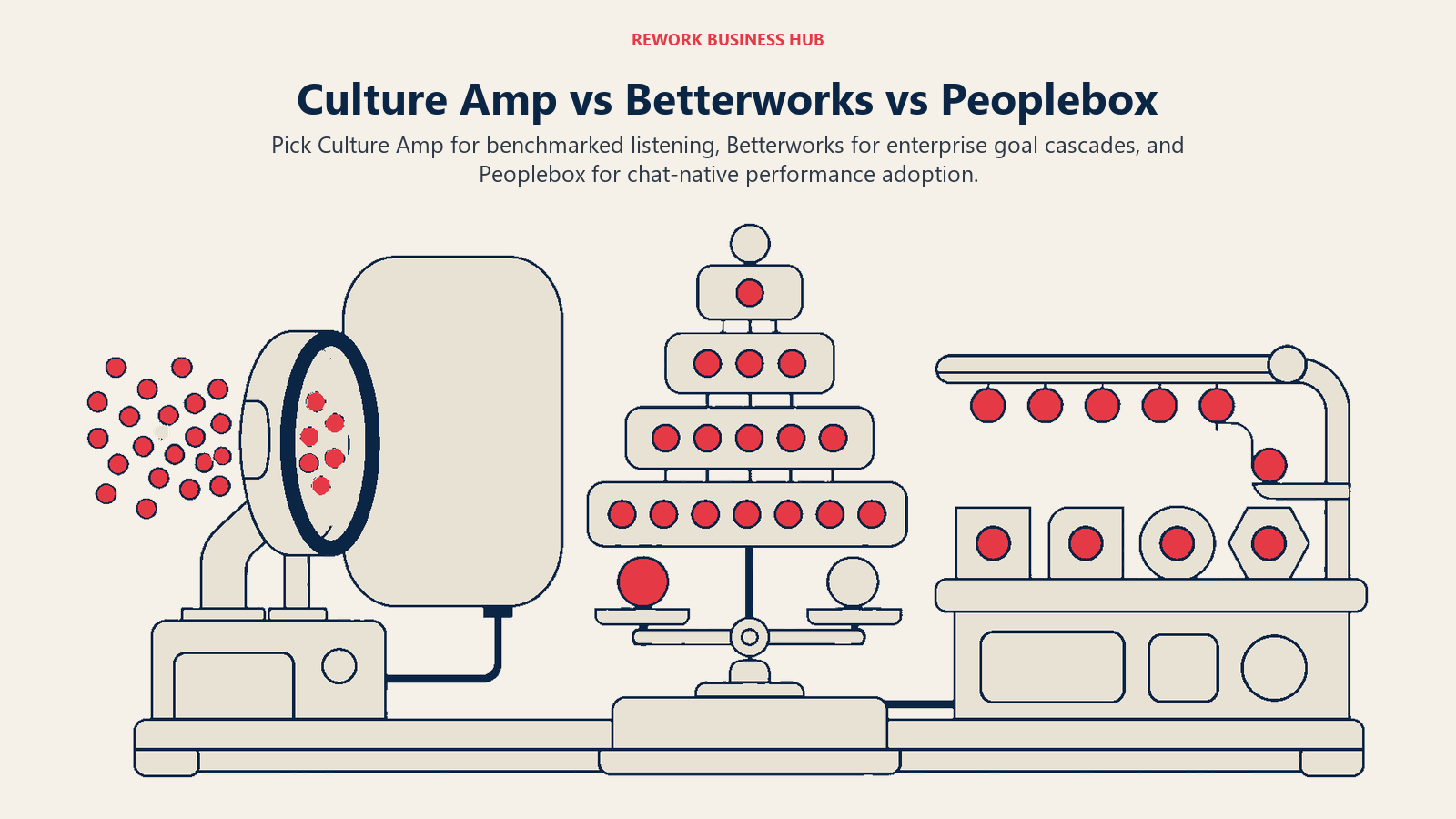
Culture Amp, Betterworks and Peoplebox all show up on the same shortlist because they all get sold under the same label: performance management. Search for any one of them and the other two appear in the "compared to" results on the first page. All three run reviews, all three handle goals, and all three will walk you through a demo that makes the checklist look nearly identical. It isn't. Line the three up and a different pattern shows up: three vendors with three genuinely different theories about what breaks performance management, and three different kinds of buyer who walks away happy.
Culture Amp is engagement-and-survey-led. It was built to measure how people feel and prove that measurement against a benchmark large enough to mean something, with performance built out from that foundation once the listening product had earned trust. Betterworks is goals-and-OKR-led, built to cascade objectives through a matrixed org chart and run a calibration season that survives a legal review, and it says openly it's built for companies over 500 employees. Peoplebox is the integration-led challenger: it lives inside Slack and Microsoft Teams, pulls goal progress from the systems where the work already happens, and undercuts both of the others on price. If you're a CHRO, VP of People, HR director or COO shopping this category, the feature checklist won't tell you which one to buy. The question that will is specific and a little uncomfortable: you don't actually know how your people feel, your goals aren't cascading the way you think they are, or nobody uses the performance tool you already bought.
TL;DR
| Culture Amp | Betterworks | Peoplebox | |
|---|---|---|---|
| Core bet | Measure how people feel, benchmark it, build performance on top | Cascade goals through a matrixed org and make calibration defensible | Run OKRs and reviews inside Slack and Teams, where work already happens |
| Organizing principle | Employee listening and people science | Goal alignment and enterprise calibration | Integration-first adoption |
| Where it lives day to day | Its own app: survey design and results dashboard | Its own app, with Slack/Teams for check-ins and nudges | Inside Slack or Microsoft Teams directly |
| Core modules | Engage (listening), Perform (reviews, goals, 1-on-1s, development) | Performance (goals, reviews, feedback), Talent Intelligence add-on | Performance Management, 360 Feedback, IDPs, Compensation, Engagement, priced separately |
| Published pricing | No, quote only by employee-count segment | Yes: $8-9/employee/mo regular, promo through August 31, 2026 | Yes, modular: $2-8/employee/mo per module |
| Scale claim | 1.61 billion questions answered, 8,900+ organizations surveyed | States 2 million+ employees run performance on the platform | 600+ companies, 100,000+ employees empowered |
| Built for under-500-employee companies | Yes, has a published under-200 segment | Vendor states it "adds the most value... over 500 employees" | Yes, no stated headcount floor |
| Typical buyer | CHRO or People Analytics lead who reports an engagement number | VP of People running formal cascades and calibration | HR or People Ops lead whose team already lives in Slack or Teams |
Key Facts
- Managers account for at least 70% of the variance in team engagement scores across business units, according to Gallup, which is close to the entire argument for building manager-facing tooling rather than just an HR dashboard.
- Business units in the top engagement quartile outperform the bottom quartile by 23% in profitability and 51% in turnover at low-turnover organizations, across 183,806 business units, per Gallup's Q12 meta-analysis, 11th edition.
- Just 2% of CHROs at Fortune 500 companies surveyed by Gallup strongly agree their performance management system inspires employees to improve, per Gallup's CHRO Roundtable research.
- The average HRIS is used by only 32% of employees, per a Gartner survey cited by SHRM, and nearly one in four organizations say new HR tech implementations fail to meet adoption expectations. Buying more modules doesn't fix that on its own.
- Culture Amp's own Benchmark Insights page states 1.61 billion questions answered and 74.15 million surveys completed across 8,900-plus organizations.
- Betterworks advertised a promotional rate of $1 per employee per month on its own pricing page through August 31, 2026, tied to a three-year agreement; confirm current pricing with Betterworks.
What Each Tool Is Actually Built For
Culture Amp built its reputation on the survey, not the review. The product exists to answer "how do our people actually feel, and how does that compare to everyone else." Its own benchmark page states 1.61 billion questions answered and 74.15 million surveys completed across 8,900-plus organizations, a comparison population large enough to turn a manager-support score of 68 from an argument into an answer. Perform, the reviews and goals product, extends into the places measurement naturally reaches: feedback, calibration framed around bias mitigation, development plans. It isn't trying to be an enterprise goal-cascade engine.
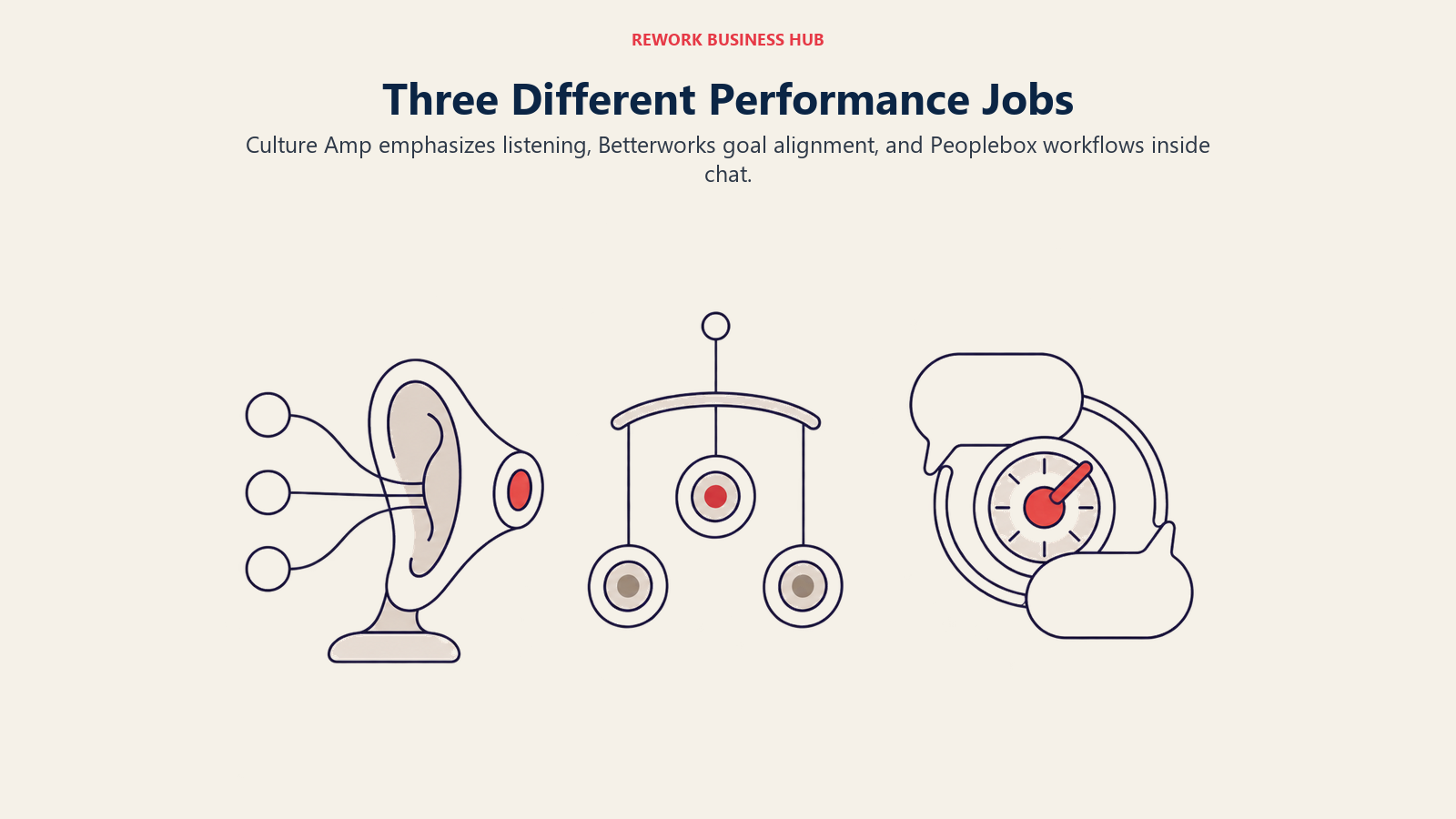
Betterworks starts from the opposite end. Its working theory is that reviews are downstream of alignment, so the product cascades objectives through a matrixed org chart, tracks progress against them, and uses that trail during a calibration season formal enough to survive a legal review. The vendor states plainly on its own pricing page that it "adds the most value for organizations with over 500 employees," more honest self-selection than most vendors offer. Its AI layer, Goal Assist, drafts objective language against strategy, and its Manager Command Center rolls team-wide goal progress into one dashboard.
Peoplebox is the youngest and cheapest of the three, and its bet is about where the software lives rather than what it measures. Reviews, check-ins, feedback and recognition run directly inside Slack or Microsoft Teams, and key results pull progress automatically from Jira, Salesforce, HRIS platforms and spreadsheets rather than waiting for someone to type a percentage into a form. The company states it serves 600-plus companies and has empowered 100,000-plus employees, a ratio that implies an average customer well under Betterworks' 500-employee floor. Its pitch is specific: OKRs and reviews shouldn't require a destination app nobody wants to open.
| Capability | Culture Amp | Betterworks | Peoplebox |
|---|---|---|---|
| Employee listening / pulse surveys | Core product (Engage) | Enterprise tier only, not in Performance or Performance + TI | Named module, $2/employee/mo |
| External benchmark data | 1.61 billion questions, 8,900+ organizations | Not a published feature | Not a published feature |
| Goals and OKRs, live sync from Jira/Salesforce | Included in Perform, no named live-sync | Named feature | Named feature |
| Performance reviews and 1-on-1s | Included in Perform | Included in Performance | Included in Performance Management |
| Calibration | Framed around bias mitigation, in Perform | Anytime Calibration, in Performance + Talent Intelligence | Not a named module |
| 360-degree feedback | Continuous, included in Perform | Not separately named | Separate paid module, $8/employee/mo |
| Succession and skills data | Not a named module | Talent Intelligence: skills inference, succession, Unified Talent Profile | Not a named module |
| Compensation | Not offered, integrates with Pave | Not detailed in published pricing | Named module, $5/employee/mo |
| Primary daily surface | Its own app | Its own app | Slack or Microsoft Teams |
HRIS Integration and How Employee Data Syncs
None of the three wants to be your system of record. All three sync employee and org data from whatever HRIS you already run rather than replacing it, but they differ on which systems they name and how deep the sync goes.
| HRIS and data-sync factor | Culture Amp | Betterworks | Peoplebox |
|---|---|---|---|
| Named HRIS integrations | Not named publicly; states it "automatically syncs with your human resources software and systems of record" | ADP, BambooHR, Oracle, SAP SuccessFactors, UKG Pro, Workday, Zenefits, plus SFTP | Workday, BambooHR, Darwinbox |
| Goal data synced from Jira or Salesforce | Not a named goals integration | Named | Named |
| Slack and Microsoft Teams | Yes, on all plans | Yes | Yes, the primary interface |
| SSO options | Included on all plans | ADFS, Google OAuth 2, Okta, OneLogin, PingOne | Azure AD, Okta, Google Workspace |
| Developer API | Yes | Yes (Betterworks API) | Not detailed in this comparison |
Betterworks names the deepest enterprise HRIS bench of the three, including Oracle and SAP SuccessFactors, consistent with its 500-plus-employee positioning. Peoplebox's named list (Workday, BambooHR, Darwinbox) leans toward platforms common at growth-stage and mid-market companies, and Darwinbox specifically signals strength in South and Southeast Asian markets. Culture Amp is the vaguest in public materials: it confirms HRIS sync is included on every plan but doesn't name partners, so get your specific system confirmed in writing before you assume compatibility.
One correction worth making here, since it comes up in almost every performance-management shortlist: Lattice is not a counter-example either. It discontinued its own HRIS and payroll products in 2026, with payroll access ending March 31 and HRIS access ending July 31. None of the vendors people actually compare in this category today, these three plus Lattice, is trying to be your system of record.
Review Cycle Configuration and Calibration Support
| Review and calibration factor | Culture Amp | Betterworks | Peoplebox |
|---|---|---|---|
| Review cycle building | Yes, in Perform | Yes, in Performance | Yes, with AI-drafted summaries from OKR evidence |
| 360-degree feedback | Continuous, included | Not separately named | Separate module, $8/employee/mo |
| Calibration workflow | Named, framed around bias mitigation | Anytime Calibration, gated to the $9 Performance + Talent Intelligence tier | Not a named module |
| Succession planning | Not a named module | Named, in Talent Intelligence | Not a named module |
| 1-on-1s | Included in Perform | Included in Performance | Included in Performance Management |
| Development plans | Included in Perform | Named, in Talent Intelligence | Separate module (Individual Development Plans), $3/employee/mo |
If a defensible, auditable calibration season across several layers of management is the actual requirement, Betterworks is built for that job specifically, and Peoplebox currently isn't. That gap alone often decides it for a 500-plus employee company, regardless of price. If calibration matters less than getting managers to finish a review cycle without HR chasing them, the gap matters less. A written performance review framework is worth having before any of the three demos, so you're testing the vendor against your actual cycle instead of the flow they'd rather show you.
Survey Benchmarking and Anonymity Thresholds
Benchmarking is Culture Amp's entire reason for existing, and the specificity shows: 1.61 billion questions answered, 74.15 million surveys completed, across 8,900-plus organizations, with cuts by industry, region and company size. Betterworks doesn't compete here by design. Its Engagement capability isn't in the $8 Performance tier or the $9 Performance plus Talent Intelligence tier; it's named only inside the custom-quote Enterprise tier. Peoplebox sells engagement as its cheapest module, $2 per employee per month, with custom surveys, anonymous responses, engagement scoring and demographic heatmaps, but publishes no external benchmark dataset at Culture Amp's scale.
| Listening and benchmark factor | Culture Amp | Betterworks | Peoplebox |
|---|---|---|---|
| Engagement module availability | Core product (Engage) | Enterprise tier only, custom quote | $2/employee/mo, standalone module |
| Published benchmark dataset | 1.61B questions, 74.15M surveys, 8,900+ orgs | Not published | Not published |
| Benchmark cuts | Industry, region, company size | Not applicable | Not applicable |
| Anonymity threshold published | Not published on any public page | Not published on any public page | Not published on any public page |
Anonymity thresholds, the minimum group size a platform requires before it will show a demographic breakdown, matter more than any of the three make obvious in public marketing. None of them publishes a specific threshold number. Ask directly what the minimum group size is at your tier before you promise employees anonymity you can't actually deliver in a 12-person department.
Decision by Business Goal
| Your situation | Best fit |
|---|---|
| "We don't actually know how our people feel, and the board keeps asking" | Culture Amp |
| "Our goals get written every quarter and forgotten within a month" | Betterworks (500+) or Peoplebox (under 500) |
| "We bought a performance tool last year and half the company has never opened it" | Peoplebox |
| "I need calibration data defensible enough for a legal review of promotion decisions" | Betterworks |
| "I need board-ready benchmark data, not just our own trend line" | Culture Amp |
| "My team already lives in Slack, and one more login is one too many" | Peoplebox |
| "We're under 500 people and enterprise goal-cascade software is overkill" | Peoplebox, or Culture Amp if listening is the bigger gap |
| "We're over 500 people with a matrixed org chart and a real calibration season" | Betterworks |
Team and Role Fit
| Culture Amp | Betterworks | Peoplebox | |
|---|---|---|---|
| Primary budget owner | CHRO, People Analytics lead | VP of People, People Ops running cascades | HR/People Ops lead, often with RevOps or IT overlap |
| Who has to adopt it daily | Employees answer surveys, managers act on results | Managers running goal check-ins and calibration | Managers and employees already inside Slack/Teams |
| Best org shape | Any, especially culture-and-retention-focused | Matrixed, multiple layers of management | Flatter product, engineering and revenue teams living in chat tools |
| Where it's structurally weakest | Enterprise goal cascade and calibration rigor | Employee listening (Engagement is Enterprise-tier only) | Enterprise calibration, external benchmark data |
| Company stage fit | Series C through public company | Late-stage private through public, 500+ employees | Series A through growth stage, tech-heavy orgs |
Pricing at Real Team Sizes
All three vendors bill annually, and none states a minimum seat count or minimum annual spend the way Lattice ($4,000) or Engagedly ($7,500) do elsewhere in this category. That's where the similarity ends.
| Employees | Culture Amp | Betterworks (Performance, regular) | Betterworks (Performance, Year 1 promo) | Peoplebox (Performance Management) |
|---|---|---|---|---|
| 100 | Quote only, under-200 segment | $9,600/yr | $1,200, then $9,600/yr from Year 2 | $9,600/yr |
| 500 | Quote only, 200-999 segment | $48,000/yr | $6,000, then $48,000/yr from Year 2 | $48,000/yr |
| 2,000 | Quote only, 1,000+ segment | $192,000/yr | $24,000, then $192,000/yr from Year 2 | $192,000/yr |
Betterworks and Peoplebox charge an identical headline rate at their entry tier: $8 per employee per month. At 100 employees that's $9,600 a year from either vendor for a broadly similar job (goals, reviews, check-ins). The difference isn't the sticker price, it's what's bundled at that price and who each vendor built it for. Betterworks' $8 tier doesn't include calibration (that needs the $9 tier or a custom Enterprise deal), and the vendor says plainly it's built for 500-plus employees. Peoplebox's $8 tier includes OKRs, reviews, 1-on-1s and continuous feedback with no stated headcount floor, but adds 360 feedback, development plans, compensation and engagement as separate paid modules.
Betterworks in detail
| Betterworks tier | Regular price | What's included |
|---|---|---|
| Performance | $8/employee/mo | Goals & OKRs, performance reviews, feedback, conversations, 1-on-1s, AI assistance, SSO, support |
| Performance + Talent Intelligence | $9/employee/mo | Everything above, plus Anytime Calibration, succession & talent mobility, skills intelligence, Unified Talent Profile, development plans, AI inference |
| Enterprise | Custom quote | Everything above, plus transformational program design, the Engagement module, in-app guides, change management services, dedicated Signature Support |
| Betterworks promo economics, Performance tier, per employee | Amount |
|---|---|
| Year 1, promotional rate ($1/employee/mo) | $12 |
| Year 2, reverts to regular rate ($8/employee/mo) | $96 |
| Year 3, stays at regular rate ($8/employee/mo) | $96 |
| 3-year total per employee | $204 (versus $288 at the straight regular rate) |
| Blended average | $68/employee/yr, or $5.67/employee/mo |
At 100 employees signing before August 31, 2026, that's $1,200 in year one, $9,600 in year two, $9,600 in year three: $20,400 total, against $28,800 if you'd paid the regular rate for all three years. The saving is real, roughly $8,400 over three years at that headcount, but it comes bundled with a mandatory three-year commitment. The offer expires in days, not months so if Betterworks is even a maybe, get the terms confirmed in writing this week.
Peoplebox in detail
| Peoplebox stack (cumulative) | Price | 100 employees | 500 employees | 2,000 employees |
|---|---|---|---|---|
| Performance Management (OKRs, reviews, 1-on-1s) | $8/employee/mo | $9,600/yr | $48,000/yr | $192,000/yr |
| + Engagement | +$2/employee/mo ($10 total) | $12,000/yr | $60,000/yr | $240,000/yr |
| + 360 Degree Feedback | +$8/employee/mo ($18 total) | $21,600/yr | $108,000/yr | $432,000/yr |
| + Individual Development Plans | +$3/employee/mo ($21 total) | $25,200/yr | $126,000/yr | $504,000/yr |
| + Compensation | +$5/employee/mo ($26 total) | $31,200/yr | $156,000/yr | $624,000/yr |
Peoplebox rewards restraint. Buying only what you need keeps it the cheapest of the three; stacking every module pushes the full build past Culture Amp's likely range at the same headcount, so price it module by module against your actual requirements rather than assuming the entry rate is the real number.
Culture Amp: what you're actually pricing
Culture Amp publishes no per-seat rate at any of the three headcounts above. What it does publish is the structure your quote will follow. At 100 employees you're quoted in the under-200 segment, with group Customer Success and 24/5 support. At 500 you move into the 200-to-999 segment, with one-on-one Customer Success, expert project management and 24/5 support. At 2,000 you're in the 1,000-plus Enterprise segment, with manager and executive training, coaching options, and results calls with Culture Amp's own people scientists. None of that gives you a dollar figure. Ask for these in writing before you build a budget:
| Ask Culture Amp for, in writing | Why it matters |
|---|---|
| Per-module rate for Engage and Perform, per employee per year | The only way to line it up against Betterworks' and Peoplebox's per-seat numbers |
| Which segment you're quoted in, and the rate on both sides of the boundary | A 195-employee company needs to know what happens at 200 |
| Price of People Science Consulting, if you want it | It's a real part of the value and a real part of the cost |
| Minimum contract term, and whether year one is discounted | A discounted first year with an undisclosed year-two rate isn't a price |
| A renewal uplift cap, written into the contract | Without a cap, your three-year cost is unknowable |
| Whether your specific HRIS is a named, tested integration | Culture Amp doesn't name HRIS partners publicly |
Implementation and Change Management
The category's shared failure mode isn't a missing feature, it's adoption. A performance tool your managers have quietly stopped opening produces worse data than no tool at all: it tells leadership performance is being managed when it isn't, and nobody notices until an exit interview or a bad quarter forces the question. Gartner's finding that the average HRIS reaches only 32% of employees is the same failure mode wearing a different label, and it applies to a performance platform's adoption curve just as much as an HRIS rollout.
| Culture Amp | Betterworks | Peoplebox | |
|---|---|---|---|
| First visible output | A survey result set with benchmark context | A completed goal cascade or calibration cycle | OKRs and check-ins running inside Slack/Teams within days |
| What earns manager usage | AI Coach on every plan, plus paid People Science Consulting | Manager Command Center dashboard, Milestone-Based Nudges in Slack/Teams | No new destination app; AI drafts review summaries from OKR evidence |
| Heaviest configuration work | Survey instrument design, demographic and hierarchy mapping | Goal cascade structure, calibration rules, org hierarchy | Per-module setup if buying more than Performance Management |
| What kills the rollout | Results land in a deck, get presented once, nothing changes | A calibration season slips, or a reorg breaks the cascade mid-cycle | Slack/Teams notification fatigue turns nudges into noise |
| Realistic time to value | Weeks, gated by survey design and comms | Weeks to months, gated by hierarchy mapping and calibration rules | Days to weeks per module |
Each vendor earns manager usage differently, and fails differently too. Culture Amp bets that AI Coach, included on every plan, plus a paid People Science Consulting add-on, gets managers from a score to an action. The honest risk is Gallup's own finding on action planning: top-quartile action planners raised engagement scores by an average of 10%, while bottom-quartile workgroups saw scores fall by roughly 3%, per Gallup. A survey nobody acts on is worse than not asking.
Betterworks earns usage with a Manager Command Center that rolls a team's goal progress and pending 1-on-1s into one dashboard, plus Milestone-Based Nudges that fire into Slack or Teams when an objective drifts off schedule. The honest risk is configuration weight: it's a consistently heavier product to configure than lighter mid-market tools, with more clicks between a manager's dashboard and an actual action. That's a fair trade for a real calibration season and a bad one for a team that just wants a weekly nudge.
Peoplebox's entire adoption bet is architectural: there's no new destination app, because reviews, check-ins and recognition happen inside Slack or Teams, and AI drafts review summaries from OKR evidence instead of asking a manager to reconstruct a quarter from memory. That removes the single biggest adoption tax the other two carry. The risk runs the other way: if your organization already suffers Slack or Teams notification fatigue, adding goal nudges to that channel can make the noise worse, and there's no separate destination app to retreat to when that happens.
None of this is free in HR time either way. Deloitte cites Adobe's managers spending over 80,000 hours a year on traditional performance evaluations before the company redesigned its process, a number worth remembering before assuming new software solves the time problem by itself (Deloitte). Budget real hours for whichever you pick: survey design and comms for Culture Amp, org-hierarchy and calibration-rule mapping for Betterworks, per-module setup for Peoplebox if you're buying more than Performance Management alone.
Risk and Governance
| Culture Amp | Betterworks | Peoplebox | |
|---|---|---|---|
| Compliance posture published | GDPR and SOC 2 named on the pricing page | Not detailed in public pricing; ask directly | Not detailed in public pricing; ask directly |
| Contract term | Annual billing only | Annual; the promo requires a 3-year commitment | Annual billing |
| Minimum seats or spend | Not stated at any tier | Not stated in published pricing | Not stated in published pricing |
| Hardest data to take with you | Benchmark comparison position; it's Culture Amp's dataset, not yours | Calibration history and Talent Intelligence (skills inference, succession, Unified Talent Profile) | No public migration playbook yet; confirm export format directly |
| Vendor lock-in risk | Low; annual-only, no multi-year requirement disclosed | Real, if you take the 3-year promo | Low; no minimum term beyond annual disclosed |
The data-portability question matters more than it looks like at signing time, because what you lose differs by vendor. Leave Culture Amp and the benchmark comparison position you've built over time doesn't travel with you: the comparison population is Culture Amp's dataset, not yours, so only your raw survey results and scores are genuinely portable. Export those before your contract ends. Leave Betterworks and the hardest layer to reconstruct is calibration history (the ranked, normalized data your leadership team used for comp and promotion calls) plus the Talent Intelligence layer, all specific to Betterworks' own AI models. Export row-level ratings and notes, not summary reports, before you cancel. Leaving Peoplebox is the least documented of the three in public materials, since it's the newest and smallest vendor here; ask directly what exports in what format, in writing, rather than assuming a migration path exists just because the other two have one.
One correction worth repeating plainly: if this trio gets compared against Lattice for context, don't treat Lattice as an HRIS option. It discontinued its own HRIS and payroll products in 2026, payroll access ended March 31 and HRIS access ended July 31. All three tools here, and Lattice, expect core HR records to live somewhere else.
When Culture Amp Is the Right Call
- Your engagement number is reported upward and gets challenged. If a board member asks "compared to what" every quarter, Culture Amp is the only one of the three that publishes its benchmark scale and the cuts it offers.
- You want a research function behind your survey instrument, not a template. People Science Consulting is a paid add-on, but it's a real team, not a knowledge-base article.
- Performance matters, but calibration and succession don't need to be enterprise-grade. Perform covers reviews, 1-on-1s, goals and development without the matrixed-org machinery Betterworks is built for.
- You're comfortable with quote-only procurement in exchange for the deepest listening product of the three.
When Betterworks Is the Right Call
- You're over 500 employees with a matrixed org chart and a calibration season that has to survive a legal review. That's the job Betterworks names as its sweet spot, and neither of the other two names calibration as a core feature.
- Pay and succession decisions need defensible skills and talent data behind them. Talent Intelligence (skills inference, succession, Unified Talent Profile) has no equivalent in Culture Amp or Peoplebox.
- You want goal progress pulled automatically from Jira or Salesforce rather than typed in by hand, and you're prepared to pay enterprise rates for that rigor.
- You can move before August 31, 2026, and you're genuinely willing to commit three years. The promotional rate is real money, but only if the term fits how long you expect to run the platform.
When Peoplebox Is the Right Call
- Your team already lives in Slack or Microsoft Teams, and one more login is one you know won't get used. Peoplebox's whole bet is removing that friction, not competing on a feature to work around it.
- You're under the 500-employee floor Betterworks names, and you want goals and reviews tied together without paying for calibration machinery you won't run yet.
- You want the cheapest credible option of the three and you're comfortable buying only the modules you need, since nothing here is priced as a mandatory bundle.
- OKR execution, not review ceremony, is the actual problem. Automatic progress updates from source systems matter more to you than a deep calibration workflow.
Decision Framework
| If this is true for you | Pick |
|---|---|
| Your board asks how engagement compares to peers | Culture Amp |
| You're over 500 employees with a matrixed org and a real calibration season | Betterworks |
| Your team already lives in Slack or Teams and won't adopt a new destination app | Peoplebox |
| You need people-science support, not just software | Culture Amp |
| You need the deepest goal-cascade and calibration rigor available | Betterworks |
| You want the cheapest of the three and no 500-employee floor | Peoplebox |
| You want enterprise calibration and goal cascades at a published rate | Betterworks, $8 per user per month for Performance |
| Comparing the whole category rather than just these three | See the 2026 performance management software guide |
What to Do Next
- Name your actual problem in one sentence. You don't know how people feel, your goals don't cascade, or nobody uses the tool you already bought. If you can't choose one, you're not ready for a demo, because all three vendors will happily sell you the half you didn't need.
- Price your real headcount against the master table above, then confirm it in writing. Betterworks and Peoplebox will give you a number on the first call; Culture Amp won't, so send the six-question list from the pricing section by email so the answers are documented.
- If Betterworks is even a maybe, price it at the standing rate. Its $1 first-year promotion expired August 31, 2026, so budget $8 per user per month for Performance, or $9 with Talent Intelligence.
- Put the manager experience in front of three real managers before anyone signs anything. For Peoplebox specifically, test it inside your actual Slack or Teams workspace, not a sandbox, since the entire pitch depends on it feeling native rather than bolted on.
- Ask each vendor the data-portability question directly: what exports, in what format, and what's gone the day the contract ends. Get the answer in writing before you need it.
- Still comparing the wider field? The performance management software roundup and OKR software roundup cover the rest of the category, and the Betterworks alternatives guide and Culture Amp alternatives guide go deeper on each vendor's specific competitive set.
Frequently Asked Questions about Culture Amp vs Betterworks vs Peoplebox
Which of the three is cheapest?
Peoplebox and Betterworks both start at $8 per employee per month for their core module, an identical headline rate, so at 100 employees either one runs $9,600 a year for goals and reviews. Peoplebox has no stated headcount floor and lets you buy only the modules you need, while Betterworks says it's built for organizations over 500 employees and gates calibration behind a $9 tier or a custom Enterprise deal. Culture Amp publishes no price at any tier, so it can't be ranked on cost without a quote.
Does Culture Amp publish pricing?
No. Its pricing page states only that cost depends on employee count, product chosen and service tier, billed annually, across three published segments: under 200 employees, 200 to 999, and 1,000-plus. There's no per-seat rate anywhere on the site, so any dollar figure you see elsewhere is a third-party estimate, not a vendor-confirmed price.
Is Betterworks' $1 per user per month price real?
It was real but conditional, and it has expired. Betterworks' pricing page stated the promotional rate covered the first contract year only and required a signed three-year agreement, and the offer lapsed on August 31, 2026. Years two and three reverted to the regular $8 (or $9 with Talent Intelligence) rate, which put the blended three-year average closer to $5.67 to $6.67 per employee per month than to $1. The page now lists only the standing rates.
Which one has the best employee listening and benchmark data?
Culture Amp, without much competition. It publishes 1.61 billion questions answered and 74.15 million surveys completed across 8,900-plus organizations, with comparisons cut by industry, region and company size. Betterworks' Engagement capability is gated to its custom-quote Enterprise tier and has no published benchmark dataset. Peoplebox sells engagement surveys as a $2 per employee per month module but doesn't publish external benchmark data at Culture Amp's scale.
Does Peoplebox have calibration like Betterworks?
No. Betterworks names Anytime Calibration as a feature of its Performance plus Talent Intelligence tier, built for cascading, ranking and normalizing performance data across a matrixed org. Peoplebox has no named calibration workflow on its public pricing page. If a formal, defensible calibration season is a hard requirement, raise that gap directly with Peoplebox's sales team before assuming it's on the roadmap.
Can you run more than one of these at the same time?
Some companies do during a transition, most often running Culture Amp for listening while a separate tool handles goals and reviews. It usually means paying for overlapping survey features and asking employees to use two systems, so treat it as a temporary migration state rather than a permanent stack unless the benchmark data and the goal-cascade rigor are both genuinely non-negotiable.
Is Lattice an HRIS I should compare against these three?
No, not anymore. Lattice discontinued its own HRIS and payroll products in 2026, with payroll access ending March 31 and HRIS access ending July 31. If Lattice comes up while you're evaluating this trio, treat it as a performance and goals platform only, the same category as Culture Amp, Betterworks and Peoplebox, not as a system-of-record alternative.
Related Resources:
- Best Performance Management Software in 2026
- Best OKR Software in 2026
- Best Betterworks Alternatives
- Best Culture Amp Alternatives
- Best Employee Engagement Software in 2026
- Lattice vs Culture Amp
- Culture Amp vs Leapsome
- Leapsome vs 15Five
- How to Choose Performance Management Software
- Performance Review Framework
- OKR Framework

Principal Product Marketing Strategist
On this page
- TL;DR
- Key Facts
- What Each Tool Is Actually Built For
- HRIS Integration and How Employee Data Syncs
- Review Cycle Configuration and Calibration Support
- Survey Benchmarking and Anonymity Thresholds
- Decision by Business Goal
- Team and Role Fit
- Pricing at Real Team Sizes
- Betterworks in detail
- Peoplebox in detail
- Culture Amp: what you're actually pricing
- Implementation and Change Management
- Risk and Governance
- When Culture Amp Is the Right Call
- When Betterworks Is the Right Call
- When Peoplebox Is the Right Call
- Decision Framework
- What to Do Next