Centage vs Vena Solutions vs Drivetrain: Which FP&A Platform Actually Fits Your Team in 2026?
Turn this article into takeaways for your work.


Each assistant summarizes the article only for you and suggests best practices for your work.
Centage, Vena Solutions and Drivetrain rarely lose a deal to each other on a feature checklist. They lose because a buyer never named the real question first: what should actually happen to the spreadsheet. All three platforms answer that question a different way, and the answer, more than any row in a comparison table, is what should drive the shortlist.
Vena's answer is the least disruptive. Keep Excel as the interface your team already knows, and put a governed database, CubeFLEX, behind it so the numbers stop drifting the moment someone emails a copy to a colleague. It's the most established of the three, and its Microsoft ties run deeper after completing its acquisition of Acterys on March 26, 2026, adding Power BI write-back and modeling aligned to Microsoft Fabric. Finance teams adopt Vena without retraining anyone on a new interface, only on a new discipline around the one they already use.
Centage takes the opposite position. Instead of asking a finance team to construct a model from a blank canvas, Centage, formerly Planning Maestro, hands over a driver-based model with the balance sheet and cash flow already wired to the P&L. That's a structured, opinionated tool built for a small finance team (Centage's own stated fit is 2 to 10 people) that wants guardrails, not a blank canvas, and it's the only one of the three willing to put a real number on its own pricing page.
Drivetrain is the newest and the most different starting position of all. Rather than modeling the general ledger and calling it done, it connects operational systems, CRM pipeline, usage data, HRIS, billing, directly into the plan, so a growth-stage company can forecast against the business it actually runs, not just the accounts it closes at month-end. Its explainability pitch, that AI operates the model but traces every number back to its source, answers a trust problem the other two barely have to solve, since neither pushes AI as deep into the model itself.
None of the three vendors say this part out loud: the easiest to adopt is also the easiest to let drift back into the same spreadsheet chaos it was bought to fix, and the two harder to adopt are the two that hold their shape once they're actually in. Which trade-off is worth making depends on the finance team doing the choosing, which is what the rest of this comparison works through.
TL;DR
| Centage | Vena Solutions | Drivetrain | |
|---|---|---|---|
| Its answer to "what about the spreadsheet" | Replace it with a pre-built, driver-based model | Keep it as the interface, govern what sits underneath it | Replace it with an AI-native model wired to operational systems |
| Started as | Budget Maestro, then Planning Maestro, rebranded Centage | An Excel layer built around CubeFLEX, a governed multidimensional database | Built AI-native from the start for growth-stage finance teams |
| Where the model lives | Centage's own web application | Your Excel workbook, and now Power BI too, via the Acterys acquisition | Drivetrain's own web application |
| Who typically owns it | An internal 2 to 10 person finance team, Centage's own stated buyer size | A trained internal Vena administrator, backed by Professional Services or a partner | A Head of Finance or RevOps owner, per the vendor's stated buyer roles |
| ERP/CRM data connections | QuickBooks, NetSuite, Sage Intacct, ADP, UKG; no CRM named | ERP and accounting sources via implementation; native Dynamics 365; no CRM named | 800+ connectors, including named CRM systems (Salesforce, HubSpot), ERP, HRIS, billing |
| Published implementation claim | "Implement in just 4-6 weeks," per Centage's own site | "As little as six to eight weeks," per Vena's own implementation guide | "Most implementations are completed in 4-6 weeks," per Drivetrain's own FAQ |
| Best-fit company size | Roughly $25M-$500M revenue, 2 to 10 person finance team | Roughly 50 to 1,000+ employees, any team unwilling to leave Excel | Roughly 50 to 1,000+ employees, subscription or usage-based businesses |
| Published pricing | Core $1,750/mo, Strategic $2,500/mo, Performance $3,500/mo, billed annually | None; Professional and Complete tiers, no dollar figures | None; custom proposal based on systems integrated and features used |
| Reported median annual contract | Not applicable; real prices are published | $34,285/year, per Vendr (reported) | $26,390/year, per Vendr (reported) |
| Free trial or self-serve demo | Not published | Not published | No self-serve trial; guided demos and proof-of-concept engagements only |
Key Facts
- Centage is the only one of the three that publishes real prices: Core at $1,750 a month, Strategic at $2,500, and Performance at $3,500, all billed annually, per Centage's own pricing page. The vendor states mid-market customers typically spend $18,000 to $40,000 a year, and its stated fit is $25M to $500M in annual revenue with a 2 to 10 person finance team.
- Vena completed its acquisition of Acterys, a Power BI-based operational planning platform, on March 26, 2026, adding a proprietary Power BI write-back engine and multidimensional modeling aligned with Microsoft Fabric (Vena newsroom).
- Vendr, a SaaS pricing intelligence firm, tracks Vena at a median annual contract of $34,285 across 34 purchases, ranging from $9,343 to $73,500, with buyers averaging a 21.82% discount off the initial quote (Vendr: Vena Solutions). Vendr tracks Drivetrain separately at a median of $26,390, ranging from $18,000 to $36,500 (Vendr: Drivetrain).
- Drivetrain's own FAQ states plainly that "implementation costs are included in your pricing package," with "no surprise setup fees," and that most implementations complete in 4 to 6 weeks, with timelines extending based on model complexity and the number of connected systems (drivetrain.ai/faq).
- Vena's own implementation guide states a rollout "can achieve value in as little as six to eight weeks" with best practices in place, and recommends a named internal administrator dedicate 1 to 1.5 days a week throughout the project (Vena: A Guide to Implementing Vena).
- 96% of FP&A professionals still use spreadsheets for planning at least weekly, even at organizations already running a dedicated planning platform, per the AFP's 2025 FP&A Benchmarking Survey of 362 practitioners (AFP). That single number is the entire argument behind Vena's Excel-native bet, and the entire warning behind the other two's pitch to replace it.
What Each Tool Is Actually Built For
Vena's premise starts from a concession most FP&A vendors won't make: Excel isn't going anywhere, so the job is to make it safe to keep using. CubeFLEX, the governed database underneath, holds the real data; Excel stays the working surface, with Power User, Contributor and View Only roles controlling who can change what. The Acterys acquisition pushes that further, adding Power BI write-back and modeling aligned with Microsoft Fabric, extending planning into what Vena calls "Orchestrated Planning" across Finance, IT and other stakeholders. For a company already standardized on Power BI, Teams and Dynamics 365, that's a structural advantage no Excel-only competitor can match.
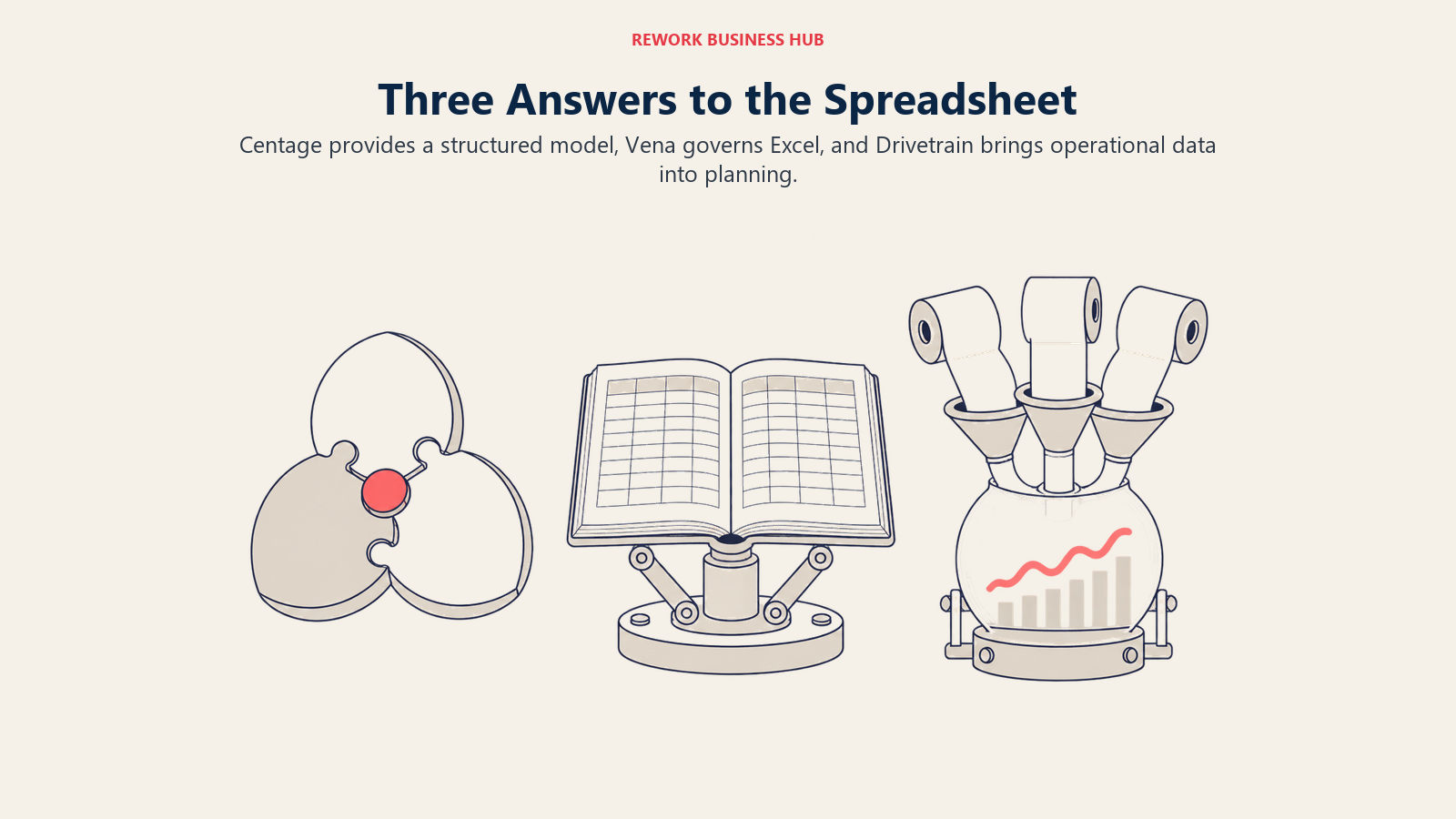
Centage starts from the opposite premise: the spreadsheet itself is the risk, not just a workflow problem on top of it. Rather than a blank canvas, it ships a driver-based budget structure with the balance sheet, income statement and cash flow already tied together, so a revenue assumption change flows through to cash automatically. Named differentiators include built-in workforce planning, true multi-entity and multi-location capability, and an AI Assistant reserved for the top tier. The vendor is direct about the problem this solves: its homepage names "one person holds all the knowledge about how the model works" as a reason finance teams switch, a key-person risk pitch aimed at a lean team that can't afford to lose its one spreadsheet expert.
Drivetrain's premise is different again: the general ledger was never the whole picture, so the model should pull in whatever data actually explains the business. Its 800+ connectors span ERP, CRM, HRIS, billing and usage systems, the widest net of the three and the only one that names CRM systems (Salesforce, HubSpot) explicitly. On top sit six named AI agents (Scenario, Modeling, Formula, Reporting, Data transformation, Data classification) plus a Budget vs. Actual agent, built around a stated commitment: "AI operates your model, explains every formula, and traces every number to its source," a direct answer to the objection every AI-heavy FP&A tool eventually meets: a finance team that won't sign off on a number it can't trace.
| Centage | Vena Solutions | Drivetrain | |
|---|---|---|---|
| Core interface | Centage's own web application | Excel, and now Power BI, synced to a governed database | Drivetrain's own web application |
| What sits behind the interface | A pre-built driver-based model with the balance sheet, income statement and cash flow already tied together | CubeFLEX, a governed multidimensional database | A connected data layer pulling from 800+ systems, with AI agents operating on top |
| Where operational data enters | Payroll and ERP connectors (QuickBooks, NetSuite, Sage Intacct, ADP, UKG) | ERP and accounting sources, wired in during implementation; native Dynamics 365 | ERP, CRM, HRIS, billing and usage systems natively, the widest net of the three |
| Named AI capability | AI Assistant, gated to the Performance tier only | Vena Copilot, included from the Professional tier up | Six named agents plus a Budget vs. Actual agent and a Slack bot |
| What the vendor says makes it different | Addresses "one person holds all the knowledge about how the model works" | "87% of companies who buy other FP&A software end up back in Excel anyway" (vendor claim) | "AI operates your model, explains every formula, and traces every number to its source" |
If forecast accuracy and how far each vendor's AI actually goes matters more to your evaluation than the interface question, best AI agents for FP&A breaks Drivetrain's and Vena's agent claims down against a stricter agentic bar, including which claims are independently verifiable.
The Trade-Off No Vendor Puts on Its Homepage
Here's the part none of the three pricing pages will tell you: the easier a platform is to adopt, the easier it is for the thing you bought it to fix to come back. Vena's whole pitch rests on this tension without naming it. Because the interface stays Excel, adoption is close to frictionless and the model can go live inside the vendor's stated six-to-eight-week window. But the AFP's 2025 survey found that 96% of FP&A professionals still use spreadsheets weekly even at companies already running a dedicated planning platform, and a separate AFP analysis found that 71% of FP&A teams already own an EPM tool, yet 85% still use spreadsheets alongside it and 57% use them specifically to bypass it. A governed database underneath Excel reduces that risk considerably; it doesn't eliminate it, since the surface a user sees is still a workbook that can be exported, edited offline and reintroduced with version drift nobody notices until close.
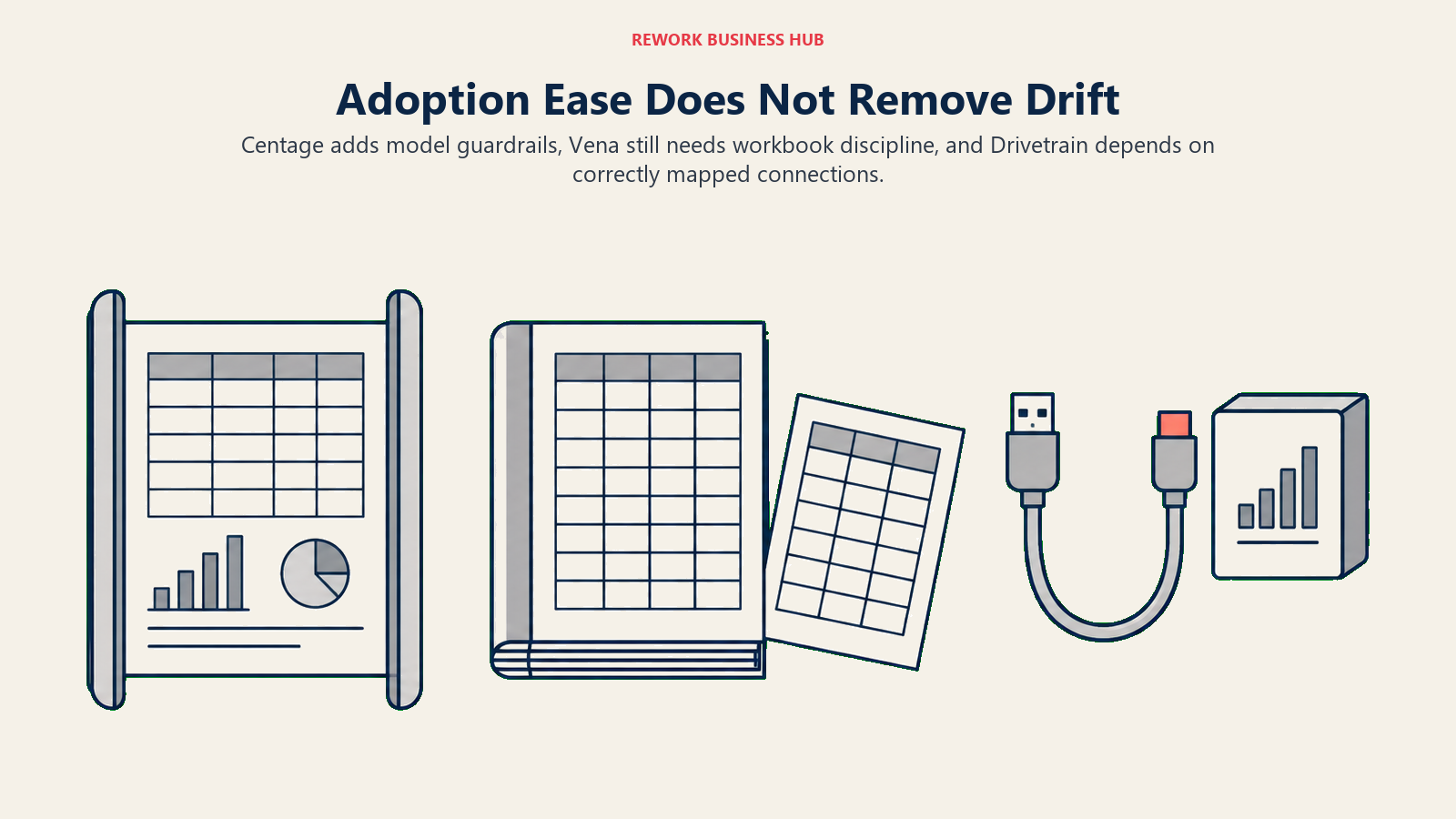
Centage and Drivetrain both take the harder road on purpose. Neither is a spreadsheet with governance wrapped around it; the model of record lives inside the vendor's own application, so there's no local tab to fork. That's real protection against the failure mode the AFP data describes, but it costs a genuine change-management project: a new interface to learn, and for Drivetrain, a new set of connected systems to keep wired correctly. The honest framing isn't which platform is better, it's which failure mode your finance team tolerates less: the slow, familiar drift back to spreadsheet chaos, or the sharper, one-time cost of learning something new that then holds its shape.
| Centage | Vena Solutions | Drivetrain | |
|---|---|---|---|
| Adoption ease | Moderate: a new interface, but scoped for a 2 to 10 person team | Easiest: the interface is the Excel your team already knows | Moderate to hard: a new interface, plus wiring in CRM and operational systems |
| What keeps the model from drifting | The model itself isn't a spreadsheet, so there's no local tab to quietly fork | A governed database sits underneath, but the surface is still a workbook a user can export and edit offline | AI agents trace every number to its source, but the model still depends on connectors staying correctly mapped |
| Where drift actually happens | Rare once live, since Excel isn't the day-to-day interface | A downloaded, edited, emailed copy of the workbook is one click away, however governed the database underneath is | A disconnected or mis-mapped integration quietly goes stale until someone notices during close |
| Who this genuinely suits | A lean finance team that wants guardrails, not a blank canvas | A finance team that will not tolerate learning a new interface, whatever the governance trade-off costs | A growth-stage team whose plan has to include pipeline, headcount and usage data, not just the GL |
Decision by Business Goal
| Your actual goal | Pick | Why |
|---|---|---|
| Keep the model inside the Excel your team already knows, with real governance behind it | Vena Solutions | CubeFLEX sits underneath a literal Excel interface; nobody has to learn a new UI |
| Get a pre-built driver-based model with the balance sheet and cash flow already wired to the P&L | Centage | The model ships structured, not something built from a blank canvas |
| Plan against pipeline, usage or CRM data alongside the general ledger, not just the GL | Drivetrain | 800+ connectors span ERP, CRM, HRIS and billing natively, the widest data net of the three |
| Remove the single point of failure where one spreadsheet owner holds all the modeling knowledge | Centage | Explicitly built to solve that named risk, per the vendor's own positioning |
| Stay inside the Microsoft ecosystem: Power BI, Teams, Dynamics 365, and now Fabric | Vena Solutions | Native ties deepened further with the Acterys acquisition, completed March 26, 2026 |
| Get a real, published dollar figure before the first sales call | Centage | The only one of the three with named monthly tiers and dollar figures on its own site |
| Trust AI-generated numbers because you can see exactly where they came from | Drivetrain | Built around explaining every formula and tracing every number to its source, not a black-box output |
| Extend planning into operational apps beyond finance, not just reporting on them | Vena Solutions | Acterys adds Power BI write-back and app development, reaching into IT and business-stakeholder workflows |
Whichever goal is driving the search, none of it holds up without someone accountable for the forecast afterward. A documented forecast governance framework matters more to whether any of these three actually sticks than any row in this comparison.
Team and Role Fit
| Team | Centage | Vena Solutions | Drivetrain |
|---|---|---|---|
| FP&A / Finance | Builds inside Centage's own driver-based interface, with the model already structured | Builds and maintains templates inside Excel, governed by CubeFLEX underneath | Builds inside Drivetrain's own interface, with AI agents drafting first-pass scenarios and reconciliations |
| Controller / Accounting | Payroll and ERP data flow in through named connectors (QuickBooks, NetSuite, Sage Intacct, ADP, UKG) | ERP and accounting sources wired in during the implementation's data-alignment phase | ERP and billing connectors sync actuals automatically across 800+ systems |
| RevOps / Sales | Not a named use case | Not a named use case | A named buyer persona; pipeline and CRM data feed the model directly |
| IT / Systems | Not required, per the vendor's own "no IT" implementation claim | Involved for Power BI and Fabric-level configuration, especially post-Acterys | Not required for onboarding; Drivetrain's own team runs it directly |
| Executive / Board | A working, pre-structured model fast, suited to a lean finance function without a dedicated systems owner | Familiar Excel output for board packages, backed by a governed database instead of email attachments | Traceable, explainable AI output, suited to a board wary of black-box forecasting |
Pricing at Real Team Sizes
Here's what a lot of shortlist roundups fudge: only one of these three will hand you a number to plan a budget around. Centage's pricing page names three tiers with real dollar figures, Core at $1,750 a month, Strategic at $2,500, and Performance at $3,500, all billed annually, plus discounted pricing on request for qualifying nonprofits. Vena and Drivetrain both stay quote-only. Vena names two tiers, Professional and Complete, with the more capable tier adding Vena Insights, Premium Support, a Sandbox Environment and Expert Managed Services, several marked "available at an additional cost" even inside Professional. Drivetrain doesn't name tiers at all; its own FAQ states pricing "depends on the systems you integrate and the features you need."
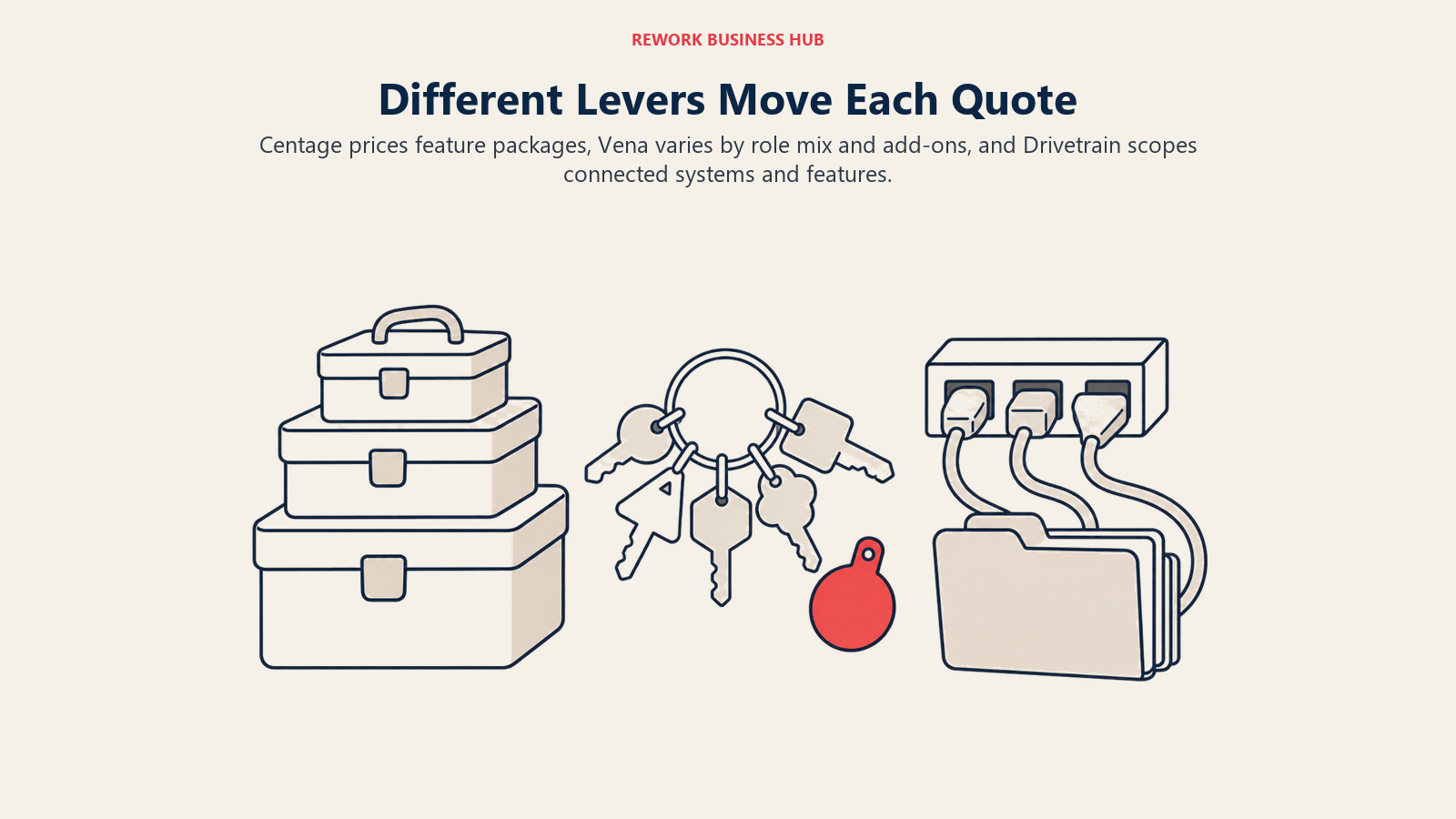
What differs most between Vena and Drivetrain is what actually moves the number. Vena's cost scales with named license roles (Power User, Contributor, View Only) plus which add-ons your team uses, not raw headcount. Drivetrain's own language points the other way: cost tracks the number of connected systems and features in scope, which correlates with headcount but isn't the same lever. That means the vendor whose price grows fastest as your company scales isn't necessarily the one with the biggest headcount number attached to its ICP.
| What to ask about | Centage | Vena Solutions | Drivetrain |
|---|---|---|---|
| Published price | Yes: Core $1,750/mo, Strategic $2,500/mo, Performance $3,500/mo, billed annually | None; Professional and Complete tiers, no figures | None; scoped to systems integrated and features used |
| What actually sets the cost | A named feature package (security depth, workflow, AI Assistant) | License role mix (Power User, Contributor, Viewer) plus add-ons | Number of connected systems (ERP, CRM, HRIS, billing) and features in scope |
| Vendor-stated typical spend | $18,000 to $40,000/year for mid-market customers | Not published | Not published |
| Reported benchmark (Vendr) | Not needed; real figures are published | Median $34,285/year, range $9,343 to $73,500, 34 tracked purchases, average 21.82% discount | Median $26,390/year, range $18,000 to $36,500 |
| Revenue or headcount ceiling stated by the vendor | $25M-$500M revenue, 2 to 10 person finance team | Not stated | Not stated |
| Implementation cost | Not stated as included | A separate engagement, run by Professional Services or a certified partner | Included in the price, per the vendor's own FAQ: "no surprise setup fees" |
Since seats and connected systems drive cost more than a flat per-user rate, a more useful exercise is estimating what each platform runs at a real company size, rather than repeating a headline figure that doesn't exist for two of the three. The table below builds a directional estimate from Centage's published tier logic and Vendr's reported ranges for Vena and Drivetrain. Treat the Vena and Drivetrain figures as planning anchors, not quotes, and get the real number in writing.
| Company size | Centage (estimated) | Vena Solutions (estimated, anchored to Vendr) | Drivetrain (estimated, anchored to Vendr) |
|---|---|---|---|
| Roughly 50 employees | Core or Strategic tier, if revenue clears the $25M floor: roughly $21,000 to $30,000/year | A lean Power User count on Professional: toward Vendr's low end, roughly $10,000 to $20,000/year (reported) | A handful of core systems connected (one ERP, one CRM, one HRIS): toward Vendr's low end, roughly $18,000 to $24,000/year (reported) |
| Roughly 250 employees | Strategic or Performance tier, finance team nearing Centage's 10-person ceiling: roughly $30,000 to $42,000/year | More Contributor licenses, likely stepping up to Complete: mid-range, roughly $30,000 to $45,000/year (reported) | More connected systems (billing, expanded CRM, HRIS): mid-to-upper range, roughly $26,000 to $36,000/year (reported) |
| Roughly 1,000 employees | Likely past Centage's own stated ceiling entirely, revenue and finance-team size both, price aside | Broad Contributor rollout, Complete tier plus add-ons: upper Vendr range and beyond, roughly $55,000 to $75,000+/year (reported) | Many more connected systems across entities: above Vendr's tracked ceiling, likely $40,000+ and climbing with system count |
That last row is the flip worth sitting with. A 1,000-employee company shopping this shortlist on price alone would miss the bigger fact: Centage's own stated fit tops out at $500M in revenue and a 10-person finance team, so the real question at that size isn't what Centage costs, it's whether Centage is still the right category of tool at all.
Implementation and Change Management
This is the part that actually determines whether any of the three sticks, starting with a question the pricing pages never ask: what data has to connect before the first model means anything. Centage's named connectors (QuickBooks, NetSuite, Sage Intacct, ADP, UKG) are ERP and payroll, not CRM; the platform answers "what will we spend and earn," not "what's in the pipeline." Vena wires in ERP and accounting sources through a named data-alignment phase, with native Dynamics 365 support, but CRM isn't named there either. Drivetrain is the outlier by design: its 800+ connectors explicitly include CRM systems like Salesforce and HubSpot alongside ERP, HRIS and billing, the only one built to plan against pipeline data as a first-class input, not a manual export.
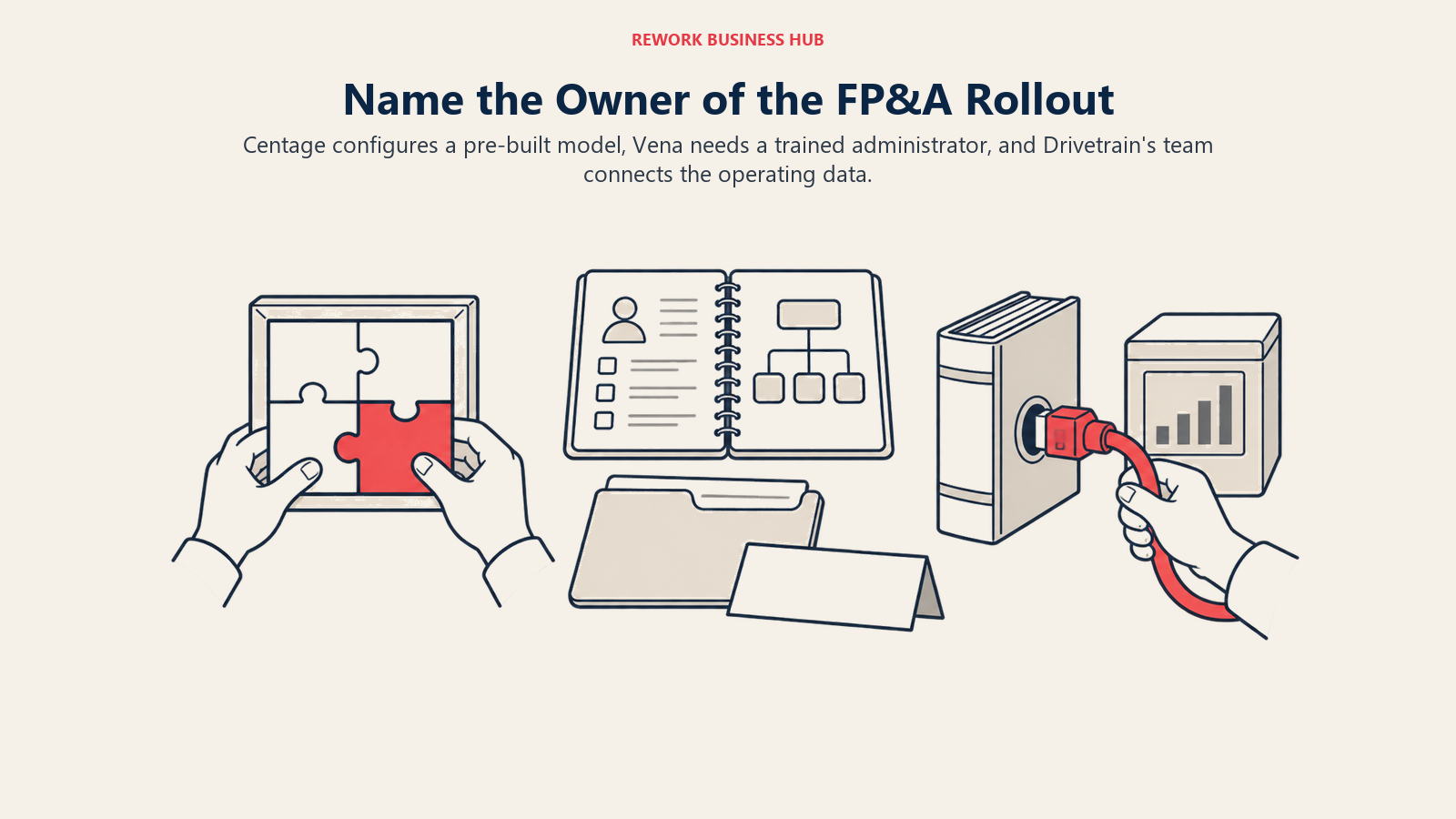
The build itself differs too. Centage's model arrives pre-structured, so the work is largely configuration against your chart of accounts; the vendor claims 4 to 6 weeks with no IT required, compressing a typical 6-week spreadsheet cycle to 2. Vena's rollout runs five named phases (Initial Alignment, Product Training, Data Alignment, Workshops and Design, then Testing and Signoff) and its own guide claims "as little as six to eight weeks" with best practices in place, a figure worth stress-testing: G2 reviewers report considerably longer real outcomes, including one implementation "not finished after 8 months" and an enterprise team that "decided to stop the process" after nine. Drivetrain states most implementations complete in 4 to 6 weeks, extending with model complexity and system count.
Ownership afterward differs just as much. Centage's stated buyer is the internal 2 to 10 person finance team itself, backed by onshore FP&A support rather than a third-party integrator. Vena recommends training a named administrator who gives 1 to 1.5 days a week during rollout and owns the templates afterward, with Professional Services or a partner running the build; the vendor's own guidance calls going it alone "not recommended" outside the simplest project. Drivetrain's own team runs onboarding directly, and its stated buyer roles, Head of Finance or RevOps, typically own the live model once it's built.
| Implementation factor | Centage | Vena Solutions | Drivetrain |
|---|---|---|---|
| Published time-to-value claim | "Implement in just 4-6 weeks" | "As little as six to eight weeks," with best practices in place | "Most implementations are completed in 4-6 weeks" |
| Reported real-world range | No independent contradiction found | G2 reviewers report far longer in practice: one implementation "not finished after 8 months," another stopped after nine | Vendor states complexity and system count extend the timeline; no independent contradiction found |
| Who typically runs it | Centage's own onshore FP&A support team; the vendor states no IT is required | Self-run (not recommended), Vena's Professional Services team, or a certified consulting partner | Drivetrain's own team, directly, per the vendor's FAQ; no outside consultants named |
| Internal time commitment | Not published | 1 to 1.5 days a week from a named Vena administrator, per the vendor's own guide | Not published |
| ERP/CRM connections | QuickBooks, NetSuite, Sage Intacct, ADP, UKG; ERP and payroll only, no CRM named | ERP and accounting sources during the data-alignment phase; native Dynamics 365; no CRM named | 800+ connectors spanning ERP, CRM (Salesforce, HubSpot named), HRIS and billing |
| Who owns the model after go-live | The internal 2 to 10 person finance team, Centage's stated buyer profile | A trained internal Vena administrator, with Professional Services or a partner available afterward | A Head of Finance or RevOps owner, per the vendor's stated buyer roles |
| Implementation cost | Not stated as included or separate | Priced separately from the license | Included in the price, per the vendor's own FAQ: no separate setup fee |
Risk and Governance
| Governance factor | Centage | Vena Solutions | Drivetrain |
|---|---|---|---|
| Security posture | MFA, SSO and audit trail, gated to the top Performance tier | Inherits Microsoft-ecosystem security through Power BI, Teams and Dynamics 365 integration | SOC 2, SOC 1, ISO 27001 and GDPR, plus a stated "zero AI training on your data" commitment |
| Key-person risk | Designed against it; the vendor names "one person holds all the knowledge" as the problem it solves | Real: a workbook, however governed underneath, is still something a power user can export and edit offline | Lower on model logic (agents trace numbers to source), real on the integration layer if the connector owner leaves |
| Vendor lock-in | Moderate; model logic lives inside Centage's own structure | Low to moderate; the workbook stays portable even if the database underneath isn't | Moderate; the connected-data architecture is Drivetrain-specific |
| AI data governance | AI Assistant, gated to the Performance tier only | Vena Copilot from the Professional tier; Acterys adds write-back into Power BI and Fabric | Every formula traced to source, with an explicit no-training commitment |
| What breaks first if this goes wrong | A finance team outgrows the $25M-$500M band or the 10-person ceiling | A user forks a local copy of the workbook and the single source of truth stops being single | A disconnected or mis-mapped integration goes stale until someone notices at close |
When Centage Is the Right Call
- Your finance team is small, roughly 2 to 10 people, and your company sits inside Centage's stated $25M to $500M revenue band.
- You want the balance sheet and cash flow already wired to the P&L, not a model you have to construct from a blank canvas.
- You want a real, published price before the first sales call, the only one of these three that offers one.
- Key-person risk is your actual worry: one spreadsheet owner holding all the modeling knowledge in their head.
- Your data sources are payroll and ERP (QuickBooks, NetSuite, Sage Intacct, ADP, UKG); you don't need CRM or pipeline data inside the model itself.
If Centage's revenue ceiling is already in sight, the best budgeting and forecasting software guide covers the wider mid-market field before you commit.
When Vena Solutions Is the Right Call
- Excel is where your team's real modeling literacy already lives, and retraining everyone on a new interface is the actual risk you're trying to avoid.
- You're already, or plan to be, deep in the Microsoft ecosystem: Power BI, Teams, Dynamics 365, and now Microsoft Fabric via the Acterys acquisition.
- You want the most established of the three, with real third-party pricing signal to negotiate against, even though the list price stays opaque.
- You're prepared to name an internal administrator and give them 1 to 1.5 days a week through the rollout, and you've budgeted for the real chance it runs longer than six to eight weeks.
- Planning needs to extend beyond finance into operational apps and dashboards other departments already view in Power BI.
If Vena's Excel dependency turns out to be the actual objection, not the vendor itself, Vena vs Datarails works through the other major Excel-native option head to head, and the best Vena alternatives roundup covers the wider field.
When Drivetrain Is the Right Call
- Your plan has to include pipeline, usage or headcount data alongside the general ledger, not just the ledger alone.
- You're a growth-stage, often subscription or usage-based company that has outgrown spreadsheets and wants AI to build the first draft, not just report on it after.
- You want implementation cost folded into the license price with no separate setup fee, in writing, rather than an integrator's bill layered on top.
- Trusting AI-generated forecasts matters enough that tracing every number to its source is a real requirement, not a nice-to-have.
- You'd rather run a guided proof-of-concept on your own data than sit through a generic demo, since there's no self-serve trial to test it yourself.
If Drivetrain's connector-driven pricing still feels like too much uncertainty to commit to without a wider comparison, the best FP&A software roundup sizes it against 14 other platforms built for a similar stage.
Decision Framework
| If this is true for you | Pick |
|---|---|
| Your team is 2 to 10 people and your company sits inside $25M to $500M in revenue | Centage |
| Excel is non-negotiable as the day-to-day interface | Vena Solutions |
| Your plan needs CRM, pipeline or usage data alongside the GL | Drivetrain |
| You want a real number before the first sales call | Centage |
| You're deep in the Microsoft ecosystem: Power BI, Teams, Dynamics 365, Fabric | Vena Solutions |
| You want AI to draft the first model, with every formula traceable to its source | Drivetrain |
| Your company is past 1,000 employees or Centage's stated revenue ceiling | See Vena Solutions or Drivetrain, or a heavier platform via the best FP&A software roundup |
| Key-person risk on one spreadsheet owner is your main fear | Centage |
| None of the three fit because sales, supply chain or workforce also need to plan on one shared system | See Anaplan vs Abacum vs Limelight or Cube vs Workday Adaptive Planning for a heavier class of platform |
What to Do Next
- Name your actual constraint before any demo. Is it "we can't leave Excel," "we need the model pre-structured because nobody in-house wants to build one," or "the plan has to include CRM and usage data, not just the GL"? Each answer eliminates one of these three for most buyers.
- If Centage is live, check your revenue against its stated $25M to $500M band and your finance team size against its 2 to 10 person ceiling before the first call. Price won't matter if you're already outside the fit.
- If Vena is live, get the Professional versus Complete feature breakdown in writing, and budget 1 to 1.5 days a week from a named administrator against the vendor's six-to-eight-week claim, not the eight-to-nine-month outcomes some G2 reviewers report.
- If Drivetrain is live, get the exact list of "systems integrated" that drives your quote in writing, and confirm the 4-to-6-week timeline against your own system count.
- Sanity-check whatever number comes back against Vendr's reported ranges (roughly $9,300 to $73,500 a year for Vena, $18,000 to $36,500 for Drivetrain). If none of the three fits, the best FP&A software roundup and Prophix vs Datarails vs Planful cover adjacent mid-market platforms worth a look first.
Frequently Asked Questions about Centage vs Vena Solutions vs Drivetrain
Does Centage publish pricing?
Yes, the only one of the three. Core runs $1,750 a month, Strategic $2,500, and Performance $3,500, all billed annually, per Centage's own pricing page. The vendor states mid-market customers typically spend $18,000 to $40,000 a year, with a stated fit of $25M to $500M in revenue and a 2 to 10 person finance team.
Does Vena Solutions publish pricing?
No. Vena names two tiers, Professional and Complete, with no dollar figures on its site. Vendr, a SaaS pricing intelligence firm, tracks a median annual contract of $34,285 across 34 purchases, ranging from $9,343 to $73,500, with buyers averaging a 21.82% discount off the initial quote.
Does Drivetrain publish pricing?
No. Drivetrain's own FAQ states pricing "depends on the systems you integrate and the features you need," with a custom proposal for every buyer. Vendr reports a median annual contract of $26,390, ranging from $18,000 to $36,500.
Which of the three is fastest to a first working budget?
All three claim a similar range on paper, roughly 4 to 8 weeks, but the gap shows up in reported outcomes, not claims. Centage and Drivetrain both state 4 to 6 weeks. Vena states 6 to 8 weeks is achievable with best practices in place, but G2 reviewers report real implementations running far longer, including one described as not finished after 8 months and another enterprise team that stopped after nine.
Which one connects to CRM data, not just the ERP?
Drivetrain. Its 800+ connectors explicitly include CRM systems like Salesforce and HubSpot alongside ERP, HRIS and billing, so pipeline data can sit inside the model itself. Centage's named connectors (QuickBooks, NetSuite, Sage Intacct, ADP, UKG) are ERP and payroll only, and CRM isn't a named integration category on Vena's site either.
What's the real difference between these three platforms?
What each one does about the spreadsheet. Vena keeps Excel as the literal interface and puts a governed database, CubeFLEX, underneath it. Centage replaces the spreadsheet with a pre-structured, driver-based model with the balance sheet and cash flow already wired to the P&L. Drivetrain replaces it with an AI-native model built to pull in CRM and usage data alongside the general ledger.
Is a 1,000-employee company too big for any of these three?
Centage most likely, yes. Its own stated ceiling is $25M to $500M in revenue and a 2 to 10 person finance team, and a 1,000-employee company has usually outgrown both regardless of budget. Vena and Drivetrain scale further, though cost climbs with license count and connected-system count respectively, so get a written quote before assuming either is the cheaper option.
Who owns the model after implementation is done?
Centage's stated buyer is a 2 to 10 person internal finance team backed by the vendor's own onshore support. Vena recommends training a named internal administrator who dedicates 1 to 1.5 days a week during rollout and owns the templates afterward. Drivetrain's own team runs onboarding directly, and its stated buyer roles, Head of Finance or RevOps, typically own the live model once it's built.
Does either Vena or Drivetrain offer a free trial?
No. Neither publishes a self-serve free trial; Drivetrain offers guided demos and proof-of-concept engagements instead, and Vena's pricing page doesn't mention a trial option. Centage doesn't publish one either, though its published pricing at least lets a buyer estimate cost before any conversation happens.

Principal Product Marketing Strategist
On this page
- TL;DR
- Key Facts
- What Each Tool Is Actually Built For
- The Trade-Off No Vendor Puts on Its Homepage
- Decision by Business Goal
- Team and Role Fit
- Pricing at Real Team Sizes
- Implementation and Change Management
- Risk and Governance
- When Centage Is the Right Call
- When Vena Solutions Is the Right Call
- When Drivetrain Is the Right Call
- Decision Framework
- What to Do Next