Anaplan vs Abacum vs Limelight: Which FP&A Platform Actually Fits Your Team in 2026?
Turn this article into takeaways for your work.


Each assistant summarizes the article only for you and suggests best practices for your work.
These three tools rarely lose a deal to each other head to head. They lose to the wrong shortlist: a 60-person finance team that ends up on an Anaplan demo built for a company ten times its size, or a 2,000-employee organization that shortlists Limelight and finds out two calls in that it needed cross-functional modeling all along. Anaplan, Abacum, and Limelight span the widest capability range you'll find in one FP&A comparison, and that range is the whole story here.
This isn't a feature-by-feature scorecard. It's a sizing exercise, and the question underneath it is the one most shortlists skip: how many people outside finance will ever actually build in this tool, do you have anyone who could own that build today, and what happens in year two when that person leaves. Modeling depth is easy to demo. Key-person risk is the cost nobody prices until the model breaks and the one person who understood it already quit.
TL;DR
| Anaplan | Abacum | Limelight | |
|---|---|---|---|
| What it actually is | A connected-planning platform where finance, sales, supply chain, and HR build on one calculation engine | An AI-native FP&A platform built for collaborative planning between finance and the business | A finance-first CPM platform built around driver-based budgeting and deep ERP connectors |
| Organizational reach | Cross-functional by design, multiple departments on one model | Finance-anchored, built to pull non-finance stakeholders into the numbers | Finance-anchored, not positioned as cross-functional |
| Who typically builds it | A certified Model Builder, often with a systems integrator | A Head of FP&A or finance systems owner, no vendor certification required | An FP&A Manager or Controller, guided by Limelight's own implementation team |
| Ownership status | Private, owned by Thoma Bravo since a 2022 take-private deal | Venture-backed, $60 million Series B in June 2025 | Small, independent team of roughly 50 people |
| Published pricing | None. anaplan.com/pricing resolves to a contact form | None. abacum.ai/pricing is a "Book a Demo" page only | No dollar figures on golimelight.com/pricing, but Limelight's own buying guide lists itself starting at $1,400/month |
| Reported median annual contract | $114,608, per Vendr (reported) | $36,875, per Vendr (reported) | Not tracked separately by Vendr |
| Self-serve trial | Not offered | Not offered; demo or interactive product tour only | "Try for free" link on the product site |
| Best-fit company size | Roughly 500 to 10,000-plus employees, multi-department | Roughly 50 to 800 employees, finance-led with business-partner reach | Roughly 20 to 500 employees, finance-only |
Key Facts
- Anaplan was taken private in a $10.7 billion Thoma Bravo acquisition announced March 20, 2022, and now operates outside public markets (Thoma Bravo press release), with workforce-data tracker Revelio Labs estimating roughly 2,700 employees as of early 2026 (reported, Revelio Labs).
- None of the three publish a rate card. Anaplan's pricing page routes to a contact form, Abacum's routes to a demo booking, and Limelight's dedicated pricing page names two tiers, Starter and Unlimited, with no dollar figures on either (anaplan.com/pricing, abacum.ai/pricing, golimelight.com/pricing).
- Vendr, a SaaS pricing intelligence firm, reports Anaplan's median annual contract at $114,608 across 67 tracked purchases, ranging from $30,590 to $301,931 (reported, vendr.com/marketplace/anaplan), and Abacum's median at $36,875, ranging from $24,610 to $110,728 (reported, vendr.com/marketplace/abacum).
- Abacum raised a $60 million Series B in June 2025, led by Scale Venture Partners with Cathay Innovation joining existing investors Y Combinator, Creandum, Kfund, and Atomico, bringing total funding to roughly $92 million across four rounds (reported, Tracxn). Abacum's own announcement states the company "tripled its revenue" over the prior 12 months and now serves customers across 31 countries (abacum.ai newsroom).
- 96% of FP&A professionals still use spreadsheets for planning at least weekly, even at organizations already running dedicated planning software, per the AFP's 2025 FP&A Benchmarking Survey of 362 practitioners (AFP).
- Limelight's own company page dates its FP&A product launch to 2017, out of a Toronto office, with a team it describes as "50 dedicated team members" and more than 100 clients (golimelight.com/company).
What Each Tool Is Actually Built For
Start with what each vendor is actually optimizing for, because it explains almost every other row in this comparison.
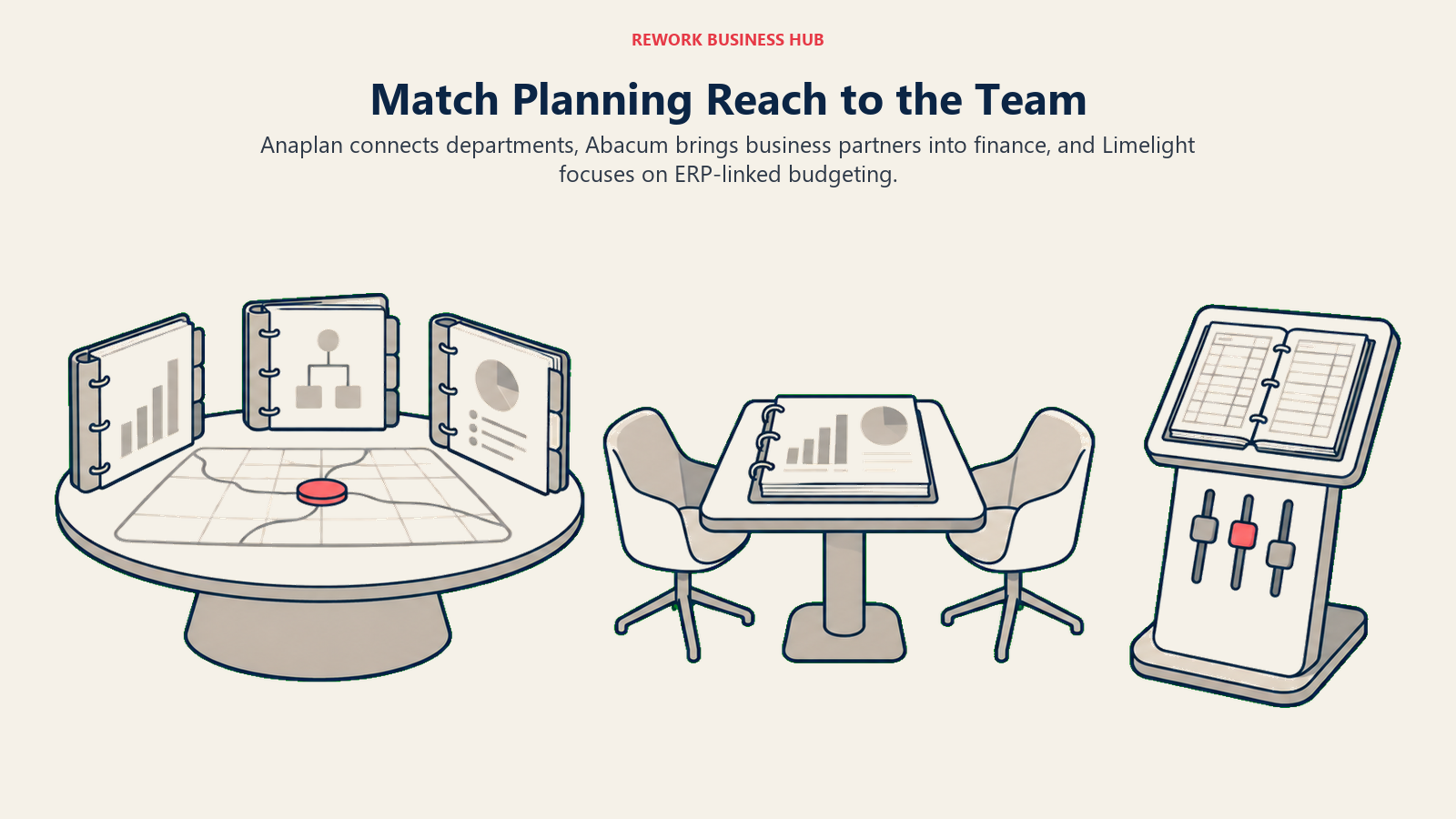
Anaplan runs on Hyperblock, an in-memory calculation engine with two architectures underneath it: Classic and Polaris, generally available since 2023 and engineered, per Anaplan's own platform page, to "process quintillions of cells, and over 100 million data points in just over a second." That ceiling is what lets finance, sales, and supply chain build genuinely interconnected models on one engine instead of exporting summaries between systems. Anaplan sells this as an "AI Intelligence Layer" combining predictive, generative, and agentic AI across that connected data, positioned around what the company calls the "Agentic Enterprise." It's the only one of the three with named applications for sales and supply chain planning, not just finance and workforce.
Abacum's pitch is narrower and more specific: the modeling engine was never the bottleneck, getting business partners outside finance to actually engage with the plan was. Its own site names six AI capabilities built into the platform, AI Backsolving, AI Data Cleaning, AI Data Classification, AI Anomaly Detection, AI Modelling, and AI Scenario Planning, plus more than 700 integrations and a self-service ETL layer so a finance team can wire up the GL, HRIS, and CRM without a technical project. Abacum's own marketing claims "10x faster reporting," "10x faster forecasting," and "8 less days to close," and cites a RapidSOS customer result of cutting headcount needs three-fold while accelerating its reporting cycle by 73%, alongside a Kajabi customer claiming 80% of finance time now goes to strategic planning instead of data wrangling (vendor-published customer claims, abacum.ai).
Limelight's story is the most finance-anchored of the three: driver-based budgeting and forecasting layered over deep ERP connectivity, more than 800 pre-built connectors including Sage Intacct, Oracle NetSuite, Microsoft Dynamics, QuickBooks Online, and SAP, per its own site. Its own claims include "Budget 3x Faster," a stated industry observation that "finance teams spend an average of 60% of their time wrestling with data," and named customer outcomes of 8% revenue growth, 40% productivity gains, and forecast accuracy above 90% (vendor-published, golimelight.com). One customer case study on the same page claims budget preparation dropped from four months to under 30 days. Named customers include Cresa, MedVet, Chicago Public Media, and EA.
| Anaplan | Abacum | Limelight | |
|---|---|---|---|
| Calculation engine | Hyperblock, two architectures: Classic and Polaris (GA 2023) | Not marketed around a named engine; positioned around live data connections | Not marketed around a named engine; positioned around driver-based logic |
| Departments modeled | Finance, sales, supply chain, workforce, all on one platform | Finance-led, with business-partner participation as the design goal | Finance-led; workforce planning is a named module, not a separate department application |
| Named AI capabilities | "AI Intelligence Layer": predictive, generative, agentic AI across connected data | AI Backsolving, Data Cleaning, Data Classification, Anomaly Detection, Modelling, Scenario Planning | Limelight AI: trend, variance, and anomaly detection with automated insights |
| Integration depth | Connects to any ERP, GL, HRIS, or CRM via integration | 700+ integrations, self-service ETL, Excel connector | 800+ pre-built connectors, named strength in Sage Intacct and NetSuite |
| Consolidation | Named Financial Consolidation application, finance-owned | Not a named standalone product | Not a named standalone product |
If your project turns out to be more about the ERP and general ledger underneath the plan than the planning layer itself, the best NetSuite alternatives and best Sage Intacct alternatives guides are worth a look before you commit to a planning tool at all.
Who Actually Builds and Owns the Model
This is the question that should eliminate at least one of these three before you ever see a demo, and it's the one most comparison pages skip in favor of feature rows.
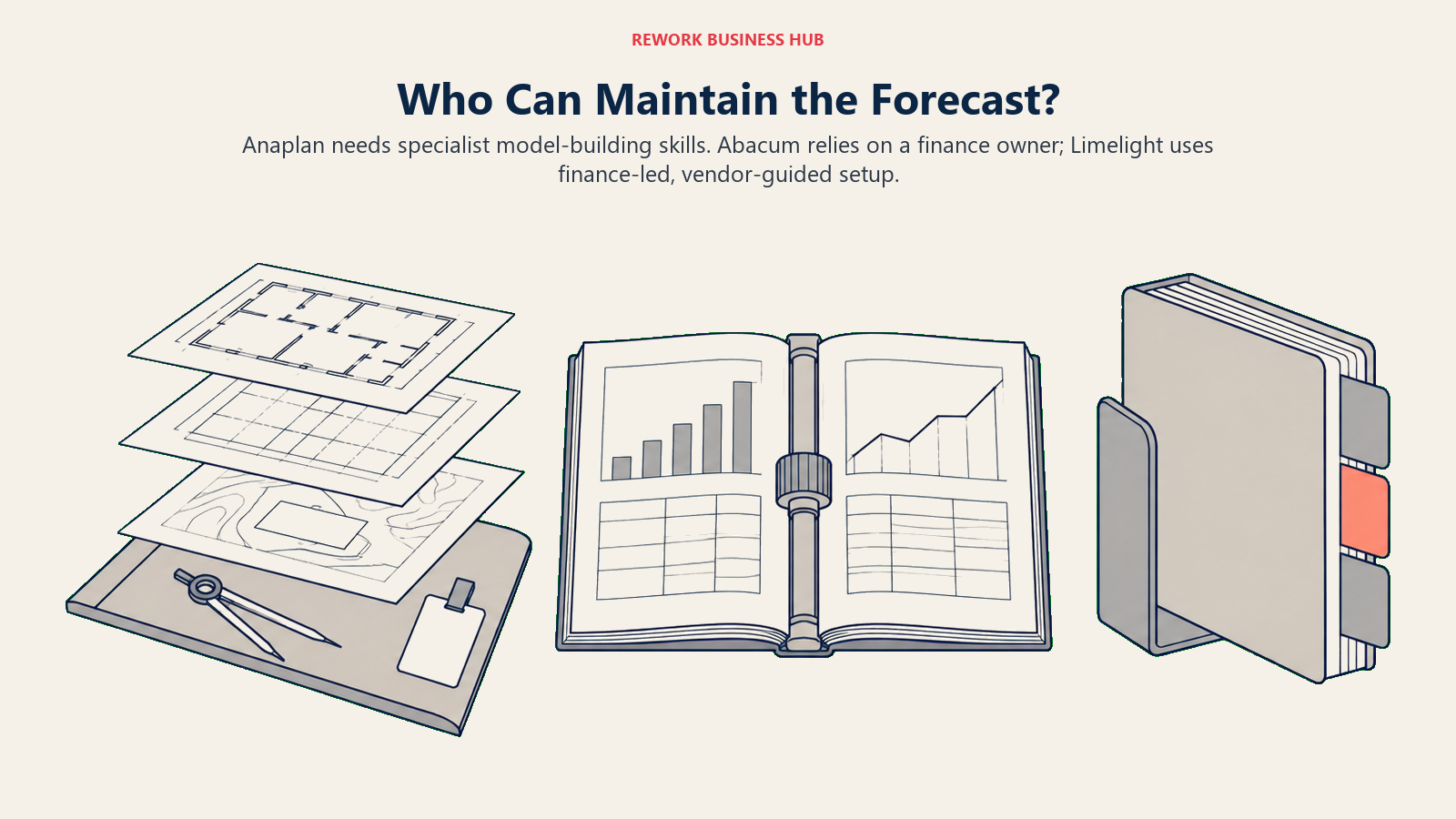
Anaplan licenses people by what they're allowed to do inside a model, not just whether they can see it: a Model Builder license for people who construct and maintain models, a Contributor license for people entering numbers inside a model someone else built, and a Viewer license for read-only access, per Anaplan's own community documentation. Anaplan Academy runs a structured, three-tier certification path on top of that: Certified Model Builder, then Certified Solution Architect, then Certified Master Anaplanner. That's a real, ongoing skills market, which cuts two ways. You can hire into it or contract a certified partner, but the moment your one or two trained Model Builders leave, the model itself doesn't get simpler, it just becomes unmaintained.
Abacum was designed around the opposite failure mode. Its live connections to the GL, HRIS, and CRM mean department heads see and interact with numbers without learning Anaplan-style modeling concepts to participate, and there's no equivalent certification market for Abacum specifically, no named credential, no partner-certification ladder. The tradeoff is that Abacum is younger and smaller than Anaplan, so if your finance systems owner leaves, you're rehiring for general FP&A and platform familiarity rather than a named, hireable specialty. That's a lower bar to clear, not a zero-risk one.
Limelight sits closest to a spreadsheet mental model on purpose: budget templates that look like a spreadsheet, backed by real drivers, headcount, unit costs, revenue assumptions, that recalculate automatically. There's no certification ecosystem here either, and Limelight's own two implementation packages, Ready-to-Go and Ready-to-Go Plus, suggest the vendor's own team does more of the initial configuration work than a self-serve rollout would. That lowers key-person risk on the build itself, but it introduces a different dependency: a 50-person vendor has a thinner bench to lean on later than a category incumbent does if your Limelight admin leaves and you need outside help fast.
| Ownership factor | Anaplan | Abacum | Limelight |
|---|---|---|---|
| Typical model owner | A certified Model Builder, often supported by a systems integrator | A Head of FP&A or finance systems owner | An FP&A Manager or Controller |
| Named certification path | Yes: Model Builder, Solution Architect, Master Anaplanner (Anaplan Academy) | No public certification path | No public certification path |
| Skill required to extend the model | Real technical discipline; closer to a modeling craft than spreadsheet skill | Configuration and integration fluency, not a modeling specialty | Advanced Excel-adjacent driver logic |
| What happens if the builder leaves | Real risk; a mature practice budgets for ongoing certified training as a line item | Lower risk; rehire for general FP&A skill, not a named credential | Lower build risk, but a smaller vendor bench to lean on for outside help |
| Non-finance participation | Requires Contributor or Viewer access, still inside Anaplan's structure | Designed for department heads to engage without training | Not built around non-finance participation |
Whichever one you pick, none of it holds up without someone actually accountable for the forecast afterward. A documented forecast governance framework matters more to whether the model survives a personnel change than any feature in this comparison.
Decision by Business Goal
| Your actual goal | Pick | Why |
|---|---|---|
| Finance, sales, and supply chain need to plan against the same connected numbers | Anaplan | The only one of the three with named cross-functional planning applications on one engine |
| Business partners outside finance should engage with the plan without learning a modeling tool | Abacum | Built specifically to pull GL, HRIS, and CRM data in front of non-finance stakeholders |
| Planning needs to sit close to your ERP with minimal specialist overhead | Limelight | 800+ connectors and a driver-based, spreadsheet-adjacent interface |
| Lowest key-person risk if your one FP&A hire leaves next year | Abacum or Limelight | Neither runs a named certification market; Anaplan's does, and that's the point |
| You want to try the product before talking to sales | Limelight | The only one of the three with a self-serve "Try for free" option |
| Statutory close and consolidation should live on the same platform as planning | Anaplan | The only one with a named, finance-owned Financial Consolidation application |
| Continuous, monthly reforecasting instead of a once-a-year static budget | Abacum | Purpose-built around collaborative, rolling forecast cycles |
| You need board confidence in a large, well-capitalized vendor over a younger or smaller one | Anaplan | Decades in the category, though now privately held under Thoma Bravo |
Team and Role Fit
| Team | Anaplan | Abacum | Limelight |
|---|---|---|---|
| FP&A / Finance | Builds and maintains the model, usually with Model Builder training | Owns setup and ongoing GL/HRIS/CRM connections | Builds budgets and forecasts in a driver-based, spreadsheet-style interface |
| Sales / Supply Chain | Full participants, modeling on the same engine finance uses | Not a named use case | Not a named use case |
| Business partners / dept heads | Contributor or Viewer access inside Anaplan's structure | Designed as primary participants, not just recipients | Views reports; not positioned as active modelers |
| Controller / Close | Named Financial Consolidation application | No named consolidation product | No named consolidation product |
| IT / Systems | Often involved for multi-department, Polaris-scale builds | Self-service ETL reduces IT dependency for most integrations | Vendor-guided implementation reduces internal IT lift |
| Executive / Board | Deep, auditable modeling a board expects from an established category leader | Fast, collaborative numbers for a growth-stage leadership team | Straightforward reporting for a lean finance function |
Pricing at Real Team Sizes
Here's the part every one of these vendor pricing pages avoids: none of the three will hand you a number to plan a budget around, and the honest move is to say so rather than reprint a rumor as a starting price.
Anaplan's page at anaplan.com/pricing resolves directly to a contact-sales form, with no editions, tiers, or figures anywhere on it. What Anaplan does document, even without dollar figures, is the pricing model: cost scales by named user and by which license tier that user holds. A team with five Model Builders and two hundred Viewers prices very differently than one with two hundred Contributors at the same headcount, so a "10 seats" or "25 seats" scenario means little without knowing the role mix. Vendr's tracked data gives the clearest outside signal: a median annual contract of $114,608 across 67 purchases, ranging from $30,590 at the low end to $301,931 at the high end (reported, not confirmed by Anaplan).
Abacum's page at abacum.ai/pricing is a "Book a Demo" page, full stop, no tier names, no ranges, no self-serve path at all. Vendr tracks Abacum separately from Anaplan with a median annual contract of $36,875, ranging from $24,610 to $110,728, roughly a third of Anaplan's median at the midpoint (reported). Abacum does not publicly disclose whether that quote scales primarily by seat count, module count, or data-source count, so the honest step before signing is asking the vendor directly which lever moves your number most.
Limelight is the one exception worth flagging. Its dedicated pricing page at golimelight.com/pricing names two tiers, Starter (capped at 5 users) and Unlimited (no user cap), with no dollar figures attached to either, and both tiers include the full feature set, budgeting, forecasting, workforce planning, reporting, and AI Insights, with no module gating. But Limelight's own FP&A software pricing guide, a separate content page on the same domain last updated June 23, 2026, states plainly: "Limelight: Starting at $1,400 per month." That figure doesn't appear on the actual pricing page, only in Limelight's own buying-guide content, so treat it as a directional starting point rather than a locked quote, and confirm it against your own conversation with sales.
| What to ask about | Anaplan | Abacum | Limelight |
|---|---|---|---|
| Published price | None; contact-sales form only | None; demo booking only | None on the pricing page; $1,400/month cited on Limelight's own buying guide |
| What sets the tier | Named-user role: Model Builder, Contributor, or Viewer | Not disclosed; likely seats, modules, or data sources by custom quote | User count up to 5 (Starter), then feature/support level (Unlimited) |
| Reported median (Vendr) | $114,608/year, range $30,590 to $301,931 (reported) | $36,875/year, range $24,610 to $110,728 (reported) | Not tracked separately by Vendr |
| Self-serve trial | Not offered | Not offered | "Try for free" link, duration not published |
| Implementation packages named | Not tiered by package on the pricing page | Not disclosed | Ready-to-Go and Ready-to-Go Plus, scoped by planning module coverage |
If any of these three come back over budget once you get a real quote, the best FP&A software roundup and the best budgeting and forecasting software guide both cover a wider field, including the rare vendors in this category that publish an actual number.
Implementation and Change Management
Implementation weight tracks almost exactly with the modeling ceiling each platform is built around, which is the whole point of putting these three in one comparison.
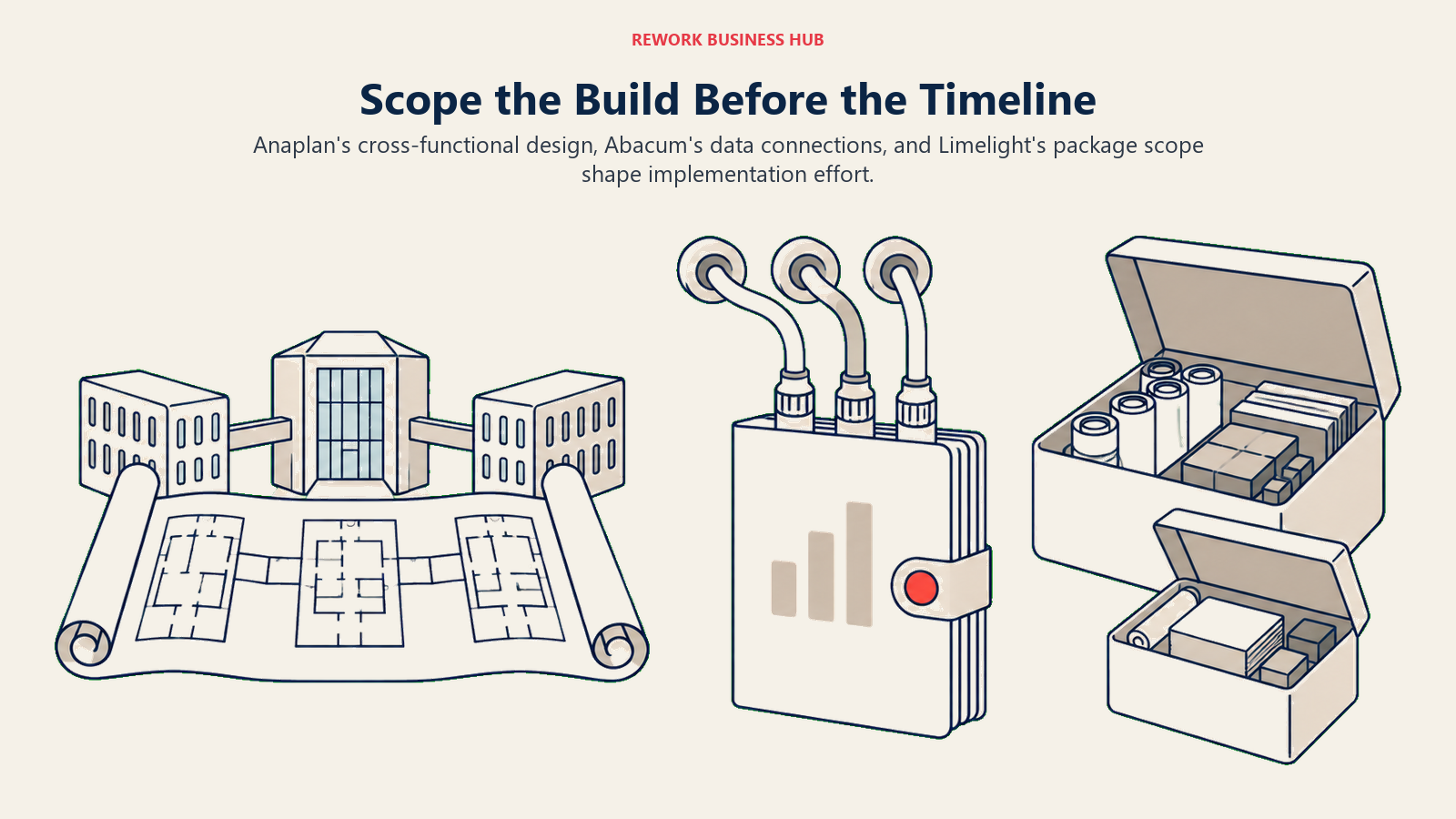
A single-department Anaplan build can move in weeks. A genuinely connected, multi-department build, the kind Anaplan is actually built for, is a bigger project that usually runs through a systems integrator or an Anaplan-certified partner, because the model architecture has to hold up across departments, not just inside one. Abacum's own site claims onboarding measured in weeks rather than months, backed by expert onboarding support included in the offering, and its self-service ETL is explicitly positioned to avoid a dedicated IT project for most data connections. Limelight's Ready-to-Go and Ready-to-Go Plus packages are pre-scoped implementation options, Ready-to-Go covers operating expenses, revenue planning, workforce planning, forecasting, and management reporting; Ready-to-Go Plus adds balance sheet and cash flow planning, advanced scenarios and drivers, and executive reporting, which suggests a guided, vendor-led setup rather than a pure self-serve rollout.
| Implementation factor | Anaplan | Abacum | Limelight |
|---|---|---|---|
| Partner typically required | Yes, for multi-department or Polaris-scale builds | Not required per vendor claims; expert onboarding included | Vendor-guided via named implementation packages |
| What drives the timeline | Number of departments and dimensionality designed in from day one | Number of data sources and modules in scope | Which implementation package (Ready-to-Go vs Plus) you choose |
| Who owns the build day to day | A trained Model Builder | A finance systems owner, supported by Abacum's onboarding team | An FP&A Manager or Controller, guided by Limelight's team |
| Evaluate before signing | Whether your build is single-department or genuinely cross-functional | Whether "weeks not months" reflects your actual integration count | Which Ready-to-Go tier your planning scope actually needs |
Risk and Governance
| Governance factor | Anaplan | Abacum | Limelight |
|---|---|---|---|
| Security certifications | SOC 1 & SOC 2 Type II (audited every six months), ISO 27001, 27017, 27018, 27701, and 42001 (trust.anaplan.com) | SOC 2 Type II and ISO 27001, per Abacum's own site | SOC 2 compliant, per Limelight's own company page |
| Vendor ownership | Private, owned by Thoma Bravo since a $10.7 billion take-private deal in 2022 | Venture-backed, most recently a $60 million Series B (June 2025) | Small independent team, roughly 50 people |
| Company scale signal | An estimated 2,700-plus employees | Headquartered in New York with offices in London and Barcelona; customers across 31 countries per its own newsroom | Toronto-based; more than 100 clients per its own site |
| Vendor lock-in | Model logic is Anaplan-specific and doesn't export cleanly to another platform | Live connections reduce data lock-in, but modeling logic still lives in Abacum | Driver logic is Limelight-specific, though the spreadsheet-style interface eases the mental shift elsewhere |
| Single point of failure | Real, if only one or two people hold Model Builder-level skill | Lower; no certification market to lose access to | Lower on the build, but less vendor bench to escalate to if you outgrow internal knowledge |
The honest read on vendor scale: Anaplan's private-equity ownership means less public financial visibility than its pre-2022 public-company years, but the balance sheet behind a $10.7 billion buyout isn't in question. Abacum's growth story is real and vendor-confirmed (tripled revenue, a $60 million raise), but a Series B company is still earlier in its lifecycle than a category incumbent. Limelight is the smallest of the three by a wide margin, which is a legitimate question to raise in procurement even though nothing here suggests instability.
When Anaplan Is the Right Call
- Finance, sales, and supply chain genuinely need to plan against the same connected numbers, not three sets of spreadsheets emailed between departments.
- Your modeling needs are highly dimensional: complex allocation logic, many entities, deep hierarchies that a driver-based or spreadsheet-style tool would struggle to represent.
- You're prepared to invest in Model Builder skill, internally or through a certified partner, and you've budgeted for what happens when that person eventually leaves.
- Statutory consolidation should live on the same platform as planning, not bridged through a separate tool.
If Anaplan's ceiling is more platform than your team actually needs, the best Anaplan alternatives roundup and the Anaplan vs Workday Adaptive Planning comparison both cover lighter paths at enterprise scale.
When Abacum Is the Right Call
- Your real bottleneck is engagement, not modeling depth: department heads who never touch the plan, not a calculation engine that can't handle your data.
- You're a growth-stage company, roughly 50 to 800 employees, that has outgrown spreadsheets but doesn't want a certified-specialist role to run planning.
- Continuous, monthly reforecasting matters more to you than a once-a-year static budget cycle.
- You want live GL, HRIS, and CRM connections without a dedicated IT integration project.
If Abacum's finance-anchored scope doesn't stretch far enough because sales or supply chain also need to plan on the same numbers, that's a genuinely different, heavier category. The best Anaplan alternatives roundup and best Pigment alternatives roundup both cover that wider field.
When Limelight Is the Right Call
- You're a lean finance team, roughly 20 to 500 employees, that wants driver-based budgeting without leaving a spreadsheet-familiar mental model.
- Your planning stack needs to sit tightly against a specific ERP, particularly Sage Intacct, NetSuite, or Dynamics, more than it needs cross-functional modeling reach.
- You'd rather try the product yourself before a sales conversation than book a demo cold.
- You're comfortable working with a smaller, more specialized vendor in exchange for a more focused, guided implementation.
If Limelight's ERP integration list doesn't include your actual system of record, the best Sage Intacct alternatives guide is a useful cross-check on the ERP layer underneath your FP&A decision.
Decision Framework
| If this is true for you | Pick |
|---|---|
| Finance, sales, and supply chain all need one connected model | Anaplan |
| You need statutory consolidation on the same platform as planning | Anaplan |
| Business partners outside finance should engage the plan without training | Abacum |
| You want continuous, rolling reforecasting instead of a static annual budget | Abacum |
| Your team is 50 to 800 people and has outgrown spreadsheets, but not enough to justify a certified specialist role | Abacum |
| Your planning needs to sit tightly against Sage Intacct, NetSuite, or Dynamics | Limelight |
| You want to try the product before you talk to sales | Limelight |
| Your team is under 500 people and finance-only, no cross-functional modeling need | Limelight |
| You're weighing key-person risk above every other factor | Abacum or Limelight, neither runs a named certification market the way Anaplan does |
| Vendor scale and category tenure matter most to your board | Anaplan, though note it's privately held since 2022 |
What to Do Next
Answer one question before any demo: who, by name, would actually build and maintain this model? If nobody at your company holds or wants to earn an Anaplan-style certification, that alone should move Anaplan to the bottom of your list regardless of how the demo goes.
If Limelight is live, use the free trial before you book anything. It's the only one of the three that lets you touch the product without a sales conversation first, and driver-based logic is easy to sanity-check yourself.
If Abacum is live, ask specifically which data sources are in your 700-plus integration count, and get a written estimate of onboarding time tied to your actual GL, HRIS, and CRM stack, not a generic "weeks" claim.
Get a written quote from all finalists at your real headcount and role mix, not a generic seat count. Anaplan's price moves with Model Builder versus Contributor versus Viewer counts; Abacum and Limelight don't publish enough structure to estimate without asking directly.
Sanity-check whatever number comes back against Vendr's reported ranges (roughly $30,600 to $301,900 a year for Anaplan, $24,600 to $110,700 for Abacum) so you know whether your quote is in line with what comparable teams pay.
If none of the three quite fit, the best FP&A software guide for 2026 and best budgeting and forecasting software guide both cover the wider field, including Cube vs Workday Adaptive Planning if company size is your primary axis, the same axis that matters most in this comparison.
Frequently Asked Questions about Anaplan vs Abacum vs Limelight
Does Anaplan publish pricing?
No. Anaplan's pricing page at anaplan.com/pricing resolves directly to a contact-sales form. Pricing scales by named user and license tier (Model Builder, Contributor, or Viewer), per Anaplan's own licensing documentation, but no dollar figures are published anywhere on the site.
Does Abacum publish pricing?
No. Abacum's pricing page is a "Book a Demo" page with no tier names, ranges, or figures. Vendr, a third-party SaaS pricing intelligence firm, reports a median annual contract of $36,875 across its tracked purchases, but that figure is not confirmed by Abacum.
Does Limelight publish pricing?
Its dedicated pricing page names two tiers, Starter and Unlimited, with no dollar figures on either. Limelight's own FP&A software buying guide, a separate page on the same site, states the product starts at $1,400 per month, but that figure doesn't appear on the actual pricing page, so confirm it directly with sales.
What's the real difference between these three platforms?
Anaplan is a cross-functional connected-planning platform where finance, sales, and supply chain build on one calculation engine. Abacum is finance-anchored but built to pull non-finance business partners into the plan without training. Limelight is the most finance-only of the three, built around driver-based budgeting and deep ERP connectivity rather than modeling breadth.
Which platform has the highest key-person risk?
Anaplan, by a wide margin. It runs a structured, three-tier certification path (Certified Model Builder, Solution Architect, Master Anaplanner) because its calculation engine supports a modeling ceiling that takes real technical skill to build and maintain. Neither Abacum nor Limelight runs an equivalent public certification market, which lowers the risk if your one trained person leaves, though it doesn't eliminate it.
Is Limelight too small a vendor to trust with FP&A?
Limelight describes its own team as roughly 50 people, small next to Anaplan's 2,700-plus employees or Abacum's venture backing. That's a legitimate scale question to raise in procurement, not a disqualifier on its own. It does mean a thinner bench to escalate to if you outgrow what your internal team can configure alone.
Is Abacum a good fit for a company under 50 employees?
Probably not the first stop. Abacum's own positioning and reported customer profile center on companies that have already outgrown spreadsheets and hired a dedicated FP&A function, generally in the 50 to 800-employee range. A smaller team is usually better served by a lighter, cheaper tool first.
How does company ownership differ across the three?
Anaplan has been privately held since Thoma Bravo's $10.7 billion take-private acquisition, announced in March 2022. Abacum is venture-backed, having raised a $60 million Series B in June 2025 that brought its total funding to roughly $92 million. Limelight is a small, independent team with no funding or ownership event of similar scale reported.
Related Resources:

Principal Product Marketing Strategist
On this page
- TL;DR
- Key Facts
- What Each Tool Is Actually Built For
- Who Actually Builds and Owns the Model
- Decision by Business Goal
- Team and Role Fit
- Pricing at Real Team Sizes
- Implementation and Change Management
- Risk and Governance
- When Anaplan Is the Right Call
- When Abacum Is the Right Call
- When Limelight Is the Right Call
- Decision Framework
- What to Do Next