Best Wave Accounting Alternatives in 2026: 12 Tools for Freelancers and Small Businesses

Turn this article into takeaways for your work.


Each assistant summarizes the article only for you and suggests best practices for your work.
Wave deserves its reputation. For a solo freelancer or micro-business that needs real double-entry accounting and invoicing at zero monthly cost, there's genuinely nothing better. The core product, accounting, invoicing, bank reconciliation, and expense tracking, is free without any client or invoice caps. That's a hard offer to argue with when you're starting out.
But Wave has real ceilings. The product moved several features, including automatic bank imports and receipt scanning, behind its $16/month Pro plan. Payroll is a separate paid add-on and only covers the US and Canada. There's no inventory management, no project profitability tracking, no time tracking, and no multi-currency on the free plan. Reporting is thin. Integrations outside of the Wave ecosystem are limited. And if you run a service business with employees, or carry any product inventory, or work with clients in multiple countries, you'll hit those ceilings faster than expected. When that happens, the question isn't whether to look elsewhere but which direction to go.
Quick Comparison Table
| Tool | Best For | Starting Price | Key Strength | Key Limitation |
|---|---|---|---|---|
| QuickBooks Online | US small businesses with a bookkeeper | $38/mo | CPA ecosystem, depth of features | Price increases; expensive at scale |
| Xero | Multi-person teams and international billing | $25/mo | Unlimited users, multi-currency | US payroll requires Gusto add-on |
| FreshBooks | Freelancers who bill hourly | $23/mo | Clean invoicing UX, time tracking native | Per-client caps; $11/mo per extra user |
| Zoho Books | Budget-conscious businesses wanting automation | Free / $20/mo | Generous free tier, strong automation | UI density; smaller CPA network |
| Zoho Invoice | Invoicing-only with no monthly fee | Free | Truly free, feature-rich invoicing | Not a full accounting system |
| FreeAgent | UK freelancers and contractors | ~$40/mo (UK) | HMRC MTD, all-in-one flat price | UK-focused; limited value outside UK |
| Sage Accounting | Low-cost full accounting for small businesses | $19/mo | Full accounting at low entry price | Fewer integrations; older UX |
| Bonsai | Freelancers managing contracts and proposals | $15/user/mo | Contracts, CRM, and invoicing in one | Not a true double-entry accounting tool |
| Patriot Accounting | US businesses needing payroll plus books | $10/mo promo, $20/mo regular | Payroll add-on option, transparent pricing | Fewer integrations; simpler UI |
| Invoice Ninja | Self-hosters and open-source advocates | Free (self-host) | Full data control, self-hostable | Not a full general ledger |
| Akaunting | Open-source full accounting, self-hosted | Free (self-host) | True double-entry, free and open-source | Smaller ecosystem; setup overhead |
| Bench | Businesses that want bookkeeping done for them | $299/mo | Real human bookkeepers, catch-up available | Not DIY software; higher cost |
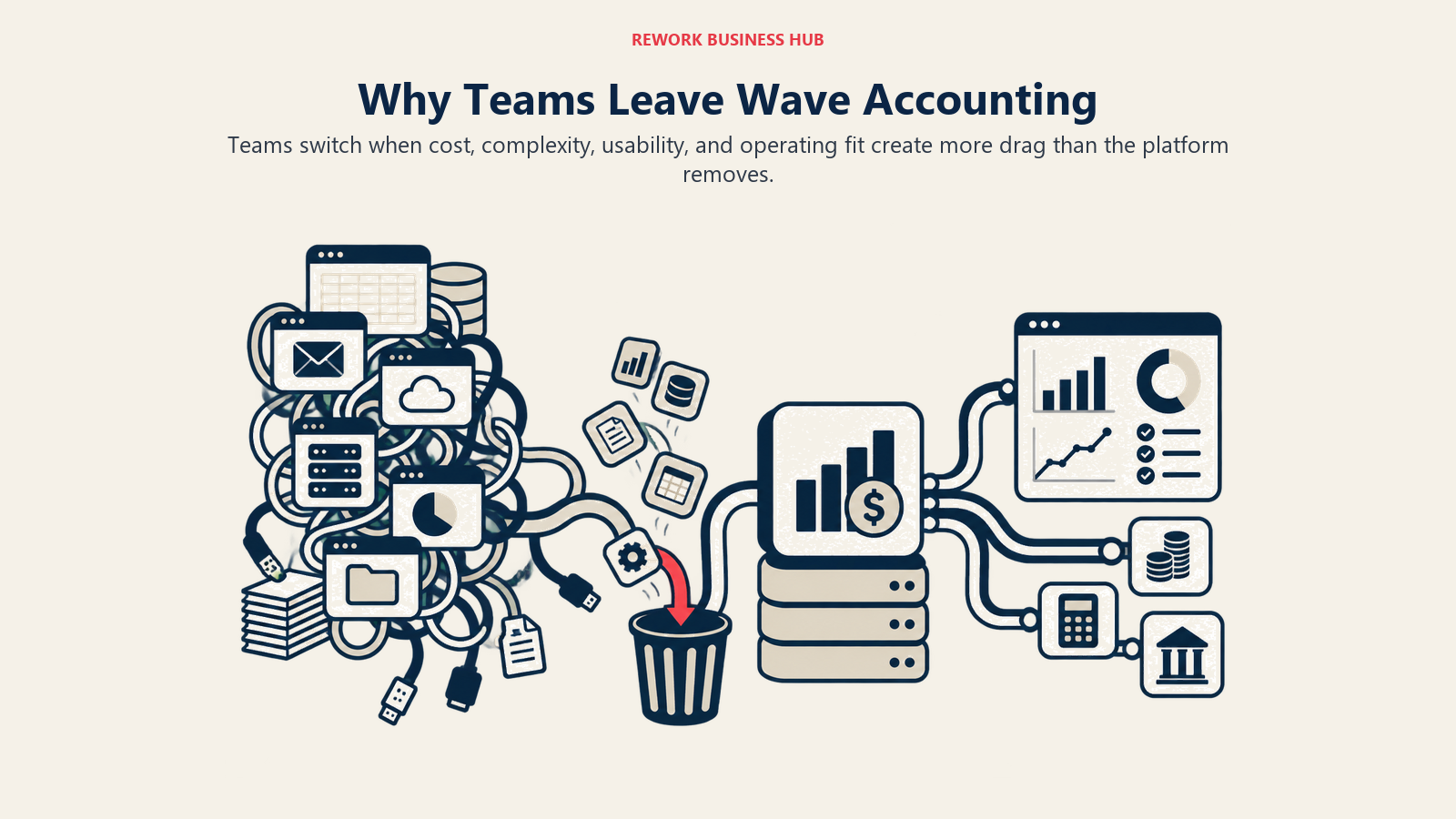
Why Businesses Actually Leave Wave
Before comparing alternatives, it's worth naming the real friction points rather than the vague "looking for something more" reasons.
| Pain Point | Who Feels It | Severity |
|---|---|---|
| Core bank import moved to $16/mo Pro plan | Anyone who connected a bank account for free previously | High |
| No inventory management | Product-based small businesses | High |
| Payroll US/Canada only, paid separately | Businesses with employees outside North America | High |
| No time tracking or project profitability | Agencies and consultants billing hourly | High |
| Thin reporting, no budgeting or forecasting | Businesses approaching $100K+ revenue | Medium |
| No multi-currency on free plan | Businesses with international clients | Medium |
| Limited integrations outside Wave's own tools | Teams running a multi-app stack | Medium |
| Email-only support on free plan | Businesses that need reliable help quickly | Low-Medium |
If none of those apply, Wave is likely still the right call. If two or more feel familiar, read on.
1. QuickBooks Online: The US Small Business Standard
QuickBooks Online is the default comparison point for any accounting tool in this category. It has the deepest CPA and bookkeeper ecosystem in the US, the most integrations, and enough reporting depth to run a real finance function through 50 employees without switching tools.
Methodology: Intuit built QuickBooks around double-entry accounting that accountants already know. The UX has modernized significantly, but the DNA is still "accountant-first, business-owner-second." That's a feature if you work with a bookkeeper. It's friction if you handle your own books solo.
Target audience: US-based small businesses with 2-50 employees, especially those working with an external accountant or bookkeeper. Also strong for product-based businesses needing inventory and any business that wants payroll built in.
| Pros | Cons |
|---|---|
| Best-in-class CPA and bookkeeper compatibility | Price increases 12-17% annually since 2023 |
| Payroll, inventory, and project tracking available | Add-ons for payroll and time tracking stack up |
| Largest third-party integration ecosystem | Can feel complex for solo users |
| Strong mobile app and reporting depth | $38/mo Simple Start is per-user only |
Sizing fit:
| Team Size | Fit |
|---|---|
| Solo freelancer | Workable but often overkill |
| Small team (2-10) | Strong, especially with a bookkeeper |
| Growing SMB (10-50) | Strong, Plus or Advanced tier |
| Mid-Market (50+) | Start evaluating NetSuite or full ERP |
Stage fit: Best for established small businesses that want a finance foundation that scales to 50 employees without switching tools. Good for startups expecting to hire a bookkeeper in their first year.
Team vs company-wide: Finance and operations tool. Payroll capabilities extend it into HR-adjacent territory for small teams.
Pricing: Solopreneur at $20/month, Simple Start at $38/month, Essentials at $85/month, Plus at $140/month, Advanced at $340/month. Payroll is a separate add-on. See QuickBooks pricing for current rates.
Best for: Small US businesses with an accountant on retainer or in-house bookkeeper who need the gold standard for CPA compatibility.
2. Xero: Unlimited Users, Global-Ready Books
Xero's clearest advantage over Wave is one you see on day one: every plan includes unlimited users. No per-seat fees. For a team of three to eight people who all need some level of accounting access, that single difference can cut your software bill in half compared to QuickBooks.
Methodology: Xero is genuinely cloud-native, built browser-first rather than retrofitted from a desktop app. Multi-currency handling is strong from the base plan upward. The bookkeeper network isn't quite the size of QuickBooks' US footprint, but it's substantial globally, especially in Australia, the UK, and New Zealand.
Target audience: Small to mid-size businesses with multiple team members, companies operating in multiple currencies or countries, and businesses that need inventory management alongside invoicing. Strong outside the US where the Xero advisor network rivals QuickBooks.
| Pros | Cons |
|---|---|
| Unlimited users on every plan | Early plan restricts invoice and bill volume |
| Strong multi-currency support | US payroll requires a Gusto add-on ($49+/mo) |
| Real inventory management on Growing+ | Steeper learning curve than Wave or FreshBooks |
| Hubdoc receipt capture bundled on Growing+ | Customer support is primarily async |
Sizing fit:
| Team Size | Fit |
|---|---|
| Solo freelancer | Overkill unless you need multi-currency |
| Small team (2-10) | Excellent, especially for cost control |
| Growing SMB (10-50) | Strong, scales cleanly |
| Mid-Market (50+) | Start evaluating NetSuite or Sage Intacct |
Stage fit: Best for growth-stage small businesses that have outgrown per-seat pricing and need real accounting depth without jumping to a full ERP. Strong for international businesses from day one.
Team vs company-wide: Finance and operations. Unlimited users means managers can review budgets without adding cost.
Pricing: Early at $25/month (limited invoices and bills), Growing at $55/month (unlimited), Established at $90/month (multi-currency, projects, expenses). See Xero pricing for current rates.
Best for: Multi-person small businesses that want real accounting depth without per-seat fees, and businesses with international clients.
3. FreshBooks: The Cleanest Invoicing Experience
FreshBooks is where Wave users often land when they want a paid tool that keeps accounting simple. The invoicing interface is genuinely the cleanest in the category, time tracking is built in rather than bolted on, and the client portal is polished enough that clients actually use it.
Methodology: FreshBooks was built for service-based small businesses, not accountants. The trade-off is intentional: the tool prioritizes invoicing clarity and the time-to-payment workflow over accounting depth. Double-entry accounting runs underneath, but the UI abstracts that complexity.
Target audience: Freelancers, consultants, and small agencies (under 10 people) that bill by the hour, manage multiple active clients, and want their accounting software to feel more like a client management tool. If you're comparing FreshBooks to Wave specifically, see the best FreshBooks alternatives for a deeper look.
| Pros | Cons |
|---|---|
| Best invoicing UX in the category | Lite plan caps you at 5 active clients |
| Native time tracking wired directly to invoicing | Per-seat fees add up fast for small teams |
| Client portal for invoice viewing and payment | Reporting depth limited for bookkeepers |
| Expense tracking with mobile receipt capture | Inventory management is absent |
Sizing fit:
| Team Size | Fit |
|---|---|
| Solo freelancer | Excellent |
| Small team (2-10) | Good, but per-seat cost grows |
| Growing SMB (10-20) | Moderate, accounting gaps emerge |
| Mid-Market (20+) | Switch to Xero or QuickBooks |
Stage fit: Early to growth-stage service businesses. Strong for anyone who outgrew Wave's limitations but doesn't yet need full accounting depth.
Team vs company-wide: Primarily the owner and a bookkeeper. Finance-forward teams will want more reporting depth.
Pricing: Lite at $23/month (5 billable clients), Plus at $43/month (50 clients), Premium at $70/month (unlimited), Select (custom). Extra team members are $11/user/month. See FreshBooks pricing for current rates.
Best for: Freelancers and small agencies who bill hourly and want the cleanest invoicing workflow in the market.
4. Zoho Books: Best Value Full-Accounting Suite
Zoho Books offers six pricing tiers including a genuinely functional free tier for businesses under $50K in annual revenue, and its paid plans cost well below QuickBooks at equivalent feature levels. If your complaint about Wave is that it lacks depth, Zoho Books adds real depth at a price that doesn't hurt.
Methodology: Zoho Books is part of the broader Zoho ecosystem, which means deep integration with Zoho CRM, Zoho Inventory, Zoho Projects, and the rest of the suite. Even standalone, it's feature-rich: automated workflows, client portal, purchase orders, and vendor credit management all show up before you hit the $50/month plan.
Target audience: Small to mid-size businesses already in the Zoho ecosystem, or businesses that want full double-entry accounting with strong automation at a lower price than QuickBooks. Also a strong pick for businesses with inventory or multi-currency needs on a budget.
| Pros | Cons |
|---|---|
| Generous free tier (sub-$50K annual revenue) | UI can feel dense for newcomers |
| Strong automation at every paid tier | CPA ecosystem smaller than QuickBooks |
| Deep Zoho suite integration | Some features locked to higher tiers |
| Client portal, purchase orders, inventory built in | Support quality varies by region |
Sizing fit:
| Team Size | Fit |
|---|---|
| Solo freelancer | Excellent on free tier |
| Small team (2-10) | Strong, Standard or Professional plan |
| Growing SMB (10-50) | Good, Premium tier handles it |
| Mid-Market (50+) | Consider Zoho ERP or NetSuite |
Stage fit: Any stage. The pricing ladder is gradual enough that you rarely have to switch tools as you grow, from free at the start through $275/month at scale.
Team vs company-wide: Finance, operations, and if you're in the Zoho ecosystem, it connects naturally to sales and project teams.
Pricing: Free (1 user, sub-$50K revenue, 1,000 invoices/year), Standard at $20/month, Professional at $50/month, Premium at $70/month, Elite at $150/month, Ultimate at $275/month. See Zoho Books pricing for current rates.
Best for: Budget-conscious small businesses that want full accounting depth, strong automation, and a realistic free starting tier.
5. Zoho Invoice: Permanently Free Invoicing
If you're leaving Wave purely for invoicing, not full accounting, Zoho Invoice is worth a close look. It's completely free, with no revenue cap and no time limit. The free plan supports two users, 500 invoices per year, three projects, time tracking, expense tracking, recurring invoices, and a client portal.
Methodology: Zoho Invoice's philosophy is that invoicing should be free infrastructure for small businesses. It monetizes through the broader Zoho suite, nudging users toward Zoho Books when they need full accounting. The tool itself has no paid tier.
Target audience: Freelancers and very small businesses that need clean invoicing, expense tracking, and time logging but don't need a full general ledger. Also useful as a step up from Wave's invoicing for businesses that aren't ready to pay for accounting software.
| Pros | Cons |
|---|---|
| Completely free, no revenue cap or time limit | Not a full double-entry accounting system |
| Time tracking, expense tracking, client portal included | 500-invoice-per-year cap on free plan |
| Integrates with Zoho Books if you need to upgrade | Limited to 2 users on free plan |
| Clean interface, better UX than Wave | "Powered by Zoho Invoice" branding on invoices |
Sizing fit:
| Team Size | Fit |
|---|---|
| Solo freelancer | Excellent |
| Small team (2-3) | Good for invoicing-only needs |
| Small team (3-10) | Upgrade to Zoho Books |
| Growing SMB (10+) | Wrong tool for this stage |
Stage fit: Early-stage freelancers and micro-businesses that need invoicing done right without a monthly bill. The natural upgrade path leads to Zoho Books when accounting depth is needed.
Team vs company-wide: Solo or small team invoicing tool. Not a company-wide finance platform.
Pricing: Free (2 users, 500 invoices/year, 3 projects). No paid tier. See Zoho Invoice pricing for current details.
Best for: Freelancers and micro-businesses that need solid invoicing and time tracking at zero cost, with a clear upgrade path to full accounting.
6. FreeAgent: All-In-One for UK Freelancers
FreeAgent bundles everything a UK freelancer or contractor needs into one flat subscription: invoicing, time tracking, expense management, self-assessment tax returns, and VAT returns. The HMRC Making Tax Digital integration is the real differentiator for UK users. And it's free with a NatWest, Royal Bank of Scotland, or Mettle business banking account.
Methodology: FreeAgent was designed specifically for sole traders, freelancers, and limited companies in the UK. The product follows the UK tax calendar, handles VAT returns natively, supports Making Tax Digital, and guides you through self-assessment. For non-UK users, most of that value disappears.
Target audience: UK-based freelancers, contractors, and small limited companies. US and international users will find it significantly less useful since the core value is in UK-specific tax automation.
| Pros | Cons |
|---|---|
| All features at one flat price, no tier complexity | Primarily valuable for UK tax workflows |
| Direct HMRC MTD and VAT return integration | US and international teams lose most of the value |
| Free with NatWest, RBS, Ulster Bank, or Mettle | No inventory management |
| Time tracking and project management built in | Limited scalability for larger teams |
Sizing fit:
| Team Size | Fit |
|---|---|
| Solo UK freelancer | Excellent, especially free via NatWest |
| Small UK team (2-10) | Good for limited companies |
| Growing SMB (10-50) | Start evaluating Xero or QuickBooks |
| Mid-Market (50+) | Not appropriate |
Stage fit: Perfect for UK freelancers from their first invoice through their first years as a limited company. The flat-fee model means no surprises as you bill more clients.
Team vs company-wide: Finance and time tracking. Self-assessment integration makes it a solo or small-team tool by design.
Pricing: Approximately £33/month (after an introductory 50% discount for the first 6 months). Free with qualifying NatWest, RBS, Ulster Bank, or Mettle business accounts. See FreeAgent pricing for current rates.
Best for: UK-based freelancers and contractors who want tax filing, invoicing, and time tracking in one place at a flat fee.
7. Sage Accounting: Low-Cost Full Accounting
Sage Accounting (formerly Sage Business Cloud) provides complete double-entry accounting, bank reconciliation, invoicing, and inventory for small businesses at a price point that undercuts QuickBooks significantly. It's not as modern as Xero or as feature-dense as Zoho Books, but it covers the accounting essentials without unnecessary complexity.
Methodology: Sage approaches accounting from a traditional, structure-first angle. The company has been in accounting software since the 1980s, so the feature set is complete even if the UX is more utilitarian than newer entrants. The tool is cloud-based but built on decades of accounting logic.
Target audience: Small businesses in the US, UK, and European market that need full accounting at a lower price than QuickBooks and don't need Wave's simplicity or Xero's depth. Good for product-based businesses that need inventory from the start.
| Pros | Cons |
|---|---|
| Low entry price for full accounting | Less modern UX compared to Xero or Zoho Books |
| Inventory and cash flow tracking included | Fewer integrations than QuickBooks |
| Cloud-based with strong UK tax compliance | Smaller third-party app ecosystem |
| 30-day free trial available | Customer support consistency varies |
Sizing fit:
| Team Size | Fit |
|---|---|
| Solo owner | Good, affordable entry |
| Small team (2-10) | Strong |
| Growing SMB (10-50) | Moderate, may need Sage 50 or Sage Intacct |
| Mid-Market (50+) | Upgrade to Sage Intacct or ERP |
Stage fit: Early and growth-stage small businesses that want complete accounting without paying QuickBooks rates. Good for product-based businesses that need inventory from day one.
Team vs company-wide: Finance and operations tool.
Pricing: US pricing starts at $19/month with a free trial period for new customers. UK pricing runs from £18 to £59/month depending on tier. See Sage Accounting pricing for current rates.
Best for: Small businesses that want full, inventory-capable accounting at a low entry cost without needing the QuickBooks ecosystem.
8. Bonsai: The Freelancer's All-In-One
Bonsai isn't a full accounting suite. It's a freelance business management platform that wraps invoicing around tools most accounting software ignores: contracts, proposals, project management, client CRM, and time tracking. If you spend as much energy chasing signed contracts as chasing payments, Bonsai solves both in one place.
Methodology: Bonsai was built for the business-of-freelancing, not just the invoicing but the entire workflow from proposal to payment. The bet is that freelancers need a tool that follows the client lifecycle, not one that starts at "create invoice." Quarterly tax estimation is built into the dashboard, and contracts are legally vetted templates rather than blank documents.
Target audience: Freelancers, consultants, and small creative agencies under 10 people that bill on proposals and contracts and want one tool rather than three separate SaaS subscriptions stitched together.
| Pros | Cons |
|---|---|
| Contracts, proposals, and CRM bundled in | Not a true double-entry accounting system |
| Time tracking wired directly to invoicing | Per-user pricing multiplies with team size |
| Quarterly tax estimation built in | Reporting depth limited for bookkeepers |
| Clean UX designed for non-accountants | Fewer integrations than dedicated accounting tools |
Sizing fit:
| Team Size | Fit |
|---|---|
| Solo freelancer | Excellent |
| Small team (2-5) | Strong for project-based agencies |
| Team (5-15) | Moderate, accounting gaps become visible |
| Mid-Market (15+) | Switch to full accounting software |
Stage fit: Early-stage freelancers and small agencies. Strong for service-only businesses where contracts and proposals are part of every client relationship.
Team vs company-wide: The freelancer's primary business tool. A bookkeeper will need separate software for year-end filing.
Pricing: Basic at $15/user/month, Essentials at $25/user/month, Premium at $39/user/month, Elite at $59/user/month (annual billing). See Bonsai pricing for current rates.
Best for: Freelancers and small agencies who want proposals, contracts, time tracking, and invoicing in one place rather than a pure accounting suite.
9. Patriot Accounting: US Payroll and Books at Low Cost
Patriot Accounting occupies a specific niche: it's one of the few tools where you can get both accounting software and a real built-in payroll system at a low combined price, with transparent pricing (a promotional rate plus a clearly stated regular rate) and no per-user fees on the accounting side.
Methodology: Patriot was built for US small businesses that want to handle payroll and accounting in one place without paying QuickBooks prices. The accounting product covers double-entry books, invoicing, expense tracking, and reporting. The payroll product handles federal and state filings, direct deposit, and tax payments. Both are simpler than QuickBooks equivalents but cover the essentials.
Target audience: US small businesses with employees, particularly the 2-25 employee range, that want an integrated payroll and accounting solution below QuickBooks pricing.
| Pros | Cons |
|---|---|
| True double-entry accounting at low cost | Fewer integrations than QuickBooks or Xero |
| Built-in payroll option available as add-on | UI is functional but not as modern |
| No per-user fees on accounting plans | Smaller bookkeeper ecosystem |
| Transparent, stable pricing | Limited inventory management |
Sizing fit:
| Team Size | Fit |
|---|---|
| Solo freelancer | Overkill unless you need payroll |
| Small team (2-15) | Strong, especially with payroll add-on |
| Growing SMB (15-50) | Moderate, may outgrow reporting depth |
| Mid-Market (50+) | Not appropriate |
Stage fit: Early to growth-stage US small businesses with employees that want payroll and accounting from one vendor at a fraction of QuickBooks' cost.
Team vs company-wide: Finance and HR-adjacent via payroll. Not company-wide.
Pricing: Accounting Basic at $10/month promotional ($20/month regular), Accounting Premium at $15/month promotional ($30/month regular), with payroll sold separately: Basic Payroll at $8.50/month plus $2/worker promotional ($17/month plus $4/worker regular), Full Service Payroll at $18.50/month plus $2.50/worker promotional ($37/month plus $5/worker regular). See Patriot pricing for current rates.
Best for: US small businesses with employees that want accounting and payroll in one system at a lower cost than QuickBooks.
10. Invoice Ninja: Open-Source Invoicing With Full Control
Invoice Ninja is a full-featured invoicing platform with an open-source core you can self-host for free. For businesses that want complete data ownership, no vendor lock-in, and deep customization over their invoicing workflow, it's the most flexible option on this list.
Methodology: Invoice Ninja's philosophy is that invoicing infrastructure should be ownable, not rented. The self-hosted version is free and includes all core features. The cloud version has pricing starting at $18/month for two users, with white-label hosting options available. Either way, you get more control over invoice templates, payment gateways, and client portals than any SaaS-only tool provides. Invoice Ninja updated its pricing in January 2026, moving from a simple Pro tier to a user-tiered cloud model.
Target audience: Technical freelancers and small agencies that prefer self-hosted tools, developers who want to customize their invoicing deeply, and businesses in regions where SaaS pricing in USD creates cost friction.
| Pros | Cons |
|---|---|
| Fully self-hostable for zero monthly cost | Not a full double-entry accounting system |
| Deep invoice customization and templates | Self-hosting requires technical setup and maintenance |
| Supports 40+ payment gateways | Cloud version's new pricing less competitive vs free alternatives |
| Client portal, recurring invoices, proposals | Smaller community than Wave or FreshBooks |
Sizing fit:
| Team Size | Fit |
|---|---|
| Solo technical freelancer | Excellent on self-hosted |
| Small team (2-10) | Good for tech-comfortable teams |
| Growing SMB (10-50) | Moderate; pair with accounting software |
| Mid-Market (50+) | Not appropriate |
Stage fit: Any stage for invoicing needs, but best for bootstrapped or technically oriented businesses that want data ownership over convenience.
Team vs company-wide: Finance and invoicing. Self-hosting is a team decision, not a company-wide platform.
Pricing: Free (self-hosted, unlimited). Cloud plans start at $18/month for 2 users. White-label self-hosted license available separately. See Invoice Ninja pricing for current rates.
Best for: Technical freelancers and small agencies that want full control over their invoicing infrastructure and are comfortable with self-hosting.
11. Akaunting: Open-Source Full Accounting
Akaunting is the open-source alternative for businesses that want complete double-entry accounting, not just invoicing, with the option to self-host for free. Unlike Invoice Ninja, which is invoicing-first, Akaunting covers the full accounting cycle including chart of accounts, journal entries, balance sheets, and profit and loss reporting.
Methodology: Akaunting treats accounting software as open infrastructure. The core platform is free and open-source (GPL-licensed). The business model relies on paid app extensions in the Akaunting marketplace (for features like payroll, banking integrations, and advanced reporting) and a cloud-hosted version for teams that don't want to self-host.
Target audience: Small businesses and freelancers who want genuine open-source accounting with self-hosting control. Technically, it's the closest free equivalent to QuickBooks or Xero for businesses with accounting depth requirements but zero budget for software subscriptions.
| Pros | Cons |
|---|---|
| True double-entry accounting, free and open-source | Setup and maintenance overhead for self-hosting |
| Full chart of accounts, journal entries, financial statements | Marketplace add-ons cost extra for advanced features |
| Multi-currency and multi-company support | Smaller user community than Wave or QuickBooks |
| Cloud plan available for teams that prefer managed hosting | UX less polished than commercial alternatives |
Sizing fit:
| Team Size | Fit |
|---|---|
| Solo freelancer | Excellent for the technically inclined |
| Small team (2-10) | Good for self-hosting teams |
| Growing SMB (10-50) | Moderate; consider cloud plan or paid tools |
| Mid-Market (50+) | Not appropriate |
Stage fit: Early-stage businesses and bootstrapped teams that need real accounting depth at zero software cost and have the technical ability to set it up.
Team vs company-wide: Finance tool. Self-hosting is a team decision.
Pricing: Free (self-hosted, open-source). Cloud plans start at $8/month (billed annually) or $12/month (billed monthly). Managed hosting via third parties from $14/month. See Akaunting pricing for current options.
Best for: Technical small businesses and freelancers who want full open-source accounting with self-hosting control at no software cost.
12. Bench: Bookkeeping Done for You
Bench isn't software in the traditional sense. It's a managed bookkeeping service that pairs you with a real human bookkeeper who handles your monthly books using their own internal platform. If you've been doing your own accounting in Wave and the real problem is that you don't want to do your own accounting at all, Bench is the answer.
Methodology: Bench's model is simple: you connect your financial accounts, a bookkeeper categorizes and reconciles your transactions each month, and you get clean financial statements delivered. The bookkeepers are Bench employees, not freelancers. They're available via message throughout the month. Tax prep and filing are available as add-ons.
Target audience: Small business owners and freelancers who want accurate books without doing them personally. Often a good fit for businesses generating $100K-$1M in annual revenue where time is more valuable than the cost of a bookkeeping service.
| Pros | Cons |
|---|---|
| Real human bookkeepers handle your monthly books | Significantly more expensive than DIY software |
| Catch-up bookkeeping available for years behind | No DIY access to the accounting platform |
| Tax prep add-on from the same team | Slower turnaround than self-service software |
| Clean financial statements delivered monthly | Not suitable for businesses that need real-time financial data |
Sizing fit:
| Team Size | Fit |
|---|---|
| Solo freelancer | Good if you can justify the cost |
| Small team (2-10) | Strong for owner-operators who hate bookkeeping |
| Growing SMB (10-50) | Good until you need an in-house controller |
| Mid-Market (50+) | Hire internal bookkeeping staff instead |
Stage fit: Growth-stage small businesses where the owner's time is better spent on revenue-generating work than bookkeeping. Also strong for businesses with years of uncategorized books who need a catch-up service.
Team vs company-wide: Owner and accountant tool. Not a platform the broader team uses.
Pricing: Plans start at $299/month. Pricing increases with transaction volume. Tax prep and filing are add-ons. See Bench pricing for current rates.
Best for: Small business owners who want their books handled by a professional without hiring an in-house bookkeeper.
Stage Fit Matrix
| Tool | Freelancer (Solo) | Small Biz (2-10) | Growing SMB (10-50) | Mid-Market (50+) |
|---|---|---|---|---|
| QuickBooks Online | Good | Strong | Strong | Transition to ERP |
| Xero | Moderate | Excellent | Strong | Transition to ERP |
| FreshBooks | Excellent | Strong | Moderate | Not appropriate |
| Zoho Books | Excellent (free tier) | Strong | Good | Transition to ERP |
| Zoho Invoice | Excellent | Good | Not appropriate | Not appropriate |
| FreeAgent | Excellent (UK only) | Good (UK only) | Limited | Not appropriate |
| Sage Accounting | Good | Strong | Moderate | Transition to Sage Intacct |
| Bonsai | Excellent | Strong | Limited | Not appropriate |
| Patriot Accounting | Limited | Strong | Moderate | Not appropriate |
| Invoice Ninja | Excellent | Good | Moderate | Not appropriate |
| Akaunting | Excellent | Good | Moderate | Not appropriate |
| Bench | Good | Strong | Good | Hire in-house |
Sizing and Persona Table
| Tool | Team Size Sweet Spot | Primary Buyer | Secondary Buyer |
|---|---|---|---|
| QuickBooks Online | 2-50 employees | Small Business Owner | Bookkeeper/CPA |
| Xero | 2-100 employees | Finance Manager | Business Owner |
| FreshBooks | 1-10 people | Freelancer/Consultant | Small Agency Owner |
| Zoho Books | 1-100 employees | Small Business Owner | Finance Manager |
| Zoho Invoice | 1-3 people | Sole Proprietor | Freelancer |
| FreeAgent | 1-10 (UK) | UK Freelancer/Contractor | Limited Company Director |
| Sage Accounting | 1-50 employees | Small Business Owner | Finance Manager |
| Bonsai | 1-10 people | Freelancer/Consultant | Small Agency Owner |
| Patriot Accounting | 2-25 employees | Small Business Owner | HR/Payroll Manager |
| Invoice Ninja | 1-20 people | Technical Freelancer | Small Agency Owner |
| Akaunting | 1-20 people | Technical Small Business Owner | Bookkeeper |
| Bench | 1-50 people | Business Owner | Controller |
How to Choose: Decision Framework
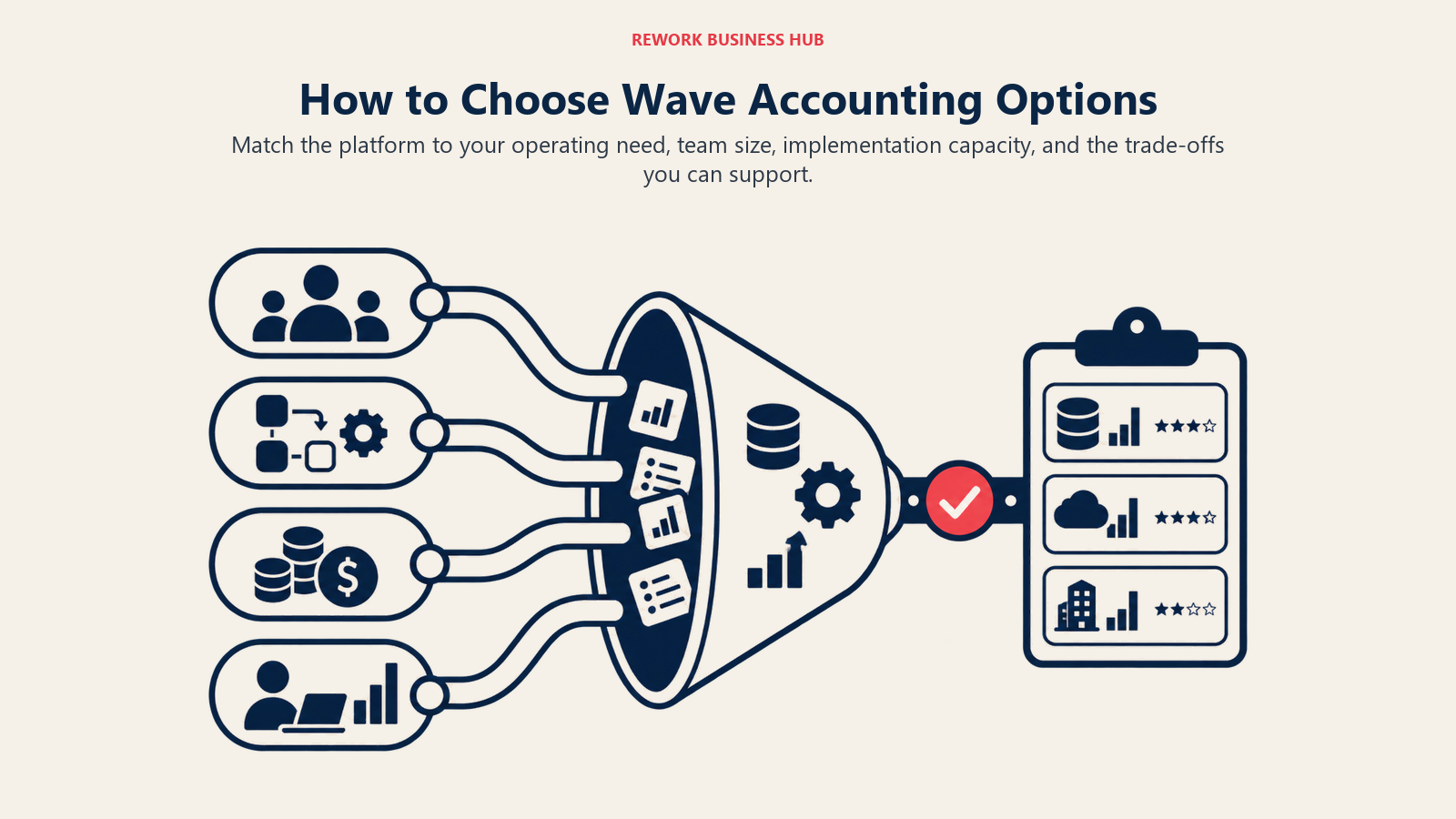
Match the platform to your operating need, team size, implementation capacity, and the trade-offs you can support.
| If you need... | Choose |
|---|---|
| Full accounting with the best US CPA ecosystem | QuickBooks Online |
| Unlimited users without per-seat fees | Xero |
| Cleanest invoicing UX with built-in time tracking | FreshBooks |
| Full accounting with a free starting tier | Zoho Books |
| Invoicing-only at zero cost, forever | Zoho Invoice |
| UK tax filing and HMRC integration in one product | FreeAgent |
| Full accounting under $20/month | Sage Accounting |
| Contracts, proposals, and invoicing as one workflow | Bonsai |
| Low-cost accounting and payroll from one vendor | Patriot Accounting |
| Self-hosted invoicing with full data control | Invoice Ninja |
| Open-source full accounting you can self-host | Akaunting |
| Books handled by a real human, not DIY software | Bench |
| A deeper look at QuickBooks for your size | Best QuickBooks alternatives |
| A closer look at Xero vs the field | Best Xero alternatives |
What Wave Still Does Best
In the interest of honest comparison: Wave isn't a bad product. It earns its position for specific use cases.
| Wave Strength | Who It Matters For |
|---|---|
| Core accounting and invoicing genuinely free | Solo freelancers and micro-businesses |
| No client or invoice caps on free plan | Businesses with many small clients |
| Double-entry accounting runs underneath the free UI | Users who want real books without paying |
| Clean, approachable interface for non-accountants | First-time business owners |
| Payment processing built in (fees apply) | Businesses that want everything from one vendor |
If you have a handful of clients, don't need payroll, don't carry inventory, and work entirely in USD, Wave is still the strongest free accounting option available. The alternatives in this list win when you outgrow those parameters.
What to Do Next
Pick your top two options from the decision framework above, then run a two-week parallel trial with real data. Don't test with dummy invoices. Import an actual month of transactions, connect your bank account, and see which tool surfaces the information you actually need day to day.
For most freelancers moving on from Wave, the choice comes down to FreshBooks (if invoicing clarity is the priority), Zoho Books (if you want depth and automation without a high price), or QuickBooks Online (if you work with a bookkeeper). For small businesses that added employees, Patriot Accounting resolves the payroll gap at a fraction of QuickBooks' cost. And if you're technically inclined and want zero ongoing software cost, Invoice Ninja or Akaunting give you full control without a monthly bill.
For teams also evaluating broader finance infrastructure as they scale, the best Odoo alternatives and best Stripe alternatives guides cover the payment processing and ERP layers that often come up in the same tooling review.
Camellia writes about finance and operations tooling for small businesses and freelancers. Last updated June 2026.

On this page
- Quick Comparison Table
- Why Businesses Actually Leave Wave
- 1. QuickBooks Online: The US Small Business Standard
- 2. Xero: Unlimited Users, Global-Ready Books
- 3. FreshBooks: The Cleanest Invoicing Experience
- 4. Zoho Books: Best Value Full-Accounting Suite
- 5. Zoho Invoice: Permanently Free Invoicing
- 6. FreeAgent: All-In-One for UK Freelancers
- 7. Sage Accounting: Low-Cost Full Accounting
- 8. Bonsai: The Freelancer's All-In-One
- 9. Patriot Accounting: US Payroll and Books at Low Cost
- 10. Invoice Ninja: Open-Source Invoicing With Full Control
- 11. Akaunting: Open-Source Full Accounting
- 12. Bench: Bookkeeping Done for You
- Stage Fit Matrix
- Sizing and Persona Table
- How to Choose: Decision Framework
- What Wave Still Does Best
- What to Do Next