SpotDraft vs ContractSafe vs Sirion: Which Contract Tool Fits Legal, a Lean Team, or Procurement in 2026?
Turn this article into takeaways for your work.


Each assistant summarizes the article only for you and suggests best practices for your work.
Sirion's figures are labeled (reported) from named third-party trackers, consistent with how Sirion is priced across this site.*
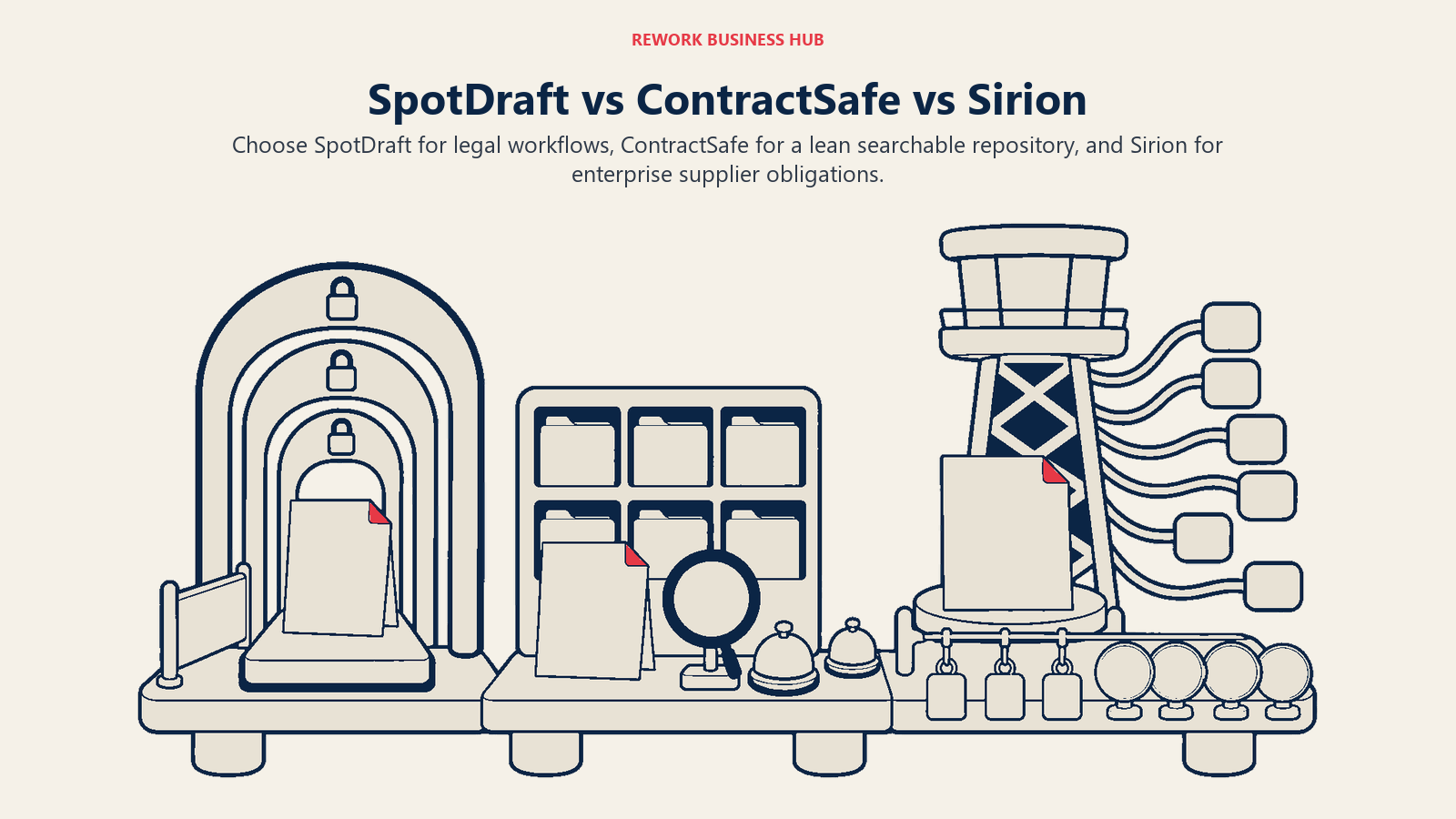
These three get shortlisted together more often than they should be. SpotDraft, ContractSafe, and Sirion all carry the "contract management software" label and all promise to get your contracts out of email, but past that they're not competing for the same deal. SpotDraft is a mid-market CLM built for an in-house legal team that wants sales to self-serve routine paper without losing control of it, sized for a company that can absorb roughly 200 people without re-platforming. ContractSafe is deliberately the simplest and cheapest of the three: a searchable, AI-tagged repository with reminders, built for a team whose actual problem is that contracts live in inboxes and shared drives, not that the approval workflow is broken. Sirion sits at the enterprise end: obligation management, supplier performance tracking, and post-award governance at a contract volume the other two aren't built to handle.
The split that matters most, and the one a feature checklist won't show you, is who's actually buying. SpotDraft and ContractSafe are almost always a legal purchase, or a founder or ops lead standing in for one, about general and sell-side contracting. Sirion is very often a procurement purchase about the buy-side supplier relationship, a different budget line and stakeholder entirely. Miss that distinction and you'll shortlist across two different jobs.
TL;DR
| SpotDraft | ContractSafe | Sirion | |
|---|---|---|---|
| What it actually is | Mid-market CLM for in-house legal, implementation included | Searchable, AI-tagged contract repository with reminders | Enterprise obligation management and post-signature AI at scale |
| Built for | Legal teams wanting self-serve contracting for sales, without losing control | Teams whose problem is scattered contracts, not a broken approval process | Procurement and legal-ops teams governing supplier contracts after signature |
| Typical buyer | General Counsel, Legal Ops Lead | Founder, Operations Manager, whoever owns "legal" part-time | Chief Procurement Officer, VP Legal Ops |
| Real pricing meter | Users or contract volume, quote-only | Contract count, not seats, published rate card | Users, modules, and contract volume, quote-only |
| E-signature | Native, ESIGN and eIDAS compliant | Native on Finalize and Maximize tiers | Not the product's focus; integrates with existing systems |
| Pricing | Quote-only; reported $5,000 to $50,000-plus/year | Published: $450 to $815/month at up to 100 contracts | Quote-only; reported $150,000 to $400,000-plus/year |
| Implementation | Weeks; six-week guided onboarding included | Days; no formal implementation phase | Months; reported 3 to 6 months, professional services common |
| Best for | A team with (or building) in-house legal wanting sales to self-serve | A lean team without dedicated legal, priced for that reality | Large, complex supplier and contract portfolios after signature |
What Each Tool Is Actually Built For
SpotDraft: In-House Legal Sets the Rules, Everyone Else Self-Serves
SpotDraft's pitch is that going live shouldn't require a separate professional-services bill. Implementation, workflow setup, integrations, legacy contract migration, and support all ship included in the price, and the vendor's own pricing page states this plainly rather than burying it in a sales call. The product covers the full pre- to post-signature loop: conditional templates and approval routing (Workflows), shared review across Word, Slack, and its native editor (Negotiation & Collaboration), a searchable repository with access controls (Management), reporting on renewals and bottlenecks (Analytics), and native e-signature compliant with the US ESIGN Act and the EU's eIDAS standard. Its AI layer, Contract Data Intelligence and Negotiation Intelligence, is built to operate inside a company's own playbook rules rather than as a generic redlining assistant, a framing SpotDraft ties to California State Bar and ABA guidance on generative AI in legal practice. Reported customers include Abnormal Security, IPSY, Guideline, and Beamery, and SpotDraft holds a 4.5 out of 5 rating on G2 with Leader and Mid-Market Leader badges (vendor-stated).
The tradeoff is scale. SpotDraft is built for a company with real contract volume and a legal function directing it, not a team with no legal function at all, and it isn't trying to match Ironclad's clause-library depth or Icertis's obligation-extraction reach at the top of the category. See Best Contract Management Software in 2026 for where it sits against that wider field.
ContractSafe: The Problem Is Findability, Not Workflow
ContractSafe doesn't try to be a negotiation platform. It's a centralized, full-text-searchable repository with automated renewal alerts, approval workflow, e-signature on its higher tiers, and AI-driven organization, built for a team whose contracts are genuinely scattered rather than a team whose approval chain is broken. Its Smart Search feature is built around that exact job: AI and natural-language search meant to return results without exact keywords or manual filters, a direct answer to the pile of loosely named PDFs most teams actually deal with. It integrates with Microsoft Word and common CRM tools, and every tier includes unlimited users at a flat rate rather than a per-seat fee, a genuinely unusual choice in this category. Reported customers span SiriusXM, United Express, the University of Arizona, TED, and Dollar Shave Club, and the vendor cites G2 recognition for "Easiest To Do Business With" and "Best Estimated ROI Mid-Market" (vendor-stated).
What it doesn't do is negotiation-stage redlining, clause libraries, or obligation extraction at anything like SpotDraft's or Sirion's depth. That's not an oversight; it's the tradeoff for a tool priced and designed for a team that would rather stay simple than pay for depth it won't use.
Sirion: Obligation Management After the Signature, at Enterprise Scale
Sirion's argument is that the hard part of contracting starts after signature. Its AI reads a signed contract for renewal terms, SLAs, and compliance obligations, then tracks performance against them across a portfolio most spreadsheets or lighter CLMs can't keep up with, work that overlaps directly with why teams also evaluate LinkSquares or Icertis. The platform is built around agentOS, an operating system for orchestrating purpose-built contract AI agents (Search, Draft, Issue Detection, Redline, Extraction, and Playbook agents among them), with AskSirion, a conversational interface across the contracting lifecycle, added in October 2025. Sirion reports enterprise customers including IBM, Vodafone, Qantas, and Bank of New York Mellon, and states it manages more than 5 million contracts worth over $450 billion across 70-plus countries (vendor-stated).
Sirion has grown by acquisition on the way to that scale: it acquired Eigen Technologies in June 2024, adding intelligent document processing that reads non-contract documents (engineering reports, service-level backup data) and ties them back to contract obligations. Its own ownership changed in 2026 too, covered in full under Risk and Governance below. None of that changes what Sirion is built to do: enterprise software for the buy-side supplier relationship, not a lighter CLM with a bigger price tag.
| Capability | SpotDraft | ContractSafe | Sirion |
|---|---|---|---|
| Contract drafting from templates | Yes, conditional templates | No, upload and organize existing documents | Yes, Draft Agent inside agentOS |
| Redlining or negotiation workspace | Yes, shared review across Word, Slack, native editor | No | Yes, Redline Agent flags deviations from playbook |
| AI search across an existing archive | Yes, repository search | Yes, Smart Search (AI, natural language) | Yes, Search and Extraction Agents |
| Post-signature obligation tracking | Basic renewal and deadline analytics | Renewal reminders only, no obligation extraction | Purpose-built, the platform's core strength |
| Approval workflow | Yes, conditional routing | Yes, on Finalize and Maximize tiers | Yes, configurable across business units |
| Native e-signature | Yes, ESIGN/eIDAS compliant | Yes, on Finalize and Maximize tiers | Not native; integrates with existing systems |
| Reads non-contract source documents (SLAs, engineering reports) | No | No | Yes, via the 2024 Eigen Technologies acquisition |
Key Facts
- Poor contract management costs organizations an average of 9.2% of annual revenue through missed deadlines, unfavorable renewals, and overlooked terms. (World Commerce & Contracting)
- 71% of organizations can't locate at least 10% of their own active contracts. (Procurement Tactics)
- The global CLM software market is valued at $3.39 billion in 2026 and is projected to reach $6.26 billion by 2031, a 13.06% compound annual growth rate. (Mordor Intelligence)
- Nearly half of legal teams (49%) still manage contracts through email, Word documents, and shared folders; automating the process cuts average cycle time from 19 days to 3. (SpotDraft's 2025 Contract Efficiency Benchmarking Survey, per Businesswire)
- Haveli Investments completed a majority investment in Sirion in February 2026, valuing the company at roughly $1 billion. (LawSites)
Who's Actually Buying This: Legal, a Generalist, or Procurement
This is a more useful filter than any feature table, and it's the one buyers miss most often, since all three tools use the same "contract management" language on their homepages.
| If the person driving the purchase is... | The right starting point is usually... | Why |
|---|---|---|
| General Counsel or a Legal Ops Lead, with real contract volume from sales | SpotDraft | Legal defines the guardrails once, then extends self-serve contracting to sales inside them |
| A founder, ops manager, or whoever owns "legal" alongside two other jobs | ContractSafe | Priced and designed for a team with no dedicated legal function; the job is findability, not workflow governance |
| A Chief Procurement Officer or Legal Ops Lead managing supplier relationships | Sirion | Post-signature obligation tracking is built for the buy-side relationship, not sell-side sales paper |
These aren't hard walls. A fast-growing company can outgrow ContractSafe into SpotDraft as contract volume and legal headcount grow, and a team with a strong procurement counterpart might run SpotDraft for sales contracts and Sirion for supplier agreements at once. Use the table to find your starting point, not to skip the rest of the evaluation.
Decision by Business Goal
| Business goal | Best fit | Why |
|---|---|---|
| Get contracting off legal's desk for routine sales paper, with implementation included | SpotDraft | Guardrails plus self-serve; onboarding isn't billed separately |
| Stop losing contracts to inboxes and shared drives without hiring into legal | ContractSafe | Priced for exactly this gap, not for negotiation workflow |
| Track supplier obligations and performance after the contract is signed | Sirion | Purpose-built post-signature AI at a scale spreadsheets can't match |
| Keep the software bill flat as headcount grows | ContractSafe | Unlimited users on every tier; the price moves with contract count, not seats |
| Justify a six-figure CLM spend to a board that wants governance, not just tidiness | Sirion | The only one of the three built for regulated, multi-entity obligation tracking |
Team and Role Fit
| SpotDraft | ContractSafe | Sirion | |
|---|---|---|---|
| Team size sweet spot | Roughly 20-500 employees | Any size, priced by contract volume not headcount | 500-plus employees, or a large supplier portfolio regardless of headcount |
| Dedicated legal function assumed | Helpful, and often the buyer | Not required, often the actual selling point | Yes, typically paired with procurement |
| Who else uses it | Sales self-serves within legal's guardrails | Whoever's managing contracts today; built for non-specialists | Legal, procurement, and finance, often across business units |
| Primary champion | General Counsel, Commercial Ops Lead | Founder, Operations Manager | Chief Procurement Officer, Legal Ops Lead |
| Contract volume that justifies it | Real, recurring volume from a sales motion | Any volume; priced by contract count, no floor | Thousands of contracts across suppliers |
Pricing at Real Team Sizes
ContractSafe is the only one of the three with prices published on its own site. SpotDraft and Sirion are both quote-only, priced by a mix of users, contract volume, and modules, which makes a straight "price per user" comparison misleading for two of the three tools.
| Team size | SpotDraft (reported, quote-only) | ContractSafe (published rate card) | Sirion (reported, quote-only) |
|---|---|---|---|
| 10 users | Reported low end of its $5,000-$50,000-plus/year range; prices by volume or user count, so light volume lands near the bottom | Unlimited users at every tier. Under 100 contracts is $5,400/year flat on Organize | Not a realistic deployment size; its $150,000-$400,000-plus/year range assumes complexity a 10-person team doesn't have |
| 50 users | Mid-range of the reported band, higher as contract volume and AI features scale | Same unlimited-user price; a 50-person company often crosses into the 100-500 contract band, pushing toward Finalize or Maximize | Sometimes sold here if those 50 sit inside a larger enterprise's procurement function managing thousands of supplier contracts; otherwise still oversized |
| 200 users | Reported top of its range, or a custom quote once AI modules and integrations are added | Unlimited users again; a 200-person company's few thousand contracts land in Finalize or Maximize's higher bands, priced on contract count, not seats | Closer to Sirion's real buyer profile if contract volume scales with headcount; still $150,000-$400,000-plus/year, more for global rollouts |
Source for SpotDraft: quote-only per SpotDraft's own pricing page; reported annual range from Bind Legal. Source for Sirion: quote-only, priced by user type, module, and integration per its own site; reported annual range from Clause & Current's CLM Pricing Index.
ContractSafe's Real Meter Is Contracts, Not Seats
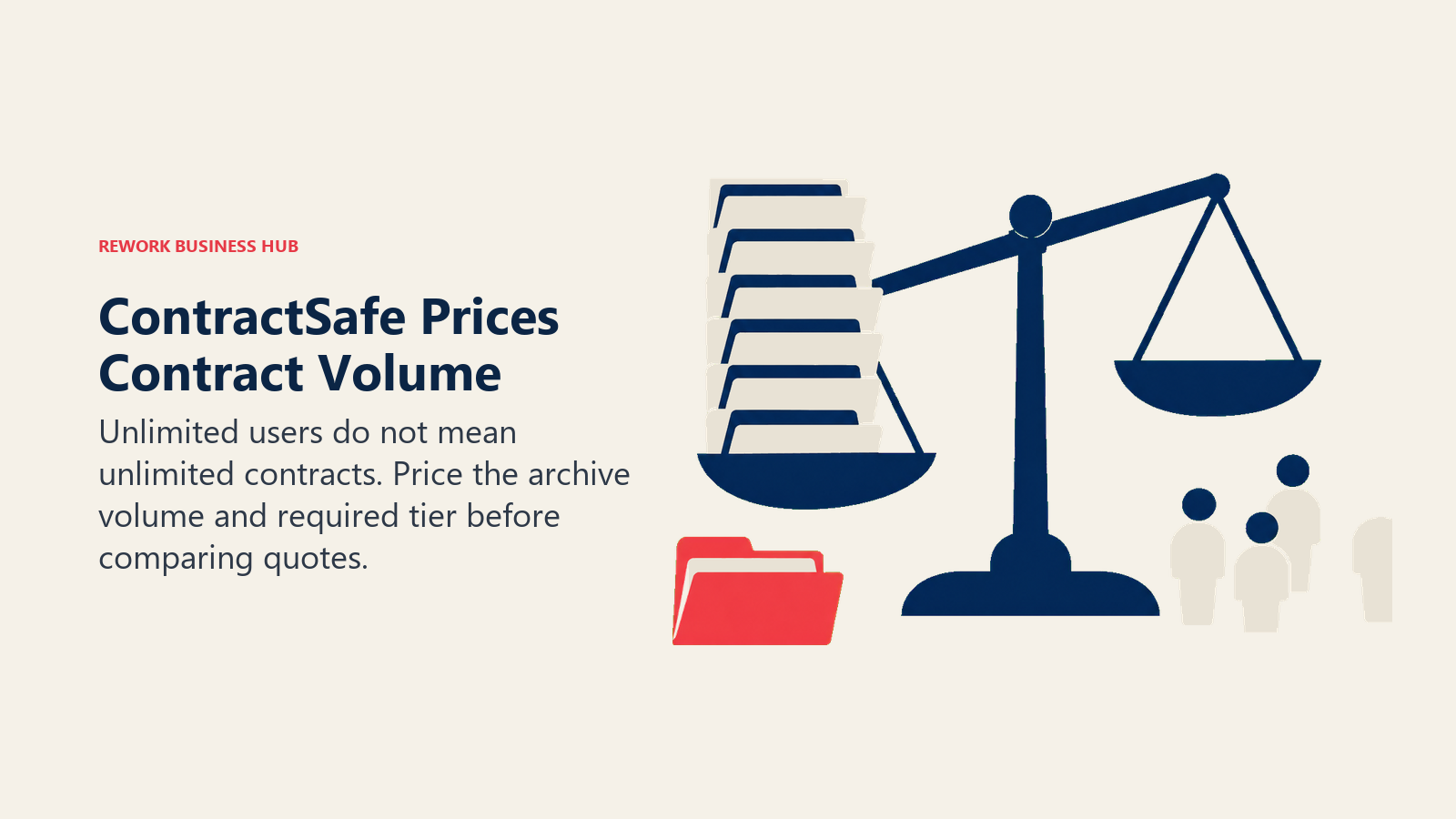
Because ContractSafe doesn't charge per user, headcount is close to irrelevant to its bill. What moves the price is the contract-volume band you select, from 100 or fewer up through 10,000-plus, so price that out precisely before assuming ContractSafe stays cheap as you scale.
| ContractSafe tier | What it adds | At 100 or fewer contracts | At 10,000-plus contracts |
|---|---|---|---|
| Organize | Repository, full-text search, renewal reminders | $450/month ($5,400/year) | $1,630/month |
| Finalize | Adds approval workflow and e-signature | $660/month ($7,920/year) | $2,125/month |
| Maximize | Adds API access, Salesforce integration, full lifecycle tracking | $815/month ($9,780/year) | $2,425/month |
Unlimited users on every tier, billed by contract volume band. Figures reported by SignEasy; ContractSafe's own pricing page requires selecting a volume band before it shows a number, and confirms unlimited users at every tier.
E-Signature: What's Bundled and What Isn't
SpotDraft bundles native, ESIGN- and eIDAS-compliant e-signature into every plan. ContractSafe adds it on Finalize and Maximize, not the base Organize tier, so an Organize-only buyer needs a separate signing tool. Sirion doesn't make e-signature the point at all; it integrates with whatever signing system a customer already runs rather than shipping its own. If e-signature turns out to be your only real gap, how to choose e-signature software covers that narrower decision on its own.
Implementation and Change Management
Time to first signed contract tells you more about real adoption risk than a feature list.
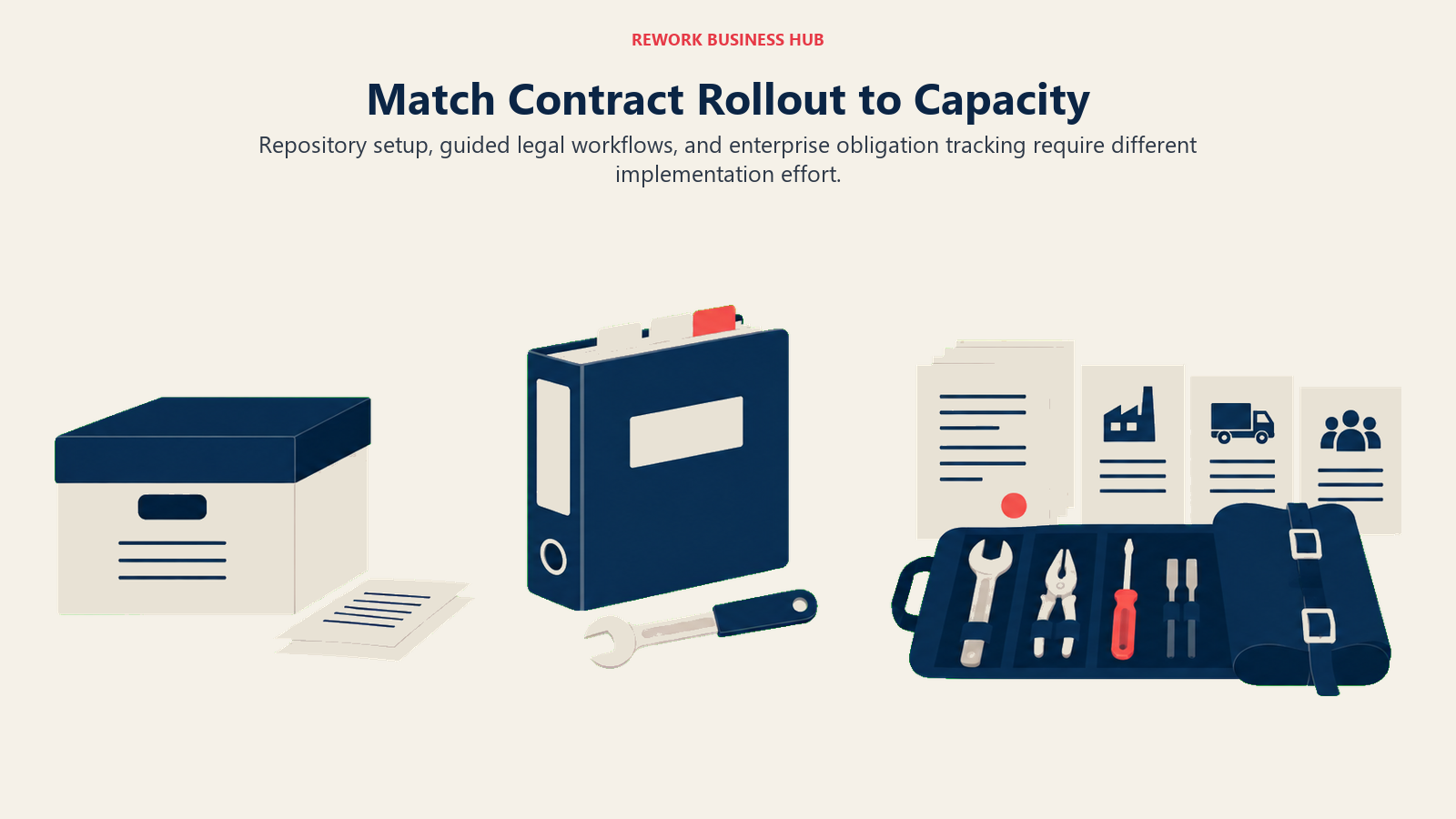
SpotDraft bundles legacy contract data migration into its six-week onboarding, done in-house rather than outsourced. ContractSafe has close to no formal implementation phase by design: its AI-powered organization and Smart Search make an existing pile of contracts usable on upload, without the metadata-tagging project that slows down heavier tools. Sirion is the outlier by design: its longer timeline buys something real, since the Eigen Technologies acquisition specifically targets reading non-contract source documents (engineering reports, SLA backup data) at the accuracy enterprise obligation tracking needs, not just OCR on the contract PDF.
Worth being honest about all three: none publishes a verified, independent accuracy benchmark for AI extraction on scanned or poorly formatted documents. Test with your own messiest contracts, not a vendor's clean demo data, before trusting any of them here.
| SpotDraft | ContractSafe | Sirion | |
|---|---|---|---|
| Time to first contract | Days to weeks | Same day to a few days | Weeks, before a full rollout even begins |
| Full rollout | Six-week guided onboarding | No formal implementation phase | 3 to 6 months (reported), longer with heavy customization |
| Legacy archive migration | Included, in-house, no extra fee | Built into the core product (AI organization, Smart Search) | Purpose-built via Eigen's document-processing acquisition |
| Dedicated internal owner needed | Helpful, often legal or commercial ops | Not required | Yes, typically legal ops, IT, or a partner |
| Support model | Dedicated Account Manager, 24/7 support, included | Standard support included | Enterprise support tier, scoped per contract |
Risk and Governance
Two questions matter more here than any feature list: what happens to your contracts if you leave, and how stable is the vendor.
On exit terms, all three have a gap worth flagging. Neither SpotDraft, ContractSafe, nor Sirion publishes a plain-language cancellation or data-retention policy comparable to what some vendors in this category post publicly. That's not unusual for this market, but the safe move is the same for all three: get export and retention terms in writing during the sales process, not after you've signed.
On vendor stability, Sirion is the one with real 2026 news to weigh. Haveli Investments, an Austin-based private equity firm, took a majority stake in a deal announced January 8, 2026 and completed February 23, valuing Sirion at roughly $1 billion and buying out earlier investors including Sequoia and Tiger Global; Peak XV, Sirion's original seed investor, remains on the cap table. CEO Ajay Agrawal called it "a strategic recapitalization" rather than a typical fundraise, and said the company was already profitable going into the deal. That's a different risk profile than a distressed sale, but still worth asking directly how it affects roadmap, pricing, and support. SpotDraft and ContractSafe have no comparable ownership news; both remain independently operated, privately held companies.
| SpotDraft | ContractSafe | Sirion | |
|---|---|---|---|
| Post-cancellation data policy | Not publicly documented | Not publicly documented | Not publicly documented |
| Recommended action | Get export terms in writing before signing | Get export terms in writing before signing | Get export terms in writing before signing |
| Ownership change in 2026 | None reported | None reported | Majority stake acquired by Haveli Investments, ~$1B valuation, closed February 2026 |
| Independently purchasable today | Yes | Yes | Yes, under the same Sirion name and pricing process |
When Each Is the Right Call
When SpotDraft Is the Right Call
- You have, or are actively building, an in-house legal function that wants to set guardrails once and let sales self-serve routine contracts inside them
- You want implementation, integrations, legacy contract migration, and support bundled into the price instead of a separate professional-services engagement
- Your contract volume is real enough to justify a dedicated CLM, but you don't need Ironclad-grade clause libraries or Icertis-grade obligation extraction
- A six-week guided onboarding fits your team's bandwidth better than a same-day tool with no workflow depth or a multi-month enterprise rollout
When ContractSafe Is the Right Call
- Your actual problem is that contracts live in inboxes, shared drives, and someone's desktop, not that your approval process is broken
- You don't have, and don't plan to hire into, a dedicated legal or contract-ops function, and want a tool priced for that reality
- Growing headcount shouldn't mean a growing software bill; unlimited users on every tier means a new hire doesn't trigger a new line item
- You've checked your real contract-volume band, not just your headcount, since that's the number that actually sets your ContractSafe price
When Sirion Is the Right Call
- Procurement, not legal, is driving the requirement, and supplier performance and obligation tracking after signature matter as much as getting a document signed
- You run enough contract volume across enough business units or supplier relationships that a spreadsheet, or a lighter CLM's reminder emails, can't keep up anymore
- You have the budget and resourcing for a multi-month implementation, and want an AI layer built to read obligations alongside non-contract source documents like SLAs and engineering reports
- You're already comparing this tier and want Icertis or Conga CLM in the mix too, not just Sirion alone
If the Real Gap Is Contracts Living Apart From the Deal
Worth naming plainly: none of these three assume your contract problem is actually a CRM problem. SpotDraft and ContractSafe both solve a genuine legal-adjacent or repository gap, and Sirion solves a genuine enterprise procurement one. But for a mid-size team where the real pattern is a signed contract getting forwarded to a salesperson's inbox and never linked back to the deal that produced it, the gap isn't clause libraries or a cheaper reminder system. It's that the contract and the CRM record live apart.
Rework's Contract module keeps agreements, renewals, and approvals on the same record as the deal, the account, and the contact, alongside its CRM/Sales, Lead Management, and Work Ops apps. That's not a fit for Sirion's buyer: enterprise-scale, procurement-led obligation management isn't the pitch. But for a SpotDraft or ContractSafe-shaped buyer whose actual friction is a contract sitting apart from the deal record, it's worth a look first. Rework's Contract module isn't publicly priced; it's quoted per organization, see rework.com/pricing for current details.
Decision Framework
| If you are... | Pick |
|---|---|
| An in-house legal team wanting self-serve contracting for sales, implementation included | SpotDraft |
| A team with no dedicated legal function whose contracts are scattered across inboxes and drives | ContractSafe |
| Procurement-led, tracking obligations and supplier performance across a large contract portfolio | Sirion |
| Growing headcount fast and don't want your software bill to scale with every new hire | ContractSafe |
| Priced out of Ironclad or Icertis but still need enterprise-grade post-signature AI | Sirion |
| Comparing more of the category before narrowing down | See our full contract management software roundup |
The verdict: there's no single winner because there's no single job. Legal owns the process and wants sales self-serving inside real guardrails: SpotDraft's bundled implementation and mid-market fit make it the strongest of the three. Nobody can find last year's NDA: ContractSafe's flat, unlimited-user pricing solves that specific problem without paying for workflow depth you won't use. Procurement owns the requirement and obligation tracking across a large supplier portfolio is the real job: Sirion is built for exactly that, at a price and timeline to match. Match the buyer and the volume, not the feature list.
What to Do Next
- Name who's actually running point, legal, an ops or finance generalist, or procurement. That answer alone eliminates one of the three for most teams.
- Count your real contract volume, not headcount, before assuming you know your ContractSafe tier or whether you're even a realistic Sirion deployment.
- Get a SpotDraft or Sirion quote at your real numbers. Only ContractSafe's rate card is public; the other two need a real conversation before you can compare total cost.
- Ask what's bundled versus billed separately. Implementation, legacy migration, and support are included at SpotDraft's price; confirm the same before signing anywhere else.
- Evaluating Sirion? Ask directly how the Haveli Investments deal affects roadmap and support commitments. A change of majority ownership is a fair diligence question, not an automatic red flag.
- Still comparing the wider category? Best Contract Management Software in 2026 covers the full field, Juro vs Concord vs Agiloft covers the tier just below SpotDraft, and Ironclad vs Conga CLM vs Icertis covers the tier at or above Sirion. Run whichever pick survives this framework through a SaaS vendor evaluation scorecard before signing.
Related Resources:

On this page
- TL;DR
- What Each Tool Is Actually Built For
- SpotDraft: In-House Legal Sets the Rules, Everyone Else Self-Serves
- ContractSafe: The Problem Is Findability, Not Workflow
- Sirion: Obligation Management After the Signature, at Enterprise Scale
- Key Facts
- Who's Actually Buying This: Legal, a Generalist, or Procurement
- Decision by Business Goal
- Team and Role Fit
- Pricing at Real Team Sizes
- ContractSafe's Real Meter Is Contracts, Not Seats
- E-Signature: What's Bundled and What Isn't
- Implementation and Change Management
- Risk and Governance
- When Each Is the Right Call
- When SpotDraft Is the Right Call
- When ContractSafe Is the Right Call
- When Sirion Is the Right Call
- If the Real Gap Is Contracts Living Apart From the Deal
- Decision Framework
- What to Do Next