Best BigCommerce Alternatives in 2026: 14 Ecommerce Platforms Compared
Turn this article into takeaways for your work.


Each assistant summarizes the article only for you and suggests best practices for your work.
BigCommerce works best for merchants wanting a deep native feature set out of the box, especially multi-storefront and B2B sellers who never want their platform taking a cut of every sale. If you're bumping into your plan's online sales limit, want an admin closer to Shopify's, or need a bigger app ecosystem, Shopify, WooCommerce, and Adobe Commerce cover the same ground, and Rework's Commerce module fits mid-size operators who'd rather run orders, inventory, and the customer record on one platform than sync a storefront to three tools. This guide compares 14 alternatives on pricing and fit, with any unpublished number labeled (reported). See Best Ecommerce Platforms in 2026 for the category view, or Shopify vs BigCommerce if that's your real shortlist of two.
BigCommerce earns its reputation honestly. Its own platform never takes a percentage of a sale, though since 1 June 2026 an Open Payment Provider Fee (2.0% on Core, 1.0% on Growth, 0.6% on Scale) applies to orders processed through a payment provider outside its embedded list (BigCommerce plan and pricing updates), its multi-storefront and native B2B tooling (company accounts, custom pricing, quote workflows) is built in rather than bolted on through apps, and its open APIs give development teams real room to build headless storefronts without stacking a dozen extra apps. But those strengths sit next to real friction: an online sales threshold that forces an automatic tier upgrade, an admin with a steeper learning curve than Shopify's, a much smaller app and theme ecosystem, and a sharp price jump once you outgrow the middle tier.
Key Facts
- Global retail ecommerce sales reached $6.419 trillion in 2025, accounting for 20.5% of total global retail sales. (eMarketer)
- US shoppers spent $257.8 billion online during the 2025 holiday season (Nov 1 to Dec 31), up 6.8% year over year and a new record. (Adobe)
- Only 14% of businesses report being satisfied with their current ecommerce platform, and 41% of those who recently switched cited improving customer experience as their primary reason. (commercetools, State of eCommerce: Replatforming and Migration Trends)
- BigCommerce calculates each plan's online sales threshold on trailing-twelve-month GMV net of a 10% reduction, and taxes and shipping count toward that cap alongside product price. (BigCommerce)
- Shopify's App Store lists more than 16,000 apps (Shopify), compared with roughly 1,200 apps in BigCommerce's own App Marketplace (BigCommerce).
BigCommerce's Actual Tiers in 2026
BigCommerce renamed its plans. Standard, Plus, and Pro no longer exist. The lineup is now Core, Growth, Scale, and Performance, though most older comparison articles still list the retired names.
| Plan | Monthly | Billed Annually | Online Sales Limit (TTM) | Open Payment Provider Fee |
|---|---|---|---|---|
| Core | $39/mo | $29/mo (save 25%) | up to $30K | 2.0% |
| Growth | $105/mo | $79/mo | up to $100K | 1.0% |
| Scale | $399/mo | $299/mo | $33,333/mo, 0.9% overage above | 0.6% |
| Performance | Custom, from $1,499/mo billed annually | Custom | Custom | 0.0% with contract |
That online sales limit is the real reason merchants replatform. It's an automatic tier upgrade once trailing-twelve-month GMV, gross order value minus 10%, crosses the threshold, and taxes and shipping count toward it, so a store selling close to $28,000 in product can cross the $30,000 Core threshold on freight and tax alone. The percentages above are the fee for a third-party payment provider; BigCommerce itself charges no platform fee.
Quick Comparison Table
| Tool | Best For | Starting Price | Key Strength | Key Limitation |
|---|---|---|---|---|
| Shopify | Fastest setup, largest app ecosystem | $39/mo (Basic, monthly, US list) | 16,000+ apps and the deepest theme/agency market | Native multi-storefront and B2B need Plus plus apps |
| WooCommerce | WordPress-native stores wanting full code control | Free plugin (hosting extra) | No licensing fee, complete customization | You own hosting, security, and every update |
| Adobe Commerce / Magento Open Source | Enterprise catalogs or dev-led teams wanting no license fee | Quote-only (Adobe); free, self-hosted (Magento) | Deep customization, enterprise catalog logic | Needs real development resources either way |
| Wix | Small businesses wanting an easy visual builder | $17-$159/mo annual (Light-Business Elite) | Simplest drag-and-drop setup on this list | Thin native commerce depth for high-volume sellers |
| Squarespace | Design-forward brand storefronts | $16/mo (Basic, annual, reported) | Best-in-class templates, visual polish | 0-7% platform fee by plan and content type |
| Rework | Orders, inventory, and CRM on one record | Quote on request | One platform instead of a storefront synced to three tools | Not a storefront builder |
| Shopware | European enterprise and multi-shop B2B | Free (Community); from EUR 600/mo (Rise) | Strong native multi-shop and B2B architecture | Euro pricing, enterprise-oriented above Community |
| Ecwid by Lightspeed | Adding commerce to an existing site or social channels | $5/mo (Starter, up to 10 products) | Drops into an existing website or social profile | Not a from-scratch storefront builder |
| Salesforce Commerce Cloud | Large enterprises already on Salesforce | No published price, quoted per merchant | Deep AI personalization tied to Salesforce CRM | Enterprise cost and implementation timeline |
| Webflow Ecommerce | Design-led marketing sites needing light ecommerce | Verify current figure at webflow.com/pricing | Best-in-class visual design control | Not built for catalog-heavy, high-volume stores |
| Square Online | Sellers already running Square POS in person | Free tier plus paid upgrades | Tight in-person/online inventory and payments sync | Thin multi-storefront or B2B tooling |
| Shift4Shop | US merchants willing to process through Shift4 Payments | $41/mo (End-to-End plan) | Full-featured, processor-linked free option | Free tier and availability are regional and conditional |
| PrestaShop | European (especially French-market) open-source sellers | Free (Classic, self-hosted); Hosted price not published | Large local module ecosystem, full code ownership | You own hosting, security, and upgrades |
| Big Cartel | Independent artists and makers with small catalogs | Free (Gold, limited); $15/mo (Platinum) | Cheapest entry point built for creative sellers | Not built for multi-storefront, B2B, or scale |
1. Shopify: The Default Migration Target for Speed and App Choice
Shopify's pitch is speed and breadth: the fastest path from idea to a live store, the largest app and theme ecosystem in the category, and a checkout that consistently converts well. See the full Shopify vs BigCommerce comparison if this is your real shortlist of two.
Shopify's US list runs Basic at $39/mo, Grow at $105/mo, Advanced at $399/mo, and Plus from $2,300/mo billed monthly, with published annual rates of Basic $29/mo, Grow $89/mo, and Advanced $359/mo; Shopify localizes pricing by country, and the $5/mo Starter plan is closed to new stores. Third-party gateway fees run 2%/1%/0.6%/0.2% on Basic/Grow/Advanced/Plus (zero with Shopify Payments), with staff caps of 5/15/unlimited on the same three tiers. Most merchants also need an email tool alongside Shopify; see Best Klaviyo Alternatives.
| What you get | What you don't |
|---|---|
| 16,000+ apps and the largest theme/agency market | Native multi-storefront or deep B2B tooling below Plus |
| The fastest path from signup to a live, sellable store | BigCommerce's zero-platform-fee model (gateway fees apply below Shopify Payments) |
| The easiest admin for a first-time merchant to learn | Sales growth is still capped by staff and feature tiers |
Pricing: Basic from $39/mo (monthly, US list), Grow $105/mo, Advanced $399/mo, Plus from $2,300/mo; roughly 25% off with annual billing. Best for: Merchants prioritizing setup speed, the largest app ecosystem, and the easiest admin to learn. Not ideal for: Sellers wanting native multi-storefront or B2B tooling without moving to Plus and layering on apps.
2. WooCommerce: Full Code Control on WordPress
WooCommerce flips the model entirely: install a free, open-source plugin on a WordPress site and pay for hosting, a theme, and whichever extensions the store needs. That suits a business already publishing on WordPress that wants commerce on the same site instead of a separate storefront domain.
WooCommerce carries no license fee and no platform revenue share. Its own cost guidance puts realistic hosting at $25 to $350 a month, extensions at $29 to $299 a year each, and WooPayments processing at roughly 2.5% to 2.9% plus 30 cents per transaction.
| What you get | What you don't |
|---|---|
| No licensing fee, complete code and data ownership | A managed platform that patches and updates itself |
| Thousands of extensions covering nearly any commerce need | A single vendor to call when something breaks |
| Full control over hosting, security, and customization | BigCommerce's built-in multi-storefront or B2B tooling |
Pricing: Free plugin; realistic total cost runs $25-$350/mo in hosting plus $29-$299/year per extension plus roughly 2.5-2.9% + $0.30 per transaction in processing. Best for: WordPress-native businesses wanting full code ownership and no recurring platform license. Not ideal for: Teams wanting a fully managed SaaS platform with no hosting or update responsibility.
3. Adobe Commerce and Magento Open Source: Enterprise Depth or Free Self-Hosted Code
Adobe Commerce (the commercial, quote-only successor to Magento Enterprise) and Magento Open Source (its free, self-hosted sibling) sit at opposite ends of the same codebase: the choice is really about who pays for what. Adobe Commerce as a Cloud Service (ACCS) launched June 2025 and is also quote-based. See Best Magento Alternatives if you're narrowing on Magento specifically.
Adobe publishes no price for Adobe Commerce; the license is quoted per merchant and sized against annual GMV, so any dollar figure elsewhere is a third-party estimate. Magento Open Source has no license fee at all: it's self-hosted, and the buyer pays hosting, development, extensions, and maintenance instead.
| What you get | What you don't |
|---|---|
| Enterprise-grade catalog and customization depth | A published price for Adobe Commerce at any tier |
| A free, self-hosted option with Magento Open Source | A quick, low-code path to launch |
| Real flexibility for complex B2B or multi-brand catalogs | A fit for teams without dedicated development resources |
Pricing: Adobe Commerce is quote-only, sized on GMV; Magento Open Source has no license fee (self-hosted, you cover hosting and development). Best for: Enterprise catalogs needing deep customization, or development-led teams wanting full code ownership without a license fee. Not ideal for: Teams without in-house or agency development capacity to run either platform.
4. Wix: The Simplest Visual Builder With Commerce Attached
Wix's core strength is how easy its visual editor is for a non-technical founder, and its ecommerce tier bolts onto that same drag-and-drop builder instead of a separate commerce-first admin. See Best Wix Alternatives if Wix itself, not BigCommerce, is the platform you're evaluating away from.
Wix's plans page renders dynamically and prices vary by region, but its own published range is $17 to $159 per month billed annually, from the entry Light plan up to Business Elite, with Core and Business in between. The Light plan does not include accepting online payments; selling starts one tier up.
| What you get | What you don't |
|---|---|
| The easiest drag-and-drop builder on this list | BigCommerce's native multi-storefront or B2B depth |
| Commerce built into the same editor as the site itself | High-volume catalog or inventory management depth |
| Fast setup for a small, visually driven catalog | A fit for B2B, wholesale, or multi-channel sellers |
Pricing: $17-$159/mo billed annually (Light to Business Elite); online payments require Core or above. Prices vary by region. Best for: Small businesses and solo founders wanting the simplest possible visual site builder with commerce attached. Not ideal for: B2B, wholesale, or high-volume sellers needing deeper native commerce logic.
5. Squarespace: Design-Forward Storefronts
Squarespace's reputation rests on template quality: its storefronts look more polished out of the box than most competitors without custom design work, which matters for brand-led sellers where the site is part of the product story. See Best Squarespace Alternatives if Squarespace, rather than BigCommerce, is the platform on your way out.
Squarespace renamed its plans in late 2025; Personal, Business, Commerce Basic, and Commerce Advanced are retired, replaced by Basic, Core, Plus, and Advanced. Commerce transaction fees run 2% on Basic and 0% above it, with digital-content/membership fees of 7%, 5%, 1%, and 0% across the same tiers; payment processing runs 2.5% to 2.9% plus $0.30. Squarespace renders dollar figures in JavaScript; third-party trackers report Basic $16, Core $23, Plus $39, Advanced $99/mo billed annually (reported).
| What you get | What you don't |
|---|---|
| The most polished default templates on this list | BigCommerce's native B2B or multi-storefront tooling |
| Zero commerce transaction fee from Core up | A large third-party app marketplace |
| Strong fit for content-and-commerce brand sites | High-volume catalog or wholesale-specific features |
Pricing: Basic $16/mo, Core $23/mo, Plus $39/mo, Advanced $99/mo, all billed annually (reported); 2% commerce fee on Basic, 0% on Core and above.
Best for: Design-forward brand storefronts where template polish and content-commerce blend matter most.
Not ideal for: High-volume, multi-channel, or B2B-heavy sellers.
6. Rework: Orders, Inventory, and the Customer Record on One Platform
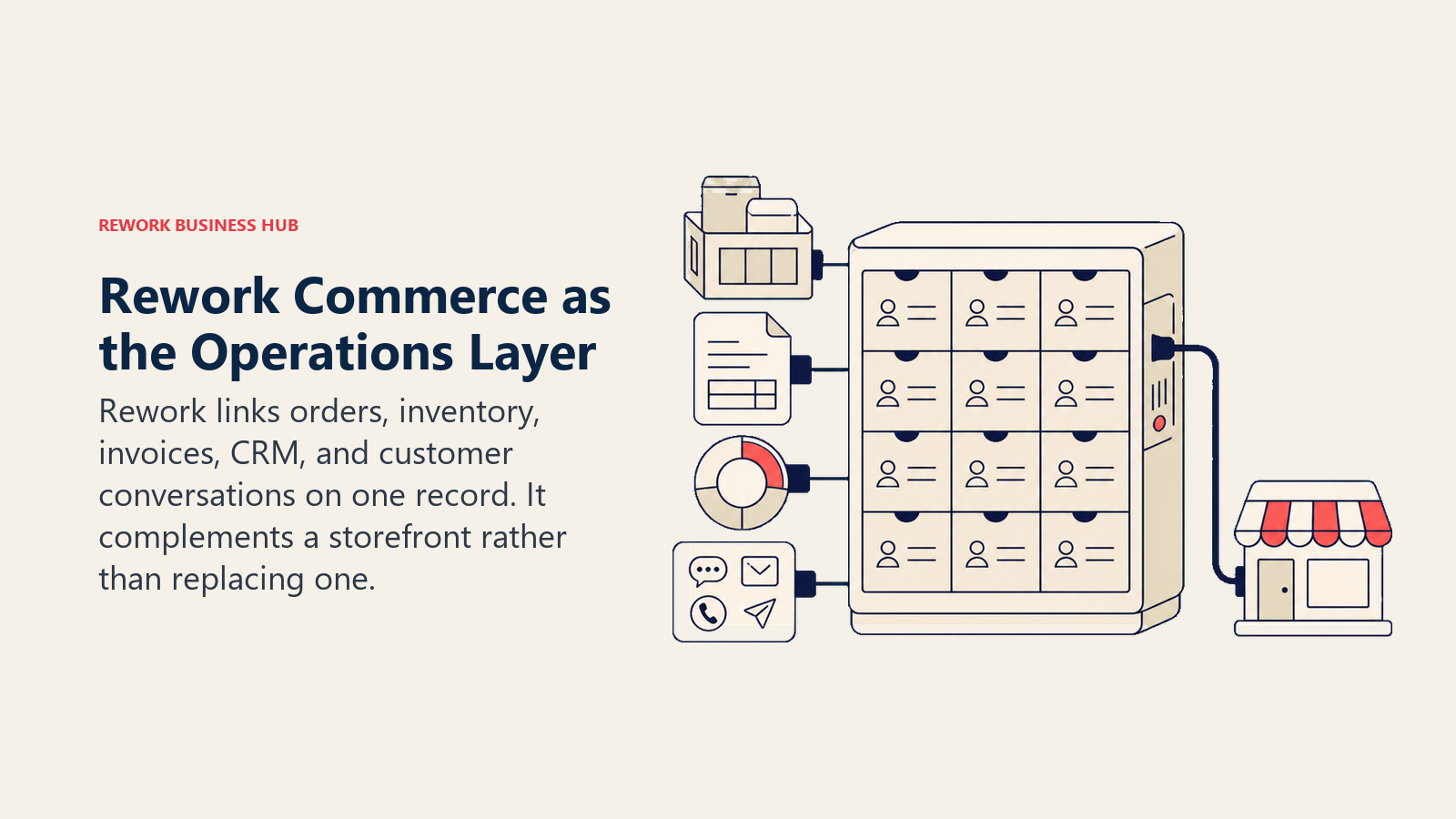
Rework's Commerce module handles order and commerce operations inside the wider Rework platform, which also carries Sales CRM, Lead, Inventory, Invoice, Product, Work Ops, and People. The pitch isn't a themed storefront to replace BigCommerce, Shopify, or Wix; it's that orders, inventory, invoices, and the customer record sit on one platform instead of syncing a storefront to a separate CRM, inventory tool, and accounting tool. Rework also runs a unified multi-channel inbox (WhatsApp, Messenger, Instagram DM, TikTok, Zalo, web chat) on one contact timeline, fitting social-commerce and B2B sellers wanting a CRM and expense tracking tied to the same order.
Rework does not publish a price for Commerce. Rework sells packaged plans, not per-user commerce licenses, and pricing is quoted per organization. See rework.com/pricing for the published product lines, or ask the team for a Commerce quote.
| What you get | What you don't |
|---|---|
| Orders, inventory, invoices, and the customer record on one platform | A themed web storefront or a template gallery |
| CRM, Lead Ops, Work Ops, and People alongside Commerce | A checkout platform for a standalone D2C web shop |
| A unified multi-channel inbox on the same contact timeline | Multi-storefront depth built for a from-scratch brand site |
Pricing: Rework does not publish a price for Commerce. Rework sells packaged plans, not per-user licenses, and Commerce is quoted per organization. See rework.com/pricing. Best for: Mid-size operators (roughly 10-200 people) wanting orders, inventory, and the customer record unified with CRM and Work Ops instead of a storefront synced to separate tools. Not ideal for: Rework is not a storefront builder. It doesn't host a themed web storefront, ship a template gallery, or serve as checkout for a D2C web shop; among storefront platforms, it's the operations layer behind or beside one, not a replacement for Shopify's or BigCommerce's storefront.
7. Shopware: European Enterprise and Multi-Shop B2B
Shopware built its name in Europe, particularly Germany, on native multi-shop and B2B architecture that rivals BigCommerce's own multi-storefront story, plus an open, API-first foundation development teams can extend without fighting the platform. It's the closest thing on this list to BigCommerce's own "deep native features, open APIs" positioning, just priced and sold differently.
Shopware's Community Edition is free and self-hosted. Paid tiers run in euros: Rise from EUR 600/mo excluding VAT, Evolve from EUR 2,400/mo excluding VAT, and Beyond custom-quoted. The Shopware Intelligence+ add-on runs EUR 29/mo on Community and EUR 19/mo on the paid editions.
| What you get | What you don't |
|---|---|
| Native multi-shop and B2B architecture out of the box | US dollar pricing (all paid tiers are quoted in euros) |
| An open, API-first platform built for developer extension | A budget-friendly entry point above Community Edition |
| A free, self-hosted Community Edition | A large English-language app marketplace like Shopify's |
Pricing: Community Edition free (self-hosted); Rise from EUR 600/mo excl. VAT; Evolve from EUR 2,400/mo excl. VAT; Beyond custom. Best for: European enterprise and mid-market sellers needing native multi-shop, B2B, and headless architecture. Not ideal for: US-based small sellers wanting a simple, dollar-denominated SaaS plan.
8. Ecwid by Lightspeed: Commerce Added to an Existing Site
Ecwid's pitch differs from every storefront-builder here: instead of replacing your website, it drops a shopping cart widget into a site, blog, or social profile you already have. That fits a business whose real site already exists and just needs a sell button, not a full replatform.
Ecwid's free-forever plan is gone. Entry is the Starter plan at $5/mo (up to 10 products), then Venture at $35/mo or $29/mo annual (100 products), Business at $65/mo or $49/mo annual (2,500 products), and Unlimited at $149/mo or $119/mo annual, with no setup or transaction fees at any tier.
| What you get | What you don't |
|---|---|
| Drops into an existing website, blog, or social profile | A from-scratch storefront builder as a primary site |
| No setup or transaction fees at any tier | A free-forever entry plan (retired) |
| Product-count-based tiers that scale predictably | Deep multi-storefront or B2B tooling |
Pricing: Starter $5/mo (10 products); Venture $35/mo or $29/mo annual (100 products); Business $65/mo or $49/mo annual (2,500 products); Unlimited $149/mo or $119/mo annual. No setup or transaction fees. Best for: Businesses wanting to add commerce to an existing website or social channel without a full replatform. Not ideal for: Sellers wanting a dedicated, ground-up storefront builder as their primary site.
9. Salesforce Commerce Cloud: Enterprise Commerce Tied to Salesforce CRM
Salesforce Commerce Cloud makes sense mainly for organizations already running Salesforce's CRM and marketing stack, since its main differentiator is deep, native tie-in to Salesforce data and Einstein AI personalization, not standalone commerce features. It's an enterprise platform sold and implemented like one.
Salesforce does not publish a simple list price for Commerce Cloud. Commerce Cloud is quoted per merchant and has historically been tied in part to gross merchandise value.
| What you get | What you don't |
|---|---|
| Deep native tie-in to Salesforce CRM and Marketing Cloud | A published price list or self-serve signup |
| Einstein AI personalization built into the commerce layer | A fast, low-touch implementation |
| A strong fit if Salesforce is already the system of record | An SMB or mid-market budget fit |
Pricing: No published price; quoted per merchant, historically tied in part to a percentage of GMV. Best for: Large enterprises already standardized on Salesforce wanting commerce tied natively to that CRM and AI layer. Not ideal for: SMB or mid-market budgets, or teams wanting fast self-serve setup.
10. Webflow Ecommerce: Design Control With Commerce Layered On
Webflow's core appeal is design control: a visual builder that outputs genuinely clean, custom-looking sites without a developer for every change, which appeals to design-led marketing teams more than commerce-first operators. Its ecommerce functionality is layered onto that design-first foundation rather than being the platform's central focus.
Webflow changed its site pricing on 13 May 2026: the CMS and Business site plans were retired for a single Premium site plan, plus a new Team platform plan and custom Enterprise tier. Webflow's ecommerce-specific plans weren't part of that change; existing customers keep current pricing until their next renewal on or after 29 June 2026 (16 November 2026 for Freelancer/Agency workspaces and legacy sites). Webflow's pricing pages block automated verification, so confirm the current Ecommerce dollar figure at webflow.com/pricing; those plans do charge a 0% Webflow transaction fee.
| What you get | What you don't |
|---|---|
| Best-in-class visual design control | A verified current dollar figure for Ecommerce plans here |
| 0% Webflow transaction fee on ecommerce plans | Catalog-heavy or high-transaction-volume commerce depth |
| Clean, custom-looking output without a developer for every edit | Native multi-storefront or B2B tooling |
Pricing: Ecommerce site plans exist alongside Webflow's May 2026 lineup change; confirm the current dollar figure directly at webflow.com/pricing. Ecommerce plans charge 0% Webflow transaction fee. Best for: Design-led marketing sites that also need light ecommerce, not catalog-heavy or high-volume stores. Not ideal for: Sellers whose primary need is deep commerce functionality over visual design control.
11. Square Online: Built for Sellers Already Running Square in Person
Square Online's real advantage shows up for a business that already runs Square's point-of-sale hardware in a physical location: inventory, payments, and orders sync tightly between the in-person register and the online store without a separate integration. For a purely online seller, that advantage mostly disappears.
Square's pricing pages block clean automated extraction. Square publishes a free tier for a basic online store plus paid upgrades, with card processing charged per transaction rather than a flat platform fee; we won't assert specific plan dollar figures without a vendor page confirming them.
| What you get | What you don't |
|---|---|
| Tight in-person and online inventory/payments sync | A verified dollar figure for every plan tier here |
| A free tier to start selling online quickly | Native multi-storefront or B2B depth |
| A natural fit if Square already runs your physical register | Deep customization for a complex, catalog-heavy store |
Pricing: Free tier plus paid upgrades; card processing charged per transaction (confirm current figures at squareup.com). Best for: Sellers already running Square point-of-sale in a physical location wanting tight online/offline sync. Not ideal for: Purely online sellers with no physical retail component, or multi-storefront and B2B operations.
12. Shift4Shop: A Processor-Linked Free Tier for US Merchants
Shift4Shop (formerly 3dcart) offers a genuinely full-featured platform, and its best-known hook is a free plan tied to processing payments through Shift4 Payments, a good trade for a US merchant comfortable committing to one processor.
Shift4Shop's End-to-End eCommerce plan is priced at $41/month, and the platform showed a regional-availability notice during pricing verification, so it isn't available everywhere. Third-party sources still describe a $0/month US plan conditional on Shift4 Payments; confirm that condition directly with Shift4Shop before counting on it.
| What you get | What you don't |
|---|---|
| A full-featured platform with a processor-linked free option | Guaranteed availability in every country or region |
| A published $41/mo plan if the free tier doesn't fit | Payment-processor independence on the free tier |
| US-market focus with a mature feature set | BigCommerce-level native B2B or multi-storefront depth |
Pricing: End-to-End eCommerce plan $41/mo; a processor-linked free tier is reported for US merchants using Shift4 Payments (reported), availability is regional.
Best for: US-based merchants willing to commit to Shift4 Payments in exchange for a free or low-cost platform tier.
Not ideal for: Sellers wanting payment-processor independence or guaranteed availability outside the US.
13. PrestaShop: Open-Source Control for the European Market
PrestaShop has its strongest footprint in France and wider Europe, with a deep ecosystem of local modules, payment providers, and agencies. Like Magento Open Source, the appeal is code ownership without a license fee, for a merchant or agency running its own infrastructure.
PrestaShop publishes a free, open-source download (Classic) and a separate Hosted offer, but does not publish a price for the Hosted offer on its own pages.
| What you get | What you don't |
|---|---|
| A free, open-source core with full code ownership | A published price for the Hosted offer |
| A deep local module and agency ecosystem in Europe | Managed hosting or automatic updates on Classic |
| Real flexibility for a development-capable team | A large English-language app marketplace |
Pricing: Classic is free and self-hosted; PrestaShop publishes no price for its Hosted offer. Best for: European, especially French-market, merchants and agencies wanting open-source control. Not ideal for: Teams wanting a managed SaaS platform with no hosting responsibility.
14. Big Cartel: The Cheapest Entry Point for Independent Makers
Big Cartel is built specifically for artists, musicians, and independent makers with small catalogs, not general-purpose commerce at any scale, and its pricing reflects that focus deliberately.
Big Cartel's plan names changed; the old $9.99/$19.99/$29.99 tiers are retired. The current lineup is a free Gold plan with limited features, Platinum at $15/mo, and Diamond at $30/mo, with annual billing reported at $12/mo (Platinum) and $24/mo (Diamond) (reported); Gold's product cap is reported at 5 products (reported).
| What you get | What you don't |
|---|---|
| The cheapest entry point on this list, including a free tier | Multi-storefront, B2B, or wholesale tooling |
| A feature set built specifically for creative sellers | Deep catalog or high-volume inventory management |
| Simple, low-friction setup for a small shop | A path that scales cleanly into serious commerce volume |
Pricing: Gold free (limited); Platinum $15/mo ($12/mo annual, reported); Diamond $30/mo ($24/mo annual, reported). Best for: Independent artists and makers with small catalogs wanting the cheapest possible entry point. Not ideal for: Any team needing multi-storefront, B2B, or serious catalog scale.
Why Teams Leave BigCommerce
BigCommerce's strengths are real: no platform percentage of a sale when you use an embedded payment partner, native multi-storefront and B2B tooling, and open APIs that beat platforms needing a stack of apps for the same depth. That's why it stays a strong default for multi-brand and B2B sellers wanting those capabilities included, not assembled.
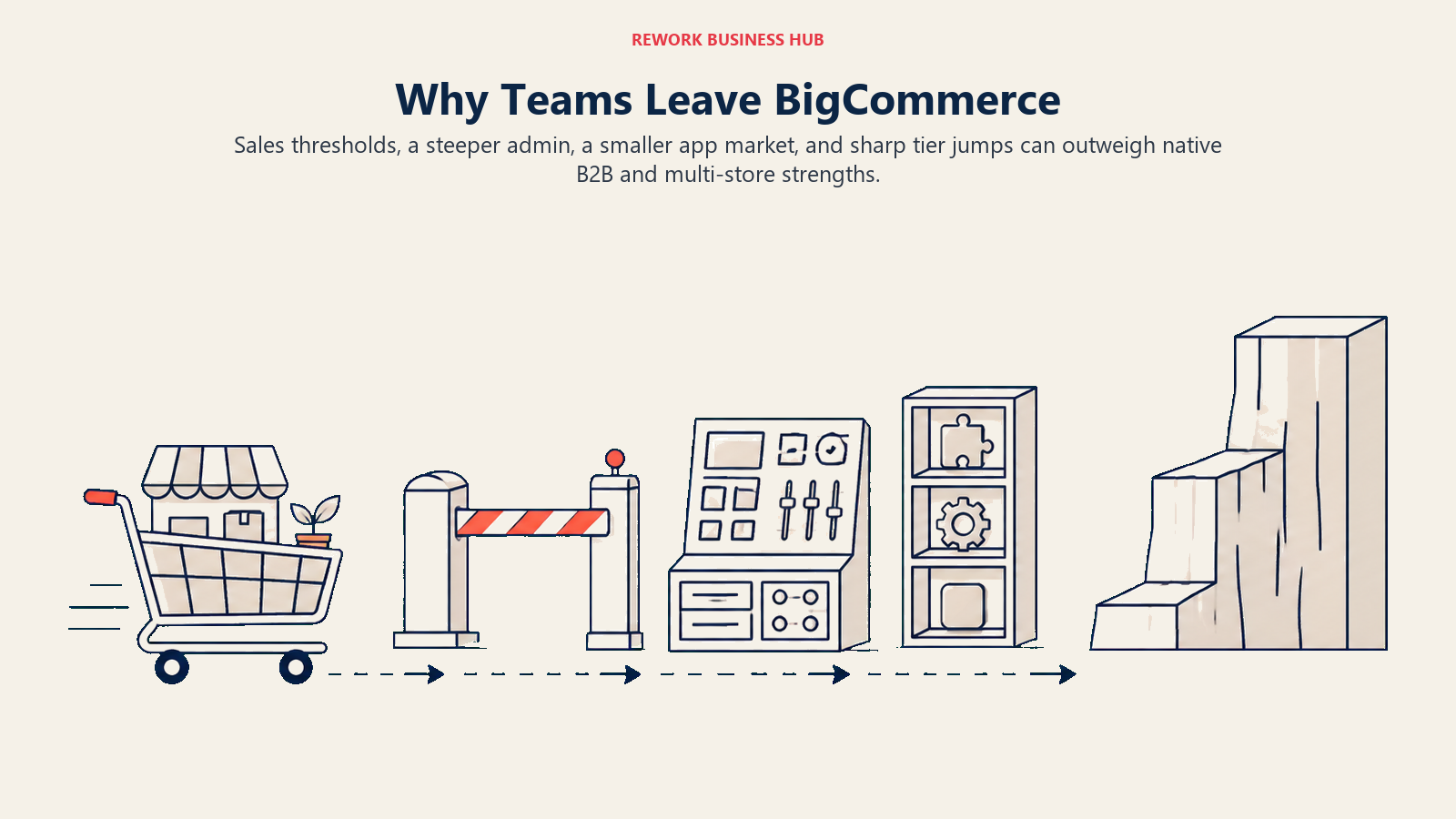
The reasons teams leave anyway:
The online sales limit forces an upgrade whether you're ready or not. BigCommerce plans are priced against trailing-twelve-month GMV, gross order value minus 10%, and taxes and shipping count toward that number. Cross $30,000 on Core or $100,000 on Growth and the account auto-upgrades, sometimes months earlier than a merchant's real growth would suggest.
A steeper admin learning curve than Shopify's. Only 14% of businesses report being satisfied with their current ecommerce platform, and among merchants who recently switched, 41% cited improving customer experience and 38% cited needing greater customization and flexibility. (commercetools) BigCommerce's deeper native feature set means more surface area to learn, which shows up most for a first-time merchant without a developer on staff.
A smaller app and theme ecosystem to lean on. Shopify's App Store lists more than 16,000 apps against roughly 1,200 in BigCommerce's own App Marketplace. For a common integration need, that gap usually means Shopify has three vetted options where BigCommerce has one, or none.
A sharp price jump above the middle tier. Growth costs $105/mo, but Scale jumps to $399/mo, and Performance moves to custom pricing from $1,499/mo annually, nearly a 4x jump the same cycle a merchant outgrows Growth's sales limit.
How to Choose: Decision Framework
Start with the operating constraint you are trying to remove, then choose the platform whose native model solves it.
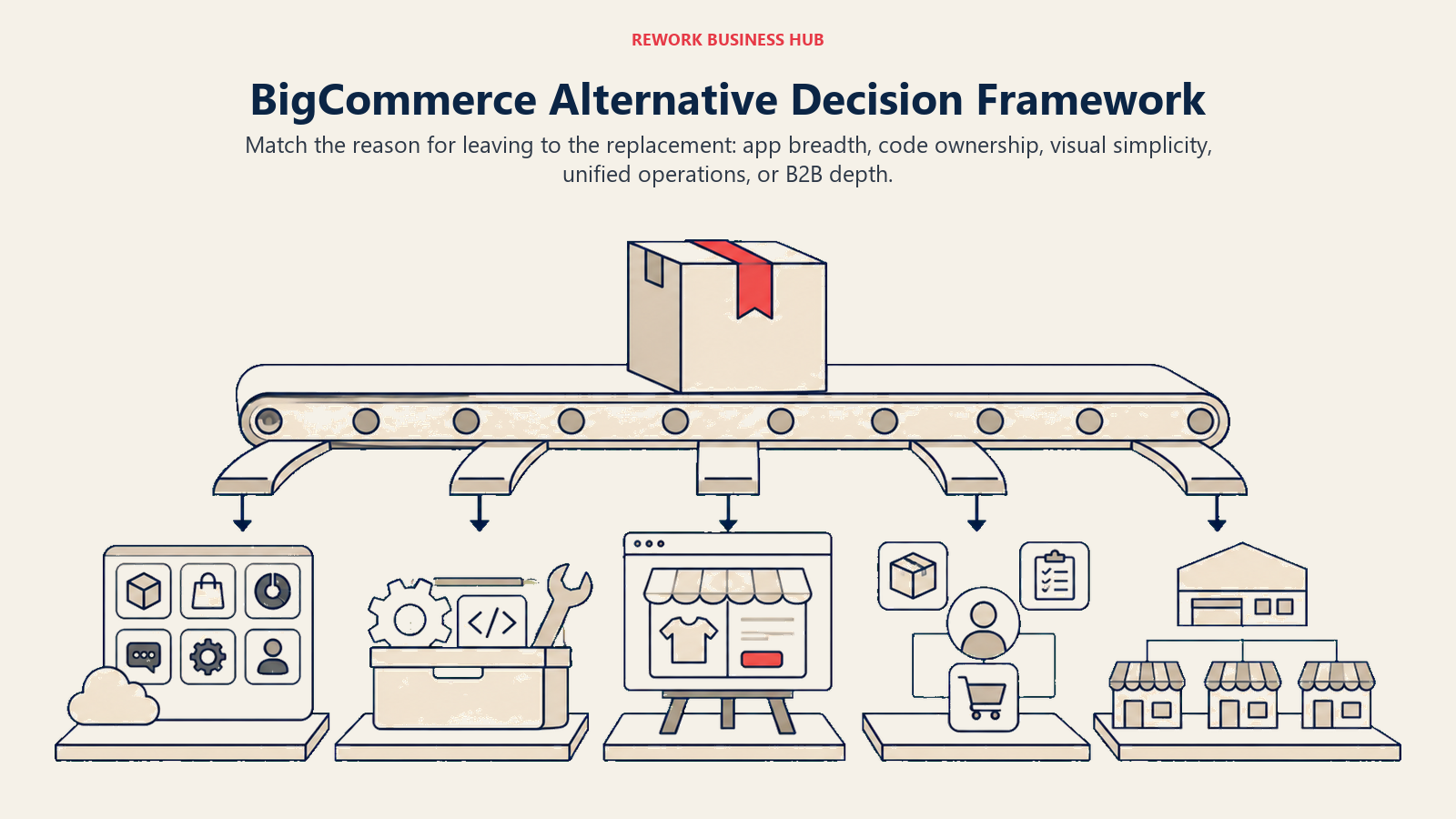
| If your team needs... | Best pick |
|---|---|
| The fastest setup and the largest app ecosystem to draw on | Shopify |
| Full code ownership on WordPress with no platform license fee | WooCommerce |
| Enterprise catalog depth or free, self-hosted code | Adobe Commerce or Magento Open Source |
| The simplest visual builder with commerce attached | Wix |
| Orders, inventory, and the customer record on one platform instead of three synced tools | Rework |
| Native multi-shop and B2B architecture, European fit | Shopware |
| To add a cart to an existing site without replatforming | Ecwid by Lightspeed |
Frequently Asked Questions about BigCommerce Alternatives
Why do merchants leave BigCommerce?
The online sales limit forces an automatic tier upgrade based on trailing-twelve-month GMV, the admin has a steeper learning curve than Shopify's, the app ecosystem is a fraction of Shopify's size, and Growth-to-Scale-to-Performance pricing jumps fast.
What are BigCommerce's actual pricing tiers in 2026, and how is the sales limit calculated?
Core $39/mo ($29 annually, up to $30K), Growth $105/mo ($79 annually, up to $100K), Scale $399/mo ($299 annually, $33,333/mo cap with overage), Performance custom from $1,499/mo annually. The limit is trailing-twelve-month GMV, gross order value minus 10%, and taxes and shipping count toward it. Standard, Plus, and Pro are retired names.
What is the cheapest BigCommerce alternative with published pricing?
WooCommerce has no platform license fee, though hosting and extensions still cost money. Ecwid's Starter plan runs $5/mo, and Big Cartel's Gold plan is free with limited features.
Does Rework replace BigCommerce?
No. Rework is not a storefront builder: it doesn't host a themed storefront, ship a template gallery, or serve as checkout for a D2C web shop. Its Commerce module fits a mid-size team wanting orders, inventory, and the customer record on the same platform as its CRM and Work Ops.
Is there a good BigCommerce alternative for B2B or multi-storefront sellers specifically?
Shopware and Adobe Commerce both offer genuine native multi-shop and B2B depth, and Salesforce Commerce Cloud fits large enterprises already on Salesforce. Shopify reaches similar functionality on its Plus tier plus apps, but not natively the way BigCommerce does.
When does it make sense to stick with BigCommerce?
If your tier's sales limit isn't close, you're using its native multi-storefront or B2B tooling, and your team has already climbed the admin learning curve, switching rarely pays off. Its zero-platform-fee model and open APIs are real advantages once the setup work is done.
What to Do Next
Match your real reason for leaving, hitting the sales limit, wanting Shopify's ecosystem, needing a cheaper self-hosted stack, or wanting orders unified with your CRM, to the framework above, then run your top two picks against a real batch of your own catalog and order data, not a vendor demo store. If app-ecosystem breadth is why you're leaving, start with Shopify; if you want orders, inventory, and the customer record unified with CRM and Work Ops instead of a synced storefront, start with Rework's Commerce module.

Principal Product Marketing Strategist
On this page
- Key Facts
- BigCommerce's Actual Tiers in 2026
- Quick Comparison Table
- 1. Shopify: The Default Migration Target for Speed and App Choice
- 2. WooCommerce: Full Code Control on WordPress
- 3. Adobe Commerce and Magento Open Source: Enterprise Depth or Free Self-Hosted Code
- 4. Wix: The Simplest Visual Builder With Commerce Attached
- 5. Squarespace: Design-Forward Storefronts
- 6. Rework: Orders, Inventory, and the Customer Record on One Platform
- 7. Shopware: European Enterprise and Multi-Shop B2B
- 8. Ecwid by Lightspeed: Commerce Added to an Existing Site
- 9. Salesforce Commerce Cloud: Enterprise Commerce Tied to Salesforce CRM
- 10. Webflow Ecommerce: Design Control With Commerce Layered On
- 11. Square Online: Built for Sellers Already Running Square in Person
- 12. Shift4Shop: A Processor-Linked Free Tier for US Merchants
- 13. PrestaShop: Open-Source Control for the European Market
- 14. Big Cartel: The Cheapest Entry Point for Independent Makers
- Why Teams Leave BigCommerce
- How to Choose: Decision Framework
- What to Do Next