Vagaro vs Calendly vs Mindbody: Meeting Scheduler or Service Business Platform in 2026?
Turn this article into takeaways for your work.


Each assistant summarizes the article only for you and suggests best practices for your work.
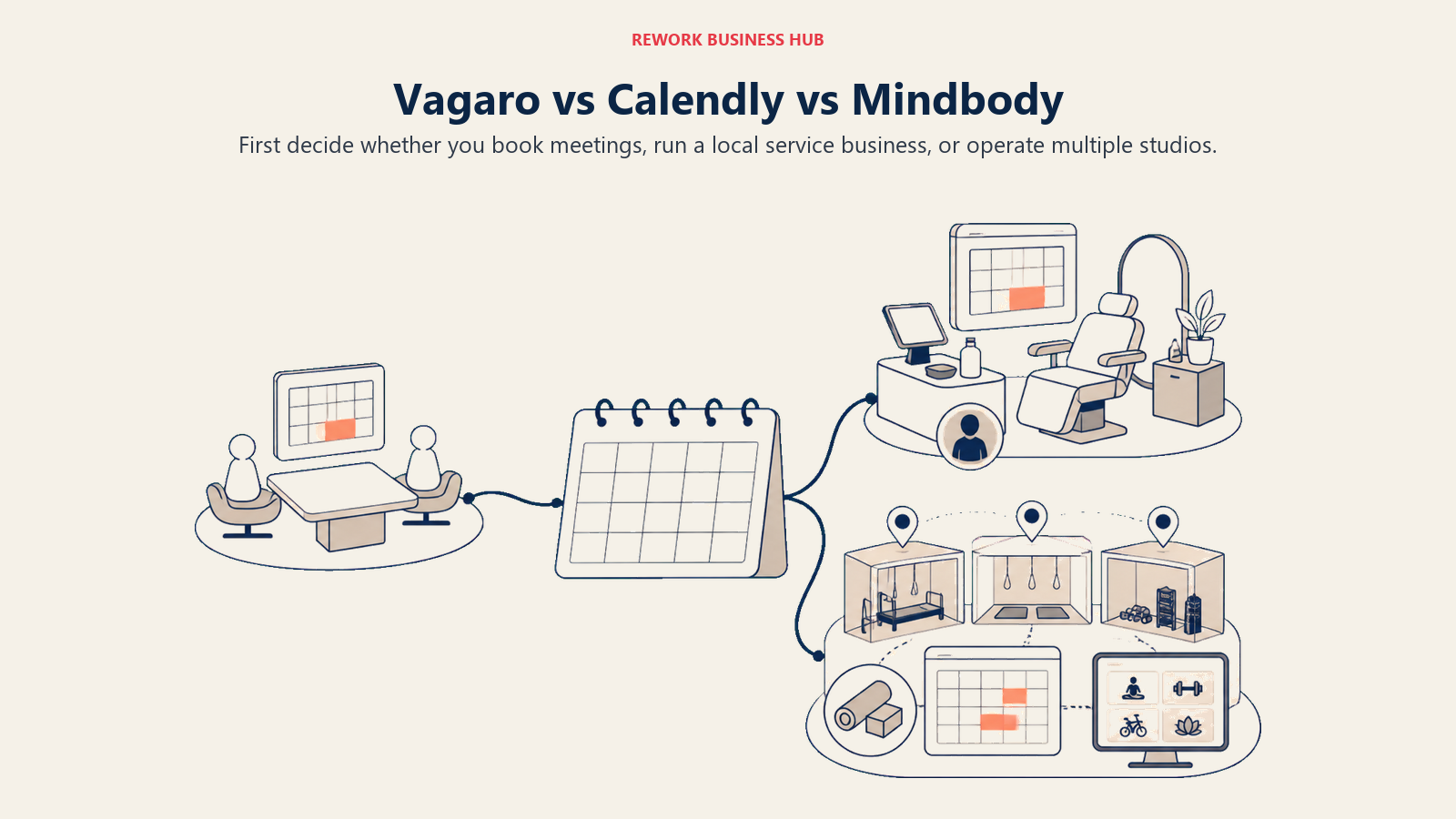
These three tools get lumped into the same "scheduling software" search results, and that's the first thing to unlearn before comparing a single feature. Calendly is meeting scheduling for knowledge workers. Someone picks a slot on your calendar, the meeting happens, and Calendly's job is done. Vagaro and Mindbody are something else entirely: business management platforms for salons, spas, gyms, and studios, where the appointment is just one module sitting next to point of sale, memberships, packages, payroll, retail inventory, and, in both cases, a consumer marketplace that sends new customers looking for somewhere to spend their money.
So the real first question isn't "which tool has better features." It's whether you're scheduling meetings or running a location-based service business. Get that wrong and you'll spend months bending the wrong tool into a shape it was never built for, either paying for salon-grade business software to book sales calls, or trying to run deposits, packages, and staff commissions through a tool that only knows how to protect a calendar.
If you land on the meeting-scheduling side, Calendly is close to the whole answer, and this guide explains why. If you land on the service-business side, the harder decision is Vagaro versus Mindbody, and that's where this article spends most of its time. Vagaro is the more affordable, more transparent option of the two, priced per bookable staff member with its pricing published down to the calendar, and it dominates with salons, barbers, and independent wellness professionals. Mindbody is the incumbent in fitness and boutique studios, with a bigger consumer marketplace, a stronger multi-location and enterprise story, pricing that's quote-only past its entry tier, and a reputation among reviewers for contracts that are harder to get out of than Vagaro's. We priced all three at 1, 5, and 15 bookable staff, and dug into payment processing rates too, since for Vagaro and Mindbody that's often where more of the real annual cost sits than the subscription line does.
Key Facts
- Vagaro's own marketplace page claims more than 52 million potential clients search it, with 35 million appointments booked annually, and states plainly that listings carry "$0 booking fees, which means you keep all the profit," per Vagaro's marketplace page (vendor claim).
- Mindbody's own app page claims more than 3 million active users and says consumers booked over 60 million classes and appointments a month globally in 2025, with more than 22,000 consumers a month making a first purchase at a business through the app, per Mindbody's app page (vendor claim).
- That marketplace reach isn't free for the business: Mindbody charges a 20% commission on a new client's first purchase made through its app, marketplace, or a promoted intro offer, capped at $30 per booking, according to multiple Mindbody fee breakdowns including Gymdesk's Mindbody fee guide (reported, not published on Mindbody's own pricing page).
- Vagaro's own support documentation publishes exact card processing rates: 2.6% + $0.10 per swiped, dipped, or tapped transaction for small merchants, and 2.29% + $0.19 for large merchants processing over $4,000 a month, per Vagaro's US processing rates article.
- The global appointment scheduling software market was valued at $546.1 million in 2025 and is projected to reach $1,905.90 million by 2034, a 14.70% CAGR, per Fortune Business Insights.
What Each Tool Is Actually Built For
Before any pricing table matters, sort out which of two jobs you're actually buying for. They aren't variations on the same product.
| Calendly | Vagaro | Mindbody | |
|---|---|---|---|
| Core job | Book a meeting slot on a calendar | Run a salon, spa, barbershop, or wellness business, with booking as one module | Run a fitness or wellness studio, often multi-location, with booking as one module |
| What "a booking" means | A meeting: sales call, interview, consult, sync | An appointment tied to a service, a price, a staff member, and usually a payment | A class or appointment tied to a service, a price, and usually a payment |
| Sits next to | A CRM or applicant tracking system, feeding meetings into a pipeline | Point of sale, memberships, packages, payroll, retail inventory, marketing | Point of sale, memberships, class packages, room and resource management, marketing |
| Consumer marketplace | None | Vagaro Marketplace, plus listing on Instagram, Facebook, and Apple Maps | Mindbody app and marketplace, the larger of the two by claimed active users |
| Typical buyer | Sales rep, recruiter, consultant, founder | Solo stylist up to a multi-chair salon or spa owner | Studio or gym owner, often overseeing more than one location |
Calendly's whole design center is protecting one person's (or one team's) calendar from an endless "does Tuesday work?" email thread. It has no native concept of a deposit, a package, or a retail product, because it was never meant to run a business, just a schedule. If you're deciding between Calendly and a single-vendor client-booking tool rather than a full business platform, we cover that narrower question directly in Calendly vs Acuity Scheduling.
Vagaro and Mindbody both assume the opposite: that booking is inseparable from running the business. A client picks a specific stylist, trainer, or class, pays at the time of booking or through a prepaid package, and that transaction needs to reconcile against retail sales, staff commissions, and monthly reporting. Neither is a fit for scheduling internal meetings or sales calls, and neither is a fit for a service business outside beauty, fitness, and wellness. A law firm, a repair shop, or a tutoring business will find both tools' features (commission tracking, class capacity, retail inventory) built for a vertical they don't belong to. If that's your situation, a general-purpose client-booking tool is the better starting point; see Best Acuity Scheduling Alternatives for that field.
One more disambiguation, since it trips up a lot of searches: none of these three tools schedule employee shifts or track labor hours. That's a workforce management problem, covered in Best Employee Scheduling Software in 2026, not an appointment-booking one.
The Marketplace Question: Paying for Software, or Paying for a Customer Pipeline
This is the part of the Vagaro-versus-Mindbody decision that isn't really a feature comparison, it's a different business relationship, and it deserves to be named plainly rather than buried in a feature table.
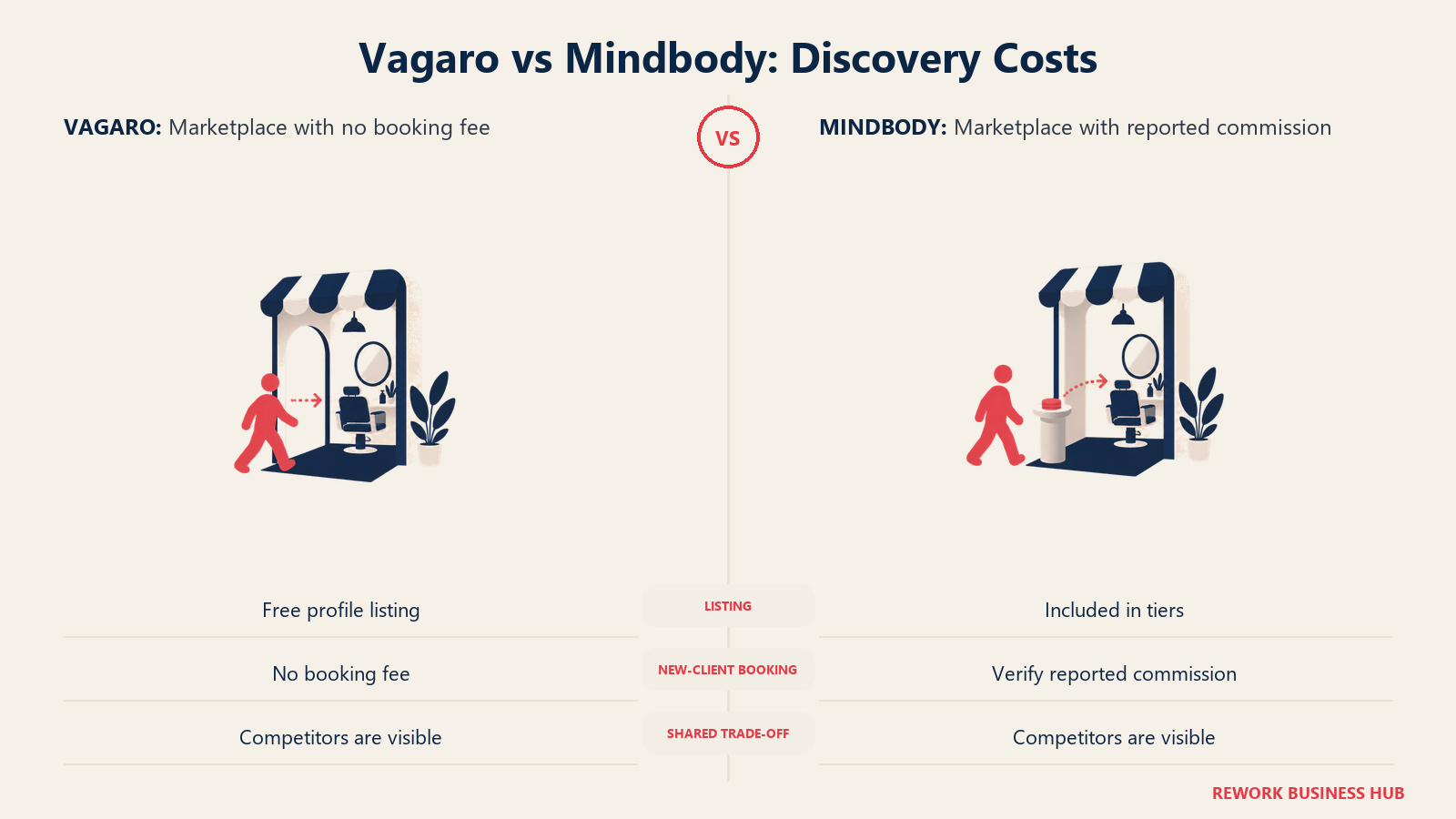
Every tool in this article lets you book existing clients. Vagaro and Mindbody go further: both operate a consumer-facing marketplace where people who've never heard of your business can find you, discover a class or service, and book it directly. That's a genuinely different value proposition from buying software. You're not just paying for a calendar, you're paying (or not paying, depending on the tool) for a customer acquisition channel, and that channel comes with a real downside: it also introduces your client base to every other business listed next to you, including your direct competitors.
| Vagaro | Mindbody | |
|---|---|---|
| Marketplace reach (vendor claim) | 52M+ potential clients searching, 35M appointments booked annually | 3M+ active users, 60M+ classes and appointments booked monthly (2025) |
| Cost to list | Free, automatic once your profile is complete | Included in all tiers |
| Cost when a marketplace lead books | $0 booking fees | 20% commission on a new client's first purchase via the app, marketplace, or a promoted intro offer, capped at $30 (reported) |
| Where you're also listed | Vagaro Marketplace, Instagram, Facebook, Apple Maps | Mindbody consumer app and marketplace |
| The tradeoff | Free discovery, smaller claimed reach | Larger claimed reach, but a real commission on the new clients it sends you |
Run the math on a single booking to see why this matters more than it looks like it should. A $100 service booked in person through either platform costs roughly the same in raw payment processing, a few dollars either way. But if that $100 booking is a brand-new client who found you through Mindbody's marketplace or app, Mindbody's reported 20% commission adds another $20 on top of processing, since $20 is under its $30 cap. That single new-client booking effectively costs somewhere around 23 to 24% combined, once processing and commission are both counted, a figure several Mindbody fee trackers land on independently, though Mindbody doesn't publish that combined number on its own pricing page. Vagaro's equivalent marketplace booking costs whatever standard card processing costs and nothing more.
Neither model is wrong. A commission you only pay when the marketplace actually sends you a paying client is, for some businesses, a perfectly reasonable growth channel, especially if Mindbody's larger claimed user base genuinely reaches more people than Vagaro's. But it's a decision you're making, not a feature you're getting for free, and it's worth naming before you sign up for either platform on the strength of "it has a marketplace" alone.
Decision by Business Goal
| Your goal | Pick |
|---|---|
| Protect your calendar and never miss a sales call or interview | Calendly |
| Route inbound meeting requests to the next available rep automatically | Calendly (Teams plan) |
| Get new clients finding you without running paid ads, and keep every dollar of what they spend | Vagaro |
| Get new clients through the largest wellness-specific consumer app, and you can absorb a commission on the first visit | Mindbody |
| Run payroll, retail inventory, and staff commissions in the same login as booking, at a transparent per-staff price | Vagaro |
| Manage a multi-location gym or studio chain with enterprise reporting and room or resource scheduling | Mindbody |
| Keep your software bill fully predictable without a sales call | Calendly or Vagaro |
| Avoid a long-term contract | Calendly or Vagaro (both cancel anytime, no fee); Mindbody's terms are reported to run longer |
Team and Role Fit
| Calendly | Vagaro | Mindbody | |
|---|---|---|---|
| Ideal buyer | Sales rep, recruiter, consultant, founder protecting their own calendar | Solo stylist through salon, spa, or barbershop owner | Studio or gym owner, often a multi-location operations lead |
| Team shape | Individuals, plus teams with centrally managed event types | Each staff member gets their own bookable calendar under one business account | Staff and class instructors under one location account, with multi-location support at higher tiers |
| Who owns the account | An individual, or a sales ops admin for team plans | The owner or an office manager, often solo | A studio manager, frequently with corporate oversight once there's more than one location |
| Who the "client" is | A prospect booking time with a specific rep | A client booking a specific person or service they already know | Often a first-time consumer discovering the business through the app |
| Typical headcount range | 1 to enterprise sales and recruiting orgs | 1 to roughly 50 | Roughly 20 to 500, skewing toward multi-location |
Pricing at 1, 5, and 15 Bookable Staff
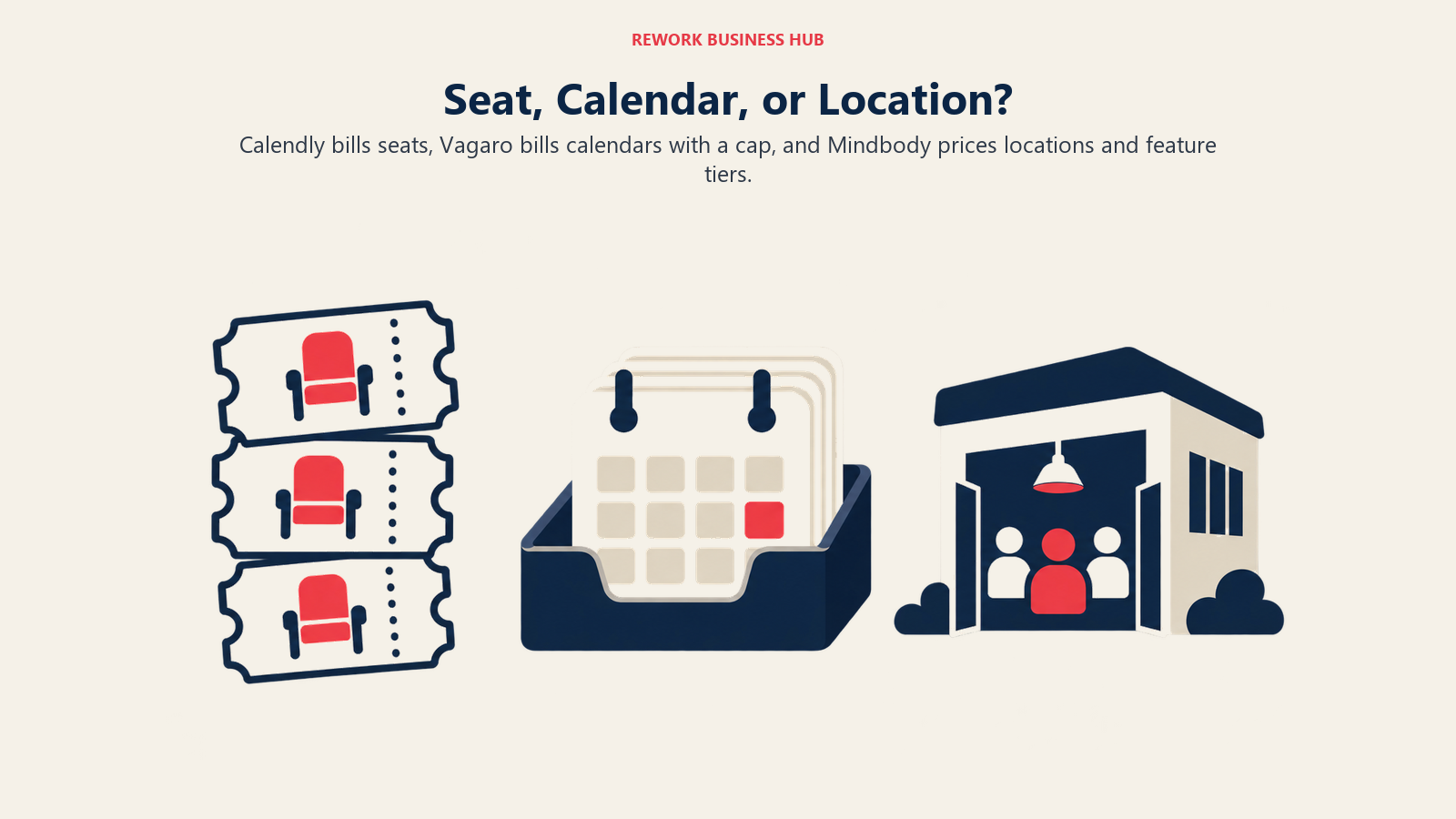
This is where the three tools stop being comparable on a single chart, because they don't price on the same unit. Calendly charges per seat. Vagaro charges per bookable calendar, with the increment published. Mindbody charges per location, with unlimited users included even at its cheapest tier, but only that cheapest tier has a public number.
Calendly, per Calendly's pricing page: Free forever, limited to 1 event type and 1 calendar connection. Standard is $10 per seat per month billed annually. Teams is $16 per seat per month billed annually, and it's the tier that adds round-robin routing and centrally managed event types. Enterprise starts at $15,000 a year with a 50-seat minimum.
Vagaro, per Vagaro's pricing page and its own plans and pricing support article: the base subscription is $23.99 a month (shown as a limited-time offer against a $30 standard rate) and includes one bookable calendar. Each additional employee calendar costs $10 a month, for up to seven calendars total. Once you've paid for seven, every calendar after that is free, which is a detail Vagaro's own help center publishes even though it doesn't show on the main pricing page's slider.
Mindbody, per Mindbody's pricing page: Starter is "starting at $99 USD per month per location," and includes unlimited users at that one location. Accelerate and Ultimate, the tiers that add analytics, room and resource management, and marketing automation, are both listed as "Let's talk" with no published number.
| Staff / calendars | Calendly (per-seat) | Vagaro (per-calendar) | Mindbody (per-location) |
|---|---|---|---|
| 1 | Free (1 event type) or Standard $10/mo = $120/yr | $23.99/mo = $287.88/yr, 1 calendar | Starter $99/mo = $1,188/yr per location, if Starter's feature set is enough |
| 5 | Standard: 5 x $10 = $50/mo = $600/yr. Teams (with routing): 5 x $16 = $80/mo = $960/yr | $23.99 + (4 x $10) = $63.99/mo = $767.88/yr, 5 calendars | Still $99/mo per location on Starter, since unlimited users are included, but many 5-person shops need Accelerate for analytics or room scheduling, which is quote-only |
| 15 | Standard: 15 x $10 = $150/mo = $1,800/yr. Teams: 15 x $16 = $240/mo = $2,880/yr | $23.99 + (6 x $10) = $83.99/mo = $1,007.88/yr, capped here since calendars 8 through 15 are free | Same $99/mo headline on Starter, but a 15-person, multi-service operation is realistically an Accelerate or Ultimate conversation, and both are quote-only |
Two things stand out. First, Vagaro's cost per month actually caps at $83.99 once you hit seven paid calendars, so a 15-person shop and a 30-person shop pay the identical base subscription, a detail worth knowing before you assume price rises in a straight line with headcount. Second, Mindbody's headline number doesn't move with staff count at all, because it prices by location and bundles unlimited users into every tier; what actually moves the price is which feature tier you need, and that's exactly the boundary where Mindbody stops publishing numbers. Budget for a sales call, not a slider, once you're past Starter's fairly basic feature set.
Payment Processing: Where the Real Cost Often Sits
For Calendly, payment is optional and rarely relevant. For Vagaro and Mindbody, nearly every booking involves a card, which means the processing rate matters as much as the subscription tier, sometimes more, over a full year.
| Calendly | Vagaro | Mindbody | |
|---|---|---|---|
| Who processes the payment | Your own connected Stripe or PayPal account | Vagaro Merchant Services, built into the platform | Mindbody's integrated payments, built into the platform |
| Card-present rate | Not applicable, Calendly doesn't process in-person payments | 2.6% + $0.10 (small merchant, under $4,000/mo volume) or 2.29% + $0.19 (large merchant, over $4,000/mo) | 2.99% + $0.30 (reported) |
| Keyed-in / online rate | Whatever your own Stripe or PayPal account charges | 3.5% + $0.19 at both merchant tiers | 3.60% + $0.30 (reported) |
| Extra fees | None from Calendly itself | $10/mo subscription for large merchants, plus small FANF and Mastercard location fees | 20% commission on a new client's first marketplace-sourced purchase, capped at $30 (reported) |
| Source | Calendly pricing | Vagaro US processing rates | Gymdesk Mindbody fee guide and similar third-party trackers |
Calendly not having a processing rate of its own isn't an oversight, it's the same story as the rest of this article: payment was never core to what Calendly sells, so it hands that job off entirely to whichever gateway you already use. Vagaro and Mindbody both built payments in because, for most of their customers, the booking is the sale. That's worth remembering if you're also shopping for a standalone payment processor. Our how to choose a payment processor guide walks through the criteria if you want to evaluate Vagaro's or Mindbody's built-in rates against a dedicated processor rather than take either bundled rate as a given.
What's Actually Bundled Beyond Booking
Since Vagaro and Mindbody are business platforms first, the appointment calendar is a small part of what you're paying for. This is where the two diverge from Calendly hardest.

| Capability | Calendly | Vagaro | Mindbody |
|---|---|---|---|
| Point of sale / retail | Not offered | Native, including inventory tracking | Native, including retail sales |
| Memberships and packages | Not offered | Native | Native, plus class series pricing |
| Staff commission tracking | Not offered | Native | Available, more common at higher tiers |
| Payroll | Not offered | Available as an add-on | Not a core feature |
| Email / text marketing | Basic reminders only | Native, 1,000 free emails monthly included | Native, deeper campaign tools on Ultimate |
| Room / resource scheduling | Not offered | Not a core feature | Native on Accelerate and above |
| CRM / pipeline integration | Native and Zapier connections to Salesforce, HubSpot, and similar tools | Limited; mostly reached through Zapier | Limited; mostly reached through Zapier |
If your team already lives inside a CRM and the booking is really a pipeline event, not a retail transaction, that CRM-native integration is one of Calendly's real advantages over either business platform; see our best CRM software roundup if that's the deciding factor for you.
Implementation and Change Management
| Calendly | Vagaro | Mindbody | |
|---|---|---|---|
| First working booking link | Minutes | Under an hour for one calendar | Longer; onboarding is guided rather than self-serve |
| Heaviest setup work | Event types, buffer rules, team routing logic | Service menu, staff calendars, POS setup, memberships, marketplace profile | Class schedules, room and resource rules, marketplace listing, payment setup |
| Who typically owns setup | An individual, or a sales ops admin | The owner or office manager, often solo | A studio manager, often working with Mindbody's own onboarding team |
| Vendor-provided onboarding | Self-serve, help center and guides | Self-serve, help center and guides | 1-on-1 setup and training included on every tier, per Mindbody's pricing page |
| Ongoing maintenance | Light, mostly new event types | Moderate: pricing, packages, and staff calendars change as the business does | Heavier, especially across multiple locations with shared reporting |
Calendly's setup is lighter because the unit of work is smaller: one person, one calendar, a handful of event types. Vagaro and Mindbody both take longer because they're standing up real business logic (pricing, staff assignment, retail, marketing), not just a shareable link. Mindbody's guided onboarding is a genuine offset to its heavier setup, and it's included rather than billed separately, which is worth factoring in if a DIY setup isn't realistic for your team.
Risk and Governance
| Calendly | Vagaro | Mindbody | |
|---|---|---|---|
| Contract terms | Monthly or annual seat billing, cancel anytime | Month-to-month; "cancel anytime with no cancellation fees" per Vagaro's own pricing page | Reported to commonly run 12-month terms with an early-termination cost, though Mindbody doesn't publish contract terms on its pricing page |
| Pricing transparency | Fully published, all tiers | Entry tier and calendar increment published; multi-location pricing is quote-only | Only the Starter tier's headline number is published; everything above it is quote-only |
| Client data exposure | None, no consumer marketplace | Listed on Vagaro's free marketplace, Instagram, Facebook, and Apple Maps | Listed on Mindbody's consumer app and marketplace |
| Buyer-reported friction | Low; it's a narrow, well-understood product | Low to moderate; mostly about calendar-scaling costs once a shop grows | Pricing opacity and contract length are the most consistently cited complaints across G2 and Capterra reviews |
The lack of published pricing above Mindbody's entry tier isn't just an inconvenience, it also means you can't model a true cost of ownership, subscription plus processing plus marketplace commission, without going through a sales conversation, which tilts that conversation in Mindbody's favor rather than yours. If contract flexibility matters as much as features to you, that's a real point in Vagaro's and Calendly's favor, since both are explicit about being cancel-anytime products.

When Calendly Is the Right Call
- You're scheduling meetings, not appointments tied to a payment. Sales calls, interviews, consultations, and internal syncs are exactly the job Calendly was built for.
- You need round-robin or centrally managed routing across a team. Neither Vagaro nor Mindbody has an equivalent; both assume a client is choosing a specific person or class on purpose.
- You want the fastest, cheapest possible setup, including a free tier that costs nothing forever, even if it's limited to one event type.
- Payment isn't part of the booking, or you already run it through a separate invoicing or POS system, so you don't need Vagaro's or Mindbody's built-in processing at all.
When Vagaro Is the Right Call
- You run a salon, spa, barbershop, or independent wellness practice and want booking, point of sale, memberships, and payroll under one transparent, per-calendar price.
- You want marketplace-driven new clients without giving up a commission. Vagaro's marketplace is free to list on and charges $0 booking fees.
- You want to know your monthly software cost in advance. Vagaro publishes its per-calendar increment and the cap once you hit seven calendars; Mindbody doesn't publish an equivalent past its entry tier.
- You're a solo practitioner or a small, multi-chair shop that doesn't need enterprise reporting or multi-location room and resource scheduling.
When Mindbody Is the Right Call
- You run a multi-location gym, studio chain, or larger wellness business that needs enterprise-grade reporting, room and resource management, and centralized multi-location administration.
- You want the largest fitness-and-wellness-specific consumer marketplace of the three, and you can absorb a commission on the new clients it sends you.
- You have the budget and appetite for quote-based enterprise software, and you'd rather have guided, done-with-you onboarding than DIY setup.
- Client discovery matters more to you than keeping every dollar of a new client's first visit. That's the honest tradeoff behind Mindbody's marketplace commission.
Decision Framework
| If this is true for you | Pick |
|---|---|
| You're booking meetings, not paid appointments | Calendly |
| You run a salon, spa, barbershop, or solo wellness practice | Vagaro |
| You run a multi-location gym or studio chain | Mindbody |
| You want free marketplace exposure with no commission | Vagaro |
| You want the larger wellness-specific marketplace and can absorb a commission | Mindbody |
| You need round-robin lead routing for a sales or recruiting team | Calendly (Teams plan) |
| You want pricing you can fully budget without a sales call | Calendly or Vagaro |
| You need enterprise multi-location reporting and room scheduling | Mindbody |
| Your service business isn't in beauty, fitness, or wellness | See Best Acuity Scheduling Alternatives for general-purpose options |
What to Do Next
- Answer the real first question before anything else. Are you booking meetings, or running a location where clients pay for a service? That alone rules out two of these three tools.
- If you're in the service-business camp, run the math at your actual staff count, not the headline price. Vagaro's cost caps at $83.99 a month once you hit seven calendars; Mindbody's doesn't move with staff count at all, since it prices by location and feature tier instead.
- Decide how you feel about the marketplace tradeoff. A free listing with no commission is a different bet than a larger, commission-based one. Neither is wrong, but know which one you're actually signing up for.
- Get an actual Mindbody quote before assuming it's the pricier option. The $99 entry tier is real, but most multi-service shops will land in Accelerate or Ultimate territory, and you won't know that number until you ask.
- Read the contract before you sign it, especially with Mindbody. Ask directly about term length, auto-renewal, and any cost to export your client data if you leave.
If what's actually pulling you away from Calendly is wanting meetings tied to your CRM and pipeline data, rather than a salon-style business platform, that's a fourth path worth knowing about, not covered by either Vagaro or Mindbody: Rework's E-Booking module ties booking to the same contact record as your CRM and pipeline. It's quoted per organization, built for teams of roughly 10 to 200, and it's not aimed at solo operators or businesses selling retail and packages, so it won't replace what Vagaro or Mindbody do. See rework.com/pricing for current details if that's closer to your actual problem.
Frequently Asked Questions about Vagaro vs Calendly vs Mindbody
What's the real difference between Calendly and Vagaro or Mindbody?
Calendly books a meeting slot on someone's calendar and its job ends there. Vagaro and Mindbody are full business management platforms for salons, spas, gyms, and studios, where booking sits next to point of sale, memberships, payroll, and a consumer marketplace. If you're booking sales calls or interviews, that's a Calendly problem. If you're running a location where clients pay for a service, that's a Vagaro or Mindbody problem.
Is Vagaro cheaper than Mindbody?
On the published numbers, yes. Vagaro's entry tier is $23.99 a month for one bookable calendar, and its per-calendar increment ($10 a month, capped once you hit seven calendars) is published in Vagaro's help center. Mindbody publishes only "starting at $99 a month per location," with its higher tiers marked "Let's talk." Sticker price isn't the whole comparison though: Mindbody's marketplace and enterprise features target a different, often larger, business than Vagaro's entry tier does.
Does Mindbody publish its full pricing?
No. Only the Starter tier's "starting at $99 USD per month per location" is public. Accelerate and Ultimate, the tiers most multi-service or multi-location businesses actually need, are both listed as "Let's talk" with no number attached. Treat any specific dollar figure you see for those tiers elsewhere as reported, not vendor-confirmed.
Does Vagaro's marketplace cost anything?
No. Vagaro's own marketplace page states "$0 booking fees, which means you keep all the profit," and lists your business automatically once your profile is complete. Vagaro claims more than 52 million potential clients search its marketplace, with 35 million appointments booked on it annually.
Does Mindbody charge a fee for marketplace-sourced clients?
Yes. Mindbody charges a 20% commission on a new client's first purchase made through its app, marketplace, or a promoted intro offer, capped at $30 per booking, on top of standard payment processing. That's the tradeoff for Mindbody's larger claimed consumer reach: more than 3 million active users and over 22,000 first-time purchases a month, per Mindbody's own app page.
Can I use Calendly to run a salon or spa?
Technically, but you'd be fighting the product. Calendly has no native concept of deposits, packages, memberships, retail inventory, or a consumer marketplace, all things a salon or spa typically needs day to day. It's built for one host and one guest booking a time slot, not a business selling services and products to walk-in and repeat clients.
What are Vagaro's payment processing rates?
Per Vagaro's own support documentation, small merchants (under $4,000 a month in processing volume) pay 2.6% + $0.10 per swiped, dipped, or tapped transaction, and large merchants (over $4,000 a month) pay 2.29% + $0.19, plus a $10 monthly fee. Keyed-in and online transactions cost 3.5% + $0.19 at both tiers.
Which one is best for a multi-location fitness business?
Mindbody, on balance. It's built for multi-location and enterprise scheduling, its marketplace is the larger of the two for fitness and wellness discovery specifically, and its higher tiers add room and resource management that a multi-location operator typically needs. The tradeoff is quote-only pricing above the entry tier and, per widely reported buyer reviews, longer contract terms than Vagaro's month-to-month plan.

Principal Product Marketing Strategist
On this page
- Key Facts
- What Each Tool Is Actually Built For
- The Marketplace Question: Paying for Software, or Paying for a Customer Pipeline
- Decision by Business Goal
- Team and Role Fit
- Pricing at 1, 5, and 15 Bookable Staff
- Payment Processing: Where the Real Cost Often Sits
- What's Actually Bundled Beyond Booking
- Implementation and Change Management
- Risk and Governance
- When Calendly Is the Right Call
- When Vagaro Is the Right Call
- When Mindbody Is the Right Call
- Decision Framework
- What to Do Next