Best AI Agents for Revenue Operations in 2026: 10 Agents for CRM Hygiene and Forecast Accuracy
Turn this article into takeaways for your work.


Each assistant summarizes the article only for you and suggests best practices for your work.
Clari and Gong Forecast lead this list for enterprise teams already running structured forecast calls, Weflow and Clay work best if you're Salesforce-native and want the real bill before a sales call, and Fullcast is worth checking first if your forecast problem is actually a territory or quota problem in disguise. Every price below comes from the vendor's own page or clearly labeled as reported, and two of the ten vendors here quietly changed their name this year.
This guide covers the operations and data layer, not the selling motion. An agent that drafts a cold email or scores an inbound lead is a different buying decision, closer to what best AI tools for sales already covers. What's ranked here keeps the CRM record honest after a deal exists: dedup and enrichment, activity capture, forecast rollup, approval enforcement, and territory accuracy. Selection method: every vendor had to demonstrably take multi-step action inside a CRM or forecast, not just render a report; two names from the original shortlist didn't clear that bar.
Updated August 2026: What Changed
- Two vendors here rebranded mid-year. BoostUp.ai is now Terret, and People.ai is now Backstory. Neither announced a shutdown; both just moved their pricing pages to a new domain, so an old bookmark or a competitor spreadsheet sends you to a dead link.
- Clari finished merging with Salesloft on December 3, 2025, into a single "Predictive Revenue System," and the combined company is sunsetting Drift on an unpublished timeline, per Salesloft's own newsroom.
- Salesforce closed its acquisition of Momentum on March 2, 2026, folding automatic call capture directly into Agentforce and CRM records, the biggest structural change to how "activity capture" gets bought this year. Full breakdown here.
- Metered, per-action pricing is spreading. Weflow now sells its Agent Builder by the action, the same logic Clay and now Backstory use too.
- One name on the original shortlist sits at a lapsed domain. openprise.com redirects to a domain marketplace; the real, active company is openprisetech.com.
Key Facts
- 87% of enterprises missed their 2025 revenue targets despite record AI spending, per Clari Labs' survey of 400 CIOs, CROs, and RevOps leaders at large North American enterprises (Salesloft Newsroom).
- 48% of enterprises say their revenue data isn't AI-ready, the same research found, which is the practical reason a forecasting agent underperforms its own demo (Salesloft Newsroom).
- 76% of enterprise AI use cases were bought rather than built in-house in 2025, up from 53% a year earlier, per Menlo Ventures' State of Generative AI in the Enterprise report (Menlo Ventures).
- Only 16% of what enterprises call an "AI agent" in production actually plans, acts, and adapts on its own; the rest are fixed-sequence workflows wearing agent branding, per the same Menlo Ventures report (Menlo Ventures).
- 57% of organizations now have AI agents running in production, rising to 67% among enterprises with 10,000 or more employees, per LangChain's State of Agent Engineering survey of 1,340 practitioners (LangChain).
Quick Comparison Table
| Tool | Best For | Starting Price | Key Strength | Key Limitation |
|---|---|---|---|---|
| Clari | Structured forecast calls | Not published (reported ~$100-125/user/mo) | Deepest forecast workflow, now unified with Salesloft | No public pricing at all |
| Gong Forecast | Existing Gong customers | Not published (reported ~$1,400-1,600/user/yr, more with Forecast) | Forecast built on data Gong already captures | Mandatory platform fee on top |
| Salesforce Agentforce (RevOps) | Salesforce-standardized orgs | $2/conversation or $500/100K Flex Credits | Writes directly to live CRM records | Momentum integration still rolling out |
| Weflow | Transparent, Salesforce-native pricing | $19/user/mo (single module) | Real published pricing, rare here | 10-user minimum |
| Backstory (formerly People.ai) | Feeding your own AI stack | Not published, consumption-based | MCP connectors for Claude, Copilot, ChatGPT | No price transparency |
| Terret (formerly BoostUp.ai) | Forecast plus rep playbooks | Not published, free 48-hr POC | Auto-generates coaching playbooks | Rebrand, materials still catching up |
| Aviso | Widest bench of prebuilt agents | Not published, contact sales | 50+ agents under one orchestrator (MIKI) | Accuracy claims are vendor-reported |
| Clay (for CRM enrichment) | Filling blank CRM fields | Free; $167/mo (Launch), $446/mo (Growth) | Claygent enriches without a built workflow | Cost tracks volume, not seats |
| Openprise | Hygiene across CRM, MAP, warehouse | $35,000/yr (Professional) | Rules enforced GTM-wide, not just CRM | Price floor excludes small teams |
| Fullcast | Territory or quota-driven forecasts | Not published, demo required | Territory, quota, forecast in one system | Not sold as a standalone product |
What Actually Counts as an Agent Here
A dashboard that shows a stale pipeline number is not an agent, no matter how much AI copy sits on the landing page. The bar here is the plan-act-observe loop covered in best AI agent platforms: something that ingests data from more than one system, takes a multi-step action (merges a duplicate, writes a field back to the CRM, rolls up a forecast and flags what moved), and can be checked on what it did, not what it merely recommended. That's why this list runs ten names, not twelve; two candidates from the original research didn't clear the bar and were dropped rather than padded in, one for reasons explained next.
The Data Plumbing You Need Before Any of This Works
None of the ten tools below fix a CRM with no agreed system of record. Only 3% of companies' data meets basic quality standards per a long-running Harvard Business Review study by Nagle, Redman, and Sammon, and Clari Labs' 2026 research found 48% of enterprises still say their revenue data isn't AI-ready. An agent pointed at inconsistent stage definitions or a CRM three teams half-trust will automate the mess faster, not fix it.
Before shortlisting anything here, confirm three things: one agreed system of record rather than three tools each claiming to be the source of truth, pipeline stages that mean the same thing in every segment, and two to four clean quarters of stage-by-stage history for a forecasting agent to learn from. If that's not true yet, a master data management layer like Syncari, which unifies and governs records without itself acting as a business agent, is the more honest first purchase; a 90-day pilot that ends in "the AI wasn't accurate" usually had a problem sitting upstream of the AI entirely.
Sizing and Persona Table
| Tool | Ideal Team Size | Primary Buyer Persona |
|---|---|---|
| Clari | 200-5,000+ employees | CRO, VP RevOps, Head of Forecasting |
| Gong Forecast | 100-2,000 employees | VP Sales, RevOps Director |
| Salesforce Agentforce (RevOps) | 200-10,000+ employees | CRO, VP RevOps, Salesforce platform owner |
| Weflow | 10-500 employees | RevOps Manager, Sales Ops Lead |
| Backstory (People.ai) | 500-10,000+ employees | CRO, VP RevOps, Head of Data/Analytics |
| Terret (BoostUp.ai) | 200-5,000 employees | CRO, VP Sales, Revenue Enablement Lead |
| Aviso | 200-5,000+ employees | CRO, VP RevOps |
| Clay | 5-500 employees | RevOps Manager, Growth or GTM Ops Lead |
| Openprise | 100-2,000 employees | Head of RevOps, Marketing/Sales Ops Lead |
| Fullcast | 50-2,000 employees | VP Sales, Head of RevOps, Sales Planning Lead |
1. Clari: The Forecast-Call Standard, Now Merged With Salesloft
Clari built its category position on one ritual: the weekly forecast call, run against a live rollup instead of a spreadsheet assembled the night before. That's still the core of the product, and why Clari is the default answer when a CRO asks for "the forecasting tool" by name. Since December 2025 it operates as one company with Salesloft, selling a combined "Predictive Revenue System" pairing engagement data with forecast data, alongside a new 1mind partnership and a Drift sunset still mid-migration.
Clari's pricing page skips tiers entirely, leading with a claimed 448% ROI instead of numbers and directing every visitor to a custom quote. Third-party buyer-pricing trackers put Clari Core (forecasting and pipeline) near $100-125/user/month, with the Copilot conversation-intelligence add-on priced separately; treat that as directional, not vendor-confirmed.
| What you get | What you don't |
|---|---|
| The category's most mature forecast-rollup workflow | No published pricing, not even a starting figure |
| Now unified with Salesloft's engagement data | Full value needs both halves of the merger adopted |
| Structured, repeatable forecast-call cadence built in | Some "unified" claims are still roadmap, not shipped |
Pricing: Not published. Contact sales for a custom quote. See clari.com/pricing.
Best for: Enterprise RevOps teams that already run a structured forecast-call cadence.
2. Gong Forecast: Forecast Rollup Built on Call Data You Already Capture
Gong's brand is conversation intelligence, but Gong Forecast is the module worth evaluating here: a forecast and deal-risk rollup drawing on the same call transcripts, email threads, and CRM activity Gong is likely already ingesting for you, instead of buying a second platform to answer "what's actually going to close." Gong's pricing page confirms the structure without the numbers: per-user licenses plus a platform fee scaled to account size, quoted only after a form. Third-party buyer data (GetMaxIQ, Vendr) puts Foundations near $1,400-1,600/user/year, with Forecast and Engage bundled in pushing that to roughly $2,880-3,000/user/year, before the separate platform fee.
| What you get | What you don't |
|---|---|
| Forecast and deal-risk scoring on data you likely already capture | Mandatory platform fee on top of per-seat licensing |
| Category-leading call and email data feeding the model | Not a standalone purchase without core Gong |
| Deep CRM write-back tied to what happened on a call | Reported cost climbs fast once Forecast and Engage are added |
Pricing: Not published. See gong.io/pricing for the quote form; reported figures per GetMaxIQ and Vendr buyer-pricing data.
Best for: Sales orgs already paying for Gong's call recording that want forecast and deal-risk scoring on the same data.
3. Salesforce Agentforce for Revenue Operations: Native Write-Back, With Momentum Coming
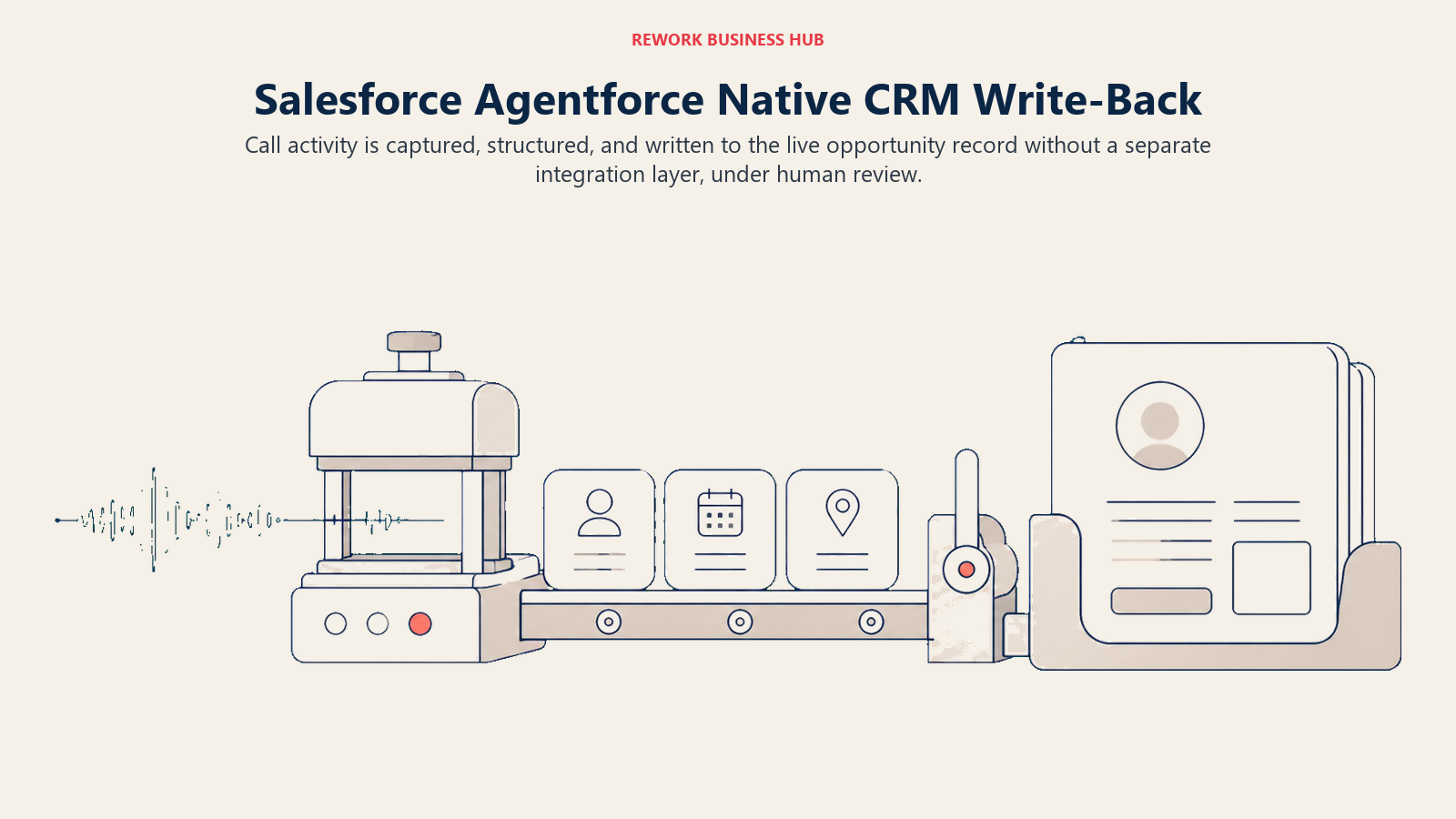
Agentforce's advantage for RevOps is structural: it reasons over live Salesforce records with no integration layer in between, so a forecast update or a flagged at-risk deal writes to the same opportunity object your reps already see. 2026 adds Momentum to that picture: Salesforce closed its acquisition of the call-capture company on March 2, and is building it into Agentforce so a rep's call gets captured, structured, and pushed into CRM fields automatically, with a human reviewing rather than creating the record. As of this reporting the rollout was still described as forthcoming, not live everywhere, so confirm status for your license tier directly.
Pricing runs on two models that can't coexist in one org: $2 per prepaid conversation for customer-facing agents, or Flex Credits at $500 per 100,000 (roughly $0.10/action) for employee-facing work like forecast updates. Enterprise Edition orgs get 100,000 free credits via Salesforce Foundations. Salesforce's pricing pages returned access errors on direct verification, so treat the credit mechanics as confirmed and the total bill as an estimate to re-check with your account team.
| What you get | What you don't |
|---|---|
| Native reasoning and write-back against live Salesforce records | Two incompatible pricing models to choose between |
| Momentum's call-capture integration folding into Agentforce | Still rolling out, not universally live yet |
| No separate vendor contract if already deep in Salesforce | Real cost depends on usage, hard to estimate upfront |
Pricing: $2 per conversation (customer-facing), or $500 per 100,000 Flex Credits (employee-facing, ~$0.10/action); 100,000 free credits for Enterprise Edition via Salesforce Foundations. Requires an underlying Sales Cloud license.
Best for: Salesforce-standardized RevOps teams comfortable being an early adopter of the Momentum integration as it matures.
4. Weflow: The Rare Vendor With a Real Public Price Tag
Weflow's pitch is Salesforce-native activity capture, conversation intelligence, and forecasting, but what sets it apart here is that you can see the bill before talking to a salesperson. Every other enterprise-leaning vendor on this list gates pricing behind a demo; Weflow publishes per-module and bundled rates plus a metered Agent Builder for teams that want to construct their own automations rather than only use the packaged ones.
Individual modules run $19-39/user/month (Activity & Contact Capture, Conversation Intelligence, Deal Intelligence & Forecasting), or bundle into Foundation, Business, or Enterprise at $49, $59, and $79/user/month, billed annually with a 10-user minimum. Agent Builder is priced separately by action: free for 25 a month, $299 for 500, $999 for 2,500, custom above that.
| What you get | What you don't |
|---|---|
| Actual published pricing, a genuine rarity here | 10-user minimum rules out very small teams |
| A metered Agent Builder for custom automations | Full forecasting sits in the $79/user Enterprise tier |
| 14-day free trial against your own Salesforce data | Salesforce-native focus, less built out elsewhere |
Pricing: $19-$39/user/month per module, or $49-$79/user/month bundled (annual, 10-user minimum); Agent Builder free (25 actions/mo) to $999/mo (2,500 actions). See weflow.ai/pricing.
Best for: Salesforce-native RevOps teams that want to see the real number before a sales call.
5. Backstory (formerly People.ai): Activity Capture for Your Own AI Stack
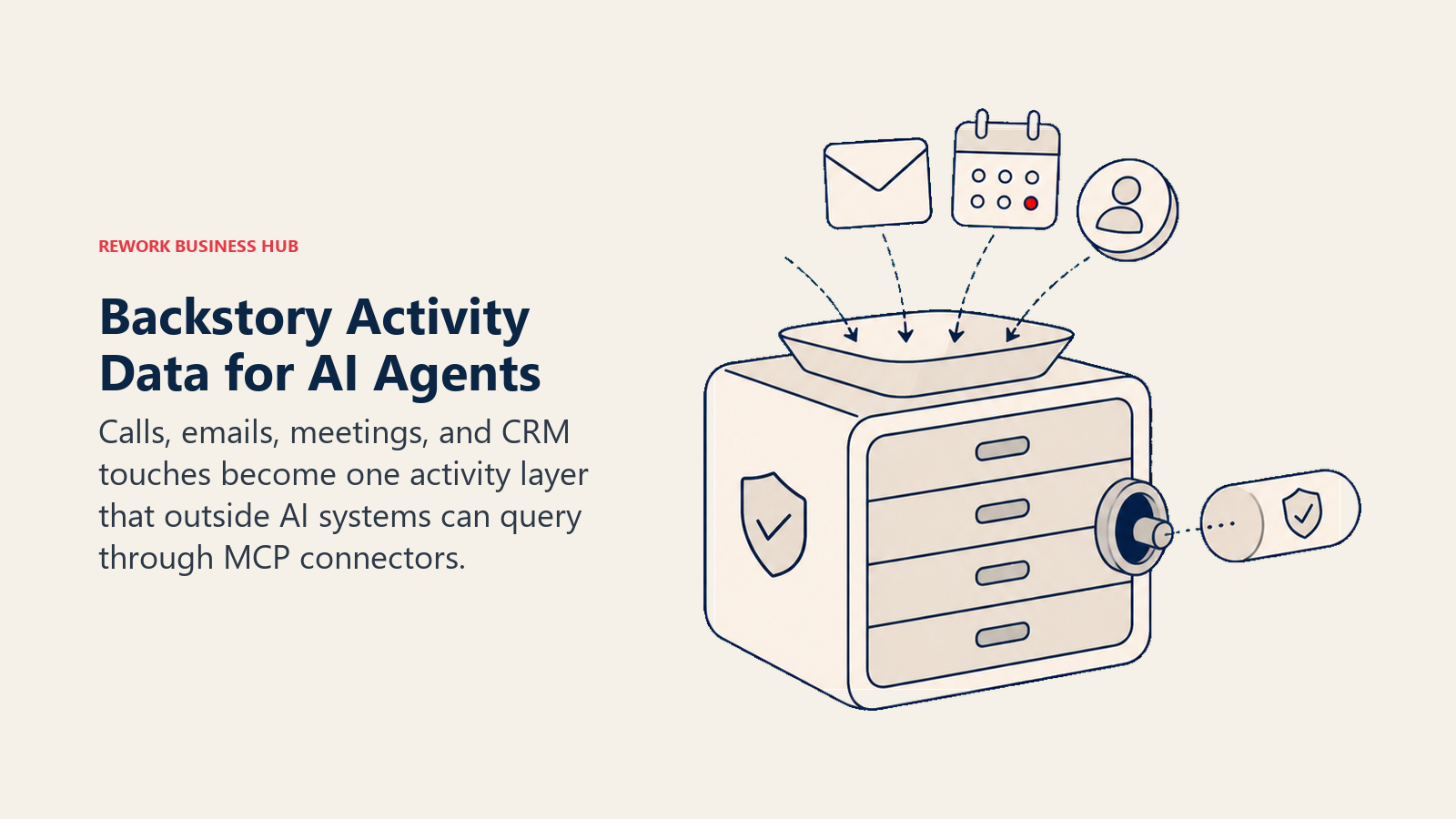
People.ai rebranded to Backstory in 2026 (its own schema markup still names People.ai, Inc. as the legal entity), repositioning around a current idea: instead of locking captured activity data inside a proprietary dashboard, expose it through Model Context Protocol connectors so Claude, Copilot, ChatGPT, or a custom agent can query it directly. The core function hasn't changed; it still captures emails, calls, meetings, and CRM touches and turns them into deal summaries, risk alerts, and coaching flags. The pricing model changed more than the product: instead of per-seat licensing, Backstory charges a connection fee per customer-facing employee whose activity feeds the system, plus consumption of the "answers" it generates. Viewers (managers, finance, ops) are unlimited and free, but no tier names or dollar figures are public.
| What you get | What you don't |
|---|---|
| MCP connectors expose activity data directly to Claude, Copilot, ChatGPT | No public pricing at all, tier names included |
| Unlimited free viewer seats for managers, finance, and ops | Consumption billing is harder to forecast than a flat fee |
| "True Forward" terms: overage isn't back-billed mid-contract | Still effectively People.ai; some materials haven't caught up |
Pricing: Not published. Consumption-based (connection fees plus usage of generated "answers"); demo required. See backstory.ai/pricing.
Best for: Enterprises that want raw activity data exposed to their own AI tooling through MCP rather than locked in a dashboard.
6. Terret (formerly BoostUp.ai): Forecast Plus Rep-Behavior Playbooks
BoostUp.ai rebranded to Terret in 2026 and bundles three products under one contract: Nexus (turns what top performers do differently into a playbook pushed to the team), Forecast (pipeline forecasting), and Conversation Intelligence (call analysis), on the pitch that reading the data matters less than getting a playbook out the other end. Terret cites Cloudflare, Udemy, and Grafana Labs as customers, which signals roughly where pricing lands even without a number attached: no tiers are published, but a free 48-hour proof of concept replaces a traditional trial.
| What you get | What you don't |
|---|---|
| Forecast, call intelligence, and coaching playbooks in one contract | No pricing published, not even a starting range |
| Enterprise reference customers signal a mature product | Brand mid-transition; some materials still say BoostUp |
| Free 48-hour proof of concept before any commitment | Customer list skews toward larger engineering-heavy orgs |
Pricing: Not published. Free 48-hour proof of concept; demo required for a quote. See terret.ai.
Best for: Enterprise RevOps teams that want forecast, call intelligence, and rep coaching bundled into one contract.
7. Aviso: The Widest Bench of Prebuilt Agents Under One Orchestrator
Aviso is the most explicitly "agentic" product here by its own description: an orchestrator called MIKI sits on top of 50+ prebuilt agents spanning forecasting, conversation intelligence, relationship intelligence, and customer success, plus a studio for custom ones, betting on breadth (one console) over the depth of a single specialist. Pricing is entirely gated behind a demo; the unusual part of the pitch is a direct contract buyout, Aviso says it will pay out a competitor's remaining term to switch, plus free migration and white-glove onboarding. Its own claimed figures (98%+ forecast accuracy, roughly 40% average win rate, up to 20 rep hours saved weekly) are marketing claims, not audited results, worth testing against your own data first.
| What you get | What you don't |
|---|---|
| 50+ prebuilt agents under one orchestrator, plus a studio | No public pricing; every figure needs a sales call |
| A contract buyout offer that removes switching friction | Accuracy and ROI numbers are vendor-claimed, not audited |
| Coverage spans forecasting, relationships, and customer success | Breadth means less depth than a single-purpose specialist |
Pricing: Not published. Contact sales; vendor offers to buy out an existing contract. See aviso.com/pricing.
Best for: Enterprise teams wanting the widest set of prebuilt agents in one console rather than stitching together point solutions.
8. Clay (for CRM Enrichment): An Agent That Fills In What's Missing
Clay is best known for prospecting and outbound research, but its enrichment agent, Claygent, is worth evaluating specifically for CRM hygiene: pointed at existing records instead of new leads, it fills blank firmographic and contact fields and standardizes formats, pulling from 150+ data providers without you hand-building a workflow first, narrower and more tactical than Clay's usual positioning. Pricing is metered by actions and data credits rather than seats, so the bill tracks enrichment volume, not logins: free covers 500 actions and 100 credits a month, Launch is $167/month (from $54/month annual), Growth is $446/month (from $185/month annual), and Enterprise is custom.
| What you get | What you don't |
|---|---|
| Claygent enriches records automatically, no workflow-building | Cost scales with volume, harder to budget flat than a seat fee |
| Access to 150+ data providers through one interface | Built for enrichment, not dedup or standardization rules |
| Unlimited seats even on the free plan | Entry-tier limits get consumed fast at CRM-wide scale |
Pricing: Free (500 actions/100 credits monthly); Launch $167/mo (from $54/mo annual); Growth $446/mo (from $185/mo annual); Enterprise custom. See clay.com/pricing.
Best for: RevOps teams whose CRM hygiene problem is mostly missing data, not duplicates or stale records.
9. Openprise: Hygiene Rules Enforced Across the Whole GTM Stack
Openprise's pitch: CRM hygiene can't be solved inside the CRM alone, since bad data enters through the marketing automation platform, the warehouse, and every other connected system, so Openprise sits above all of them, running the same standardization, deduplication, and routing rules everywhere at once. One practical note: openprise.com is a lapsed, parked domain; the active company is at openprisetech.com. The Professional tier starts at $35,000/year for unlimited seats, 400+ prebuilt connectors, and 5,000 AI-orchestration API calls a day across 20-plus prebuilt solutions; Enterprise is custom-quoted, doubling the API allowance to 10,000 calls a day and adding a 24/7, 2-hour-response SLA.
| What you get | What you don't |
|---|---|
| Hygiene and dedup rules enforced across CRM, MAP, warehouse | $35,000/year floor rules out small or mid-size teams |
| 400+ prebuilt connectors and 20+ ready-made solutions | Real domain confusion; openprise.com is now a parking page |
| Dedicated Customer Success manager at every tier | Built for GTM-wide standardization, not a quick point fix |
Pricing: Professional from $35,000/year (unlimited seats, 5,000 AI-orchestration API calls/day); Enterprise custom (10,000 calls/day, 24/7 2-hour SLA). See openprisetech.com/pricing.
Best for: Mid-market to enterprise GTM ops teams that need the same hygiene rules enforced across CRM, MAP, and warehouse together.
10. Fullcast: When the Forecast Problem Is Actually a Territory Problem
Fullcast's angle differs from everything else here: instead of starting with forecast rollup or call data, it starts with territory design, quota setting, and lead routing, on the theory that a lot of what looks like a forecasting problem is really stale coverage or a quota nobody rebalanced after a reorg. Its three connected modules (Plan for territory and quota, Revenue Intelligence for forecasting, Pay for commissions) mean a territory change propagates into quota, forecast, and commission calculations automatically. It uses Model Context Protocol to connect planning data to OpenAI, Gemini, and Claude models, letting an agent automate updates instead of an admin rebuilding maps by hand. The vendor claims its forecasting module lands within plus or minus 5 to 10 percent accuracy, worth testing against your own closed-deal history; pricing sits entirely behind a demo request.
| What you get | What you don't |
|---|---|
| Territory, quota, and forecast changes propagate automatically | Forecasting isn't sold standalone, only in the suite |
| MCP-based agents update plans without manual rebuilding | No public pricing anywhere on the site |
| Commission recalculation tied to the same underlying data | Best fit is narrow: a coverage-design problem specifically |
Pricing: Not published. Demo required. See fullcast.com.
Best for: RevOps teams whose forecast problem traces back to territory design or stale quotas, not pipeline visibility alone.
How to Test a Forecast-Accuracy Claim Before You Buy
Every vendor here that touches forecasting leads with an accuracy number, and none are audited by anyone outside the company that published them. Given that 87% of enterprises missed their 2025 revenue targets despite record AI spending, per Clari Labs' research, a demo-dataset accuracy claim is close to meaningless for your pipeline. Test it before you sign.
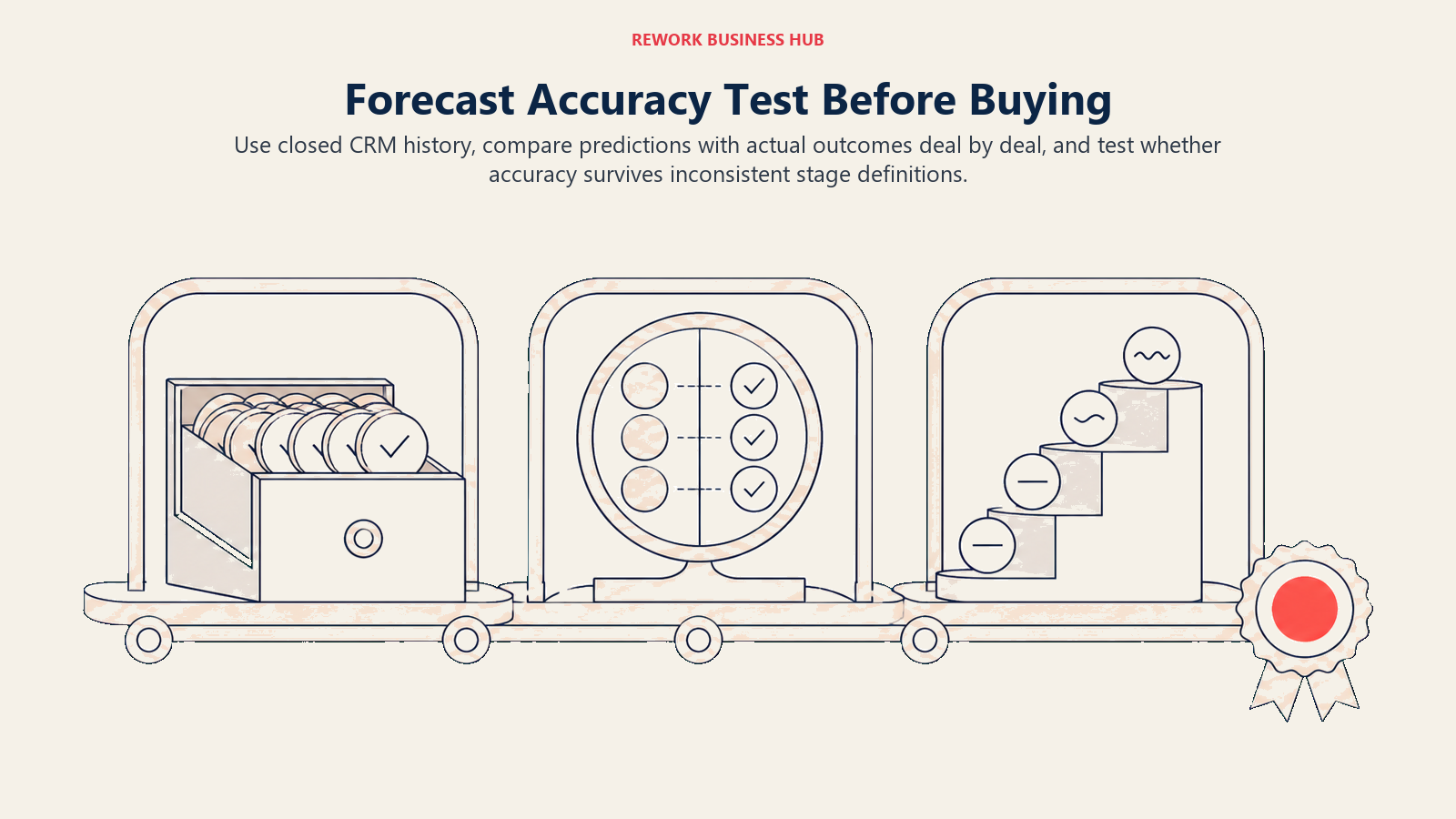
- Pull four to eight quarters of your own closed-won and closed-lost history, with full stage-by-stage timestamps, from your CRM, not a spreadsheet reconstruction.
- Run that window through the vendor's trial and compare its retroactive prediction against what actually closed, deal by deal, not just the aggregate total.
- Check whether accuracy is measured at the deal level or the total-number level, and ask what happens to it when stage definitions are inconsistent across segments, since that gap is the most common reason real-world accuracy falls short of pilot numbers.
| Signal in the sales pitch | What to actually check | Why it matters |
|---|---|---|
| "98% forecast accuracy" | Deal-level accuracy on your own closed history, not vendor demo data | Aggregate accuracy can hide being wrong about which deals close |
| "AI-native forecasting" | Whether it retrains on your data or ships a fixed model | A model tuned on someone else's pipeline won't fit yours |
| Fast pilot results (2-4 weeks) | Whether the pilot used your actual multi-quarter history | Clean, cherry-picked data won't reflect year-round reality |
Write-Back Safety: What to Ask Before an Agent Touches Your CRM
Every agent here that scores high on capability also scores high on risk: scoring, enriching, or forecasting is safe to get wrong, writing directly to a deal record isn't. Only one in five companies has a mature governance model for autonomous agents, per Deloitte's State of AI in the Enterprise research, and the same Clari Labs survey behind the Key Facts above found 42% of enterprises still have no formal governance framework for their revenue data. Get clear answers to these questions before any agent above gets write access to your system of record.
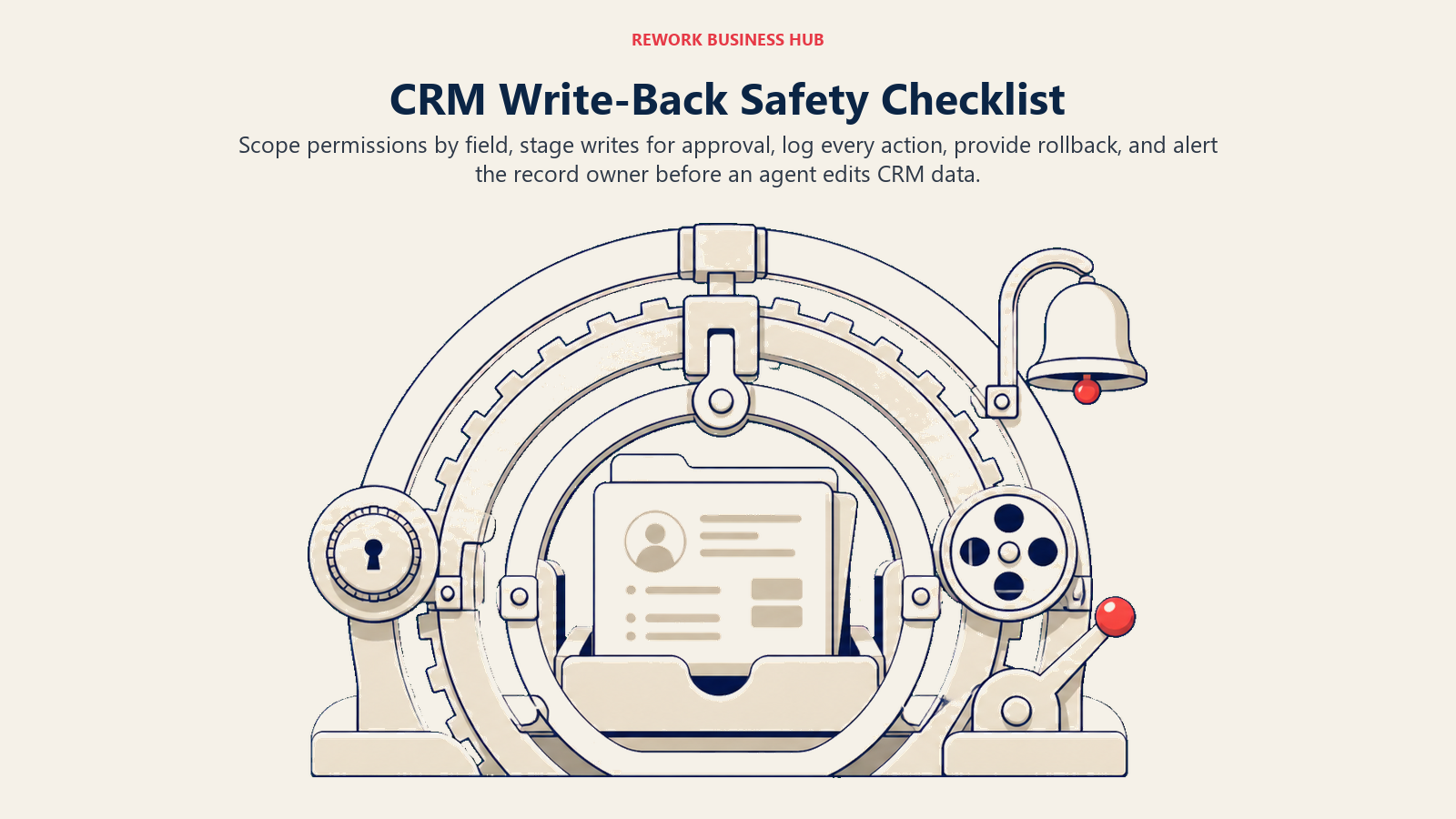
| Question to ask the vendor | Good answer | Red flag |
|---|---|---|
| Writes directly, or stages for approval? | Configurable per field or workflow, approval gate available | "It just updates the record," no review step |
| Can write permissions be scoped by field? | Yes, field-level and object-level permissioning | Access is all-or-nothing at the object level |
| Is there an audit trail for every write? | A queryable log of what, when, and which action triggered it | "Check the CRM's native field history" only |
| Can a change be rolled back? | A one-click or documented undo path | No rollback, or "you'd fix it manually" |
| Who gets notified when it acts? | Configurable alerts to the record owner or manager | Silent writes, no notification by default |
The AI CRM hygiene agent blueprint covers this exact scoped, human-reviewed write pattern, and the AI deal desk agent blueprint covers approval-routing for pricing and non-standard terms. For a formal security review, best enterprise AI agent platforms covers the certifications it will raise.
How to Choose: Decision Framework
Use this framework to match the agent to the specific revenue operations job and the data it is allowed to change.
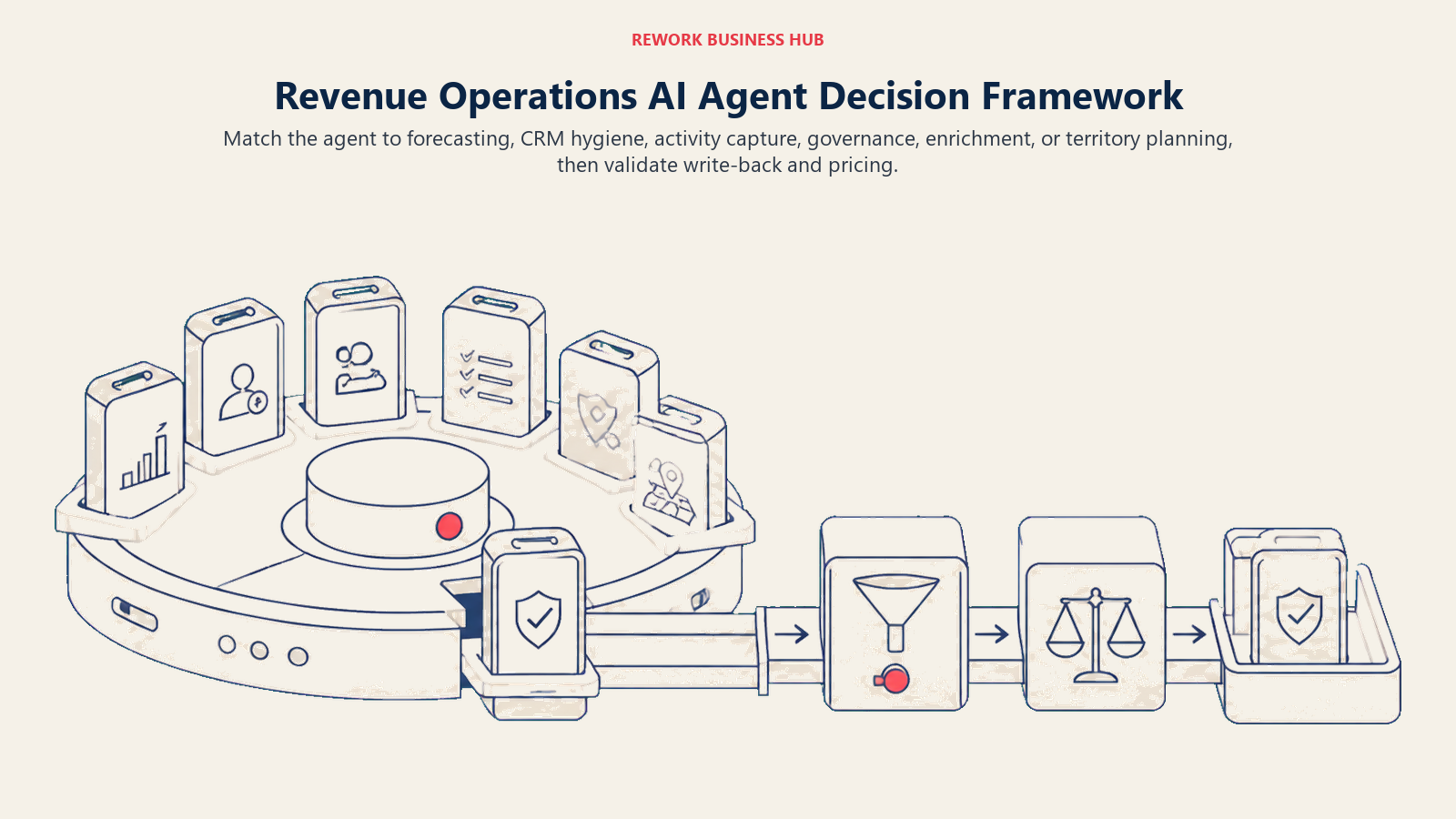
| If you need... | Pick... | Why |
|---|---|---|
| The most mature forecast-call workflow, budget no constraint | Clari | Category standard, now unified with Salesloft |
| Forecast rollup on data you already capture via Gong | Gong Forecast | Same call and CRM data, no second source to reconcile |
| Native write-back, zero integration layer, already on Salesforce | Salesforce Agentforce (RevOps) | Reasons directly over live records; Momentum adds call capture |
| Transparent pricing before a sales call | Weflow | Published per-seat and per-action rates |
| Raw activity data for your own AI stack via MCP | Backstory | Purpose-built MCP connectors for Claude, Copilot, ChatGPT |
| Forecast plus auto-generated rep coaching playbooks | Terret | Bundles forecasting, calls, and playbooks in one contract |
| The widest bench of prebuilt agents in one console | Aviso | 50+ agents under one orchestrator, plus a buyout offer |
| An agent to fill blank CRM fields, not just flag them | Clay | Claygent enriches records from 150+ data providers |
| Hygiene rules enforced across CRM, MAP, and warehouse | Openprise | One rule set applied GTM-wide, not per-system |
| A forecast problem that's really territory or quota | Fullcast | Territory, quota, and forecast propagate together |
What to Do Next
Don't start with a demo. Pull four quarters of your own closed-deal history and write down, in one sentence, the specific problem you're solving: dirty records, missing activity data, an inaccurate forecast, or stale territories. That sentence determines which half of this list is relevant. Then run your top two candidates through the forecast-accuracy or write-back-safety checks above, using your own data, before anyone signs a contract. If the real bottleneck sits upstream of all ten tools, meaning your CRM has no agreed system of record yet, fix that first.
If your next question is further upstream, in the demand generation feeding this pipeline, best AI agents for demand generation is the natural next read.

Principal Product Marketing Strategist
On this page
- Updated August 2026: What Changed
- Key Facts
- Quick Comparison Table
- What Actually Counts as an Agent Here
- The Data Plumbing You Need Before Any of This Works
- Sizing and Persona Table
- 1. Clari: The Forecast-Call Standard, Now Merged With Salesloft
- 2. Gong Forecast: Forecast Rollup Built on Call Data You Already Capture
- 3. Salesforce Agentforce for Revenue Operations: Native Write-Back, With Momentum Coming
- 4. Weflow: The Rare Vendor With a Real Public Price Tag
- 5. Backstory (formerly People.ai): Activity Capture for Your Own AI Stack
- 6. Terret (formerly BoostUp.ai): Forecast Plus Rep-Behavior Playbooks
- 7. Aviso: The Widest Bench of Prebuilt Agents Under One Orchestrator
- 8. Clay (for CRM Enrichment): An Agent That Fills In What's Missing
- 9. Openprise: Hygiene Rules Enforced Across the Whole GTM Stack
- 10. Fullcast: When the Forecast Problem Is Actually a Territory Problem
- How to Test a Forecast-Accuracy Claim Before You Buy
- Write-Back Safety: What to Ask Before an Agent Touches Your CRM
- How to Choose: Decision Framework
- What to Do Next