Best AI Agents for IT Support in 2026: 11 Agents That Resolve Issues, Not Just Answer Them
Turn this article into takeaways for your work.


Each assistant summarizes the article only for you and suggests best practices for your work.
For large enterprises, Moveworks, ServiceNow AI Agents, and Atomicwork lead on maturity and integration depth. For teams that want to sign up and test something this week without a sales call, Workativ, Siit, and Freshservice's Freddy AI Agent are the real self-serve options. This guide grades 11 agents on one question that matters more than any feature list: which write actions can the agent actually take, a password reset, an MFA re-enrollment, a software license grant, a device fix, an onboarding provisioning run, versus which ones it can only explain in a chat window. Every entry states plainly what identity or endpoint system the agent needs write access to in order to do its job.
This is a different job than the ticket queue. Our helpdesk and ticketing guide covers the ITSM platform an IT team runs its whole queue on. This guide covers the agent an employee actually talks to when their MFA is locked, they need access to a tool, or their laptop won't join the office Wi-Fi, the agent that has to resolve the problem, not just log it for a human to pick up later. It's also a different product class than an assistive AI tool for support: a tool drafts something for a human to send, while an agent holds write credentials in an identity provider or endpoint manager and executes the fix itself, with a human checked in only at the approval gate, not at every click. If you're deciding whether to buy one of these or build one, the IT helpdesk agent blueprint walks through the same job from the build side.
Key Facts
- Only 16% of what enterprises call an "AI agent" in production actually plans, observes, and adapts on its own; most are fixed-sequence workflows wearing agent branding, per Menlo Ventures' State of Generative AI in the Enterprise report.
- Freddy AI Agent posts a 65.7% ticket deflection rate for IT support, and organizations running Freddy AI Copilot saw a 76.6% cut in resolution time, saving 431,270 hours across 10,551 organizations and 187 million tickets, per Freshworks' 2025 benchmark.
- Gartner predicts agentic AI will autonomously resolve 80% of common service issues without human intervention by 2029, a 2029 deadline worth noting: most of this category is still deflection today, not full resolution.
- 58% of executives reported an AI-related security issue or close call in the past 12 months, and only 34% of organizations apply the same security controls to AI agents that they apply to human employees, per Okta's AI Agents at Work 2026 report.
- Only 21% of organizations have a mature governance model for autonomous agents, even as most plan to expand agent use within two years, per Deloitte's State of AI in the Enterprise.
- A full-time US service desk analyst costs roughly $59,600 to $60,700 a year in base salary alone, before benefits and overhead, per Glassdoor and Salary.com pay data, the number every per-seat agent price below should be measured against.
Quick Comparison Table
| Agent | Best For | Starting Price | Key Strength | Key Limitation |
|---|---|---|---|---|
| Moveworks (a ServiceNow Company) | The deepest employee IT/HR assistant | Custom quote, reported $50K-$200K+/yr | Mature password reset and unlock across Okta, Azure AD, AD | Independent roadmap uncertain post-acquisition |
| ServiceNow AI Agents | Existing ServiceNow ITSM shops | Custom quote, reported $90-$200+/user/mo | Native CMDB and case-data grounding, plus Moveworks | No self-serve pricing; fully autonomous tier still rolling out |
| Atomicwork | Mid-market agentic ITSM plus ESM | $25,000/yr (Professional, 2 AI coworkers) | Published pricing, direct write actions on 4+ identity systems | Extra AI coworkers cost $499/mo each above the included count |
| Aisera (an Automation Anywhere Company) | A prebuilt ITSM/HR/CX agent catalog | Custom quote, reported $50K-$1.2M/yr | Prebuilt flows from password reset through device provisioning | No self-serve tier; wide reported price range |
| Rezolve.ai | Enterprises (2,000+ employees) wanting AI-native ITSM | Per-employee/mo, quote-based | People-based pricing, not per-ticket or credit metering | 2,000-employee minimum shuts out smaller teams |
| Workativ | SMBs wanting self-serve, no-code IT and HR automation | $99/mo (Starter, 200 sessions) | Transparent self-serve pricing, 100+ app connectors | Only 2 automation Actions included on Starter |
| Resolve (formerly Espressive Barista) | Enterprises pursuing "zero ticket" IT | Custom quote | Conversational depth plus cross-domain automation | Pricing and pre-merger certifications not confirmed |
| Leena AI | One agent across IT, HR, and finance | Custom quote, employee-count based | Broad scope beyond IT alone, on one employee record | IT-specific depth is thinner than IT-only specialists |
| Siit | Mid-market teams living in Slack or Teams | $23/admin/mo (Essentials); AI agents at $89/admin/mo | Per-admin pricing; unlimited employees at no extra cost | Full agent actions require the $89/admin/mo Pro tier |
| Freshservice Freddy AI Agent | Teams already standardizing on Freshservice | $19/agent/mo (Starter); Freddy AI Agent needs Enterprise | Fully published per-seat pricing, 65.7% deflection at scale | Freddy AI Agent sessions ship only on the Enterprise tier |
| Rippling IT | Companies running HR, payroll, and IT on one record | Requires the Rippling Unity platform; IT module quote-based | Permission-aware actions across HR, IT, and finance together | Not a standalone agent; requires the core HR platform first |
Action Versus Answering: How We Actually Graded These
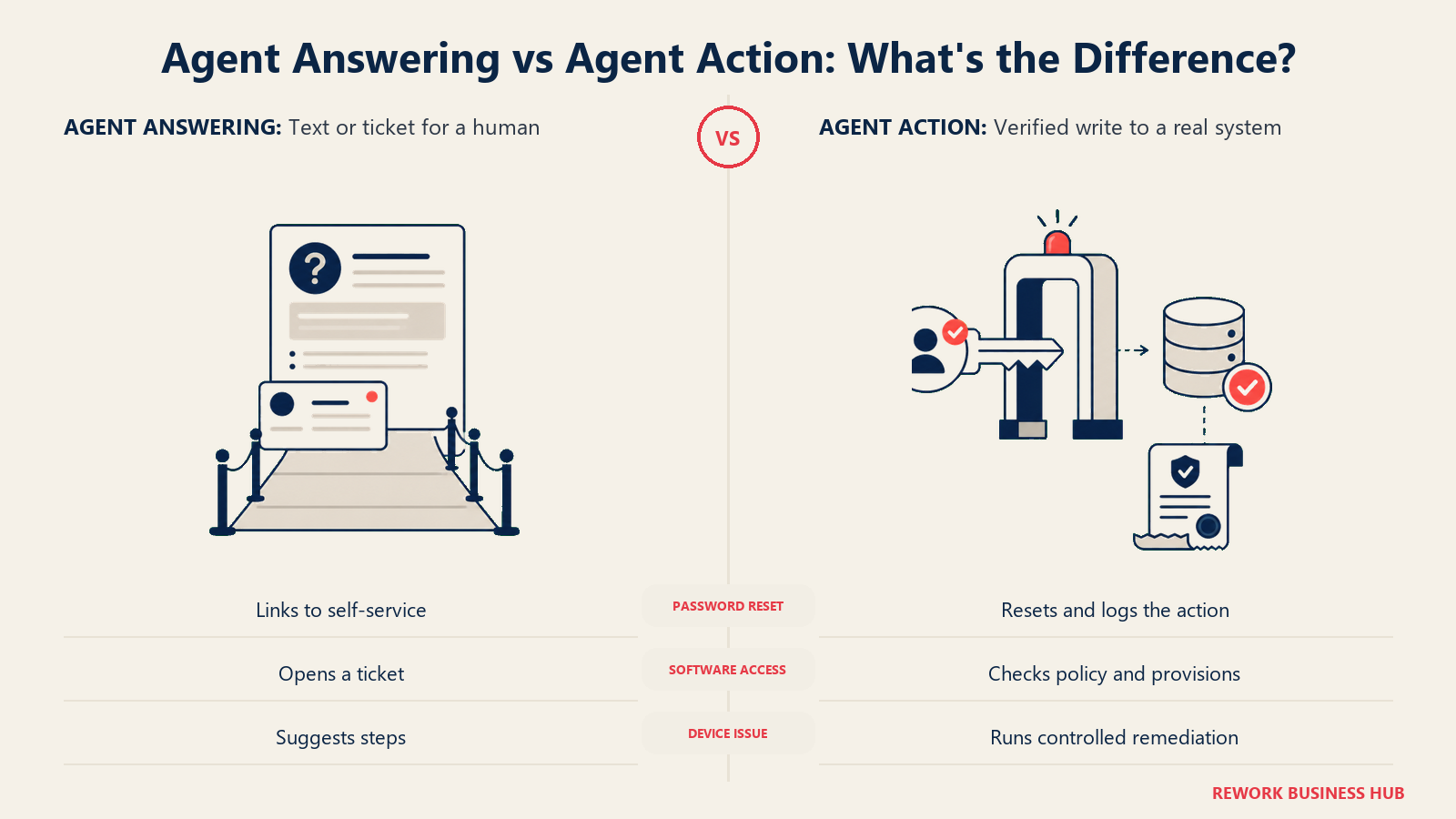
"Agentic" is the most overused word in this category, so the grading here comes down to one test: can the product take a write action against a real system of record, or does it only produce text a human still has to act on. That distinction is why Menlo Ventures found that just 16% of what enterprises call an agent in production genuinely plans, observes, and adapts, the rest is a chatbot or a fixed workflow wearing agent branding. For IT support, the five jobs that matter are the same five in every real deployment we researched:
| Employee IT Job | What a Genuine Agent Does | What an Assistive Tool Does Instead |
|---|---|---|
| Password and MFA reset | Verifies identity, calls the identity provider's API, resets the credential or re-enrolls MFA, logs the action | Links to a self-service portal and tells the employee how to do it themselves |
| Software access and license requests | Checks entitlement policy, provisions or revokes the license in the SaaS admin console | Opens a ticket and waits for a human to action it manually |
| Device and endpoint troubleshooting | Runs a remediation script or pushes a config change through the MDM directly | Suggests troubleshooting steps for the employee to try on their own |
| Onboarding and offboarding provisioning | Creates accounts, assigns groups, and on exit revokes every credential the same day | Generates a checklist for IT to work through by hand |
| IT knowledge Q&A | Answers from the current runbook, the one job that doesn't require write access | Also does this well; the gap only shows up once an action is required |
We also looked at Electric AI and NinjaOne and left both out. Electric pairs its software with human technicians who do the actual resolution work, its assistant supports a person rather than acting on its own. NinjaOne's AI investment is aimed at the technician managing endpoints through remote monitoring and management, not at an employee asking for help in plain language. Both are solid IT management products; neither is the employee-facing agent this guide is grading, so we dropped them rather than padding the list to round numbers.
The Privilege Problem: A Security Decision, Not Just a Deflection One
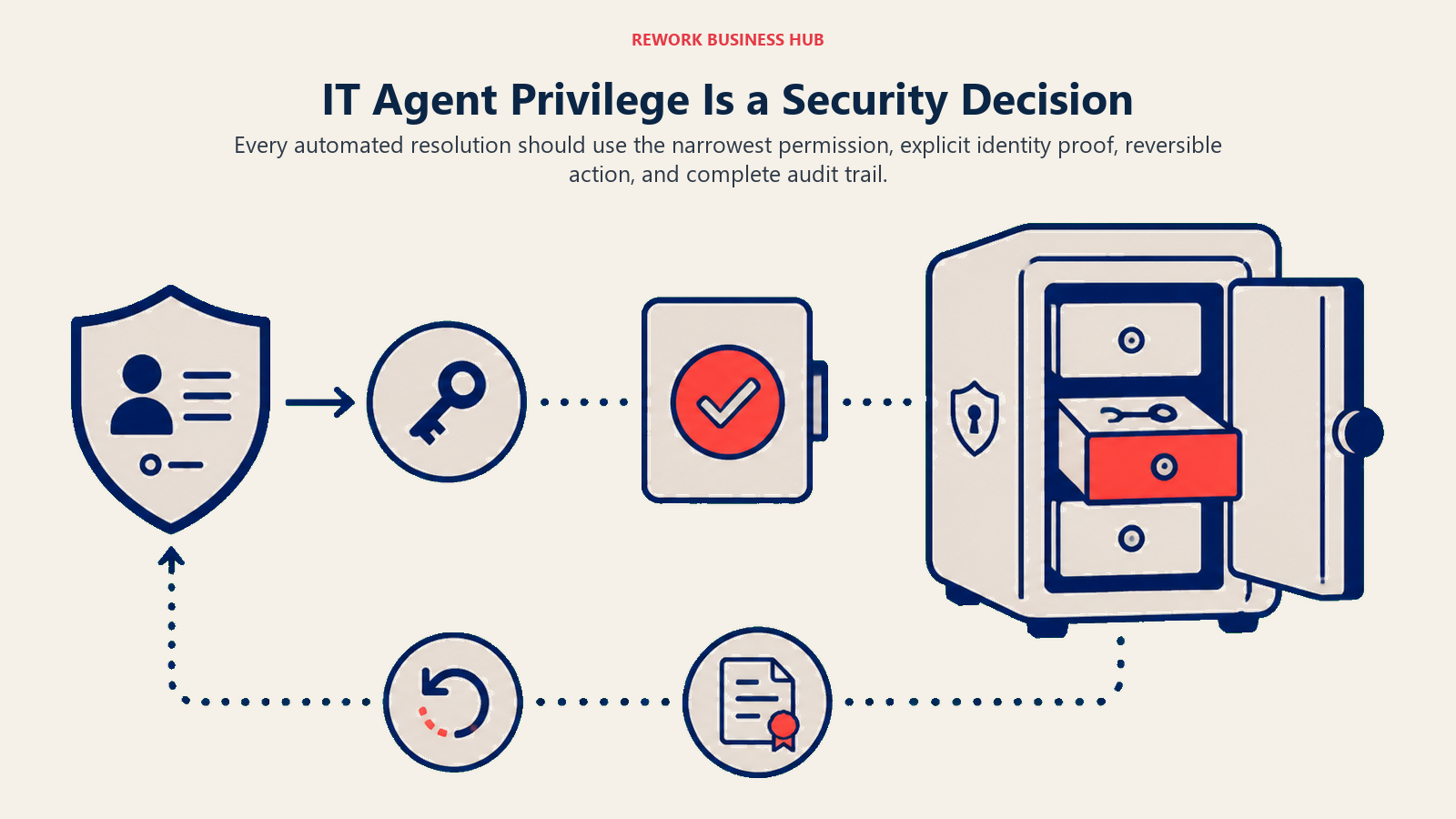
To reset a password or grant a license, an agent needs standing write access to your identity provider, your MDM, or both, which makes it a new privileged identity sitting inside your directory, not a feature toggle. That's the part vendors underplay in a demo. Okta's 2026 research found 58% of executives reported an AI-related security issue or close call in the past year, and only 34% of organizations apply the same security controls to AI agents that they apply to human employees. Deloitte separately found just 21% of organizations have a mature governance model for autonomous agents at all. Before you grade any vendor on deflection rate, grade it on what it can touch and who has to approve that.
| Integration the Agent Needs | What Access It Requires | What a Misconfiguration Exposes |
|---|---|---|
| Okta / Entra ID (identity provider) | Read/write to the user directory, credential reset, MFA enrollment | Every employee account in the company |
| Jamf / Intune (device management) | Device config push, remote wipe, policy enforcement | Every managed laptop and phone |
| CrowdStrike / endpoint security | Read access to device risk posture, sometimes remediation triggers | Security signal integrity if the agent misreads a threat |
| ITSM or ticketing (ServiceNow, Freshservice, Jira) | Ticket create, update, close; CMDB read | The audit trail of who did what and when |
Some of the industry response is real and dated: CrowdStrike's Continuous Identity for AI Agents, announced June 2026, authorizes each agent action individually against current risk rather than granting standing access once, specifically to eliminate the always-on privilege that makes an agent's credentials a bigger blast radius than any single human's. Ask every vendor below for the equivalent: does a high-risk action (an admin-level grant, a device wipe, an MFA reset outside normal hours) require a human approval step, and is every action logged somewhere your security team can actually audit. Moveworks caps self-service account unlocks at three a day specifically to prevent abuse of that exact privilege. Not every vendor states its equivalent guardrail publicly, and where one doesn't, we say so rather than assume it exists. For the build-side version of this problem, AI agent security and AI agent guardrails cover the same approval-gate design decisions in more depth.
Deflection Is Not the Same Number as Resolution
Every vendor in this guide will hand you a deflection rate. Read it carefully, because deflection only means the ticket didn't reach a human, not that the employee's problem actually got solved. An employee who gives up on a bad self-service flow, or who gets redirected to an article they still have to act on manually, counts as "deflected" in most vendor dashboards. True autonomous resolution, the agent completing the action end to end with nothing left for the employee or IT to do, is the harder number, and it's why Gartner puts full autonomous resolution of common service issues on a 2029 timeline rather than claiming it's already here. When you're evaluating a vendor's headline stat, ask for the resolution rate specifically, not the deflection rate, and ask how they define the difference.
What This Actually Costs Against a Service Desk Analyst's Salary
A full-time US service desk analyst runs $59,600 to $60,700 in base salary alone before benefits, payroll tax, and overhead are added on top. Every price below should be read against that number, and the pricing unit matters more than the headline figure, because it decides whether your bill grows with headcount, with ticket volume, or with neither.
| Vendor | Pricing Unit | What Grows Your Bill | What Doesn't |
|---|---|---|---|
| Atomicwork | AI coworker count plus end-user tier | More coworkers, more end users | Ticket volume within your tier's credits |
| Freshservice | Per human IT agent seat | More IT staff seats, Enterprise tier for AI | Freddy AI Agent sessions, until you exceed the pooled 1,200/license/year |
| Rezolve.ai | Per employee or per fulfiller, per month | Total headcount | Ticket volume |
| Siit | Per admin (people who resolve requests) | More admins | Total employee headcount |
| Workativ | Session bracket per plan | Chat session volume | Number of employees who can use it |
| Moveworks, Aisera, ServiceNow | Custom quote | Whatever gets negotiated | Rarely disclosed either way |
At Atomicwork's $25,000-a-year Professional tier, two AI coworkers covering up to 250 employees costs less than half of one analyst's base salary alone, before benefits and overhead widen that gap further. At Siit, that same 200-person company running 2 to 3 admins on the Pro tier pays $2,136 to $3,204 a year, nowhere near what a per-employee model would charge at that headcount. The inverse is also true: Rezolve.ai and Leena AI price per employee, so the bill scales with company size regardless of how many people actually file a ticket, which rewards high-ticket-volume organizations and penalizes companies with a lot of employees who rarely need IT.
1. Moveworks (a ServiceNow Company): The Category-Defining Employee IT Assistant
Moveworks built its reputation before "agentic" became a category label, on a Reasoning Engine that resolves employee IT and HR requests through Slack, Teams, or email. For IT support specifically, its Account Access Assistant takes a real write action: it unlocks a locked account and issues a single-use password reset link through Okta, Azure AD, or Active Directory, capped at three self-service unlocks a day so the feature can't be looped or abused. ServiceNow completed its acquisition of Moveworks on December 15, 2025, and the product still runs its own security page and certifications even as it folds into the broader ServiceNow AI Platform.
Moveworks deliberately doesn't touch a user's actual password in chat. It links to the identity provider's own reset flow rather than intermediating the credential itself, which is the right security call even though it means the agent isn't fully self-contained.
| What you get | What you don't |
|---|---|
| Mature password reset and account unlock across Okta, Azure AD, and AD | No public price list; budget a real enterprise sales cycle |
| SOC 2 Type 2, ISO 27001/17/18/27701, ISO 42001, FedRAMP, GDPR, CCPA | Long-term roadmap independence is an open question post-acquisition |
| Explicit no-training commitment on customer data | Overlaps with ServiceNow's own native AI Agents, a real "which one" question |
Pricing: No public price list; quote-only, billed per employee per year. Reported figures range from roughly $50,000 to $100,000/year at 500 to 1,000 employees up to $200,000+/year above 5,000 employees, with a reported median around $130,000/year (reported, aggregated third-party buyer data, unconfirmed by Moveworks directly). Moveworks security page.
Best for: Enterprises wanting the most mature employee-facing IT assistant on the market, especially ones already moving toward ServiceNow as their AI platform of record.
2. ServiceNow AI Agents: ITSM-Native Actions, Now With Moveworks Built In
ServiceNow's pitch for IT support is that the agent already sits inside the system holding the CMDB, the case history, and the approval workflow, so a password reset or access request doesn't need a separate integration layer bolted on. Now Assist for Virtual Agent handles password reset conversations end to end, with ServiceNow marketing resolution in 30 seconds or less for that specific flow when deployed on the platform's own Password Reset application. An AI Agent Orchestrator coordinates multiple agents on one request, and an AI Control Tower governs what those agents can touch across every connected system, not just ServiceNow's own modules.
Since April 2026, ServiceNow replaced its older ITSM tiers with three AI-native tiers: Foundation, Advanced, and Prime, with Prime the only tier carrying fully autonomous agents, and Now Assist generative AI bundled into all three.
| What you get | What you don't |
|---|---|
| Native CMDB and case-data grounding; sub-30-second password reset flows | No public price list; expect a custom quote |
| AI Control Tower governs agent activity across connected systems | Fully autonomous agent tier (Prime) is still rolling out through 2026 |
| ISO 27001/17/18, SOC 2, FedRAMP, and IRAP certifications | Value concentrates heavily in existing ServiceNow shops |
Pricing: No public price list; ServiceNow directs buyers to a custom quote. Third-party estimates put core tiers around $90 to $200+ per user per month depending on tier (reported, unconfirmed by ServiceNow directly). ServiceNow AI Agents.
Best for: Enterprises already running ServiceNow for ITSM that want IT support actions grounded in the same CMDB and case data, without adding a separate vendor.
3. Atomicwork: Agentic ITSM With Published, Per-Outcome Pricing
Atomicwork's pitch is a Universal Agent it calls Atom, running across full ITSM (incident, request, problem, change, asset, and configuration management) with the same infrastructure extended to HR, Finance, Legal, and Operations as enterprise service management. For password resets specifically, Atom verifies identity first, then resets the credential directly through Okta or Microsoft Entra rather than only linking out, and it syncs entitlements from Okta, Azure AD, Google Workspace, JumpCloud, and Microsoft Intune to handle access requests as real actions.
It's also one of the few vendors here that publishes real numbers instead of a "contact sales" wall. The Professional plan runs $25,000 a year for two AI coworkers covering up to 250 end users, 500 managed devices, and 50 applications, with extra coworkers priced at $499 per worker per month. Organizations already running ServiceNow or Jira Service Management can deploy Atomicwork's layer on top with outcome-based pricing instead: $1 per resolved knowledge query, $2 per handled access request, and $3-plus per resolved ticket.
| What you get | What you don't |
|---|---|
| Published pricing, not a universal demo-gated wall | $25,000/yr floor is real money for a small IT team |
| SOC 2 Type II, ISO 27001, ISO 42001 (responsible AI), HIPAA, GDPR, CCPA | Extra AI coworkers cost $499/mo each past the included count |
| Direct write actions on Okta, Entra ID, Google Workspace, and Intune | Business tier itself is "flexible," not a published number |
Pricing: Professional $25,000/yr (2 AI coworkers, up to 250 end users); Business custom-sized (5 AI coworkers, up to 1,000 end users); Enterprise custom (unlimited). ServiceNow/JSM overlay: $1 per resolved query, $2 per access request, from $3 per resolved ticket.
Best for: Mid-market IT teams that want agentic ITSM and ESM together and would rather see a real number than book a demo to find one.
4. Aisera (an Automation Anywhere Company): A Prebuilt Catalog Across IT, HR, and CX
Aisera ships a prebuilt catalog of agentic workflows for IT service management rather than asking you to build flows from scratch, under what it calls its TRAPS trust framework. The IT support pattern is concrete: the agent authenticates the employee through MFA, reaches into the identity access management system, resets the credential, and closes the ticket, the same shape it applies to VPN access, software provisioning, and device setup and troubleshooting. Automation Anywhere announced its acquisition of Aisera on November 4, 2025, folding the agent catalog into its broader automation portfolio.
| What you get | What you don't |
|---|---|
| Prebuilt password reset, VPN access, and device provisioning flows | Recent acquisition adds real roadmap and rebranding uncertainty |
| ISO 27001, CSA STAR Level 1, SOC 2 Type II, GDPR, HIPAA with a BAA | No self-serve option; enterprise sales-led only |
| TRAPS framework commits to not cross-training on customer data | Wide reported price range makes budgeting hard upfront |
Pricing: No public price list; enterprise sales-led. A marketplace listing suggests roughly $200,000/year for up to 1,000 users scaling to about $1,200,000/year for up to 10,000 users, while other aggregated deal data shows a median closer to $90,000/year within a $50,000 to $120,000 range (reported, figures vary meaningfully by source). Aisera security and compliance.
Best for: Enterprises wanting prebuilt IT, HR, or CX agent workflows without building from scratch, especially ones already evaluating Automation Anywhere for RPA.
5. Rezolve.ai: People-Priced, AI-Native ITSM for IT and HR
Rezolve.ai's pricing philosophy is built around one idea: you pay for people, not usage. Its Conversational AI Flow Builder can take an employee from a request for software access to a provisioned license in the same chat thread across Teams, Slack, web, or mobile, and the platform reports 60% to 80% autonomous resolution across common ticket types, including password resets and access management, not just deflection to a knowledge article. A separate Autonomous Agents tier prices per agent-run instead of per seat, for teams that want to bring their own LLM.
The tradeoff is minimum scale. Rezolve is built for organizations north of 2,000 employees, and while the "one scoping call" model is honest about being all-in (license, implementation, migration, training, and support), it gives you no self-serve way to see the real number before that call.
| What you get | What you don't |
|---|---|
| People-based pricing (per employee or per fulfiller), not per-ticket credits | 2,000-employee minimum excludes smaller IT teams |
| ISO 27001, SOC 2 Type II, HIPAA, GDPR, CCPA; least-privilege access reviews | No published rate card; every price requires a scoping call |
| "Glass-box" framing positions agent decisions as reviewable, not opaque | Multi-year contracts (2 to 3 years) are the norm, not month-to-month |
Pricing: Quote-based, priced per employee per month or per fulfiller per month depending on tier (AI for Employees, AI for Technicians, AI-Native ITSM, Autonomous Agents); minimum org size around 2,000 employees.
Best for: Large enterprises that want IT and HR support on one AI-native ITSM platform and are comfortable with a multi-year, sales-led contract.
6. Workativ: No-Code Self-Serve Automation for IT and HR
Workativ is one of the few vendors in this guide you can sign up for and configure without a sales call. It's a no-code agent builder purpose-built for employee IT and HR support, connecting to SharePoint, Google Drive, Notion, Confluence, and 100+ apps including Okta, Azure AD, Office 365, ServiceNow, and Jira Service Management to answer questions and trigger real actions: password resets, access requests, and ticket creation. Customers report 65% to 80% query automation, meaning most requests are answered, actioned, and closed without IT ever touching a ticket.
The catch is what "Actions" means on the pricing page. The $99-a-month Starter plan includes just 2 automation Actions and 1 AI Agent, enough to prove out password reset and one more workflow, not enough to run a full IT support motion. That jump happens at the $349-a-month Business tier, which adds 5 Actions and 500 sessions.
| What you get | What you don't |
|---|---|
| Real self-serve signup; no demo required to see pricing | Starter plan's 2 included Actions barely covers one use case |
| 100+ app connectors, including Okta, Azure AD, ServiceNow, and JSM | Session-based pricing means a busy month costs more |
| 65-80% reported query automation across customers | Smaller company; less enterprise-scale track record than incumbents |
Pricing: Starter $99/mo (200 sessions, 1 AI Agent, 2 Actions); Business $349/mo (500 sessions, 2 AI Agents, 5 Actions); Enterprise custom, roughly 15% cheaper billed annually.
Best for: SMBs and mid-market IT teams that want to configure and test a real IT support agent themselves before committing budget.
7. Resolve (formerly Espressive Barista): Conversational Depth Toward "Zero Ticket" IT
Espressive's Barista, long known as a strong conversational layer for IT and HR self-service, is now part of Resolve after Resolve Systems acquired the company on September 10, 2025. The combined platform organizes around three agent types: a Knowledge Agent (RITA) that deflects tickets with contextual answers across chat and portals, an Automation Agent that executes cross-domain remediation and configuration changes in real time, and Agent Assist, which hands a human technician enriched diagnostics and next-best actions for whatever the other two couldn't close. Integrations span ServiceNow, Jira, Microsoft 365, Active Directory, Azure, Intune, and Okta, covering the identity and endpoint layer this category depends on.
Resolve reports aggressive outcomes across its full customer base (up to 90% ticket reduction, more than 20 million hours saved), but those are platform-wide vendor-reported totals, not an IT-support-specific, independently audited figure. Public, self-serve pricing isn't published, and it isn't yet clear which of Espressive's pre-acquisition certifications carried over to the combined platform.
| What you get | What you don't |
|---|---|
| Three-tier agent design: knowledge, automation, and human-assist | Public pricing not available; former certifications not confirmed post-merger |
| Broad integrations: ServiceNow, Jira, M365, AD, Azure, Intune, Okta | Recently merged; brand and roadmap continuity still settling |
| Explicit "Zero Ticket" positioning aimed at prevention, not just speed | Reported outcome stats are platform-wide, not isolated to IT support |
Pricing: Not published; contact for a quote. Resolve (formerly Espressive Barista, acquired September 2025).
Best for: Enterprises that valued Espressive's conversational IT self-service and want that layer paired with broader automation and orchestration.
8. Leena AI: One Agent Across IT, HR, and Finance
Leena AI's Work Assistant is built to be the single agent an employee talks to regardless of which department owns the request, with IT service desk automation as one module inside a broader employee-service platform that also covers HR and finance. It can action password resets and assign users to Okta groups for access provisioning directly, rather than only explaining how, and the vendor cites a 70% reduction in IT, HR, and finance tickets combined. Pricing is entirely employee-count-based: the more headcount on the license, the higher the bill, regardless of how many of those employees file an IT ticket in a given month.
That breadth is the honest tradeoff. Because IT is one module among several rather than the sole focus, teams that need IT-specific depth (granular endpoint remediation, device-specific troubleshooting flows) may find Leena thinner there than a dedicated IT specialist like Atomicwork or Rezolve.ai.
| What you get | What you don't |
|---|---|
| One agent across IT, HR, and finance on a single employee record | License cost is tied to total headcount, not ticket volume |
| Okta group assignment and password reset as real actions, not just answers | IT-specific depth is thinner than an IT-only specialist |
| GDPR, SOC 2, HIPAA, ISO, and AICPA SOC compliance badges published | No rate card; every quote requires a sales conversation |
Pricing: Quote-based, employee-count licensing; publicly reported estimates span roughly $10 to $100 per employee depending on modules and scope (reported, unconfirmed by Leena AI directly).
Best for: Enterprises that want IT, HR, and finance requests handled by one employee-facing agent instead of three separate tools.
9. Siit: Slack- and Teams-Native Service Desk, Priced Per Admin
Siit, a Paris-based startup founded by former Aircall employees, flips the usual pricing model for this category: it charges per admin (the people who actually resolve requests), not per employee, so headcount growth never moves the bill. Essentials starts at $23 per admin per month for conversational request management inside Slack or Teams, but the AI agent layer that actually resolves requests autonomously, rather than just triaging and routing them, only unlocks at the $89-per-admin-per-month Pro tier, alongside AI Assist, AI Triage, and monitoring. Customers include Ramp, Qonto, Swile, and Gorgias, a real, if not enterprise-scale, base for a company that closed only a $5 million seed round in November 2024.
For a 200-employee company running 2 to 3 admins, that per-admin model lands anywhere from $552 a year at Essentials up to $3,204 a year at Pro, well under what per-employee pricing would charge at the same headcount, though the genuinely agentic tier still requires Pro.
| What you get | What you don't |
|---|---|
| Per-admin pricing; unlimited employees at no extra cost | Full autonomous "Agents" capability requires the $89/admin/mo Pro tier |
| Native Slack and Teams resolution, no separate portal to check | Young company (seeded late 2024); certifications not independently confirmed |
| Real named customers (Ramp, Qonto, Swile, Gorgias) at real scale | Smaller integration catalog than incumbents at the Essentials tier |
Pricing: Essentials $23/admin/mo, Standard $45/admin/mo, Pro $89/admin/mo (AI Agents unlock here), Enterprise custom, billed annually, 14-day free trial.
Best for: Mid-market IT and ops teams already living in Slack or Teams that want per-admin pricing instead of per-employee cost creep.
10. Freshservice Freddy AI Agent: Verified Per-Seat Pricing, Enterprise-Gated AI
Freshservice is the most transparently priced ITSM platform in this guide, with four published per-agent tiers: Starter at $19, Growth at $49, Pro at $99, and custom Enterprise, all billed per human IT agent seat rather than per employee. The ready-made IT Agent workflow handles password resets and device setup end to end, and Freddy AI, across a real benchmark of 187 million tickets and 10,551 organizations, posts a 65.7% ticket deflection rate for IT support specifically, with a 76.6% cut in resolution time where Freddy AI Copilot is active.
The gate is that Freddy AI Agent (Classic), the piece that actually resolves tickets rather than assisting the human agent, ships only on the Enterprise plan, bundled with 1,200 AI Agent sessions per license per year, pooled across every Enterprise seat on the account. Freddy AI Copilot, a separate assistant for the human IT agent rather than the employee, is available as a $29-per-agent-per-month add-on on Pro and Enterprise instead.
| What you get | What you don't |
|---|---|
| Fully published per-seat pricing across all four tiers | Freddy AI Agent (resolution, not just Copilot) requires Enterprise |
| 65.7% verified IT ticket deflection at scale (187M-ticket benchmark) | 1,200 pooled AI sessions per license per year can run out on a busy account |
| Deployable across Support Portal, Teams, and Slack, 40+ languages | Real IT-agent price is the Enterprise rate, not the $19 headline |
Pricing: Starter $19/agent/mo, Growth $49/agent/mo, Pro $99/agent/mo, Enterprise custom (annual billing); Freddy AI Agent (Classic) included in Enterprise at 1,200 sessions/license/year; Freddy AI Copilot add-on $29/agent/mo on Pro/Enterprise.
Best for: Teams already standardizing on Freshservice that want to grow into agentic resolution without switching platforms later.
11. Rippling IT: Permission-Aware Actions, But Only Inside the Rippling Platform
Rippling IT is the honest outlier on this list: it isn't a dedicated IT support agent, it's the IT module of an HR-and-finance platform. Rippling AI, launched in March 2026, is a cross-product agent that executes natural-language requests across HR, IT, and finance against the same employee record, with permission-aware responses so a request only touches data the requester is authorized to see. For IT specifically, that looks like an admin asking the agent to find unused software licenses and stage deprovisioning in one flow, or a device's policies (encryption, patch level, password requirements) getting applied automatically based on the role and department data already sitting in HR.
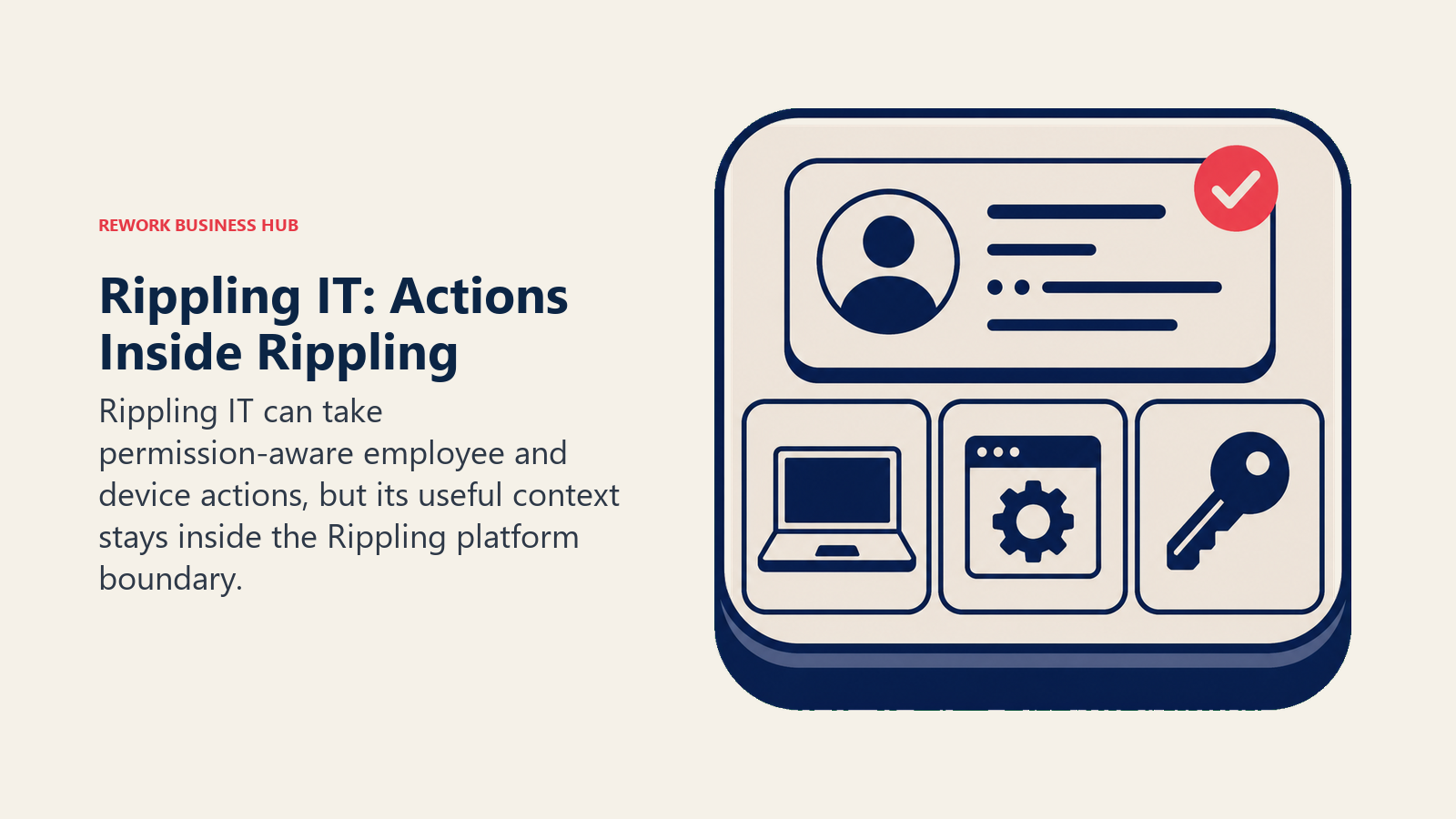
The tradeoff is that none of this is buyable on its own. Rippling requires the core Rippling Unity platform first, IT module pricing isn't published, and third-party buyer estimates put IT management around $5 to $20 per employee per month on top of the base platform fee (reported, unconfirmed directly).
| What you get | What you don't |
|---|---|
| One employee record driving HR, IT, and finance actions together | Not a standalone product; requires the core Rippling HR platform |
| Permission-aware actions, including license deprovisioning and device policy | IT module pricing isn't published; reported PEPM ranges are third-party estimates |
| A real March 2026 launch, actively expanding (Data Cloud, Procurement since) | Built for companies consolidating onto Rippling, not a pure IT swap-in |
Pricing: Requires the core Rippling Unity platform (base fee plus a per-module rate); IT management is reported at roughly $5 to $20 per employee per month on top of that (reported, third-party buyer estimates; not independently confirmed on Rippling's own site).
Best for: Companies already running, or planning to run, HR and payroll on Rippling that want IT actions on the same employee record instead of a separate identity system.
How to Choose: Decision Framework
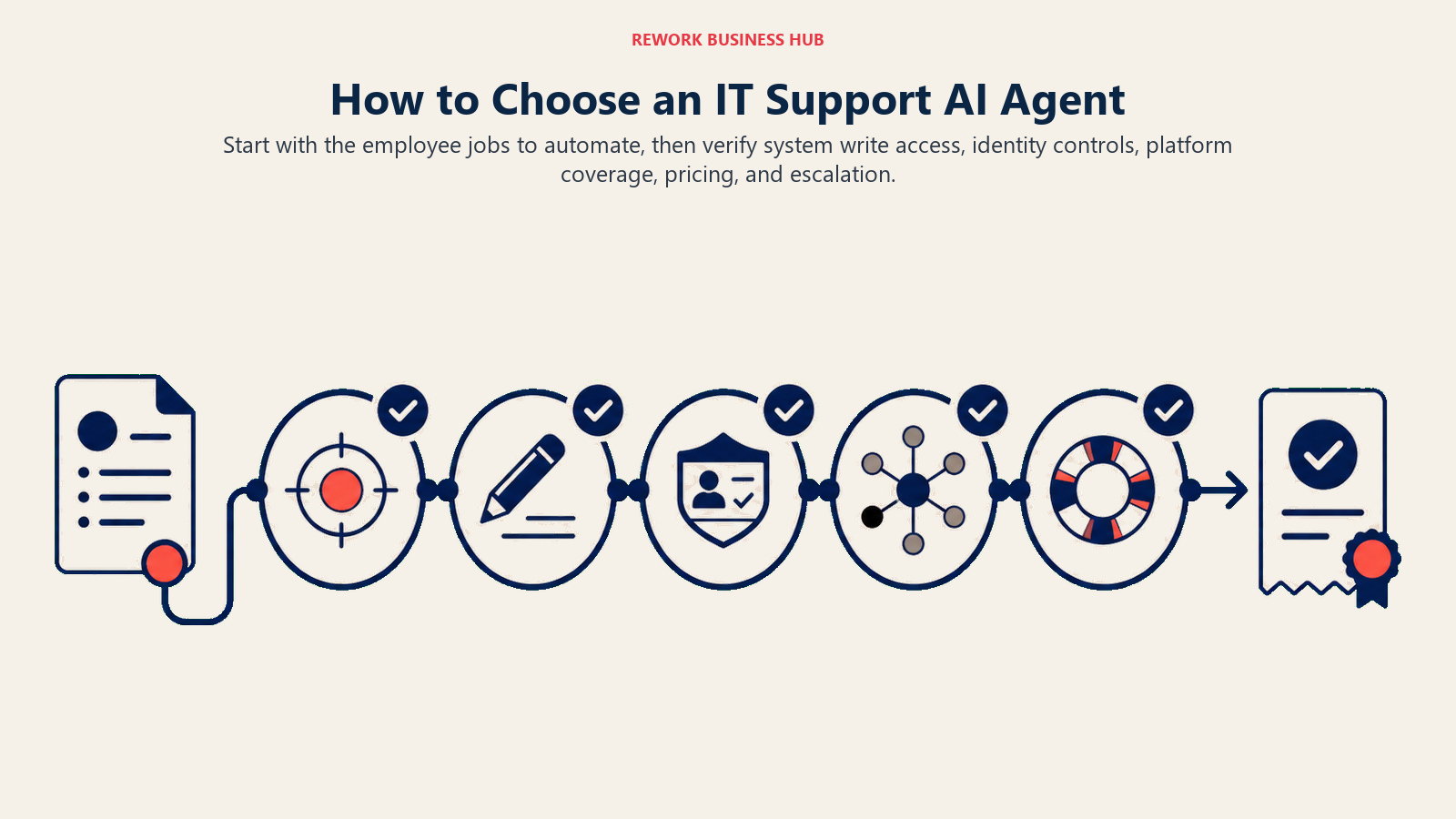
Start with the employee jobs to automate, then verify system write access, identity controls, platform coverage, pricing, and escalation.
| If you need... | Pick... | Why |
|---|---|---|
| The most mature employee-facing IT/HR assistant | Moveworks | Deepest self-service password reset and account unlock track record |
| IT actions grounded in your existing ITSM system of record | ServiceNow AI Agents | Native CMDB and case data; no separate integration layer |
| Published pricing instead of a demo-gated quote | Atomicwork | Real numbers ($25,000/yr Professional) with per-outcome overlay pricing |
| A prebuilt catalog instead of building flows yourself | Aisera | Prebuilt password reset, VPN, and provisioning workflows |
| IT and HR on one AI-native ITSM platform, 2,000+ employees | Rezolve.ai | People-based pricing purpose-built for that scale |
| To configure and test an agent yourself before buying | Workativ | Self-serve signup, published session-based pricing |
| Conversational depth plus cross-domain remediation | Resolve (Espressive) | Knowledge, automation, and human-assist agents in one platform |
| IT, HR, and finance requests on one employee-facing agent | Leena AI | Broadest single-agent scope across departments |
| Per-admin pricing inside Slack or Teams, not per-employee | Siit | Unlimited employees at no extra cost; native chat resolution |
| Verified, fully published per-seat pricing | Freshservice Freddy AI Agent | The only fully transparent rate card in this guide |
| IT actions on the same record as HR and payroll | Rippling IT | Permission-aware actions across HR, IT, and finance |
What to Do Next
Match your scale to the pricing model before you book a single demo: Workativ or Siit if you want to configure something yourself this month, Atomicwork if you want published enterprise pricing, and Moveworks, ServiceNow, Aisera, or Rezolve.ai if you're already committed to a multi-month enterprise buying process. Then pilot on one action, not five. Password reset is the standard starting point because the blast radius of a mistake is small and the volume is high enough to prove the deflection-versus-resolution math within a few weeks. Require human approval on every access-grant and device-level action until the audit trail has earned your security team's trust, then expand scope from there. If you haven't settled on which class of agent platform to build on more broadly, the AI agent platforms guide is the right starting point, and if your IT support needs sit alongside a broader HR automation push, AI agents for HR covers the overlapping ground this list touches through Leena AI, Atomicwork, and Rippling IT.

Principal Product Marketing Strategist
On this page
- Key Facts
- Quick Comparison Table
- Action Versus Answering: How We Actually Graded These
- The Privilege Problem: A Security Decision, Not Just a Deflection One
- Deflection Is Not the Same Number as Resolution
- What This Actually Costs Against a Service Desk Analyst's Salary
- 1. Moveworks (a ServiceNow Company): The Category-Defining Employee IT Assistant
- 2. ServiceNow AI Agents: ITSM-Native Actions, Now With Moveworks Built In
- 3. Atomicwork: Agentic ITSM With Published, Per-Outcome Pricing
- 4. Aisera (an Automation Anywhere Company): A Prebuilt Catalog Across IT, HR, and CX
- 5. Rezolve.ai: People-Priced, AI-Native ITSM for IT and HR
- 6. Workativ: No-Code Self-Serve Automation for IT and HR
- 7. Resolve (formerly Espressive Barista): Conversational Depth Toward "Zero Ticket" IT
- 8. Leena AI: One Agent Across IT, HR, and Finance
- 9. Siit: Slack- and Teams-Native Service Desk, Priced Per Admin
- 10. Freshservice Freddy AI Agent: Verified Per-Seat Pricing, Enterprise-Gated AI
- 11. Rippling IT: Permission-Aware Actions, But Only Inside the Rippling Platform
- How to Choose: Decision Framework
- What to Do Next