Best AI Agents for Helpdesk and Ticketing in 2026: 13 Tools for IT Service Desks
Turn this article into takeaways for your work.


Each assistant summarizes the article only for you and suggests best practices for your work.
Best for a ServiceNow shop adding governed autonomy: ServiceNow AI Agents or Moveworks. Best for a mid-market team that wants clear, unbundled pricing: Freshservice or SysAid. Best for an Atlassian-standardized IT org: Jira Service Management. Best for a modern, Slack-first internal desk without ITIL overhead: Siit. This guide evaluated 13 agents on what actually sits in the ticket queue, and each was scored on whether it reports honest resolution numbers, whether it can touch an identity provider to grant or revoke access, and how it fits against the ITSM platform and CMDB you already run.
This is the internal, employee-facing side of the ticket queue: IT service management, service desk triage, and joiner-mover-leaver access requests. If your queue is customer-facing support tickets instead, that's a separate buying decision with different vendors and different metrics; our companion roundup on AI agents for customer service covers that ground, and the underlying AI agent platforms guide covers the category one level up. And a quick line worth drawing before anything else: an agent plans a sequence of actions, calls tools such as your identity provider or ITSM API, observes the result, and decides what to do next. An assistive AI tool drafts a reply for a human to send. If a product on this list never touches your ticketing system directly, it's a tool wearing agent branding; see what an AI agent actually is for the fuller definition.
Key Facts
- Freddy AI Agent posts a 65.7% ticket deflection rate across 187 million tickets and 10,551 organizations, while the separate Freddy AI Copilot cuts resolution time by 76.6%, two different metrics Freshworks keeps honestly labeled rather than blending into one headline number (Freshworks).
- Gartner predicts agentic AI will autonomously resolve 80% of common service issues without human intervention by 2029 (Gartner), and separately found 91% of customer service and support leaders feel executive pressure to implement AI in 2026, based on a survey of 321 leaders (Gartner).
- Only 55% of employees feel fully supported by their organization's IT service desk, and 66% would rather self-serve a password reset than open a ticket, per Forrester's State of the Service Desk research (Forrester, via Freshworks).
- Roughly 50% of ex-employees still have access to corporate applications after they leave, and 20% of companies have experienced a breach tied to a former employee's still-active account, based on identity governance research (ID Dataweb).
- Cost per IT service desk ticket in North America runs $6 to $40 or more depending on complexity and channel efficiency, a range wide enough that the automation tier you buy changes your real cost per resolution more than the sticker license price does (InvGate).
What Changed in 2026
Consolidation hit this category harder than most. ServiceNow completed its acquisition of Moveworks on December 15, 2025. Automation Anywhere acquired Aisera on November 4, 2025. Resolve Systems acquired Espressive on September 10, 2025, folding Barista into its "Zero Ticket IT" platform. Three of the best-known employee-facing IT assistants now sit inside a bigger parent, which is worth asking about directly on any sales call: what changes in the roadmap now that the acquirer owns it.
The bigger shift is in how vendors price the work. Zendesk's Employee Service AI Agents, in early access since August 3, 2026, are built to charge only for resolutions that a separate AI evaluation model independently confirms, not for every conversation the agent touches. Atomicwork prices two of its four products directly on outcomes: a dollar per resolved knowledge query, two dollars per completed access request. That's a direct response to a problem this guide covers in detail below: vendor-published deflection numbers have historically run well ahead of what independent benchmarks find.
Ticket Deflection vs. Resolution: Measured Honestly
Deflection and resolution are not the same metric, and vendors that blend them make an agent look better than it is. Deflection counts an interaction the AI touched, whether a customer got an FAQ link and gave up or genuinely got their answer. Resolution counts problems actually solved, typically defined as no human agent involved and no re-open within a set window (72 hours is the common threshold). A platform can carry a 90% deflection rate and a 40% true resolution rate at the same time, because deflected tickets that quietly come back as a phone call or a re-opened ticket still count as a "deflection" on most dashboards.
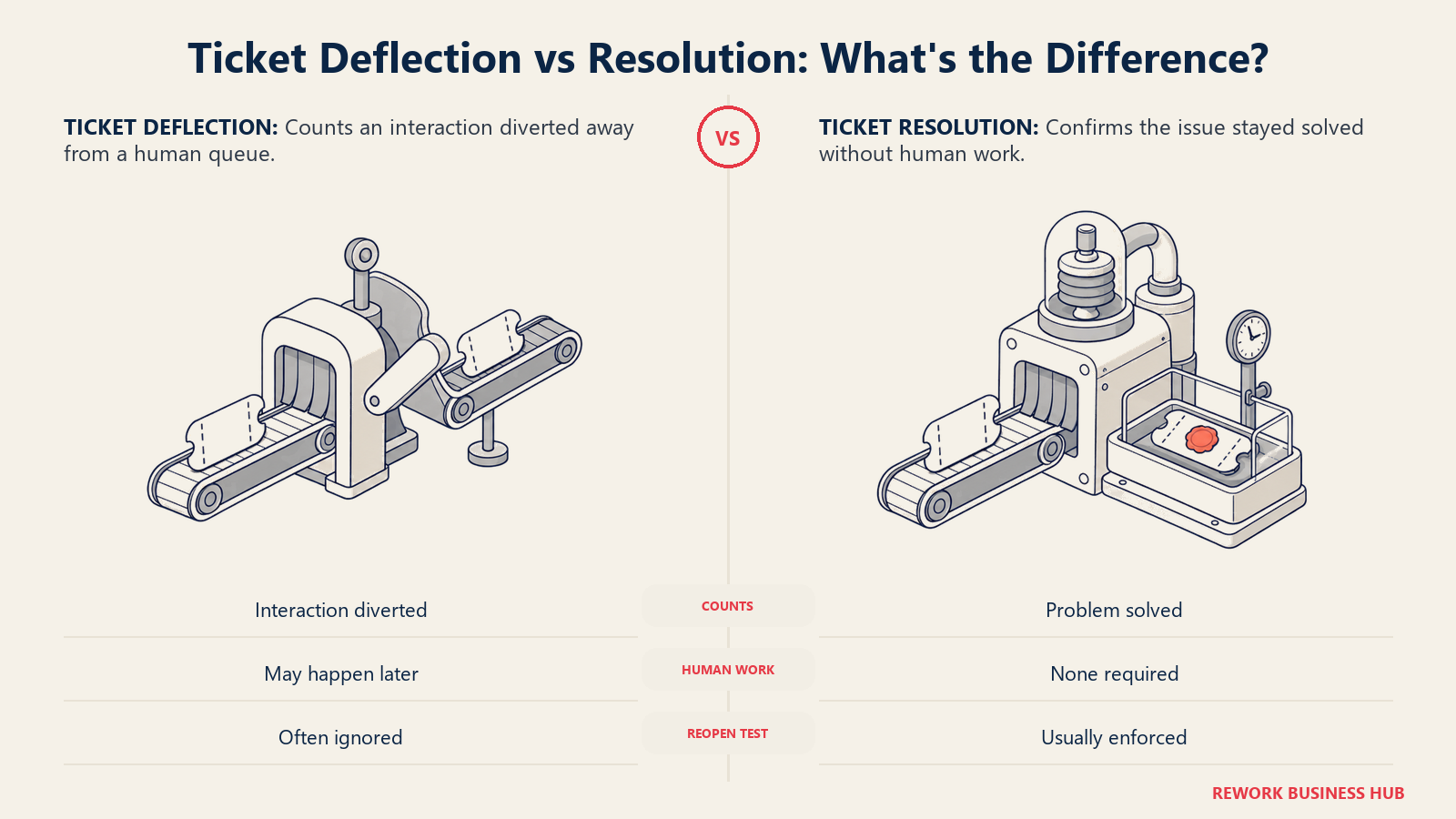
Independent benchmarking puts real-world numbers well below what vendor case studies typically publish. Gartner Peer Insights data puts the industry average deflection rate at 20 to 30% and best-in-class mature deployments at 40 to 60%, both under a strict definition requiring full autonomous resolution with no re-open. Vendor case studies commonly cite 50 to 75%, generally under a looser definition of what counts as "handled." That gap doesn't mean the vendor is lying; it usually means the number in a case study slide and the number a skeptical buyer should budget against are measuring two different things.
The table below shows what each vendor on this list actually publishes, and whether it's a deflection number, a resolution number, or a speed metric being presented as neither.
| Vendor | What It Publishes | Deflection, Resolution, or Speed | Independently Verified? |
|---|---|---|---|
| ServiceNow AI Agents | No published blended number; case studies vary 40 to 70% by maturity | Unclear, mixed use across sources | No |
| Moveworks | Case studies: Mercari 74% handled, Unity 90% CSAT, Nutanix 7-second average MTTR | Deflection (case-study specific) | No |
| Atomicwork | Prices per resolved query/ticket rather than a headline rate | Resolution (built into the pricing model) | Structural, not a claimed rate |
| Aisera | Case studies: Cisco and LifeScan 65%, 8x8 50% | Deflection (case-study specific) | No |
| Freshservice | 65.7% deflection (Agent) and 76.6% faster resolution (Copilot), reported separately | Both, clearly labeled | Yes, vendor benchmark study |
| Jira Service Management | No headline rate; usage metered in assisted conversations, not outcomes | Neither published | N/A |
| Zendesk | New pricing pays only for AI-confirmed and independently validated resolutions | Resolution (built into the pricing model) | Structural, not a claimed rate |
| Leena AI | "Auto-resolve 70% of IT tickets" | Resolution (as labeled by vendor) | No |
| Rezolve.ai | No headline rate; positions "Agent Assist" and a separate "Autonomous Agents" tier | Neither published | N/A |
| Espressive (Resolve) | "Deflecting up to 90% of IT tickets autonomously" | Deflection | No |
| SysAid | No headline deflection or resolution rate published | Neither published | N/A |
| Siit | No headline deflection or resolution rate published | Neither published | N/A |
| HaloITSM | No headline deflection or resolution rate published | Neither published | N/A |
Treat every unverified percentage in that table as a starting point for your own pilot, not a number to budget against. Freshservice and the two agents that price by resolution (Atomicwork, Zendesk) are the only three that structurally can't inflate the number, because the vendor gets paid differently depending on which metric moves.
Quick Comparison Table
| Agent | Best For | Starting Price | Key Strength | Key Limitation |
|---|---|---|---|---|
| ServiceNow AI Agents | Enterprises already on ServiceNow ITSM | Custom quote; reported $90-$200+/user/mo | CMDB-grounded, now includes Moveworks | Fully autonomous Prime tier still rolling out |
| Moveworks (a ServiceNow company) | Employee IT/HR assistant, ServiceNow-adjacent orgs | Custom quote; reported $50K-$200K+/yr | Strong employee-facing search and assistant layer | Roadmap independence uncertain post-acquisition |
| Atomicwork | Teams wanting agent-native ITSM or an overlay on existing tools | $25,000/yr (Professional) or per-resolution | Outcome-based pricing on access and resolution | Multi-agent orchestration locked to Business tier+ |
| Aisera (an Automation Anywhere company) | Prebuilt ITSM/HR/CX agent catalog | Custom quote; reported $50K-$1.2M/yr | Wide prebuilt agent catalog across functions | No self-serve tier, wide reported price range |
| Freshservice (Freddy AI) | Mid-market IT teams wanting clean, tiered pricing | $19/agent/mo (base); Freddy Agent Enterprise-only | Deflection and resolution reported separately, honestly | Freddy AI Agent gated to the Enterprise tier |
| Jira Service Management | Atlassian-standardized, dev-adjacent IT teams | $20/agent/mo (Standard) | Virtual Service Agent plus native Assets/CMDB | AI features gated to Premium ($51.42/agent/mo)+ |
| Zendesk (Employee Service AI Agents) | Teams wanting resolution-verified pricing | Free during EAP; GA pricing resolution-based | Only major vendor pricing strictly on verified resolutions | New product, still in early access as of August 2026 |
| Leena AI | Large enterprises wanting one assistant across IT, HR, Finance | Custom quote, employee-based | Broad enterprise service delivery beyond just IT | No published pricing or independent deflection data |
| Rezolve.ai | 2,000+ employee orgs overlaying agents on an existing ITSM | Custom quote, per-fulfiller/employee | Explicit overlay for ServiceNow, Freshservice, Jira | 2,000-employee minimum, quote-only |
| Espressive (a Resolve company) | Teams wanting a dedicated "Zero Ticket IT" assistant | Custom quote, demo-gated | Claims up to 90% autonomous deflection | No public pricing; claim sits above independent benchmarks |
| SysAid | Mid-market teams wanting AI bundled, not metered | $89/agent/mo (Professional) | Unlimited agentic AI with no usage caps at that price | No headline deflection or resolution number published |
| Siit | Modern, Slack/Teams-native internal helpdesk | $23/admin/mo (Essentials) | Billed per admin, not per requester; fast to deploy | Full AI Agents locked to the $89/admin/mo Pro tier |
| HaloITSM | Teams wanting one flat price with AI included standard | £66/agent/mo, single tier | No AI add-on fee; every feature ships in one price | Shallower agentic depth than purpose-built ITSM AI |
Internal Helpdesk vs. External Support: Why This List Is Different
An internal IT helpdesk and a customer-facing support desk share a ticket queue shape, but the job is different enough that the same tool rarely wins both. Internal tickets carry identity: the requester is a known employee in your HRIS and identity provider, so an agent can verify who they are before it acts. External tickets carry a customer relationship: the agent needs to protect brand tone and avoid promising a refund it has no authority to give, covered in depth in our best AI tools for customer support roundup, which draws that assistive-tool line from the customer side. Internal tickets also carry ITIL baggage that customer support tools were never built for: change advisory boards, configuration items, problem-versus-incident distinctions. How to choose ITSM software and how to choose help desk software both cover that split in more depth if you're still deciding which category you're even buying in.
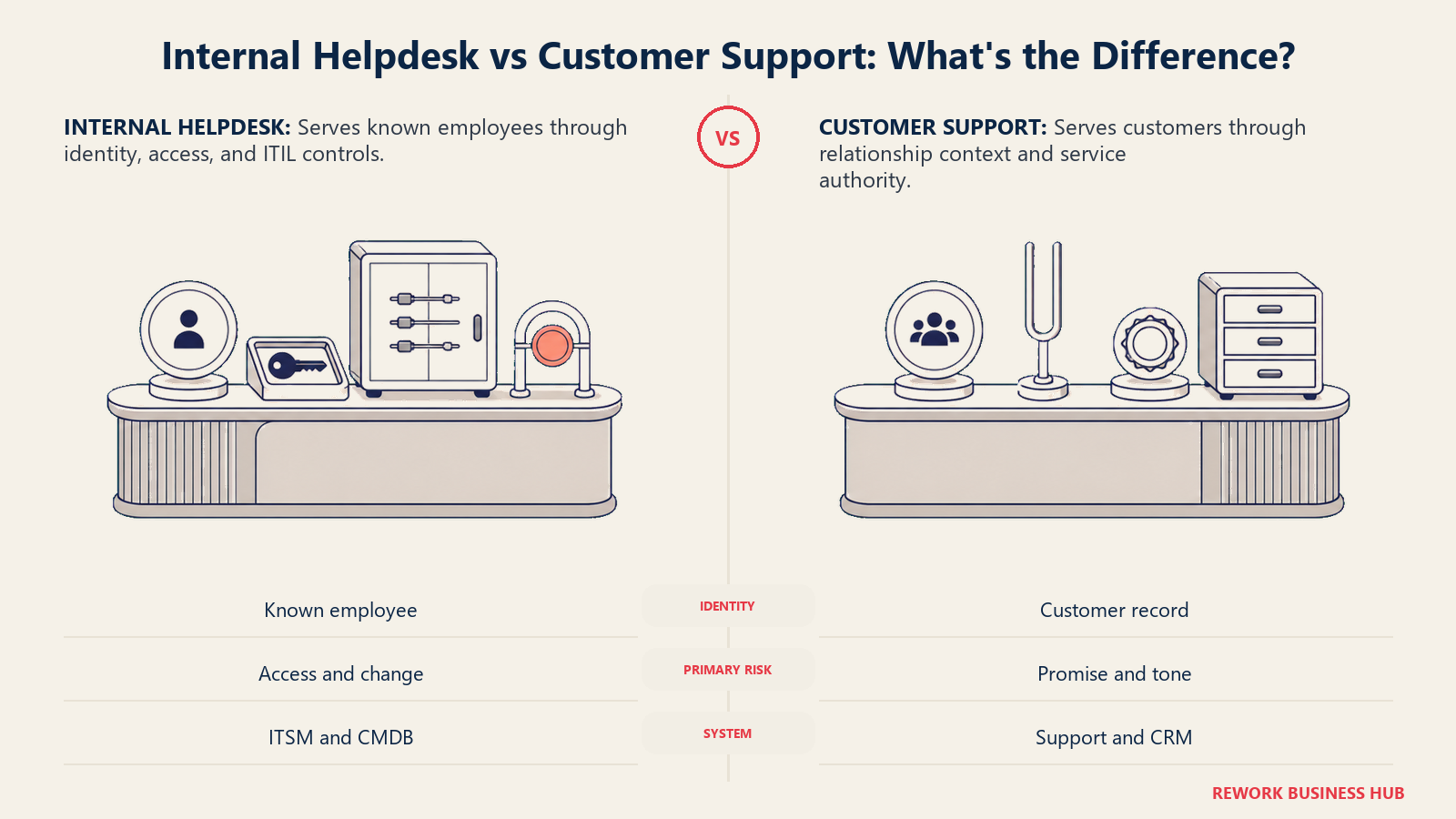
That's why ServiceNow, Freshservice, and Jira Service Management show up here and not in a customer support roundup, and why Zendesk, usually a customer-facing name, earns a spot only because it shipped a genuinely separate employee-facing product in 2026 rather than repackaging its support suite.
Access and Provisioning: Which Agents Actually Touch Your Identity Provider
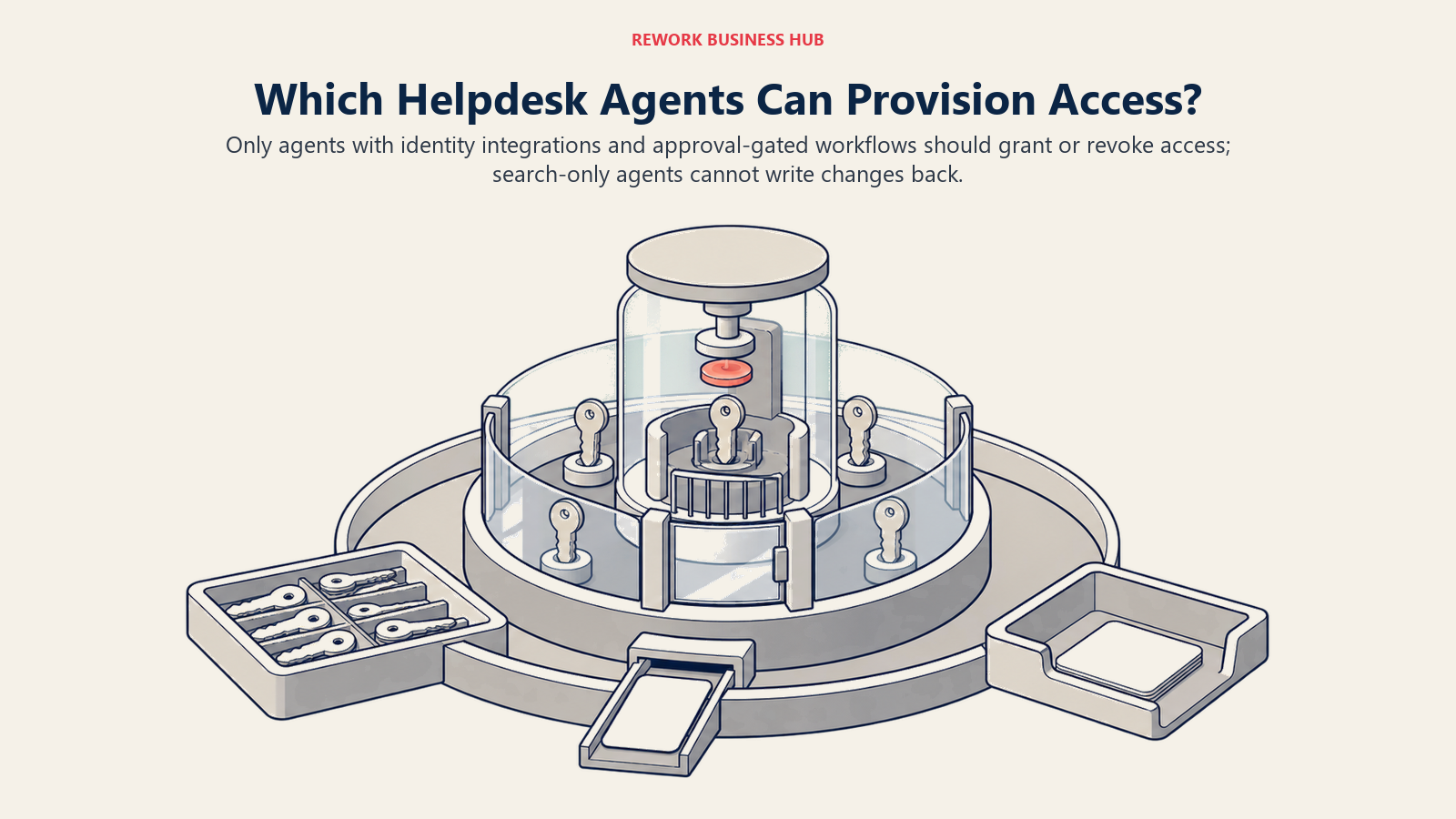
Answering "how do I reset my VPN" is a knowledge-grounded search problem. Granting a new hire's Salesforce license, or pulling access the moment someone is terminated, is an identity-system write operation, and it's the highest-stakes thing on this list. Roughly half of ex-employees keep some access after they leave, and one in five companies has been breached through a stale former-employee account, so the agent that actually executes joiner-mover-leaver requests against Okta, Azure AD, or Google Workspace is doing meaningfully riskier work than the one that only answers questions. Our build blueprint for an AI access provisioning agent covers the guardrails this kind of agent needs regardless of which vendor executes them.
| Agent | Touches Identity Provider Directly | Access Request Model | Notable Detail |
|---|---|---|---|
| ServiceNow AI Agents | Yes, via connected workflow | Approval-gated request fulfillment | Grounded in the same CMDB as the rest of ITSM |
| Moveworks | Yes, via IdP integration | Conversational request, policy-checked | Now shares ServiceNow's governance layer |
| Atomicwork | Yes | Priced per completed request ($2 each) | Only vendor here pricing access work as a line item |
| Aisera | Yes, prebuilt workflow | Catalog-based request fulfillment | Part of a broader ITSM/HR/CX catalog |
| Freshservice | Via asset/access request workflow | Ticket-based, not a dedicated agent action | Freddy AI Agent handles the conversation, not the grant |
| Jira Service Management | Via Assets module (Premium+) | Workflow-approval based | Access sits inside general request types, not a distinct product |
| Zendesk | Search only, not a write action | N/A for provisioning | Permission-aware search, doesn't grant or revoke access itself |
| Leena AI | Yes, via enterprise integration | Automated for IT, HR, Finance requests | Positioned across three functions, not IT-only |
| Rezolve.ai | Yes, via identity and Microsoft estate integration | Fulfiller-priced, tied to existing ITSM | Explicit overlay on your identity stack |
| Espressive (Resolve) | Yes, via connected systems | Self-healing workflow trigger | Part of the "Zero Ticket" automation claim |
| SysAid | Via Workato-powered automation | Credit-metered workflow | Access automation built through the credit pool, not a fixed rate |
| Siit | Via HRIS/asset integration (Standard+) | Workflow-based | Lighter identity depth than the ITSM incumbents |
| HaloITSM | Via standard ITSM workflow | Approval-gated request fulfillment | No distinct AI-specific access product |
Zendesk is the one clear exception on this list: its Employee Service AI Agents search across connected systems and respect source-level permissions, but the product answers and routes rather than writing changes back into an identity provider. If access provisioning is your primary use case, that's a real gap to confirm directly with Zendesk before you buy.
ITSM System of Record and CMDB Fit
The agent that grounds itself in the CMDB you already trust needs less new integration work than one bolted on top of a system it doesn't understand. Some of the names below are the ITSM platform itself; others are an AI layer designed to sit on whichever ITSM platform you already run.
| Agent | Native Platform or Overlay | Works With | CMDB / Asset Depth |
|---|---|---|---|
| ServiceNow AI Agents | Native (is the system of record) | N/A, ServiceNow itself | Deep, native CMDB |
| Moveworks | Native, now inside ServiceNow | ServiceNow, Slack, Teams | Inherits ServiceNow's CMDB |
| Atomicwork | Both: full native ITSM or overlay | ServiceNow, Jira Service Management | Native request/incident/problem/change/asset/config |
| Aisera | Overlay | ServiceNow, and other major ITSM platforms | Prebuilt catalog, not its own CMDB |
| Freshservice | Native | N/A, Freshservice itself | Native asset management |
| Jira Service Management | Native | Jira Software, Confluence, Slack, Teams | Native Assets module (Premium+) |
| Zendesk | Native ticketing, thin ITIL depth | Slack, Teams, help center | Not built for deep CMDB work |
| Leena AI | Overlay | Enterprise systems broadly, IT/HR/Finance | Depends on connected system |
| Rezolve.ai | Overlay | ServiceNow, Freshservice, Jira | Fixed fee add-on for assets/CMDB |
| Espressive (Resolve) | Overlay/automation layer | Hundreds of ITSM and monitoring tools | Depends on connected system |
| SysAid | Native | N/A, SysAid itself | Native all-in-one asset management |
| Siit | Native, lightweight | Slack, Teams, HRIS, MDM | Asset & SaaS management (Standard+), not deep CMDB |
| HaloITSM | Native | N/A, single unified platform | Native, bundled across IT/CS/Sales/Projects |
If you're not sure which category you even need, how to choose ITSM software walks through the ITIL-alignment questions that determine whether a native platform or a lighter overlay is the right starting point.
Change and Approval Controls When an Agent Can Act
Everything above this point is about what an agent can do. This section is about what should stop it. The moment an agent moves from answering a question to executing a change (resetting a password, granting a license, closing a P1 incident) it needs the same change-control thinking your CAB already applies to human-initiated changes, not a lighter version of it. Every credible vendor on this list gates high-risk actions behind an approval step rather than letting the agent act unilaterally: ServiceNow and Jira Service Management route through their existing change and approval workflows, Atomicwork and Rezolve.ai flag anything outside a standard access mapping for human sign-off, and SysAid and HaloITSM apply the same ticket-approval logic that's already in the base ITSM product.
The pattern that holds up in production, regardless of vendor, is a three-tier decision rule: act autonomously on low-risk, clearly-scoped requests; ask one clarifying question when a detail is missing; hand off immediately for anything that looks like privilege escalation or doesn't match a known scenario. Our IT helpdesk agent blueprint and access provisioning agent blueprint both build that logic out in full, including the specific guardrails (never bypass MFA, never treat a verbal request as an approval) worth checking any vendor's actual configuration against before you trust it with write access.
1. ServiceNow AI Agents: CMDB-Grounded Autonomy, Now Plus Moveworks
ServiceNow's agentic stack, Agent Studio for building agents, an AI Agent Orchestrator for coordinating them, and an AI Control Tower for governance, is grounded in the same CMDB and case data your ITSM instance already holds. Since completing its Moveworks acquisition in December 2025, ServiceNow folded that employee-facing search and assistant layer into the same platform, though the two products' integration was still settling.
| What you get | What you don't |
|---|---|
| Agents grounded in existing ITSM case data and the CMDB | No public price list, expect a custom quote |
| Three AI-native tiers (Foundation, Advanced, Prime) since April 2026 | Fully autonomous Prime tier is still rolling out |
| ISO 27001, SOC 2, FedRAMP certifications | Value concentrates heavily in existing ServiceNow shops |
| Now Assist generative AI bundled into all three 2026 tiers | Moveworks integration depth still maturing post-acquisition |
Pricing: No public price list; ServiceNow directs buyers to a custom quote. Third-party estimates put core tiers around $90 to $200+ per user per month depending on tier (reported, unconfirmed by ServiceNow directly). For ITSM Professional specifically, quotes commonly land $100 to $140 per fulfiller per month at 100 to 500 agents.
Best for: Enterprises already running ServiceNow for ITSM that want agents grounded in that workflow data without adding a second vendor's identity model. For the deeper procurement and compliance read on this vendor, see our best enterprise AI agent platforms guide.
2. Moveworks (a ServiceNow Company): Employee-Facing Search and Assistant
Moveworks built its name on front-end assistance for employee IT, HR, and facilities questions through what it calls a Reasoning Engine, resolving requests conversationally in Slack and Teams rather than through a ticket form. ServiceNow completed its acquisition on December 15, 2025, and the product now operates inside the broader ServiceNow AI Platform.
| What you get | What you don't |
|---|---|
| Strong employee-facing search and assistant layer, proven pre-acquisition | Long-term roadmap independence is a real open question |
| SOC 2 Type 2, ISO 27001/27017/27018, FedRAMP certifications | Pricing is quote-only with a wide reported range by company size |
| Explicit no-training commitment on customer data | Overlaps with ServiceNow's own native AI Agents |
| Case studies report strong deflection and satisfaction gains | Independent verification of those case-study numbers isn't public |
Pricing: No public price list; quote-only, billed per employee per year. Reported figures range from roughly $50,000 to $100,000/year at 500 to 1,000 employees up to $200,000+/year above 5,000 employees, with a reported median around $130,000/year (reported, aggregated third-party buyer data, unconfirmed by Moveworks directly).
Best for: Enterprises wanting a dedicated employee IT/HR assistant, especially ones already standardizing on ServiceNow as their broader AI platform of record.
3. Atomicwork: Outcome-Priced AI Coworkers for ITSM
Atomicwork's pitch is a full ITSM stack, request, incident, problem, change, asset, and configuration management, run by AI "coworkers" instead of bolted-on chatbots, deployable as a standalone platform or layered onto ServiceNow or Jira Service Management with no platform fee. Its outcome-based pricing (paying per resolved query or completed access request rather than per seat) is the most structurally honest pricing model on this list.
| What you get | What you don't |
|---|---|
| Full native ITSM stack or a no-platform-fee overlay | Multi-agent orchestration requires Business tier or above |
| Outcome-based pricing: $1/resolved query, $2/completed access request | Additional AI Coworkers on Professional cost $499/mo each |
| Access Automation priced and tracked as its own line item | Newer entrant with less third-party case-study volume |
| Can run on top of ServiceNow or JSM without replacing them | Business tier pricing is not published, requires a sales call |
Pricing: Professional $25,000/year (2 AI Coworkers, up to 250 end users). Business: flexible pricing (5 AI Coworkers, up to 1,000 end users). Enterprise: custom (10 AI Coworkers, unlimited). Outcome-based alternative: Knowledge Support $1 per resolved query, Access Automation $2 per completed access request, Service Resolution from $3 per resolved ticket, confirmed on Atomicwork's pricing page.
Best for: IT teams that want agent-native ITSM from the ground up, or that want to test an agent layer on their existing ServiceNow or Jira Service Management instance before committing to a platform switch.
4. Aisera (an Automation Anywhere Company): Prebuilt ITSM, HR, and CX Agents
Aisera ships a prebuilt catalog of agentic AI for IT service management, HR, and customer self-service under what it calls its TRAPS trust framework. Automation Anywhere announced its acquisition on November 4, 2025, adding Aisera's catalog to its broader automation portfolio.
| What you get | What you don't |
|---|---|
| Prebuilt agent catalog across ITSM, HR, and CX | No self-serve tier, every deal runs through enterprise sales |
| ISO 27001, SOC 2 Type II, HIPAA with BAA, GDPR, CCPA | FedRAMP not confirmed |
| PII anonymization built in by default | Recent acquisition adds real roadmap uncertainty |
| Case studies report 50-65% deflection at Cisco, LifeScan, 8x8 | Independent benchmarks put comparable strict figures roughly 10 points lower |
Pricing: No public price list; enterprise sales-led with no self-serve option. A marketplace listing suggests roughly $200,000/year for up to 1,000 users scaling to about $1,200,000/year for up to 10,000 users, while other aggregated deal data shows a median closer to $90,000/year with a range of roughly $50,000 to $120,000 (reported, figures vary by source, confirm directly with Aisera or Automation Anywhere).
Best for: Enterprises wanting a prebuilt ITSM, HR, or CX agent catalog without building from scratch, especially ones already evaluating Automation Anywhere for RPA.
5. Freshservice (Freddy AI): The Honest-Metrics Mid-Market Pick
Freshservice is Freshworks' ITSM product, and its 2025 benchmark study (187 million tickets across 10,551 organizations) is the most rigorously disclosed dataset in this category. It's also the clearest example of a vendor reporting deflection and resolution as two separate, correctly labeled numbers instead of one flattering blend.
| What you get | What you don't |
|---|---|
| Deflection (Agent) and resolution speed (Copilot) reported separately | Freddy AI Agent is gated to the Enterprise tier only |
| Clear four-tier pricing from $19 to $99/agent/mo, Enterprise custom | Freddy AI Copilot is a $29/agent/mo add-on on top of Pro+ |
| Full ITSM stack: incident, problem, change, asset management | Three AI products billed three different ways adds real complexity |
| 431,270 hours saved annually across the benchmark sample | Freddy AI Agent sessions cap at 1,200/year per Enterprise license |
Pricing: Starter $19/agent/mo, Growth $49/agent/mo, Pro $99/agent/mo, Enterprise custom (annual billing). Freddy AI Copilot adds $29/agent/mo on a Pro-or-higher base. Freddy AI Agent (Classic) is included only in Enterprise, with 1,200 sessions per license per year, per Freshworks' own Freshservice pricing page.
Best for: Mid-market IT teams that want a full ITSM platform with AI pricing they can actually model, and that trust a vendor more for separating its metrics than for the size of the number.
6. Jira Service Management: Virtual Service Agent for Atlassian Shops
Jira Service Management pairs its ITIL-aligned service desk with Atlassian Intelligence and Rovo Agents, credit-metered AI features that scale by tier. Its Virtual Service Agent handles conversational support, and independent aggregation puts its published deflection figures closer to strict, verified numbers than most competitors on this list.
| What you get | What you don't |
|---|---|
| Free tier for up to 3 agents, unlimited customers | AI features (Virtual Service Agent, deeper Rovo) start at Premium |
| Native Assets/CMDB module from Premium up | Rovo credits (25/70/150 per user/mo by tier) cap real usage |
| Deep integration with Jira Software and Confluence for dev-adjacent IT | Not built for teams outside the Atlassian ecosystem |
| Published deflection figures track closer to independent strict benchmarks | Enterprise pricing requires switching to annual billing to view |
Pricing: Free (3 agents). Standard $20/agent/month, including 25 Rovo credits per user/month. Premium (recommended by Atlassian) $51.42/agent/month, adding the Virtual Service Agent, advanced AIOps, and 70 Rovo credits per user/month. Enterprise: custom, billed annually, 150 Rovo credits per user/month, per Atlassian's Service Collection pricing page.
Best for: Atlassian-standardized IT organizations, especially ones already running Jira Software or Confluence, that want AI support features without adding a new vendor's login.
7. Zendesk (Employee Service AI Agents): Pays Only for Verified Resolutions
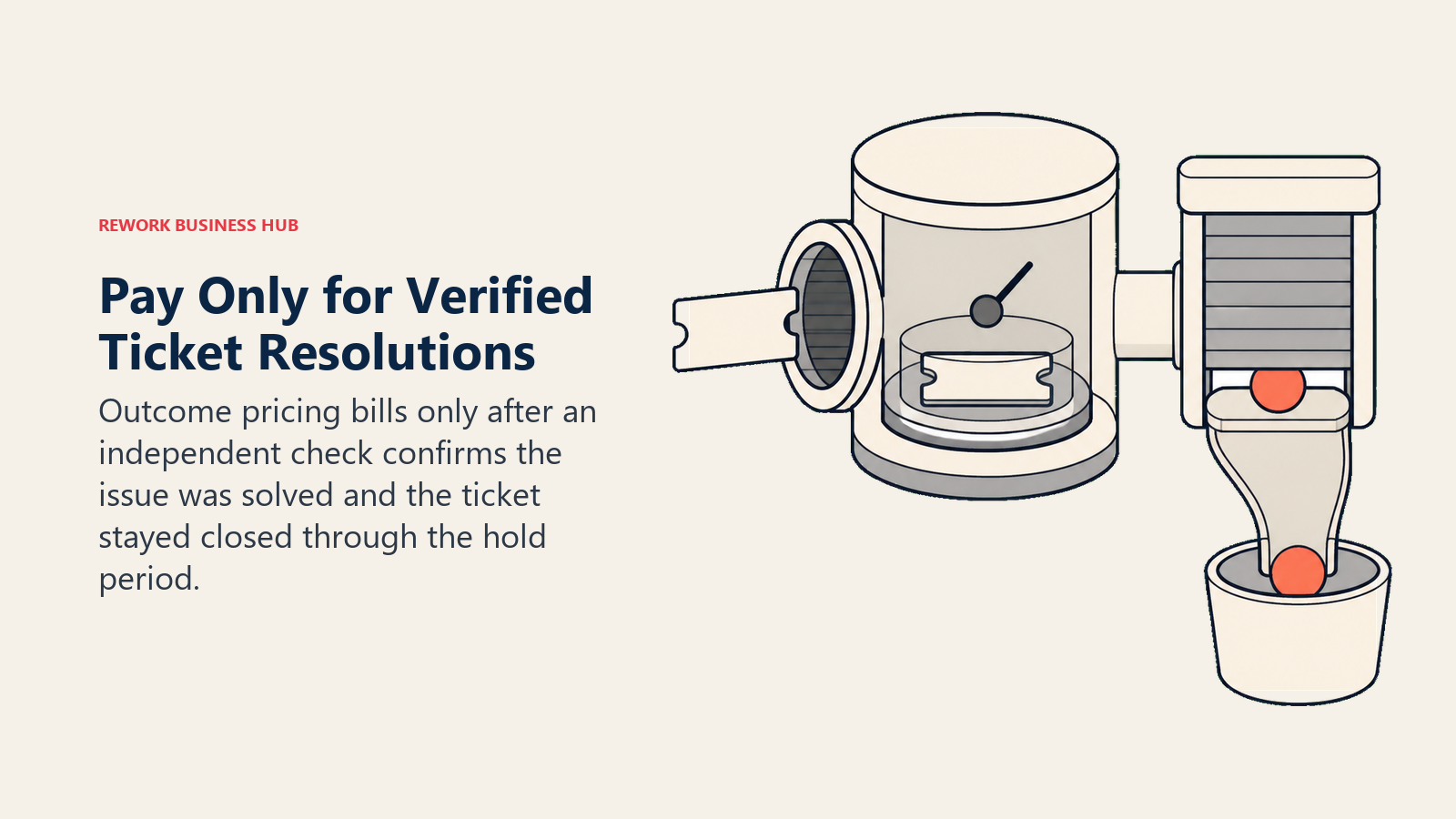
Zendesk built its name on customer-facing support, but its Employee Service AI Agents, in early access since August 3, 2026, are a genuinely separate product for internal IT, HR, and Finance requests, powered by its Unleash acquisition. The headline feature isn't the agent itself; it's the pricing model behind it, the same verified-resolution philosophy Zendesk uses on its customer-facing side, where a resolution only bills after a 72-hour hold and an independent AI evaluation model confirms it, not on raw deflected conversations.
| What you get | What you don't |
|---|---|
| Pricing tied to independently verified resolutions, not seats or touches | Product is new; GA pricing for Employee Service AI Agents isn't public yet |
| Permission-aware search across Box, Confluence, Drive, Notion, SharePoint | Answers and routes; doesn't itself write changes to an identity provider |
| Free during the EAP period through rollout | Excluded for HIPAA/FedRAMP accounts and Employee Service Suite Team plans |
| Operates natively inside Slack and Microsoft Teams | Thinner native ITIL/CMDB depth than ServiceNow, Freshservice, or JSM |
Pricing: Free during the current Employee Service AI Agents early access period; general-availability pricing will be resolution-credit based, not yet published, per Zendesk's own EAP announcement. The underlying Employee Service Suite it sits on is reported at Team $29, Growth $59, and Professional $99 per agent per month, annual billing, with Enterprise custom-quoted (reported).
Best for: Teams that want the most defensible pricing model in this category and are comfortable adopting a product still in early access rather than a mature one.
8. Leena AI: One Assistant Across IT, HR, and Finance
Leena AI's WorkLM platform positions itself as a single enterprise assistant spanning IT, HR, and Finance requests rather than an IT-only tool, aimed at large organizations that want one deployment instead of three departmental point solutions.
| What you get | What you don't |
|---|---|
| One platform covering IT, HR, and Finance service delivery | No published pricing or self-serve tier |
| Vendor claims 70% auto-resolution of IT tickets | No independent verification of that figure found |
| Employee-based licensing that scales with headcount | Typically deployed with professional services attached |
| Real-time helpdesk insights across functions | Less IT-specific depth than a dedicated ITSM platform |
Pricing: No public price list; quote-based, employee-based licensing scaled to organization size, per Leena AI's own IT Service Delivery pricing page.
Best for: Large enterprises that want one AI assistant deployed across IT, HR, and Finance rather than separate tools per function.
9. Rezolve.ai: An Overlay for Whatever ITSM You Already Run
Rezolve.ai doesn't ask you to replace ServiceNow, Freshservice, or Jira Service Management. It layers "Agent Assist" for technicians (pre-analyzed tickets, drafted replies) and a separate "Autonomous Agents" tier directly on top of the ITSM you already have, priced per fulfiller or per employee rather than as a platform swap.
| What you get | What you don't |
|---|---|
| Explicit overlay for ServiceNow, Freshservice, and Jira | 2,000-employee minimum organization size |
| Separate pricing lines for employees, technicians, and full ITSM | No published pricing; every quote requires a scoping call |
| A distinct "Autonomous Agents" tier separate from assistive Agent Assist | Not seat-based for autonomous agents, harder to budget upfront |
| Fast quote turnaround (reported within 48 hours of a scoping call) | Not a fit for small or mid-size IT teams under 2,000 employees |
Pricing: Quote-based across four separate products: AI for Employees (per employee/month), AI for Technicians (per fulfiller/month), AI-Native ITSM (per fulfiller/month plus a fixed CMDB/assets fee), and Autonomous Agents (fixed annual fee or per-agent-run). Rezolve.ai states a "firm all-in number" typically within 48 hours of a 30-minute scoping call, as stated on Rezolve.ai's pricing page.
Best for: Organizations of 2,000+ employees that want an agent layer on top of the ITSM platform they've already invested in, rather than a rip-and-replace.
10. Espressive (a Resolve Company): The Zero Ticket IT Bet
Espressive built Barista, a conversational AI for employee self-service, before Resolve Systems acquired it on September 10, 2025 and folded it into Resolve's broader "Zero Ticket IT" automation platform. The pitch is aggressive: deflect and resolve the large majority of IT requests before they ever become a ticket a human sees.
| What you get | What you don't |
|---|---|
| Claims deflecting up to 90% of IT tickets autonomously | That figure sits well above Gartner's 40-60% best-in-class strict ceiling |
| Integrates with hundreds of ITSM tools and monitoring platforms | No public pricing; fully demo-gated |
| Self-healing workflow automation beyond conversational Q&A | Recent acquisition adds real product-continuity questions |
| Established Espressive brand and case-study base pre-acquisition | Product now competes for roadmap priority inside Resolve |
Pricing: No public pricing; demo-gated, contact Resolve directly for a quote, per Resolve's own product site.
Best for: Teams willing to pilot an aggressive deflection claim directly against their own ticket data before trusting the headline number, rather than budgeting off the marketing page.
11. SysAid: AI Bundled In, No Metering
SysAid's Professional tier bundles a full ITSM stack (request, incident, change, problem, asset management) with an AI Copilot and prebuilt AI agents at one flat per-agent price, explicitly marketed around not metering AI usage the way several competitors on this list do.
| What you get | What you don't |
|---|---|
| Unlimited agentic AI with no usage caps at the base Professional price | No headline deflection or resolution rate published |
| Full ITSM plus asset management in one product | Workato automation credits (100K/mo) can still be a real ceiling |
| AI Agent Builder for custom internal automations | Enterprise tier requires a minimum of 20 agents |
| Straightforward, single-tier-plus-Enterprise pricing | Less brand recognition in AI agent circles than ServiceNow or Moveworks |
Pricing: Professional $89/agent/month, including AI Copilot, prebuilt AI agents, and 100,000 Workato automation credits. Enterprise: custom, minimum 20 agents, including 300,000 Workato credits and tailor-made agents, confirmed on SysAid's pricing page.
Best for: Mid-market IT teams that want AI agent capability bundled into a predictable per-agent price rather than a separate metered add-on.
12. Siit: Modern, Slack-Native Internal Helpdesk
Siit skips the ITIL-heavy interface most incumbents on this list carry and builds a lightweight, conversational internal helpdesk natively inside Slack and Microsoft Teams. Its billing model is also different: you pay per admin (the people resolving requests), and every requester in the company is free and unlimited.
| What you get | What you don't |
|---|---|
| Billed per admin, unlimited free requesters | Full AI Agents and AI Triage locked to the $89/admin/mo Pro tier |
| Native Slack, Teams, and email ticketing from the entry tier | Lighter CMDB and asset depth than the ITSM incumbents |
| Fast to deploy for teams that don't need formal ITIL processes | No published headline deflection or resolution figure |
| 14-day free trial with full feature access | Newer product with less enterprise case-study history |
Pricing: Essentials $23/admin/month, Standard $45/admin/month (adds automated workflows and HRIS integration), Pro $89/admin/month (adds AI Agents and AI Triage), Enterprise custom, all billed annually, per Siit's published pricing page.
Best for: Smaller or leaner IT teams that live in Slack or Teams already and want a modern internal helpdesk without adopting a full ITIL-process platform.
13. HaloITSM: One Flat Price, AI Included Standard
Halo's pitch is simplicity: a single per-agent price with every capability, including its AI Virtual Agent, Suggested Replies, Sentiment Analysis, and AI Triaging, included standard rather than gated behind a premium tier or metered add-on.
| What you get | What you don't |
|---|---|
| AI included standard, no separate license or metering | Agentic depth is the shallowest of the ITSM-native options here |
| One unified price across IT, customer service, and other modules | No headline deflection or resolution rate published |
| Free, unlimited end-user (requester) access | Enterprise unlimited-license package runs a reported $1M/year |
| No tiers to navigate, every feature ships at the same price | Community reviews note AI performs better in demos than production |
Pricing: £66/agent/month, billed annually, single unified tier with no add-ons. An Enterprise Package offering unlimited licenses is available at a reported $1,000,000/year with funded implementation, per Halo's pricing page.
Best for: IT teams that want predictable, all-inclusive pricing and are comfortable with a more conversational Virtual Agent rather than the deeper multi-step autonomy of the purpose-built AI-native platforms above.
How to Choose: Decision Framework
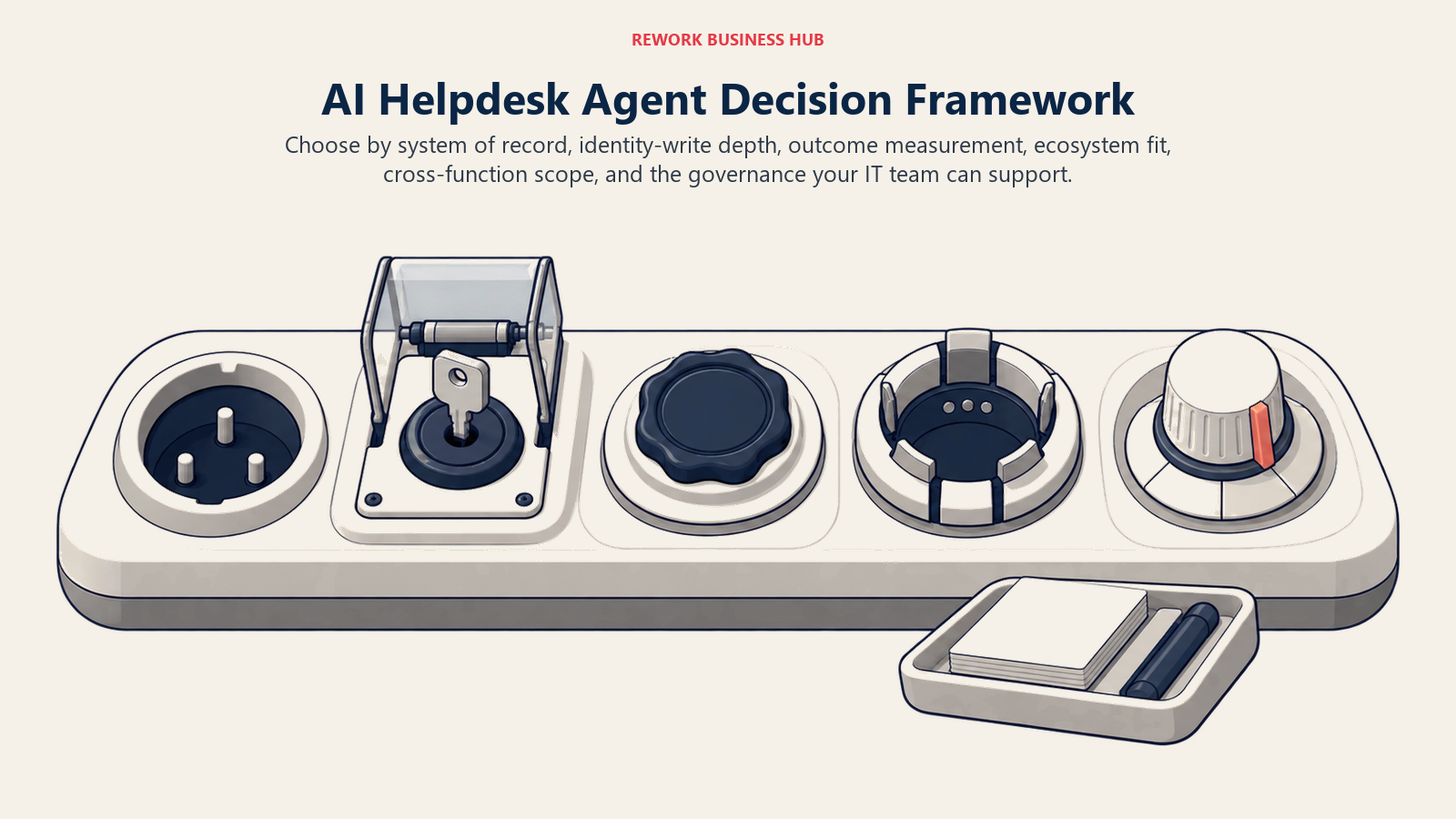
Choose around the system of record, the action boundary, and how success is billed. This decision table separates CMDB grounding, identity actions, verified outcomes, ecosystem depth, cross-function coverage, and lightweight Slack-first operation.
| If you need... | Pick... | Why |
|---|---|---|
| Deep CMDB grounding and you're already on ServiceNow | ServiceNow AI Agents | Native workflow and CMDB data, no new integration layer |
| A dedicated employee IT/HR conversational assistant | Moveworks | Strongest pre-acquisition track record on that specific job |
| Agent-native ITSM or a no-platform-fee overlay on what you have | Atomicwork | Only vendor pricing access and resolution as line items |
| A prebuilt catalog spanning IT, HR, and CX | Aisera | Ships prebuilt agents instead of build-from-scratch |
| Honest, separately reported deflection and resolution numbers | Freshservice | The most rigorously disclosed benchmark data in the category |
| Deep Atlassian-ecosystem integration | Jira Service Management | Native Assets/CMDB, Virtual Service Agent at Premium |
| Pricing tied strictly to verified resolutions | Zendesk Employee Service AI Agents | Pays only for independently confirmed outcomes |
| One assistant across IT, HR, and Finance | Leena AI | Multi-function coverage beyond IT alone |
| An overlay on an existing ITSM at 2,000+ employees | Rezolve.ai | Explicit ServiceNow/Freshservice/Jira overlay model |
| The most aggressive deflection claim, pilot-tested first | Espressive (Resolve) | Highest published number; verify against your own data |
| AI bundled at one flat price, no metering | SysAid | Unlimited agentic AI included in the base Professional tier |
| A modern, Slack-first desk without ITIL overhead | Siit | Per-admin pricing, unlimited free requesters, fast setup |
| One simple price across every module, AI included | HaloITSM | No tiers, no AI add-on fee |
Helpdesk AI Buying Mistakes to Avoid
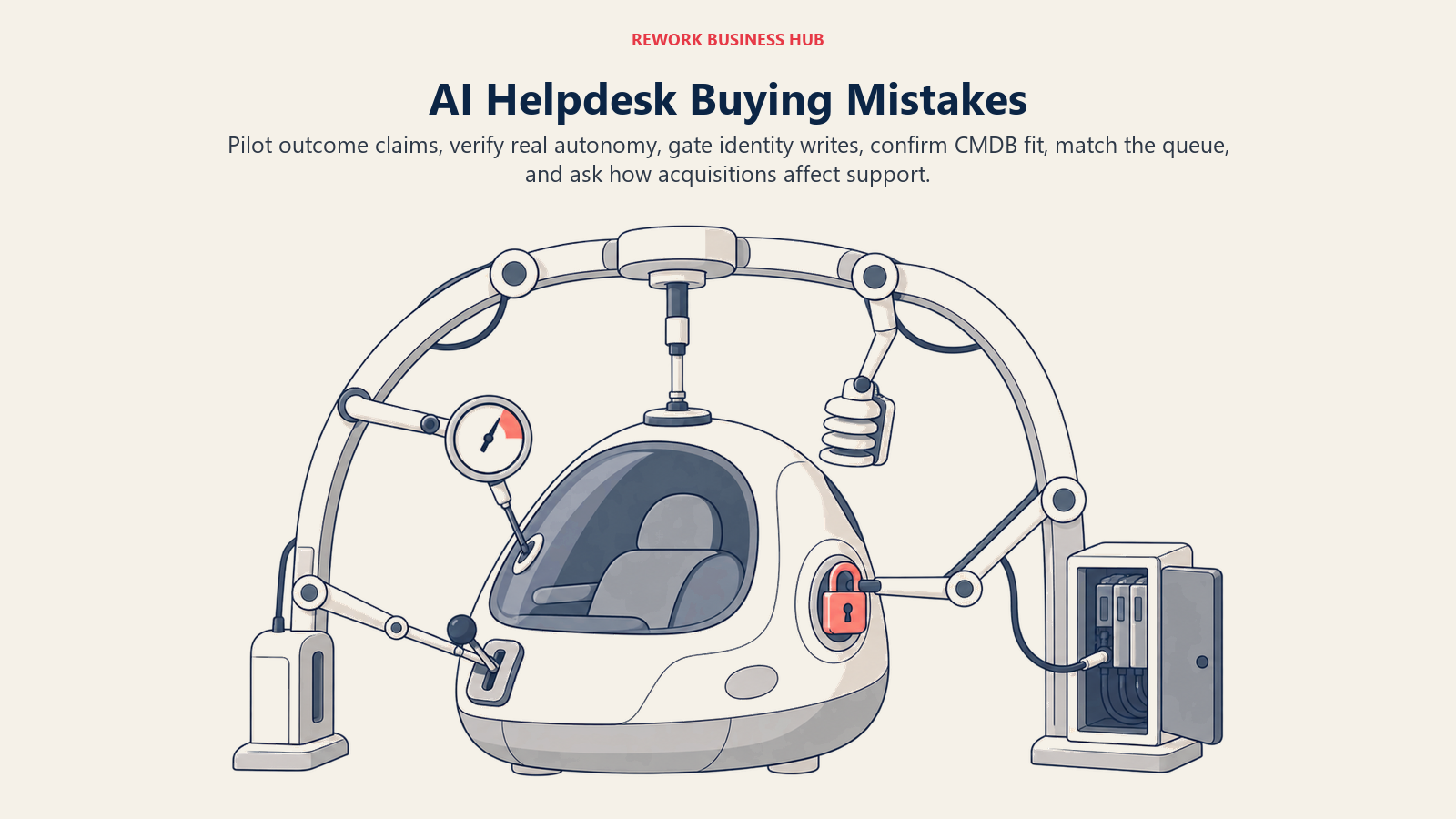
Helpdesk AI risk concentrates where a marketing claim meets privileged systems and real ticket behavior. This inspection highlights the checks to complete before granting access or trusting a headline automation rate.
| Mistake | What It Looks Like | What to Do Instead |
|---|---|---|
| Budgeting off a vendor's headline deflection number | Assuming an 80-90% claim will hold in your environment | Pilot against your own ticket data before signing a multi-year contract |
| Confusing an assistive Copilot with an autonomous Agent | Buying the cheaper add-on expecting it to resolve tickets end to end | Check whether the product drafts a reply for a human or takes the action itself |
| Letting an agent execute access changes with no approval gate | Granting write access to an identity provider on day one | Require human sign-off on anything outside a standard role-to-access mapping |
| Ignoring which ITSM platform the agent actually grounds against | Buying an overlay agent with no plan for the CMDB it needs to read | Confirm native integration with your system of record before the demo, not after |
| Treating internal and external helpdesk tools as interchangeable | Shortlisting a customer-support AI tool for an internal IT queue | Match the vendor to the job: employee identity and ITIL versus customer relationship |
| Skipping the M&A question | Signing with a newly acquired vendor without asking about roadmap continuity | Ask directly how the acquisition changes support SLAs and the product roadmap |
What to Do Next
Pick two agents, the one grounded in the ITSM platform you already run and one overlay or challenger option, and run a 30-day pilot against your real ticket queue before signing anything multi-year. Track deflection and resolution as two separate numbers from day one, not the vendor's blended figure, and confirm in writing whether the agent can actually execute access changes or only talk about them. If you're still deciding whether you need a full ITSM platform or a lighter internal helpdesk before you even get to the agent layer, start with how to choose ITSM software, then come back to this list once that decision is made.

Principal Product Marketing Strategist
On this page
- Key Facts
- What Changed in 2026
- Ticket Deflection vs. Resolution: Measured Honestly
- Quick Comparison Table
- Internal Helpdesk vs. External Support: Why This List Is Different
- Access and Provisioning: Which Agents Actually Touch Your Identity Provider
- ITSM System of Record and CMDB Fit
- Change and Approval Controls When an Agent Can Act
- 1. ServiceNow AI Agents: CMDB-Grounded Autonomy, Now Plus Moveworks
- 2. Moveworks (a ServiceNow Company): Employee-Facing Search and Assistant
- 3. Atomicwork: Outcome-Priced AI Coworkers for ITSM
- 4. Aisera (an Automation Anywhere Company): Prebuilt ITSM, HR, and CX Agents
- 5. Freshservice (Freddy AI): The Honest-Metrics Mid-Market Pick
- 6. Jira Service Management: Virtual Service Agent for Atlassian Shops
- 7. Zendesk (Employee Service AI Agents): Pays Only for Verified Resolutions
- 8. Leena AI: One Assistant Across IT, HR, and Finance
- 9. Rezolve.ai: An Overlay for Whatever ITSM You Already Run
- 10. Espressive (a Resolve Company): The Zero Ticket IT Bet
- 11. SysAid: AI Bundled In, No Metering
- 12. Siit: Modern, Slack-Native Internal Helpdesk
- 13. HaloITSM: One Flat Price, AI Included Standard
- How to Choose: Decision Framework
- Helpdesk AI Buying Mistakes to Avoid
- What to Do Next