Best AI Agents for HR in 2026: 11 Agents for the Employee Lifecycle
Turn this article into takeaways for your work.


Each assistant summarizes the article only for you and suggests best practices for your work.
If you're buying an AI agent for HR rather than another assistive tool, Leena AI and Resolve lead purpose-built employee helpdesk agents, Workday Illuminate and SAP SuccessFactors lead agents embedded in the HRIS you already run, and Rippling AI and Darwinbox lead agents that act across HR, IT, and finance at once. This guide covers 11 real HR agent products, each evaluated on one question first: does it read a request, check it against your actual written policy, and act or escalate on its own, or does it just answer a question and leave the work to a person?
This is the buy side of a decision most HR teams also face on the build side. AI Agents for HR maps this same employee lifecycle to build blueprints for teams that would rather design the process than buy it. And if what you actually need is software that assists a person rather than a system that plans and executes on its own, best AI tools for HR and best AI tools for HR teams cover that larger, adjacent category instead. An AI agent for HR plans a sequence of actions (read the request, check it against policy, act or ask one clarifying question, escalate when a case needs judgment) and runs with a human checking in at defined boundaries, not at every step. An employee-facing helpdesk buy and an HR-ops automation buy are two different purchases even when one vendor sells both, so this guide keeps them separate instead of ranking everything on a single list.
Key Facts
- 82% of CHROs plan to adopt AI agents within the next year, per Gartner's "Prepare for the Future of AI Agents in HR" research, cited via Eightfold.
- Yet 88% of HR leaders say their organization hasn't realized significant business value from AI tools so far, per a Gartner survey of 114 HR leaders (October 2025).
- Only 16% of what companies call an "AI agent" in production actually plans, observes, and adapts on its own; most are fixed-sequence workflows wearing agent branding, per Menlo Ventures' State of Generative AI in the Enterprise.
- 57% of organizations now have AI agents running in production, rising to 67% among enterprises with 10,000 or more employees, per LangChain's State of Agent Engineering survey.
- Recruitment AND ongoing employment management (task allocation, performance monitoring, promotion, and termination decisions) are both classified high-risk under Annex III of the EU AI Act, with obligations enforceable since August 2, 2026, per the European Commission's AI Act Service Desk.
What Changed in 2026
- ServiceNow closed its $2.85 billion acquisition of Moveworks on December 15, 2025, then launched ServiceNow EmployeeWorks in February 2026, folding Moveworks' conversational AI directly into ServiceNow's unified employee portal for HR, IT, and finance requests.
- Resolve acquired Espressive on September 10, 2025, and merged Espressive's conversational AI into its own Resolve-branded agents. The standalone Espressive site is retired; espressive.com now redirects straight to resolve.io.
- Zendesk announced Employee Service AI Agents at Relate 2026 (May 19), with an Early Access Program starting August 3, 2026. Pricing is set per resolution rather than per seat, a deliberate break from its customer-service pricing model.
- SAP shipped five new Joule Agents for SuccessFactors, generally available May 2026: Payroll, Recruiting, Onboarding, HR Service, and Workforce Upskilling assistants, each purpose-built rather than one generalized bot.
- Rippling AI launched March 18, 2026 under the tagline "built to do the work, not just talk about it": it now executes actions across HR, IT, and finance rather than only answering questions.
- Personio acquired the recruiting AI startup aurio on April 22, 2026, but broad customer rollout of aurio's agentic sourcing and screening is still landing through the rest of 2026, so it's left off the numbered list below until that's further along.
- The EU AI Act's Annex III high-risk obligations for employment-related AI became enforceable on August 2, 2026. See the compliance section below; this affects most of the agents in this guide, not only the recruiting-specific ones.
Quick Comparison Table
| Agent | Primary Job | Best For | Starting Price | Automates or Assists |
|---|---|---|---|---|
| Leena AI (Harrison) | Employee helpdesk | Enterprises with high HR ticket volume | Custom quote only | Automates |
| Resolve (formerly Espressive) | Employee helpdesk | Multi-department IT and HR ticket deflection | Custom quote only | Automates |
| Moveworks (ServiceNow EmployeeWorks) | Employee helpdesk | ServiceNow shops folding HR into one portal | ~$130K/yr median (reported) | Automates |
| Zendesk Employee Service AI Agents | Employee helpdesk | Zendesk CX shops extending inward; EAP stage | ~$1.50-$2/resolution (reported) | Automates (preview) |
| Atomicwork | Employee helpdesk, IT-led | IT-led orgs wanting one agent for IT, HR, Finance | $25,000/yr (Professional) | Automates |
| Workday Illuminate | HR ops, performance, analytics | Large enterprises (1,000+) already on Workday | Custom, Flex Credits | Automates |
| SAP SuccessFactors (Joule Agents) | HR ops, payroll, onboarding | Existing SuccessFactors customers | Custom, ~$6-38 PEPM (reported) | Automates |
| Dayforce AI Agents | Payroll, time, performance coaching | Existing Dayforce customers | Custom, ~$22-45 PEPM (reported) | Automates |
| Darwinbox (Super Agent / Cortex) | HR ops across HR, IT, Finance | Large employers, especially in Asia | Custom, ~$3-25 PEPM (reported) | Automates |
| Rippling AI | HR ops, cross-system actions | Companies consolidating HR, IT, finance on Rippling | $8/employee/mo + $35/mo base | Automates |
| HiBob (Bob Companion) | Performance, engagement insights | Mid-size, culture-forward teams (100-1,000) | $8-25/user/mo (custom quote) | Tier-dependent |
What Actually Runs vs. What Just Answers
An AI tool for HR assists a person who stays in the loop for every step: it drafts a policy summary an HR admin edits, or answers one question in a chat window and stops. An AI agent for HR plans a sequence of actions across a job (read the request, check it against your written policy or HRIS record, act or ask one clarifying question, escalate when a case needs judgment) and runs with a human checking in only at boundaries you define, the same plan-act-observe loop covered in what is an AI agent. That line matters more in HR than in almost any other function, because a wrong answer here isn't just an inconvenience. It can become something the company is on the hook to honor. If you're assembling a broader AI-assisted HR stack rather than shopping for a single autonomous system, best AI tools for HR and best AI tools for HR teams cover the assistive layer this guide deliberately leaves out: AI-generated engagement reports, review-drafting copilots, and people-analytics dashboards a person still reads and acts on.
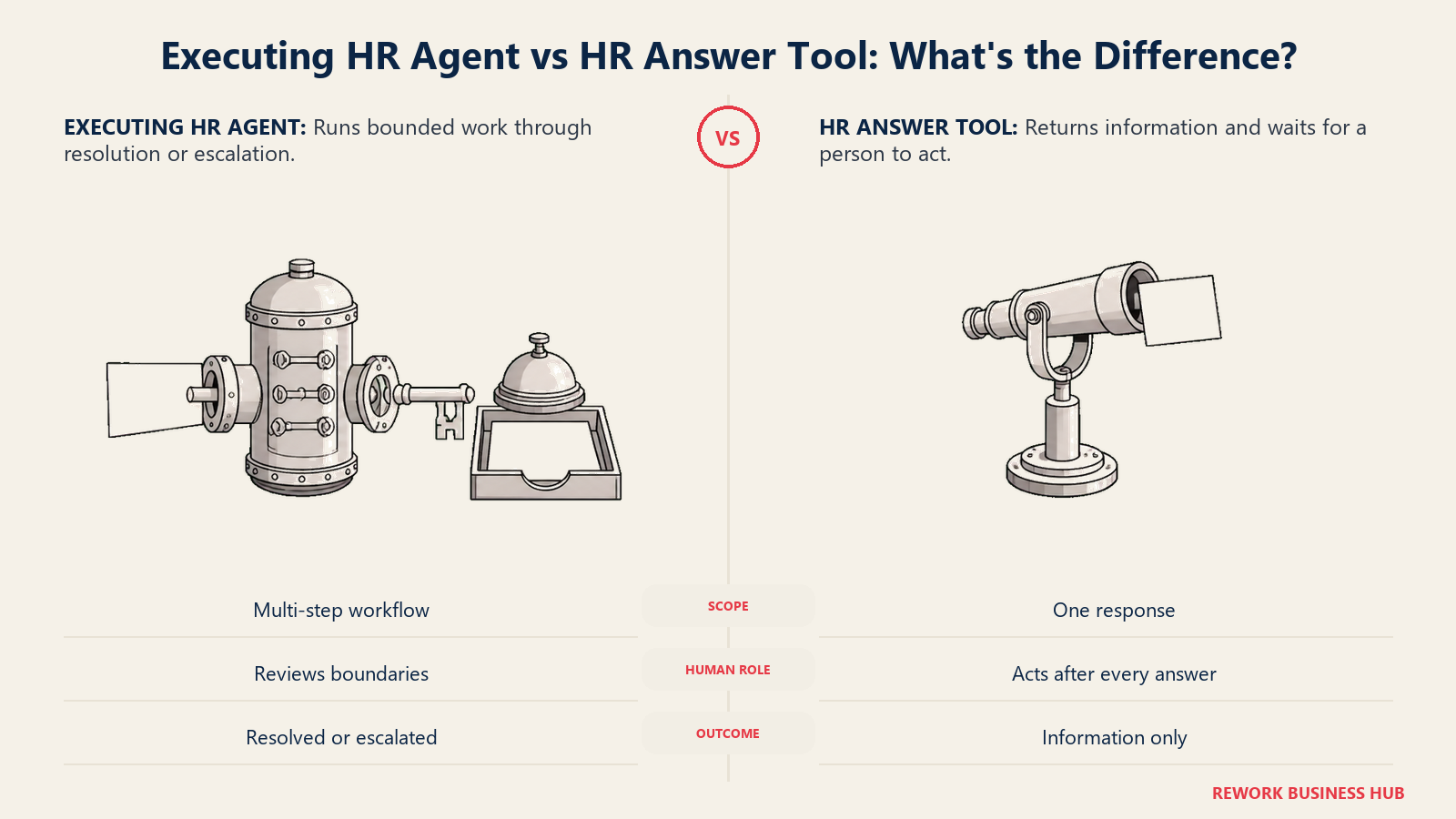
Watch for "agent washing" here specifically. A vendor that rebrands a policy FAQ chatbot as an "agent" is selling the same thing HR teams have bought for a decade with a new label attached. The products below were kept on this list because each one demonstrably plans and executes, not because its marketing uses the word "agent."
Map the HR Jobs: Which Agent Owns Which One
HR breaks into a handful of repeatable jobs, and most "AI agent for HR" pitches really claim one or two of them, not the whole employee lifecycle. Match the job actually costing you hours before you compare vendors.
| HR Job | What It Actually Involves | Agents That Own It |
|---|---|---|
| Employee helpdesk and policy Q&A | Answer PTO, benefits, and policy questions; resolve or route a ticket without a person opening one | Leena AI, Resolve, Moveworks (ServiceNow), Zendesk, Atomicwork |
| Onboarding and HR ops automation | Paperwork, checklists, and provisioning that span HR, IT, and finance systems at once | Rippling AI, SAP's Onboarding Assistant, Darwinbox's Super Agent, Workday's Business Process Copilot Agent |
| Performance management | Assembling review packets, coaching prompts, succession-adjacent talent development | Workday's Performance Agent, Dayforce's AI Workspace coaching tools, HiBob's Bob Companion |
| Workforce analytics | Sentiment tracking, headcount and spend drivers, compliance monitoring | Workday's Employee Sentiment Agent, Dayforce's People Analytics agent, Rippling AI |
| Payroll support | Answering pay questions and flagging discrepancies before a pay run goes out | SAP's Payroll Assistant, Dayforce's pay agents, Leena AI's Harrison, Darwinbox |
Recruiting and candidate sourcing are their own deep buying decision with a different evaluation criteria (sourcing breadth, screening bias, EU AI Act Annex III recruitment obligations specifically), so this guide covers HR-wide agents only far enough to place them correctly, not to rank them. If any row above fits your team better as something you build than something you buy, the matching blueprint is a faster start than a blank prompt: AI Employee Onboarding Agent, AI Performance Review Agent, or AI Payroll Agent.
Employee-Facing HR Helpdesk Agents
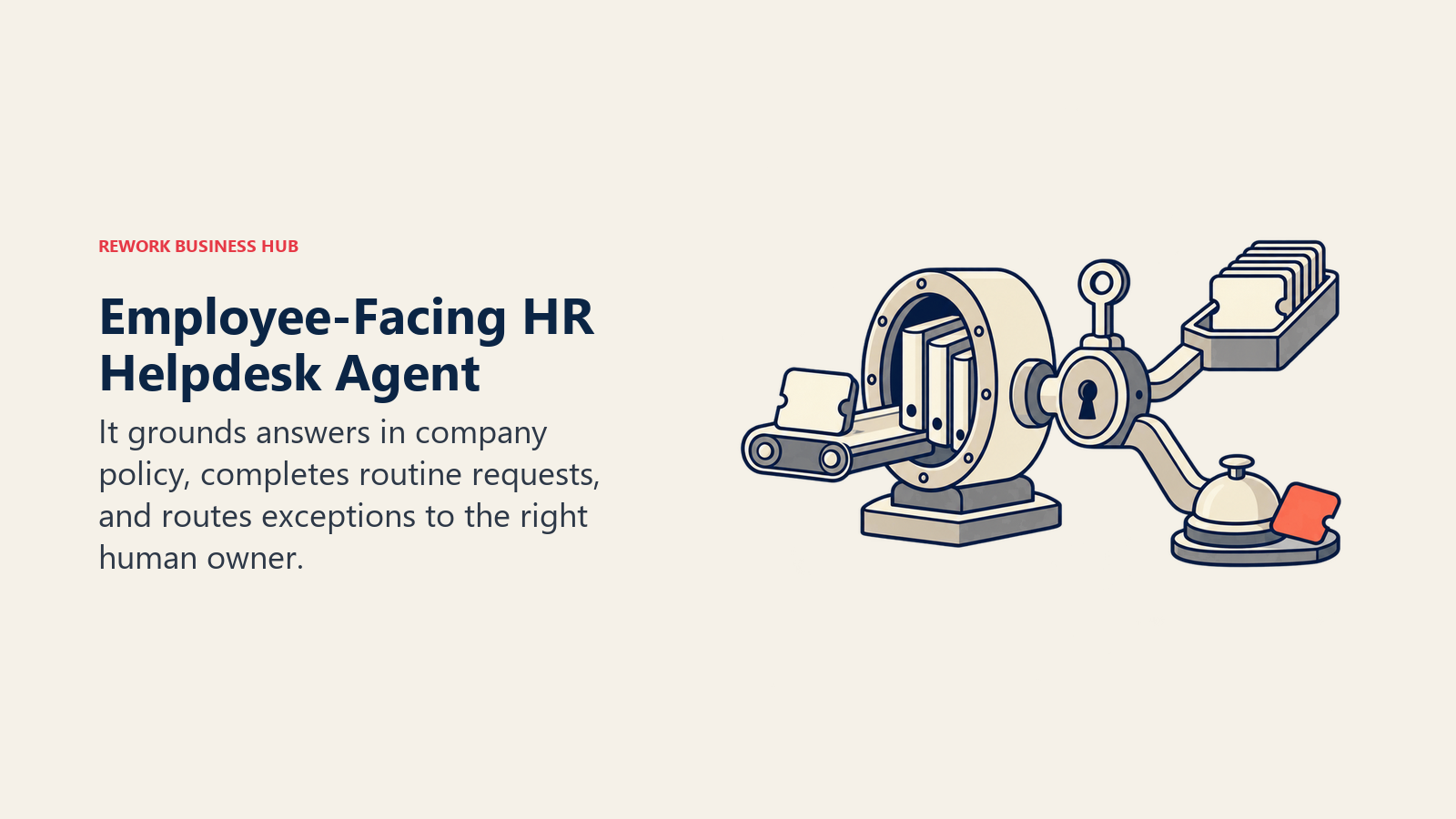
These agents sit between an employee and HR: they answer the question or resolve the request themselves, and only escalate to a person when a case genuinely needs judgment. The buying criteria here are ticket volume, engine coverage (does it answer from your actual policy documents or generic training knowledge), and how it decides when to hand off.
1. Leena AI (Harrison): The Purpose-Built HR Helpdesk Agent
Leena AI's product is Harrison, positioned as a "Universal HR Assistant" and an always-on HR helpdesk that handles onboarding questions, leave requests, payroll questions, and general policy Q&A through 11 pre-built Agent Operating Protocols and roughly 10 native integrations. It supports voice interaction and more than 100 languages, and Leena AI reports agents going live in around 45 days with more than 70% of tickets auto-resolved, a vendor claim worth validating in your own pilot rather than taking at face value.
| What you get | What you don't |
|---|---|
| Purpose-built HR helpdesk agent, not a bolt-on to a broader ITSM suite | Custom, quote-driven pricing with no published tiers |
| Vendor-reported 70%+ auto-resolution and roughly 45-day go-live | Headcount-based pricing is hard to forecast ahead of a demo |
| Voice support and 100+ languages out of the box | Built for large, stable enterprise headcounts, not small teams |
Pricing: Custom, enterprise-only. Contact Leena AI directly for a quote based on employee count and modules.
Best for: Large enterprises with high HR ticket volume that want a dedicated HR helpdesk agent rather than one module inside a broader employee-service suite.
2. Resolve (Formerly Espressive): Three Agents for Zero-Ticket IT and HR
Resolve acquired Espressive in September 2025 and merged its conversational AI into Resolve's own agent lineup rather than keeping it as a separate product; the Espressive brand and site are retired. The resulting platform runs three agents together: a Knowledge Agent that answers instantly across chat, portals, and collaboration tools before a ticket even forms, an Automation Agent that executes autonomous workflows for remediation and configuration, and Agent Assist, which hands a person enriched diagnostics for the cases that need one. Resolve reports customers seeing up to 90% ticket reduction, a vendor figure to confirm against your own volume before you budget around it.
| What you get | What you don't |
|---|---|
| Three-agent structure spans instant answers, autonomous fixes, and escalation | No published pricing; every deal runs through a demo |
| Vendor-reported up to 90% ticket reduction across IT and HR combined | Espressive's standalone brand and roadmap are gone; verify current packaging |
| Built for "zero ticket" IT and employee service, not HR alone | Less HR-specific depth than a purpose-built HR helpdesk agent |
Pricing: Not published. Contact Resolve for a quote.
Best for: Enterprises that already evaluated Espressive and want the current, Resolve-branded version of the same conversational and automation capability.
3. Moveworks, Now ServiceNow EmployeeWorks: HR Folded Into One Governed Portal
ServiceNow closed its $2.85 billion acquisition of Moveworks in December 2025, the largest in ServiceNow's history, and launched ServiceNow EmployeeWorks two months later: Moveworks' conversational AI and enterprise search now live inside ServiceNow's unified employee portal rather than as a standalone product. Requests can be handed off to agents that execute the work from start to finish, following the business rules, approval paths, and role-based permissions ServiceNow already enforces. The first named specialist, a Level 1 Service Desk AI Specialist, is in controlled availability now with general availability expected in Q2 2026; ServiceNow reports a 50% reduction in live agent chats within 30 days across IT, HR, and procurement combined.
| What you get | What you don't |
|---|---|
| Conversational AI and search inside ServiceNow's governed workflow engine | Effectively requires ServiceNow as the underlying platform |
| Serves HR, IT, and finance requests from one interface | No standalone, HR-only entry point post-acquisition |
| Vendor-reported 50% cut in live agent chats within 30 days | Level 1 Service Desk AI Specialist is controlled availability, not full GA yet |
Pricing: Subscription, priced per user; not publicly disclosed. Third-party trackers report a median annual contract near $130,000 (roughly $15-45 per employee).
Best for: Enterprises already running ServiceNow for IT service management that want employee service AI extended into HR on the same governed platform.
4. Zendesk Employee Service AI Agents: Outcome-Priced, Still in Early Access
Zendesk introduced Employee Service AI Agents at its Relate 2026 event on May 19, framing them as part of an "Autonomous Service Workforce" for internal IT, HR, and finance support, built on Unleash, the enterprise-search company Zendesk acquired in December 2025. The agents come pre-trained on common HR and IT topics (payroll, benefits, software access) and can complete routine, multi-step requests, like a password reset or an access approval, using your own workflows and policies, deployed into email, an intranet widget, or Slack and Teams. The genuinely new part is pricing: Zendesk is charging per resolution rather than per seat, a deliberate break from how it prices customer-facing support. The Early Access Program only opens August 3, 2026, so treat this as a preview, not a mature product, when you evaluate it.
| What you get | What you don't |
|---|---|
| Pre-trained on common HR and IT topics from day one | Early Access Program starts August 3, 2026; not broadly GA |
| Outcome-based pricing: pay per resolution, not per seat | No published per-resolution rate; third-party estimates vary |
| Deploys where employees already work (email, intranet, Slack, Teams) | Newer than the other helpdesk agents on this list; less of a track record |
Pricing: Not published on a rate card. Third-party analyses converge on roughly $1.50 per resolution inside a committed pack and about $2.00 pay-as-you-go, on top of Zendesk's base Suite plans.
Best for: Existing Zendesk customer-service shops that want to extend the same agent framework inward to HR and IT, and are comfortable piloting an Early Access product.
5. Atomicwork: One Agent Platform for IT, HR, and Finance Tickets
Atomicwork is built IT-first: an agentic service-management layer that unifies a "Universal AI coworker" for employees with a governed AI workforce for IT, then extends the same infrastructure to HR, Finance, and Legal rather than treating HR as a separate product. Its billing runs on credits, drawn each time an AI Coworker completes a job, which scales with task complexity rather than seat count.
| What you get | What you don't |
|---|---|
| One agent platform covering IT, HR, Finance, and Legal tickets | HR-specific depth is thinner than a purpose-built HR helpdesk agent |
| Credit-based billing tied to completed jobs, not seats | Entry tier caps at 250 end users and a fixed credit pool |
| Enterprise tier adds unlimited end users and 24x7 support | Best fit for orgs that already run IT service management this way |
Pricing: Professional $25,000/year (2 AI Coworkers, up to 250 end users, 25,000 credits). Business: flexible pricing (5 AI Coworkers, up to 1,000 end users). Enterprise: custom contract (10 AI Coworkers, unlimited end users, volume credit discounts). Source: atomicwork.com/pricing.
Best for: IT-led organizations that want one agent platform covering the IT, HR, and finance helpdesk instead of three separate tools.
HR-Ops and HRIS-Embedded Agents
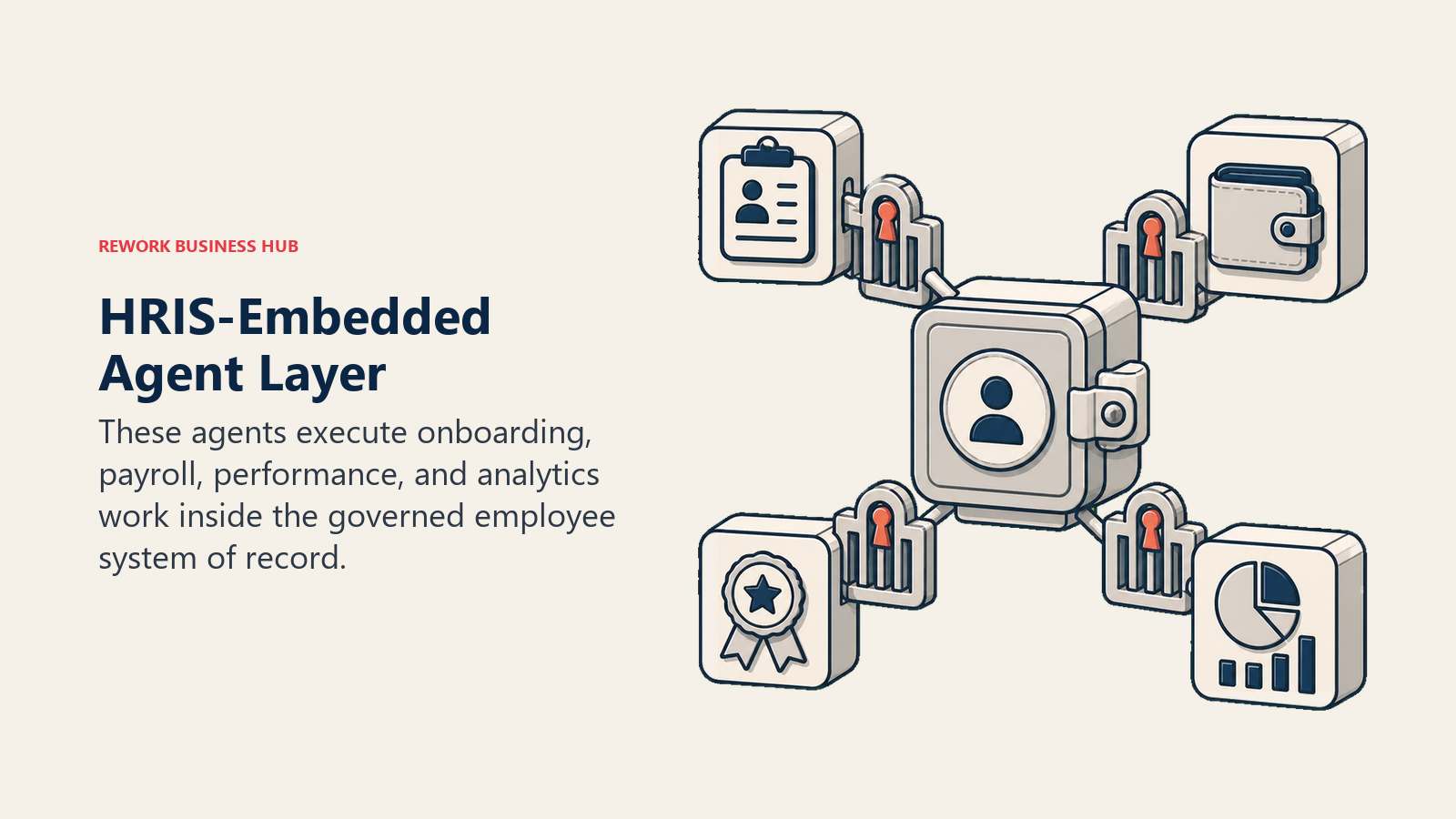
These agents live inside the system of record. Instead of sitting between an employee and HR, they automate the work HR itself does: onboarding sequences, payroll prep, performance cycles, workforce analytics. The buying criteria shift accordingly: does the agent read and write your actual HRIS data with no sync layer in between, and does it come as one generalized assistant or several purpose-built agents per job.
6. Workday Illuminate: Six Named Agents Inside the HCM You Already Run
Workday expanded Illuminate with six purpose-built HR agents in 2025: a Business Process Copilot Agent that automates setup of new business processes, a Case Agent that manages administrative case resolution, a Document Intelligence for Contingent Labor Agent, an Employee Sentiment Agent that continuously analyzes workforce feedback, a Job Architecture Agent that maintains job ladders, and a Performance Agent that reviews performance data and suggests next steps. Pricing runs on Flex Credits, a consumption model where customers get an annual credit allotment included in their subscription and buy more as needed, with no separate tier structure per agent.
| What you get | What you don't |
|---|---|
| Six named agents purpose-built for distinct HR jobs, not one generalist | No public price for Flex Credits; budgeting needs a real usage estimate |
| Native to Workday's HCM data, no separate integration layer | Implementation commonly adds $300K-$800K in year one |
| Deepest fit for organizations already standardized on Workday HCM | Overkill for teams under roughly 1,000 employees |
Pricing: Custom enterprise quote. Flex Credits are included annually and topped up as needed; no public per-credit rate. Base Workday HCM subscriptions are reported from roughly $34 per employee per month. Source: Workday's own Illuminate announcement.
Best for: Large enterprises (1,000+ employees) already running Workday HCM that want purpose-built agents across case management, sentiment, and performance rather than one bolt-on chatbot.
7. SAP SuccessFactors (Joule Agents): Purpose-Built Agents Per HR Function
SAP took a specialized approach with SuccessFactors rather than shipping one generalized copilot: five new Joule Agents went generally available in May 2026, covering payroll (identifying issues before a run and guiding administrators to resolution), recruiting (matching and interview coordination), onboarding (managing the transition after an offer is accepted), HR service (resolving common policy questions and directing employees to next steps), and workforce upskilling (personalized learning tied to skill gaps). The agents sit inside SuccessFactors and SAP Business Data Cloud, reasoning over live enterprise HR data rather than a synced export.
| What you get | What you don't |
|---|---|
| Five purpose-built agents mapped to distinct HR functions | No public pricing; every deployment is a custom SAP quote |
| Native reasoning over live SuccessFactors and Business Data Cloud records | Best value requires an existing SuccessFactors investment |
| HR Service Assistant routes to a ticket when it can't find a real answer | Newer agents (GA May 2026); limited independent track record yet |
Pricing: Custom enterprise quote; not published. Third-party trackers report SuccessFactors modules running roughly $6-38 per employee per month depending on which are active, with a full negotiated suite for a large employer landing near the top of that range.
Best for: Existing SAP SuccessFactors customers who want specialized agents for payroll, onboarding, and HR service rather than one catch-all assistant layered on top.
8. Dayforce AI Agents and AI Workspace: One Data Model Across Pay, Time, and Talent
Dayforce's pay, time-off, and job-description agents, plus a content-authoring agent, have been live inside Dayforce Co-Pilot since late 2025, with a People Analytics agent following through 2026. Dayforce AI Workspace, a newer addition available to new customers starting in 2026, adds a shared environment where compliance monitoring runs on proactive regulatory alerts and audit trails, engagement survey data turns into 30/60/90-day action plans, and managers get AI-assisted coaching with real-time transcription. Everything sits on one data model spanning HR, pay, time, and talent, which is what lets an agent reason across those domains instead of working from a single module's slice of the data.
| What you get | What you don't |
|---|---|
| Several named agents already live since Q4 2025, not all still upcoming | People Analytics agent and AI Workspace still rolling out through 2026 |
| One shared data model across pay, time, talent, and analytics | No public pricing; every deal is custom-quoted |
| Compliance monitoring with proactive alerts and shared audit trails | Implementation commonly $50,000-$120,000+ as a one-time fee |
Pricing: Custom enterprise quote; not published. Third-party trackers report roughly $22-31 per employee per month for core HCM and payroll, rising to $35-45 PEPM for enterprise/full-feature tiers.
Best for: Existing Dayforce customers who want agents reasoning across pay, time, and talent data already unified in one platform, rather than a bolted-on assistant.
9. Darwinbox (Super Agent and Cortex): 30+ Agents Behind the First HCM MCP Server
Darwinbox launched Super Agent in September 2025 with more than a dozen embedded agents and has since expanded it into Cortex, an AI-native HCM architecture serving more than 1,400 enterprises and 4.5 million employees by the vendor's count. Cortex now runs more than 30 function-specific agents across recruiters, HRBPs, payroll admins, line managers, and employees, coordinated through what Darwinbox calls a Context Graph that maps the organization's people, policies, and workflows. Darwinbox was the first HCM vendor to ship a Model Context Protocol server, exposing HR actions as tools under role-based access controls inherited from existing HR permissions, so external agents can safely reach HR data without a custom integration for each one.
| What you get | What you don't |
|---|---|
| 30+ function-specific agents across the employee lifecycle | No public pricing; every deployment is a custom quote |
| First HCM platform with an MCP server for safe external agent access | Strongest track record is in Asia; less established in North America |
| Role-based access controls inherited directly from HR permissions | Governance Control Center adds real setup work before go-live |
Pricing: Custom enterprise quote; not published. Third-party trackers report roughly $3-25 per employee per month depending on scale and region, with India-specific bands running lower.
Best for: Large employers, especially in Asia, that want one coordination layer across HR, IT, and finance instead of stitching together several point agents.
10. Rippling AI: Built to Act, Not Just Answer, Across HR, IT, and Finance
Rippling AI, launched in March 2026 under the tagline "built to do the work, not just talk about it," translates a natural-language request into actions that execute across Rippling's connected HR, payroll, IT, and finance systems, with permission-aware responses so a person only sees and touches data they're authorized for. The examples Rippling itself demos are concrete: an employee gets a personalized explanation of their own pay and benefits without pinging HR, an IT admin finds unused software licenses and stages deprovisioning in one flow, a finance leader gets the actual drivers behind an over-plan headcount number surfaced automatically. The advantage is structural: Rippling owns the underlying structured data across every module the agent touches, rather than reasoning over a synced copy.
| What you get | What you don't |
|---|---|
| Executes actions across HR, IT, and finance, not just Q&A | Newly launched (March 2026); shorter track record than incumbents |
| Permission-aware by design; users only reach authorized data | Module-level pricing is custom and not fully published |
| No separate integration layer; reasons over Rippling's own data | Full value depends on running most of your stack on Rippling already |
Pricing: Core HR from $8/employee/month plus a $35/month base fee; most full builds land $20-35 per employee per month once payroll, IT, and benefits modules are added, per third-party pricing trackers (Rippling doesn't publish full pricing). Source: Rippling's own Rippling AI announcement.
Best for: Companies already consolidating HR, IT, and finance on Rippling that want an AI layer native to that shared data instead of a bolted-on assistant.
11. HiBob (Bob Companion): Specialized Agents on a Culture-Forward HRIS
HiBob's Bob Companion runs a network of specialized AI agents that work together across the platform, working inside existing workflows to surface insights and take action within a user's own permissions, rather than a single generic chat window bolted onto the HRIS. HiBob paired that with an AI Skills Framework and AI Skills Assessment Guide shipped in July 2026, aimed at helping organizations define and evaluate the skills their workforce needs as AI changes the work itself. HiBob states plainly that neither it nor its AI providers train models on customer data, a governance detail worth confirming for any HR vendor handling employee records.
| What you get | What you don't |
|---|---|
| Specialized agents that work together, not one generic chatbot | Less independent detail on exactly which actions run without approval |
| AI Skills Framework ships alongside the agent layer, not as an afterthought | No published pricing; HiBob quotes are custom per company |
| Explicit no-training-on-customer-data commitment | Payroll depth still varies by region; verify coverage before assuming parity |
Pricing: $8-25 per user per month depending on modules selected (custom quote); third-party trackers report a median buyer paying around $36,504 per year.
Best for: Mid-size, culture-forward companies (roughly 100-1,000 employees) that want agent-assisted HR without committing to a full enterprise HCM platform.
Policy Grounding: A Wrong Answer Here Is a Legal Exposure, Not a Quality Bug
When a customer-support bot invents a detail, the fix is an apology. When an HR agent invents a policy, the fix might be a legal obligation. Courts have already started treating an AI system's statements as binding on the company that deployed it: per the Library of Congress Global Legal Monitor, a German court held a company liable for its own chatbot's fabricated claims about staff qualifications. Nothing about that reasoning is specific to physicians. An HR agent that confidently invents a leave entitlement, a bonus eligibility rule, or a severance term creates the same exposure, and an employee who reasonably relied on the answer has a real grievance even if no human at the company ever approved that "policy."
This is exactly why AI Agents for HR frames the safe design pattern as "write the policy down before the agent needs it": an agent can only ground its answer in a document that actually exists. Before you buy any agent on this list, ask the vendor to show you, live, the exact source behind a sample answer, not just the answer itself.
| Ask the vendor... | Because... |
|---|---|
| Show the exact policy document behind a sample answer | An answer with no traceable source is a guess wearing a citation |
| How does the agent respond when no written policy covers the question | It should say so and escalate, not generate a plausible-sounding answer |
| Can you audit which answers came from retrieval versus general model knowledge | Without that log, a hallucinated policy is nearly impossible to find after the fact |
| Who signs off before the agent's answer becomes something HR has to honor | That decision belongs to HR, not to the vendor's default settings |
EU Deployments: GDPR, Works Councils, and the AI Act's High-Risk Bar
Deploying any of these agents in the EU adds three separate compliance layers most US-first buyers underestimate, and none of them is optional paperwork.
The EU AI Act's Annex III covers more than recruiting. Section 4(a) classifies recruitment and candidate screening as high-risk, which most buyers already expect. Section 4(b) goes further: AI systems used to make decisions about promotion or termination, to allocate tasks based on an individual's behavior or traits, or to monitor and evaluate performance, are also high-risk, per the European Commission's own Annex III text. That second category covers a meaningful share of the HR-ops and performance agents in this guide, not only the recruiting-specific ones, and the obligations (documented risk assessment, bias testing, human oversight with the ability to override, disclosure to employees, and technical documentation) became enforceable on August 2, 2026.
Works councils have real, tested authority here, and the line is narrower than most vendors imply. Germany's Works Constitution Act gives a works council co-determination rights over any technical system capable of monitoring employee performance or behavior, under Section 87(1) No. 6 BetrVG. The Labor Court Hamburg ruled in February 2024 that this didn't extend to employees using their own private ChatGPT accounts on their own time, because the employer had no way to monitor those accounts, per SHRM's reporting on the case. But the same ruling was explicit that a company-provided tool with monitoring capability is a different legal question entirely, and a company-issued HR agent connected to your HRIS is squarely that second case. Loop in the works council before deployment, not after go-live.
GDPR adds a third, quieter layer. HR agents routinely touch data adjacent to special categories (medical certificates behind a leave request, disciplinary history behind a case) even when the agent itself only handles routine questions. That typically calls for a documented data protection impact assessment before go-live, not a EULA a person clicked through.
None of this is legal advice, and the exact requirements depend on your specific deployment and jurisdiction, so involve counsel and your works council early. But the shape of what's required is clear enough to plan a procurement timeline around now, rather than after a vendor is already selected.
How to Choose: Decision Framework
Start with the employee or operations workflow you need resolved, then choose the agent category built for that system and boundary.
| If you need... | Pick... | Why |
|---|---|---|
| A dedicated employee helpdesk agent, not a bolt-on module | Leena AI or Resolve | Both are purpose-built for conversational HR and IT resolution, not a broader suite's add-on |
| HR folded into an ITSM platform you already run | Moveworks (ServiceNow EmployeeWorks) or Atomicwork | Governed workflow engine already covers IT; HR rides the same rails |
| A helpdesk agent priced by outcome instead of seats | Zendesk Employee Service AI Agents | Charges per resolution, but budget for an Early Access product, not a mature one |
| Purpose-built agents inside the HCM you already run | Workday Illuminate or SAP SuccessFactors | Native reasoning over live records; no separate agent-only vendor to integrate |
| One data model spanning pay, time, and performance coaching | Dayforce | AI Workspace and its agents share the same underlying HCM data |
| One coordination layer across HR, IT, and finance at once | Darwinbox or Rippling AI | Both act across departments using data they already own, not a synced copy |
| Agent-assisted HR without a full enterprise HCM commitment | HiBob (Bob Companion) | Specialized agents on a mid-market, culture-forward platform |
What to Do Next
Pick the one HR job actually losing you the most hours right now (the helpdesk queue, onboarding paperwork, or a performance cycle that always runs late), not the vendor with the flashiest agent demo. Shortlist two products from the same row of the decision framework above, and before you run a pilot, get the vendor to show you, on a real question, exactly which document their agent's answer came from. If it can't show its source, that's your answer before you've spent a dollar. For enterprise procurement and security review once you've narrowed the field, best enterprise AI agent platforms covers the compliance and vendor-assessment process most 1,000-plus-employee buyers run before signing. And if HR isn't the only function you're evaluating agents for, best AI agents for sales and the AI agent platforms pillar guide cover the rest of the stack this same vendor landscape touches.

Principal Product Marketing Strategist
On this page
- Key Facts
- What Changed in 2026
- Quick Comparison Table
- What Actually Runs vs. What Just Answers
- Map the HR Jobs: Which Agent Owns Which One
- Employee-Facing HR Helpdesk Agents
- 1. Leena AI (Harrison): The Purpose-Built HR Helpdesk Agent
- 2. Resolve (Formerly Espressive): Three Agents for Zero-Ticket IT and HR
- 3. Moveworks, Now ServiceNow EmployeeWorks: HR Folded Into One Governed Portal
- 4. Zendesk Employee Service AI Agents: Outcome-Priced, Still in Early Access
- 5. Atomicwork: One Agent Platform for IT, HR, and Finance Tickets
- HR-Ops and HRIS-Embedded Agents
- 6. Workday Illuminate: Six Named Agents Inside the HCM You Already Run
- 7. SAP SuccessFactors (Joule Agents): Purpose-Built Agents Per HR Function
- 8. Dayforce AI Agents and AI Workspace: One Data Model Across Pay, Time, and Talent
- 9. Darwinbox (Super Agent and Cortex): 30+ Agents Behind the First HCM MCP Server
- 10. Rippling AI: Built to Act, Not Just Answer, Across HR, IT, and Finance
- 11. HiBob (Bob Companion): Specialized Agents on a Culture-Forward HRIS
- Policy Grounding: A Wrong Answer Here Is a Legal Exposure, Not a Quality Bug
- EU Deployments: GDPR, Works Councils, and the AI Act's High-Risk Bar
- How to Choose: Decision Framework
- What to Do Next