Best AI Agents for Cybersecurity in 2026: 13 Agents for SOC Triage and Autonomous Investigation
Turn this article into takeaways for your work.


Each assistant summarizes the article only for you and suggests best practices for your work.
If your SOC is buried in alerts, the best AI agents for cybersecurity in 2026 are Microsoft Security Copilot and CrowdStrike Charlotte AI for teams standardized on a major platform, Torq HyperSOC and Dropzone AI for the newer breed of autonomous Tier-1 analysts, and Palo Alto Cortex XSIAM or Google Security Operations for teams ready to replace a legacy SIEM outright. This guide ranks 13 agents built for one job: defensive security work a human used to do by hand, alert triage, investigation and enrichment, threat hunting, phishing analysis, and vulnerability or identity exposure management. Every one plans multi-step work and calls tools on its own; none of them just answers questions about your environment and waits for you to act.
That distinction matters because two very different guides get lumped together under "AI for security." An AI tool assists a human: it drafts a report, summarizes a log, or answers a question in plain English. An AI agent for security runs the investigation itself, decides what to check next, and in a growing number of cases takes the containment action, isolating a host, disabling an account, blocking an IP, without a person clicking through five tools first. If you want the wider assistive stack (SIEM copilots, posture dashboards, email gateways that only flag rather than act), see our Best AI Tools for Cybersecurity guide instead. This list is scoped to defensive SOC work bought by a security team, not the employee-facing IT helpdesk agents that reset passwords and reimage laptops, and not offensive security tooling built for red teams. Every vendor below was evaluated on its own site or product pages in August 2026, and any pricing not published by the vendor is labeled as such rather than guessed.
Updated August 2026: What Changed
- OWASP published its first Top 10 for Agentic Applications in December 2025, a framework separate from the older LLM Top 10 that names risks specific to agents: tool misuse, memory poisoning, and rogue agents among them (OWASP GenAI Security Project). Every vendor on this list now ships directly into that threat model, whether they say so publicly or not.
- Torq shipped HyperSOC-2o, its most autonomous release yet, with at least one enterprise customer reporting more than half of Tier 1 and Tier 2 alerts closed without a human touching them (Torq).
- Google's Alert Triage and Investigation agent reached general availability and has now investigated more than 5 million alerts, while three more named agents (detection engineering, threat hunting, and malware analysis) moved into preview (Google Cloud).
- CrowdStrike became the first vendor on this list to earn ISO/IEC 42001 certification, an externally audited standard for responsible AI governance that covers Charlotte AI directly (CrowdStrike).
- Abnormal Security completed its rebrand to Abnormal AI, the name it used before 2018, and expanded past email into Identity Threat Protection, ranking accounts and non-human identities by how exploitable they are (Abnormal AI).
- SentinelOne opened Purple AI's agentic investigation layer to reason over any SIEM or data source through OCSF-normalized data, not just telemetry native to the Singularity platform.
Key Facts
- Organizations that use AI and automation extensively in security save $1.9 million per breach and identify incidents 80 days faster than those using none, per IBM's Cost of a Data Breach research.
- The global cybersecurity workforce gap sits at 4.8 million unfilled roles, up 19% year over year, per ISC2's Cybersecurity Workforce Study.
- Gartner predicts 50% of security operations centers will deploy AI-based decision support by the end of 2026, per Gartner's Top Cybersecurity Trends.
- Even with that growth, Gartner still rates autonomous AI SOC agents an "embryonic" category at just 1% to 5% market penetration today, two to five years from mainstream adoption (Gartner, cited via Simbian).
- Gartner separately predicts that 25% of enterprise breaches will trace back to AI agent abuse by 2028, from both external attackers and malicious insiders (Gartner).
- OWASP's Top 10 for Agentic Applications, published in December 2025, is the first framework to treat an agent's goals, credentials, memory, and tool access as its own attack surface, separate from the model underneath it (OWASP GenAI Security Project).
Quick Comparison Table
| Agent | Best For | Starting Price | Key Strength | Key Limitation |
|---|---|---|---|---|
| Microsoft Security Copilot | Microsoft-centric SOCs on E5/E7 | Included SCU allotment on E5/E7; pay-as-you-go from $4/SCU-hour | Named agents (Phishing Triage, Alert Triage, Conditional Access) across Defender, Sentinel, Entra | Full agent lineup is still rolling out; deep value needs the Microsoft stack |
| CrowdStrike (Charlotte AI) | Endpoint-first teams standardized on Falcon | Falcon $7.99 to $19.99/device/month; Charlotte AI adds an estimated $8 to $14/endpoint/year | ISO 42001-certified bounded autonomy; AgentWorks builds custom agents in natural language | Agentic depth tracks how much of Falcon you've already bought |
| Palo Alto (Cortex XSIAM) | Enterprise SOCs replacing a legacy SIEM outright | Not published; demo-gated | Cortex AgentiX runs a full agent workforce on a unified data lake; up to 99% noise reduction claimed | No public pricing; enterprise-only sales motion |
| SentinelOne (Purple AI) | Autonomous investigation on any SIEM or XDR | Singularity Complete from $179.99/endpoint/year list | Reasons over third-party data too, not just Singularity telemetry; documents every verdict | Not sold as a standalone SKU apart from the platform |
| Google Security Operations | High-volume log ingestion with transparent agents | Standard about $30 to $50/employee/year | Triage Agent has processed 5M+ alerts, cutting 30-minute analysis to 60 seconds | Newer agents (threat hunting, detection engineering) are still in preview |
| Torq (HyperSOC / Socrates) | Large enterprises replacing legacy SOAR entirely | From $450,000/year (AWS Marketplace, 12-month term) | Socrates autonomously closes over half of Tier 1/2 cases at reference customers | Enterprise-grade price puts it out of reach below large-enterprise scale |
| Dropzone AI | Lean SOC teams wanting an autonomous Tier-1 analyst | From $36,000/year for 4,000 investigations, unlimited users | Glass-box audit trail; configurable per-action-type approval gates | Per-investigation billing can spike with unpredictable alert volume |
| Prophet Security | Teams with an existing SIEM/EDR wanting a layered AI analyst | Usage-based, about $10/investigation | Investigates autonomously from day one, acts only on pre-approved action types | Custom quotes only; budgeting needs your investigation volume upfront |
| Radiant Security | Mid-market SOCs wanting flat, predictable pricing | Not published; flat-rate, demo-gated | Investigates 100% of alerts across 10+ alert domains with no per-alert fee | No public numbers; unlimited log retention is the only quantified perk |
| Intezer | Endpoint- and phishing-heavy teams on a per-endpoint budget | Not published; priced by endpoint count | Auto-resolves false positives at the entry tier; adds identity triage at Complete | Numeric pricing isn't public even for the entry tier |
| Exaforce | Cloud- and SaaS-native security teams | Not published; demo-gated, managed option available | Four purpose-built Exabots cover detection through response across 100+ sources | Newest, least proven vendor here; no self-serve pricing yet |
| Swimlane | Enterprises and MSSPs wanting SOAR-grade explainability | Not published; quote-based, action-volume pricing | Every agent verdict is built to stay explainable and auditable, not a black box | No public pricing; packaging spans several named tiers plus MSSP |
| Abnormal AI | Stopping AI-generated phishing and identity-based attacks | List pricing roughly $15 to $35/employee/year | Behavioral baseline catches payloadless attacks; new agent ranks exploitable identities | Strongest on email and identity specifically, not a general SOC platform |
How to Choose: What Actually Separates These Agents
Most teams shopping this category compare feature lists first and ask the harder questions during procurement, which is backward. Answer these before you take a single demo.
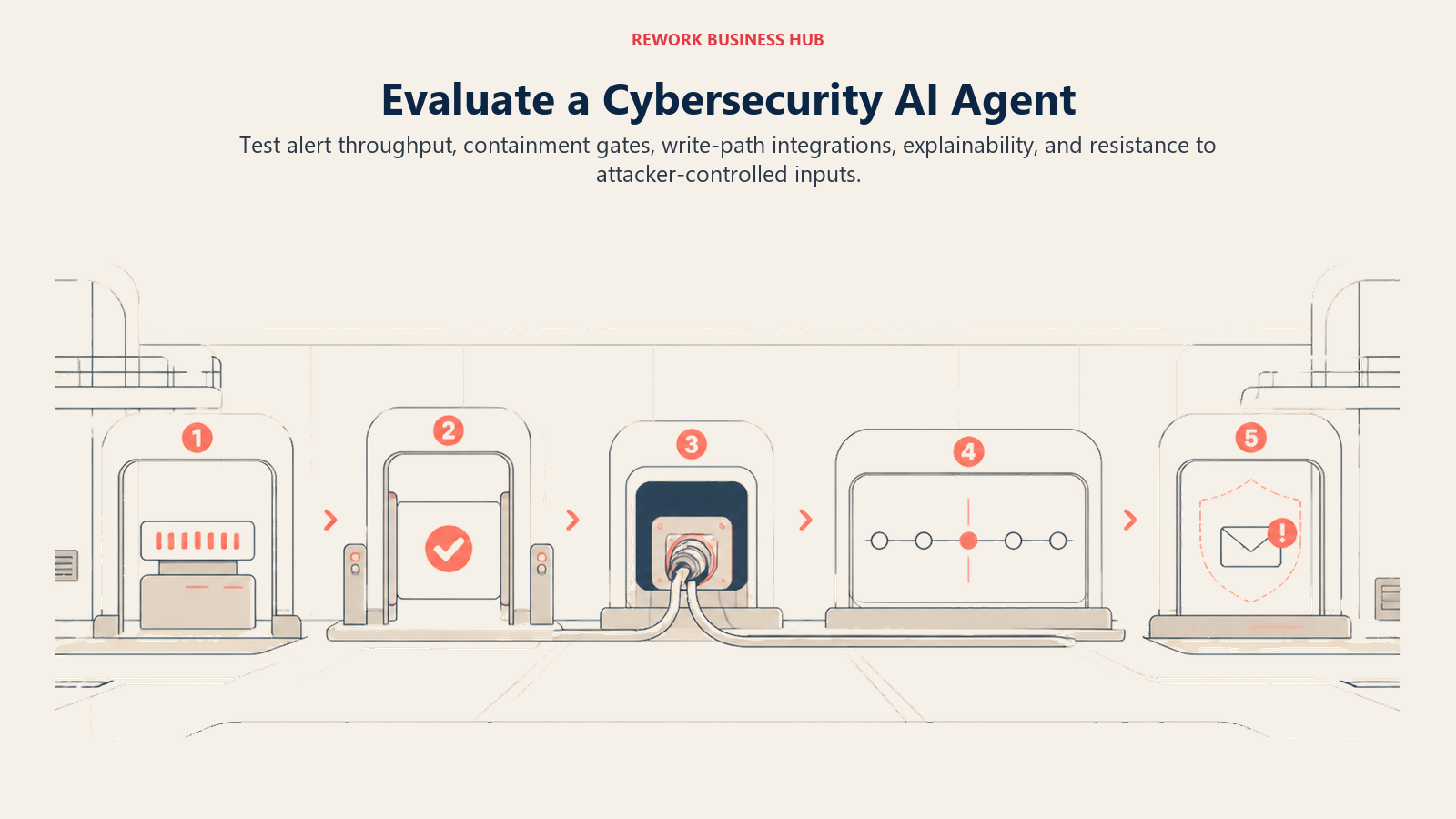
The ROI case is throughput, not intelligence. Security teams field an average of nearly 3,000 alerts a day, and 63% go unaddressed because there aren't enough analyst hours to triage them, per Vectra AI's alert fatigue research. Every agent here sells against that gap, but proves it differently: Google names a concrete before and after, 30 minutes of manual analysis down to 60 seconds across 5 million real alerts, while Torq cites a customer closing over half of Tier 1/2 cases with no human. Dropzone and Prophet Security both price by investigation volume, so the ROI math is the bill itself. Ask any vendor for their real alert-to-investigation ratio, their false-positive rate on auto-closed cases, and a reference customer at your alert volume, not just your industry.
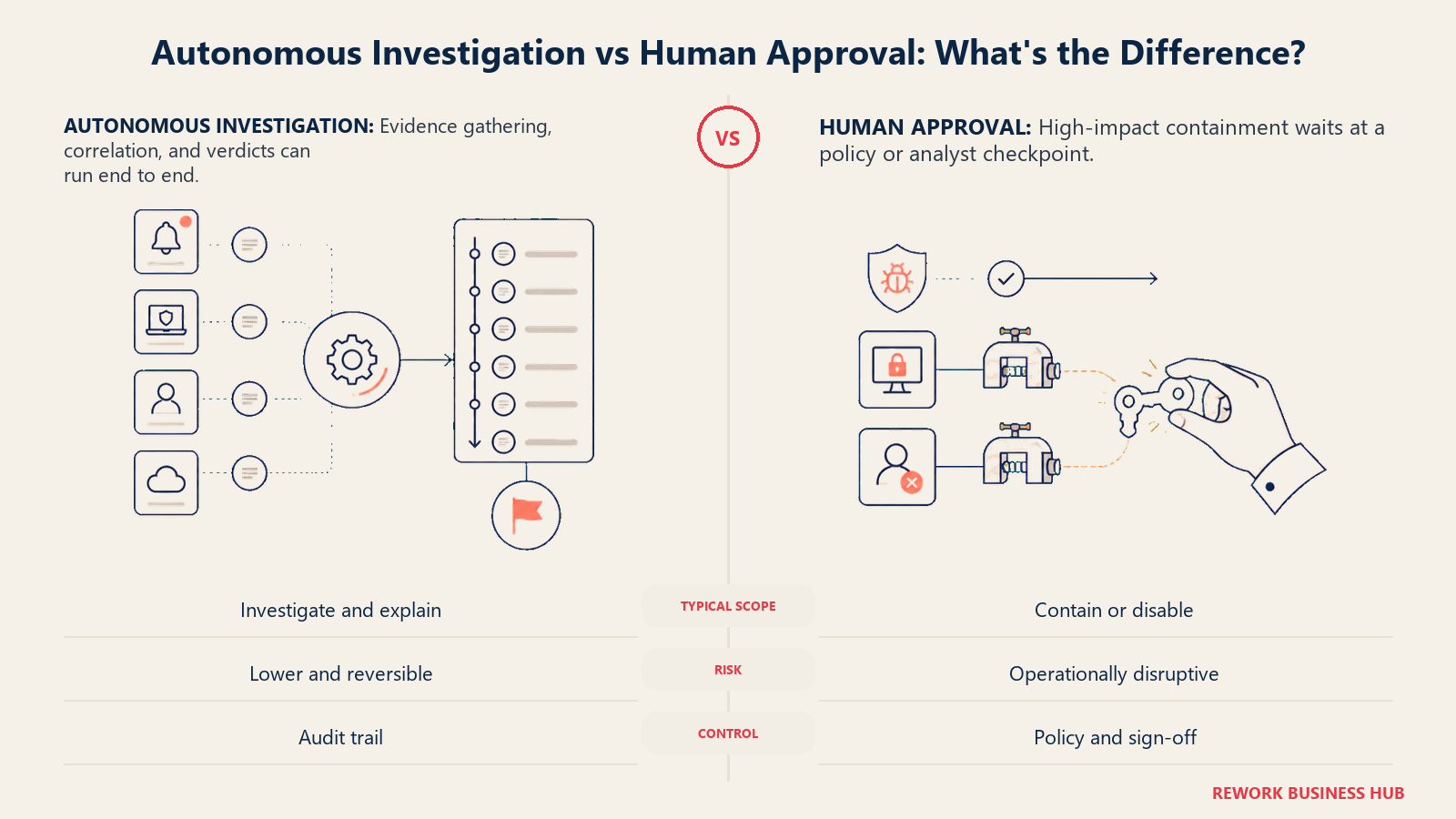
Autonomous containment needs an approval gate, because a false positive that quarantines production is worse than the alert it was chasing. Investigation is low risk to automate; containment isn't, since an agent that isolates the wrong host or disables the wrong account can trigger a customer-facing outage nobody signed off on. The vendors doing this well ship a spectrum, not one autonomy setting. Dropzone lets a team configure which actions fire immediately (blocking a known-malicious IP, quarantining a flagged file) and which wait for a human to approve after reviewing the investigation (isolating a host, disabling a user). Prophet Security defaults the same way: it investigates autonomously from day one but only acts on pre-approved actions, widening scope as its track record earns it. Torq's Socrates is the outlier, built to execute containment autonomously once an investigation completes, with human approval available as a policy choice rather than the default. Ask exactly which of your top ten response actions are eligible for full autonomy on day one, and which stay gated no matter what.
Integrations decide whether the agent can act at all, not just what it can see. Read-only access to your SIEM or EDR gets a good investigator that still hands off to a human for every action; write-path access is what makes "agent" mean more than "chatbot with search." Check the exact list, not the logo wall: Torq ships 300+ pre-built integrations, Exaforce and Prophet Security both cite 200+, Dropzone counts 90+, and Intezer only unlocks SIEM, cloud, and identity triage at its Complete tier, not the entry Starter plan. If your environment runs on tools a vendor doesn't natively support, you're buying a slower rollout at best and an investigation-only tool at worst.
Explainability is what lets an analyst audit why the agent closed an alert, and it varies a lot. Dropzone's glass-box design logs every question, tool call, and finding behind a verdict. SentinelOne's Purple AI attaches a "Verdict Justification" to every decision and writes findings into Investigation Notebooks. Swimlane frames its playbook-governed agents the same way: explainable and auditable by design. CrowdStrike states Charlotte AI's answers are traceable and every action user-authorized, backed by its ISO 42001 certification. Others are thinner on specifics in their own materials, so if compliance will need to reconstruct why an agent closed a case months from now, ask to see an actual investigation trace before you sign, not a slide describing one.
The agent is also new attack surface, and attacker-controlled data is the way in. An AI SOC agent reads exactly the content an attacker wants it to misjudge: phishing emails, ticket text, scraped threat intel, log fields an intruder can partially control. OWASP's Top 10 for Agentic Applications exists specifically because agents introduce risks a plain model doesn't: tool misuse, memory poisoning, one agent manipulating another in a multi-agent pipeline. Gartner's prediction that a quarter of enterprise breaches will trace back to AI agent abuse by 2028 is aimed squarely at tools like these, not just internal-facing agents. Treat every SOC agent's inputs as untrusted the way you'd treat a public web form, and read our AI agent security blueprint before granting one broad write access. A SOC agent talked into closing a real incident as a false positive is a worse outcome than the alert fatigue it was bought to fix.
Autonomy and Approval Gate Comparison
Most security agents can investigate without a person. The meaningful difference is which containment actions can fire automatically and which stop at a policy or analyst gate.
| Agent | Investigates Autonomously | Can Contain Without a Human | Explainability / Audit Trail |
|---|---|---|---|
| Microsoft Security Copilot | Yes (Phishing Triage, Alert Triage agents) | Configurable per agent; identity changes are recommended, not auto-applied | Step-by-step response guidance shown per investigation |
| CrowdStrike Charlotte AI | Yes | Agentic SOAR takes policy-bound automated actions | Vendor states answers are traceable and actions user-authorized; ISO 42001 certified |
| Palo Alto Cortex XSIAM | Yes (Case Investigation Agent) | Cloud Posture Agent applies pre-approved fixes; broader actions need policy sign-off | Not detailed in public materials |
| SentinelOne Purple AI | Yes (Auto-Triage, Auto-Investigations) | Can remediate in seconds, or prompt an analyst to convert findings into a workflow first | Verdict Justification and Investigation Notebooks on every case |
| Google Security Operations | Yes (Triage, Threat Hunting, Detection Engineering agents) | Agentic Automation keeps analysts "in absolute control of critical, high-impact actions" | Comprehensive explanation delivered with every verdict |
| Torq (Socrates) | Yes | Yes, autonomously executes containment once investigation completes; human approval optional | Workflow-level logging; full audit-trail depth not fully public |
| Dropzone AI | Yes, full end-to-end investigation | Configurable by action: low-risk fires automatically, host isolation and account disable can require a click | Glass-box: every question, tool call, and finding logged |
| Prophet Security | Yes, from day one | No by default; only pre-approved action types execute automatically | Evidence-backed reasoning with a compiled case timeline |
| Radiant Security | Yes, 100% of alerts | Escalated cases go to an analyst for one-click approval | Reasoning shown per case; no published third-party audit standard |
| Intezer | Yes (AI investigation chat agent) | Auto-remediates true positives at the Complete tier only | Conversational investigation trail; no published audit standard |
| Exaforce | Yes (Detect, Triage, Investigate Exabots) | Respond Exabot coordinates actions "with analyst oversight" | Not detailed in public materials |
| Swimlane | Yes, agents close cases autonomously | Playbooks gate human-in-the-loop per action type by design | Built to be explainable and auditable by default |
| Abnormal AI | Yes (behavioral email and identity scoring) | Quarantine and URL rewriting can be automatic; identity actions are typically reviewed | Ranks identity risk and attack susceptibility per account |
Sizing and Persona Table
| Agent | Ideal Deployment | Primary Buyer |
|---|---|---|
| Microsoft Security Copilot | Any SOC already licensed for M365 E5/E7 | CISO, SOC Manager on a Microsoft-centric stack |
| CrowdStrike Charlotte AI | Mid-market to enterprise, Falcon-standardized | SOC Director, Head of Endpoint Security |
| Palo Alto Cortex XSIAM | Enterprise SOC replacing a legacy SIEM | CISO, VP Security Operations |
| SentinelOne Purple AI | Mid-market to enterprise on Singularity or any SIEM | SOC Manager, Detection and Response Lead |
| Google Security Operations | High-volume enterprise, Google Cloud-invested | SOC Director, Detection Engineering Lead |
| Torq (HyperSOC) | Large enterprise ready to retire legacy SOAR | CISO, Head of Security Automation |
| Dropzone AI | Lean SOC teams and MSSPs | SOC Manager, Security Team Lead |
| Prophet Security | Teams with an established SIEM/EDR stack | SOC Manager, Detection and Response Lead |
| Radiant Security | Mid-market SOC wanting flat pricing | Security Director, SOC Manager |
| Intezer | SMB to mid-market, endpoint- and phishing-heavy | IT Security Manager, Security Analyst Lead |
| Exaforce | Cloud- and SaaS-native mid-market to enterprise | CISO, Cloud Security Lead |
| Swimlane | Enterprise and MSSP, governance-sensitive | SOC Director, Security Automation Engineer |
| Abnormal AI | Any size on Microsoft 365 or Google Workspace | CISO, Security Awareness or Identity Lead |
1. Microsoft Security Copilot: Named Agents Across Defender, Sentinel, and Entra
Microsoft treats the SOC agent as a set of named specialists rather than one generalist. The Phishing Triage Agent investigates reported emails and clears false positives dramatically faster by Microsoft's own account, and the Alert Triage agent and Vulnerability Remediation agent extend the same pattern into general alert queues and patch prioritization. Because they run inside Defender, Sentinel, and Entra, none of them require a new console or a data migration; they act on telemetry your team already collects.
The identity angle deserves a callout: the Conditional Access Optimization Agent scans Entra policies for the gaps attackers actually exploit, missing MFA enforcement, stale conditional access rules, and flags them rather than silently changing production identity policy. That's a sensible default for an action with blast radius across your whole workforce. The tradeoff is that agent maturity varies across the catalog, and pricing runs on Security Compute Units rather than a flat seat fee, so cost tracks usage more than headcount.
| What you get | What you don't |
|---|---|
| Named agents (Phishing Triage, Alert Triage, Conditional Access) embedded in tools you already run | Full agent catalog is still expanding; some agents are newer than others |
| Included SCU allotment makes it close to free to pilot on E5/E7 | Standalone pay-as-you-go pricing is expensive outside that allotment |
| Identity-focused agent flags exposure without auto-changing policy | Deepest value requires real investment in the Microsoft security stack |
| Scales from a single analyst to a full enterprise SOC | Less useful for teams running a primarily non-Microsoft stack |
Best for: Security teams already standardized on Defender, Sentinel, or Entra who want named, purpose-built agents instead of one generalist.
2. CrowdStrike (Charlotte AI): The First ISO 42001-Certified Agent on This List
Charlotte AI reasons over Falcon's endpoint telemetry directly, and in 2026 it moved well past a chat interface. AgentWorks lets a team build custom security agents in natural language, setting goals and data scope without writing code, and Charlotte Agentic SOAR coordinates multi-agent workflows that combine deterministic automation with agentic reasoning. CrowdStrike calls the model "bounded autonomy": teams define when and how automated actions occur, rather than granting the agent an open mandate.
The credibility marker that separates Charlotte AI from the rest of this list is ISO/IEC 42001 certification, an externally audited standard for responsible AI governance, confirmed on CrowdStrike's own site and covering Charlotte AI directly alongside Falcon endpoint security and Insight XDR. The catch is that Charlotte AI's usefulness scales with how deep a team already is in the Falcon ecosystem; a thin Falcon deployment gets a thinner agent.
| What you get | What you don't |
|---|---|
| Externally audited ISO 42001 AI governance certification | Value is tied to how much of the Falcon platform you've already adopted |
| AgentWorks builds custom agents from natural language, no code required | Bounded-autonomy model means broad automation still needs policy setup |
| Agentic SOAR coordinates multi-agent workflows across your environment | Charlotte AI pricing benchmarks are still settling as a newer add-on |
| Deep endpoint telemetry powers genuinely contextual answers | Weaker case as a standalone AI layer outside CrowdStrike |
Pricing: Falcon platform runs $7.99 to $19.99/device/month across four tiers; Charlotte AI typically adds an estimated $8 to $14/endpoint/year on enterprise contracts, consistent with benchmark pricing from signed Falcon deals.
Best for: Endpoint-first security teams already standardized on CrowdStrike Falcon who want a certified, bounded-autonomy agent layered on top.
3. Palo Alto (Cortex XSIAM): An Agent Workforce Built Into the Data Lake
Palo Alto's bet is that agentic AI is only as good as the data foundation under it, so Cortex XSIAM pairs its AgentiX agent layer with the Cortex Extended Data Lake, a purpose-built store for the volume agentic reasoning requires. The Case Investigation Agent analyzes case artifacts and complex signals to accelerate triage, recommends next steps, and builds AI case summaries, acting with analyst oversight rather than free rein. A separate Cloud Posture Agent uncovers and triages misconfigurations and can apply pre-approved fixes, and an Automation Engineer Agent generates working playbook code from a plain-English prompt.
Palo Alto states the platform can cut manual work by roughly 75% and reduce alert noise by up to 99%, vendor-reported figures worth validating against your own alert mix in a pilot. The honest gap is pricing transparency: every page pushes toward a demo, and no self-serve numbers exist anywhere on Palo Alto's site.
| What you get | What you don't |
|---|---|
| AgentiX runs a full agent workforce on a unified data lake, not bolted onto legacy SIEM storage | No public pricing anywhere; every engagement starts with a sales call |
| Case Investigation, Cloud Posture, and Automation Engineer agents cover distinct jobs | Cloud Posture Agent's "approved fixes" still require policy setup upfront |
| Vendor-reported 75% manual-work reduction and up to 99% noise reduction | Explainability and audit-trail detail aren't published for public review |
| Built for enterprise SOCs replacing a legacy SIEM outright | Overkill and cost-prohibitive for teams not already running at that scale |
Pricing: Not published; demo-gated. Contact Palo Alto Networks for a quote.
Best for: Enterprise SOCs ready to replace a legacy SIEM with an AI-native platform built around agentic investigation from the ground up.
4. SentinelOne (Purple AI): Agentic Investigation That Now Reasons Beyond Its Own Platform
Purple AI's differentiator in 2026 is that it stopped being a SentinelOne-only tool. It now reasons across OCSF-normalized data pulled from both native Singularity telemetry and third-party sources, auto-triaging alerts and running full investigations regardless of where the underlying data originates. Every decision carries a "Verdict Justification," and the agent documents its work in Investigation Notebooks, giving an analyst something concrete to review rather than a bare conclusion.
Purple AI ships inside the Singularity Complete tier rather than as its own SKU, so pricing tracks the broader platform. List price sits around $179.99/endpoint/year at Complete, though negotiated enterprise deals commonly land lower. The tradeoff is that you can't buy Purple AI's specific agentic capabilities without buying into Singularity Complete first.
| What you get | What you don't |
|---|---|
| Reasons over third-party data, not limited to SentinelOne's own telemetry | No standalone SKU; requires the Singularity Complete tier |
| Verdict Justification and Investigation Notebooks on every case | List pricing per endpoint is high before enterprise negotiation |
| Auto-triage and auto-investigation run without waiting on an analyst | Weaker fit for teams not already evaluating SentinelOne as their EDR |
| "Built in, not bolted on" design across the Singularity console | Full agentic depth still favors native Singularity deployments |
Best for: Teams standardized on SentinelOne, or wanting one agentic investigator that reasons across a mixed SIEM and third-party data estate.
5. Google Security Operations: The Agent With the Clearest Published Results
Google's Alert Triage and Investigation agent is the strongest evidence in this whole category that agentic SOC work actually saves the time vendors claim: it has investigated more than 5 million real alerts, cutting a typical 30-minute manual analysis down to about 60 seconds, and it's generally available today rather than a roadmap promise. It autonomously gathers evidence, runs analysis, and delivers a verdict with a comprehensive explanation attached, trained in part on intelligence from Google's Mandiant team.
Three more named agents sit in preview: a Detection Engineering agent that turns new exploitation patterns into custom detections automatically, a Threat Hunting agent that scours petabytes of historical telemetry for stealthy adversary behavior, and Agentic Automation, a hybrid model that pairs dynamic agents with deterministic playbooks specifically to keep analysts in control of high-impact actions. Pricing is per employee per year rather than per gigabyte logged, which removes the incentive to under-log your environment to control cost.
| What you get | What you don't |
|---|---|
| Triage agent has processed 5M+ real alerts with a published time-savings result | Detection Engineering and Threat Hunting agents are still in preview |
| Agentic Automation explicitly keeps analysts in control of high-impact actions | Full agent lineup favors teams already invested in Google Cloud |
| Per-employee pricing removes the incentive to under-log your environment | Individual agent costs aren't itemized separately from tier pricing |
| Backed by Mandiant threat intelligence baked into agent training | Enterprise Plus tier needed for the deepest retention and agent access |
Best for: High-volume enterprises wanting a generally available, transparently benchmarked triage agent rather than an early-access promise.
6. Torq (HyperSOC / Socrates): The Highest Autonomous Containment Rate on This List
Torq's argument is that legacy SOAR hit its ceiling and only a fully agentic replacement can keep pace with modern alert volume. Socrates, Torq's agentic SOC orchestrator, coordinates specialized HyperAgents across the full Tier-1 case lifecycle, from enrichment through containment, escalating to a human only when genuine judgment is required. Once an investigation completes, Socrates autonomously executes containment and remediation plans across your stack: isolating compromised endpoints, revoking access rights, blocking malicious sources.
That's real autonomy, not a marketing claim: one enterprise customer reports Socrates closing over 50% of Tier 1 and Tier 2 alerts with no human involved, with a stated goal of 70%+ by year end. Human-in-the-loop approval is available as a configured policy rather than Torq's default posture, which makes Torq the outlier in this guide's approval-gate comparison. The ambition shows up in the price tag: HyperSOC lists at $450,000/year on AWS Marketplace, an enterprise-only commitment.
| What you get | What you don't |
|---|---|
| Socrates autonomously executes containment once investigation completes | $450,000/year entry price puts it out of reach for mid-market teams |
| A reference customer reports 50%+ of Tier 1/2 alerts closed with no human | Default posture favors autonomy; human-in-loop is a policy you configure |
| 300+ pre-built integrations reduce custom playbook-building | Positioned to fully replace legacy SOAR, a significant migration project |
| Built for full-stack security hyperautomation, not a narrow point tool | Overkill for teams that only need Tier-1 alert triage |
Pricing: HyperSOC from $450,000/year (12-month contract, AWS Marketplace listing); broader platform pricing scales by workflows and automation actions.
Best for: Large enterprises ready to replace legacy SOAR entirely with an agentic platform that acts, not just recommends.
7. Dropzone AI: The Clearest Approval-Gate Model in This Category
Dropzone built its reputation on autonomous Tier-1 triage specifically, and it's the cleanest example in this guide of what a real approval gate looks like in practice. Low-risk, high-confidence containment (blocking a known-malicious IP, quarantining a file multiple threat-intel sources flag) can fire immediately once the agent confirms a threat. Higher-risk actions, isolating a host or disabling a user account, are configured to stop and wait: the agent prepares the full investigation and evidence, makes a recommendation, and a human presses approve before anything executes.
That configurability sits on top of a genuinely transparent design. Dropzone's glass-box approach records every question the agent asked, every tool it queried, and every finding behind a verdict, producing a complete audit trail rather than a black-box conclusion. It now ships with 90+ integrations and threat intel included in the base subscription, and unlike most of this list, it doesn't charge per analyst seat.
| What you get | What you don't |
|---|---|
| Configurable approval gates, low-risk auto-fires, high-risk waits for a click | Per-investigation billing can spike with unpredictable alert volume |
| Glass-box audit trail logs every question, tool call, and finding | Custom Enterprise/MSSP pricing required beyond standard investigation volume |
| 90+ integrations and threat intel included in the base subscription | Newer entrant with less enterprise track record than platform incumbents |
| Unlimited users on the base plan, unusual for security tooling | Requires deliberate alert-source selection to avoid runaway costs |
Pricing: From $36,000/year for 4,000 investigations annually, unlimited users, integrations and threat intel included; volume discounts and custom Enterprise/MSSP pricing above that.
Best for: Security teams drowning in Tier-1 alert volume who want autonomous triage with a configurable, auditable containment gate.
8. Prophet Security: Autonomous Investigation, Conservative by Default on Action
Prophet Security's position is close to Dropzone's, an AI SOC analyst focused on end-to-end investigation, but its default posture leans more conservative on the action side. Prophet states plainly that it "investigates autonomously from day one, but only takes actions you've approved," previewing every response action before it runs and widening autonomous scope only once a team's own track record justifies it. Every alert gets a full investigation: a determination of benign, malicious, or inconclusive, a severity rating, remediation steps, and a compiled timeline, with evidence-backed reasoning behind each call.
Pricing is usage-based and unusually direct: roughly $10 per investigation, so a team running 5,000 investigations a year budgets around $50,000/year plus the same per-investigation rate on overage. That's an honest model, but it requires knowing your investigation volume before you can plan a budget with confidence, and Prophet doesn't publish tiered pricing publicly.
| What you get | What you don't |
|---|---|
| Investigates every alert autonomously, but response stays human-approved by default | Usage-based pricing requires knowing your investigation volume upfront |
| Per-investigation pricing ties cost directly to actual usage | No published tiered pricing; every quote is custom |
| 200+ integrations spanning SIEM, EDR, identity, cloud, and email | Newer entrant still building the track record larger platforms have |
| Compiled case timeline gives analysts a clear audit story | Conservative default autonomy means less hands-off than Torq or Dropzone |
Best for: Teams with an established SIEM and EDR stack who want an autonomous investigator but want to earn autonomous response gradually.
9. Radiant Security: Flat Pricing, 100% Alert Coverage
Radiant's whole pitch is coverage without a per-alert cost penalty: its triage and research agents investigate every single alert across more than 10 domains, email, endpoint, identity, network, cloud, insider threat, SIEM, WAF, DLP, OT and IoT, dark web, and supply chain, rather than sampling the loudest ones. The platform states it eliminates up to 98% of noise and escalates only the cases that matter, and escalated cases come with a one-click remediation option for the analyst reviewing them, keeping response human-gated rather than fully autonomous.
Radiant doesn't publish a numeric price anywhere on its own site; every page routes to a demo request. What it does state clearly is a flat-rate philosophy: no separate AI module fee, no per-query charge, and unlimited log retention included in the base platform rather than billed as an add-on.
| What you get | What you don't |
|---|---|
| Investigates 100% of alerts across 10+ domains, not a sampled subset | No published pricing anywhere; every engagement starts with a demo |
| Escalated cases route to a human for one-click approval before remediation | Fewer named integration partners disclosed than larger competitors |
| Unlimited log retention included, not a metered add-on | Newer entrant with a thinner public track record than platform incumbents |
| Flat-rate philosophy avoids per-query or per-alert billing surprises | Harder to comparison-shop without a sales conversation |
Pricing: Not published; flat-rate model, demo-gated. Contact Radiant Security for a quote.
Best for: Mid-market SOCs that want every alert investigated without a bill that scales with alert volume.
10. Intezer: Per-Endpoint Pricing for Phishing and Endpoint-Heavy Teams
Intezer's autonomous SOC splits into two tiers with a clean philosophical difference. Starter covers one alert source (endpoint or phishing) with 24/7 monitoring, automated triage, sandboxing, and an AI investigation chat agent that auto-resolves false positives. Complete unlocks unlimited alert sources, adding SIEM, cloud, identity, and network alert triage, custom response workflows, and auto-remediation of confirmed true positives, a meaningfully more autonomous posture than the entry tier.
Both tiers price by endpoint count rather than alert volume, a structural choice that removes any incentive to under-investigate to control cost. The gap is transparency: Intezer's own pricing page confirms the tier structure but discloses no actual numbers, so budgeting requires a sales conversation even for the entry plan.
| What you get | What you don't |
|---|---|
| Priced by endpoint count, not alert volume, no penalty for full coverage | No numeric pricing published, even for the entry Starter tier |
| AI investigation chat agent auto-resolves false positives at every tier | SIEM, cloud, and identity triage locked behind the Complete tier |
| Auto-remediation of true positives at Complete, a real autonomy step up | Smaller public track record than the platform incumbents on this list |
| Forensic malware-analysis heritage strengthens phishing and endpoint depth | No published audit-trail or explainability standard beyond the chat agent |
Pricing: Not published; priced by endpoint count across Starter and Complete tiers. Contact Intezer for a quote.
Best for: Endpoint- and phishing-heavy teams that want autonomous triage on a budget that scales with device count, not alert noise.
11. Exaforce: A Cloud-Native Agentic SOC Built From Scratch
Exaforce is the newest platform on this list, built as an agentic SOC from the ground up rather than retrofitted onto legacy SIEM architecture, and it's well capitalized to make that bet: a $125 million Series B in 2026 brought total funding to $200 million. Four named Exabots split the work: Detect learns normal behavior and surfaces anomalies without manual detection engineering, Triage investigates alerts with what Exaforce describes as senior-analyst depth, Investigate pivots across identity, cloud, endpoint, and SaaS for continuous threat hunts, and Respond coordinates action explicitly "with analyst oversight."
Teams choose autopilot or copilot mode depending on how much autonomy they want to delegate, and Exaforce covers cloud and SaaS environments many competitors treat as secondary, GitHub, Slack, and OpenAI usage among them, through 100+ integrations. Exaforce also offers a managed option where its own analysts work alongside the Exabots as an outsourced 24/7 SOC. No self-serve pricing exists yet; every engagement starts with a demo or a conversation with the managed-service team.
| What you get | What you don't |
|---|---|
| Four purpose-built Exabots cover detection through response end to end | Newest, least proven vendor in this guide; no long track record yet |
| Native coverage of GitHub, Slack, OpenAI usage, and other SaaS/cloud sources | No self-serve pricing; every engagement starts with a sales conversation |
| Autopilot or copilot mode lets a team set its own autonomy level | Explainability and audit-trail detail aren't published for public review |
| Well-funded ($200M total) with a managed-SOC option for lean teams | Best fit still concentrated in cloud- and SaaS-heavy environments |
Pricing: Not published; demo-gated, with a managed MDR option available. Contact Exaforce for a quote.
Best for: Cloud- and SaaS-native security teams wanting an agentic SOC built specifically for that environment, not adapted from one.
12. Swimlane: SOAR-Grade Explainability for Enterprises and MSSPs
Swimlane's fleet of AI agents grew out of its SOAR heritage, and that shows in how deliberately it talks about control. Agents handle work that used to require multiple deterministic playbook steps, like querying several threat-intelligence feeds and returning one unified, explainable verdict, and Swimlane states its Hero AI can close cases autonomously at scale (one customer reports thousands of autonomous closures) while still keeping operations "predictable, auditable, and compliant" through playbook-defined guardrails.
That governance-first framing is Swimlane's real differentiator: playbooks decide, per action type, whether an agent acts alone or waits for human validation, and the company positions that as a feature for regulated and MSSP environments rather than a limitation. The tradeoff is total pricing opacity. Nothing is published; packaging spans several named enterprise tiers plus a dedicated MSSP track, and every number requires a quote based on automated-action volume.
| What you get | What you don't |
|---|---|
| Explainable, auditable verdicts by design, not bolted on after the fact | No public pricing at all; packaging is genuinely complex to evaluate |
| Playbooks gate human-in-the-loop validation per action type | Quote-based, action-volume pricing makes budgeting hard without a sales call |
| Multi-tenant architecture built for MSSPs managing many clients | Fewer named SIEM/EDR integration partners disclosed than competitors |
| Deep SOAR heritage brings mature workflow and case-management tooling | Less positioned as a pure-play autonomous Tier-1 analyst than Dropzone or Prophet |
Pricing: Not published; quote-based, priced by automated actions per day across named enterprise and MSSP tiers. Contact Swimlane for a quote.
Best for: Enterprises and MSSPs that need SOAR-grade governance and multi-tenant explainability, not just fast autonomous triage.
13. Abnormal AI: Behavioral Defense Against Phishing, Now Extending Into Identity
Abnormal AI, the rebranded name Abnormal Security returned to in 2025, built its reputation on one insight: modern phishing and business email compromise rarely carry a malicious payload, so signature-based gateways miss them. Its behavioral baseline scores every employee and vendor relationship, then flags anomalies in real time and can automatically quarantine the message or rewrite a malicious URL, whether that's a vendor invoice from a slightly wrong domain or a CEO impersonation with flawless grammar. Verizon's 2026 Data Breach Investigations Report found AI-assisted text in malicious phishing emails doubled year over year, which is exactly the shift Abnormal's behavioral approach is built to catch, since AI-polished phishing defeats grammar and reputation-based filters by design.
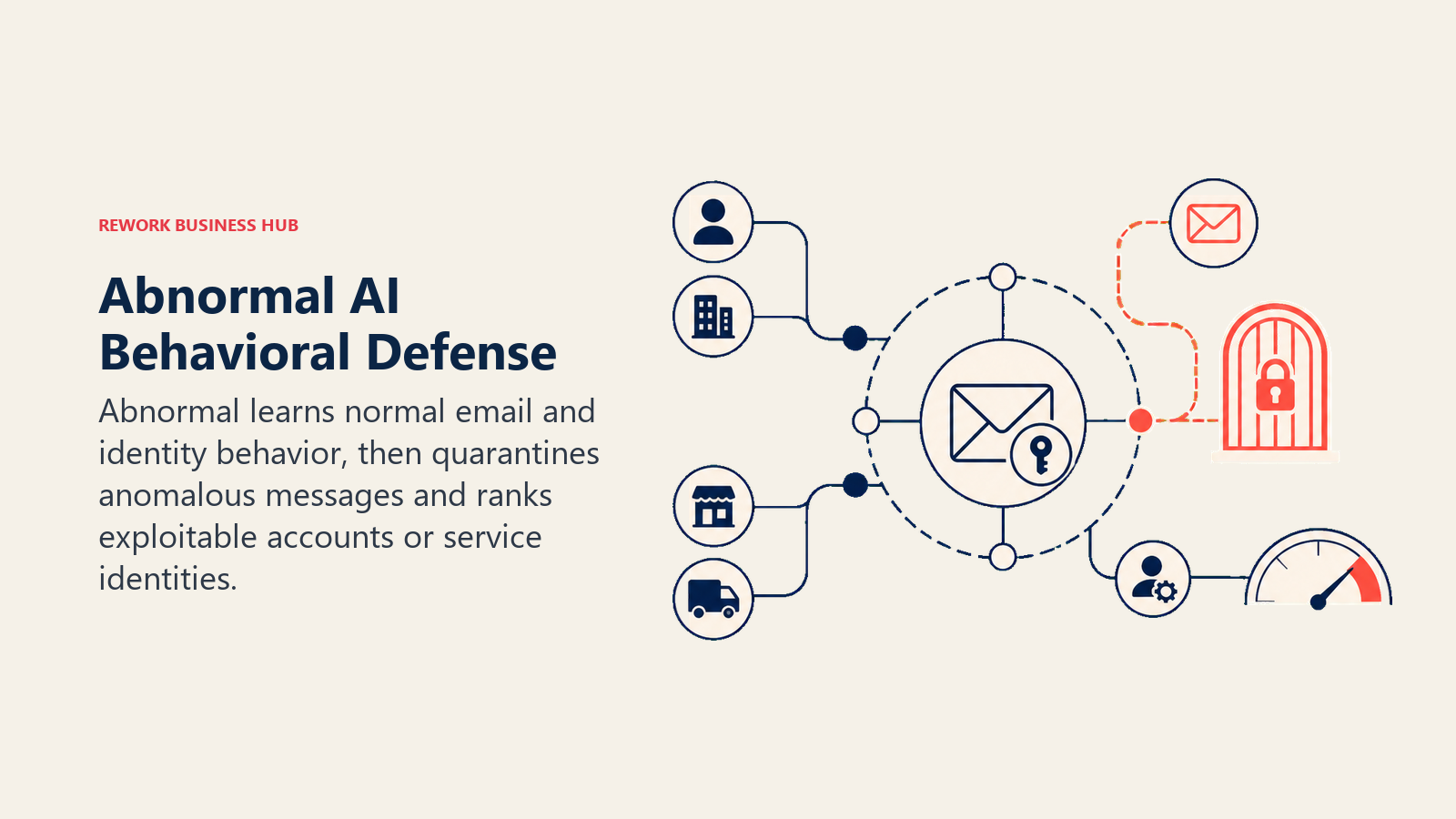
The 2026 expansion worth noting for this guide is Identity Threat Protection, which applies the same behavioral model to accounts and non-human identities: it surfaces weaknesses like missing MFA and overprivileged service accounts, ranked by how likely they are to be exploited, and maps real-world attack patterns like adversary-in-the-middle phishing and OAuth abuse to a customer's actual environment. That's an investigation and prioritization agent for identity exposure, not a full identity-governance platform. Abnormal's honest limitation is scope: it's a specialist in email and identity behavior, not a general SOC platform, so it sits alongside endpoint, network, and SIEM coverage rather than replacing them.
| What you get | What you don't |
|---|---|
| Behavioral baseline catches payloadless phishing and BEC signature tools miss | Email- and identity-focused; not a general SOC investigation platform |
| Automatic quarantine and URL rewriting act without waiting on a human | List pricing leaves real room for negotiation, so treat it as a starting point |
| New Identity Threat Protection ranks exploitable accounts and non-human identities | Broader containment (beyond email/identity) still needs a separate platform |
| Purpose-built for the AI-assisted phishing surge documented in the 2026 DBIR | Smaller organizations may find dedicated identity AI overkill versus a bundled suite |
Pricing: List pricing roughly $15 to $35/employee/year; negotiated multi-year deals for 500 to 2,000 employees commonly land $18 to $28/employee/year, consistent with the pricing in our best AI tools for cybersecurity guide under the company's prior name.
Best for: Any organization on Microsoft 365 or Google Workspace that wants autonomous, behavioral defense against phishing and identity-based attacks specifically.
Buying Mistakes to Avoid
| Mistake | What It Looks Like | What to Do Instead |
|---|---|---|
| Buying "agentic" without verifying multi-step action | Assuming any AI-branded feature counts as an agent | Ask for a live demo of an end-to-end autonomous investigation, not a chatbot answering questions |
| Granting containment authority on day one | A new agent isolates a production host on its first false positive | Start in a human-approval mode; graduate specific action types to autonomous once you've watched it get them right |
| Ignoring integration depth | An agent can detect but has no write-path into your EDR or identity provider | Confirm the exact SIEM, EDR, and IdP integrations before buying, not just the logo wall |
| Treating pricing as apples to apples | Comparing a flat per-seat platform fee to a per-investigation SOC-analyst fee | Normalize every quote to a cost per resolved alert at your real alert volume |
| Skipping the vendor's own trust page | Assuming a "compliant" claim on a blog post is still current | Verify every certification on the vendor's own trust or security page before procurement |
| Assuming the agent can't be attacked | Feeding it attacker-controlled log, email, or ticket content without treating it as untrusted input | Apply the same least-privilege and prompt-injection defenses you'd apply to any AI agent |
| Connecting the entire alert firehose on day one | Investigation-based pricing spikes, or a manipulated agent gets broader reach than intended | Pilot against a defined, bounded set of alert types first |
| Confusing an AI SOC agent with a broader AI tool | Buying a chat assistant bolted onto a SIEM and expecting autonomous triage | Check whether it plans and executes multi-step action, or only answers questions |
How to Choose: Decision Framework
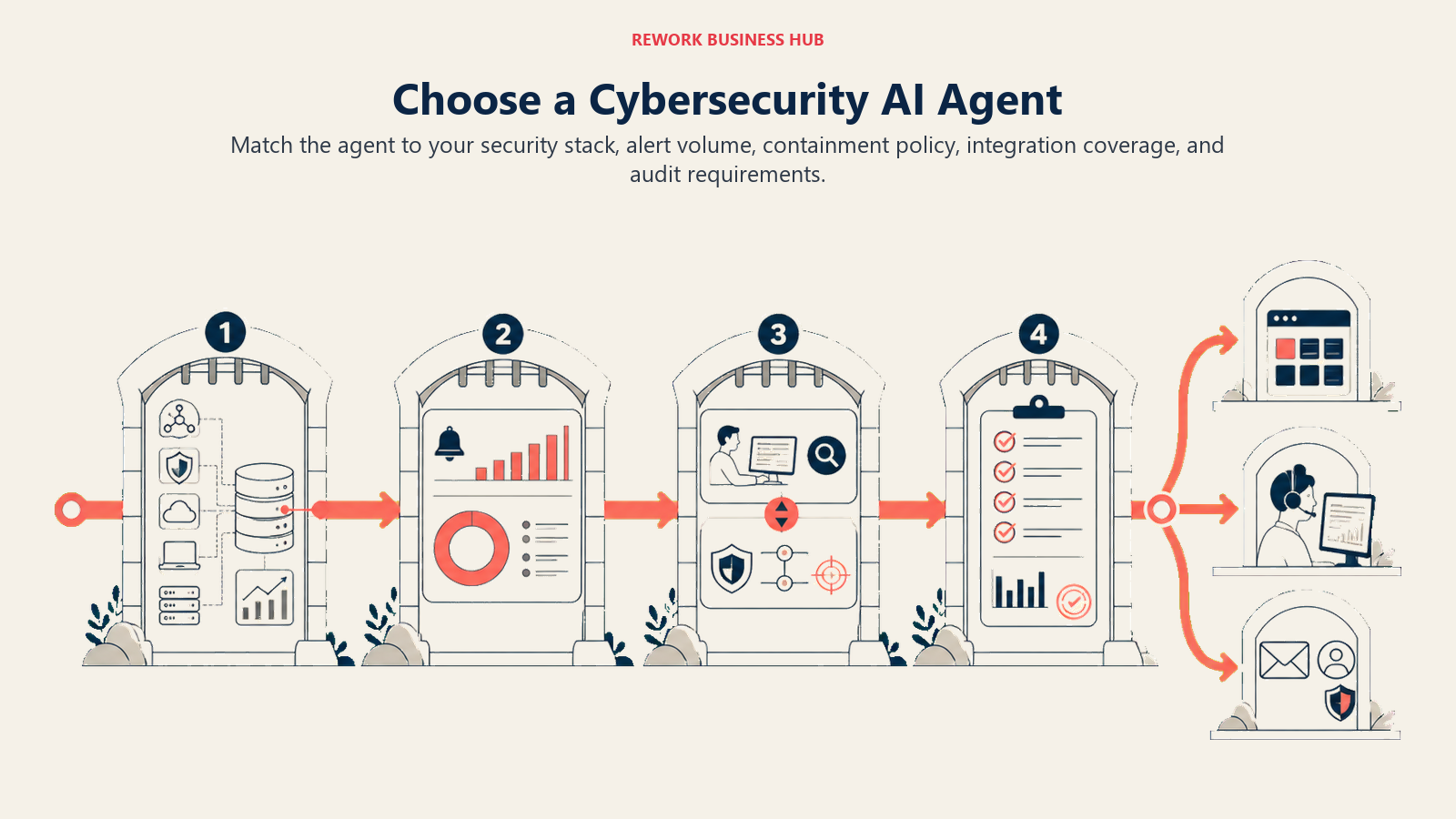
Choose from the security stack outward: telemetry fit first, then alert volume, containment policy, integration depth, and audit requirements.
| If you need... | Pick... | Why |
|---|---|---|
| AI embedded in a Microsoft-centric SOC you already run | Microsoft Security Copilot | Included SCU allotment on E5/E7 and named agents across Defender, Sentinel, and Entra |
| A certified, bounded-autonomy agent on deep endpoint telemetry | CrowdStrike Charlotte AI | ISO 42001-certified; reasons over Falcon data your team already collects |
| To replace a legacy SIEM with an AI-native platform outright | Palo Alto Cortex XSIAM | AgentiX runs a full agent workforce on a purpose-built data lake |
| Agentic investigation that reasons beyond your own platform's data | SentinelOne Purple AI | Now works over third-party sources, not just Singularity telemetry |
| The most transparently benchmarked results in the category | Google Security Operations | 5M+ alerts investigated, 30 minutes cut to 60 seconds, generally available today |
| The highest autonomous containment rate for Tier 1/2 | Torq (HyperSOC / Socrates) | Reference customers report 50%+ of cases closed with no human |
| A lean team's first autonomous Tier-1 analyst, with a clear approval gate | Dropzone AI or Prophet Security | Both price by investigation volume and let you configure exactly what needs a human |
| Full alert coverage without a bill that scales with volume | Radiant Security | Investigates 100% of alerts across 10+ domains on flat pricing |
| A cloud- and SaaS-native SOC built from scratch | Exaforce | Exabots purpose-built for GitHub, Slack, OpenAI, and cloud-native environments |
| SOAR-grade governance for a regulated enterprise or MSSP | Swimlane | Playbook-gated autonomy built to stay explainable, auditable, and compliant |
| To stop AI-generated phishing and rank exploitable identities | Abnormal AI | Behavioral baseline plus a new agent scoring identity and non-human-identity risk |
What to Do Next
Pick the job that hurts most right now, Tier-1 alert fatigue, phishing that's slipping past your gateway, or a SOC that can't scale with headcount, and shortlist two agents from the same row of the decision framework above. Before connecting a single production system, agree internally on exactly which response actions your team will let run autonomously on day one and which stay gated behind a human, then pilot against a bounded set of alert types so you can measure the agent's real false-positive rate before it touches anything that matters.
If your organization already runs Microsoft, CrowdStrike, SentinelOne, Palo Alto, or Google as its core security platform, ask what agentic capability is already included before buying a new point tool. And before granting any agent broad write access to your environment, read the AI agent security blueprint alongside the AI security monitoring agent, AI incident response agent, and AI vulnerability management agent build blueprints, useful whether you're evaluating a vendor's design decisions or considering building a narrower agent yourself for the pieces a platform doesn't cover. For the full landscape of agent platforms beyond security specifically, see our Best AI Agent Platforms roundup, our Best Autonomous AI Agents guide for a deeper look at how far different agents run without a human, and Best Enterprise AI Agent Platforms if procurement and governance review is your next hurdle. If explainability is the deciding factor for your compliance team, Best AI Agent Observability Tools covers the tracing and monitoring layer that sits underneath agents like these in production.

Principal Product Marketing Strategist
On this page
- Updated August 2026: What Changed
- Key Facts
- Quick Comparison Table
- How to Choose: What Actually Separates These Agents
- Autonomy and Approval Gate Comparison
- Sizing and Persona Table
- 1. Microsoft Security Copilot: Named Agents Across Defender, Sentinel, and Entra
- 2. CrowdStrike (Charlotte AI): The First ISO 42001-Certified Agent on This List
- 3. Palo Alto (Cortex XSIAM): An Agent Workforce Built Into the Data Lake
- 4. SentinelOne (Purple AI): Agentic Investigation That Now Reasons Beyond Its Own Platform
- 5. Google Security Operations: The Agent With the Clearest Published Results
- 6. Torq (HyperSOC / Socrates): The Highest Autonomous Containment Rate on This List
- 7. Dropzone AI: The Clearest Approval-Gate Model in This Category
- 8. Prophet Security: Autonomous Investigation, Conservative by Default on Action
- 9. Radiant Security: Flat Pricing, 100% Alert Coverage
- 10. Intezer: Per-Endpoint Pricing for Phishing and Endpoint-Heavy Teams
- 11. Exaforce: A Cloud-Native Agentic SOC Built From Scratch
- 12. Swimlane: SOAR-Grade Explainability for Enterprises and MSSPs
- 13. Abnormal AI: Behavioral Defense Against Phishing, Now Extending Into Identity
- Buying Mistakes to Avoid
- How to Choose: Decision Framework
- What to Do Next