More in
Berita AI di Tempat Kerja
OpenAI Membuka Pengiklanan ChatGPT kepada Perniagaan Kecil pada Sebarang Bajet
Jun 6, 2026
AI Ada Di Mana-mana di Tempat Kerja. Hanya 1 daripada 10 yang Menyatakan Ia Mengubah Pekerjaan
Jun 6, 2026
Detik $10.5B Vibe Coding: AI Kini Memulakan Kebanyakan Pembangunan Perisian Baharu
Jun 6, 2026
Ejen AI Kini Mempunyai Lebih Banyak Akses Sistem daripada Pekerja Anda. Sedikit yang Dilindungi
Jun 5, 2026
Patut Bina atau Beli AI Anda? Perhatikan Apa yang Dibeli oleh Gergasi.
Jun 5, 2026
Uber Menetapkan Had Perbelanjaan AI Pekerja pada $1,500 Setiap Tempat Duduk Selepas Anggaran Terlampau
Jun 5, 2026
Perintah Eksekutif AI Trump Bersifat Penyahregulan. Risiko Pematuhan Anda Tidak Bergerak
Jun 4, 2026
AI Menolak 220 Unicorn di Bawah $1B. Syarikat Pra-ChatGPT Berdepan Pertanggungjawaban
Jun 4, 2026
Harga Token Jatuh 67% Tahun Ini. Bil AI Anda Tetap Naik
Jun 3, 2026
Perniagaan Kecil yang Menggunakan AI Melaporkan Hasil Lebih Tinggi dan Hari Kerja Lebih Pendek
Jun 3, 2026
ServiceNow dan Accenture Bertaruh Bahawa Jurutera Forward Deployed Menyelesaikan Jurang Ejen-ke-Persekitaran Produksi
Turn this article into takeaways for your work.


Each assistant summarizes the article only for you and suggests best practices for your work.
Kebanyakan program AI perusahaan mati antara demo dan invois. ServiceNow dan Accenture baru sahaja mengumumkan model yang direka untuk membetulkan perkara itu, dan ia wajar diberi perhatian kerana ia bukan sekadar peringkat perkhidmatan baharu, melainkan kategori perolehan yang sama sekali berbeza.
Pada 6 Mei 2026, di persidangan Knowledge 2026 ServiceNow, kedua-dua syarikat melancarkan program Forward Deployed Engineering (FDE) bersama. Premis, menurut pengumuman ServiceNow, ialah AI agentic gagal mencapai persekitaran produksi bukan kerana teknologinya salah, tetapi kerana model pelaksanaannya. Jawapan mereka: hantar jurutera masuk.
Pandangan Pantas: FDE-sebagai-perolehan kini adalah corak berbilang vendor. ServiceNow dan Accenture bukan satu-satunya. Jika RFP AI agentic anda yang berikutnya masih kelihatan seperti templat langganan SaaS, ia sudah ketinggalan zaman.
Apakah Sebenarnya Program FDE Ini
Forward Deployed Engineering bermakna jurutera vendor, atau jurutera rakan kongsi yang bertindak sebagai sambungan vendor, bekerja di dalam persekitaran pelanggan, bukan dari bilik penglibatan perkhidmatan di ibu pejabat. Mereka tidak menyerahkan platform dan pergi. Mereka kekal sehingga sesuatu dihantar ke persekitaran produksi.
Dalam model ServiceNow-Accenture, dua kumpulan bekerja bersama satu sama lain: pasukan FDE asli AI ServiceNow dan FDE tertumpu industri Accenture. Mereka membina aliran kerja agentic secara asli pada Platform AI ServiceNow, iaitu tempat sebahagian besar pengurusan kerja pelanggan yang sedia ada sudah berjalan. Matlamatnya adalah untuk menyampaikan nilai persekitaran produksi yang boleh diukur sebelum sebarang pelancaran yang lebih luas, bukan untuk mewujudkan program perintis yang kekal selama-lamanya dalam persekitaran sandbox.
Pelanggan juga mendapat akses kepada lebih 300 kemahiran ejen AI dan aliran kerja agentic prasiap pada platform. AI Control Tower ServiceNow bertindak sebagai lapisan tadbir urus, memberi kepimpinan pandangan bersatu tentang prestasi ejen merentas perusahaan apabila pelaksanaan berkembang.
Fakta Utama
- Gartner meramalkan 40% projek AI agentic akan dibatalkan sebelum mencapai persekitaran produksi penuh menjelang akhir 2027 (sumber: Gartner, 2025 Agentic AI Hype Cycle).
- Platform AI ServiceNow termasuk 300+ kemahiran ejen AI prasiap dan aliran kerja agentic yang tersedia pada pelancaran program FDE (sumber: ServiceNow, Mei 2026).
- Program bersama ini diumumkan di Knowledge 2026 pada 6 Mei 2026, dengan ServiceNow dan Accenture mengesahkan butiran secara serentak (sumber: bilik berita ServiceNow dan Accenture, Mei 2026).
Mengapa FDE-sebagai-Perolehan Kini Adalah Corak
Selama bertahun-tahun, model kejuruteraan forward deployed Palantir dianggap sebagai kelainan khusus untuk kontrak pertahanan dan risikan. Idea bahawa vendor perisian akan menyematkan jurutera di dalam persekitaran pelanggan sehingga kes penggunaan dihantar terasa lebih seperti teater perundingan daripada strategi go-to-market yang boleh diskala.
Gambaran itu kini sudah lapuk.
Lima hari selepas pengumuman ServiceNow-Accenture, OpenAI mengumumkan Syarikat Pelaksanaan OpenAI, menggabungkan pengambilalihannya ke atas Tomoro dengan pasukan kira-kira 150 jurutera forward-deployed dalam unit yang bernilai kira-kira $4 bilion. Snowflake telah mengembangkan jejak FDE sendiri melalui pengambilalihannya ke atas Natoma. Dan Accenture kini menyebarkan FDE industrinya merentas pelbagai platform vendor, bukan hanya satu.
Benang yang sama: setiap vendor platform utama menyimpulkan bahawa "lempar perisian ke seberang tembok" kalah dalam era AI agentic. Aliran kerja yang benar-benar mewujudkan nilai, yang menyentuh kelulusan perolehan, pembaharuan kontrak, eskalasi pelanggan, onboarding pekerja, terlalu terintegrasi dengan proses sedia ada untuk playbook pelaksanaan standard mengendalikannya. Anda memerlukan seseorang di dalam bangunan yang memahami platform dan proses tersebut.
Ini bukan jualan tambahan perundingan. Ia adalah tindak balas struktur kepada mod kegagalan yang nyata. Apabila Gartner mengatakan 40% projek AI agentic akan dibatalkan, mereka menggambarkan jurang yang sama yang direka program FDE untuk ditutup: jarak antara ejen yang dikonfigurasikan dengan baik dalam persekitaran demo dan ejen yang mengendalikan beban kerja sebenar secara boleh dipercayai dalam sistem persekitaran produksi.
Untuk latar belakang yang lebih mendalam tentang cara AI agentic sesuai dalam tumpukan kemampuan perusahaan yang lebih luas, lihat Execute: Apabila AI Mengubah Keadaan Luaran (dan Mengapa Ia Berisiko) dan Ejen Autonomi: Matlamat Pelbagai Langkah Dengan Penggunaan Alat.
Apa yang Ini Ubah untuk CIO
Model perolehan adalah berita di sini, bukan teknologinya. Dan bagi CIO, ini penting dalam tiga cara khusus.
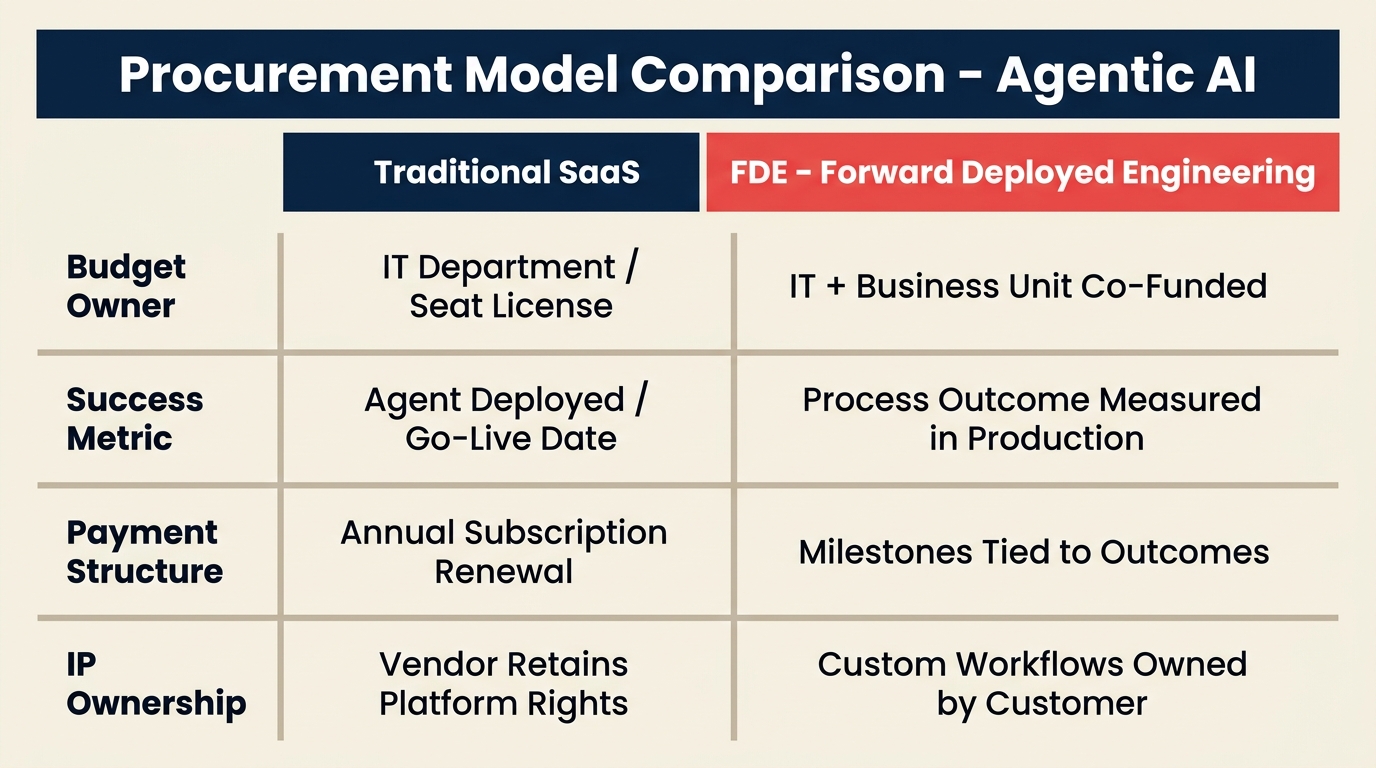
Pemilikan belanjawan beralih. Kontrak SaaS tulen mendarat dengan kemas dalam belanjawan IT: lesen tempat duduk, had penggunaan, tarikh pembaharuan. Penglibatan FDE-plus-platform kelihatan lebih seperti program transformasi. Unit perniagaan yang memiliki proses yang diautomasikan mempunyai kepentingan. Kewangan mahukan pencapaian yang dikaitkan dengan pembayaran, bukan hanya tarikh pelaksanaan. Itu bermakna struktur pembiayaan bersama, akauntabiliti kongsi untuk hasil, dan kitaran kelulusan yang melalui kepimpinan operasi serta IT.
Templat RFP adalah salah. Kebanyakan templat perolehan IT perusahaan dioptimumkan untuk menilai platform SaaS: soal selidik keselamatan, dokumentasi integrasi, perjanjian pengendalian data, peringkat SLA sokongan. Penglibatan FDE memerlukan bahagian yang berbeza: bagaimana jurutera tertanam diurus, tadbir urus mana yang meliputi akses mereka, bagaimana harta intelek (IP) dalam mana-mana aliran kerja tersuai dimiliki, dan apa yang berlaku apabila penglibatan berakhir? Soalan-soalan tersebut tidak ada dalam kebanyakan templat semasa.
Metrik kejayaan perlu berubah. Pelaksanaan SaaS berjaya apabila produk aktif dan penggunaan sedang dijejak. Penglibatan FDE sepatutnya berjaya apabila proses tertentu menghasilkan hasil yang ditentukan. "Ejen X dilaksanakan" bukan metrik kejayaan. "Kitaran pembaharuan kontrak dikurangkan daripada 12 hari kepada 4 hari, diukur selama 90 hari volum persekitaran produksi" adalah. Jika kontrak penglibatan tidak menentukan metrik hasil dan pencetus rollback, anda membiayai projek perundingan tanpa akauntabiliti.
Untuk konteks tentang cara menilai inisiatif AI pada peringkat perolehan, lihat Rangka Kerja Bina-lwn.-Beli-lwn.-Bermitra untuk CEO Pasaran Pertengahan dan Jurang Tadbir Urus: Apa yang Pemimpin Salah Faham tentang AI di Tempat Kerja.
Ujian Kontrak FDE: 4 Soalan untuk Mana-mana RFP Perolehan AI Agentic
Sebelum pasukan anda menghantar RFP untuk mana-mana penglibatan AI agentic bergaya FDE, sama ada ServiceNow-Accenture, Syarikat Pelaksanaan OpenAI, Snowflake, atau vendor lain, jalankan empat soalan ini berbanding kontrak yang dicadangkan.
1. Apakah metrik hasil yang khusus, dan bagaimana ia diukur? Penglibatan itu sepatutnya menamakan proses dan pengukuran sebelum/selepas. Masa-untuk-resolusi, kadar ralat, masa kitaran, kos setiap transaksi. Jika vendor tidak dapat menamakan satu dalam cadangan, itu adalah tanda amaran, bukan titik permulaan rundingan.
2. Bagaimana pembayaran dikaitkan dengan pencapaian, bukan peringkat pelaksanaan? Pembayaran yang dikaitkan dengan pencapaian perlu distrukturkan sekitar hasil dalam persekitaran produksi, bukan pada tarikh "go-live". Pelaksanaan bukan penghantaran. Pencapaian sepatutnya memerlukan volum transaksi sebenar yang ditentukan yang dikendalikan oleh ejen pada atau melebihi ambang prestasi.
3. Siapa yang memiliki IP mana-mana aliran kerja tersuai yang dibina semasa penglibatan? Komponen platform prasiap dimiliki oleh vendor. Aliran kerja tersuai yang dibina untuk memenuhi proses anda sepatutnya dimiliki oleh anda. Ini perlu dinyatakan dengan jelas dalam kontrak. Fasal pemilikan bersama yang kedengaran munasabah dalam rundingan menjadi mahal apabila anda menukar platform atau merundingkan semula penetapan harga.
4. Apakah pencetus rollback? Takrifkan terlebih dahulu apa yang berlaku jika prestasi ejen jatuh di bawah ambang. Siapa yang memulakan rollback, apakah komitmen masa tindak balas, dan siapa yang menanggung kos memulihkan proses manual? Vendor yang yakin dengan pendekatan mereka akan menjawab soalan ini tanpa penolakan.
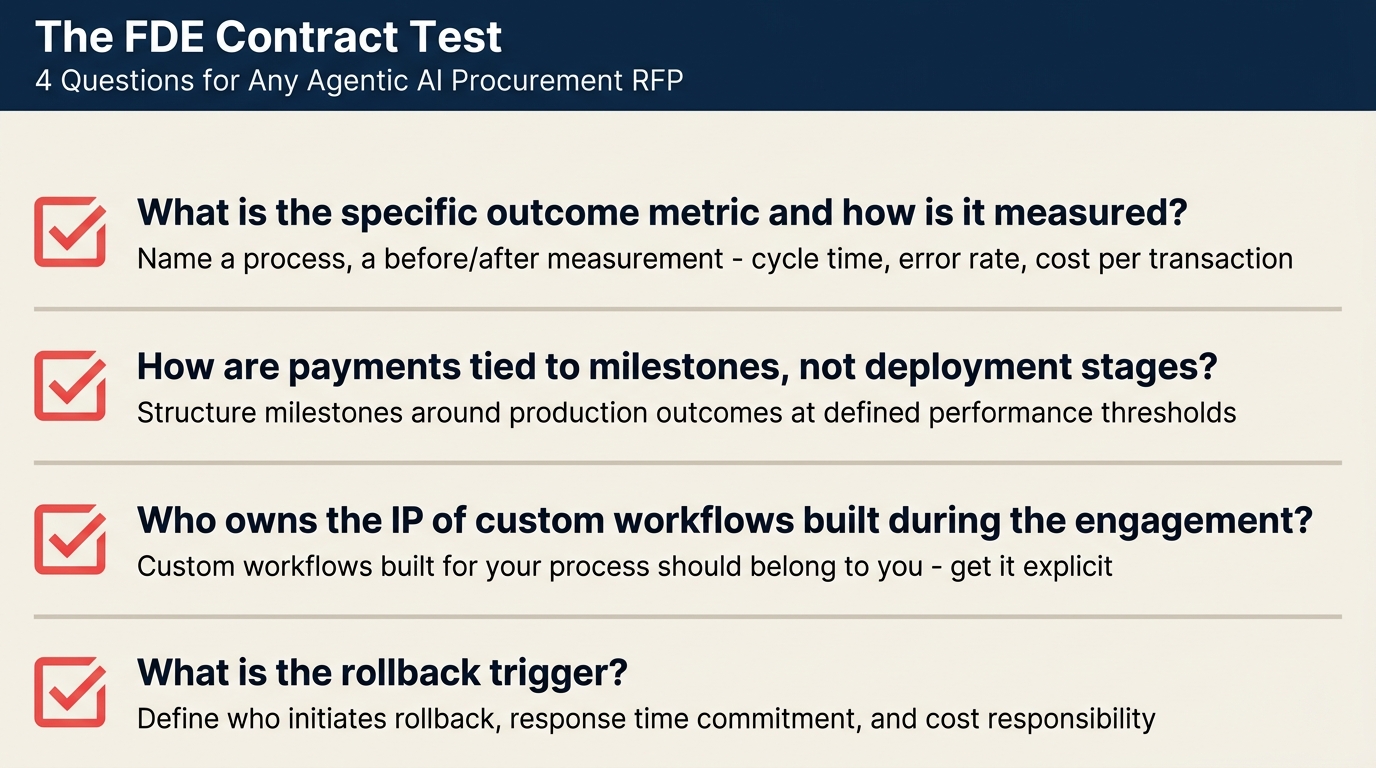
Empat soalan ini membentuk apa yang boleh anda namakan Ujian Kontrak FDE. Ia terpakai sama ada anda menilai penglibatan bernilai $200,000 atau program transformasi bernilai $20 juta. Strukturnya tidak berubah; pertaruhannya berubah.
Untuk pemikiran yang lebih luas tentang cara menyusun tadbir urus dan pengawasan AI, lihat Mengukur ROI AI Melampaui 'Masa yang Dijimatkan' dan Kecerunan Risiko Merentas Corak AI.
Apa yang Perlu Dilakukan Minggu Ini
Pengumuman ServiceNow-Accenture adalah fungsi pemaksaan yang baik untuk semakan yang kebanyakan pasukan IT dan perolehan perlu lakukan dari semasa ke semasa. Berikut adalah perkara yang perlu dijadualkan.
Minggu ini:
- Tarik templat RFP AI agentic semasa anda (atau RFP perkhidmatan AI terakhir yang dihantar oleh pasukan anda). Tandai setiap bahagian yang mengandaikan model perolehan SaaS. Kira berapa banyak daripada empat soalan Ujian Kontrak FDE yang ditanganinya. Kebanyakan templat menjawab sifar.
- Jadualkan panggilan 30 minit dengan CFO atau ketua kewangan anda untuk menyelaraskan tentang cara penglibatan bergaya FDE perlu dibelanjawankan. Perbualan itu perlu berlaku sebelum perbualan vendor seterusnya, bukan semasa ia.
- Maklumkan pasukan perolehan anda tentang perbezaan antara pelesenan platform, perkhidmatan pelaksanaan, dan kejuruteraan tertanam bergaya FDE. Ini memerlukan kriteria penilaian yang berasingan dan struktur kontrak yang berasingan.
30 hari berikutnya:
- Kemas kini templat perolehan AI utama anda untuk memasukkan bahagian khusus FDE yang merangkumi metrik hasil, struktur pembayaran pencapaian, pemilikan IP aliran kerja tersuai, dan pencetus rollback.
- Petakan tiga calon AI agentic teratas anda (semasa atau dirancang) kepada model FDE. Untuk setiap satu: kenal pasti pemilik proses, takrifkan metrik hasil calon, dan putuskan sama ada IT atau unit perniagaan perlu memiliki belanjawan.
- Tanya dua atau tiga vendor platform AI teratas anda secara langsung sama ada mereka menawarkan model FDE atau kejuruteraan tertanam. Jika mereka tidak, tanya apa jawapan mereka kepada jurang perintis-ke-persekitaran produksi. Cara mereka bertindak balas memberitahu anda banyak tentang betapa seriusnya mereka memikirkan pelaksanaan persekitaran produksi.
Vendor yang memenangi gelombang kontrak AI perusahaan berikutnya bukan sahaja akan mempunyai model terbaik atau pustaka kemahiran ejen prasiap terbesar. Mereka adalah yang berjaya menghantar nilai di dalam bangunan pelanggan, pada proses pelanggan, berbanding metrik pelanggan.
ServiceNow dan Accenture bertaruh itulah yang dikehendaki oleh pasaran. Memandangkan apa yang Gartner katakan tentang tempat kebanyakan projek berakhir, pertaruhan itu kelihatan tepat.
Soalan Lazim
Apakah program Forward Deployed Engineering ServiceNow Accenture?
Program Forward Deployed Engineering ServiceNow-Accenture, yang diumumkan pada 6 Mei 2026, menyematkan jurutera asli AI ServiceNow bersama jurutera tertumpu industri Accenture secara langsung di dalam persekitaran pelanggan bersama. Daripada mengkonfigurasi platform dari jauh dan menyerahkannya, pasukan gabungan membina aliran kerja agentic secara asli di tempat kerja pelanggan dan kekal sehingga aliran kerja tersebut berada dalam persekitaran produksi dan menghasilkan hasil yang boleh diukur.
Apakah forward deployed engineering dan mengapa ia penting untuk AI?
Forward Deployed Engineering (FDE) adalah model di mana jurutera vendor atau rakan kongsi bekerja di dalam persekitaran pelanggan sehingga kes penggunaan tertentu dihantar ke persekitaran produksi, daripada menyampaikan platform dan meninggalkan pelaksanaan kepada pelanggan. Ia penting untuk AI agentic kerana titik kegagalan yang paling biasa untuk program AI bukan pada model atau platform: ia adalah jurang antara demo yang dikonfigurasi dan aliran kerja yang mengendalikan volum persekitaran produksi sebenar. Program FDE menangani jurang tersebut secara langsung dengan memastikan jurutera bertanggungjawab terhadap hasil persekitaran produksi, bukan hanya pelaksanaan.
Bagaimana CIO harus membelanjawankan penglibatan FDE berbanding pelaksanaan SaaS tradisional?
Pelaksanaan SaaS tradisional biasanya berada dalam belanjawan IT sebagai barisan item: pelesenan, pelaksanaan, dan kos sokongan dengan syarat pembaharuan tahunan yang boleh diramalkan. Penglibatan FDE kelihatan lebih seperti program transformasi. Perancangan belanjawan perlu memasukkan pembiayaan bersama daripada unit perniagaan yang memiliki proses yang diautomasikan, pembayaran pencapaian yang dikaitkan dengan hasil persekitaran produksi daripada tarikh go-live, dan peruntukan untuk kos rollback kepada proses manual jika ejen tidak memenuhi ambang prestasi. CIO perlu menyelaraskan dengan CFO mereka tentang perbezaan ini sebelum perbualan vendor pertama.
Ketahui Lebih Lanjut
- Jurang Tadbir Urus: Apa yang Pemimpin Salah Faham tentang AI di Tempat Kerja
- Mengukur ROI AI Melampaui 'Masa yang Dijimatkan'
- Rangka Kerja Bina-lwn.-Beli-lwn.-Bermitra untuk CEO Pasaran Pertengahan
- Execute: Apabila AI Mengubah Keadaan Luaran (dan Mengapa Ia Berisiko)
- Kecerunan Risiko Merentas Corak AI
- Ejen Autonomi: Matlamat Pelbagai Langkah Dengan Penggunaan Alat
