Net Tuition Revenue Optimization: Strategic Framework for Sustainable Enrollment Growth
Turn this article into takeaways for your work.


Each assistant summarizes the article only for you and suggests best practices for your work.
Your enrollment hit its target: 1,200 new students. Your admission team celebrates. But when the finance numbers come in, net tuition revenue fell 3% despite flat enrollment. The celebration feels premature.
This scenario plays out at institutions across the country. Enrollment growth doesn't always mean revenue growth. Higher admit numbers don't guarantee financial health. And hitting class size targets might actually worsen your budget if you're discounting too aggressively to get there.
That's why net tuition revenue, not enrollment headcount, should drive your strategic planning.
Net Tuition Revenue Optimization Framework
Net tuition revenue starts with gross tuition and fees, what you'd collect if every student paid full sticker price. Subtract institutional grant aid, the scholarships and discounts funded from your operating budget. What remains is net tuition revenue, the actual cash your institution collects from students after institutional aid.
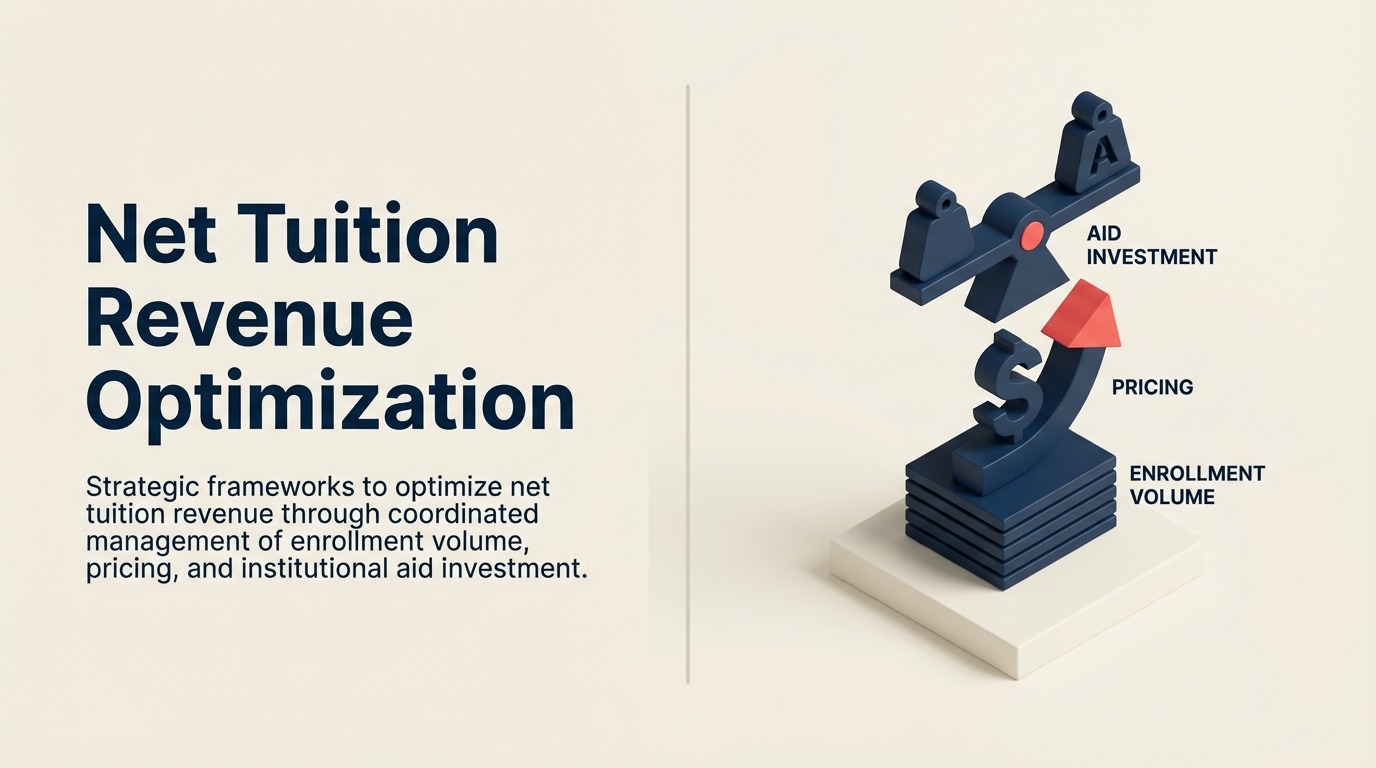
The formula seems simple: Gross tuition minus institutional aid equals net tuition. But optimizing this equation requires balancing three interconnected variables: enrollment volume, price level, and discount rate. Change one, and the others shift.
Net tuition per student, total net revenue divided by number of students, reveals your average revenue per enrollment. This metric matters more than sticker price for understanding institutional financial health. You can raise published tuition while simultaneously eroding net tuition per student if discount rates rise faster than sticker price.
Total net tuition revenue, net tuition per student times enrollment volume, represents your overall enrollment revenue contribution to the operating budget. This is what your CFO cares about. This is what funds your faculty salaries, academic programs, and student services. Everything else is accounting mechanics.
The Net Revenue Equation
Enrollment volume impact seems obvious, more students should mean more revenue. And it does, assuming you maintain net tuition per student. But here's where strategy gets complicated. Enrollment growth often requires higher discounting to attract additional students. That higher discounting reduces net tuition per student, potentially offsetting the revenue gains from volume growth.
Consider a scenario: You enroll 1,000 students at 20,000 dollars net tuition each, generating 20 million in net revenue. Next year you want to grow to 1,100 students. But to hit that target, you need to increase average aid by 2,000 dollars, reducing net tuition per student to 18,000 dollars. Now you have 1,100 students × 18,000 dollars = 19.8 million, less total revenue despite 10% enrollment growth.
Average gross tuition effect reflects both sticker price and enrollment mix. If you raise tuition 4% but simultaneously enroll more students in lower-priced programs (say, undergraduate education rather than business), your average gross tuition might rise by only 2%. Program mix matters as much as pricing decisions.
Many institutions operate multiple tuition schedules, undergraduate versus graduate, online versus residential, program-based differential tuition. Understanding enrollment mix across these categories reveals whether you're growing in high-revenue or low-revenue segments.
Discount rate influence on net revenue operates through both the rate itself and the enrollment volume it enables. A lower discount rate increases net tuition per student but might reduce enrollment if your pricing becomes uncompetitive. A higher discount rate decreases net per student but could boost volume enough to increase total revenue.
The optimal discount rate balances these forces. It's not about minimizing discounting at all costs. It's about finding the rate that maximizes total net revenue given your market position, competitive dynamics, and institutional capacity. According to NACUBO's 2024 Tuition Discounting Study, the average discount rate at private nonprofit institutions reached 56.3% for first-time undergraduates, the highest on record, highlighting the intensifying competitive pressure on pricing strategy.
Student mix considerations add another layer of complexity. Not all students generate the same net revenue. Full-pay students contribute maximum revenue. High-need students receiving substantial aid contribute less. Merit scholarship recipients fall somewhere in between. The composition of your enrolled class, how many full-pay, how many highly discounted, how many in the middle, determines total net revenue as much as average discounts do.
Strategic Optimization Framework
Volume-price-discount tradeoffs require integrated analysis, not siloed decision-making. You can't optimize enrollment volume without considering the discount rates required to achieve it. You can't set pricing strategy without understanding volume implications. And you can't manage discount rates without assessing enrollment and revenue impacts.
Model scenarios that account for all three variables simultaneously. What happens to net revenue if you enroll 50 fewer students but reduce average discounts by 3 percentage points? What if you raise tuition 5% but increase aid only 3%, effectively reducing affordability? What if you grow enrollment 8% while holding net per student flat?
Run these scenarios with realistic assumptions about price sensitivity and competitive response. Students respond to net price changes. Competitors may match your pricing moves. Your historical data on yield rates by net price level should inform your modeling assumptions. Strategic enrollment management research emphasizes the critical integration of enrollment strategy with budgeting and institutional financial planning, you can't separate enrollment goals from revenue modeling.
Student segment portfolio management treats different applicant populations as strategic choices with different return profiles. High-stat students typically require aggressive merit aid, generating lower net revenue per student. Lower-stat students might need less merit aid but present higher attrition risk. High-need students require substantial aid but advance access mission. International students might pay closer to full price but come with different recruitment costs and visa risks.
Your optimal enrollment portfolio balances these segments strategically. Don't simply enroll whoever accepts your offer. Actively manage class composition through aid allocation and recruitment prioritization, and admission selectivity to optimize the mix of net revenue, mission fit, and student success outcomes.
Aid ROI by segment reveals where your aid investment generates positive enrollment returns and where it doesn't. Calculate the incremental enrollment you'd lose if you reduced aid by 1,000 dollars for each student segment. For highly price-sensitive populations, modest aid cuts might crater enrollment. For less price-sensitive groups, you could reduce aid with minimal enrollment impact.
Target your most generous aid at segments where it changes enrollment behavior, typically middle-income students who lack access to substantial need-based federal aid but can't afford full price. Reduce aid for segments that will enroll either way, students with no alternatives, strong institutional affinity, or full financial capacity.
Marginal revenue analysis focuses on the incremental impact of enrollment changes, not averages. The question isn't whether your average student generates positive net revenue. It's whether your marginal student, the last one you enrolled, the next one you're considering, contributes more revenue than they cost.
If you're operating below capacity with fixed instructional costs, the marginal cost of additional students is low. In that case, even heavily discounted students generate positive margin and warrant enrollment. But if you're at capacity and additional students require new faculty, facilities, or programs, marginal costs rise substantially. Now you need students who generate significant net revenue to justify the investment.
Revenue Optimization Strategies
Program pricing strategy recognizes that different academic programs carry different market value, instructional costs, and competitive dynamics. Business programs might support premium pricing. Education programs might require competitive pricing. Graduate programs might command higher tuition than undergraduate. Online programs might carry different pricing than residential.
Use market research and competitive analysis to identify programs where you have pricing power versus programs where you're price-takers. Invest in growing high-revenue programs while carefully managing enrollment in programs with challenging economics.
Differential tuition by program, higher rates for engineering, business, nursing, allows you to capture market value where it exists without overpricing programs where students have lower willingness to pay. But implement this carefully. Large differentials create equity concerns and may push students toward lower-priced programs even when their interests lie elsewhere.
Differential discounting by segment allocates aid strategically rather than uniformly. You don't need to discount all students at the same rate. Target deeper discounts to priority populations, high academic achievers you want to enroll, students from target geographies, students in strategic academic programs, populations that advance diversity goals.
Reserve full-pay or lightly discounted spots for students who can afford them and will enroll anyway. This tiered approach maximizes net revenue from students with ability to pay while using aid strategically to shape enrollment composition.
High-value student identification focuses recruitment resources on applicants who combine strong enrollment probability with high net revenue contribution. These aren't always the same students who generate the highest sticker price revenue. A student with a 95% enrollment probability at 25,000 dollars net tuition contributes more expected revenue (95% × 25,000 = 23,750 dollars) than one with 50% probability at 35,000 dollars (50% × 35,000 = 17,500 dollars).
Use predictive modeling to score applicants on both enrollment likelihood and net revenue potential. Prioritize outreach, personal attention, and strategic aid offers to students who score well on both dimensions.
Retention revenue impact often exceeds the revenue potential of new student recruitment. A retained student continuing from year two to year three typically generates net revenue at much lower discount rates than new freshmen. Their renewal aid often lags tuition increases, and they don't require recruitment spending.
Calculate the net revenue value of retention improvements. If boosting your retention rate from 78% to 80% means 20 additional continuing students, and those students average 28,000 dollars in net revenue (versus 22,000 dollars for new students with higher aid), that's 560,000 dollars in incremental revenue with minimal incremental cost. That ROI typically exceeds new student recruitment returns.
Performance Measurement
Net tuition per student trends reveal whether your revenue per enrollment is growing, flat, or declining over time. Calculate this annually for 5-10 years to identify clear patterns. If your net per student has declined even as sticker price increased, you have a discount rate problem that demands strategic attention.
Compare your net per student trajectory to peer institutions. If your trend matches market norms, you're facing industry-wide dynamics. If your decline outpaces peers, you have institution-specific issues to address, possibly overly aggressive merit aid, weak competitive positioning, or ineffective financial aid strategy. Research from the College Board's Trends in College Pricing provides valuable benchmark data for contextualizing your institution's pricing and discount trends against national averages.
Total net revenue growth measures your overall enrollment revenue performance. This is what your board should track, not just enrollment headcount. A budget that assumes 3% net revenue growth to balance operations needs exactly that, not enrollment growth that might or might not translate to revenue.
Model your enrollment scenarios through the revenue lens. What combination of volume, price, and discount delivers your target net revenue? What's the risk if enrollment misses by 50 students? What if discount rates run 2 points higher than projected? Sensitivity analysis on these variables helps you understand your budget risk.
Discount rate efficiency asks whether your aid investment generates proportional enrollment return. If your discount rate rose from 48% to 52% over three years, did enrollment grow by a corresponding amount? If not, you're getting less enrollment per aid dollar invested, a sign of declining aid efficiency. The steady upward trend in discount rates across higher education, from 48% in 2015-16 to over 56% today, suggests this efficiency challenge is widespread.
Calculate the marginal enrollment cost of discount rate increases. If moving from 50% to 52% discount generated 30 additional students in a 1,000-student class, each marginal student cost roughly the equivalent of 2 percentage points of discount on 1,000 students. Is that sustainable? Does it generate positive net revenue? These questions should guide your aid strategy.
Revenue per enrolled student differs from net tuition per student by including all revenue sources, tuition, fees, room, board, auxiliary services. This comprehensive metric reveals total financial contribution by student. On-campus residential students typically generate more total revenue than commuters. Full-time students contribute more than part-time. Understanding these patterns helps you optimize enrollment mix strategically.
Sustainable Growth Requires Net Revenue Focus
Enrollment growth is a means to an end, not an end itself. The goal is financial sustainability that allows you to fulfill your educational mission. That requires net revenue growth, not just enrollment headcount increases.
The institutions achieving sustainable enrollment growth manage the complete revenue equation, pricing, volume, and aid, as an integrated strategy. They model scenarios rigorously. They track net revenue metrics alongside enrollment numbers. They adjust strategy based on what drives revenue, not just what fills seats.
They also recognize that net revenue optimization doesn't mean maximizing revenue at any cost. Mission matters. Access matters. Enrollment composition matters. But those priorities need to exist within a sustainable financial framework. You can't fulfill your mission if your institution is financially unstable.
Start by establishing net revenue targets, not just enrollment targets. Give your enrollment management team goals that balance volume and revenue. Track both metrics monthly. Make strategic adjustments when you're on track for enrollment growth but revenue shortfalls.
Build your budget on realistic net revenue assumptions grounded in recent trends and competitive dynamics. Don't plan for 4% net revenue growth if your trend is flat. Don't assume discount rates will stop growing if they've increased steadily for five years.
And connect enrollment strategy to institutional financial health in your board and leadership communications. Help decision-makers understand that enrollment success means net revenue success, not just hitting headcount targets while revenue erodes.
Sustainable enrollment growth requires net revenue focus. Everything else is just counting students.
Learn More
