Work Ethic: What It Is and How to Show It

Work ethic is one of those competencies that shows up in every job posting, every performance review, and almost every hiring decision. But it's rarely defined clearly enough to act on.
What Is Work Ethic?
Work ethic is a set of values and behaviors that shapes how a person approaches their responsibilities. At its core, it means doing what you said you'd do, doing it well, and doing it without needing to be constantly managed. Someone with a strong work ethic takes ownership of their output, maintains consistency across different conditions, and holds themselves to standards even when no one is watching.
Work ethic isn't the same as working long hours or always being available. It's about the quality, reliability, and integrity behind your effort, not the volume of hours logged.
Key Facts: Work Ethic
- 73% of employers rank work ethic as one of the top qualities they look for in candidates, according to the National Association of Colleges and Employers (NACE) Job Outlook survey.
- Gallup research finds that employees who are engaged and demonstrate strong personal ownership are 17% more productive and 21% more profitable to their organizations than disengaged peers.
- A study by the Journal of Vocational Behavior found that conscientiousness -- the personality trait most closely linked to work ethic -- is the single strongest personality predictor of job performance across industries and roles.
Why Work Ethic Matters
For individuals, work ethic is one of the fastest-building reputation assets available. People who consistently deliver on commitments get trusted with more interesting work, more autonomy, and more advancement opportunities. It compounds quickly. A reputation for reliability in year one of a role can open doors that technical skills alone won't.
For organizations, a culture of strong work ethic drives operational performance. Teams where members hold themselves accountable waste less time in follow-up loops, miss fewer deadlines, and require less supervisory overhead. Managers can focus on strategic decisions rather than tracking down deliverables.
Work ethic also ties directly to accountability. When people own their outcomes, they surface problems early, communicate honestly about delays, and bring solutions rather than excuses. That kind of operating style builds trust at every layer of an organization.
And from a professional ethics standpoint, work ethic represents more than performance. It reflects character. Doing quality work even when it's inconvenient, honoring commitments when circumstances change, and treating your role with care -- these aren't just professional habits. They're expressions of who you are at work.
The Traits of a Strong Work Ethic
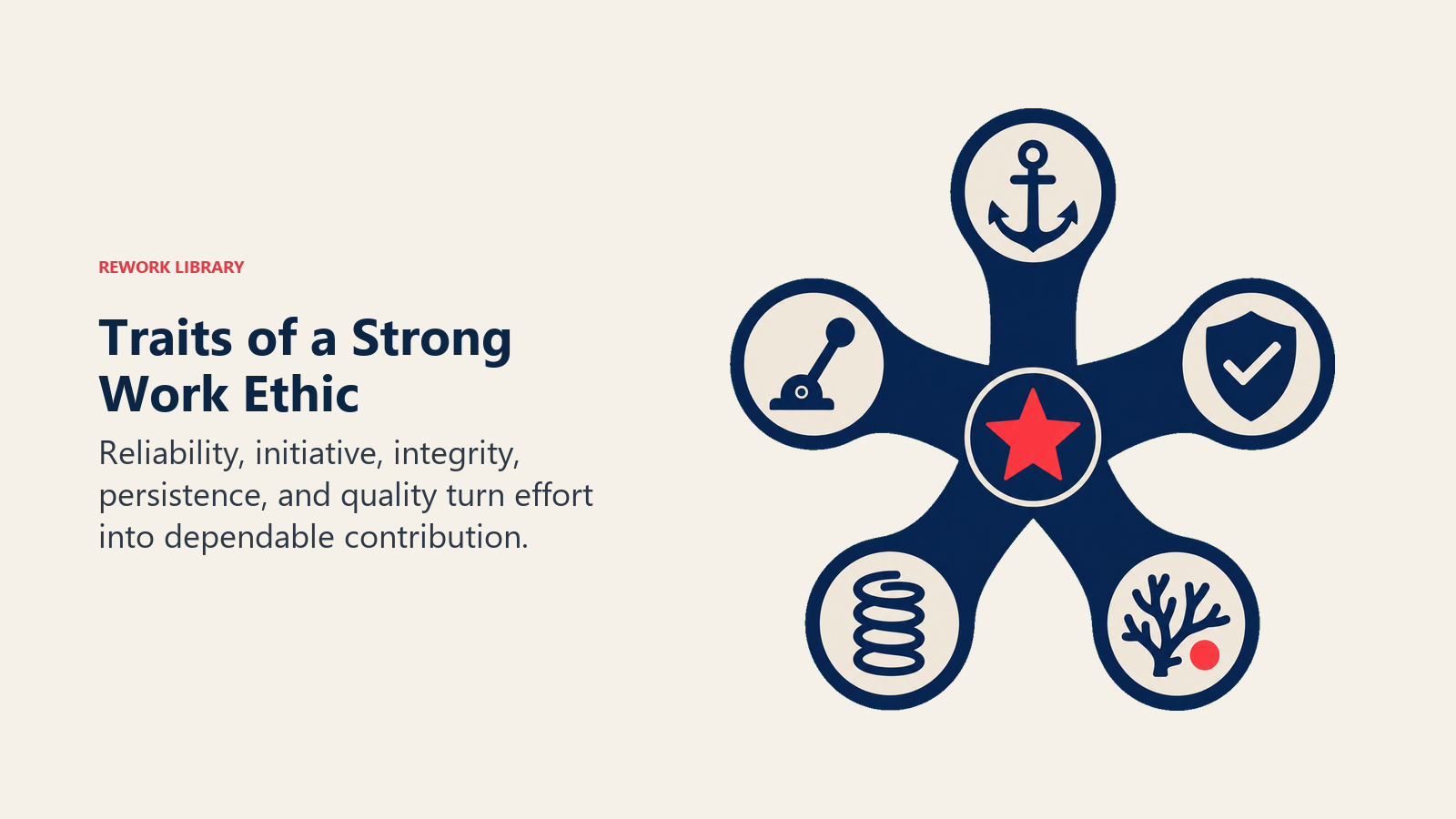
Strong work ethic isn't a single trait. It's a cluster of related behaviors that tend to appear together in high-performing individuals.
| Trait | What it looks like in practice |
|---|---|
| Reliability | Delivers on time, consistently. Rarely needs reminders. |
| Accountability | Owns outcomes, including when things go wrong. Doesn't deflect blame. |
| Discipline | Maintains focus and quality even on repetitive or difficult work. |
| Initiative | Acts on problems and opportunities without waiting to be asked. |
| Professionalism | Meets commitments with care, respects others' time, communicates clearly. |
| Integrity | Does the right thing even when it would be easier not to. Doesn't cut corners. |
| Perseverance | Pushes through obstacles instead of abandoning difficult tasks mid-way. |
These traits don't all need to be equally strong. But the more of them that show up consistently, the clearer the signal to managers, peers, and clients that someone brings real dependability to the work.
Initiative deserves a closer look here. It's often undervalued. Employees who see a problem and act without being directed -- who fill gaps, improve processes, and raise issues proactively -- demonstrate a level of ownership that immediately distinguishes them from peers who wait for instructions.
Strong vs Weak Work Ethic
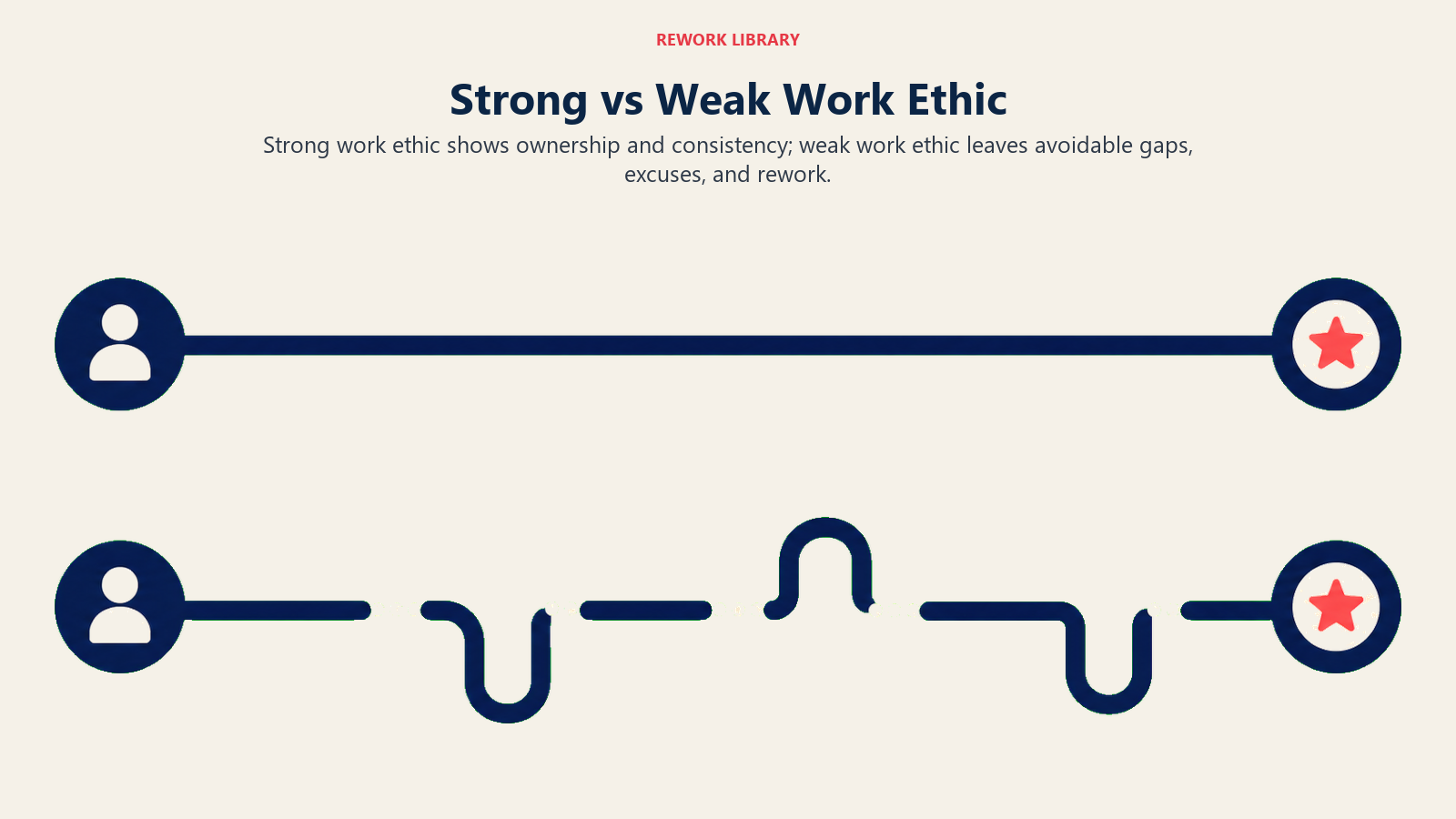
Seeing the contrast side by side makes the difference concrete.
| Behavior | Strong Work Ethic | Weak Work Ethic |
|---|---|---|
| Meeting deadlines | Delivers on time or flags early if a delay is coming | Misses deadlines without warning, often blames external factors |
| Quality of output | Checks work before submitting, asks if uncertain | Submits first drafts as final, expects others to catch errors |
| Response to feedback | Accepts input, adjusts behavior, follows through | Gets defensive, repeats the same mistakes |
| Handling difficult tasks | Works through complexity, asks for help when stuck | Avoids hard tasks, delegates downward to escape discomfort |
| Attitude toward slow periods | Uses downtime to improve processes, learn, or help others | Does the minimum and waits for the next assignment |
| Commitment to standards | Maintains quality even when pressure is high | Lets standards slip when inconvenient |
| Ownership of mistakes | Acknowledges errors, explains root cause, presents a fix | Minimizes errors, looks for someone else to blame |
No one is perfectly in the left column all the time. But patterns matter. Over weeks and months, consistent behavior in one direction or the other creates a lasting impression.
Examples of Work Ethic at Work
Work ethic looks different depending on role and context. Here are concrete scenarios.
| Role / Scenario | What strong work ethic looks like |
|---|---|
| Individual contributor | Flags a blocker to their manager two days before a deadline instead of the morning it's due. Submits work that's been proofread, not a rough draft. |
| Manager | Shows up to 1-on-1s prepared with notes. Follows through on commitments made to direct reports, like providing feedback on a presentation by Thursday. |
| Team member on a group project | Does their portion without needing reminders. Tells teammates immediately if their section will be late, instead of going quiet. |
| Sales rep | Makes the full activity count even in a slow quarter. Doesn't take shortcuts on CRM data or call logging just because the quarter is rough. |
| New hire in first 90 days | Asks clarifying questions before starting, delivers clean work, and applies feedback from the first review to subsequent work. |
| Remote worker | Communicates proactively, delivers on schedule, and doesn't let the lack of physical oversight become an excuse for reduced standards. |
The through-line across all of these is ownership: the person does what they said they would, and they're honest when something isn't going as planned.
Strong results orientation pairs closely with work ethic here. Effort alone isn't the goal. The goal is outcomes. People with strong work ethic care about both the process and the result.
How to Develop a Strong Work Ethic
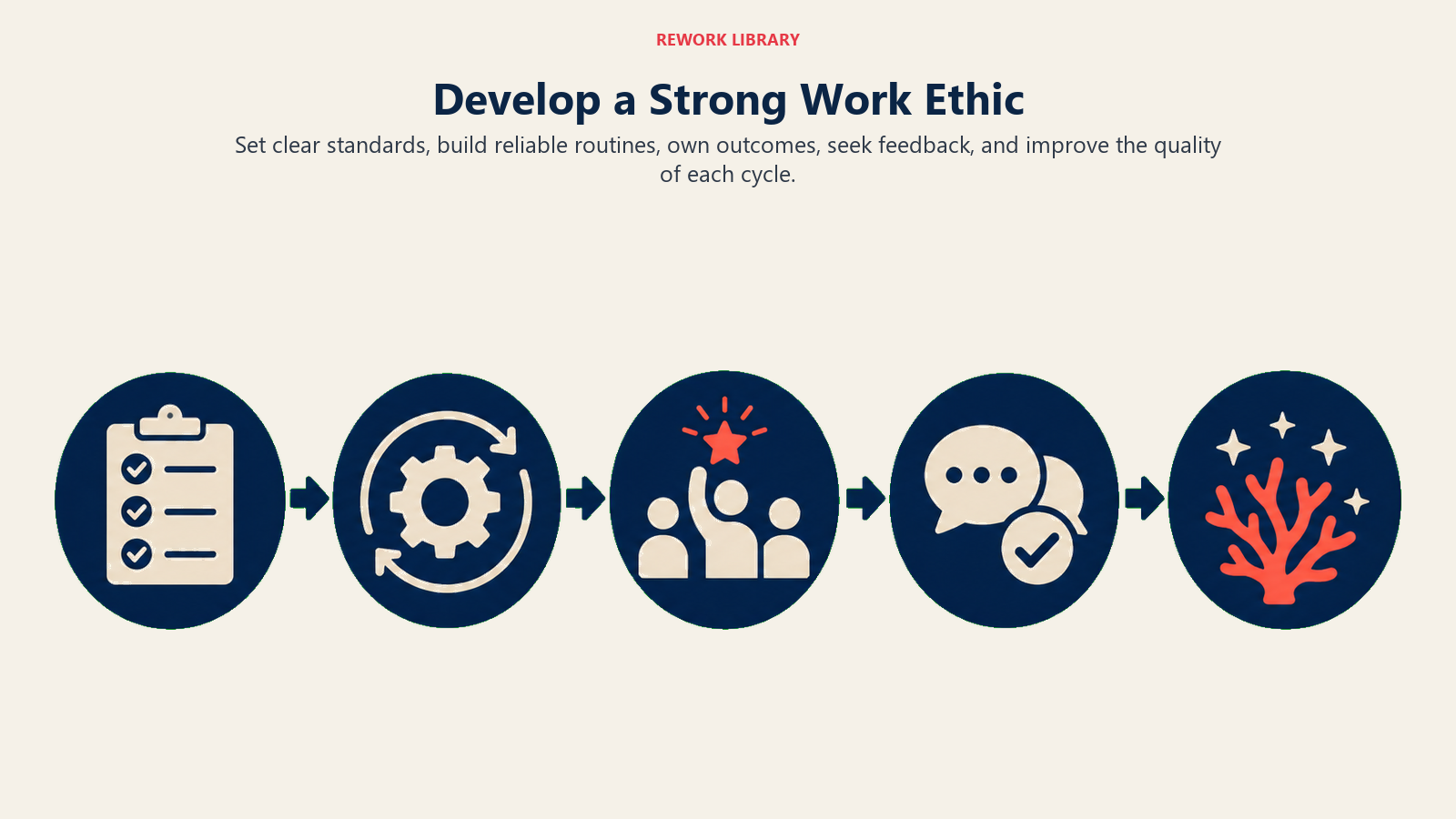
Work ethic isn't fixed. It's a set of habits and mindsets that can be built deliberately.
Step 1: Get clear on your commitments
You can't honor commitments you haven't tracked. Write down everything you've agreed to: deliverables, deadlines, implied responsibilities. Most people are surprised by how many informal commitments they have in flight. A simple list or task manager is enough. The habit of capturing commitments builds the discipline to fulfill them.
Step 2: Manage your time with intention
Time management is the infrastructure of work ethic. If you can't control how your hours are spent, consistency becomes accidental. Block time for focused work. Protect high-priority tasks from being crowded out by reactive work. Review your calendar and task list at the start of each day.
Step 3: Build in quality checkpoints
Before submitting any piece of work, ask: "Would I be comfortable if a senior leader reviewed this right now?" That question catches most quality issues. Build this check into your workflow so it becomes automatic, not an afterthought.
Step 4: Communicate proactively
If something is going to be late or fall short of expectations, say so as early as possible. The work ethic failure isn't always the delay. It's going quiet and hoping no one notices. Proactive communication preserves trust even when performance dips.
Step 5: Follow through on small things
Work ethic lives in the details. If you said you'd send a document by end of day, send it by end of day. If you told a colleague you'd check on something for them, check on it. Small commitments kept consistently build the same trust as large ones, and they're often noticed more clearly.
Step 6: Reflect on patterns, not just incidents
At the end of each week, spend five minutes asking: "Where did I let a commitment slip? Where did I deliver well?" The goal isn't self-criticism. It's pattern recognition. Repeated misses in the same area usually point to a systems problem (unclear priorities, no buffer time) rather than a character problem.
How to Show Work Ethic in an Interview or Resume
Work ethic is one of those qualities almost every hiring manager is trying to evaluate, but most candidates don't address it directly or well. Here's how to stand out.
On your resume:
- Include specific, quantified outcomes that required sustained effort. "Reduced report turnaround from 5 days to 1 day over 3 months" says more than "strong work ethic" in a skills list.
- Highlight consistency, not just peaks. If you've maintained performance metrics across a full year, show the trend, not just one good quarter.
- Note examples of going beyond the defined scope: systems you improved, processes you cleaned up, gaps you filled without being asked.
In an interview:
- Use the STAR format (Situation, Task, Action, Result) to tell specific stories about ownership and follow-through. Concrete examples beat generic claims every time.
- When asked behavioral questions about difficult situations, describe what you actually did rather than what the "right" answer sounds like. Interviewers can tell the difference.
- Describe how you handle mistakes. A candidate who can walk through a real failure, own their part in it, and describe what they changed demonstrates the kind of accountability that signals genuine work ethic.
Common interview questions that assess work ethic:
- "Tell me about a time you had to push through a difficult or frustrating project."
- "Describe a situation where you had to deliver results without much guidance."
- "What do you do when your workload is too heavy to complete everything on time?"
- "Have you ever disagreed with a deadline? How did you handle it?"
Don't just say you have a strong work ethic. Show it through the stories you tell.
Frequently Asked Questions
What are examples of a good work ethic? Delivering work on time without reminders, communicating early when a deadline is at risk, producing clean and accurate output before submitting, following through on informal commitments (not just official tasks), and maintaining quality standards even when under pressure. The common thread is that someone with a good work ethic doesn't need someone else to enforce their standards for them.
Is work ethic a skill or a value? It's both. As a value, work ethic reflects a belief that doing quality work and honoring commitments matters. As a skill, it expresses itself through specific behaviors like time management, communication, and personal organization that can be learned and improved. This means work ethic isn't simply something you either have or don't have. It can be developed.
Can you have a strong work ethic without working long hours? Yes. Work ethic is about the quality, reliability, and integrity of your effort, not the quantity of hours. Someone who works 40 focused hours a week, delivers consistently, and communicates proactively has a stronger work ethic than someone who works 60 hours but misses deadlines and produces inconsistent output. Confusing busyness with work ethic is a common mistake.
How is work ethic different from professionalism? Professionalism covers a broader set of workplace conduct norms: how you communicate, how you treat others, how you present yourself. Work ethic is specifically about how you approach your responsibilities and commitments. The two overlap significantly, and both matter, but someone can be professionally polished while still being unreliable, and vice versa.
How do you address weak work ethic in a team member? Start with clarity. Often, what looks like weak work ethic is actually unclear expectations. Make sure the person knows what "good" looks like and by when. Then address specific behaviors, not character. "The report was submitted two days late without notice" is a behavior you can address. "You don't have a strong work ethic" is a judgment that usually triggers defensiveness rather than change. Set clear expectations, follow up consistently, and document what you observe.
Work ethic is built through small acts of ownership repeated over time. The reputation it creates is hard to manufacture and hard to fake, which means the people who do the work of building it genuinely stand out. Start with clarity about your commitments, protect the time to honor them, and communicate openly when things don't go as planned. That's the foundation.
Related reading

Senior Operations & Growth Strategist
On this page
- What Is Work Ethic?
- Why Work Ethic Matters
- The Traits of a Strong Work Ethic
- Strong vs Weak Work Ethic
- Examples of Work Ethic at Work
- How to Develop a Strong Work Ethic
- Step 1: Get clear on your commitments
- Step 2: Manage your time with intention
- Step 3: Build in quality checkpoints
- Step 4: Communicate proactively
- Step 5: Follow through on small things
- Step 6: Reflect on patterns, not just incidents
- How to Show Work Ethic in an Interview or Resume
- Frequently Asked Questions
- Related reading