日本語

Business Writing: How to Write Clearly at Work

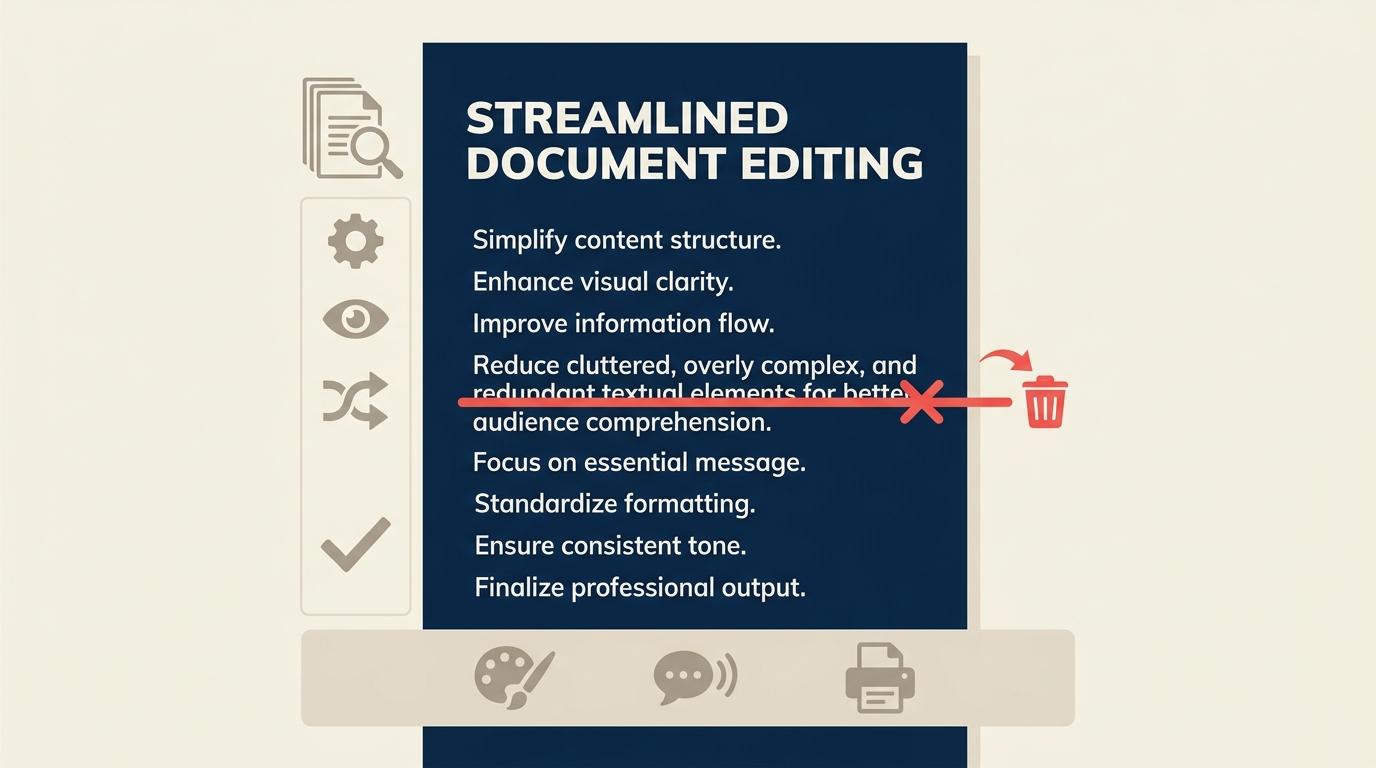
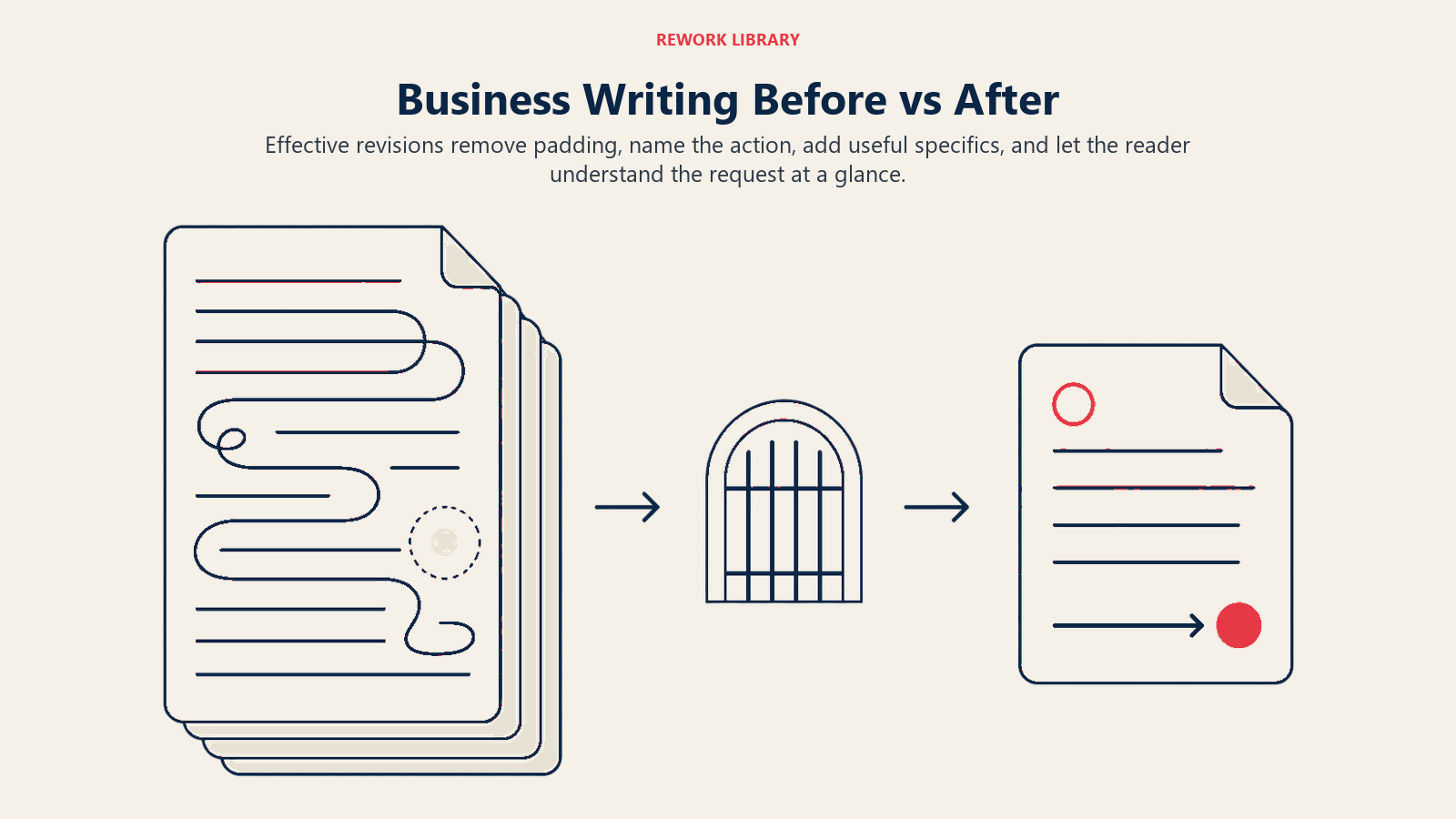
Clear business writing document with the main point up front and clutter edited out

Poor business writing costs organizations time, trust, and money every single day. A buried request, a jargon-heavy report, a five-paragraph email asking a yes/no question -- these slow decisions, create confusion, and quietly signal that the writer is not as sharp as they actually are. Strong business writing skills fix all of that. And the good news? Writing more clearly at work is a learnable skill, not a talent.

What Is Business Writing?

Business writing is purposeful, professional writing that gets a clear message across so the reader can act. It covers emails, reports, proposals, memos, and messages of all kinds. Its job is clarity and action, not eloquence. Unlike academic writing, which rewards complexity, or creative writing, which rewards style, business writing is judged by one question: did the reader understand what to do next?

Key Facts

  • A 2016 survey by writing consultant Josh Bernoff found that 81% of business professionals say unclear writing wastes significant time -- and he estimated the annual cost to U.S. organizations at roughly $400 billion. (Source: Josh Bernoff, "Bad Writing Costs Businesses Billions," HBR, 2016)
  • Workers spend an average of 28% of their workday on email -- reading, writing, and managing it. (Source: McKinsey Global Institute, "The social economy," 2012)
  • Written communication ranks as one of the top five applied skills employers want from new college graduates, according to the NACE Job Outlook survey (NACE, 2023).

"In business writing, the goal isn't to sound smart. It's to be impossible to misunderstand."

Why Business Writing Skills Matter

When writing is unclear, people don't act. They ask follow-up questions, schedule unnecessary meetings, or guess -- and guess wrong. That friction adds up fast.

But the cost runs deeper than wasted time. How you write is how people experience your thinking. A clear, well-structured email signals competence. A rambling one raises doubts. At every career level, your writing creates an impression that travels without you -- to colleagues, clients, and leadership who may never meet you in person.

Remote and async work has made this even sharper. When you're not in the room, your words are doing the work. An unclear Slack message or a poorly scoped project brief can stall a team for hours. Strong communication skills, and business writing in particular, become your most visible professional asset.

Types of Business Writing

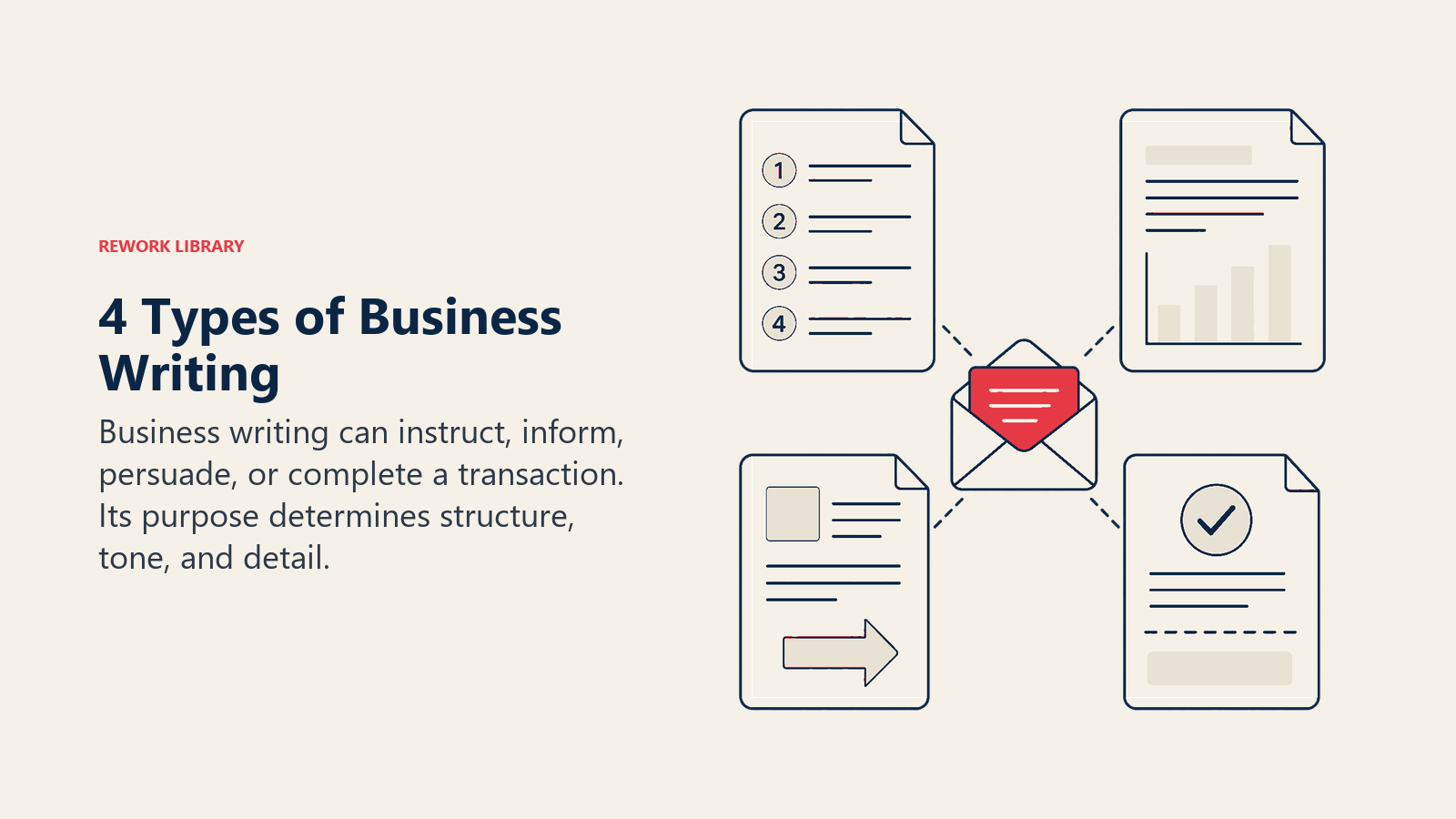
Business writing falls into four broad categories. Knowing which type you're writing changes how you approach it.

Type Purpose Examples
Instructional Tell someone how to do something Manuals, how-to guides, SOPs, onboarding docs
Informational Share facts, status, or analysis Reports, memos, meeting notes, technical documentation
Persuasive Get someone to agree or act Proposals, pitches, recommendation memos, sales emails
Transactional Complete a routine exchange Request emails, confirmations, announcements, invoices

Most professionals write all four types daily. The instinct to write every document the same way -- dense, defensive, padded -- is the root of most business writing problems.

The Principles of Clear Business Writing

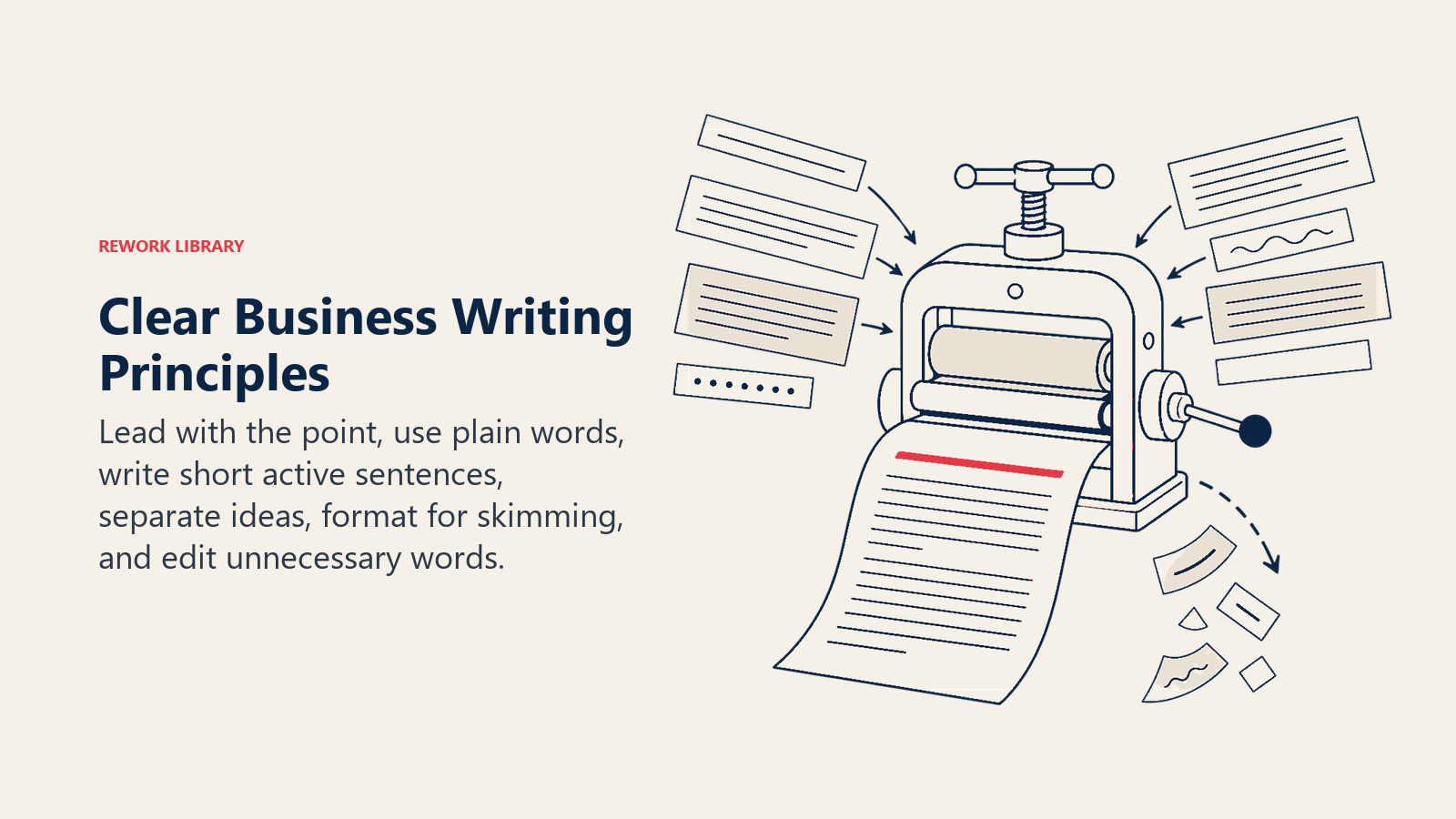
These principles apply across all four types. They're not stylistic preferences. They're structural choices that determine whether the reader acts or stalls.

Lead with the point (bottom line up front). The military calls this BLUF, which stands for bottom line up front (BLUF). State the conclusion, decision, or request in the first sentence. Readers shouldn't have to scroll to find out why they're reading.

Use plain words. If a simpler word exists, use it. "Use" beats "utilize." "Start" beats "commence." Plain language is not lazy writing -- it's respectful writing. It treats the reader's time as valuable. Attention to detail includes choosing the right word, not the most impressive one.

Write short sentences. Sentences longer than 25 words start losing readers. When you're tempted to stack clauses together, split them. Shorter sentences also force clarity -- you can't hide a fuzzy idea in a short sentence.

Use active voice. "The team missed the deadline" is clearer and more honest than "The deadline was missed by the team." Active voice names who does what.

One idea per paragraph. A paragraph is a unit of thought. If you're covering two different points, use two paragraphs. White space is not wasted space -- it's breathing room that helps readers track your logic.

Format for skimming. Most business readers skim before they read. Use headers, bullet points, and bold text to let them find what they need fast. A wall of unbroken text is a reader's first reason to stop.

Edit ruthlessly. First drafts are always longer than they need to be. Cut every word that doesn't carry its weight. If you can delete a sentence without losing meaning, delete it.

How to Write a Clear Business Document

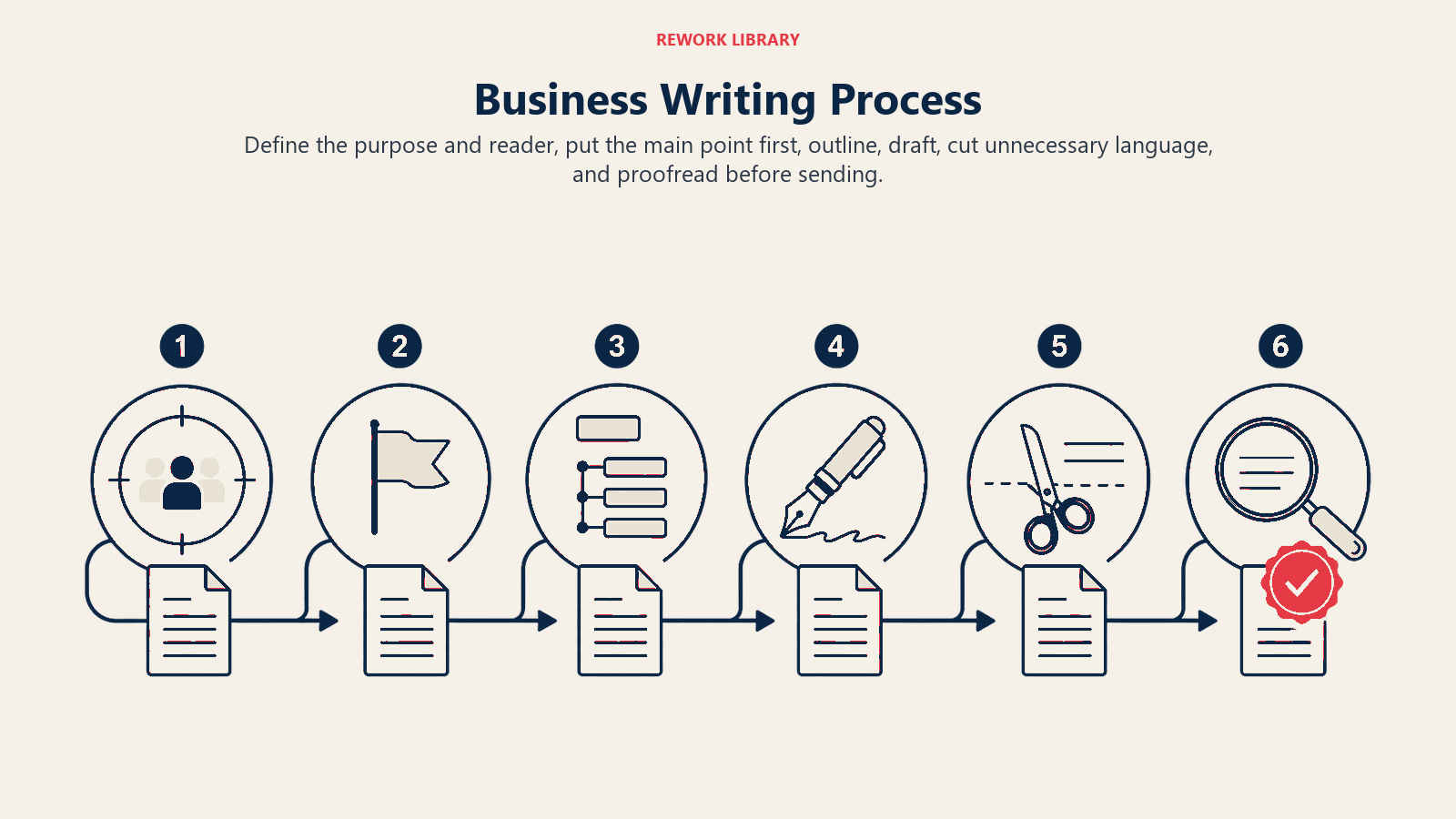
Clarity doesn't start with writing -- it starts with thinking. Follow these steps for any business document longer than a quick reply.

Step 1: Define Your Purpose and Reader

Before you write one word, answer two questions: what do you want the reader to do, and who are they? A proposal for a CFO needs different framing than the same proposal for an engineering lead. Know your audience's priorities, vocabulary, and decision-making context.

Step 2: Put the Main Point First

Write your key request, recommendation, or finding at the top. Not after the background. Not at the end. At the top. If the reader stops after the first paragraph (and many will), they should leave knowing exactly what you needed from them.

Step 3: Outline Before You Draft

Spend three minutes sketching the structure: what sections do you need, in what order? A simple outline prevents you from writing around your point instead of making it. Persuasion skills benefit from structure just as much as informational writing does.

Step 4: Draft Fast

Don't edit while you write. Get ideas out first, then tighten. Editing mid-draft is how writers spend an hour on the opening paragraph while the rest stays blank.

Step 5: Cut and Tighten

Go back through your draft with one goal: remove what doesn't need to be there. Look for repeated ideas, unnecessary qualifiers ("very," "really," "quite"), passive constructions, and padding phrases like "It is important to note that."

Step 6: Proofread with Fresh Eyes

Read your document aloud, or at minimum away from the screen for a few minutes before final review. Errors you missed on screen become obvious when you hear them. For high-stakes documents, ask a colleague to read for clarity before you send -- attention to detail at this stage protects your credibility.

Business Writing Examples: Before and After

Short, concrete revisions illustrate the principles faster than any description.

Before After
"I wanted to reach out to you in order to discuss the possibility of scheduling a meeting at your earliest convenience to go over the Q2 results." "Can we meet this week to review Q2 results? I'm free Tuesday or Thursday after 2pm."
"It is our considered view that the implementation of the proposed software solution may have the potential to yield efficiency improvements across multiple operational areas." "We recommend adopting the new software. It should cut processing time by 30% across three departments."
"Due to the fact that the report has not yet been finalized at this point in time, it would be premature to share any preliminary conclusions." "The report isn't final yet. We'll share conclusions by Friday."

Every "before" is real. Every "after" was written in under ten seconds by asking: what am I actually trying to say?

How to Improve Your Business Writing

Improvement comes from practice with feedback, not from reading about writing. These habits build the skill faster than any course.

Write every day. Even short -- a daily project update, a concise meeting summary, one clear email that could have been a Slack thread. Volume builds the habit of translating thought into words.

Read widely and critically. Pay attention to writing you find clear. Ask what makes it easy to follow. Read dense documents too, and notice where they lose you. Storytelling at work sharpens similar instincts -- how structure guides a reader from one point to the next.

Read your writing aloud. Awkward phrasing and missing logic show up in speech before you see them on the page. If you stumble reading it, your reader will too.

Keep an edit log. Note the patterns in your mistakes -- do you bury the lead? Over-explain? Use passive voice? Knowing your tendencies lets you target them directly.

Get feedback on real documents. Ask a trusted colleague: "Is this clear? What would you cut?" Feedback on actual work you've written sticks better than abstract critique.

Study great workplace writing. Warren Buffett's shareholder letters are famous for their plain language. Jeff Bezos required six-page narrative memos instead of slide decks at Amazon. Facilitation skills and business writing share the same discipline: structure your thinking so others can follow it.

Common Mistakes

Burying the ask. Putting your request or recommendation at the bottom means many readers never get there. Lead with what you need.

Jargon as a substitute for clarity. Technical terms have their place. But using industry jargon to sound credible -- when a plain word would do -- signals the opposite. It suggests you're obscuring rather than explaining.

Passive voice everywhere. "Mistakes were made" is the most famous example of passive voice hiding accountability. In business writing, passive voice usually weakens the message and makes attribution unclear.

Walls of text. Dense paragraphs tell readers you haven't done the work of organizing for them. Formatting is part of the writing. Headers, bullets, and white space are not decoration -- they're navigation tools.

Skipping proofreading. A typo in a proposal, a wrong number in a report, a misspelled client name in an email -- these are small errors that carry outsized signals about your care and professionalism. Presentation skills and writing share this: errors visible to the audience land harder than you expect.

Treating every document the same. A transactional request email doesn't need three paragraphs of context. A proposal needs structure and evidence. Matching format to purpose is half the skill.

Frequently Asked Questions

What is BLUF in business writing? BLUF stands for bottom line up front. It means stating your conclusion, request, or recommendation at the very start of a document or email -- before context or background. The term comes from U.S. military communication, where orders need to be understood instantly. Applied to business writing, BLUF ensures readers get the key point even if they only read the first sentence.

Is business writing a hard skill or a soft skill? It's both, depending on how you look at it. Business writing is teachable and measurable, which puts it in hard-skill territory. But it also requires judgment, audience awareness, and clear thinking -- qualities often grouped as soft skills. For practical purposes, treat it as a technical skill you can practice and improve deliberately, like interpersonal skills or data analysis.

How can I make my emails clearer? Start with your request or point in the first sentence. Use a subject line that tells the reader exactly what the email is about. Keep the body to three to five short paragraphs. Use a numbered or bulleted list if you have multiple questions or items. End with a specific call to action -- what do you need, by when? Reading the email aloud before sending catches most clarity problems.

What's the difference between business writing and academic writing? Academic writing rewards thoroughness, complexity, and comprehensive citations. Business writing rewards brevity, clarity, and action. Academic writing builds to a conclusion; business writing leads with one. If you trained in academic writing and now write at work, the hardest adjustment is putting the bottom line first and cutting material that is accurate but not necessary.

How do I improve business writing fast? Pick one principle and apply it to everything you write this week. Start with BLUF: put the main point first in every email and document. After a week, add one more rule -- short sentences, or cutting every unnecessary qualifier. Layering one habit at a time compounds faster than trying to overhaul your writing style all at once.

Strong business writing is not about being a gifted writer. It's about being a clear thinker who respects the reader's time. Every professional who learns to write plainly, structure well, and lead with the point builds a compounding advantage -- in credibility, in influence, and in how fast their ideas actually move.