What is CS-Product Alignment: The Operating Model for Customer-Driven Growth

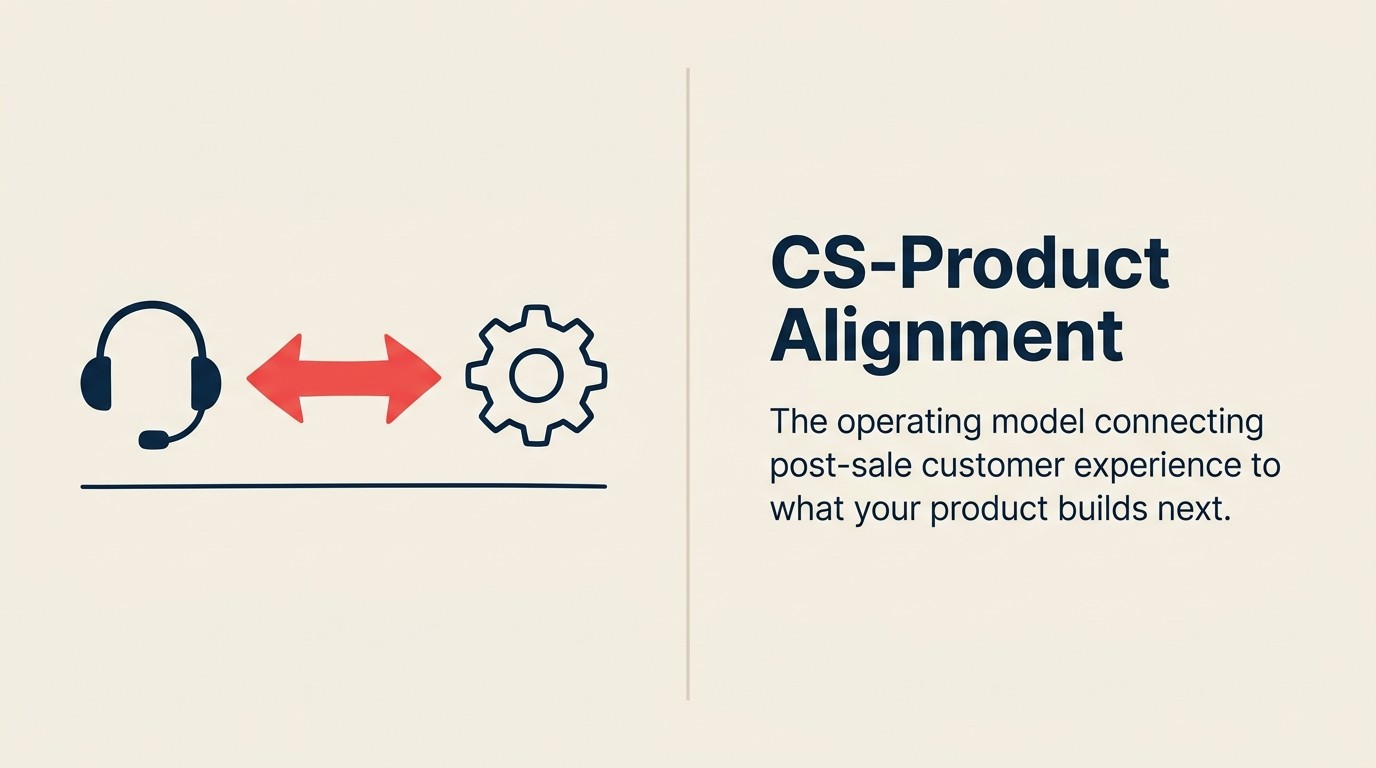
CS-Product alignment is the connection between what customers experience after signing the contract and what the product team decides to build next. It's not a culture initiative. It's not "let's get these two teams talking more." It's an operating model, with structures, rituals, and feedback flows.
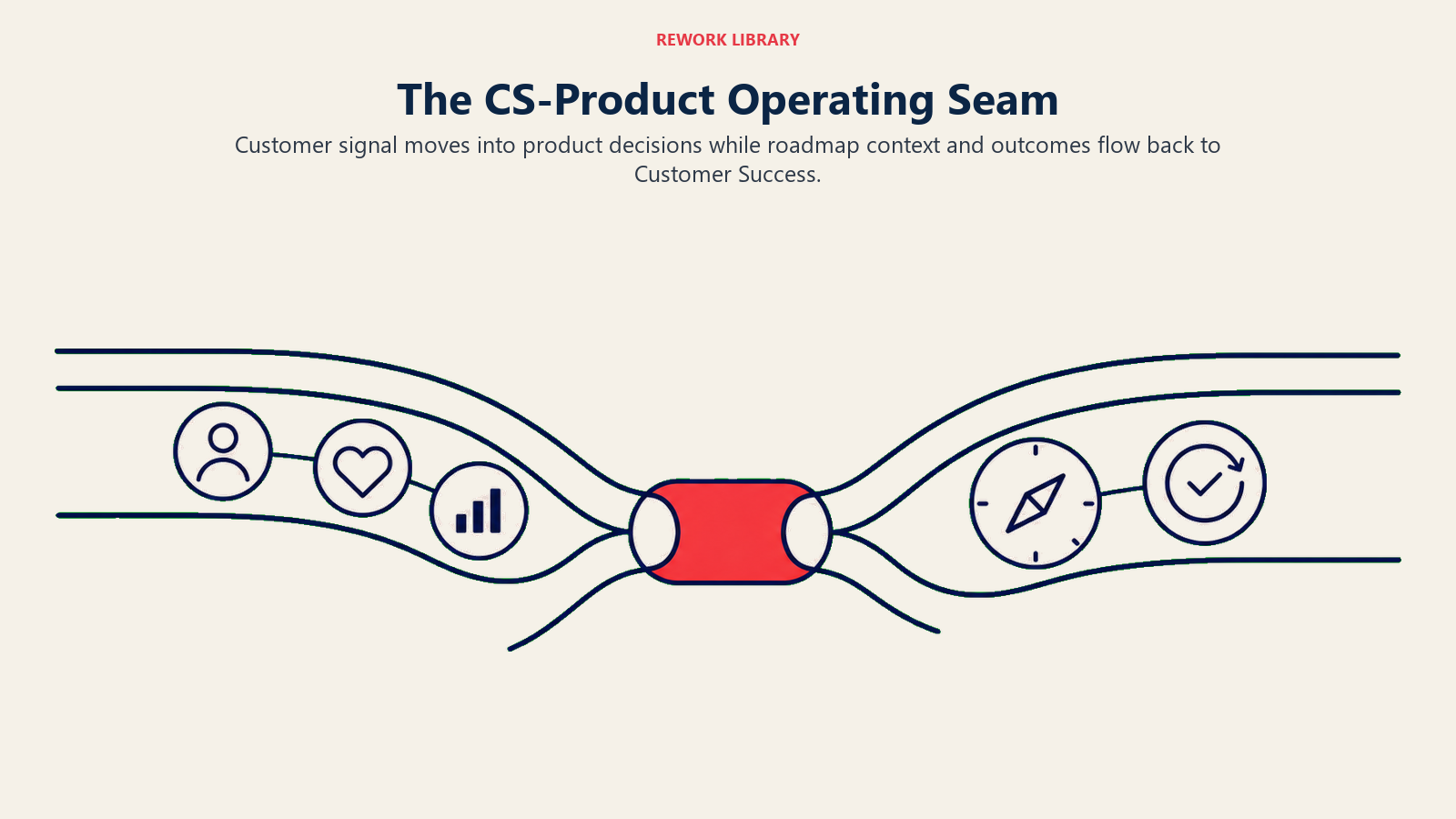
Without it, both functions end up working hard in the wrong directions at the same time. Understanding this seam matters just as much as understanding what post-sale management looks like in execution.
Here's what the failure looks like up close. The product team ships a redesigned dashboard. Usage analytics show adoption ticking up in the first two weeks. The Customer Success Managers (CSMs) on the other side of the building are fielding six concurrent conversations about a data export limitation that's been on the feature request list for 14 months. The $200K account threatening to churn in Q3 cited that limitation in their last three Quarterly Business Reviews (QBRs). The product team didn't know. The Customer Success team assumed someone had flagged it properly. Both assumptions were wrong.
That's the misalignment tax. It doesn't always show up as drama. More often it shows up as drift, a quiet accumulation of decisions made without the signal that would have changed them.
What CS-Product Alignment Actually Means

The clearest definition: CS-Product alignment is what happens when the people who own the customer relationship post-sale and the people who own the build decision are working off the same signal. TSIA research on CS-Product collaboration confirms that organizations where these two functions are misaligned show the lowest levels of product adoption practices , making alignment a measurable performance gap, not just an organizational preference.
This is not about intent. Every VP CS and Head of Product will tell you they want to be aligned. The question is whether there's a workflow connecting them, or whether "alignment" means "we're in the same office and we chat when things get urgent."
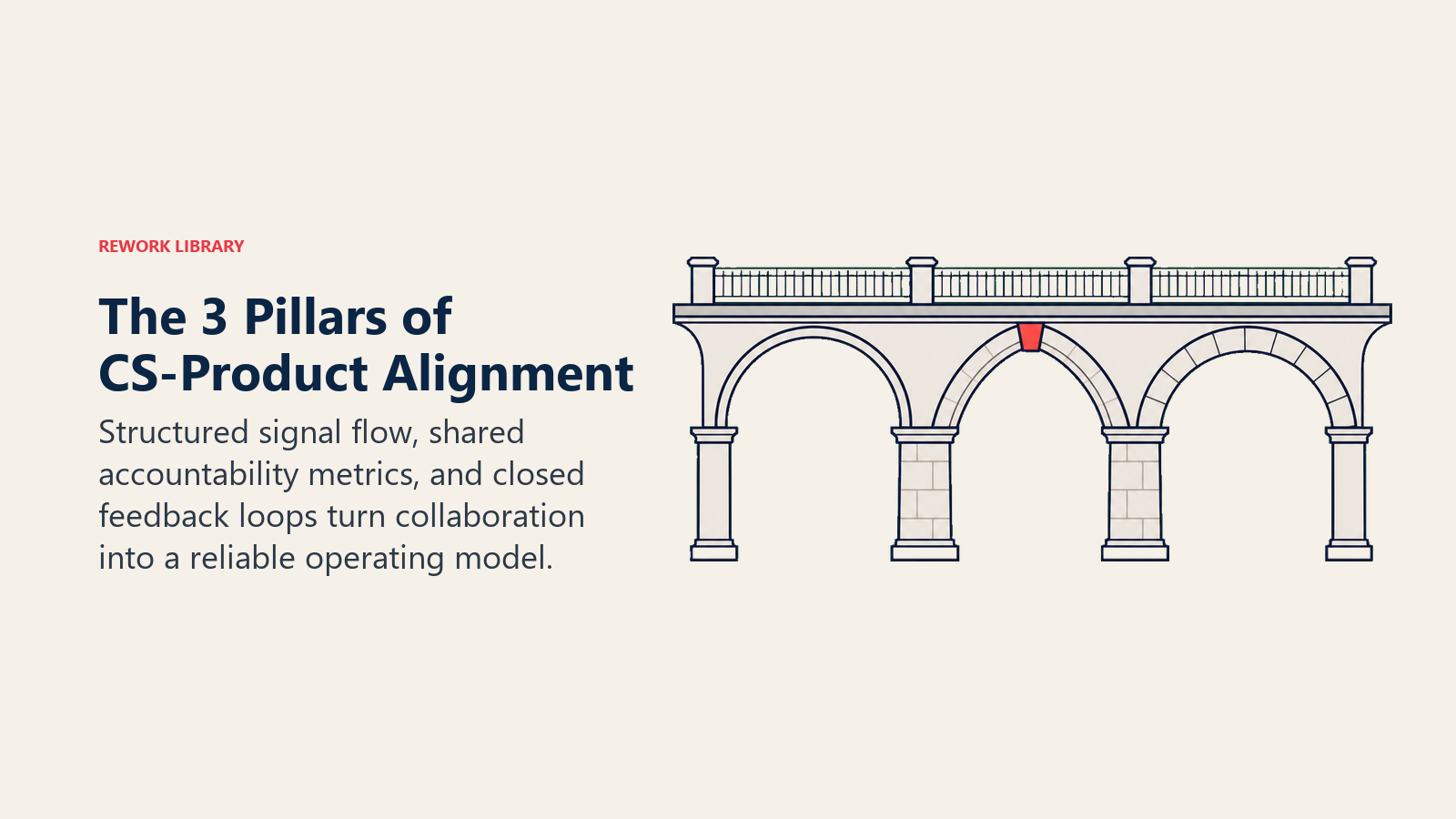
Three things distinguish a real operating model from a good intention. Together, they form The 3 Pillars of CS-Product Alignment:
Pillar 1: Structured Signal Flow. Customer feedback moves from CSM notes into a format that Product can triage, prioritize, and respond to. Not because individuals are chasing each other across Slack, but because there's a defined path with known stops along the way.
Pillar 2: Shared Accountability Metrics. At least one metric crosses the org boundary. Retention. Feature adoption. Expansion rate. When CS and Product are each accountable for a number the other team can influence, the incentive structure starts to pull them in the same direction.
Pillar 3: Closed Feedback Loops. The CSM who surfaces a customer pain knows what happened to that input. Either it's on the roadmap, it's been declined with a reason, or it's under review. The customer who asked a CSM about a feature gets an answer that's credible and consistent, not a hedge or a Slack-sourced approximation.
Without all three pillars, you don't have alignment. You have two teams with overlapping customers and diverging priorities.
Key Facts: The CS-Product Alignment Gap
- According to ProductPlan's State of Product Management report, only 22% of product teams say they have a formal, consistent process for incorporating customer feedback from post-sale teams into their roadmap.
- Gainsight research found that 74% of customers who churned could have been retained if their vendor had taken action on signals that were visible before churn. Those signals typically live in CSM notes and QBR transcripts, not support tickets.
- McKinsey analysis of B2B tech companies found that top-quartile net revenue retention (NRR) performers are 3x more likely to have a structured voice-of-customer (VoC) process connecting post-sale teams to product decisions.
Quotable: "CS-Product alignment is not a culture initiative. It's an operating model with three load-bearing pillars: structured signal flow, shared accountability metrics, and closed feedback loops. Remove any one pillar and the structure collapses."
Who This Concerns
The conversation about CS-Product alignment typically starts between the VP of Customer Success and the Head of Product. But it quickly involves Product Marketing, because the Product Marketing Manager (PMM) sits at the intersection of roadmap communication and customer narrative, the natural translator between CS language ("customers are confused about the reports module") and product language ("we need to scope a UX improvement for the analytics layer").
In mid-market companies, the CEO often ends up in this conversation too. Not because it's a strategic initiative that requires executive sponsorship, but because when CS and Product are misaligned at a company under 200 people, the CEO is usually the one hearing about it from both directions simultaneously.
The target reader for this collection is the VP CS and the Head of Product reading together. Both should recognize their own side in every article. Neither should feel lectured at by the other.
The real question isn't who owns this problem. It's what your organization looks like when it goes unsolved. That's what the next section covers.
What Alignment Actually Looks Like in Practice

Good CS-Product alignment is visible in the operational details, not in how well the teams describe their relationship in an all-hands.
VoC data moves from CSM notes to structured backlog input. Not because CSMs are doing extra work, but because there's a lightweight process (a tagged field in the CRM or CS platform, a weekly or biweekly review, a clear owner) that catches feedback before it disappears into email threads. The VoC pipeline from CS to product is where that process lives in operational detail.
Roadmap visibility flows back to CSMs before customers ask. The CSM learns about an upcoming release two weeks before it hits the changelog, with enough context to answer customer questions and frame the value. They're not reading the release notes at the same time as the customer and improvising a response.
Product Manager (PM)-CSM cadences are on the calendar. The most effective alignment structure most mid-market companies can implement immediately: a monthly or biweekly 1:1 between each PM and the CSMs who own accounts in that PM's product area. Not a status meeting. A working session where the PM brings what's in discovery and the CSM brings what's showing up in the field.
Shared metrics cross the org boundary. At Stage 3 of alignment maturity, at least one metric appears in both CS and Product team goals. Feature adoption at 90 days is the most common bridge metric: CS needs it because low adoption predicts churn, and Product needs it because adoption validates the build decision.
But knowing what good looks like still leaves a gap. You need to know what you're actually trying to avoid. The failure modes are specific and recurring.
What It Is Not
Three scope guardrails that need to be explicit, because confusion on these points is where alignment initiatives stall.
CS acting as product managers. CSMs should surface and structure customer signal. They shouldn't be running discovery sessions, writing PRDs, or making roadmap prioritization decisions. That's not their function, and when CS is pulled into that work, they're not doing the relationship work that makes the signal valuable in the first place.
Product being held hostage to every customer request. A structured VoC channel is not a mechanism for CS to force features onto the roadmap. Product retains prioritization authority. The structure simply ensures that the signal CS is seeing actually reaches product decisions rather than being filtered out by organizational distance.
A single Slack channel called #cs-product-feedback. This is Stage 0. It feels like alignment. Every message in the channel is available to everyone. Nothing gets tagged, weighted, or tracked. The loudest voice wins. The channel accumulates posts and nobody knows whether any of it influenced anything. It creates the appearance of information flow without the reality of it. The next section explains why mid-market organizations stay stuck there longer than they should.
Why Mid-Market Companies Feel This Pain Most
The CS-Product alignment problem exists at all company sizes, but mid-market companies (roughly 50-500 employees) feel it in a specific, predictable way. It mirrors the prior handoff problem explored in what is Sales-CS alignment, the same organizational distance, different seam.
They have enough customers to generate substantial signal. A 200-account CS book of business produces more feedback data than any individual PM can absorb. But they don't yet have the process infrastructure to make that signal usable. There's no dedicated VoC program, no product operations function, often no PMM layer standing between the raw feedback and the roadmap decisions.
Product and CS are often still in the same building, or on the same Slack instance. That physical and organizational proximity creates a false sense of alignment. "We talk to each other all the time" is a real description of a Stage 1 organization, and it's also a reason why Stage 1 persists longer than it should. The informal feedback feels sufficient until it suddenly isn't.
The mid-market moment also tends to be the moment when CS and Product start pulling in genuinely different directions. CS is under pressure to retain accounts and hit NRR targets in a quarter where churn is already elevated. McKinsey analysis shows that top-quartile NRR performers in B2B tech sustain valuation multiples more than twice those of bottom-quartile peers, which means the stakes of getting retention right extend well beyond a single quarter. Product is under pressure to build toward a product vision that may require moves customers haven't asked for explicitly. Both pressures are legitimate. Alignment is what keeps them from becoming contradictions.
Quotable: "Mid-market SaaS companies have enough customers to generate substantial feedback signal but not enough process infrastructure to make it usable. That gap (high signal volume, low routing fidelity) is where CS-Product misalignment costs start compounding."
The Three Failure Modes Without Alignment
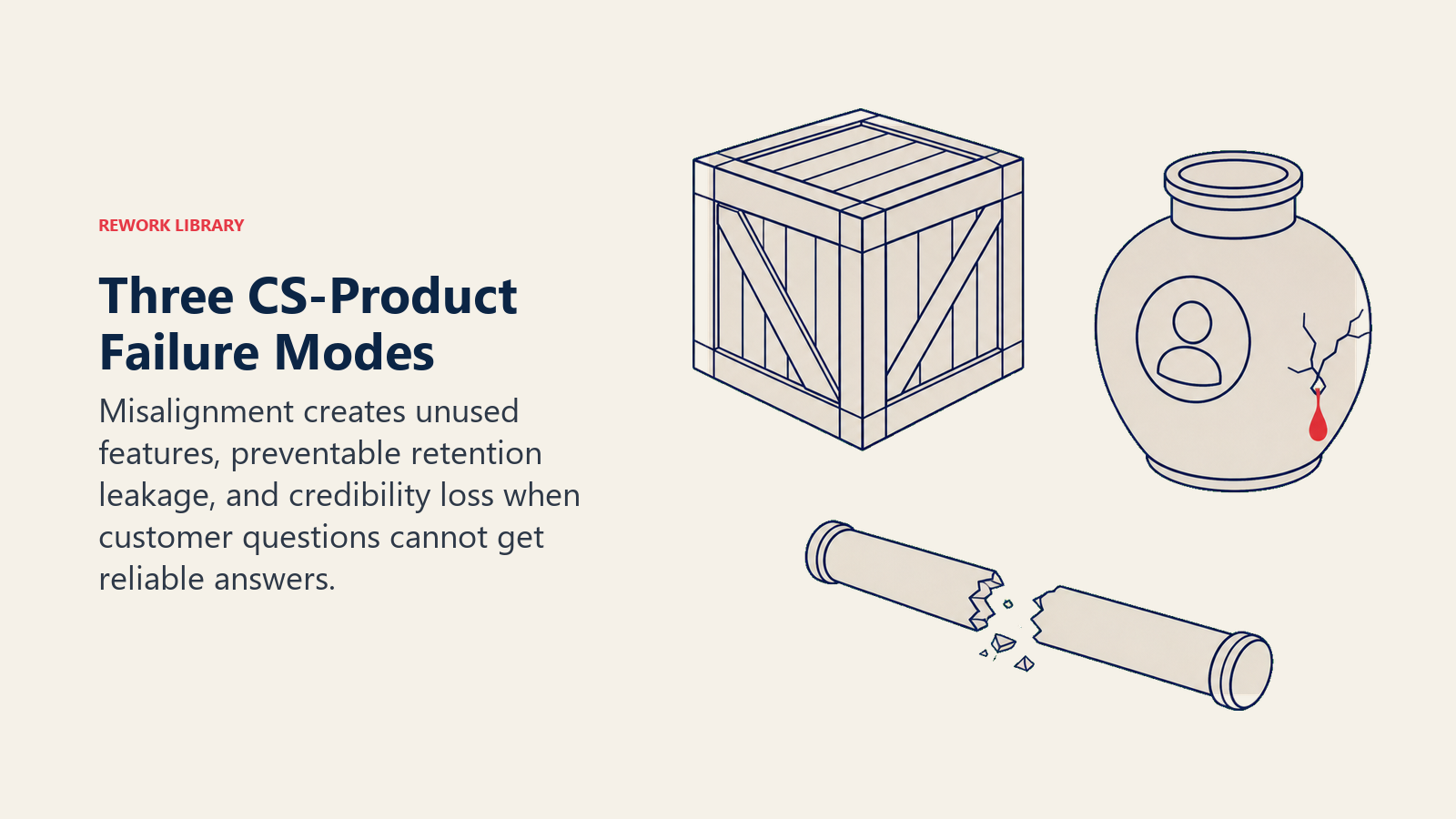
Misalignment isn't a single failure state. It produces three distinct patterns, each visible in different parts of the business.
The feature graveyard. Engineering builds something. It ships. Adoption is flat. Six months later, the feature is mentioned in a roadmap review as "we shipped this" but nobody can articulate what customer problem it solved. The root cause: the build decision was made without CS signal, so it was solving a hypothesis the product team generated internally rather than a pain that showed up consistently in post-sale conversations.
The fix isn't to blame product for building the wrong thing. It's to ask: what was the customer signal that should have informed this decision, and why didn't it reach the team that made it?
Retention leakage from solvable product gaps. A cohort of accounts churns in Q3. Exit interviews and churn reason codes all point to the same gap: a specific integration, a reporting limitation, a workflow that requires too many manual steps. The CSMs have been flagging this for two quarters. The feedback never made it to the roadmap in a form that could drive a build decision. The churn was technically product-caused but operationally preventable through a functioning feedback channel.
This is the failure mode that converts fastest when alignment improves. The signal already exists. The gap is in the routing.
CSM credibility collapse. A customer asks their CSM: "When is the API rate limit increase coming? We're at 80% of our limit and we're building a new integration." The CSM doesn't know. They say they'll check. They send a Slack to the product channel. Three days later, no answer. They email the PM directly. The PM responds with "it's on the backlog but not scheduled." The CSM goes back to the customer with that answer. The customer, who has been waiting for this conversation for a week, starts wondering whether this vendor knows what they're doing.
That moment happens hundreds of times a day across mid-market SaaS organizations without anyone flagging it as an alignment failure. But it is. And it erodes the customer relationship in ways that don't show up in health scores until it's too late.
The Maturity Spectrum

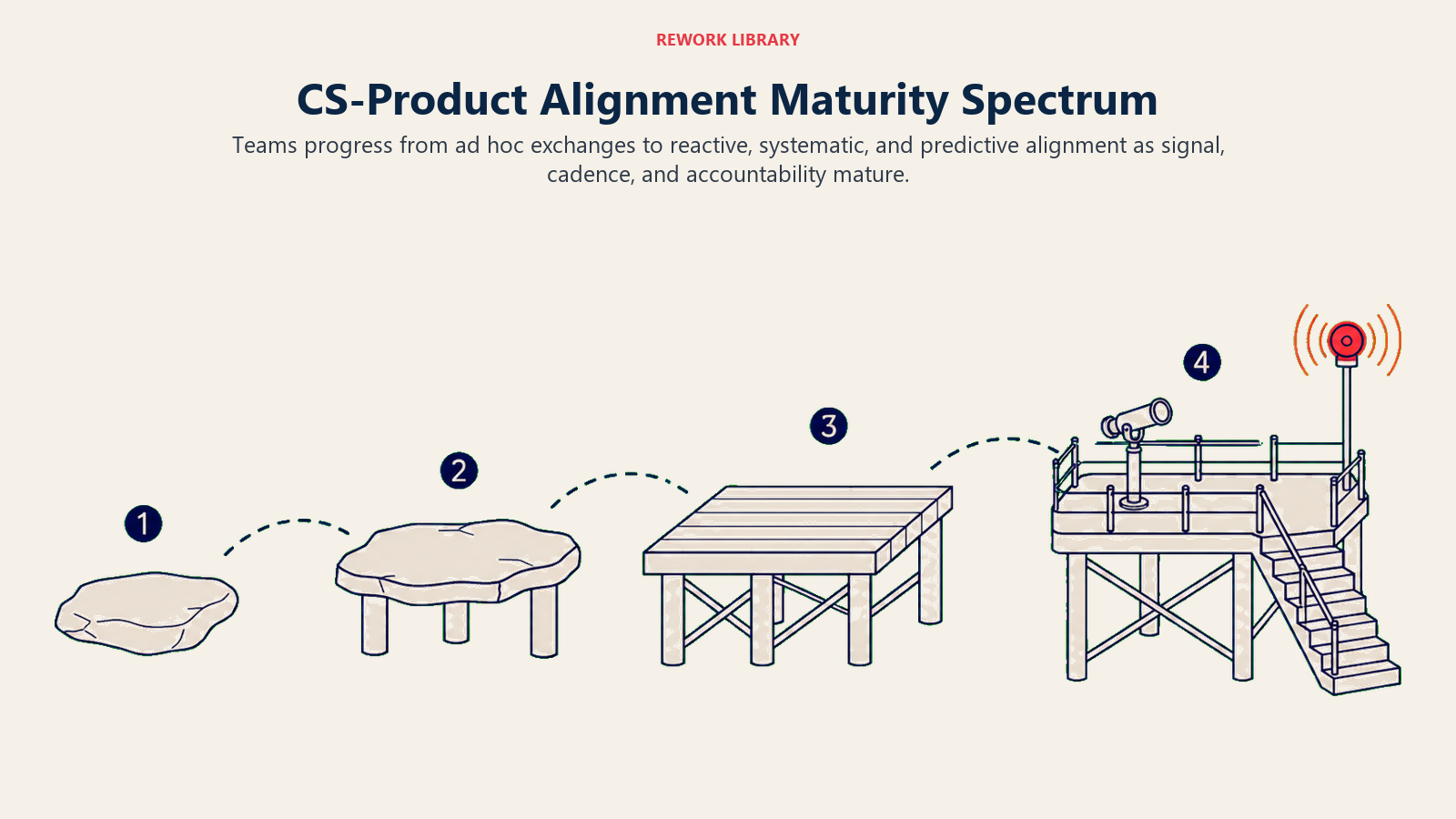
CS-Product alignment isn't binary. It's a spectrum with observable stages.
Ad hoc: Feedback travels by Slack ping and whoever happens to be in the same room. PM-CSM relationships are personal: if the PM and CSM happen to get along, information flows. If they don't, it doesn't. Nothing is institutionalized. Roadmap communication is informal.
Reactive: A shared channel or spreadsheet exists. Feedback is captured inconsistently. Product acknowledges input when someone follows up persistently enough. Roadmap is shared when someone asks. There's intent toward alignment but no reliable process behind it.
Systematic: A defined VoC pipeline routes feedback from CSM notes to a tagged backlog. Feedback is annual recurring revenue (ARR)-weighted. PM-CSM cadences are scheduled and held. Roadmap is shared on a predictable cadence before customer communications go out. Beta programs are structured with CS input on participant selection.
Predictive: CS data feeds product discovery before features are scoped. Churn prediction models inform roadmap priority. Joint OKRs cross the CS-Product boundary. PMM owns the translation layer between functions. Product managers have retention metrics in their performance goals. McKinsey's customer success research identifies this cross-functional integration as a defining characteristic of the next generation of CS operating models.
Rework Analysis: Companies that reach Stage 3 alignment (where the 3 Pillars of CS-Product Alignment are fully operational) typically see two measurable outcomes within 90 days: CSMs spend 40-50% less time on feedback overhead, freeing that capacity for expansion and health work. Feature adoption at 90 days post-launch improves by 15-20% because the team closest to customers is briefed before release rather than after. The ROI on the operating model investment appears in those two lines before any NRR improvement shows up in quarterly reporting. Rework's alignment-tracking tools support both metrics natively, tracking CSM time allocation and per-feature adoption against the accounts flagged during beta.
Most mid-market companies that are actively working on alignment land at Stage 2 or 3. Stage 4 requires deliberate org design decisions (PMM investment, metric restructuring, discovery process changes) that aren't feasible until the operational foundation of Stage 3 is solid. The maturity model article goes deep on how to self-assess and what the highest-leverage moves are at each stage transition.
Knowing where your organization sits on this spectrum is useful. But the more immediate question is how to structure the work that follows. That's what the collection breakdown below maps out.
How This Collection Is Organized
This collection covers the CS-Product alignment operating model across four areas:
Foundations (this section): The what and why. Definitions, cost of misalignment, the VoC channel model, the maturity stages, and the warning signs. Read these articles in sequence if you're starting from first principles, or use the warning signs article as a quick diagnostic if you need to locate a specific problem.
VoC Pipeline: The how of structured feedback collection. Capturing, tagging, ARR-weighting, and routing customer signal from CSM notes through to roadmap input. This section is the operational core of the alignment model.
Roadmap Communication: How Product communicates back to CS. Pre-launch briefings, roadmap formats that work for CSMs, and the closed-loop mechanics that keep feedback feeling worth submitting.
Beta and Co-Design: How CS brings strategic accounts into product development before launch. Beta program design, customer advisory councils, and co-creation structures that produce adoption as a side effect of the design process itself.
Joint Operations and Org Design: The structural layer. PMM as bridge function, PM incentive design, the cadences that sustain alignment when individual relationships change.
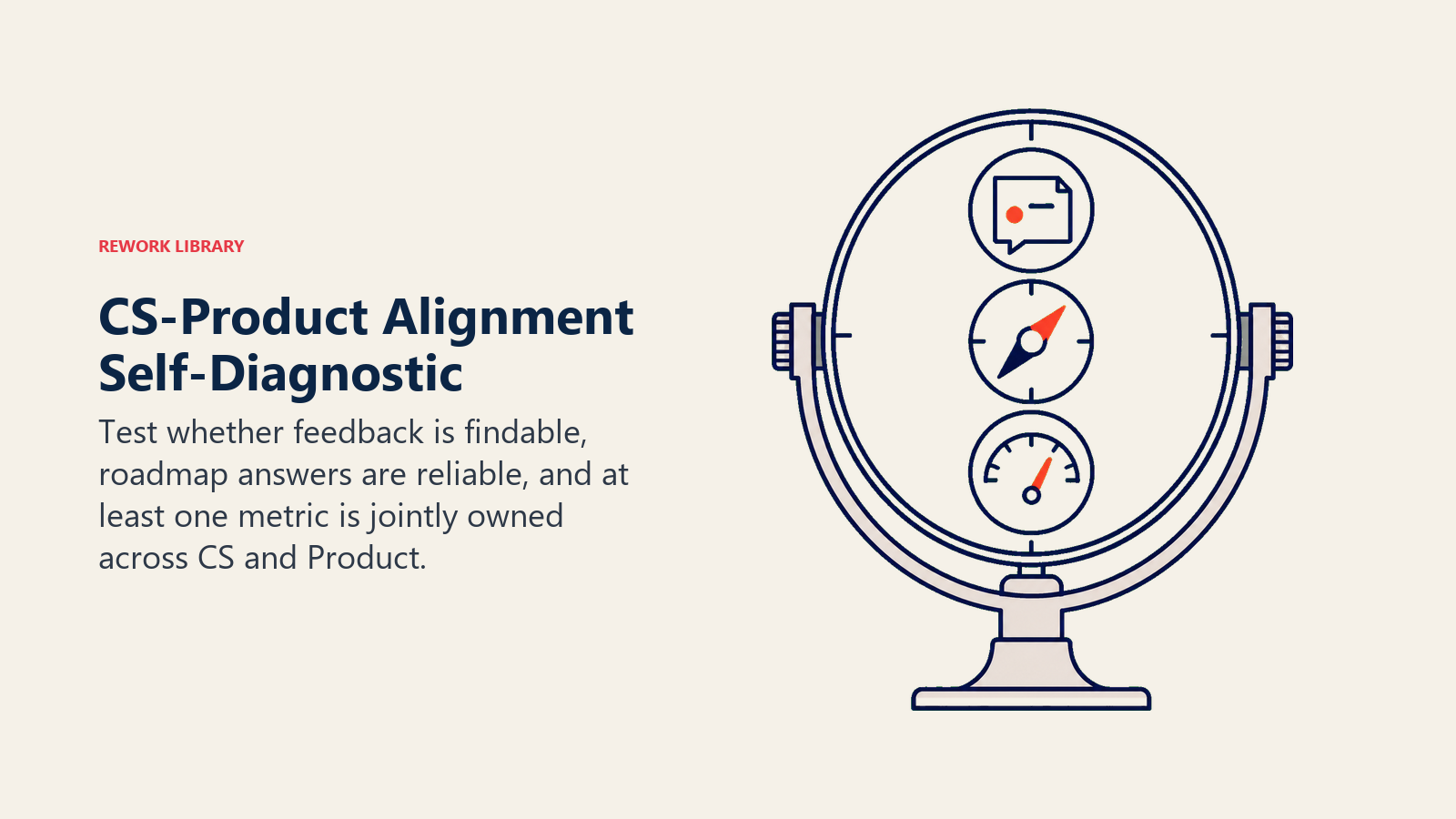
Before moving to the next article, take five minutes with your counterpart and answer three diagnostic questions.
Where to Start: A Three-Question Self-Diagnostic
Before opening the next article in this collection, take five minutes with your counterpart (VP CS with Head of Product, or the equivalent) and answer these three questions together:
1. If I asked five of our CSMs right now what the top three customer product gaps are, would they give me consistent answers? If the answers vary significantly, you don't have a structured capture process. The signal exists but it's fragmented.
2. When Product shipped the last major release, did our CSMs know it was coming two weeks before customers did? If not, your roadmap communication is reactive rather than systematic. CSMs are learning at the same time as customers and improvising their responses.
3. In the last quarter, did any CS-sourced feedback close the loop (meaning a CSM learned what happened to a request they submitted)? If you can't name a specific example, your feedback loop doesn't close. CSMs have no evidence that submitting feedback changes anything.
One or two "no" answers means you have specific gaps worth addressing. All three "no" means the operating model doesn't exist yet. The cost of CS-product misalignment article will help you build the financial case for fixing it before the next planning cycle.
Frequently Asked Questions
What is CS-Product alignment?
CS-Product alignment is the operating model that connects what customers experience post-sale, surfaced by Customer Success, to what the product team builds next. It's built on three components: structured signal flow (feedback moves from CSM notes to product input consistently), shared accountability metrics (at least one metric crosses the org boundary), and closed feedback loops (CSMs and customers know what happened to their input).
Why does CS-Product alignment matter more in mid-market than in early stage?
Early-stage companies have few enough customers that the CEO and founders are often in direct contact with most of them, so informal alignment works because the signal density is low. Mid-market companies have enough customers to generate substantial signal but haven't yet built the process infrastructure to make it usable. The informal model breaks, but the formal model hasn't been built yet. That gap is where misalignment costs start compounding.
What's the difference between CS-Product alignment and post-sale management?
Post-sale management covers how CS executes after they own the account: onboarding mechanics, adoption programs, health scoring, QBR formats. CS-Product alignment covers the feedback seam between the two functions, specifically how customer experience signals flow into product decisions and how product decisions flow back to the customer relationship team. This collection focuses on the seam, not the execution.
What does CS-Product alignment have to do with NRR?
Net Revenue Retention is the product of gross retention, expansion, and contraction avoidance. All three legs are influenced by the CS-Product feedback loop. Retention is hurt when product gaps that CS flagged go unaddressed. Expansion is limited when CSMs can't credibly pitch a roadmap that addresses what customers have been asking for. Contraction often traces to dissatisfaction that a product fix would have addressed. Alignment directly affects all three NRR components.
Who owns CS-Product alignment?
Joint ownership between the VP Customer Success and the Head of Product, with PMM often serving as the operational bridge. Neither function can impose alignment unilaterally. It requires explicit agreement on how signal flows, who reviews it, and how decisions close the loop back to CS. In scaling organizations, a product operations or customer insights function sometimes maintains the infrastructure that makes alignment durable.
What is the fastest way to improve CS-Product alignment?
The fastest improvement comes from two moves done in sequence: agree on what "good feedback" looks like before any tooling change. A 30-minute CS-Product working session is enough to produce this. Then establish a single submission path for all CSM feedback: one system, one tagging schema, consistently used. Most teams see measurable behavior change within 60 days of locking in those two moves, without any additional process or technology investment.
How does CS-Product alignment differ from CS-Sales alignment?
CS-Sales alignment covers the handoff from pre-sale to post-sale: how customer expectations set during the deal transfer accurately to the CSM who owns the relationship. CS-Product alignment covers the feedback seam after the handoff: how what customers experience post-sale informs what the product team builds next. The two are related but operate on different workflows, different information types, and different org boundaries. Both are necessary; they're not interchangeable.
Learn More
- The Cost of CS-Product Misalignment
- CS-Product Alignment Maturity Model
- 8 Warning Signs of CS-Product Misalignment
- CS as Voice of Customer Channel
- PMM as the Bridge
- CS-Product Alignment Glossary
- What is Post-Sale Management
- What is Sales-CS Alignment
- VoC Pipeline from CS to Product
- CS-PM 1:1 Cadence Guide
- Feature Request Graveyard Problem
- At-Risk Customer Management

Senior Operations & Growth Strategist
On this page
- What CS-Product Alignment Actually Means
- Who This Concerns
- What Alignment Actually Looks Like in Practice
- What It Is Not
- Why Mid-Market Companies Feel This Pain Most
- The Three Failure Modes Without Alignment
- The Maturity Spectrum
- How This Collection Is Organized
- Where to Start: A Three-Question Self-Diagnostic
- Frequently Asked Questions
- What is CS-Product alignment?
- Why does CS-Product alignment matter more in mid-market than in early stage?
- What's the difference between CS-Product alignment and post-sale management?
- What does CS-Product alignment have to do with NRR?
- Who owns CS-Product alignment?
- What is the fastest way to improve CS-Product alignment?
- How does CS-Product alignment differ from CS-Sales alignment?
- Learn More