More in
Berita Sales Tech
Tim Sales Berbasis AI Tumbuh 2,6x Lebih Cepat. Gartner Menyatakan Pembeli Masih Menginginkan Rep Manusia
Jun 6, 2026
Aircall Mengakuisisi Piper AI untuk Mengubah Setiap Sales Call Menjadi Pipeline
Jun 6, 2026
Salesforce Baru Saja Memberi Pemasar AI Agent yang Membangun Sales Pipeline
Jun 6, 2026
Revenue Intelligence Menunjukkan Risikonya. Revenue Execution Bertindak Atasnya.
Jun 5, 2026
Meta Menempatkan AI Agent di WhatsApp yang Menutup Penjualan untuk Bisnis Mana Pun
Jun 4, 2026
VC Menggelontorkan Lebih dari $200M ke Startup AI Sales: Sinyal GTM Stack
Jun 4, 2026
Apakah AI SDR Sepadan di 2026? Data Menunjukkan Bangun Tim Hibrida
Jun 3, 2026
GTM Engineering di 2026: Rekrutan Sales yang Menggantikan Tiga Peran Sekaligus
Jun 3, 2026
ZoomInfo Memasok Data Terverifikasi ke AI Sales Agent Anda: Pertimbangan Vendor Tunggal
Jun 3, 2026
Salesforce Summer '26 Menghadirkan Multi-Agent Orchestration pada 15 Juni. Inilah Audit Sales Ops Sebelum Agent Anda Mulai Melakukan Handoff
Jun 2, 2026
Bahasa Indonesia
Smart Deal Progression HubSpot Kini Menyusun Pembaruan CRM Setelah Setiap Panggilan Penjualan. Ini Audit RevOps yang Perlu Dijalankan Sebelum Mengaktifkannya
Turn this article into takeaways for your work.


Each assistant summarizes the article only for you and suggests best practices for your work.
HubSpot baru saja menempatkan AI tepat di momen yang selalu dimiliki revenue operations (RevOps): sepuluh menit setelah panggilan penjualan berakhir. Dan jika data panggilan Anda tidak bersih, mengaktifkan fitur ini tidak akan membantu Anda. Fitur itu justru akan mempercepat kekacauan.
Pada Spring 2026 Spotlight tanggal 14 April 2026, HubSpot merilis lebih dari 100 pembaruan. Menurut pengumuman resmi Spring 2026 Spotlight HubSpot, rilis ini diorganisir di sekitar tiga tujuan: membangun kesadaran, menumbuhkan pendapatan, dan menskalakan dukungan. Tema komersial utamanya adalah "Growth Context" yang menyatakan bahwa large language model (LLM) bekerja lebih baik ketika diberi pengetahuan yang mendalam dan spesifik bisnis alih-alih akses data mentah yang tidak memiliki konteks.
Sebagian besar dari lebih dari 100 pembaruan itu bersifat inkremental. Smart Deal Progression tidak demikian. Fitur ini mendarat langsung di dalam alur kerja pasca-panggilan yang sudah dikelola RevOps, dan membawa risiko baru: AI menulis ke catatan customer relationship management (CRM) produksi secara otomatis setiap kali panggilan penjualan berakhir.
Apa yang Sebenarnya Dilakukan Smart Deal Progression
Fakta Kunci
- Spring 2026 Spotlight HubSpot merilis lebih dari 100 pembaruan yang diorganisir di sekitar tiga tujuan: membangun kesadaran, menumbuhkan pendapatan, menskalakan dukungan (HubSpot, 14 April 2026).
- Smart Deal Progression dipicu setelah setiap panggilan penjualan, kemudian menyarankan pembaruan bidang CRM, menyusun email tindak lanjut, dan memunculkan item tindakan, semuanya diambil dari transkrip ditambah riwayat deal lengkap (HubSpot, 2026).
- HubSpot AEO menggunakan data CRM pelanggan sendiri untuk memprediksi pertanyaan yang kemungkinan besar akan diketikkan pembeli nyata ke dalam LLM, dan tersedia sebagai produk tersendiri seharga $50 per bulan (HubSpot, 2026).
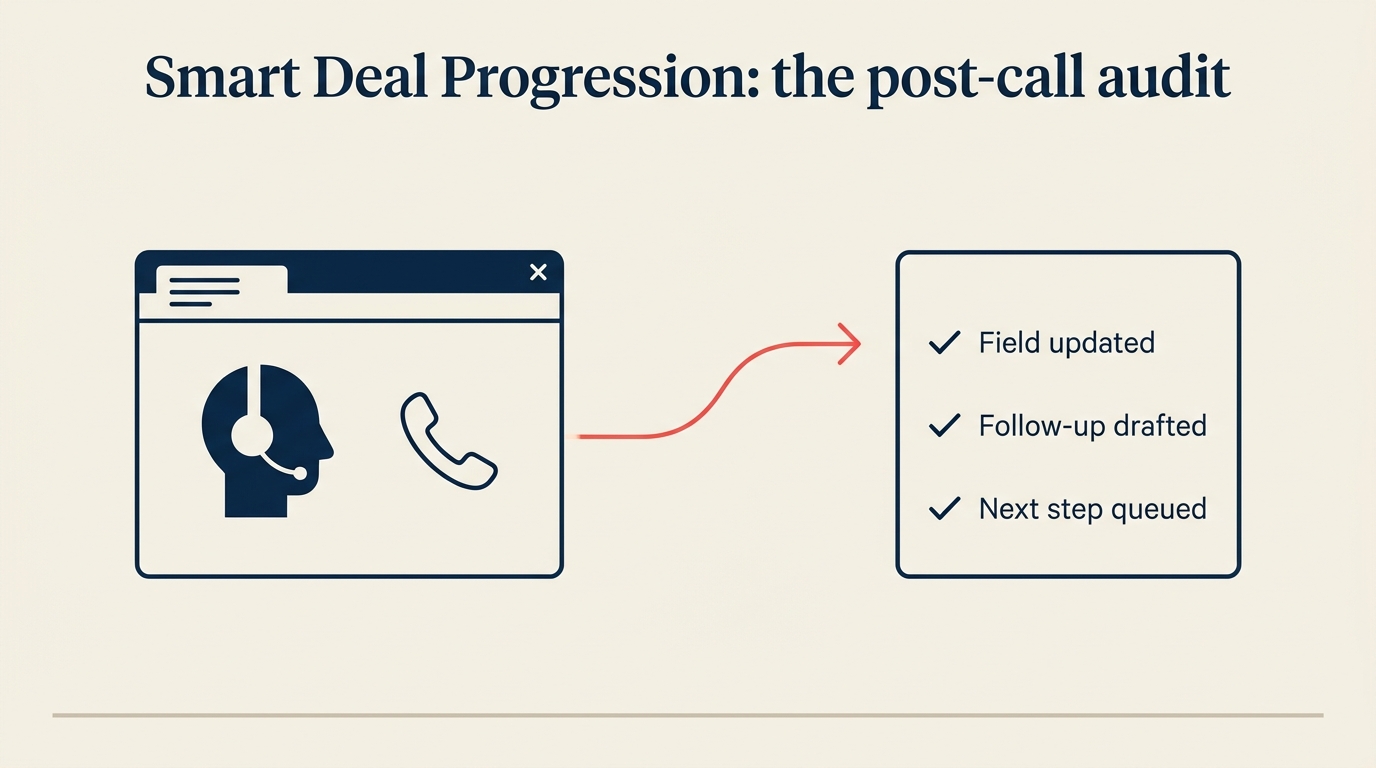
Smart Deal Progression dipicu secara otomatis setelah panggilan penjualan berakhir. Fitur ini tidak menunggu perwakilan mencatat catatan atau ingat untuk membuka HubSpot. Fitur ini membaca transkrip rapat bersama riwayat deal lengkap (email sebelumnya, catatan CRM, aktivitas deal, dan catatan interaksi masa lalu) dan menghasilkan tiga keluaran:
- Saran pembaruan bidang CRM
- Email tindak lanjut yang sudah disusun
- Item tindakan yang dimunculkan
Proposisi nilainya nyata. Pekerjaan manual mengonversi panggilan menjadi pembaruan CRM adalah salah satu pembuang waktu terbesar dalam hari kerja tim penjualan, dan jeda antara berakhirnya panggilan dan entri catatan adalah tempat konteks deal menguap. Perwakilan mengingat lebih sedikit semakin lama mereka menunggu. Smart Deal Progression menutup celah itu dengan membaca transkrip panggilan dan bertindak segera.
Namun fitur ini menulis ke, atau mengusulkan tulisan ke, catatan CRM produksi. Itu profil risiko yang berbeda dibandingkan dashboard yang memunculkan wawasan. Ketika sebuah bidang berubah di CRM Anda, perubahan itu berlaku untuk pelaporan pipeline, forecasting, dan setiap proses hilir yang membaca bidang tersebut. RevOps memiliki konsekuensi hilir tersebut.
Pertanyaannya bukan apakah ini berguna. Memang berguna. Pertanyaannya adalah apakah infrastruktur data Anda dapat mendukungnya tanpa menimbulkan kekacauan baru. Itulah tujuan audit ini.
AEO: Fitur Lain yang Perlu Diketahui RevOps
Answer Engine Optimization (AEO) HubSpot adalah fitur utama kedua dari Spring 2026 Spotlight, dan layak mendapat catatan singkat bagi pemimpin RevOps meski berada di luar alur kerja pasca-panggilan.
AEO menggunakan data CRM pelanggan sendiri untuk mengidentifikasi pertanyaan yang kemungkinan besar akan diketikkan pembeli nyata ke dalam LLM seperti ChatGPT, Gemini, dan Perplexity. Argumennya: jika Anda mengetahui apa yang ditanyakan pelanggan Anda kepada sistem AI, Anda dapat menerbitkan konten yang menjawab pertanyaan-pertanyaan tersebut dan mendapatkan kutipan dalam respons yang dihasilkan AI. Fitur ini tersedia di dalam Marketing Hub Pro dan Enterprise, atau sebagai produk tersendiri seharga $50 per bulan.
Relevansi RevOps bersifat tidak langsung tetapi nyata. AEO memunculkan sinyal niat dari pembeli yang sedang melakukan riset sebelum pernah berbicara dengan perwakilan. Jika sinyal-sinyal tersebut pada akhirnya masuk ke CRM sebagai aktivitas kontak atau konteks deal, sinyal itu menjadi bagian dari riwayat deal yang dibaca Smart Deal Progression ketika panggilan pertama terjadi. Kualitas data intake tersebut membentuk kualitas saran Smart Deal Progression. Jadi AEO dan Smart Deal Progression lebih terhubung dari yang tampak pada pandangan pertama.
Uji Kepercayaan AI Pasca-Panggilan
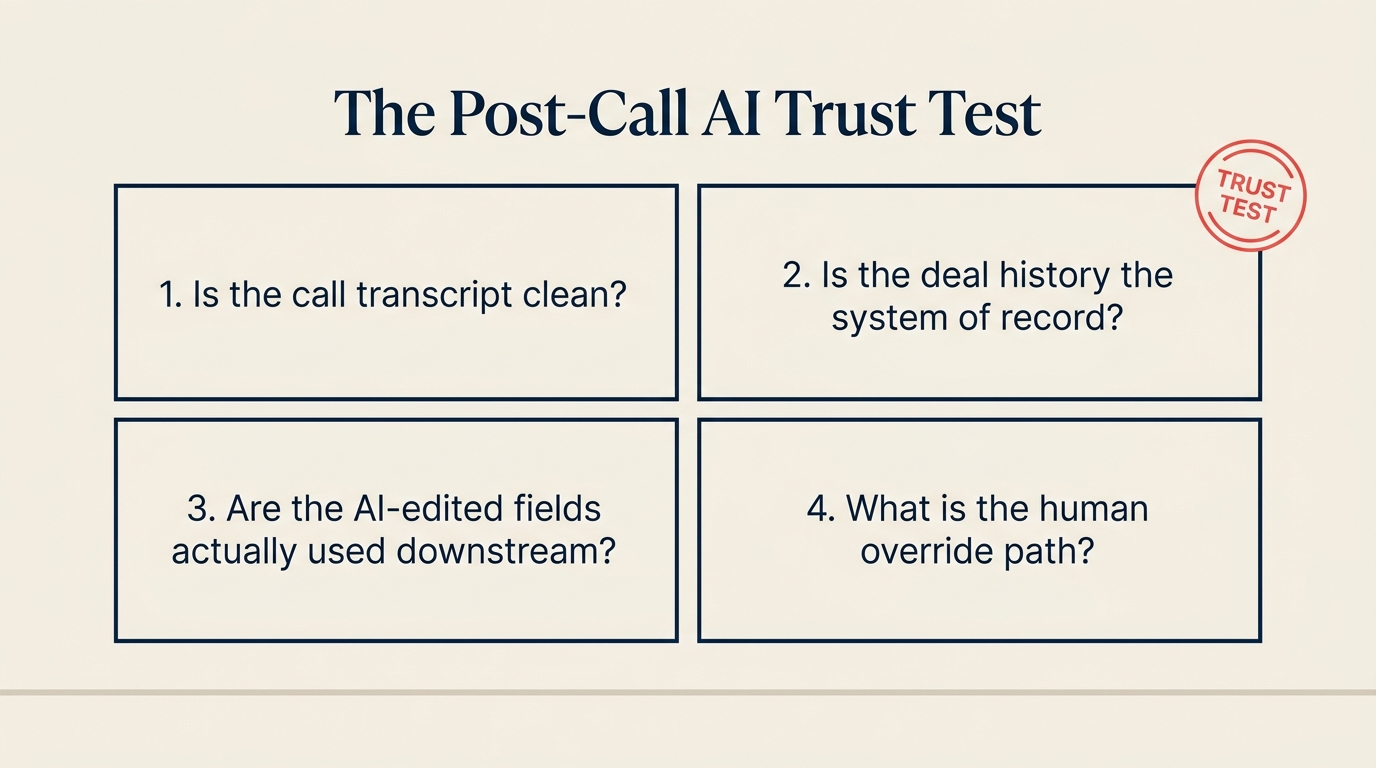
Sebelum mengaktifkan Smart Deal Progression di seluruh tim penjualan, RevOps perlu menjalankan empat pertanyaan. Sebut saja ini Uji Kepercayaan AI Pasca-Panggilan. Setiap pertanyaan dipetakan ke mode kegagalan yang mengubah fitur yang membantu menjadi sumber entropi CRM.
Pertanyaan 1: Apakah transkrip panggilan cukup bersih untuk dipercaya?
Smart Deal Progression membaca transkrip. Jika cakupan rekaman panggilan tidak lengkap, atribusi pembicara tidak akurat, atau transkripsi kesulitan dengan nama produk dan istilah harga, AI bekerja dari sumber yang berisik. Sampah masuk, saran yang sampah keluar. Periksa tingkat cakupan rekaman di seluruh tim dan periksa secara acak dua puluh lima transkrip terkini untuk akurasi atribusi sebelum Anda mengasumsikan lapisan input sudah solid.
Pertanyaan 2: Apakah riwayat deal benar-benar sistem catatan?
Smart Deal Progression menganalisis "riwayat deal lengkap" di HubSpot. Namun untuk sebagian besar tim, riwayat deal lengkap tidak berada di satu tempat. Percakapan kunci terjadi di thread email yang tidak pernah dicatat, di pesan Slack yang tidak ditautkan ke deal, di dokumen bersama yang berada di luar HubSpot sepenuhnya. Jika riwayat deal di HubSpot adalah catatan yang parsial, saran AI akan mencerminkan parsialitas tersebut. AI mungkin dengan percaya diri mengusulkan pembaruan bidang yang bertentangan dengan konteks yang tidak pernah dilihat AI.
Periksa kebersihan data CRM dan arsitektur pipeline untuk melihat apakah catatan deal Anda benar-benar sumber kebenaran, atau hanya ringkasan dari percakapan yang terjadi di tempat lain.
Pertanyaan 3: Apakah bidang yang akan diedit AI benar-benar digunakan hilir dalam tinjauan pipeline?
Tidak setiap bidang CRM penting. Beberapa bidang digunakan untuk pelaporan pipeline dan forecasting. Beberapa ada karena seseorang menambahkannya dua tahun lalu dan tidak ada yang membacanya lagi. Smart Deal Progression akan mengusulkan pembaruan pada bidang apa pun yang dianggapnya relevan. Jika bidang-bidang tersebut adalah bidang kosmetik, sarannya adalah kekacauan yang tidak berbahaya. Namun jika AI mulai memperbarui bidang yang mengisi tinjauan pipeline dan kriteria kualifikasi peluang, pembaruan tersebut memiliki bobot hilir yang nyata.
Tarik laporan penggunaan bidang yang terhubung ke template rapat pipeline Anda. Ketahui bidang mana yang benar-benar dibaca dalam tinjauan deal sebelum AI mulai menyentuhnya.
Pertanyaan 4: Apa jalur penolakan oleh manusia ketika AI salah?
AI kadang-kadang akan salah. Itu bukan kritik, itu aritmatika. Pada volume yang dioperasikan Smart Deal Progression (setelah setiap panggilan, di seluruh perwakilan), bahkan tingkat kesalahan yang rendah menghasilkan jumlah saran yang salah yang berarti. Pertanyaan tata kelola adalah apakah tim Anda memiliki jalur yang jelas dan mudah untuk menolak saran, melacak asalnya, dan mencegahnya menyebar.
Penolakan satu klik penting. Jejak audit penting. Penulisan diam-diam, di mana saran langsung ke produksi tanpa konfirmasi perwakilan, adalah skenario yang perlu dicegah. Tinjau cara tindakan terbaik berikutnya dan alur kerja yang disusun otomatis dalam pengaturan Anda saat ini menangani penolakan, dan terapkan logika tersebut ke konfigurasi Smart Deal Progression.
Perbedaan dengan Agen HubSpot Breeze yang Ada
Jika Anda telah mengikuti peluncuran agen HubSpot Breeze yang lebih luas, Smart Deal Progression layak dibedakan dari kerangka agen Breeze yang ada.
Agen Breeze, seperti yang dibahas dalam artikel tata kelola RevOps tentang Breeze, mengharuskan seseorang untuk memicunya: perwakilan memilih agen dari dropdown di dalam kartu catatan CRM dan menjalankannya. Manusialah yang memulai aksi. Tata kelola dalam model tersebut berarti mengontrol siapa yang dapat menjalankan agen mana dan apakah keluaran memerlukan tinjauan sebelum ditulis.
Smart Deal Progression menghapus langkah inisiasi tersebut. Fitur ini terpicu secara otomatis saat panggilan selesai. Pemicunya bukan keputusan manusia, melainkan acara kalender. Itu adalah perbedaan tata kelola yang signifikan. Kasus penggunaan pengenalan sinyal pembelian yang didukung Breeze bersifat opt-in di tingkat perwakilan. Smart Deal Progression bersifat opt-out di tingkat deal, setelah diaktifkan. RevOps perlu memutuskan apakah tim memiliki fondasi data yang cukup untuk mendukung tingkat otomasi tersebut sebelum fitur aktif secara default untuk semua orang.
Yang Harus Dilakukan RevOps Bulan Ini
Anda tidak perlu memutuskan apakah akan mengaktifkan Smart Deal Progression hari ini. Namun Anda harus menjalankan audit sekarang, karena pekerjaan data membutuhkan waktu terlepas dari linimasa Anda.
Empat langkah konkret untuk bulan ini:
Pemeriksaan kualitas transkrip secara acak. Tarik dua puluh lima rekaman panggilan terkini secara acak. Periksa tingkat cakupan rekaman, akurasi atribusi pembicara, dan apakah nama produk serta istilah spesifik deal ditranskripsikan dengan benar. Jika Anda melihat kesalahan yang konsisten, perbaiki lapisan transkripsi sebelum melapisi AI di atasnya.
Laporan penggunaan bidang yang terhubung ke tinjauan pipeline. Ekspor daftar setiap bidang deal di HubSpot dan cocokkan dengan bidang yang benar-benar dibahas tim Anda dalam rapat pipeline. Identifikasi bidang mana yang kemungkinan akan disentuh Smart Deal Progression dan apakah bidang-bidang tersebut memiliki bobot hilir. Laporan ini berguna terlepas dari apakah Anda mengaktifkan Smart Deal Progression atau tidak.
Penyusunan SOP penolakan. Tulis SOP satu halaman tentang cara perwakilan menangani saran AI yang salah. Buat spesifik: di mana harus mengklik untuk menolak, informasi apa yang perlu diambil saat menolak, dan siapa di RevOps yang menerima sinyal tersebut. SOP juga memberi sinyal kepada perwakilan bahwa mereka memiliki akurasi catatan CRM mereka, meski AI yang membuat saran.
Pilot satu segmen sebelum peluncuran penuh. Jika audit menunjukkan hasil yang bersih, mulai Smart Deal Progression dengan satu segmen penjualan, satu jenis perwakilan, atau satu tahapan deal. Jalankan selama empat minggu. Bandingkan akurasi bidang CRM, kualitas email tindak lanjut yang disusun otomatis, dan kecepatan perkembangan deal terhadap grup kontrol. Data itu akan memberi tahu Anda apakah peluncuran penuh adalah keputusan yang tepat, dan akan memunculkan mode kegagalan yang tidak Anda antisipasi dalam audit.
Smart Deal Progression adalah infrastruktur yang benar-benar berguna jika data di bawahnya bersih. Audit bukan alasan untuk menunda. Audit adalah alasan untuk siap.
Pelajari Lebih Lanjut
- Dari Panggilan ke Pembaruan CRM, Secara Otomatis
- Rekaman Panggilan Penjualan dan Analisis Transkrip
- HubSpot Breeze untuk CRO: Strategi Peluncuran
- Tata Kelola RevOps untuk HubSpot Breeze
- Penetapan Harga Berbasis Hasil HubSpot: Playbook Anggaran CRO
FAQ
Apa itu Smart Deal Progression HubSpot?
Smart Deal Progression adalah fitur yang diumumkan di Spring 2026 Spotlight HubSpot yang dipicu secara otomatis setelah setiap panggilan penjualan. Fitur ini membaca transkrip rapat bersama riwayat deal lengkap di HubSpot (email sebelumnya, catatan CRM, aktivitas deal) dan menghasilkan tiga keluaran: saran pembaruan bidang CRM, email tindak lanjut yang sudah disusun, dan item tindakan yang dimunculkan. Tujuannya adalah menutup celah antara berakhirnya panggilan dan pembaruan CRM tanpa mengharuskan perwakilan mengambil langkah pencatatan manual.
Apa perbedaan Smart Deal Progression dengan agen HubSpot Breeze yang ada?
Agen Breeze yang ada mengharuskan perwakilan memulai aksi: mereka memilih agen dari dropdown di dalam kartu catatan CRM dan menjalankannya. Smart Deal Progression terpicu secara otomatis saat panggilan selesai, tanpa aksi perwakilan apa pun. Itu menghapus inisiasi manusia dari loop, yang mengubah model tata kelola. RevOps membutuhkan kontrol persetujuan dan jalur penolakan yang sudah tersedia sebelum otomasi berjalan dengan ritme tersebut tanpa pemicu manusia.
Apa yang harus diaudit RevOps sebelum mengaktifkan Smart Deal Progression?
Uji Kepercayaan AI Pasca-Panggilan mencakup empat area: (1) apakah transkrip panggilan cukup akurat untuk digunakan sebagai input AI, (2) apakah riwayat deal di HubSpot benar-benar sistem catatan atau hanya ringkasan parsial, (3) apakah bidang CRM yang akan diedit AI adalah bidang yang penting bagi pelaporan pipeline dan tinjauan deal, dan (4) apakah ada jalur yang jelas dan mudah bagi perwakilan untuk menolak saran yang salah dan melacak asalnya. Jika ada satu dari keempat hal tersebut yang goyah, aktifkan Smart Deal Progression pada pilot terbatas terlebih dahulu.
