Bahasa Indonesia
Spesialisasi Firma: Strategi Pertumbuhan Berani yang Mengungguli Generalis
 Strategi pertumbuhan yang berani bagi firma jasa profesional berarti berkomitmen pada satu spesialisasi alih-alih mengejar setiap deal. Spesialis menghasilkan lebih banyak daripada generalis pada pendapatan yang sama: margin lebih tinggi, win rate mendekati 40% hingga 50%, proyek lebih besar, dan siklus penjualan lebih singkat. Panduan ini menunjukkan cara memilih niche, memodelkan ekonominya, dan menjalankan transisinya.
Turn this article into takeaways for your work.


Each assistant summarizes the article only for you and suggests best practices for your work.
Ini adalah kenyataan yang tidak nyaman: 65% firma jasa profesional tidak pernah membuat keputusan strategis yang jelas tentang spesialisasi. Mereka hanya mengalir mengikuti arus. Menerima pekerjaan apa pun yang datang, membangun kapabilitas secara reaktif, dan akhirnya menjadi "cukup baik" di banyak hal alih-alih luar biasa di satu bidang tertentu.
Posisi tengah seperti itu semakin mahal biayanya. Pembeli menginginkan spesialis. Mereka bersedia membayar 30–50% lebih mahal untuk firma yang memahami industri mereka, mengerti tantangan mereka, dan bisa menunjukkan rekam jejak pekerjaan serupa. Sementara firma generalis bersaing berdasarkan harga karena tidak dapat membuktikan keahlian khusus.
Namun inilah kendalanya, spesialisasi itu menakutkan. Bagaimana jika Anda memilih niche yang salah? Bagaimana jika Anda harus menolak bisnis yang bagus? Bagaimana jika pasar bergeser dan spesialisasi Anda menjadi usang? Ini adalah kekhawatiran nyata yang membuat para pemimpin firma terjebak dalam kelumpuhan analisis.
Panduan ini membahas keputusan spesialisasi secara sistematis. Anda akan belajar cara mengevaluasi pilihan, memilih fokus yang menguntungkan, membangun keahlian mendalam, dan menjalankan transisi tanpa merusak bisnis yang sudah ada. Spesialisasi bukan taruhan semua atau tidak sama sekali, ini adalah pilihan strategis dengan berbagai model dan jalur implementasi.
Dilema spesialisasi: mengapa sebagian besar firma tetap stuck
Sebagian besar firma jasa profesional memulai sebagai generalis karena kebutuhan. Saat membangun sebuah praktik, Anda tidak bisa menolak pekerjaan. Anda mengambil proyek di berbagai industri, melayani berbagai jenis klien, dan mengembangkan kapabilitas yang luas. Itu wajar.
Masalahnya adalah apa yang terjadi setelahnya. Firma tumbuh hingga $5 juta, $10 juta, atau bahkan $20 juta dalam pendapatan tanpa pernah mendefinisikan apa yang sebenarnya mereka spesialisasikan. Mereka punya klien di sektor kesehatan, klien di jasa keuangan, dan klien di manufaktur, masing-masing menyumbang 15–20% dari pendapatan. Tidak ada satu fokus yang jelas, tidak ada positioning pasar yang tegas.
Mengapa ini terjadi? Ada beberapa alasan:
Ketakutan membatasi peluang. Para partner khawatir bahwa spesialisasi berarti harus menolak potensi bisnis. Dan mereka tidak sepenuhnya salah, Anda memang akan menolak beberapa hal. Namun matematikanya menguntungkan Anda. Ketika Anda berspesialisasi, win rate Anda di bidang yang Anda pilih jauh lebih tinggi. Win rate bisa naik dari 20% menjadi 40–50% karena Anda adalah pilihan paling jelas.
Keragaman klien yang sudah ada. Jika Anda sudah punya klien di berbagai industri, ide untuk fokus pada satu saja terasa seperti meninggalkan pendapatan. Tapi Anda tidak harus memecat klien, Anda hanya berhenti secara aktif mengejar pekerjaan di luar spesialisasi. Klien-klien yang beragam itu sering tetap bertahan sebagai hubungan jangka panjang sementara upaya bisnis baru Anda fokus pada niche yang ditargetkan.
Ketidaksepakatan antar partner. Partner yang berbeda memiliki latar belakang dan preferensi yang berbeda. Satu ingin fokus pada kesehatan, yang lain pada jasa keuangan, yang ketiga pada perusahaan teknologi. Tanpa konsensus, firma tetap generalis. Ini pada dasarnya adalah masalah tata kelola yang membutuhkan kepemimpinan untuk membuat keputusan strategis dan berkomitmen padanya.
Ketidakpastian pasar. Bagaimana jika niche yang Anda pilih berhenti bertumbuh? Bagaimana jika regulasi berubah? Bagaimana jika teknologi baru mengganggu seluruh vertikal? Risiko ini ada, tapi juga ada untuk generalis. Perbedaannya adalah spesialis melihat pergeseran pasar lebih awal karena mereka tertanam dalam di dunia itu.
Biaya tetap menjadi generalis tersembunyi tapi nyata. Anda tidak bisa membangun keahlian mendalam di semua hal. Anda tidak bisa menciptakan IP atau metodologi khusus industri. Anda tidak bisa membangun jaringan referral yang kuat di beberapa vertikal. Anda menyebarkan sumber daya terlalu tipis alih-alih membangun keunggulan kompetitif.
Ekonomi: perbandingan kinerja keuangan spesialis vs generalis
Mari kita lihat angkanya karena spesialisasi pada akhirnya adalah keputusan ekonomi.
Berdasarkan data dari ribuan firma jasa profesional, inilah gambaran kinerja keuangannya:
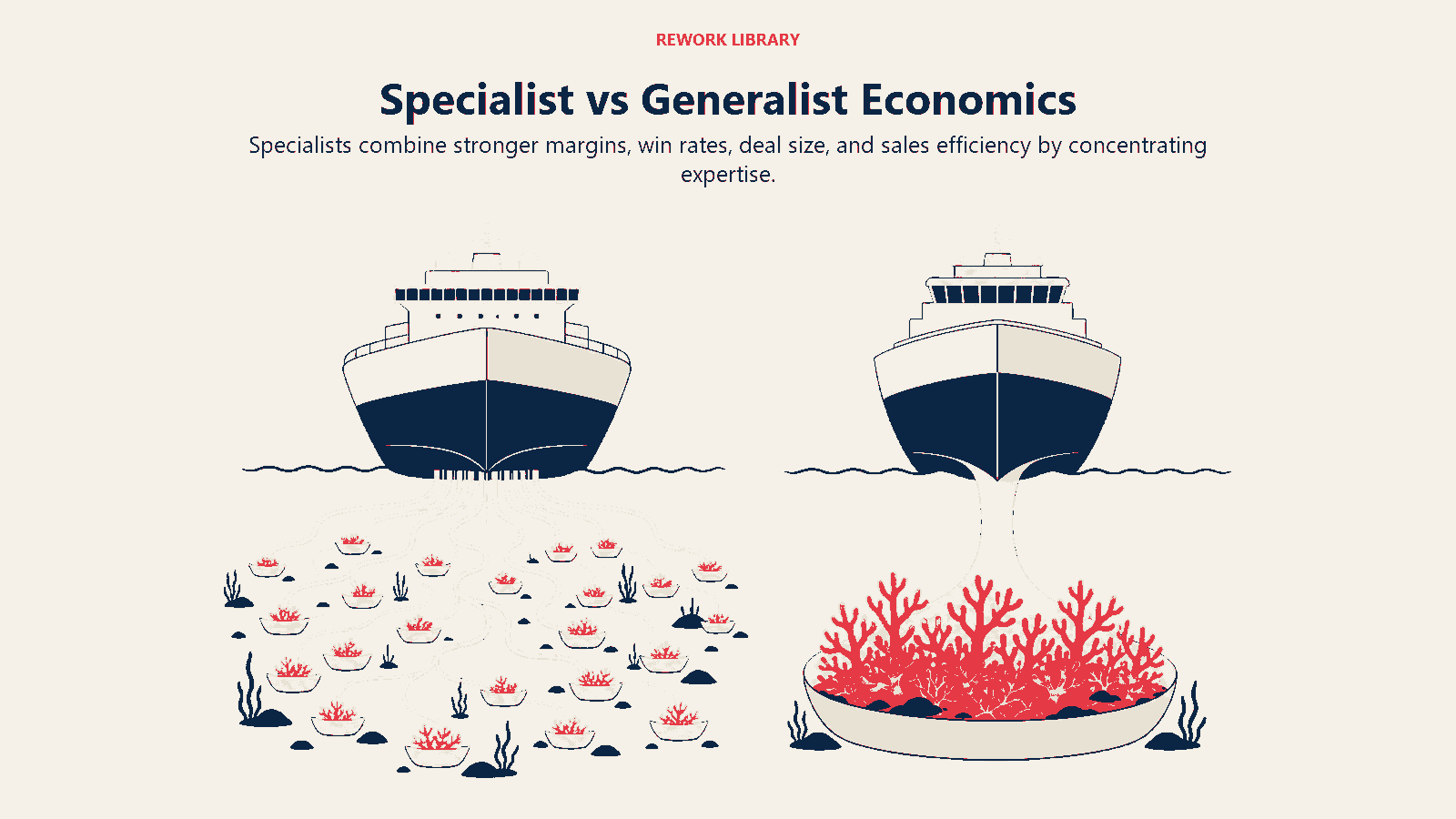
Firma generalis (tidak ada fokus industri yang dominan):
- Rata-rata pendapatan per karyawan: $150K–$180K
- Gross margin: 40–50%
- Win rate pada proposal: 15–25%
- Siklus penjualan: 3–6 bulan
- Rata-rata ukuran proyek: baseline
- Biaya akuisisi klien: tinggi (banyak hubungan satu kali)
- Tingkat referral: sedang (klien mereferensikan ke berbagai industri)
Firma spesialis (60%+ pendapatan dari satu vertikal atau niche):
- Rata-rata pendapatan per karyawan: $200K–$250K
- Gross margin: 50–65%
- Win rate pada proposal: 35–50%
- Siklus penjualan: 2–4 bulan
- Rata-rata ukuran proyek: 30–50% lebih besar dari baseline
- Biaya akuisisi klien: lebih rendah (jaringan referral yang terkonsentrasi)
- Tingkat referral: tinggi (jaringan industri yang dalam)
Keunggulan spesialis terus bertambah. Margin yang lebih tinggi ditambah ukuran proyek yang lebih besar ditambah win rate yang lebih baik menghasilkan ekonomi yang jauh lebih baik. Firma generalis senilai $10 juta mungkin menghasilkan $3 juta dalam gross profit. Firma spesialis senilai $10 juta di niche yang bagus bisa menghasilkan $5 juta+ dengan biaya penjualan yang lebih rendah.
Ada juga faktor penetapan harga premium. Ketika klien melihat Anda sebagai pakar di bidang mereka, mereka kurang sensitif terhadap harga. Anda tidak bersaing melawan lima firma lain berdasarkan tarif per jam, Anda bersaing berdasarkan hasil dan rekam jejak. Itu adalah posisi yang jauh lebih baik.
Namun inilah yang paling sering terlewatkan: spesialis juga memiliki efisiensi operasional yang lebih baik. Ketika Anda melakukan pekerjaan serupa berulang kali, Anda menjadi lebih cepat. Anda mengembangkan template, framework, dan proses. Tim Anda beradaptasi lebih cepat karena mereka tidak mempelajari industri baru di setiap proyek. Biaya tenaga kerja sebagai persentase dari pendapatan pun menurun.
Memahami kontinum spesialisasi
Spesialisasi bukan biner. Ada berbagai model antara generalis penuh dan hyper-spesialis. Memahami di mana Anda mungkin berada membantu dalam pengambilan keputusan strategis.
Model generalis penuh: Tidak ada fokus industri atau layanan. Anda akan bekerja dengan siapa saja untuk pekerjaan apa pun dalam area kemampuan luas Anda (konsultansi strategi, layanan pemasaran, dll.). Ini hanya berkelanjutan jika Anda memiliki diferensiasi lain, dominasi geografis di pasar kecil, model pengiriman yang unik, hubungan personal yang mendorong bisnis. Jika tidak, Anda bersaing terutama berdasarkan harga.
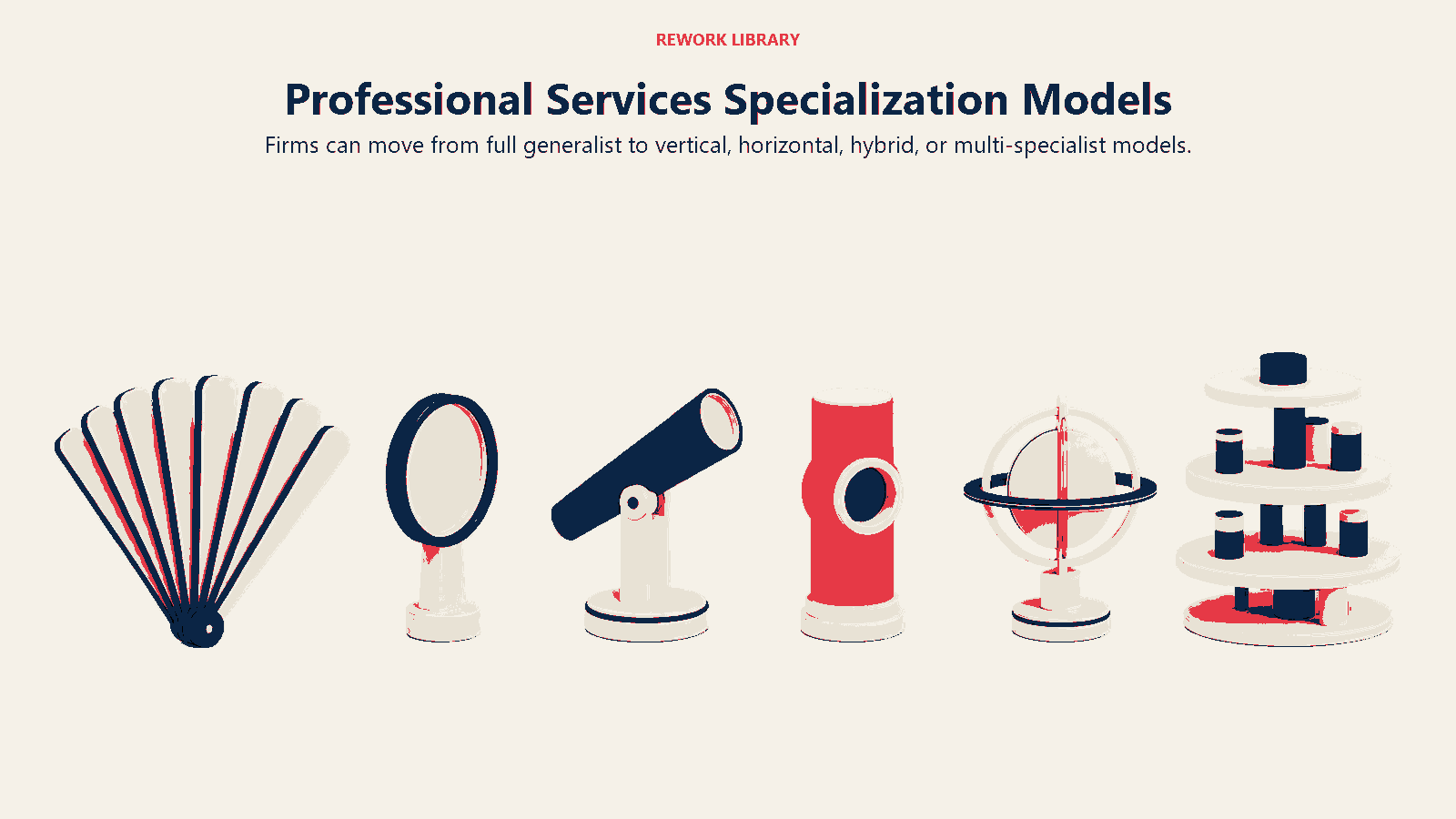
Spesialis luas dengan keunggulan kapabilitas: Anda fokus pada kategori umum tapi membangun keahlian mendalam di kapabilitas tertentu. Misalnya, "kami melakukan pemasaran untuk perusahaan B2B" atau "kami melakukan konsultansi keuangan untuk perusahaan middle-market." Anda tidak terikat pada satu industri, tapi Anda memiliki profil layanan yang jelas dan jenis klien yang ditargetkan. Ini berhasil jika metodologi atau keahlian Anda benar-benar terdiferensiasi.
Spesialis vertikal: Anda fokus pada satu industri dan melayani klien di seluruh vertikal itu. "Kami hanya bekerja dengan penyedia layanan kesehatan" atau "kami berspesialisasi dalam firma jasa keuangan." Ini adalah model spesialisasi yang paling umum. Anda membangun pengetahuan industri yang mendalam, memahami lingkungan regulasi, mengembangkan IP khusus industri, dan dikenal sebagai firma unggulan untuk sektor tersebut.
Spesialis horizontal: Anda fokus pada satu jenis masalah atau fungsi lintas industri. "Kami melakukan konsultansi keamanan siber" atau "kami berspesialisasi dalam advisory M&A." Ini berhasil ketika masalahnya serupa terlepas dari industri, dan keahlian Anda dalam memecahkan masalah spesifik itu lebih berharga daripada pengetahuan industri.
Model hybrid (inti + adjacent): Anda berspesialisasi dalam satu niche utama tapi mempertahankan 1–2 area adjacent di mana Anda memiliki kekuatan yang sudah ada. Mungkin 60% dari pendapatan berasal dari kesehatan, 25% dari ilmu kehidupan, 15% dari farmasi. Keduanya cukup terkait sehingga keahlian Anda dapat ditransfer, tapi Anda tidak sepenuhnya bergantung pada satu sektor.
Model platform (multi-spesialis): Anda membangun area praktik yang berbeda, masing-masing dengan spesialisasinya sendiri. Ini sebenarnya adalah portofolio praktik spesialis di bawah satu merek firma. Membutuhkan skala (biasanya pendapatan $20 juta+) dan kepemimpinan praktik yang kuat. McKinsey beroperasi dengan cara ini, mereka punya spesialis kesehatan, spesialis teknologi, spesialis jasa keuangan, semua di bawah satu atap.
Sebagian besar firma yang bergerak menuju spesialisasi berada di model spesialis vertikal atau hybrid. Cukup konkret untuk dibangun namun cukup fleksibel untuk mengelola risiko.
Framework pemilihan niche: menemukan kesesuaian terbaik Anda
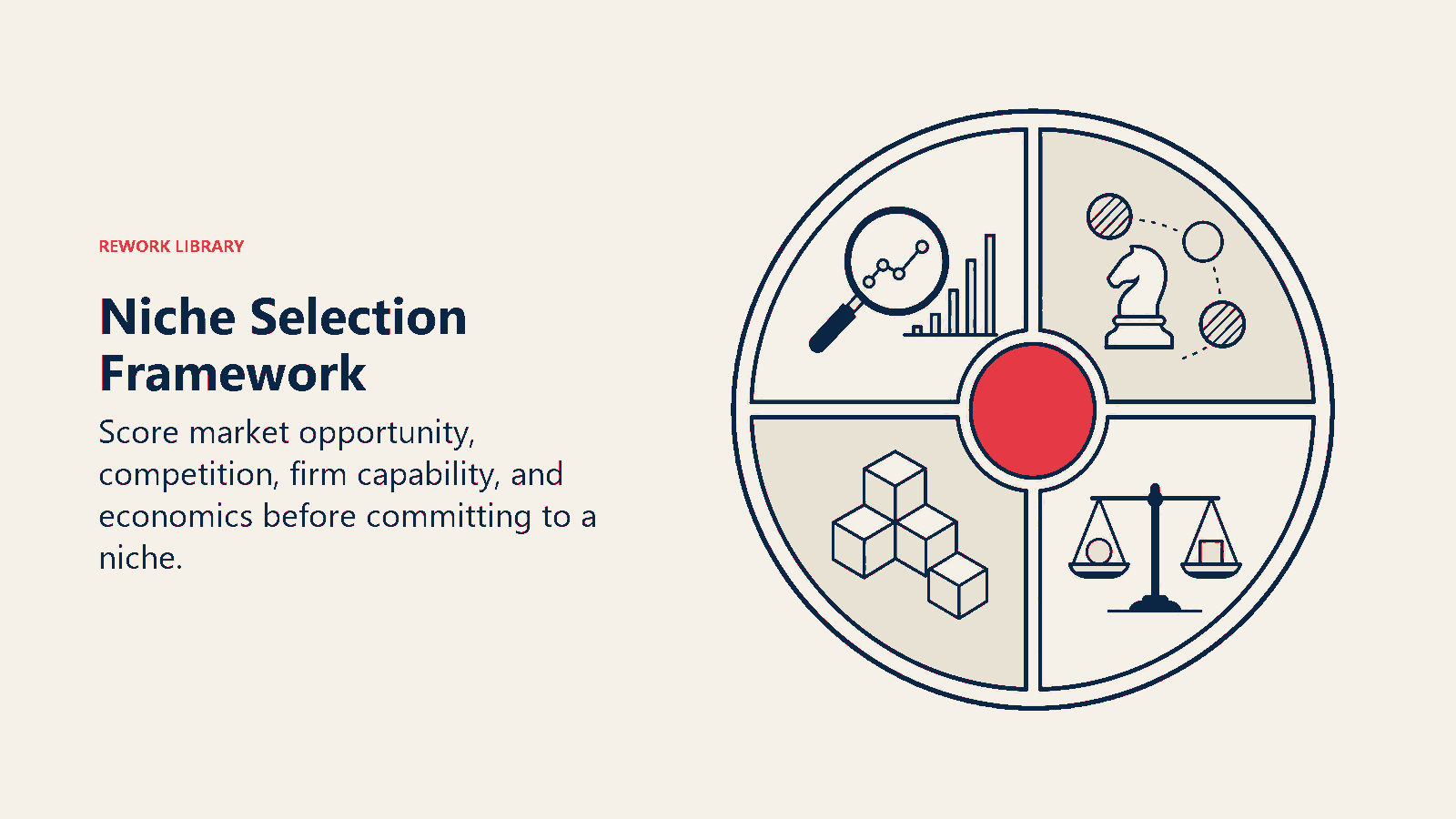
Memilih niche bukan tentang memilih apa yang terdengar menarik. Ini tentang menemukan persimpangan antara peluang pasar, kapabilitas Anda, dan kelayakan ekonomi. Berikut cara mengevaluasi pilihan secara sistematis.
Daya tarik pasar (25% dari bobot keputusan)
Anda melihat ukuran ekonomi dan kesehatan niche potensial:
Ukuran pasar: Apakah ada cukup peluang untuk membangun praktik yang bermakna? Sebuah niche membutuhkan setidaknya 500–1.000 calon klien target untuk menopang sebuah firma. Jika hanya ada 100 perusahaan di ruang itu, terlalu kecil kecuali mereka adalah perusahaan enterprise besar dengan anggaran besar.
Trajektori pertumbuhan: Apakah pasar berkembang, stabil, atau menurun? Pasar yang tumbuh menciptakan lebih banyak peluang, perusahaan berinvestasi, pemain baru terbentuk, dan ada anggaran untuk bantuan eksternal. Pasar yang menurun cepat menjadi sadar biaya.
Ketersediaan anggaran: Apakah perusahaan di ruang ini benar-benar membeli jasa profesional? Perusahaan teknologi banyak menghabiskan uang untuk konsultan. Bisnis ritel kecil biasanya tidak. Beberapa industri memiliki margin dan anggaran yang sehat. Yang lain selalu memotong biaya.
Fragmentasi pasar: Apakah pasar didominasi oleh beberapa pemain besar atau banyak perusahaan menengah? Biasanya, Anda menginginkan fragmentasi, lebih banyak perusahaan berarti lebih banyak peluang. Tapi jika pemain besar banyak menghabiskan uang untuk layanan, pasar yang terkonsentrasi pun bisa berhasil.
Positioning kompetitif (25% dari bobot keputusan)
Anda perlu memahami dengan siapa Anda bersaing:
Firma spesialis yang sudah ada: Apakah sudah ada 10 firma spesialis mapan yang mendominasi niche ini? Itu membuat masuk menjadi lebih sulit. Jika hanya ada 1–2 spesialis dan sebagian besar adalah generalis, ada ruang untuk pemain spesialis baru.
Hambatan masuk: Seberapa sulit membangun kredibilitas di sini? Beberapa niche memerlukan sertifikasi, latar belakang spesifik, atau pengetahuan regulasi yang menciptakan hambatan alami. Sebenarnya itu bagus setelah Anda masuk, itu melindungi posisi Anda.
Peluang diferensiasi: Bisakah Anda membangun sudut pandang atau metodologi yang unik? Jika setiap firma melakukan hal yang pada dasarnya sama, Anda akan bersaing berdasarkan harga. Jika Anda dapat mengembangkan pendekatan yang khas, Anda dapat memerintahkan premium.
Minat firma besar: Apakah firma global besar (Deloitte, Accenture, dll.) aktif mengejar ruang ini? Jika demikian, Anda bersaing di pasar atas. Itu tidak selalu buruk, sering ada ruang untuk butik spesialis, tapi Anda perlu realistis tentang di mana Anda akan bermain.
Kesesuaian kapabilitas firma (30% dari bobot keputusan)
Ini adalah faktor terpenting karena menentukan seberapa kredibel spesialisasi Anda:
Basis klien yang ada: Apakah Anda sudah memiliki 3–5 klien kuat di niche ini? Jika 20–30% dari pendapatan Anda sudah berasal dari ruang ini, Anda punya fondasi. Jika Anda tidak punya klien di sana, Anda mulai dari nol.
Keahlian tim: Apakah orang-orang senior Anda memiliki pengalaman mendalam di ruang ini? Apakah mereka berasal dari industri ini? Apakah mereka telah mengerjakan beberapa proyek di sana? Kredibilitas datang dari keahlian yang terbukti.
Studi kasus yang relevan: Bisakah Anda menunjukkan hasil nyata? Prospek ingin bukti bahwa Anda telah memecahkan masalah serupa. Jika Anda punya 2–3 studi kasus yang kuat, Anda bisa membangun dari sana. Jika Anda tidak punya apa-apa, membangun kredibilitas membutuhkan waktu bertahun-tahun.
Kurva pembelajaran: Berapa lama tim Anda membutuhkan waktu untuk benar-benar menjadi ahli? Beberapa industri itu kompleks, kesehatan, jasa keuangan, energi. Yang lain lebih mudah diakses. Jujurlah tentang waktu adaptasi yang diperlukan.
Daya tarik ekonomi (20% dari bobot keputusan)
Fundamental keuangannya perlu berhasil:
Rata-rata ukuran proyek: Apakah perusahaan di ruang ini membeli proyek senilai $50K atau $500K? Deal yang lebih besar berarti Anda membutuhkan lebih sedikit klien untuk mencapai target pendapatan. Deal yang lebih kecil berarti Anda membutuhkan volume.
Siklus pembelian: Berapa lama dari kontak pertama hingga kontrak ditandatangani? Perusahaan software enterprise memiliki siklus penjualan 6–12 bulan. UKM bisa bergerak dalam hitungan minggu. Siklus yang lebih panjang berarti lebih banyak sumber daya penjualan dan biaya akuisisi klien yang lebih tinggi.
Lifetime value: Apakah ini hubungan satu proyek atau keterlibatan multi-tahun? Pendapatan berulang dan hubungan klien jangka panjang jauh lebih berharga daripada proyek satu kali.
Margin dan penetapan harga: Apakah klien di ruang ini bersedia membayar tarif premium? Apa model penetapan harga yang umum, per jam, berbasis proyek, retainer? Beberapa niche mendukung harga yang lebih tinggi daripada yang lain.
Ketika Anda menilai niche potensial di keempat dimensi ini, pola akan muncul. Peluang terbaik mendapat nilai baik di semua faktor. Peluang marjinal memiliki satu atau dua dimensi yang kuat tapi kelemahan di tempat lain.
Spesialisasi vertikal: strategi berbasis industri
Sebagian besar firma memilih spesialisasi vertikal karena intuitif dan value proposition-nya jelas: "Kami mengetahui industri Anda." Tapi menjalankan spesialisasi vertikal dengan baik membutuhkan lebih dari sekadar mengklaim fokus industri.
Mengidentifikasi vertikal berpotensi tinggi

Cari industri dengan karakteristik khusus:
Kompleksitas regulasi: Kesehatan, jasa keuangan, energi, industri-industri ini membutuhkan keahlian khusus karena aturannya rumit. Generalis kesulitan mengikuti perubahan regulasi, menciptakan peluang bagi spesialis.
Tekanan transformasi digital: Industri yang terganggu oleh teknologi membutuhkan bantuan beradaptasi. Ritel tradisional, asuransi, perbankan, semuanya berinvestasi besar dalam modernisasi dan membutuhkan panduan yang memahami baik industri maupun teknologi.
Aktivitas konsolidasi: Ketika industri berkonsolidasi melalui M&A, ada pekerjaan yang harus dilakukan. Proyek integrasi, rasionalisasi sistem, keselarasan budaya. Firma yang memahami dinamika industri memenangkan pekerjaan ini.
Keputusan konsekuensi tinggi: Industri di mana kesalahan mahal menciptakan permintaan untuk bantuan ahli. Perusahaan manufaktur yang membuat keputusan peralatan modal senilai $50 juta menginginkan spesialis. Firma konstruksi yang membangun infrastruktur besar membutuhkan para ahli.
Membangun keahlian vertikal yang mendalam
Menjadi spesialis vertikal berarti mengetahui lebih dari sekadar dasar-dasar industri:
Pahami model bisnis secara mendasar: Bagaimana perusahaan di ruang ini sebenarnya menghasilkan uang? Apa unit ekonominya? Apa yang mendorong profitabilitas? Anda seharusnya bisa membicarakan model bisnis sebaik orang dalam industri.
Ketahui lingkungan regulasi: Lembaga apa yang mengatur ruang ini? Apa persyaratan kepatuhan utamanya? Perubahan apa yang akan datang? Klien Anda mengharapkan Anda mengetahui hal ini.
Pantau tren industri dan dinamika kompetitif: Siapa perusahaan-perusahaan terkemuka? Strategi apa yang berhasil? Inovasi apa yang muncul? Baca publikasi industri, hadiri konferensi, berpartisipasilah dalam asosiasi industri.
Kembangkan framework dan IP khusus industri: Buat metodologi yang disesuaikan untuk vertikal ini. Alih-alih framework strategi generik, Anda punya "model pertumbuhan penyedia layanan kesehatan" atau "roadmap transformasi digital jasa keuangan." IP proprietary memperkuat keahlian Anda.
Perbedaan go-to-market vertikal
Penjualan dalam spesialisasi vertikal berbeda dari penjualan generalis:
Event dan konferensi industri sangat penting: Alih-alih konferensi bisnis umum, Anda hadir di Healthcare Financial Management Association atau Retail Technology Summit. Di situlah pembeli Anda berada, di mana Anda membangun visibilitas, dan di mana Anda berjejaring.
Publikasi dan media industri: Dapatkan artikel diterbitkan di publikasi perdagangan, bukan hanya jurnal bisnis. Ketika American Banker atau Healthcare IT News menampilkan perspektif Anda, Anda membangun kredibilitas dengan pasar target Anda.
Studi kasus dan referensi khusus industri: Materi pemasaran Anda harus secara eksklusif menampilkan klien di vertikal target. Jangan melemahkan positioning Anda dengan menampilkan contoh industri yang beragam. Anda ingin prospek berpikir "orang-orang ini hanya melakukan apa yang kami lakukan."
Thought leadership yang berfokus vertikal: Posting blog, webinar, dan topik berbicara Anda semuanya harus berpusat pada isu-isu khusus industri. Anda tidak membicarakan "kepemimpinan di masa yang tidak pasti", Anda membicarakan "bagaimana rumah sakit komunitas menavigasi transisi value-based care."
Kedalaman spesialisasi bertambah seiring waktu. Setelah lima tahun dalam satu vertikal, Anda mengenal semua orang. Klien mereferensikan Anda kepada rekan-rekan mereka. Anda diundang untuk berbicara di event industri. Anda mengembangkan hubungan dengan analis dan influencer industri. Jaringan tersebut menjadi competitive moat.
Membangun competitive moat melalui spesialisasi
Spesialisasi menciptakan keunggulan yang dapat dipertahankan yang sulit ditiru oleh generalis. Moat ini melindungi posisi dan pricing power Anda.
Keahlian dan modal intelektual
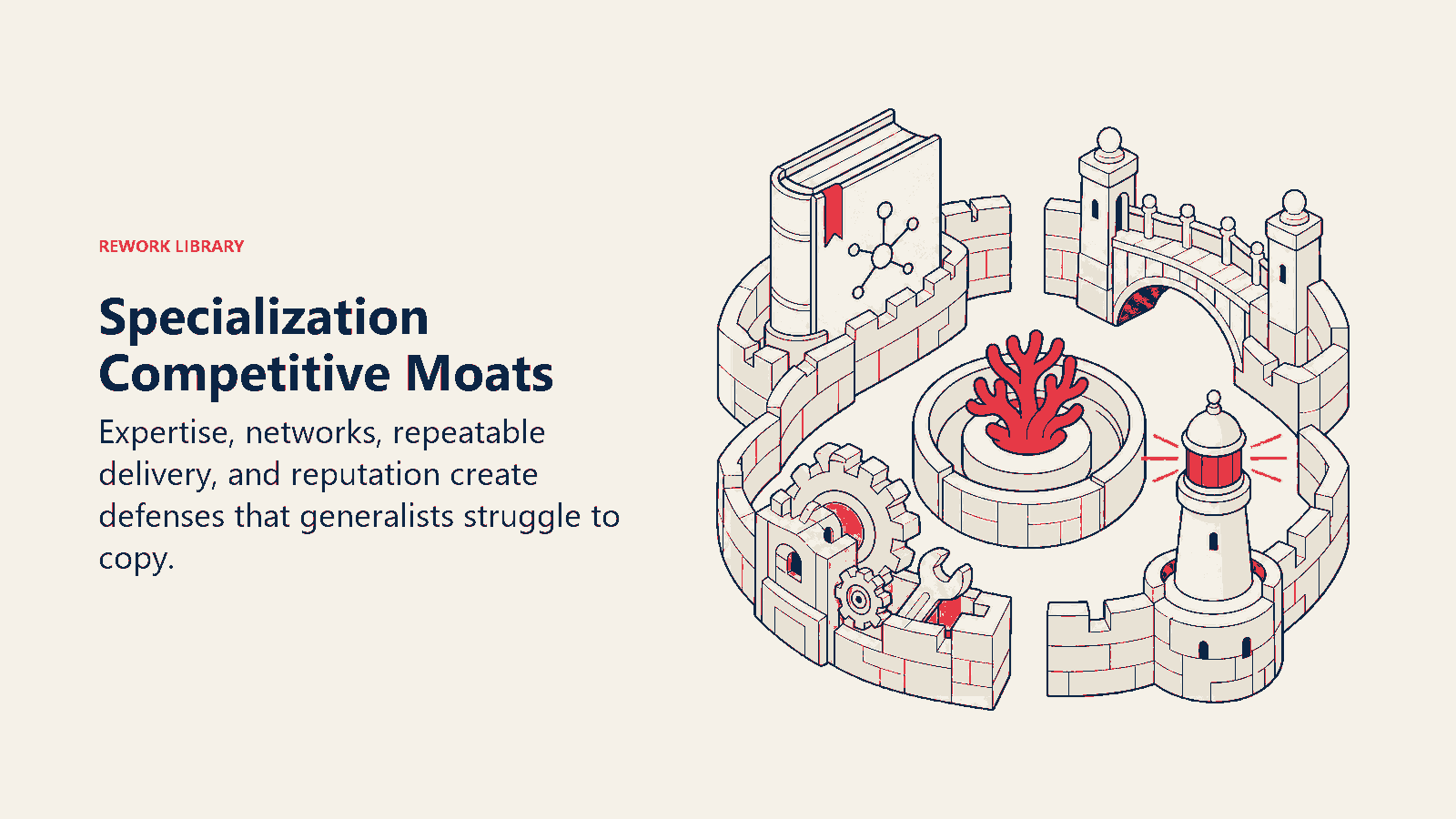
Semakin banyak proyek yang Anda lakukan di suatu ruang, semakin pintar Anda. Anda mengenali pola. Anda tahu apa yang berhasil dan apa yang tidak. Anda mengembangkan framework dan metodologi yang memberikan hasil lebih baik lebih cepat.
Keahlian ini terwujud sebagai:
- Alat diagnostik dan framework penilaian proprietary
- Benchmark dan dataset khusus industri
- Best practice dan playbook yang terdokumentasi
- Tim terlatih dengan pengetahuan khusus yang mendalam
- Sertifikasi dan kredensial khusus untuk niche
Klien membayar untuk kebijaksanaan yang terakumulasi ini. Mereka tidak membeli waktu Anda, mereka membeli pengetahuan yang telah Anda bangun melalui puluhan keterlibatan serupa. Seorang generalis harus belajar di tempat kerja. Anda sudah tahu.
Keunggulan hubungan dan jaringan
Sebagai spesialis, jaringan Anda menjadi sangat berharga:
Hubungan klien yang mendorong referral: Ketika Anda telah bekerja dengan 30 perusahaan dalam satu industri, dan mereka semua saling mengenal, referral mengalir secara alami. "Dengan siapa kami harus berbicara tentang ini?" "Hubungi XYZ Consulting, mereka melakukan pekerjaan ini untuk semua orang di ruang kami."
Partnership dan aliansi industri: Anda mengembangkan hubungan dengan vendor teknologi, mitra implementasi, dan penyedia layanan lain yang melayani pasar yang sama. Partnership ini menciptakan aliran deal dan kredibilitas.
Pengaruh dan visibilitas industri: Seiring waktu, Anda menjadi suara yang dikenal di industri. Anda berbicara di konferensi mereka, menulis di publikasi mereka, bertugas di komite industri. Visibilitas ini menjadi mesin lead generation.
Keunggulan efisiensi operasional
Pekerjaan serupa yang berulang menciptakan efisiensi proses:
Metodologi yang terstandarisasi mengurangi risiko pengiriman: Anda tidak menemukan kembali pendekatan di setiap proyek. Anda punya playbook yang terbukti berhasil.
Adaptasi tim yang lebih cepat: Ketika Anda mempekerjakan seseorang ke dalam praktik yang terspesialisasi, mereka mempelajari satu domain secara mendalam alih-alih terus-menerus berpindah konteks. Mereka menjadi produktif lebih cepat.
Alat dan template yang dapat digunakan kembali: Template proyek, alat analisis, dan format deliverable Anda disempurnakan dan digunakan kembali. Ini mempercepat pengiriman dan meningkatkan kualitas.
Perkiraan sumber daya yang lebih baik: Ketika proyek Anda mengikuti pola serupa, Anda dapat memprediksi kebutuhan sumber daya dengan lebih akurat. Utilisasi meningkat karena Anda tidak terus-menerus kesulitan mengisi berbagai jenis proyek.
Keunggulan operasional ini langsung mengalir ke margin. Biaya pengiriman Anda turun sementara penetapan harga Anda tetap atau meningkat. Itulah premium spesialisasi.
Persepsi merek dan pasar
Dikenal untuk sesuatu yang spesifik adalah pemasaran yang kuat:
- Ketika seseorang di pasar target Anda memiliki masalah yang Anda selesaikan, nama Anda muncul. "Bicara dengan ABC Consulting, itu satu-satunya yang mereka lakukan."
- Anda mendapatkan inbound leads dari pasar target karena positioning Anda jelas.
- Anda dapat menetapkan harga premium karena Anda diposisikan sebagai ahli, bukan penyedia komoditas.
- Win rate Anda meningkat secara dramatis karena Anda adalah pilihan yang jelas untuk pekerjaan terspesialisasi.
Moat ini membutuhkan waktu untuk dibangun, biasanya 3–5 tahun fokus yang berkomitmen. Tapi begitu sudah terbentuk, sulit bagi pesaing untuk menerobosnya.
Model penilaian pemilihan niche
Saat mengevaluasi beberapa niche potensial, gunakan model penilaian terstruktur untuk membuat keputusan berbasis data. Berikut adalah framework dengan kriteria berbobot:
Ukuran dan Pertumbuhan Pasar (25% dari total skor)
Ukuran pasar target (calon klien): 0–10 poin
- 2.000+ perusahaan (10 poin)
- 500–2.000 perusahaan (7 poin)
- 100–500 perusahaan (4 poin)
- <100 perusahaan (0 poin)
Tingkat pertumbuhan pasar: 0–10 poin
- Bertumbuh >10% per tahun (10 poin)
- Bertumbuh 3–10% per tahun (7 poin)
- Stagnan atau menurun <3% (3 poin)
- Menurun >5% per tahun (0 poin)
Ketersediaan anggaran: 0–5 poin
- Margin kuat, belanja layanan tinggi (5 poin)
- Belanja sedang untuk jasa profesional (3 poin)
- Anggaran rendah untuk bantuan eksternal (1 poin)
Positioning Kompetitif (25% dari total skor)
Jumlah spesialis mapan: 0–10 poin
- 0–2 pesaing spesialis yang jelas (10 poin)
- 3–5 pesaing spesialis (6 poin)
- 6–10 spesialis di pasar (3 poin)
-
10 spesialis, pasar penuh (0 poin)
Potensi diferensiasi: 0–10 poin
- Tinggi, pendekatan unik memungkinkan (10 poin)
- Sedang, beberapa diferensiasi (6 poin)
- Rendah, layanan komoditas (2 poin)
Minat firma besar: 0–5 poin
- Minat rendah dari firma besar (5 poin)
- Kompetisi sedang (3 poin)
- Kehadiran firma besar yang kuat (0 poin)
Kesesuaian Kapabilitas Firma (30% dari total skor)
Basis klien yang ada: 0–15 poin
- 5+ klien, 30%+ dari pendapatan (15 poin)
- 3–4 klien, 15–30% dari pendapatan (10 poin)
- 1–2 klien, <15% dari pendapatan (5 poin)
- Tidak ada klien saat ini (0 poin)
Keahlian tim: 0–10 poin
- Beberapa orang senior dengan latar belakang mendalam (10 poin)
- Beberapa pengalaman tim di ruang ini (6 poin)
- Tidak ada keahlian khusus (0 poin)
Studi kasus dan bukti: 0–5 poin
- 5+ studi kasus yang kuat (5 poin)
- 2–4 studi kasus (3 poin)
- 0–1 studi kasus (0 poin)
Daya Tarik Ekonomi (20% dari total skor)
Rata-rata ukuran proyek: 0–10 poin
- Rata-rata deal $500K+ (10 poin)
- Rata-rata deal $150K–$500K (7 poin)
- Rata-rata deal $50K–$150K (4 poin)
- Rata-rata deal <$50K (1 poin)
Lifetime value klien: 0–10 poin
- Hubungan berulang multi-tahun (10 poin)
- Proyek berulang sesekali (6 poin)
- Sebagian besar keterlibatan satu kali (2 poin)
Nilai setiap niche potensial di semua kriteria. Opsi dengan skor tertinggi menjadi fokus utama Anda. Namun juga cari opsi yang mendapat nilai baik pada kesesuaian meskipun ukuran pasarnya sedang, itu bisa menjadi niche yang bagus karena Anda bisa mendominasi mereka.
Skor di atas 70 menunjukkan peluang yang kuat. 50–70 layak tapi menantang. Di bawah 50, Anda mungkin memaksanya.
Strategi go-to-market spesialisasi
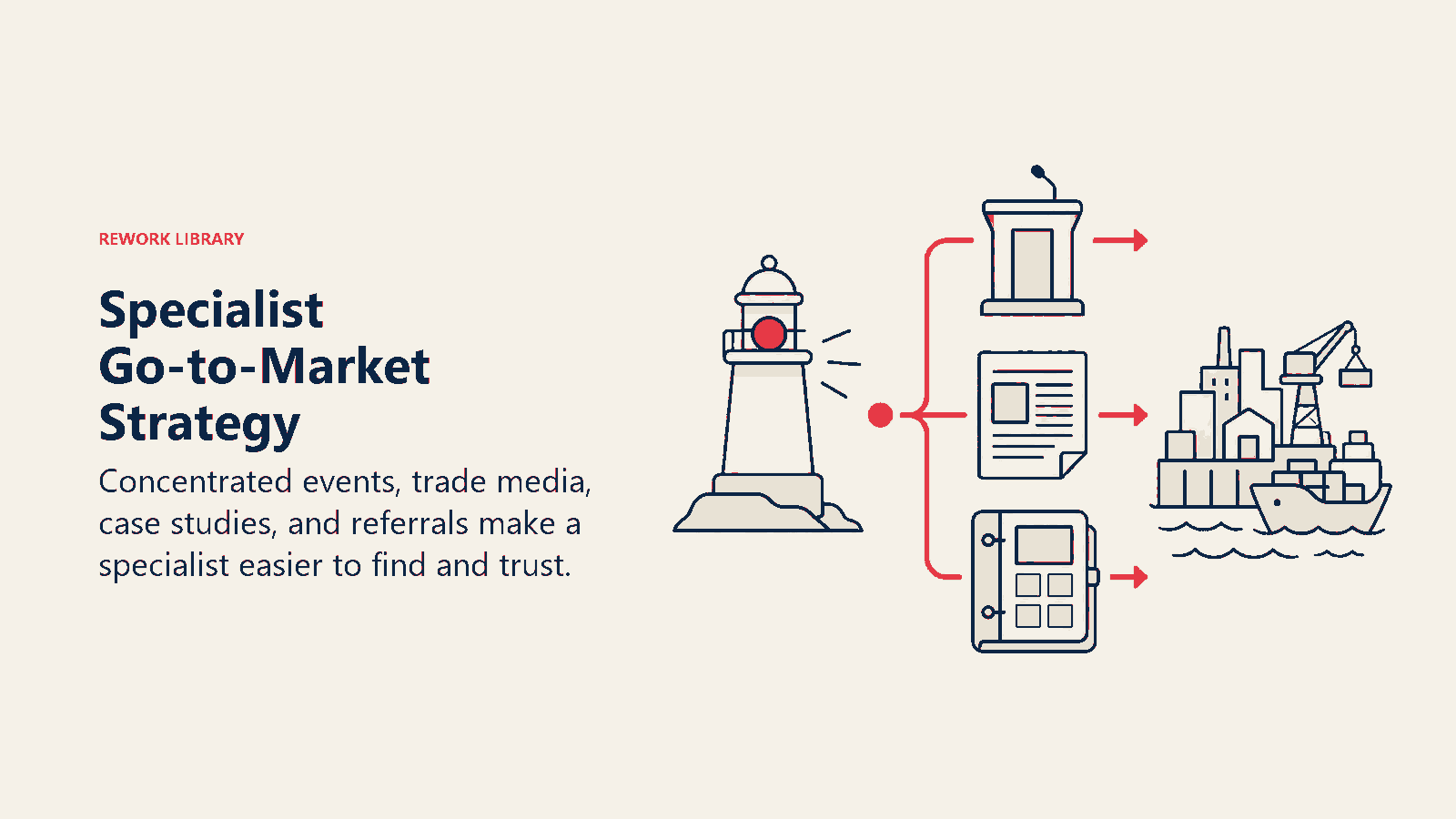
Setelah memilih niche, Anda membutuhkan rencana go-to-market yang terfokus untuk membangun kredibilitas dan menghasilkan Pipeline.
Positioning dan pesan
Positioning Anda perlu sangat jelas:
Perbarui website Anda untuk memimpin dengan spesialisasi. Headline harus segera mengkomunikasikan fokus Anda: "Strategi Pertumbuhan untuk Penyedia Layanan Kesehatan" bukan "Layanan Konsultansi Strategis."
Tulis ulang deskripsi firma Anda untuk menekankan keahlian industri dan hasil: "Kami telah membantu 40 sistem rumah sakit meningkatkan operating margin melalui framework efisiensi kami yang terbukti."
Buat value proposition yang jelas khusus untuk niche: Hasil spesifik apa yang Anda berikan? Masalah apa yang Anda selesaikan yang unik untuk ruang ini?
Thought leadership dan pembangunan merek
Thought leadership sangat penting dalam spesialisasi karena membuktikan keahlian:
Publikasikan secara teratur tentang topik khusus industri: Posting blog, artikel LinkedIn, dan tulisan yang dikontribusikan di publikasi perdagangan. Konten harus menunjukkan pengetahuan mendalam, bukan observasi tingkat permukaan. Lihat strategi thought leadership untuk taktik terperinci.
Berbicara di konferensi dan event industri: Mulai dengan mengusulkan panel atau workshop di event tingkat kedua. Bangun reputasi sebagai pembicara, lalu naik ke keynote di konferensi utama. Pelajari lebih lanjut melalui strategi berbicara dan menerbitkan.
Kembangkan riset atau benchmark proprietary: Riset orisinal mendapat perhatian. Survei industri tahunan, laporan benchmark, atau analisis tren menjadikan Anda sebagai sumber data. Ini juga menghasilkan liputan media dan undangan berbicara.
Selenggarakan webinar dan roundtable: Satukan pemimpin industri untuk mendiskusikan topik-topik panas. Posisikan diri Anda sebagai penyelenggara dan moderator. Event ini membangun jaringan Anda sambil menunjukkan keahlian.
Penjualan dan business development
Pendekatan penjualan Anda harus mencerminkan keahlian yang terspesialisasi:
Identifikasi target account list: Alih-alih outreach yang luas, fokus pada 100–200 perusahaan yang merupakan klien ideal Anda di niche. Riset mereka secara mendalam, pahami tantangan mereka, dan dekati dengan wawasan yang relevan.
Gunakan consultative business development: Jangan pitch layanan. Mulailah percakapan tentang tantangan industri yang Anda amati. Bagikan perspektif. Bangun hubungan. Lihat consultative business development untuk pendekatan ini.
Kembangkan prospecting khusus industri: Alih-alih outbound generik, referensikan event industri yang telah Anda hadiri, artikel yang telah Anda tulis, atau observasi tentang perusahaan mereka berdasarkan pengetahuan industri.
Spesialisasi konten dan pemasaran
Semua konten Anda harus memperkuat keahlian terspesialisasi Anda:
Studi kasus industri: Tampilkan hasil klien di niche target Anda. Sertakan metrik spesifik, tantangan unik untuk industri, dan hasil yang penting bagi perusahaan serupa.
Perpustakaan konten khusus vertikal: Bangun hub konten yang sepenuhnya berfokus pada niche Anda. Alih-alih blog dengan topik campuran, buat "Pusat Sumber Daya CFO Kesehatan" atau "Wawasan Keunggulan Manufaktur."
Email nurture sequence untuk niche: Marketing automation Anda harus menyertakan track konten khusus industri. Ketika seseorang mengunduh sumber daya, mereka masuk ke urutan nurture dengan konten yang relevan dengan tantangan industri mereka. Lebih lanjut tentang ini di content marketing untuk layanan.
Strategi partnership
Strategic partnership mempercepat spesialisasi:
Vendor teknologi yang melayani industri: Bermitralah dengan perusahaan software, penyedia platform, atau vendor teknologi yang menjual ke pasar target Anda. Mereka membutuhkan mitra implementasi, dan Anda membutuhkan akses klien.
Penyedia layanan komplementer: Bangun hubungan dengan firma yang melakukan pekerjaan berbeda untuk klien yang sama. Firma konsultansi IT dan firma strategi dapat saling mereferensikan tanpa bersaing.
Asosiasi dan kelompok industri: Bergabunglah dengan asosiasi industri, sponsori event, dan berpartisipasilah secara aktif. Ini membangun visibilitas dan kredibilitas. Beberapa asosiasi bahkan memiliki program vendor pilihan.
Strategi go-to-market adalah permainan jangka panjang. Dibutuhkan 12–18 bulan untuk membangun visibilitas yang bermakna di niche baru. Tapi investasi itu terbayar dengan positioning yang lebih kuat dan biaya akuisisi klien yang lebih rendah.
Membangun keahlian mendalam: dari spesialis menjadi otoritas
Mengklaim spesialisasi adalah langkah pertama. Benar-benar menjadi ahli adalah yang penting. Berikut cara membangun kedalaman seiring waktu.
Manajemen pengetahuan
Tangkap dan organisasikan apa yang Anda pelajari:
Buat repositori pengetahuan terpusat: Dokumentasikan wawasan, best practice, tantangan umum, dan solusi dari setiap proyek. Ini menjadi pengetahuan institusional Anda.
Kembangkan framework khusus industri: Saat Anda melihat pola di berbagai klien, kodifikasikan mereka ke dalam metodologi. Framework ini membuat keahlian Anda nyata dan dapat diulang.
Bangun database competitive intelligence: Lacak apa yang dilakukan pesaing di industri, strategi apa yang berhasil, perusahaan mana yang memimpin. Klien Anda mengharapkan Anda mengetahui lanskap ini.
Pertahankan perpustakaan tren dan riset: Kumpulkan laporan industri, studi riset, perubahan regulasi, dan analisis pasar. Jadilah firma yang paling terinformasi di ruang Anda.
Pengembangan kapabilitas tim
Orang-orang Anda perlu menjadi spesialis juga:
Pekerjakan dari industri jika memungkinkan: Praktisi industri sebelumnya membawa kredibilitas dan konteks yang sulit dikembangkan dari luar. Konsultan yang menghabiskan 10 tahun sebagai administrator rumah sakit memahami kesehatan dengan cara yang tidak bisa ditandingi oleh orang luar.
Investasikan dalam pelatihan dan pendidikan industri: Kirim anggota tim ke konferensi industri, program sertifikasi, dan pendidikan berkelanjutan khusus untuk niche. Anggarkan ini sebagai pengeluaran berkelanjutan.
Buat program pembelajaran internal: Sesi berbagi pengetahuan reguler di mana anggota tim mempresentasikan wawasan industri, tantangan klien, atau perkembangan baru. Ini menyebarkan keahlian ke seluruh tim.
Rotasikan orang melalui proyek beragam di niche: Paparan ke beberapa klien dan situasi mempercepat pembelajaran. Pastikan orang tidak terjebak di satu klien secara tidak terbatas.
Strategi pengembangan IP
Kekayaan intelektual membedakan spesialis dari generalis:
Kembangkan alat penilaian dan diagnostik: Buat framework yang mendiagnosis masalah spesifik di niche Anda. "Model Kematangan Revenue Cycle Kesehatan" atau "Penilaian Kesiapan Digital Manufaktur." Alat-alat ini menunjukkan keahlian dan menciptakan peluang keterlibatan.
Bangun kemampuan benchmarking: Jika Anda bekerja dengan cukup banyak klien, Anda dapat membuat benchmark industri. "Berdasarkan pekerjaan kami dengan 50 produsen menengah, inilah cara Anda membandingkan." Data proprietary sangat berharga.
Tulis buku atau laporan riset utama: Buku yang berfokus pada niche Anda membangun otoritas seperti tidak ada yang lain. Ini adalah proyek jangka panjang, tapi imbalan kredibilitasnya substansial.
Buat program sertifikasi atau pelatihan: Jika metodologi Anda cukup kuat, Anda dapat mensertifikasi praktisi di dalamnya. Ini menciptakan aliran pendapatan lain dan menyebarkan pengaruh Anda.
Validasi eksternal
Pengakuan pihak ketiga mempercepat kredibilitas:
Kejar penghargaan dan pengakuan industri: Sebagian besar industri memiliki penghargaan untuk penyedia layanan. Memenangkan "Konsultan Kesehatan Terbaik" penting di pasar itu.
Dapatkan liputan analis: Di beberapa industri (seperti teknologi), firma analis seperti Gartner melacak penyedia layanan. Diakui dalam laporan mereka sangat berharga.
Dapatkan liputan media industri: Dikutip di publikasi perdagangan sebagai pakar, atau memiliki perspektif Anda ditampilkan, membangun otoritas. Kembangkan hubungan dengan jurnalis dan blogger industri.
Kumpulkan testimoni klien dan studi kasus: Bukti sosial dari perusahaan yang dikenal di industri memvalidasi keahlian Anda. Tampilkan ini secara menonjol dalam pemasaran Anda.
Membangun keahlian adalah proses yang berkelanjutan. Bahkan setelah lima tahun di suatu niche, Anda masih belajar. Industri berkembang, tantangan baru muncul, dan best practice bergeser. Spesialis terbaik tetap menjadi pelajar di bidang yang mereka pilih.
Roadmap implementasi spesialisasi
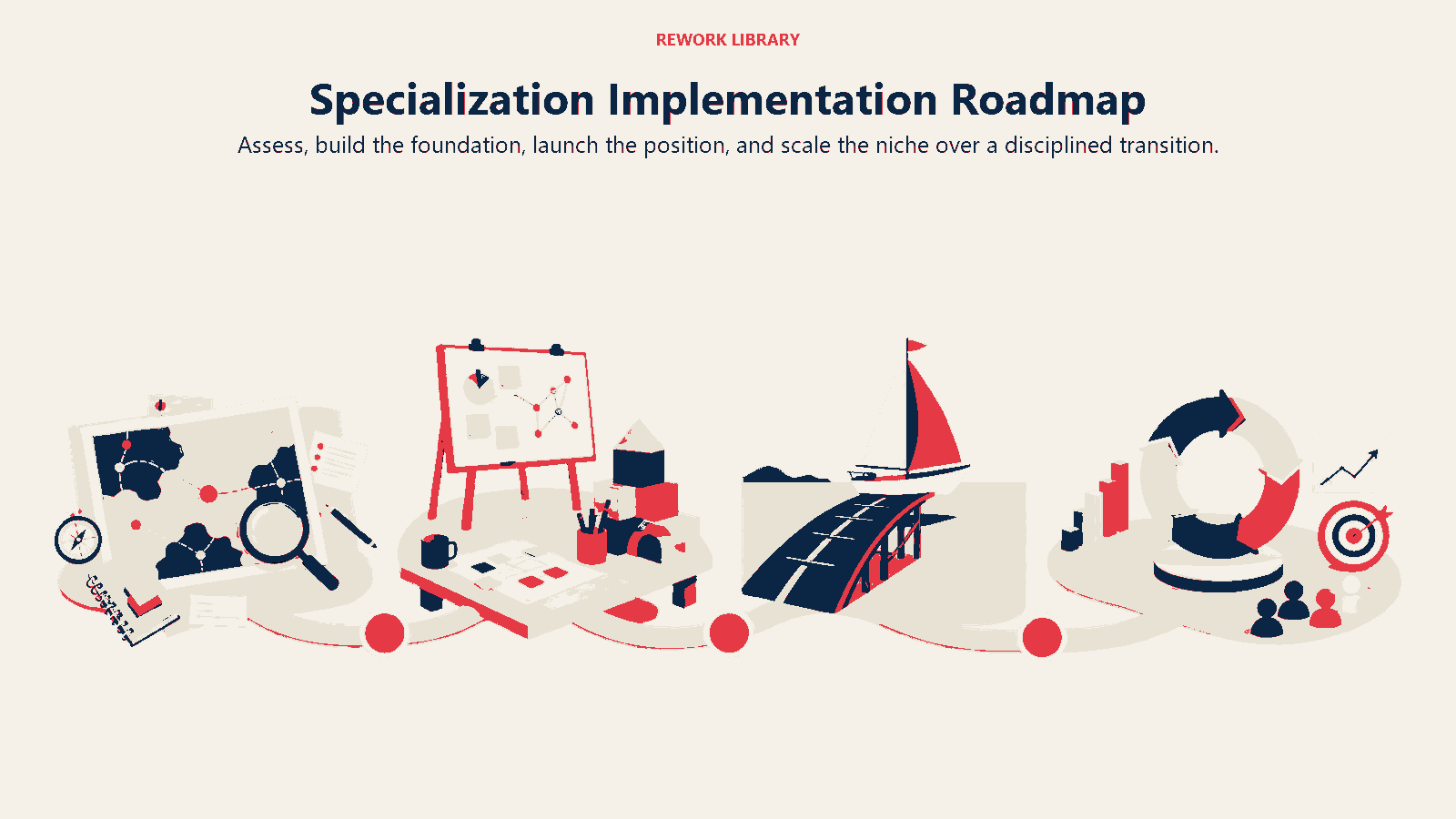
Berpindah dari generalis ke spesialis membutuhkan pendekatan bertahap. Berikut adalah timeline yang realistis dan apa yang harus difokuskan di setiap tahap.
Fase 1: Penilaian dan Perencanaan (Bulan 1–3)
Ini adalah pekerjaan fondasi sebelum Anda mengumumkan apa pun:
Lakukan analisis niche yang ketat: Nilai niche potensial menggunakan framework di atas. Dapatkan konsensus di antara partner tentang fokus yang dipilih.
Audit kapabilitas dan kesenjangan saat ini: Keahlian apa yang sudah Anda miliki? Apa yang perlu Anda bangun? Siapa di tim yang memiliki pengalaman relevan?
Analisis portofolio klien yang ada: Klien mana yang sesuai dengan fokus baru? Klien mana yang tidak? Berapa banyak pendapatan yang berasal dari setiap kategori?
Kembangkan skenario keuangan: Modelkan dampak pendapatan. Bagaimana jika Anda kehilangan 20% klien non-fokus? Berapa lama untuk menggantikannya dengan pekerjaan terspesialisasi? Apa timeline break-even-nya?
Buat keselarasan stakeholder: Dapatkan partner, staf senior, dan stakeholder kunci yang mendukung strategi. Tanpa keselarasan internal, eksekusi gagal.
Fase 2: Pembangunan Fondasi (Bulan 3–6)
Mulai membangun keahlian dan kapabilitas sebelum pemasaran besar:
Pekerjakan atau kembangkan bakat terspesialisasi: Rekrut pakar industri atau investasikan dalam melatih anggota tim yang ada. Mulai membangun bench.
Buat IP dan framework awal: Kembangkan metodologi khusus industri pertama Anda, template, atau alat penilaian. Anda membutuhkan sesuatu yang proprietary untuk dibicarakan.
Kembangkan 3–5 studi kasus yang kuat: Dokumentasikan hasil dari pekerjaan apa pun yang sudah ada di niche target. Jika Anda belum memiliki studi kasus, ambil beberapa proyek untuk membangunnya, bahkan dengan margin yang lebih rendah jika diperlukan.
Bangun fondasi pengetahuan industri: Anggota tim menghadiri konferensi, bergabung dengan asosiasi industri, mulai membaca publikasi perdagangan, terhubung dengan kontak industri.
Desain ulang materi pemasaran inti: Perbarui positioning website, tulis ulang deskripsi firma, buat pitch deck baru yang berfokus pada spesialisasi.
Fase 3: Peluncuran dan Masuk Pasar (Bulan 6–12)
Inilah saat Anda memublikasikan positioning:
Luncurkan merek dan pesan terspesialisasi: Perbarui semua komunikasi eksternal untuk mencerminkan fokus Anda. Siaran pers, peluncuran ulang website, pembaruan media sosial yang mengumumkan spesialisasi.
Mulai program thought leadership: Terbitkan artikel, mulai berbicara di event industri, luncurkan podcast atau seri video, buat konten khusus industri.
Inisiasi business development yang ditargetkan: Bangun target account list, mulai outreach ke klien ideal di niche, hadiri event networking industri.
Kembangkan strategic partnership: Bentuk aliansi dengan vendor teknologi, penyedia layanan komplementer, atau asosiasi industri.
Pantau dan sempurnakan positioning: Lacak apa yang beresonansi. Pesan apa yang berhasil? Keberatan apa yang Anda dengar? Sesuaikan berdasarkan feedback pasar.
Fase 4: Pertumbuhan dan Scaling (Tahun ke-2+)
Sekarang Anda membangun dominasi dan menskalakan praktik:
Perluas tim dengan rekrutmen terspesialisasi: Rekrut lebih banyak pakar industri, kembangkan kapasitas pengiriman, bangun tim praktik terspesialisasi.
Kembangkan IP dan penawaran yang lebih canggih: Buat alat, framework, dan penawaran layanan yang lebih canggih berdasarkan keahlian yang terakumulasi.
Kejar posisi kepemimpinan pasar: Menangkan penghargaan industri, tampil di publikasi utama, berbicara di konferensi tingkat atas, bergabung dengan dewan advisory industri.
Bangun ekosistem referral: Kembangkan hubungan dengan klien, partner, dan influencer industri yang mendorong referral.
Pertimbangkan ekspansi adjacent: Setelah mendominasi satu niche, Anda dapat menambahkan area adjacent. Tapi hanya setelah spesialisasi inti terbentuk dengan kuat.
Timeline ini mengasumsikan eksekusi yang stabil. Kenyataannya lebih berantakan, beberapa fase membutuhkan waktu lebih lama, beberapa peluang mempercepat kemajuan. Tapi urutannya penting: bangun kapabilitas sebelum memasarkannya, bangun kredibilitas sebelum scaling.
Jebakan spesialisasi umum yang harus dihindari
Sebagian besar kegagalan spesialisasi berasal dari kesalahan yang dapat diprediksi. Berikut yang perlu diwaspadai.
Memilih niche berdasarkan klien saat ini vs peluang pasar
Hanya karena 30% pendapatan Anda berasal dari kesehatan bukan berarti kesehatan adalah spesialisasi yang tepat. Mungkin klien-klien itu menemukan Anda secara kebetulan. Mungkin peluang pasarnya terbatas. Pilih berdasarkan analisis ke depan, bukan kebetulan historis.
Kurang berkomitmen pada sumber daya
Spesialisasi adalah investasi yang membutuhkan sumber daya yang signifikan: rekrutmen, pelatihan, pemasaran, business development. Firma yang mencoba berspesialisasi "di pinggir" sambil mempertahankan pendekatan generalis tidak membangun keahlian atau kredibilitas yang nyata. Anda membutuhkan fokus yang berkomitmen.
Spesialisasi terlalu sempit membatasi peluang
Ada keseimbangan antara terfokus dan terlalu sempit. "Kami hanya bekerja dengan pusat bedah ortopedi pediatrik di Tenggara" mungkin terlalu spesifik kecuali Anda menargetkan akun enterprise besar. Pastikan niche Anda memiliki addressable market yang cukup untuk mendukung tujuan pertumbuhan Anda.
Kehilangan bisnis yang ada selama transisi
Ketika Anda mengumumkan spesialisasi, beberapa klien yang ada di luar niche itu mungkin khawatir Anda meninggalkan mereka. Anda membutuhkan rencana untuk mengalihkan pekerjaan itu, mempertahankan hubungan tersebut secara terpisah, atau mengkomunikasikan secara eksplisit bahwa klien yang ada tetap didukung sepenuhnya.
Tidak membangun diferensiasi yang nyata
Hanya mengklaim "kami fokus pada kesehatan" tidak cukup jika Anda melakukan pekerjaan yang sama dengan generalis. Anda perlu mengembangkan pendekatan, framework, atau keahlian yang benar-benar terdiferensiasi yang memberikan hasil lebih baik. Jika tidak, Anda hanyalah generalis dengan pemasaran yang lebih sempit.
Keterbatasan geografis
Beberapa niche terkonsentrasi secara geografis. Jika Anda berspesialisasi dalam minyak dan gas, Anda perlu bersedia bekerja di Houston, Calgary, atau Aberdeen. Jika Anda berkomitmen untuk tetap lokal, pastikan niche yang Anda pilih memiliki kehadiran lokal yang cukup.
Gagal beradaptasi seiring pasar berkembang
Industri berubah. Teknologi mengganggu. Regulasi bergeser. Spesialis yang berhasil tetap selangkah di depan perubahan ini. Mereka yang gagal terus menggunakan pendekatan yang sudah usang karena "begitulah cara kami selalu melakukannya." Bangun pembelajaran berkelanjutan ke dalam strategi spesialisasi Anda.
Kapan harus mendiversifikasi atau memperluas spesialisasi
Spesialisasi tidak permanen. Ada saatnya memperluas atau berpindah masuk akal secara strategis.
Sinyal kejenuhan di niche inti
Anda akan tahu bahwa Anda menjenuhi niche Anda ketika:
- Win rate Anda mulai menurun meskipun keahlian Anda kuat
- Anda melihat prospek yang sama berulang kali dan kalah dari pesaing yang sama
- Pertumbuhan pendapatan di niche telah stagnan meskipun upaya penjualan yang kuat
- Dinamika pasar telah bergeser (konsolidasi, pemotongan anggaran, perubahan regulasi)
Ketika Anda melihat sinyal-sinyal ini, sudah waktunya untuk mempertimbangkan ekspansi adjacent atau diversifikasi portofolio.
Pengenalan peluang adjacent
Ekspansi terbaik adalah adjacent ke niche inti Anda:
- Anda berspesialisasi dalam sistem rumah sakit dan berkembang ke pusat bedah rawat jalan
- Anda fokus pada bank ritel dan menambahkan credit union
- Anda melayani perusahaan manufaktur dan menambahkan perusahaan distribusi
Langkah adjacent memungkinkan Anda memanfaatkan keahlian yang ada sambil mengakses pasar baru. Kurva pembelajaran lebih pendek daripada melompat ke industri yang sama sekali berbeda.
Ekspansi kapabilitas tim
Terkadang peluang datang dari bakat. Anda mempekerjakan partner yang kuat yang membawa keahlian mendalam di niche yang berbeda. Alih-alih kehilangan kapabilitas itu, Anda dapat membangun spesialisasi kedua. Tapi hanya jika Anda memiliki skala untuk mendukung beberapa praktik, biasanya ini berarti Anda sudah berpendapatan $15 juta+.
Rebalancing portofolio
Jika niche inti Anda menghadapi tantangan struktural (industri yang menurun, tekanan regulasi, gangguan), diversifikasi menjadi strategi manajemen risiko. Jangan menunggu sampai pasar kolaps. Mulai membangun spesialisasi berikutnya sementara yang sekarang masih kuat.
Manajemen siklus ekonomi dan pasar
Beberapa niche bersifat siklikal. Layanan konstruksi boom dan bust mengikuti ekonomi. Konsultansi energi mengikuti harga komoditas. Jika niche Anda volatile, memiliki fokus sekunder yang counter-cyclical dapat memperlancar pendapatan. Tapi ini hanya berhasil jika Anda benar-benar dapat mempertahankan keahlian di kedua area.
Prinsip kuncinya: perluas dari kekuatan, bukan kelemahan. Jangan menambahkan spesialisasi baru karena yang sekarang sedang gagal. Bangun yang baru karena Anda telah berhasil dan memiliki sumber daya untuk berinvestasi dalam pertumbuhan.
Model kematangan spesialisasi
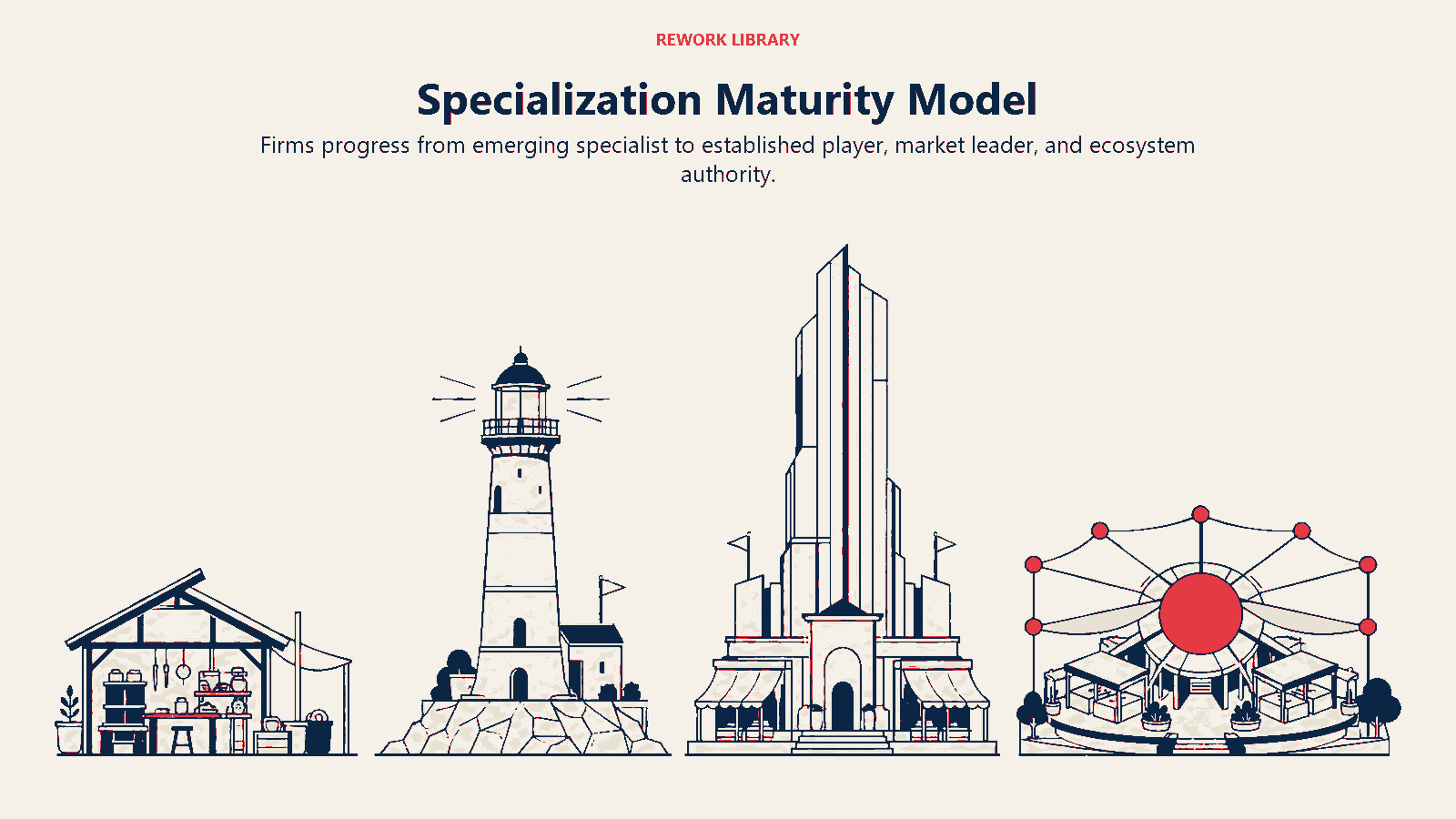
Memahami di mana Anda berada dalam perjalanan spesialisasi membantu menetapkan ekspektasi dan tujuan yang realistis.
Tahap 1: Spesialis yang Sedang Muncul (Tahun ke-1)
Pada tahap ini, Anda membangun kredibilitas:
- 20–40% pendapatan dari niche target
- 2–5 studi kasus klien di niche
- Materi dan pesan dasar khusus industri
- Tim mengembangkan pengetahuan terspesialisasi
- Visibilitas industri terbatas
- Win rate meningkat di niche vs pasar umum
- Masih menerima pekerjaan di luar spesialisasi untuk mempertahankan pendapatan
Fokus di sini adalah membangun proof point dan keahlian sambil mengelola transisi pendapatan.
Tahap 2: Spesialis yang Mapan (Tahun ke-2 hingga ke-3)
Anda kini dikenal di niche Anda:
- 50–70% pendapatan dari niche target
- 8–15 studi kasus klien
- Kehadiran thought leadership yang kuat (berbicara, menerbitkan)
- Framework dan IP terspesialisasi dikembangkan
- Jaringan dan visibilitas industri yang tumbuh
- Referral mulai mengalir secara teratur
- Win rate secara signifikan lebih tinggi dalam pekerjaan niche
- Dapat lebih selektif tentang pekerjaan non-spesialisasi
Di sinilah ekonomi mulai benar-benar berhasil. Siklus penjualan memendek, win rate meningkat, penetapan harga menguat.
Tahap 3: Pemimpin Pasar (Tahun ke-3 hingga ke-5)
Anda termasuk di antara spesialis teratas di niche Anda:
- 70–90% pendapatan dari niche target
- 20+ studi kasus klien
- Thought leader yang diakui (konferensi top, publikasi besar)
- IP dan metodologi proprietary
- Ekosistem referral yang kuat
- Penghargaan dan pengakuan industri
- Pricing power premium
- Inbound leads dari reputasi
Pada tahap ini, Anda tidak mengejar pekerjaan, pekerjaan mencari Anda. Merek dan reputasi Anda mendorong business development.
Tahap 4: Pemain Ekosistem (5+ tahun)
Anda adalah bagian dari infrastruktur industri:
- 80–100% pendapatan dari niche (atau beberapa spesialisasi yang mapan)
- Portofolio klien dan hasil yang luas
- Penentu standar industri (framework Anda diadopsi secara luas)
- Buku atau riset utama yang dikutip
- Posisi dewan atau peran advisory di organisasi industri
- Ekosistem kemitraan yang mendorong aliran deal yang signifikan
- Program pelatihan atau sertifikasi yang dibayar orang lain
- Margin dan pertumbuhan terdepan di pasar
Di sinilah Anda tidak hanya melayani industri, Anda membantu mendefinisikannya. Keahlian Anda adalah standar emas.
Sebagian besar firma mencapai plateau di Tahap 2 atau 3, yang tidak masalah. Anda tidak perlu mencapai Tahap 4 untuk memiliki spesialisasi yang sukses secara ekonomi. Tapi memahami trajektori membantu Anda menetapkan tujuan dan berinvestasi dengan tepat.
Pemodelan keuangan untuk spesialisasi
Sebelum berkomitmen pada spesialisasi, modelkan dampak keuangan. Berikut yang perlu diproyeksikan.
Dampak pendapatan dari spesialisasi
Bangun model tiga skenario:
Skenario konservatif:
- 15% dari pendapatan non-terspesialisasi saat ini berkurang selama 24 bulan
- Pendapatan terspesialisasi tumbuh 20% per tahun
- Mix bergeser ke 60% terspesialisasi pada tahun ke-3
Skenario dasar:
- 10% dari pendapatan non-terspesialisasi saat ini berkurang
- Pendapatan terspesialisasi tumbuh 35% per tahun
- Mix bergeser ke 70% terspesialisasi pada tahun ke-3
Skenario optimis:
- 5% dari pendapatan saat ini berkurang
- Pendapatan terspesialisasi tumbuh 50% per tahun
- Mix bergeser ke 80% terspesialisasi pada tahun ke-3
Skenario mana yang realistis tergantung pada titik awal dan peluang pasar Anda. Gunakan analisis niche Anda untuk menginformasikan asumsi.
Potensi peningkatan gross margin
Spesialisasi harus meningkatkan margin melalui:
- Penetapan harga premium: tarif 10–30% lebih tinggi dalam pekerjaan terspesialisasi
- Efisiensi operasional: pengiriman 15–25% lebih cepat melalui framework yang dapat digunakan kembali
- Biaya penjualan yang lebih rendah: pengurangan 20–40% dalam biaya akuisisi klien
- Win rate yang lebih tinggi: peningkatan 30–50% dalam keberhasilan proposal
Model gross margin berdasarkan jenis pekerjaan:
- Pekerjaan terspesialisasi: gross margin 55–65%
- Pekerjaan non-terspesialisasi: gross margin 40–50%
Seiring mix bergeser ke yang terspesialisasi, gross margin keseluruhan meningkat.
Keuntungan efisiensi penjualan dan pemasaran
Lacak metrik ini seiring waktu:
- Panjang siklus penjualan (terspesialisasi vs non-terspesialisasi)
- Biaya per qualified lead
- Tingkat proposal-to-close
- Biaya akuisisi klien sebagai % dari pendapatan tahun pertama
Spesialisasi harus menunjukkan:
- Siklus penjualan 25–40% lebih pendek dalam pekerjaan niche
- Biaya akuisisi klien 30–50% lebih rendah
- Peningkatan 40–100% dalam win rate
Keuntungan efisiensi ini berarti Anda dapat menumbuhkan pendapatan tanpa secara proporsional menskalakan headcount penjualan.
Leverage operasional dan profitabilitas
Seiring Anda membangun keahlian terspesialisasi:
- Jam pengiriman per dolar pendapatan menurun (Anda bekerja lebih cepat)
- Staf junior dapat menangani lebih banyak (template dan proses yang lebih baik)
- Pengerjaan ulang dan risiko berkurang (Anda tahu apa yang berhasil)
- Utilisasi meningkat (pencocokan dan perkiraan sumber daya yang lebih baik)
Model dampak EBITDA:
- Tahun ke-1: Tekanan margin dari investasi dalam spesialisasi
- Tahun ke-2: Margin pulih ke baseline seiring efisiensi mulai berlaku
- Tahun ke-3+: Margin berkembang 300–500 basis poin dari kombinasi penetapan harga dan efisiensi
Investasi yang diperlukan dan periode payback
Spesialisasi membutuhkan investasi di muka:
- Rekrutmen atau pelatihan terspesialisasi: $100K–$500K tergantung ukuran firma
- Pemasaran dan positioning: $50K–$200K
- Pengembangan IP dan framework: $50K–$150K
- Penjualan dan business development: $100K–$300K
- Konferensi, keanggotaan, visibilitas: $25K–$100K
Total investasi tahun pertama: $325K–$1,25 juta untuk firma berukuran menengah
Payback biasanya terjadi dalam bulan ke-18 hingga ke-24 seiring pertumbuhan pendapatan dan peningkatan margin mengimbangi investasi.
Skenario risiko dan analisis sensitivitas
Model skenario downside:
- Bagaimana jika pendapatan terspesialisasi hanya tumbuh 10% alih-alih 35%?
- Bagaimana jika 20% dari pendapatan saat ini berkurang alih-alih 10%?
- Bagaimana jika peningkatan margin hanya 200bp alih-alih 400bp?
Jalankan analisis sensitivitas untuk memahami asumsi mana yang paling berpengaruh. Biasanya, tingkat pertumbuhan pendapatan terspesialisasi memiliki dampak terbesar pada hasil.
Pemodelan keuangan memberi Anda kepercayaan dalam keputusan dan membantu Anda mengelola transisi. Ini juga menyediakan metrik untuk melacak kemajuan terhadap rencana.
Perbandingan ekonomi spesialisasi vs generalis
Mari kita buat ekonominya konkret dengan contoh nyata. Dua firma, keduanya berpendapatan $10 juta, satu generalis dan satu spesialis.
Profil Firma Generalis:
- Pendapatan: $10 juta
- Ukuran tim: 65 orang (partner, konsultan, pendukung)
- Rata-rata pendapatan per karyawan: $154K
- Gross margin: 45%
- EBITDA margin: 12%
- Rata-rata ukuran proyek: $75K
- Siklus penjualan: 4,5 bulan
- Win rate: 22%
- Biaya akuisisi klien: $18K per klien
- Lifetime value klien: $125K
- Konsentrasi pendapatan: Tidak ada klien >5%, tidak ada industri >20%
Profil Firma Spesialis (fokus Kesehatan):
- Pendapatan: $10 juta
- Ukuran tim: 50 orang
- Rata-rata pendapatan per karyawan: $200K
- Gross margin: 58%
- EBITDA margin: 22%
- Rata-rata ukuran proyek: $120K
- Siklus penjualan: 3 bulan
- Win rate: 42%
- Biaya akuisisi klien: $12K per klien
- Lifetime value klien: $280K
- Konsentrasi pendapatan: 75% dari kesehatan, klien teratas 8%
Perbandingan ROI:
Firma spesialis menghasilkan:
- $1,3 juta lebih banyak dalam gross profit pada pendapatan yang sama ($5,8 juta vs $4,5 juta)
- $1,0 juta lebih banyak dalam EBITDA ($2,2 juta vs $1,2 juta)
- Profit per karyawan 83% lebih tinggi ($44K vs $24K)
- 37% lebih sedikit orang yang harus dikelola (50 vs 65)
Spesialis menutup deal lebih cepat, menang lebih sering, dan menghabiskan lebih sedikit untuk mengakuisisi klien. Klien mereka bertahan lebih lama dan membeli lebih banyak. Ekonominya jauh lebih baik.
Analisis break-even:
Jika Anda beralih dari generalis ke spesialis, kapan Anda mencapai break-even?
Asumsikan firma generalis $10 juta menginvestasikan $500K di tahun ke-1 untuk berspesialisasi:
- Tahun ke-1: Pendapatan turun 5% menjadi $9,5 juta karena hilangnya pekerjaan non-terspesialisasi, EBITDA turun menjadi $800K (dari baseline $1,2 juta) karena investasi
- Tahun ke-2: Pendapatan pulih menjadi $11 juta seiring pekerjaan terspesialisasi tumbuh, EBITDA pulih menjadi $1,5 juta
- Tahun ke-3: Pendapatan tumbuh menjadi $13 juta, EBITDA mencapai $2,1 juta
EBITDA kumulatif pada akhir tahun ke-3:
- Jalur generalis (tanpa spesialisasi): $3,6 juta
- Jalur spesialis: $4,4 juta
Anda telah mencapai break-even dan melangkah maju pada tahun ke-3. Dan trajektori dari sana sangat menguntungkan spesialis.
Keunggulan generalis terutama terkait risiko: diversifikasi, fleksibilitas, tidak bergantung pada satu pasar. Tapi keunggulan spesialis bersifat ekonomi dan strategis.
Framework keputusan strategis untuk spesialisasi
Membuat keputusan spesialisasi membutuhkan lebih dari sekadar analisis keuangan. Berikut adalah framework komprehensif untuk pilihan strategis.
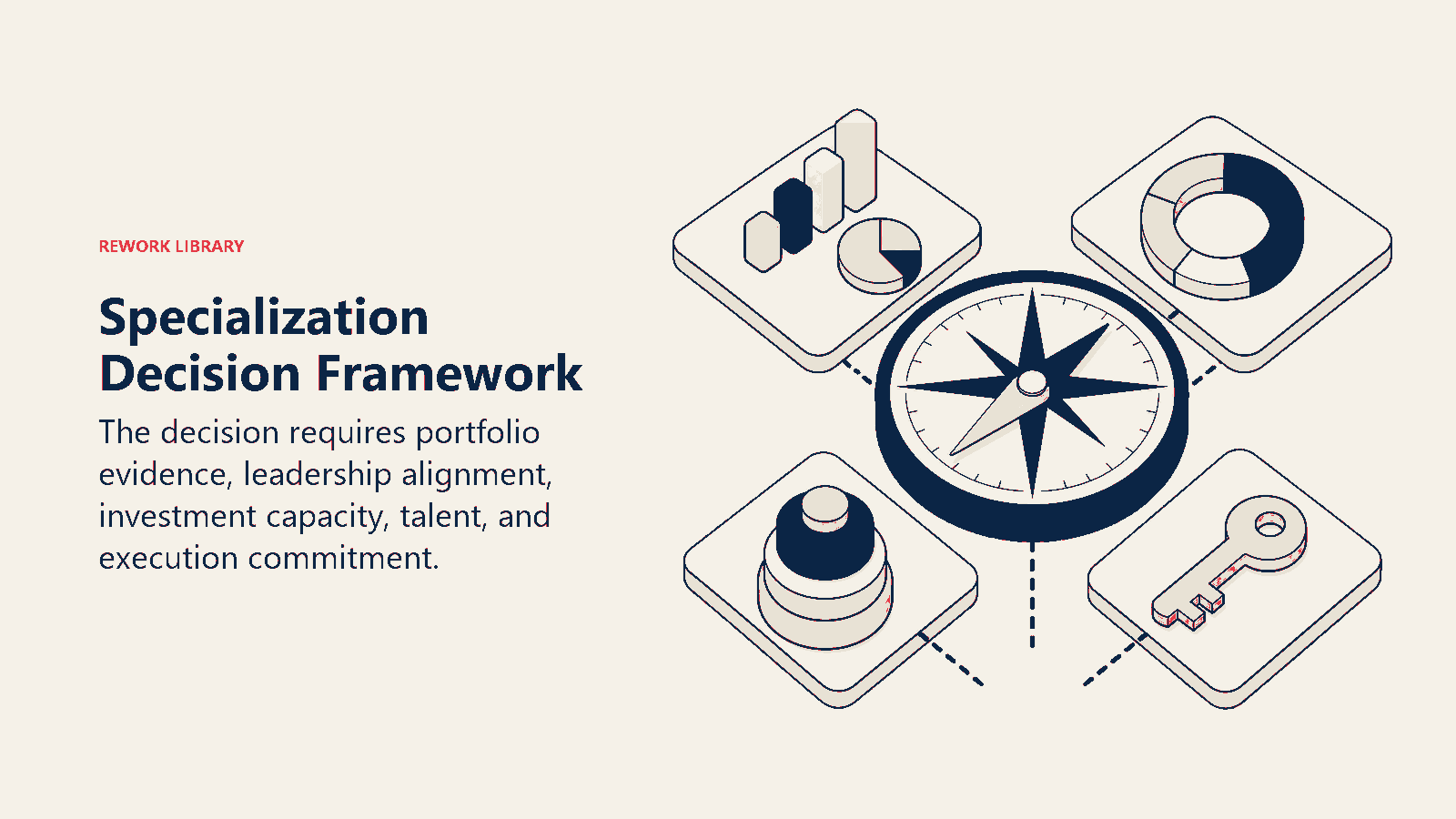
Tinjauan portofolio dan penilaian peluang
Mulailah dengan keadaan saat ini:
- Dari mana pendapatan berasal hari ini (berdasarkan industri, layanan, jenis klien)?
- Segmen mana yang tumbuh vs menurun?
- Di mana Anda memiliki studi kasus dan hasil yang paling kuat?
- Pasar mana yang menunjukkan daya tarik terkuat untuk layanan Anda?
- Apa yang sebenarnya dibeli oleh klien dan prospek?
Kemudian analisis peluang masa depan:
- Pasar mana yang tumbuh dan berinvestasi?
- Di mana persaingan paling lemah relatif terhadap peluang?
- Spesialisasi mana yang selaras dengan semangat dan keahlian tim Anda?
- Apa yang dapat Anda klaim dan buktikan secara kredibel?
Keselarasan tim manajemen
Spesialisasi gagal tanpa konsensus kepemimpinan:
- Apakah partner setuju tentang fokus yang dipilih?
- Apakah mereka bersedia menolak pekerjaan di luar fokus itu?
- Akankah mereka menginvestasikan waktu dalam membangun keahlian industri?
- Apakah mereka berkomitmen untuk jangka waktu 3–5 tahun yang diperlukan untuk membangun posisi?
Jika Anda tidak dapat mendapatkan keselarasan, Anda akan berakhir dengan upaya setengah hati yang tidak memberikan hasil. Lebih baik tetap menjadi generalis daripada berpura-pura berspesialisasi.
Komitmen keuangan dan investasi
Kuantifikasi apa yang bersedia Anda investasikan:
- Anggaran rekrutmen atau pelatihan terspesialisasi
- Investasi pemasaran dan positioning
- Sumber daya pengembangan IP dan framework
- Biaya penjualan dan business development
- Pendapatan yang hilang dari pekerjaan yang ditolak
Tetapkan anggaran dan komitmen padanya. Mendanai transisi yang kurang memadai lebih buruk daripada tidak melakukannya sama sekali.
Strategi bakat dan rencana rekrutmen
Siapa yang Anda butuhkan untuk membuat ini berhasil:
- Pakar industri untuk dipekerjakan (mantan praktisi, pesaing)
- Pelatihan dan pengembangan untuk tim yang ada
- Kapabilitas baru untuk ditambahkan (keterampilan teknis khusus industri)
- Definisi peran dan jalur karir dalam praktik terspesialisasi
Petakan roadmap bakat untuk 18 bulan pertama.
Rencana eksekusi go-to-market
Detail strategi peluncuran dan pemasaran:
- Rollout positioning dan pesan
- Timeline redesain website dan materi
- Kalender konten thought leadership
- Jadwal berbicara dan konferensi
- Rencana outreach business development
- Target pengembangan kemitraan
Tetapkan kepemilikan dan tenggat waktu. Spesialisasi adalah upaya manajemen perubahan yang signifikan.
Pengukuran dan metrik keberhasilan
Definisikan seperti apa kesuksesan di setiap tahap:
6 bulan:
- % Pipeline baru dari niche target
- Partisipasi tim dalam event industri
- Artikel thought leadership yang diterbitkan
- Win rate dalam pekerjaan terspesialisasi vs non-terspesialisasi
12 bulan:
- Pendapatan dari spesialisasi
- Jumlah klien baru di niche
- Gross margin pada pekerjaan terspesialisasi
- Metrik visibilitas industri (berbicara, media)
18 bulan:
- Konsentrasi pendapatan dalam spesialisasi
- Referral klien dari niche
- Rata-rata ukuran deal di niche vs rata-rata firma
- Tren biaya akuisisi klien
24+ bulan:
- Pertumbuhan pendapatan keseluruhan
- Peningkatan EBITDA margin
- Posisi pasar dan pengakuan
- Keahlian dan retensi tim
Lacak metrik ini setiap kuartal dan sesuaikan berdasarkan apa yang Anda pelajari.
Rencana kontingensi dan manajemen risiko
Rencanakan apa yang bisa salah:
- Bagaimana jika pendapatan terspesialisasi tidak terwujud secepat yang diproyeksikan?
- Bagaimana jika klien kunci di industri lain pergi?
- Bagaimana jika niche yang dipilih menghadapi gangguan yang tidak terduga?
- Bagaimana jika bakat terspesialisasi yang kritis pergi?
Untuk setiap risiko, definisikan pemicu dan rencana respons. Jangan hanya berharap semuanya berjalan baik, kelola transisi secara aktif.
Kesimpulan tentang strategi spesialisasi
Spesialisasi adalah salah satu keputusan dengan leverage tertinggi yang dibuat firma jasa profesional. Datanya jelas: spesialis mendapatkan margin yang lebih tinggi, tumbuh lebih cepat, dan membangun bisnis yang lebih dapat dipertahankan daripada generalis.
Tapi spesialisasi hanya berhasil jika Anda berkomitmen sepenuhnya. Spesialisasi setengah hati, mengklaim fokus industri sambil tetap mengejar pekerjaan apa pun yang datang, tidak memberikan manfaat. Anda perlu membuat pilihan sulit tentang apa yang akan Anda fokuskan dan apa yang akan Anda tolak.
Waktu terbaik untuk berspesialisasi adalah ketika Anda tumbuh dari kekuatan, bukan melarikan diri dari kelemahan. Jika Anda punya fondasi yang solid dan melihat peluang untuk mendominasi niche, itulah saat untuk melangkah. Jangan menunggu sampai tekanan kompetitif memaksa tangan Anda.
Pilih spesialisasi Anda berdasarkan persimpangan peluang pasar, kapabilitas firma, dan daya tarik ekonomi. Jangan hanya mengikuti pendapatan ke mana pun kebetulan berada hari ini. Bangun menuju di mana Anda ingin berada dalam lima tahun.
Jalankan transisi secara sistematis dengan fase, investasi, dan metrik yang jelas. Spesialisasi adalah perjalanan multi-tahun yang membutuhkan eksekusi yang sabar dan berkomitmen.
Dan ingat: spesialisasi tidak berarti kekakuan. Pasar berubah. Strategi Anda harus berkembang seiring Anda belajar dan peluang bergeser. Tujuannya bukan untuk memilih satu hal selamanya, ini untuk membangun keahlian mendalam di satu area, menangkap nilai yang diciptakannya, dan kemudian membuat pilihan yang tepat tentang ke mana akan pergi selanjutnya.
Pertanyaan yang Sering Diajukan
Apakah spesialisasi benar-benar strategi pertumbuhan yang berani atau hanya taktik pemasaran? Ini adalah pilihan strategis yang membentuk ulang ekonomi firma, bukan sekadar pesan pemasaran. Firma spesialis biasanya mencatat gross margin 50% hingga 65% dibandingkan 40% hingga 50% untuk generalis, memenangkan 35% hingga 50% proposal dibandingkan 15% hingga 25%, dan mematok premi harga 30% hingga 50%. Itu keunggulan struktural, bukan sekadar positioning.
Bagaimana cara memilih niche yang tepat untuk dispesialisasikan? Beri skor pada setiap kandidat niche di empat dimensi: daya tarik pasar (25%), posisi kompetitif (25%), kecocokan kapabilitas firma (30%), dan daya tarik ekonomi (20%). Niche terbaik adalah persimpangan antara pasar yang tumbuh, kompetisi yang dapat dikalahkan, keahlian nyata yang sudah ada, dan ekonomi deal yang sehat. Skor tertimbang di atas 70 menandakan peluang yang kuat.
Bukankah berspesialisasi berarti menolak bisnis yang bagus? Anda memang akan menolak sebagian pekerjaan, tetapi Anda hanya berhenti secara aktif mengejar pekerjaan di luar spesialisasi, bukan memutus klien yang sudah ada. Win rate di dalam niche naik dari sekitar 20% menjadi 40% hingga 50%, sehingga hitungannya menguntungkan fokus. Klien yang beragam sering tetap menjadi hubungan jangka panjang, sementara bisnis baru terkonsentrasi pada pasar target.
Berapa lama waktu yang dibutuhkan untuk membangun spesialisasi? Rencanakan pembangunan selama 24 bulan: bulan 1 hingga 3 untuk penilaian dan perencanaan, bulan 3 hingga 6 untuk fondasi dan IP, bulan 6 hingga 12 untuk peluncuran dan masuk pasar, lalu tahun kedua untuk skala. Sebagian besar firma mencapai balik modal pada bulan ke-18 hingga 24 ketika win rate dan margin yang lebih tinggi menutup investasi awal.
Sumber daya terkait
- Strategi Service Line - Cara menyusun dan mengembangkan penawaran layanan terspesialisasi
- Strategi Thought Leadership - Bangun visibilitas dan kredibilitas dalam spesialisasi yang Anda pilih
- Consultative Business Development - Pendekatan penjualan yang berhasil untuk firma terspesialisasi
- Model Pertumbuhan Professional Services - Framework pertumbuhan keseluruhan untuk firma jasa profesional
- Content Marketing untuk Layanan - Buat konten khusus niche yang menarik klien ideal
- Ekspansi Geografis - Pertimbangkan spesialisasi sebelum atau bersamaan dengan pertumbuhan geografis

Sales Director
On this page
- Dilema spesialisasi: mengapa sebagian besar firma tetap stuck
- Ekonomi: perbandingan kinerja keuangan spesialis vs generalis
- Memahami kontinum spesialisasi
- Framework pemilihan niche: menemukan kesesuaian terbaik Anda
- Spesialisasi vertikal: strategi berbasis industri
- Membangun competitive moat melalui spesialisasi
- Model penilaian pemilihan niche
- Strategi go-to-market spesialisasi
- Membangun keahlian mendalam: dari spesialis menjadi otoritas
- Roadmap implementasi spesialisasi
- Jebakan spesialisasi umum yang harus dihindari
- Kapan harus mendiversifikasi atau memperluas spesialisasi
- Model kematangan spesialisasi
- Pemodelan keuangan untuk spesialisasi
- Perbandingan ekonomi spesialisasi vs generalis
- Framework keputusan strategis untuk spesialisasi
- Kesimpulan tentang strategi spesialisasi
- Pertanyaan yang Sering Diajukan
- Sumber daya terkait