A Day in the Life of an Enterprise AE
Turn this article into takeaways for your work.


Each assistant summarizes the article only for you and suggests best practices for your work.
It's Monday, 7:14 AM. You haven't opened email yet. You're managing 12-15 active opportunities. The smallest is $200K, the largest just shy of $2M. Each one involves at least six stakeholders, each somewhere in a 9-12 month cycle.
Across those deals you have roughly 70 live conversations going: champions, technical evaluators, security reviewers, procurement contacts, deal desk, your own SE, customer success, legal on both sides. Some threads went quiet last week. A few are hours away from going sideways and you don't know which yet.
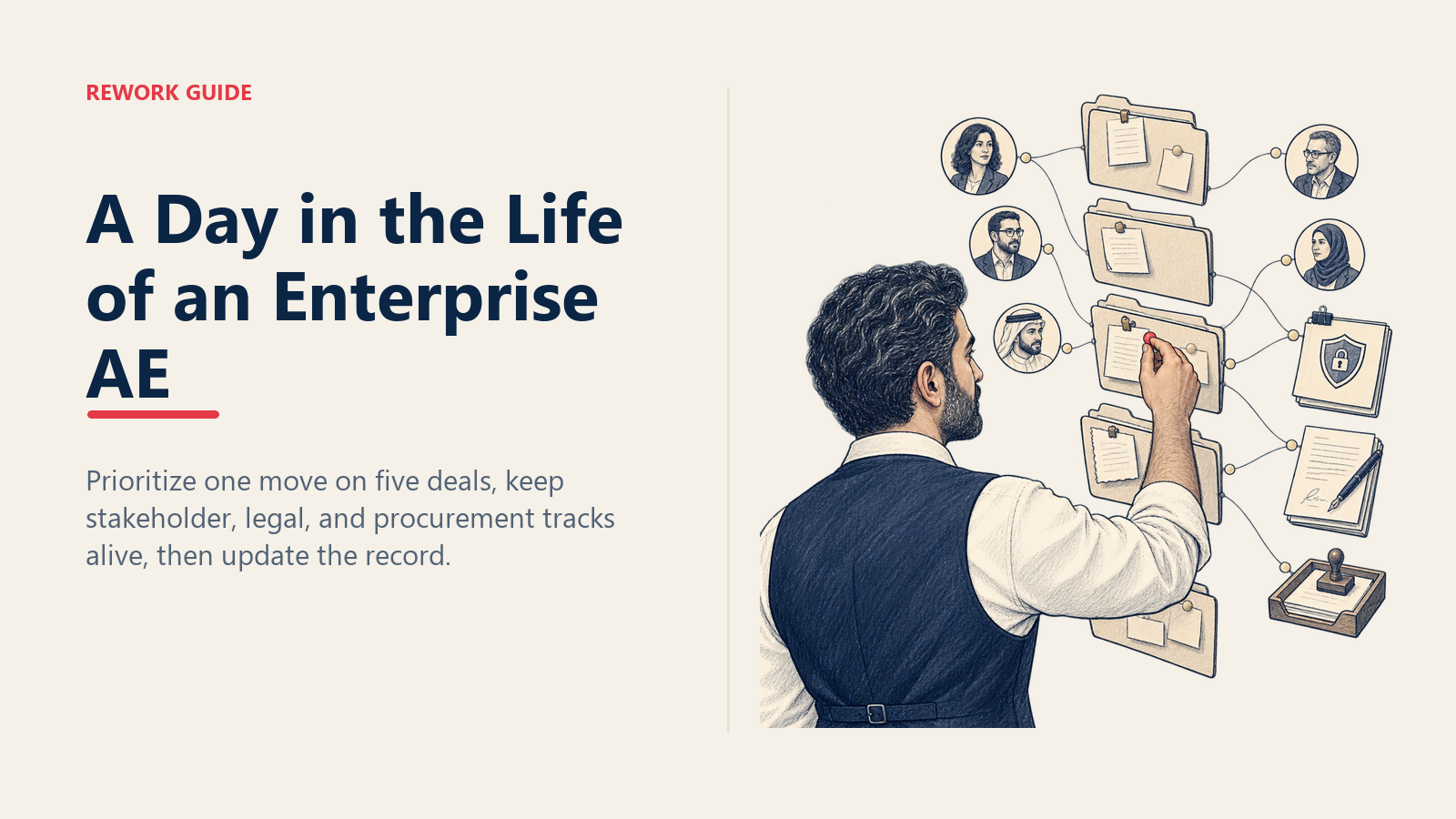
This is not a "working a deal" day. There is no working a deal in enterprise. There are five concurrent threads inside every deal, and you're the only person with line of sight to all of them.
So Monday morning isn't about prospecting. It's about deciding which of those 70 conversations get your attention this week. Most articles about enterprise sales skip this part. They show the closed-won announcement, not the 4:30 PM redline review.
Why Enterprise AE Work Breaks Most People Who Try It
Enterprise AE work is non-linear. That single sentence is what most AEs from SMB or mid-market backgrounds miss for the first two quarters of their pivot.
In SMB, the funnel is a ladder: discovery, demo, proposal, close. You move a deal up one rung at a time and hold five deals in your head. The motion is sequential, and your brain works the same way.
In enterprise, discovery is still happening on a deal that's also in security review, procurement, and legal redlines. Your champion is preparing an internal business case while your SE responds to architecture questions while procurement asks for a SOC 2 attestation while the economic buyer decides whether to give you 15 minutes next month. None of these tracks waits for the others.
AEs who treat enterprise like a stage-by-stage funnel either miss Q4 (because half their pipeline stalled in stages they weren't watching) or burn out context-switching 40 times a day to keep every track alive.
The AEs who survive (and eventually move up to Strategic AE) build a rhythm. The rhythm doesn't maximize activity. It protects against context-switching. It front-loads parallel work that feels uncomfortably early but compounds over 9 months. And it treats unglamorous work like CRM hygiene, procurement chasing, and redline review as the actual job, not overhead.
Here's what that rhythm looks like on a representative Monday.
The Hour-by-Hour Day
This is a working enterprise AE's calendar, time-blocked. Not aspirational. The structure matters more than the exact times. Shift them to fit your time zone and your team's meeting culture, but keep the blocks.
7:30-8:30 AM: Deal-Strategy Review
No email. No Slack. No CRM dashboard with 50 open opportunities staring at you.
You pull up your top five deals, ranked by weighted pipeline value and proximity to close. For each one you re-read the most recent champion notes, re-look at the stakeholder map, and write down the one move that advances this deal this week.
Not five moves. One. For deal one it might be getting the CIO on a 30-minute call with our CTO. For deal two, sending the redlined MSA back to procurement with a clean summary of remaining issues. For deal three, re-engaging the champion who went quiet with a relevant data point (not a check-in).
That hour is the most leveraged hour of your week. Every other hour you'll spend reacting. This one is yours.
8:30-10:30 AM: Multi-Thread Email Block
Now you write. Four emails per priority deal, minimum. One to the economic buyer, one to the technical evaluator, one to the end-user champion, one to the procurement contact.
Each email is different. The economic buyer email talks about business outcomes and timeline. The technical evaluator email is about an architecture question or a reference customer. The champion email is about the internal narrative. The procurement email is about process.
No batching templates across stakeholders. The moment you send the same email to four different roles, you've stopped multi-threading and started bulk emailing. Buyers spot that pattern in seconds. For the deeper playbook, see Multi-Threading Enterprise Deals.
This block is also where you re-thread deals that have gone quiet. Not with "just checking in," but with something the recipient hasn't seen yet: a customer story, a benchmark, a point of view on something they mentioned six weeks ago.
10:30-11:30 AM: Discovery or First Calls
One or two new-logo discovery calls. Sometimes a second-meeting deep dive on a deal that just qualified.
If the deal is over $500K, you don't run discovery solo. You bring an SE. Not because you can't handle the technical questions, but because the buyer reads it as a signal that the seller is taking the conversation seriously. It also means the SE hears the original buyer language directly, instead of filtered through your notes a week later.
You debrief with the SE for ten minutes immediately after. The signal degrades overnight.
11:30 AM-12:30 PM: Internal Sync
Standing 30-minute meeting with your assigned SE and your CS lead. Top accounts only, usually four to six deals on any given week.
You share updated stakeholder maps, surface blockers, and decide who owns what before the next customer touch. The CS lead might flag that your champion at one account is also the executive sponsor for an existing deployment that's having renewal trouble, which completely changes how you message your expansion conversation.
This meeting is where deals get saved. It's also where deals get exposed as weaker than they look. If you can't list the four active stakeholders on a $1M deal here, better to learn it now than in a forecast call.
12:30-1:30 PM: Lunch and Async Catch-Up
Most "internal selling" happens in this hour. You're eating at your desk or on a walk, but your phone is open to Slack. Deal desk needs confirmation on a discount structure. Legal has a question about a redline. Finance asks whether your end-of-quarter commit is still on track.
None of this is customer-facing selling. All of it is selling. Internal coordination is half of enterprise AE work. The AEs who treat it as a distraction are the ones whose deals stall the night before close because deal desk hadn't approved the discount.
1:30-3:00 PM: Executive Briefing or Live Deal Call
One scheduled customer meeting per day, usually the most important meeting of your week. Often a VP or C-level.
You pre-brief 30 minutes before. The pre-brief covers three things: the one outcome we want, the most likely objection, and what the other side wants that we can give quickly.
You debrief 15 minutes after, while it's fresh. You log the next step in Salesforce before you end the Zoom. Not "later today." Now.
3:00-4:30 PM: Procurement and Legal Coordination
This is where deals die quietly. Not in a final "no." In a slow drift past quarter-end while a redline sits in someone's inbox for 11 days.
Once a deal crosses into procurement, you touch it daily. Not optional. You email the procurement contact every 48 hours. You ask the champion to apply gentle pressure inside their org. You stay in your own legal team's queue so your redline turnaround stays under 72 hours, not seven days.
If you have one deal in procurement, use the rest of the block to engage procurement earlier on a deal that's about to enter that stage. Read Navigating Procurement and Legal for the engagement timeline that prevents quarter-end disasters.
4:30-5:30 PM: Champion Check-Ins
Personal Slack messages. Voice notes. Five to eight champions on active deals.
You're not selling. You're maintaining relationships. You send a champion an article you genuinely thought of them when you read it. You congratulate another on a LinkedIn promotion. You ask a third how their kid's soccer tournament went, because they mentioned it three weeks ago and you wrote it down.
The deal that closes in four months depends on the champion who feels seen today. The AEs who skip this hour because it's "not productive" are the ones whose champions get quiet at week 32 and they can't figure out why.
5:30-6:30 PM: CRM Hygiene and Tomorrow's Plan
The unglamorous hour. The one nobody Instagrams.
You update Salesforce on every deal you touched today. For your top five, you write next-step, current risk, and champion temperature. You log the MEDDPICC fields: metrics, economic buyer, decision criteria, decision process, paper process, identified pain, champion, competition.
Then you write tomorrow's three priority deals somewhere you'll actually look at first thing in the morning. And you close the laptop.
At 12-15 deals with 6+ stakeholders each, your memory is not a system. If it's not in Salesforce by 6 PM, it didn't happen, and your forecast call on Friday will catch you flat-footed.
A Sample Deal-Strategy Doc
The single most useful artifact an enterprise AE keeps is a one-page doc per active deal. Not a Salesforce report. A working doc you actually look at. Sections:
Account / Deal Header. Account name, deal value, close date, weighted forecast category, SQL date, age in days, last touched date.
Stakeholder Map. Four to eight named contacts with role, title, influence, and temperature. Mark the economic buyer, technical evaluator, end-user champion, and executive sponsor explicitly.
MEDDPICC State. One line per field. "Economic buyer: inferred, not confirmed" is more useful than blank.
Last Five Touches. Date, stakeholder, channel, summary.
Next Three Moves. Each owned by you, the SE, or the champion, with a target date.
Risk Register. Two to four current risks. "Champion may be reorged in next 60 days." "Competitor is in for procurement review."
Champion Temperature. One honest paragraph. If they've gone quiet, write that.
You read this doc before every customer touch and update it after. It's the artifact that prevents you from showing up to a 30-minute exec briefing and forgetting which two questions the CFO had on the last call.
What This Looks Like When It Goes Wrong
A real failure pattern, anonymized but composite.
An AE is 11 months into a $1.4M deal at a Fortune 500 manufacturer. The champion is a Director of Operations who's been incredible. She built the internal business case, set up the steering committee, walked the AE through procurement.
The AE has been single-threading. Not on purpose. The champion is just so effective that every conversation routes through her. The economic buyer (a VP) has been on two calls. The technical evaluator (an Architect) has been on the demo and one follow-up. Procurement has been mostly in email through the champion.
Week 47. Three weeks before expected close. The champion announces an internal move to a sister business unit. Different priorities, different budget cycle, no longer the operational owner.
The AE doesn't have a strong second thread. The VP barely knows her. The Architect has no relationship outside the SE. The replacement Director is brand new with her own priorities. The deal slips one quarter. Then two. The AE loses it to a competitor 14 months in.
The fix wasn't possible at week 47. It was possible at week 12, when the AE could have insisted on a 20-minute call between their CEO and the Fortune 500 VP, built a working relationship between their SE and the Architect, and started a procurement-to-procurement conversation. None of it would have felt urgent then. All of it would have saved the deal later.
This is the lesson enterprise AEs learn the expensive way. Multi-threading and procurement engagement happen earlier than feels comfortable. By the time it feels necessary, it's too late.
Common Pitfalls
Single-threading enterprise deals. Champion gets reorganized, promoted, or laid off. Deal dies. Minimum four active threads per deal over $500K.
Treating a director-level champion as an executive sponsor. They're not the same. A champion drives the project. An executive sponsor provides air cover when procurement slow-walks you. Without VP+ sponsorship, your timeline is at the mercy of the most cautious person in the buyer's legal department.
Engaging procurement at close stage. You loop them in three weeks before quarter end. They have a six-week SLA. The math doesn't work. Engage procurement when you send the proposal, not when you need the signature.
Letting CRM hygiene slip. You can hold three deals in your head. Maybe five. You cannot hold 12. The AE who tells their manager "yeah I know that deal" without logging it is the AE whose forecast accuracy collapses around month seven.
Maximizing daily activity instead of daily leverage. Sending 60 emails feels productive. Sending 20 emails to the right four stakeholders on five priority deals actually moves pipeline.
How to Tell If You're Building the Right Rhythm
Four numbers, tracked quarterly.
Deal cycle time. Median time from SQL to closed-won. Healthy enterprise: 6-9 months. If yours is creeping past 12, you're not multi-threading early enough or you're letting procurement slip into the final quarter.
Multi-thread depth. Average count of active stakeholders per open opportunity. Below four is a flag. Above six on deals over $1M is where you want to live.
Average sale price. Quarter over quarter. If ASP is shrinking while deal count grows, you've slipped back into a mid-market motion, taking smaller deals because they close faster instead of building the patience for bigger ones.
Win rate at $1M+. Track this separately from your overall win rate. Different muscle, different stakeholder count, different timeline. This is the number that gets you the conversation about Strategic AE.
For a deeper breakdown, see Enterprise AE Metrics That Actually Matter.
The Tools You'll Actually Use
Most enterprise AEs end up with a working stack of about eight tools: CRM (Salesforce most often), sales engagement (Outreach or Salesloft), conversation intelligence (Gong or Chorus), stakeholder mapping, e-signature, deal desk software, a champion-enablement tool, and Slack.
The trap is assuming more tools will solve the rhythm problem. They won't. Rhythm comes from time-blocking and discipline. Tools just remove friction from the parts you've already established. For a fuller breakdown, see Enterprise AE Tools and Tech Stack.
What This Job Looks Like When You're Doing It Right
You don't feel like a hero. You feel like someone running a small operation. You're a project manager, an internal lobbyist, a relationship maintainer, an analyst, and a presenter, in roughly that order most weeks.
You close two to four deals a quarter. You lose more than you close. But the deals you close are the ones that change companies. And the rhythm, once you have it, protects you in a way that activity never did.
If you're considering whether enterprise is the right move from mid-market or SMB, read the Enterprise Account Executive Job Description for the formal scope and comp profile. Then come back and re-read the calendar above. The job is what's on the calendar, not what's in the JD. That gap is where most pivots fail, and where the good ones begin.

Principal Product Marketing Strategist
On this page
- Why Enterprise AE Work Breaks Most People Who Try It
- The Hour-by-Hour Day
- 7:30-8:30 AM: Deal-Strategy Review
- 8:30-10:30 AM: Multi-Thread Email Block
- 10:30-11:30 AM: Discovery or First Calls
- 11:30 AM-12:30 PM: Internal Sync
- 12:30-1:30 PM: Lunch and Async Catch-Up
- 1:30-3:00 PM: Executive Briefing or Live Deal Call
- 3:00-4:30 PM: Procurement and Legal Coordination
- 4:30-5:30 PM: Champion Check-Ins
- 5:30-6:30 PM: CRM Hygiene and Tomorrow's Plan
- A Sample Deal-Strategy Doc
- What This Looks Like When It Goes Wrong
- Common Pitfalls
- How to Tell If You're Building the Right Rhythm
- The Tools You'll Actually Use
- What This Job Looks Like When You're Doing It Right