Enterprise AE Tools and Tech Stack
Turn this article into takeaways for your work.


Each assistant summarizes the article only for you and suggests best practices for your work.
It's Tuesday at 4 PM. The Enterprise AE is managing 12 active deals. The CRM has stale notes from last week. Conversation intel is sitting in a separate tab, unread since Monday. The sequencer has 40 contacts in cadences that don't match where those deals actually are. The deal room from last Friday's executive briefing hasn't been opened by the buyer yet, and nobody on the seller side noticed. The e-sign tool flagged two redlines yesterday. Nobody saw them.
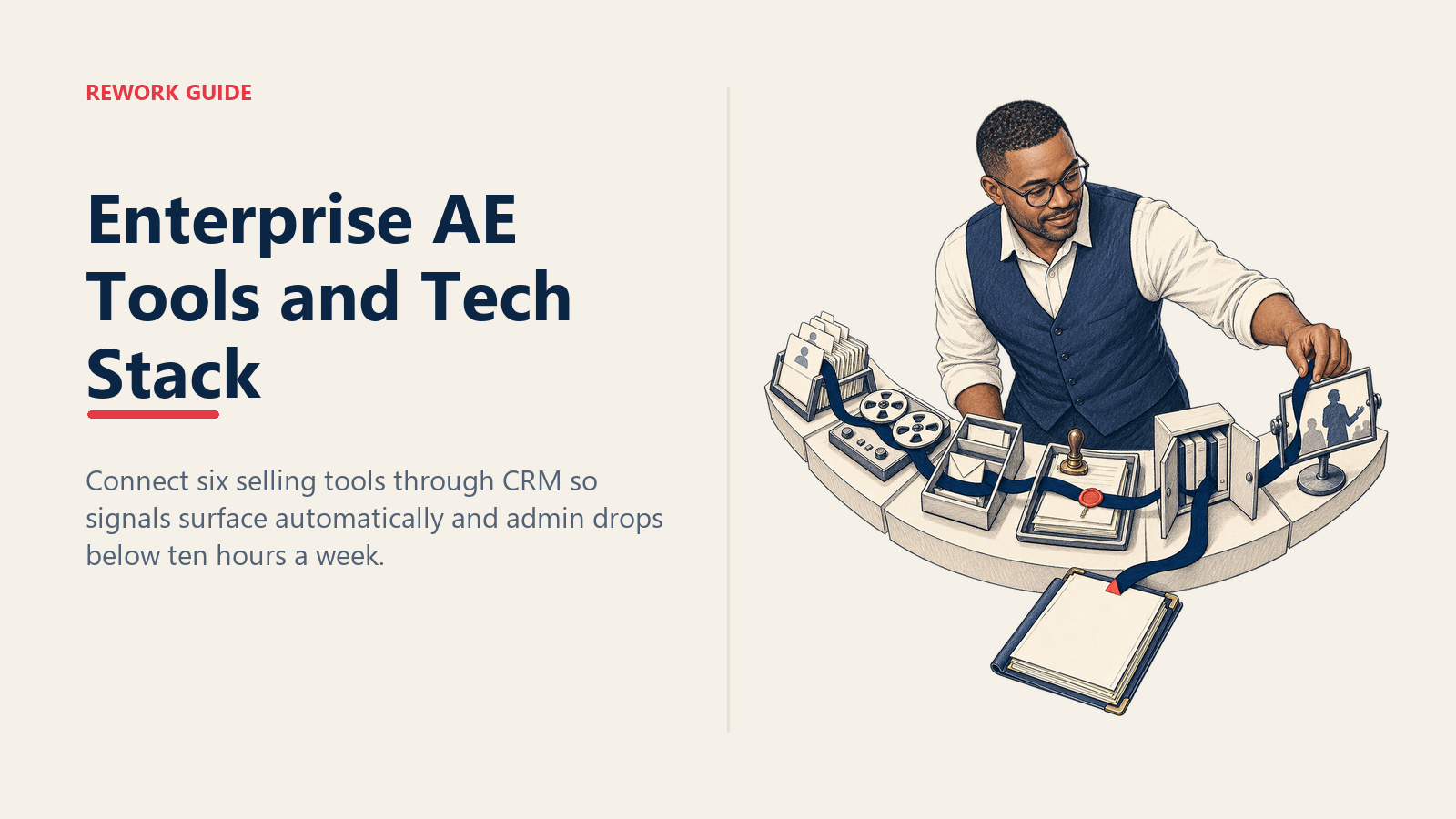
Six tools. No spine.
The EAE isn't selling. The EAE is reconciling tools.
This is the failure mode the right stack prevents. Not a productivity question. Not a "nice to have." It's the difference between an EAE who carries 12 enterprise deals at $800K average and an EAE who burns out trying to carry 8.
Why Stack Quality Is a Pipeline Ceiling
At enterprise deal sizes ($200K to $2M, 6+ stakeholders, 9 to 12 month cycles), administrative load scales non-linearly with deal count. An EAE running 12 deals with a disconnected stack spends 40 to 50 percent of the work week on tool reconciliation: copy-pasting between systems, re-typing call notes, hunting for the latest deck, asking legal where a redline lives.
An EAE with an integrated stack pushes that to 15 to 20 percent and reinvests the recovered hours into things that actually move enterprise deals: champion development, executive prep, multi-thread expansion, and discovery that goes deeper than the surface pain.
That's the math. The stack isn't about features. The stack is a ceiling on how much enterprise pipeline one human can carry. The stack you tolerate is the productivity you get.
This piece serves two audiences. Enterprise AEs who want to know what to push their RevOps team to fix. RevOps leaders designing tooling for an enterprise selling motion who don't want to get talked into a 53-tool "best in breed" stack nobody can actually use. Same blueprint, both jobs.
The Six-Layer Enterprise AE Stack
Six layers, in priority order. If you can't fully fund all six, fund them in this sequence. Skipping a higher-priority layer to add a lower-priority one is how stacks become expensive without becoming useful.
Layer 1: CRM as Deal Source-of-Truth
The non-negotiable layer. Every stakeholder, every touch, every next step, every risk lives here. If it's not in CRM by 6 PM, it didn't happen.
Enterprise-grade options: Salesforce, HubSpot Enterprise, or Rework CRM (the Sales Engine from $69 per month billed yearly, or the Revenue Engine at $159 per month billed yearly with lead management added), one option for teams that want CRM, lead management, and cross-team work in a single stack instead of stitching three vendors together. The choice matters less than what you do with the one you pick.
What enterprise customization actually looks like:
- Stakeholder roles per opportunity. Not "contact" as a flat list. Each tagged as economic buyer, champion, technical evaluator, procurement, end user, or detractor. Without this, you have no multi-thread map.
- MEDDPICC or MEDDIC fields. Metrics, Economic Buyer, Decision Criteria, Decision Process, Paper Process, Identify Pain, Champion, Competition. Required fields, not optional.
- Mutual close plan. A structured field linking to the shared close plan with the buyer. If it's blank past discovery, the deal isn't qualified.
- Champion temperature. A field, not a vibe. Updated weekly. A champion who hasn't taken a call in two weeks isn't a champion.
- Risk register. Three named risks, refreshed at each stage gate.
Set the rule: no deal review without CRM updated within 24 hours of the meeting. Managers who run pipeline reviews off memory are coaching ghosts.
Layer 2: Conversation Intelligence for Multi-Stakeholder Calls
The EAE runs calls with four to eight people on the customer side. Sometimes more. They cannot take notes and run the meeting. Conversation intel is not optional at enterprise scale.
Named options: Gong, Chorus by ZoomInfo, or equivalent. The job: auto-capture the meeting, surface objections, flag competitor mentions, time-stamp pricing pushback, and let the EAE re-listen to a CFO's exact wording before the next executive call.
The mistake most teams make is buying the platform and never re-listening. The intel only pays back if the EAE re-watches the moments where a stakeholder hesitated, disagreed, or shifted tone. That's where the next-move signal lives. RevOps tip: feed call summaries directly into the CRM opportunity record. If the AE has to switch tabs to find what the buyer said, they won't.
Layer 3: Sequencer for Multi-Thread Cadences
Outreach, Salesloft, or Apollo. But used very differently than mid-market.
Enterprise sequences are not high-volume cold blasts. They're parallel, role-specific cadences. One cadence for the economic buyer, with a different tone, different proof points, and different timing than the cadence to the technical evaluator. A third cadence for procurement contact. The sequencer's job is to enforce that the EAE sends the right thing to the right role on a defensible cadence, not to flood inboxes.
The anti-pattern: dumping all stakeholders from a $1.4M deal into a single 8-step generic sequence. One bad sequenced email to the champion and the EAE has to explain to a senior buyer why they got the same template a junior SDR sent six weeks ago. That conversation is unwinnable.
Sequences for enterprise are personalization scaffolding. They remind the AE to send the executive summary on day 4 and the security one-pager on day 7. They don't write the email. The AE writes the email. The sequencer just ensures it gets sent.
Layer 4: E-sign and Contract Velocity
DocuSign, PandaDoc, or Ironclad for CLM. Enterprise deals die in legal review. They don't lose to competitors as often as they lose to weeks of redline back-and-forth that quietly let the buyer's quarter end without a signature.
The right e-sign and CLM platform shows redline history, version diff, and signature status without a single email to legal. RevOps wires it so the AE sees redline activity as a CRM field, not as a buried email thread noticed Friday afternoon when the deal is already three days behind.
A small-sounding integration that pays back enormously: when legal opens the document, when redlines are added, when procurement opens the latest version, those events write to the CRM opportunity timeline automatically. Procurement velocity is measurable, and the EAE only manages what they can see.
Layer 5: Deal Rooms (Digital Sales Rooms)
Mutiny, Mindtickle DSR, Aligned, Dock. The highest-leverage tool addition for EAEs in 2026, and most teams still don't have it.
Replace "deck attached to email" with a single shared workspace per deal. The buyer accesses the latest pricing, ROI model, security docs, mutual close plan, and recorded demo at one URL. The EAE sees who viewed what, when, and how long they stayed on the ROI tab. That data tells you which stakeholder is doing the internal selling and which one needs another call.
Enterprise deals are won inside the buyer's company, not in the room with the seller. The champion has to convince three stakeholders the AE has never met. A deal room compresses that internal cycle 30 to 50 percent because the champion isn't forwarding stale PDFs. They send one link.
The deal room is the artifact that makes multi-threading scale. You can't email seven stakeholders eight times each. You can host one shared room and watch who shows up.
Layer 6: AI Roleplay and Executive Prep
Hyperbound, Second Nature, or internal AI tools. Before a CFO meeting on a $1.2M deal, the EAE rehearses with an AI playing the CFO: pushback on pricing, ROI scrutiny, the questions a real CFO will actually ask in minute six of the call.
20 minutes of rehearsal, measurably better live performance. AEs who use this consistently report a step-change in executive presence within a quarter. The ones who don't keep showing up under-prepared and learning the answers in front of the buyer, which is an expensive way to learn.
RevOps tip: build internal personas off real customer call recordings, not stock vendor personas. A CFO persona that talks like your actual customers is worth ten times more than a generic one.
For where AI fits across the broader EAE workflow, see AI in the Enterprise AE Workflow.
The Integration Spine
The integration spine matters more than the tool selection. Six best-in-class tools that don't talk to each other are worse than four mediocre tools that do.
The non-negotiable rule: if a tool doesn't write to CRM and surface signal automatically, it's not an enterprise tool. It's a tab the AE forgets to open.
Specifically, every tool must do at least two of these three things:
- Write to CRM automatically. Calls logged, emails synced, document opens, deal-room views, redline activity. If a human has to copy something from tool A to CRM, that data is going to be 50 percent stale 50 percent of the time.
- Surface signal without manual log-in. A digest in Slack, an email summary, a CRM field that lights up. The AE shouldn't have to remember to check 14 tabs at 9 AM.
- Save the AE at least 30 minutes per week. If a tool can't justify 30 minutes of saved admin time, it's overhead. Kill it.
A tool that fails two of those three is a candidate for removal. Run that test on every tool in the stack, every six months. Stack discipline is a maintenance practice, not a procurement decision.
The EAE Stack Rubric
A 1-page checklist for evaluating tools or auditing the existing stack:
- Does it write to CRM automatically?
- Does it surface signal without manual log-in?
- Does it save at least 30 minutes per week?
- Does it serve the enterprise motion specifically, or was it tuned for high-velocity SMB?
- Does it have a real cost per AE per month, or has the per-seat cost ballooned to the point where the team can't afford to keep using it?
Pass three of five, keep it. Fail three of five, kill it. Be honest. Tools that AEs "could use better" are tools nobody actually uses.
The Weekly Tool Audit (Friday at 4 PM)
15 minutes. Every Friday. Non-negotiable for any EAE running 8 or more active deals.
- Are CRM notes current on every active deal?
- Are sequences matched to current deal stage? (A discovery sequence still running on a deal that's now in procurement is noise.)
- Are deal rooms updated for active deals? (New ROI numbers, latest security docs, current pricing.)
- Did conversation intel surface anything I missed this week? (Re-listen to the two highest-stakes calls.)
- Is anything in the e-sign queue waiting on me? (Or the buyer's legal team that I should be nudging?)
This audit is how the stack stays useful instead of becoming a graveyard of half-updated tools. AEs who skip the Friday audit are AEs whose Mondays start in chaos.
The Daily Checklist
Roughly 45 minutes total, spread across the day. Most of it lives inside CRM if the integration spine is working.
Morning (15 min): CRM review (what deals moved, what stalled, what slipped). Deal-room check (who viewed which artifacts overnight). Conversation-intel digest (read the auto-generated summaries from yesterday's calls).
Midday (15 min): Sequencer touches (the AE-written, AE-sent personal touches the sequencer queued). E-sign status (anything stuck, anything closing today).
Evening (15 min): CRM hygiene (every meeting from today logged, every next step entered, every stakeholder updated). Tomorrow's prep (what calls am I in, what's the prep brief for each).
For a full picture of how the daily rhythm fits into a real enterprise selling week, A Day in the Life of an Enterprise AE shows how this checklist plays out across deal stages.
Five Common Pitfalls
1. No CRM hygiene. The most expensive stack in the world fails when the CRM is stale. If notes from yesterday's call aren't in by tonight, the next call is run from memory. At 12 deals, memory is not a system.
2. Sequencer-as-spam. Treating Outreach like an SMB volume play. Enterprise champions get one bad sequenced email and the EAE loses the relationship. Sequences for enterprise are personalization scaffolding, not automation throughput.
3. Ignoring conversation intel. Buying Gong, never re-listening. The intel only pays back if the EAE actually goes back and watches the 90 seconds where the buyer's tone shifted.
4. Tool sprawl without an integration spine. 14 tools, none connected. Every tool that doesn't write to CRM is a tool that adds reconciliation work.
5. RevOps designs for the average AE, not the enterprise AE. Enterprise selling motion has different requirements than mid-market. A stack tuned for 80 deals per quarter at $30K average is the wrong stack for 12 deals per quarter at $800K. Audit the stack against the actual deal profile, not the headcount-weighted average.
Measuring Stack ROI
Four numbers tell you whether the stack is working.
Admin hours per week. Target: under 10 hours of pure tool reconciliation. Enterprise AEs in well-tooled orgs report 6 to 8. Poorly tooled orgs report 18 to 22. The delta is one extra major deal worked per quarter, and that's not a small number when one deal might be $800K in ARR.
Deal velocity. Median days from stage to stage. The right stack doesn't replace selling, but it eliminates the dead air between meetings. Watch for compression in legal and procurement stages. That's where stack ROI shows up first.
Multi-thread depth. Average active stakeholders per deal. A working sequencer plus deal room should push this from 2 or 3 to 5 to 7 within a quarter. Not because more people are involved (they always were) but because more people are now visible and reachable.
Forecast accuracy. AEs with disciplined CRM hygiene and current deal-room data forecast within 10 percent. AEs without it forecast within 25 to 30 percent. The CRO notices the second number. The CRO notices it loudly.
For the broader metric set EAEs are evaluated against (not just stack-driven metrics but selling outcome metrics) see Enterprise AE Metrics That Actually Matter.
What to Do With This
If you're an Enterprise AE: take this list to your RevOps lead and ask, layer by layer, what we have, what doesn't write to CRM, and what we've been tolerating that's costing us hours. Don't ask for more tools. Ask for the integration spine.
If you're a RevOps leader designing the stack: pick one tool per layer. Wire them all to CRM. Run the rubric every six months. Resist the urge to add a seventh layer because a vendor showed you a slick demo. The seventh tool is almost always the one that breaks the spine.
The stack's job is not to add features. The stack's job is to compress admin time into coaching, relationship, and strategy time. When it's doing that, the AE will be on calls, not in tabs.
Six tools, one spine, ten hours a week reclaimed. That's the brief.

Principal Product Marketing Strategist
On this page
- Why Stack Quality Is a Pipeline Ceiling
- The Six-Layer Enterprise AE Stack
- Layer 1: CRM as Deal Source-of-Truth
- Layer 2: Conversation Intelligence for Multi-Stakeholder Calls
- Layer 3: Sequencer for Multi-Thread Cadences
- Layer 4: E-sign and Contract Velocity
- Layer 5: Deal Rooms (Digital Sales Rooms)
- Layer 6: AI Roleplay and Executive Prep
- The Integration Spine
- The EAE Stack Rubric
- The Weekly Tool Audit (Friday at 4 PM)
- The Daily Checklist
- Five Common Pitfalls
- Measuring Stack ROI
- What to Do With This