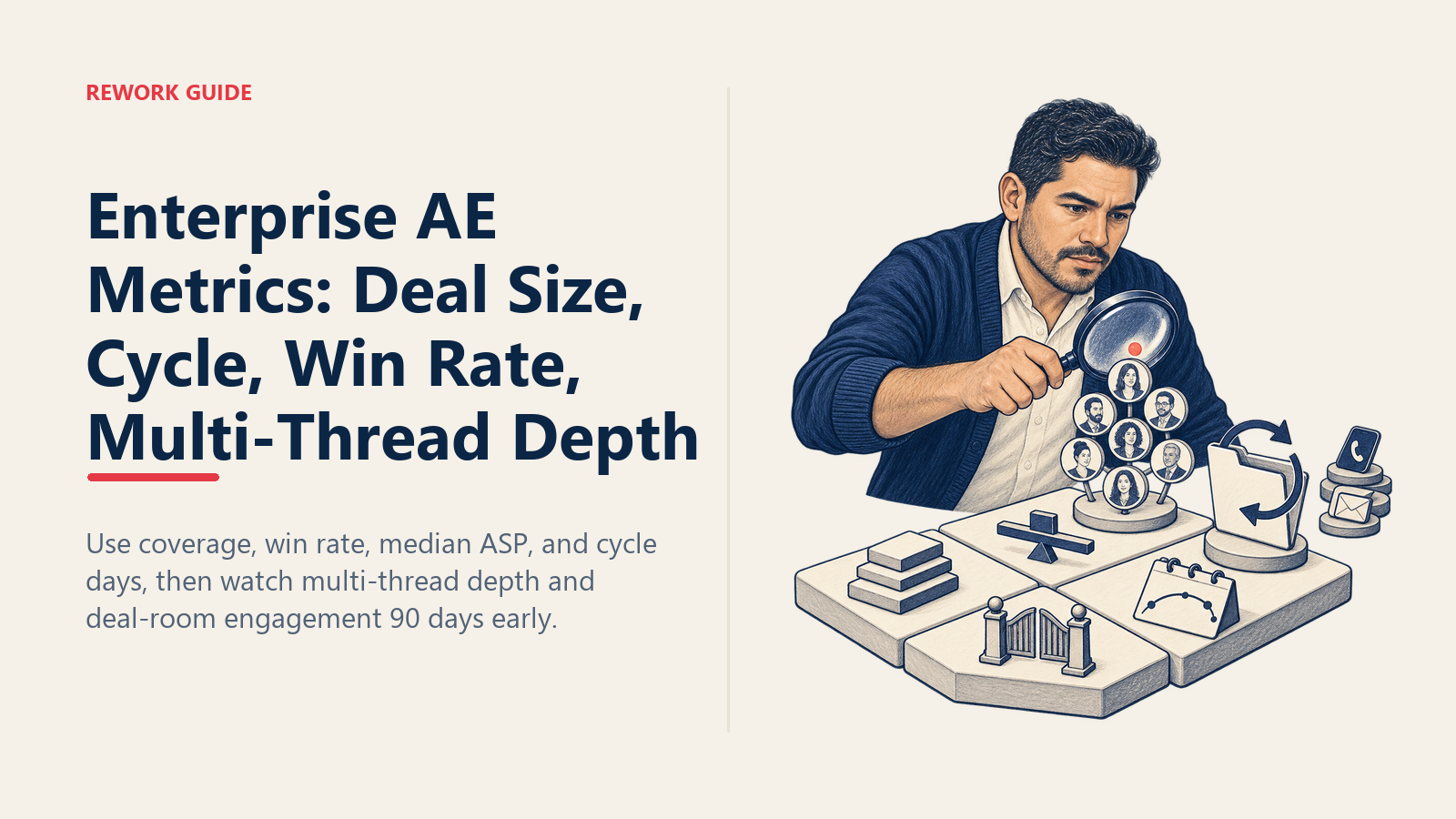
Enterprise AE Metrics: Deal Size, Cycle, Win Rate, Multi-Thread Depth
Turn this article into takeaways for your work.


Each assistant summarizes the article only for you and suggests best practices for your work.
The 4-Number EAE Math (Memorize This)
- Pipeline Coverage: 5–7x of remaining quota, measured by stage, not in total
- Win Rate: Segmented by deal size: the only segment that pays the mortgage is $1M+
- Average Sale Price (ASP): Use median, not mean; one whale will lie to you
- Cycle Days: Median time from first qualified meeting to closed-won, by deal size band
- Two leading indicators: Multi-thread depth (5–7 stakeholders for $500K+, 8–12 for $1M+) and deal-room engagement (opens, return visits, forward shares)
- The headline number: Deals with fewer than 3 contacts close around 12%. Deals with 7+ contacts close around 48%. Multi-thread depth is the single strongest leading indicator we have.
It's the second week of month three. You're at 70% of quota with one quarter left. Three deals you've been calling "great" since January have slipped for the second time. Your manager pings you on Slack: "What's the one number we should be looking at?"
You don't have an answer. You've been tracking calls, emails, and demos (the activity metrics your SDR ramp drilled into you), and somehow none of it tells you whether the three deals are going to close. The pipeline coverage report says you're at 4.2x. That feels fine until you realize half of it is in stage 2 with deals 5 months from a decision.
This is the moment most enterprise AEs realize the volume metrics that worked in SMB are noise at the enterprise level. Activity dashboards don't predict $500K outcomes. Four numbers do, plus two leading indicators that fire 90 days before the deal closes or dies.
Why Enterprise Quota Math Is Structurally Different
A mid-market AE running a $1M quota might close 40 to 80 deals a year at a $15K ASP. Volume metrics (calls per day, demos per week, opportunities created per month) work for them because the law of large numbers smooths out the variance. Run enough activity and the funnel produces a predictable conversion rate.
An enterprise AE running a $5M quota closes 8 to 15 deals a year at a $500K ASP. The law of large numbers does not apply. One bad deal can be 10% of your quota. One champion change can cost you a quarter. Activity volume is irrelevant. Calling 50 people at one Fortune 500 buying committee will not get you to 51, and most of the additional calls add nothing once you're already in the deal.
What does work is depth: multiple stakeholders, multiple use cases, multiple champions. Enterprise selling rewards the AE who knows seven stakeholders well over the AE who knows seventy stakeholders barely. The metrics need to reflect that, and most CRM dashboards, designed for high-velocity teams, do not.
Number 1: Pipeline Coverage (5–7x, by Stage)
Coverage is the ratio of qualified pipeline to remaining quota. SMB teams use 3x. Enterprise teams need 5–7x because:
- Win rates are lower (20–30% at $500K, 15–25% at $1M+)
- Slip risk is higher (procurement, legal, security review can all push a deal out a quarter)
- Deal lumpiness means you can't average your way to safety
The mistake is reporting coverage as a single number. An EAE at "5x coverage" with 80% of pipeline in stage 2 (early discovery) and 20% in stage 4 (proposal) has a very different forecast than an EAE at 5x with the inverse split.
Coverage by stage: minimum healthy ratios:
| Stage | Definition | Minimum coverage | Why |
|---|---|---|---|
| 2: Discovery | Pain confirmed, multiple stakeholders identified | 4x | High volume, low close probability |
| 3: Solution Fit | Demo done, technical validation in progress | 3x | Reasonable conversion expected |
| 4: Proposal | Pricing shared, mutual close plan | 2x | Most should land |
| 5: Verbal | Champion committed, paper in flight | 1.2x | Slip-buffer only |
If any stage is below its minimum 90 days before quarter close, the gap is unrecoverable through that quarter. The cycle is too long. You have to source new top-of-funnel and accept the current quarter is going to be at risk.
Number 2: Win Rate (Segmented by Deal Size)
A blended win rate is misleading at the enterprise level. The win rate at $1M+ is the only one that pays the mortgage, and it's almost always lower than your blended number suggests.
A typical EAE win-rate distribution:
| Deal size | Typical win rate | Why |
|---|---|---|
| $50K–$250K | 32% | Smaller buying committees, faster decision |
| $250K–$500K | 25% | Procurement engages, security review starts |
| $500K–$1M | 20% | Multi-stakeholder sign-off, legal review |
| $1M+ | 15–18% | Board visibility, vendor consolidation pressure, multi-quarter cycle |
If your blended win rate is 24% and you assume it applies uniformly, you'll over-forecast every $1M+ deal. The fix is to forecast each deal at its segment's win rate, not the team blended rate. A $1.2M deal in stage 3 isn't a 24% probability; it's closer to 15% until something specific de-risks it (multi-thread depth, executive sponsor confirmed, mutual close plan signed).
Track win rate trending by segment, by quarter, for the last six quarters. If the $1M+ rate is dropping, your ICP or your champion-development motion is slipping and no amount of activity will fix it. See Enterprise AE Common Pitfalls for the patterns that drag $1M+ win rates down quietly.
Number 3: Average Sale Price (Use Median)
ASP drift is the silent quota killer. Your team's ASP can fall 20% over four quarters without anyone flagging it because:
- One $2M whale per quarter masks the trend in the average
- Sales leadership reports mean ASP, which gets distorted by outliers
- Reps celebrate the whale, not the median, so the slow drift toward smaller deals goes unspoken
Use median, not mean. Median strips the outlier effect. If your team's mean ASP is $620K but the median is $340K, you have an ASP problem hiding behind one or two flagship deals. The quota math built on $620K will not produce the deal count you need.
A simple guardrail: track median ASP by quarter on a rolling 4-quarter chart. If it's falling, the explanation is almost always one of three things:
- ICP drift: reps are working accounts that don't have the budget for the full platform
- Discount creep: procurement is winning more aggressively, and reps are conceding to close
- Land-strategy distortion: initial lands are getting smaller, and the expand motion is not yet returning ARR
Each of these has a different fix, but you can't pick the right fix if you're staring at a mean that hides the trend.
Number 4: Cycle Days (Median, By Deal Size)
Same logic. Mean cycle is distorted by the one deal that took 18 months. Median cycle by deal-size band is the number you actually plan against.
Typical enterprise medians:
| Deal size | Median cycle (first qualified meeting → closed-won) |
|---|---|
| $250K–$500K | 5–6 months |
| $500K–$1M | 7–9 months |
| $1M+ | 9–12 months |
The cycle number is not just for forecasting. It's for pipeline timing. If you need to close $5M in Q4 and your median $500K cycle is 9 months, the pipeline that produces Q4 revenue had to be sourced in Q1. Sourcing in July for December close is wishful thinking; the procurement process alone is often 60–90 days at the back end.
Track the stage-to-stage median cycle too. Most slip happens between proposal and verbal. That's where procurement, security review, and legal compress timelines you didn't budget for. Read Navigating Procurement and Legal for the back-end timing reality that most cycle-day estimates underweight.
Sample Math: The $5M EAE Walkthrough
Here is the four-number math worked all the way through. If you can't reproduce this on a napkin, the rest of the article hasn't landed yet.
Inputs:
- Annual quota: $5,000,000
- Median ASP: $500,000
- Win rate at this segment: 25%
- Coverage required: 6x
- Median cycle: 9 months
Step 1: Deals required: $5,000,000 ÷ $500,000 = 10 deals/year
Step 2: Qualified opportunities required: 10 deals ÷ 25% win rate = 40 qualified opps/year
Step 3: Pipeline dollars required (coverage): 40 opps × $500,000 ASP × 6x coverage ÷ 6x = $20M of pipeline (Or: 10 deals × $500K × 6x coverage = $30M if you express coverage against quota dollars rather than expected closed dollars. Both framings circulate; the discipline is to pick one and apply it consistently.)
Step 4: Lead time: 9-month median cycle means the pipeline that closes in December must be qualified by March. Sourcing in October for December close is too late. Even one round of procurement will push you past year-end.
Step 5: Quarterly source target: 40 opps ÷ 4 quarters = 10 newly qualified opps every quarter, sustained, to keep the engine in steady state.
Sanity check the year:
| Quarter | New opps sourced | Pipeline dollars added | Deals closed | ARR closed |
|---|---|---|---|---|
| Q1 | 10 | $5M | 2 | $1.0M |
| Q2 | 10 | $5M | 2 | $1.0M |
| Q3 | 10 | $5M | 3 | $1.5M |
| Q4 | 10 | $5M | 3 | $1.5M |
| Total | 40 | $20M | 10 | $5.0M |
If any quarter sources fewer than 10 opps, the gap shows up two to three quarters later, not immediately. That delay is why so many EAEs hit the back half of the year underwater after a "good" Q1: they coasted on inherited pipeline and stopped sourcing.
Leading Indicator 1: Multi-Thread Depth
Lagging metrics tell you what already happened. Multi-thread depth tells you what's about to happen.
The number to track: distinct stakeholders engaged per active deal. Engaged means a real interaction in the last 30 days: meeting, email reply, deal-room visit. Not "I scraped their LinkedIn into the contact list."
Benchmarks by deal size:
| Deal size | Target stakeholders | Floor (below this = at risk) |
|---|---|---|
| $250K–$500K | 4–6 | 3 |
| $500K–$1M | 5–7 | 4 |
| $1M+ | 8–12 | 6 |
Why this matters: deals with fewer than 3 contacts close at roughly 12%. Deals with 7+ contacts close at roughly 48%. The relationship is causal in both directions. Single-threaded deals lose the champion and die; multi-threaded deals survive personnel changes, find new use cases, and expand their own scope.
Track multi-thread depth as a weekly trend on the active pipeline. A deal where stakeholder count is dropping week over week is going dark even if the champion still answers. The full playbook for building this depth is in Multi-Threading Enterprise Deals.
Leading Indicator 2: Deal-Room Engagement
If you use a digital deal room (Mutual Action Plan tool, shared workspace, or a CRM-linked sales room), you have engagement signal that fires three weeks before the deal goes dark.
Three signals to watch:
- Document opens. Is anyone other than your champion opening the proposal, the security packet, the ROI doc?
- Return visits. Did stakeholders open it once and never come back, or are they returning?
- Forward shares. Has the doc been shared internally? An ROI deck shared to a CFO who wasn't in your contact list is a positive signal even if you don't know who opened it.
A deal where engagement was 5–7 unique opens per week and drops to zero for 14 days is going dark. That signal precedes the "we're going to delay this to next quarter" email by about three weeks. You have time to act. Most EAEs miss it because they're tracking activity (their own outbound) instead of engagement (the buyer's behavior).
Common Pitfalls
Over-indexing on activity. Calls per day, emails sent, demos run: these matter for an SDR. They are noise for an EAE. The enterprise rep who runs 30 calls a week and closes one $1M deal per quarter outperforms the rep who runs 80 calls and closes none.
Tracking only lagging metrics. Closed-won, ARR, quota attainment: these tell you the result. By the time they're red, the quarter is already over. Multi-thread depth, deal-room engagement, and stage-to-stage cycle days let you see the problem in time to fix it.
No multi-thread tracking at all. Single-threaded deals look healthy in CRM until the champion takes a new job. The CRM doesn't have a "champion just left" field, but a contact-count field that reads "1" tells you the same story.
Reporting mean ASP and mean cycle. One whale destroys the average. Median forces honesty.
Forecasting blended win rate. A $1.5M deal forecast at the team's 24% blended rate is over-forecast by roughly 35–40%. Use the segment-specific rate.
The Weekly EAE Scorecard (One Page, Six Numbers)
The whole point of the four numbers plus two leading indicators is that they fit on one page. Here's the template:
| Metric | This week | Last week | Status |
|---|---|---|---|
| Pipeline coverage by stage (each stage min met?) | 2: 4.2x / 3: 3.1x / 4: 2.0x / 5: 1.4x | 2: 4.5x / 3: 2.8x / 4: 1.7x / 5: 1.1x | Yellow (stage 4 just at minimum) |
| Median ASP, last 8 closed | $480K | $495K | Yellow (drifting) |
| Win rate at $1M+, rolling 4Q | 19% | 18% | Green |
| Median cycle days, $500K+ band | 248d | 252d | Green |
| Avg multi-thread depth, active pipeline | 5.4 | 5.1 | Green |
| Deal-room engagement, top 5 deals (opens last 14d) | 4, 7, 0, 11, 2 | 6, 9, 3, 8, 4 | Red (deal #3 dark) |
Six numbers. One page. Reviewed every Monday. If a manager and an EAE can't have a useful 15-minute conversation off this page, the page is broken. Fix the page, not the conversation. For context on how this fits into the rest of the EAE week, see Day in the Life of an Enterprise AE.
Measuring Success
The metrics-on-metrics that tell you the system is working:
- Forecast accuracy within ±10% by month two of every quarter. If you're more than 10% off in week eight, the leading indicators aren't being trusted.
- Ramp-to-quota under 9 months for new EAEs. Possible only if pipeline-build discipline is taught from week one.
- Win rate at $1M+ trending up quarter over quarter. The segment that determines whether the team will scale or stall.
- Average multi-thread depth ≥ 5 across active pipeline at all times. The leading indicator that protects against champion loss.
How Rework Supports Enterprise AE Metrics
Most EAEs juggle three places to track this: the CRM has the deals and stages, a spreadsheet has the coverage math, and the deal-room tool (or LinkedIn) has the multi-thread reality. The handoffs are where the metrics break. A deal with 8 stakeholders engaged in the deal room shows up in CRM as 1 contact because no one ever updated the record. Rework CRM puts coverage by stage, win rate by segment, multi-thread count, and deal-room engagement signal on the same record, and rolls them up to the weekly scorecard automatically. Pricing starts at $69/month billed yearly for the Sales Engine with 5 sales seats included, which is the budget conversation an EAE shouldn't have to fight to win when one missed forecast costs the company more than three years of seat fees. The companion Enterprise Account Executive job description describes the role this metric stack supports.
What to Do Monday Morning
If you've been running on activity metrics and want to switch:
- Pull your last 8 closed deals. Calculate median ASP and median cycle days.
- Segment your pipeline by deal-size band ($250K, $500K, $1M+) and apply segment-specific win rates.
- For your top 5 active deals, count distinct engaged stakeholders in the last 30 days.
- For any deal under 4 stakeholders, schedule outreach to widen the thread this week.
- Set up the six-number weekly scorecard. Review it every Monday. Change one thing each week based on what it tells you.
The four-number math doesn't care how you feel about the pipeline. It tells you the truth about whether the quarter will close. Run it.
Learn More

Principal Product Marketing Strategist
On this page
- Why Enterprise Quota Math Is Structurally Different
- Number 1: Pipeline Coverage (5–7x, by Stage)
- Number 2: Win Rate (Segmented by Deal Size)
- Number 3: Average Sale Price (Use Median)
- Number 4: Cycle Days (Median, By Deal Size)
- Sample Math: The $5M EAE Walkthrough
- Leading Indicator 1: Multi-Thread Depth
- Leading Indicator 2: Deal-Room Engagement
- Common Pitfalls
- The Weekly EAE Scorecard (One Page, Six Numbers)
- Measuring Success
- How Rework Supports Enterprise AE Metrics
- What to Do Monday Morning
- Learn More