Solution Selling: Process and Examples
Turn this article into takeaways for your work.


Each assistant summarizes the article only for you and suggests best practices for your work.
Solution selling is the methodology that changed how B2B sales teams think about their job. Instead of walking into a meeting with a pitch deck ready to go, solution sellers walk in with questions. And the first order of business is understanding the buyer's problem, not explaining the product.
It sounds obvious now. But when Michael Bosworth introduced the framework in the early 1980s, most sales training still revolved around product features, objection scripts, and closing techniques. Solution selling was a genuine shift.
What Is Solution Selling?
Solution selling is a sales methodology that focuses on identifying and diagnosing a prospect's specific pain points, then positioning your product or service as the solution to those pains. Rather than leading with features or capabilities, a solution seller leads with discovery: asking questions, mapping the buyer's current state, and building a shared picture of what "solved" looks like before any product discussion happens.
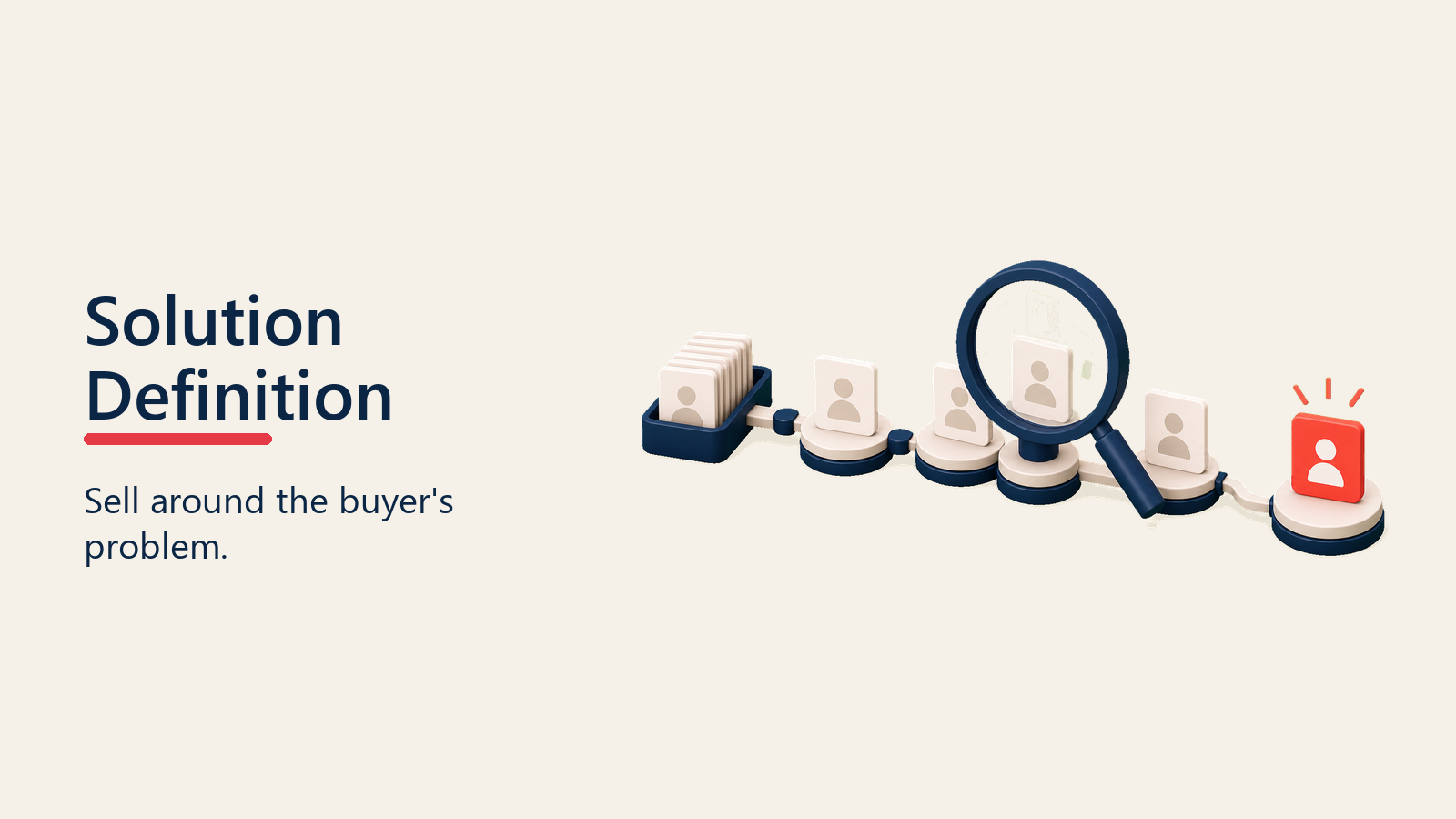
Michael Bosworth developed the framework in the early 1980s based on his work at Xerox. He later codified it in his 1994 book "Solution Selling: Creating Buyers in Difficult Selling Markets." The core premise is that buyers don't want products; they want relief from problems. Your job as a seller is to help them see their pain clearly, develop a vision of the solution, and make the case that your offering delivers that vision.
Key Facts
- Companies that adopt formal solution selling training report 28% higher win rates on competitive deals compared to product-led sales teams (Richardson Sales Performance, 2022).
- 74% of B2B buyers say they choose the vendor who first helped them understand their problem clearly, before anyone discussed a solution (Gartner, 2023).
- The average enterprise B2B deal now involves 6 to 10 decision-makers, which makes pain-centric discovery more important than ever since each stakeholder has a different version of the problem (Gartner, 2022).
Solution selling works best in complex B2B environments: long sales cycles, multiple stakeholders, high deal values, and problems that aren't fully understood by the buyer. It pairs well with qualification frameworks like MEDDIC and BANT, which help you determine whether a deal is worth pursuing, while solution selling guides how you pursue it.
Solution Selling vs Product Selling
The clearest way to understand solution selling is to put it next to what came before it.
| Dimension | Product Selling | Solution Selling |
|---|---|---|
| Opening move | Present features and capabilities | Ask discovery questions about the buyer's situation |
| Focus | What the product does | What the buyer needs to fix |
| Demo timing | Early, often first meeting | After pain is diagnosed and vision is aligned |
| Sales rep role | Product expert | Trusted advisor / problem solver |
| Buyer outcome | Understands the product | Understands their own problem and sees a path forward |
| Works best for | Simple, transactional, short-cycle sales | Complex B2B, multi-stakeholder, longer-cycle deals |
| Risk of failure | Commodity pricing wars, no differentiation | Takes longer to get to the pitch, requires strong discovery skills |
Product selling isn't wrong. For simple, high-velocity transactions, it's actually more efficient. But when the deal is complex and the buyer doesn't fully understand the scope of their own problem, leading with the product creates a mismatch. The buyer hears features; they needed to feel pain relief first.
The Solution Selling Process
Solution selling follows a disciplined sequence. You don't skip steps or re-order them. Each phase builds on the last.
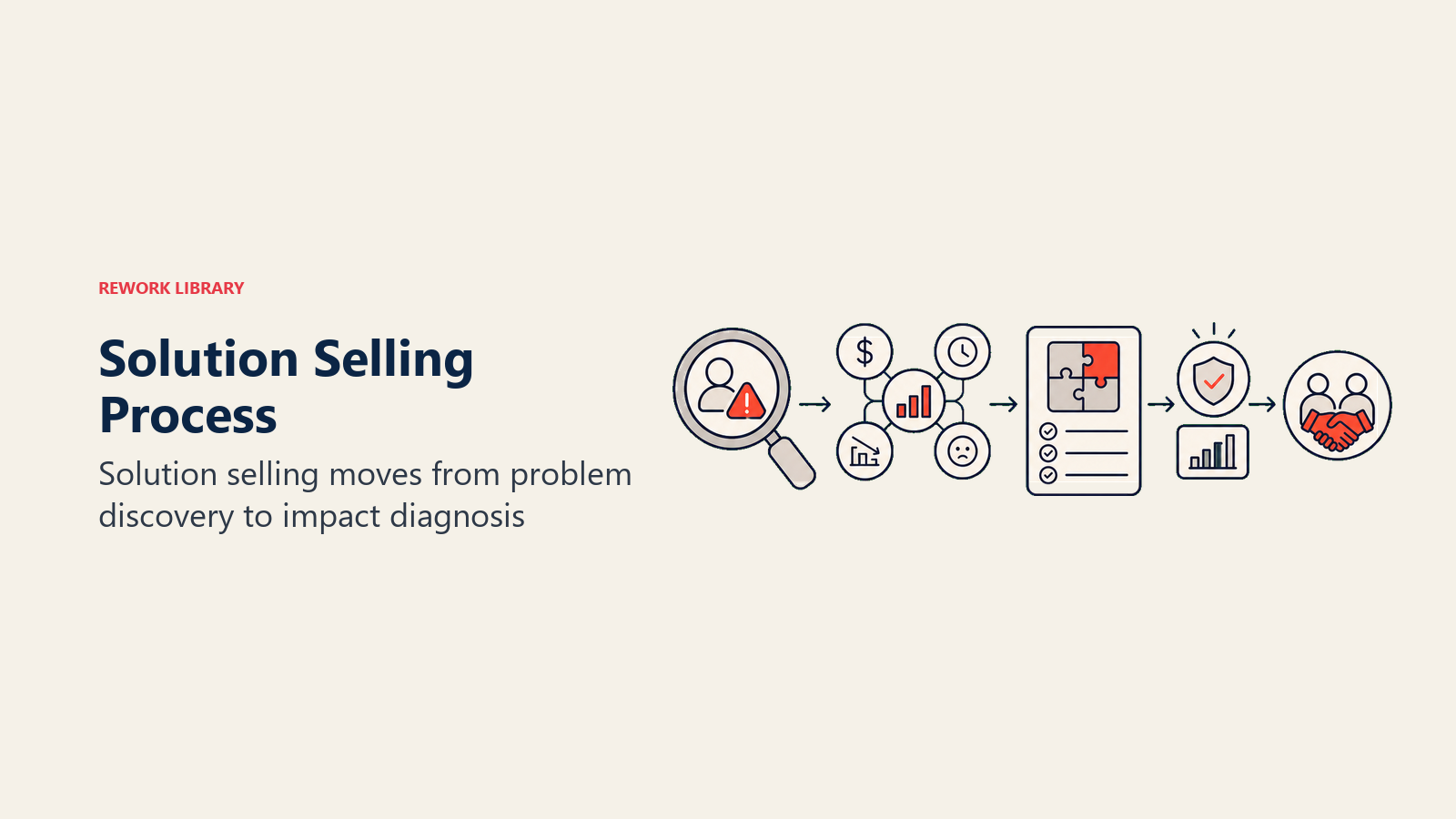
1. Prospect for Pain, Not Just Fit
Most sales prospecting filters for firmographic fit: company size, industry, revenue. That's table stakes. Solution sellers add a second filter: is there a likely pain worth solving?
Before reaching out, research the account. Look for signals: recent tech investment that might be underperforming, a growth stage that typically creates operational pressure, a competitive announcement that shakes up the status quo. You're trying to develop a hypothesis about the buyer's problem before you ever speak to them.
This shapes your outreach. Instead of "we help companies like yours with X," you lead with "I've noticed companies in your situation often deal with Y. I'd like to share how we've helped others fix it." That's a pain hypothesis, not a product pitch.
2. Diagnose the Pain
This is the core of solution selling. Once you're in front of the buyer, your job is to help them articulate their problem, often more clearly than they could on their own.
Use structured discovery questions: What are they currently doing? Where is it breaking down? What does that cost in time, money, or opportunity? Who else in the organization feels the impact?
Pain has three levels in the solution selling model:
- Latent pain: The buyer senses something is off but hasn't quantified it or prioritized fixing it.
- Active pain: The buyer knows there's a problem and is thinking about solving it.
- Vision: The buyer has a picture of what solved looks like and is actively evaluating solutions.
Your job in discovery is to move buyers from latent to active pain, and then help them build the vision. If you skip this and go straight to the pitch, you're selling to latent pain, and that almost never closes.
For a structured approach to this qualification stage, the opportunity qualification framework gives you a repeatable way to score deals based on how clearly pain is defined.
3. Develop the Vision of a Solution
Once the pain is real and quantified, you help the buyer build a picture of what success looks like. You're not telling them what the solution is. You're asking them to describe it.
"If this problem went away, what would be different in your workflow? What would your team be able to do that they can't do now?"
This does two things. It deepens the buyer's emotional investment in solving the problem. And it lets you map the vision directly to your capabilities without sounding like a pitch. When the buyer says "I'd need something that handles X automatically and gives my manager visibility into Y," and your product does exactly that, the match feels like discovery, not selling.
4. Prove the Value
Now you present. But it's a targeted presentation, not a standard demo. You're showing how your solution addresses the pain they've articulated and fulfills the vision they've described.
This is where proof points matter: case studies, ROI calculations, reference customers who faced the same problem. You're answering the implicit question the buyer is already asking: "Will this actually work for us?"
In multi-stakeholder deals, tailor the proof to each person's version of the pain. Finance needs different evidence than operations. The executive sponsor needs outcomes; end users need to see the workflow change.
Good deal progression management discipline keeps this stage on track. Each proof step should move the deal forward, not just maintain the relationship.
5. Negotiate and Close
By the time you reach negotiation, you've already established that the solution addresses the pain and delivers the vision the buyer described. You're not defending why your product exists; you're working out the logistics of deployment.
Procurement will push on price. Security reviews will add timelines. But the foundation is solid: the buyer wants what you're offering and said so in their own words. Common close-stage risks are the champion getting reassigned, the economic buyer not releasing budget, or a competitor re-entering with a lower price after you did all the discovery work. Deal progression management and a clear mutual action plan are your defenses.
Solution Selling vs Challenger Sale vs Consultative Selling
These three methodologies share DNA but differ in what they ask the seller to do.
| Dimension | Solution Selling | Challenger Sale | Consultative Selling |
|---|---|---|---|
| Origin | Michael Bosworth, 1983 | Dixon and Adamson, 2011 | Mack Hanan, 1970 |
| Core mechanic | Diagnose pain, build vision together | Teach, tailor, take control | Align to business objectives, co-create value |
| Seller posture | Curious advisor who draws out pain | Expert who challenges buyer's thinking | Strategic partner who works at the executive level |
| When it works best | Buyer has a pain but hasn't fully defined it | Buyer is comfortable with the status quo and needs disruption | Long-term, strategic enterprise relationships |
| Key risk | Slow cycle if discovery drags | Can feel aggressive if poorly calibrated | Requires deep business acumen to execute |
| How they interact | Often combined with Challenger at the insight stage | Can layer on top of solution selling discovery | Compatible with both; emphasizes relationship depth |
The Challenger Sale is sometimes positioned as the successor to solution selling, but they're not mutually exclusive. Challenger adds a "teach" phase where the rep brings insight the buyer didn't have. Solution selling's discovery phase makes that teaching land better because you know exactly where the buyer's thinking has gaps.
Why Solution Selling Works
A few reasons this methodology has lasted four decades while other frameworks came and went.
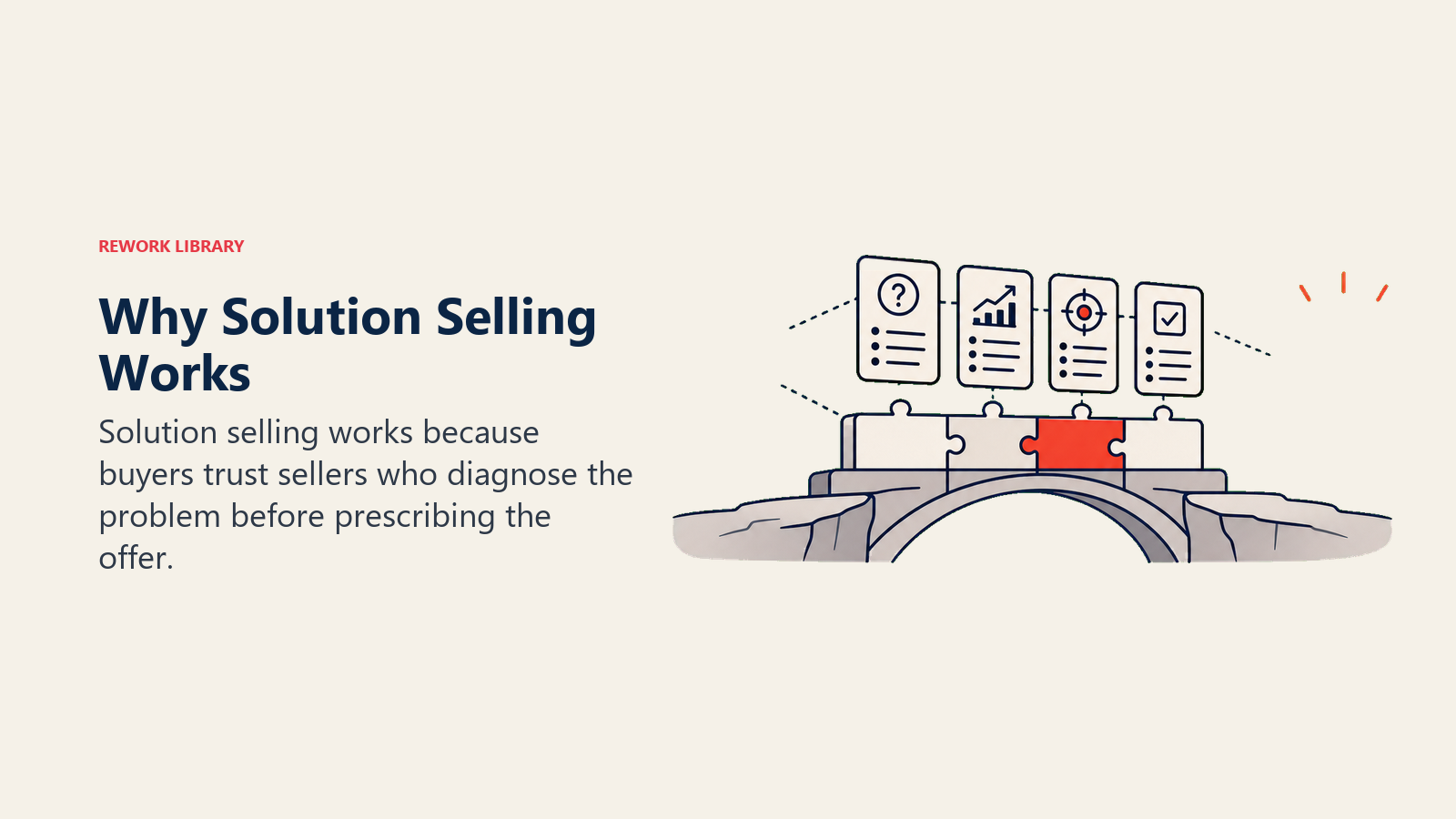
Buyers trust people who understand them. When a rep demonstrates they grasp the pain before talking about the product, it signals competence. That trust compounds through the whole sales cycle.
Discovery reduces competitive risk. If you've helped the buyer define what "solved" looks like, your capabilities are baked into that definition. Competitors who arrive later with a standard pitch are playing catch-up.
It aligns your pipeline to real buying intent. Deals where pain is clearly diagnosed close at higher rates than deals where the buyer is still vague about their problem. For teams managing a structured sales pipeline, the pain-diagnosis stage is often what separates real opportunities from wishful thinking.
It works across deal sizes. The core mechanic, diagnose before pitching, applies whether the deal is $10,000 or $1,000,000. Discovery depth scales with complexity, but the principle holds everywhere.
Solution Selling Examples
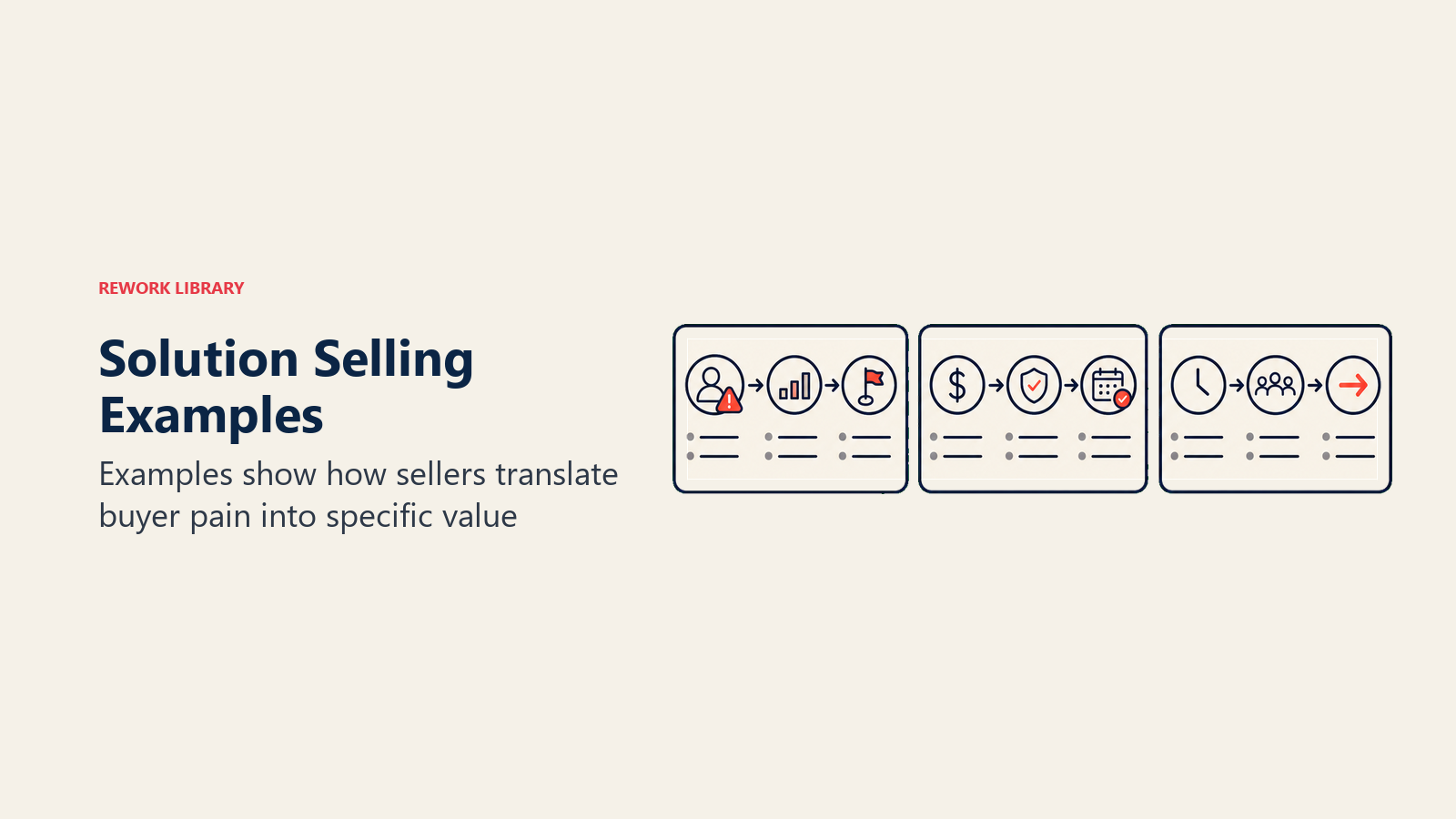
Here's how a solution selling engagement plays out for a B2B software company selling pipeline analytics to a VP of Sales.
| Stage | What Happens | What the Rep Does |
|---|---|---|
| Prospecting | VP of Sales at a 200-person SaaS company just missed Q1 quota. | Rep sends a message referencing the missed-quota pattern common in scaling teams and asks for 20 minutes. |
| Pain Diagnosis | First call covers the current forecasting process, where deals get stuck, and the VP's confidence in the pipeline number. | Uncovers that the forecast is unreliable because reps don't log activity consistently. |
| Vision Building | Rep asks: "If you had real-time pipeline visibility, what decisions would you make differently going into Q2?" | VP describes wanting earlier warnings on slipping deals and rep accountability without micromanaging. |
| Proof | Rep demos a filtered view: deals with no activity in 14 days, flagged automatically. | Ties the demo to the pain from discovery. Shows a case study where a similar company improved forecast accuracy by 31%. |
| Close | VP aligns internally and brings procurement in. Negotiation focuses on contract length and implementation. | Rep provides a mutual action plan with next steps for procurement, IT, and the VP's ops team. |
Notice that the product wasn't mentioned until the VP described what she needed, in her own words. That's solution selling.
Common Mistakes
Starting with the demo. This is the most common failure mode. Reps default to the demo because it's comfortable, and it kills deals by presenting before pain is real.
Surface-level discovery. Asking "what are your challenges?" and accepting "we want to be more efficient" is not pain diagnosis. You need to push for specifics: what breaks, how often, what it costs, who else feels it.
Building the vision without the buyer. If you tell the buyer what the vision is instead of asking them to describe it, you lose the emotional ownership that makes the close easier.
Skipping qualification. Not every buyer with pain is worth pursuing. Use a framework like BANT or MEDDIC to confirm budget, authority, and timeline before investing deep discovery cycles.
Neglecting multi-stakeholder alignment. In complex deals, the VP of Sales has different pain than the CFO or the ops manager. You need to run the pain-vision conversation with each key stakeholder, not just the champion.
Best Practices
Create a pain hypothesis before every outreach. Research the account, develop a specific idea about what might be hurting, and lead with it. You'll get more responses and better first conversations.
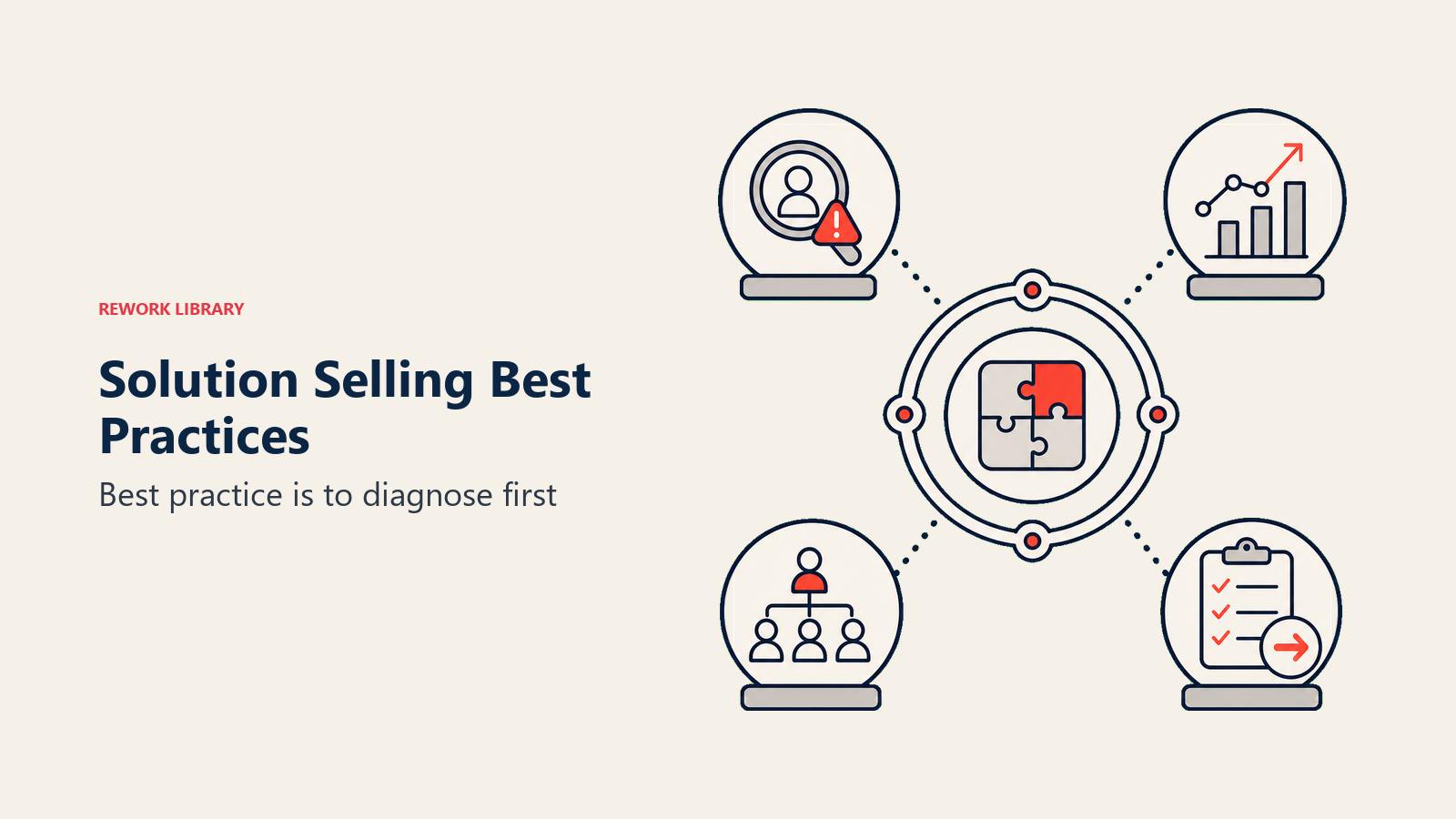
Use a structured discovery framework. Whether it's a formal questioning model or a consistent set of internal questions, don't wing discovery. The quality of your diagnosis depends on the depth of your questions. SPIN selling gives you a complementary question structure that works naturally inside solution selling's discovery phase.
Document the pain in the buyer's words. When you write up the vision or send a follow-up email, use the exact language the buyer used to describe their problem. It signals that you were listening and reinforces their ownership of the diagnosis.
Align your lead qualification frameworks to pain clarity. The cleanest signal that a deal is real is that the buyer can articulate their pain without prompting. If they can't, you're probably still in latent pain territory and need more discovery before advancing the stage.
Measure pipeline health by pain quality. Not all qualified opportunities are equally solid. Teams that track "pain clearly defined and quantified" as a pipeline milestone tend to have more predictable forecasts. The MEDDIC framework gives you a structured way to capture pain metrics in your CRM.

Head of Enterprise Solutions
On this page
- What Is Solution Selling?
- Solution Selling vs Product Selling
- The Solution Selling Process
- 1. Prospect for Pain, Not Just Fit
- 2. Diagnose the Pain
- 3. Develop the Vision of a Solution
- 4. Prove the Value
- 5. Negotiate and Close
- Solution Selling vs Challenger Sale vs Consultative Selling
- Why Solution Selling Works
- Solution Selling Examples
- Common Mistakes
- Best Practices