MQL-zu-SQL-Schwellenwerte: Wie Sie die Zahl festlegen, mit der beide Teams leben können
Turn this article into takeaways for your work.


Each assistant summarizes the article only for you and suggests best practices for your work.
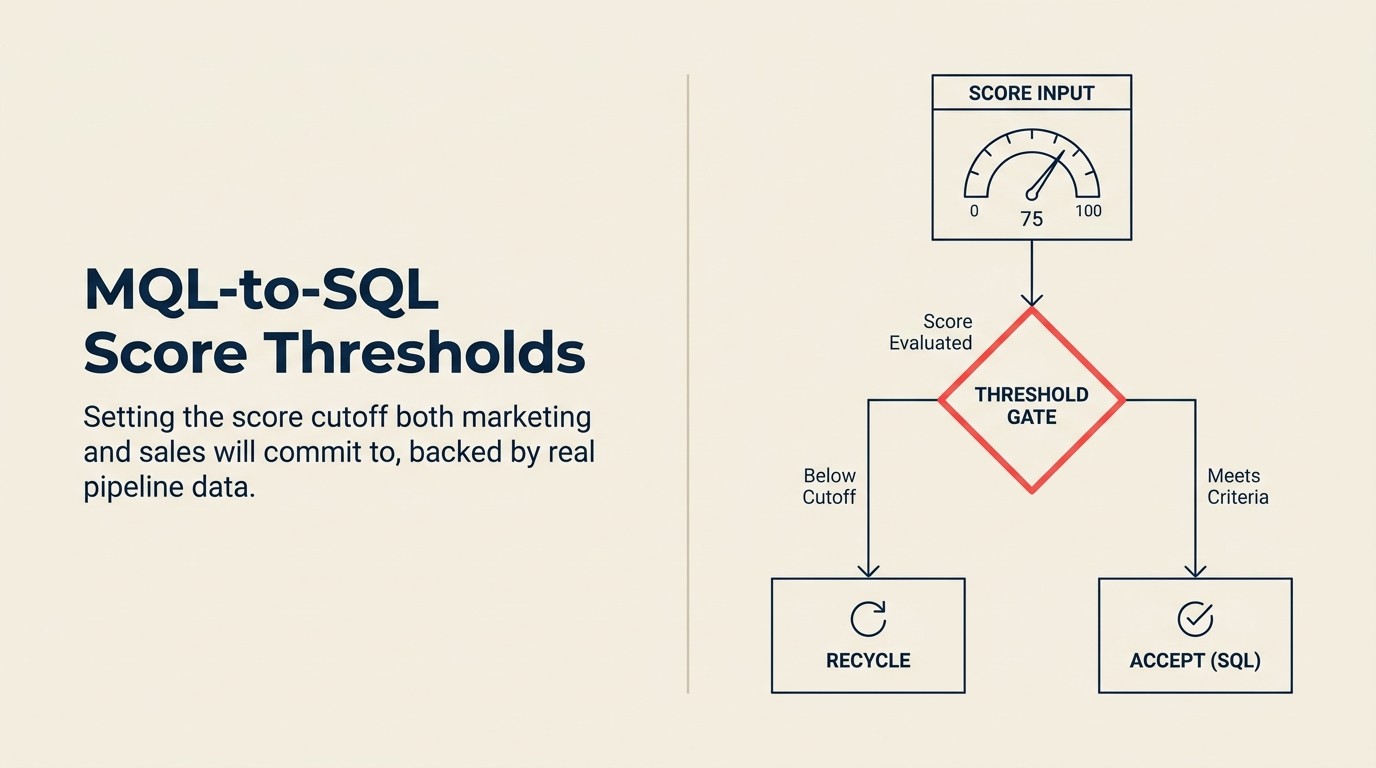
Die meistdiskutierte Zahl in jedem Revenue-Team ist nicht die Quota. Es ist der MQL-Schwellenwert.
Marketing möchte ihn niedriger haben. Sales möchte ihn höher haben. RevOps möchte ihn „datengetrieben" haben. Am Ende einigen sich alle auf eine Zahl (meistens 50, 75 oder 100), die entweder von einem früheren Mitarbeiter übernommen, einem Blogartikel entnommen oder einfach deshalb gewählt wurde, weil sie rund klang.
Keines davon ist per se falsch. Aber keines davon ist auch richtig, denn der MQL-Schwellenwert ist keine mathematische Antwort. Er ist eine strategische Entscheidung. Er bestimmt, wie viele Leads pro Monat an Sales übergeben werden, wie die durchschnittliche Qualität dieser Leads aussieht und unter welchem Druck Marketing steht, Pipeline zu erzeugen. Liegt er in die falsche Richtung, bricht etwas: Entweder ertrinkt Sales in minderwertigen Leads, oder Marketing wird für eine Pipeline-Lücke verantwortlich gemacht, die eigentlich ein Schwellenwertproblem ist.
So legen Sie einen Schwellenwert fest, den beide Teams mittragen können, untermauert durch Daten aus Ihrem eigenen CRM.
B2B-Sales-Teams, die MQL-Schwellenwerte auf Basis von Closed-Won-Analysen festlegen, anstatt Anbieterstandards oder runde Zahlen zu verwenden, erzielen laut Forrester Research eine bis zu 30 % höhere MQL-zu-Opportunity-Konversionsrate.
Wenn MQL-Schwellenwerte zu niedrig angesetzt werden, liegen die Ablehnungsraten in fehlausgerichteten Unternehmen im Durchschnitt bei 40–60 %, was bedeutet, dass Vertriebsmitarbeiter einen erheblichen Teil ihrer Zeit damit verbringen, Leads auszusortieren, anstatt Abschlüsse zu erzielen (SiriusDecisions-Benchmark-Daten).
Unternehmen, die den Volume-Quality-Tradeoff modellieren, bevor sie einen Schwellenwert ändern, indem sie eine +15/-15-Szenarioanalyse durchführen, reduzieren das Risiko von Pipeline-Störungen, weil beide Teams gemeinsame Daten als Diskussionsgrundlage haben.
Was der Schwellenwert tatsächlich steuert
Bevor Sie an der Zahl drehen, lohnt es sich zu verstehen, was Sie eigentlich anpassen.
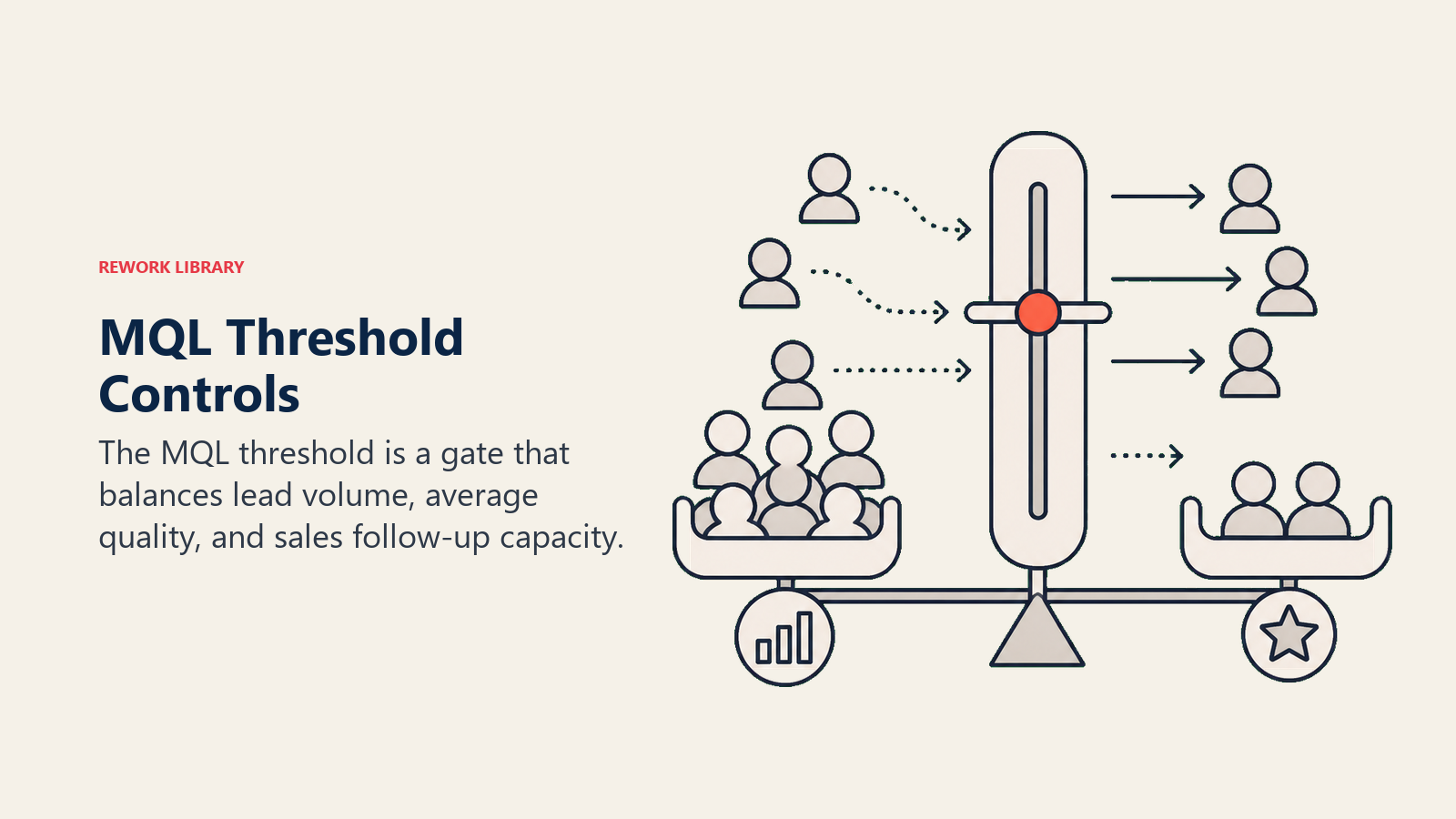 Der MQL-Schwellenwert ist ein Gate. Wenn der kumulierte Score eines Leads diesen überschreitet, wird der Lead von MQL zu SQL umgewandelt und zur Nachverfolgung an Sales weitergeleitet. Jeder Punkt, um den Sie den Schwellenwert verschieben, beeinflusst gleichzeitig drei Dinge.
Volumen der an Sales weitergeleiteten Leads. Senken Sie den Schwellenwert um 20 Punkte, könnte sich die Anzahl der durchfließenden Leads verdoppeln. Erhöhen Sie ihn um 20 Punkte, erhält Sales halb so viele Leads, erwartet aber, dass diese doppelt so bereit sind. Keines davon ist von Natur aus besser. Es hängt von der Sales-Kapazität, der Reaktionsgeschwindigkeit der Mitarbeiter und der Konversionsrate in den einzelnen Score-Bändern ab.
Durchschnittliche Qualität bei der Übergabe. Das ist das, worauf Sales am meisten Wert legt. Wenn Mitarbeiter 40 % ihrer Zeit mit Leads verbringen, die nicht konvertieren, ist der Schwellenwert wahrscheinlich zu niedrig. Wenn sie 80 % dessen abschließen, was Marketing übergibt, sich aber über das Volumen beschweren, ist er wahrscheinlich zu hoch.
Produktionsdruck für Marketing. Ein hoher Schwellenwert bedeutet, dass Marketing mehr Rohleads generieren muss, um dieselbe Anzahl von MQLs zu produzieren. Das kostet mehr bei Media-Ausgaben, mehr bei Content, mehr bei Campaign-Overhead. Ein niedriger Schwellenwert entlastet den Druck auf die Top-of-Funnel-Generierung, verlagert das Problem aber nach unten in den Funnel.
Diese drei Faktoren sind nicht unabhängig voneinander. Wenn Sie einen optimieren, beeinflussen Sie die anderen. Deshalb ist der Schwellenwert ein strategisches Gespräch, keine Konfigurationsaufgabe. Und ohne einen Daten-Anker lässt sich dieses Gespräch nicht führen.
Wichtige Fakten: Lead Scoring und MQL-Schwellenwerte
- Unternehmen mit eng aufeinander abgestimmten MQL-zu-SQL-Übergabeprozessen erzielen laut MarketingProfs-Forschung zu Marketing-Sales-Alignment 209 % mehr Umsatz aus Marketingmaßnahmen.
- Nur 27 % der an Sales weitergeleiteten Leads werden jemals kontaktiert, was bedeutet, dass die Schwellenwertkalibrierung einen überproportionalen Einfluss darauf hat, welche Leads tatsächlich bearbeitet werden (InsideSales.com).
- Unternehmen, die ihre Lead-Scoring-Schwellenwerte quartalsweise überprüfen und rekalibrieren, erzielen im Vergleich zu Teams, die Schwellenwerte einmal festlegen und nie ändern, eine bis zu 30 % höhere MQL-zu-Opportunity-Konversion (Forrester Research).
Einen ersten Schwellenwert festlegen: Die Threshold-Setting-Methode
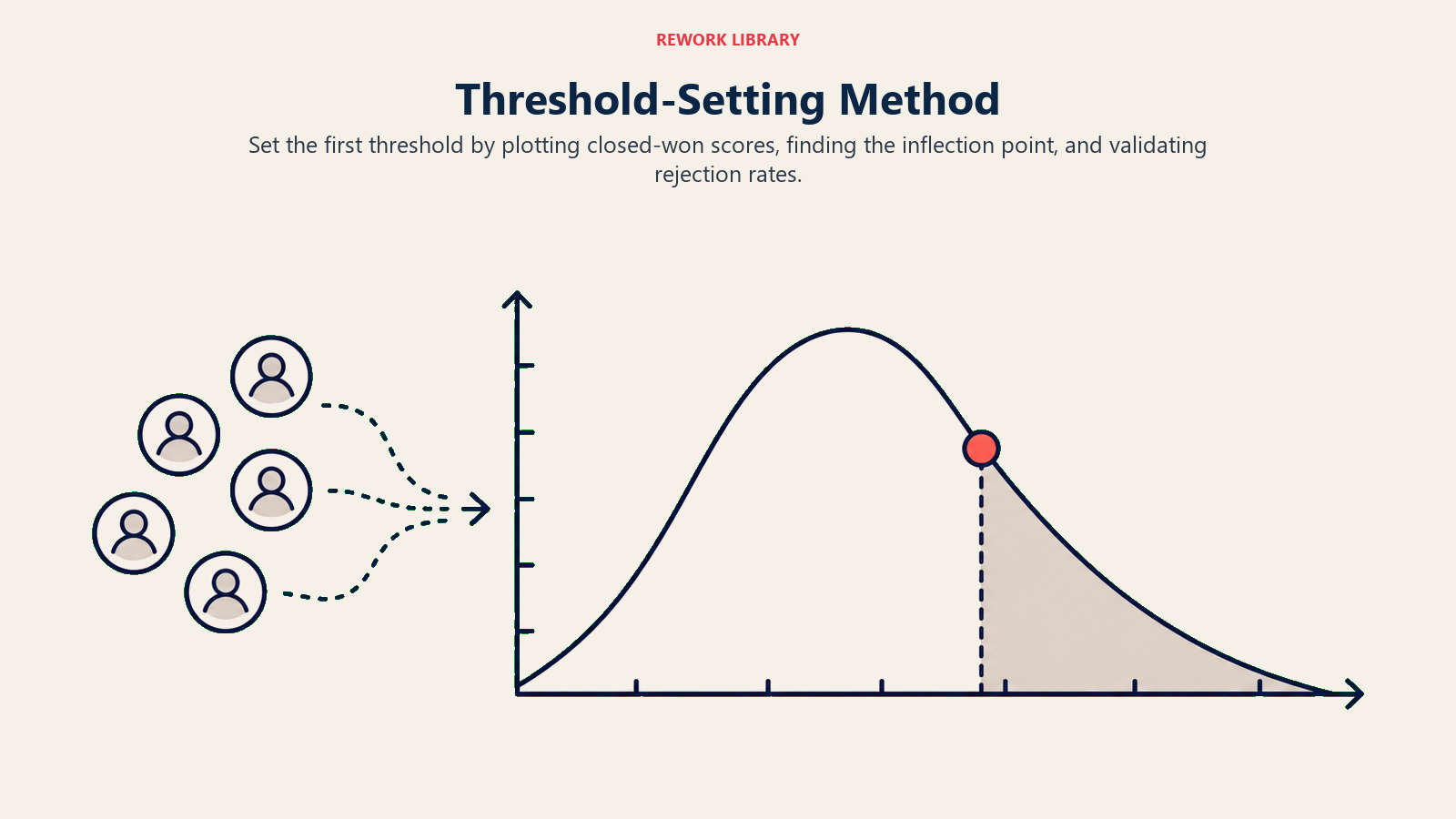
Die Threshold-Setting-Methode ist ein vierstufiger, datenorientierter Prozess zur Festlegung vertretbarer MQL-zu-SQL-Schwellenwerte. Anstatt eine runde Zahl von einem früheren Mitarbeiter zu übernehmen oder einen Anbieterstandard zu kopieren, verankert sie die Schwellenwertentscheidung in Ihren tatsächlichen Closed-Won-Daten: Ziehen Sie abgeschlossene Deals, plotten Sie die Score-Verteilung, finden Sie den Wendepunkt (nicht den Durchschnitt) und validieren Sie gegenüber Ihrer Ablehnungsrate. Das Ergebnis ist ein Schwellenwert, der darauf basiert, wie Ihre Käufer tatsächlich aussahen, als sie abgeschlossen haben, keine Vermutung.
 Wenn Sie von Grund auf neu beginnen oder einen willkürlich festgelegten Schwellenwert zurücksetzen, beginnen Sie mit Ihren historischen Closed-Won-Daten. Das ist der einzige ehrliche Ankerpunkt, den Sie haben. Ihr Lead-Qualifizierungs-Framework zeigt Ihnen, welche Attribute tatsächlich den Abschluss vorhersagen, nutzen Sie das als Scoring-Input, bevor Sie die Schwellenwert-Zahl anfassen.
Schritt 1: Ziehen Sie Ihre Closed-Won-Deals der letzten 12–18 Monate.
Exportieren Sie jeden Deal, der als gewonnen abgeschlossen wurde. Sie benötigen den Score des Leads zum Zeitpunkt der SQL-Konversion, nicht den heutigen Score, nicht den final angereicherten Score, sondern den Score bei der Übergabe. Einige MAPs protokollieren dies automatisch. Wenn Ihres das nicht tut, müssen Sie es anhand von Aktivitäts-Zeitstempeln rekonstruieren.
Schritt 2: Plotten Sie die Score-Verteilung.
Erstellen Sie ein Häufigkeitshistogramm der SQL-Scores zum Zeitpunkt der Konversion für diese gewonnenen Deals. Sie werden typischerweise etwas wie Folgendes sehen:
| Score bei SQL-Konversion | % der Closed-Won-Deals |
|---|---|
| < 40 | 8 % |
| 40–59 | 14 % |
| 60–79 | 31 % |
| 80–99 | 28 % |
| 100+ | 19 % |
Schritt 3: Finden Sie den Wendepunkt, nicht den Durchschnitt.
Der durchschnittliche Score über gewonnene Deals könnte 72 betragen. Aber das bedeutet nicht, dass 72 der richtige Schwellenwert ist. Suchen Sie nach der Stelle, an der die Verteilung die Steigung ändert, konkret dort, wo der Prozentsatz gewonnener Deals pro Score-Band stark ansteigt. In der obigen Tabelle liegt dieser Wendepunkt zwischen 60 und 80. Der Schwellenwert gehört nahe an den unteren Rand des Hochkonzentrationsbandes, nicht an den Mittelwert.
Schritt 4: Validieren Sie gegenüber der Ablehnungsrate.
Führen Sie dieselbe Analyse für abgelehnte oder nie kontaktierte Deals durch. Wie war ihr Score bei der SQL-Konversion? Wenn abgelehnte Leads stark unter 60 clustern, haben Sie gute Belege dafür, dass 60 ein vertretbarer Floor ist.
Diese Methode gibt Ihnen keine präzise Antwort. Aber sie gibt Ihnen eine Bandbreite, die darin begründet ist, was tatsächlich abgeschlossen wurde, nicht in Intuition oder Anbieterstandards. McKinseys Forschung zur Pipeline-Konversion zeigt konsistent, dass frühe Qualifizierungsdisziplin, nicht höheres Volumen, die größte Pipeline-Verbesserung bewirkt.
Der Volume-Quality-Tradeoff
Keine Schwellenwertkalibrierung ist vollständig, ohne zu modellieren, was passiert, wenn Sie die Zahl verschieben.
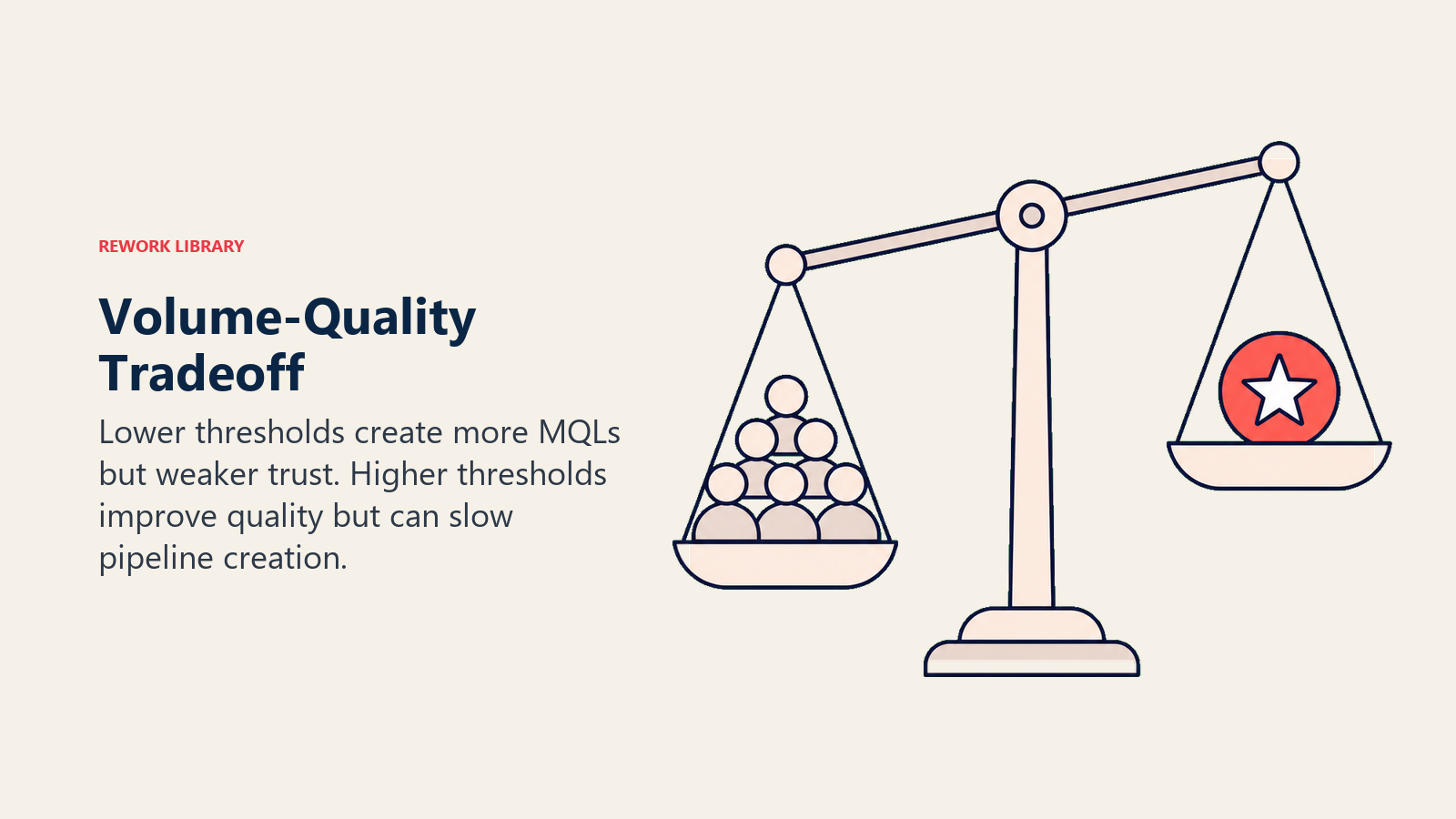 Schwellenwert zu niedrig setzen:
Marketing jubelt: Das MQL-Volumen sieht großartig aus. Aber Sales beginnt, mehr Leads abzulehnen. Ablehnungsraten steigen über 30 %, dann 40 %. Mitarbeiter verbringen mehr Zeit damit, „kein Match" einzuloggen, als Anrufe zu tätigen. Die Mitarbeiter, die an den minderwertigen Leads arbeiten, verschwenden Follow-up-Kapazität und verpassen ihre Connect-Rate-Ziele. Schließlich vertraut Sales der MQL-Bezeichnung überhaupt nicht mehr. Alles, was Marketing übergibt, wird standardmäßig mit Skepsis behandelt.
Das sind die versteckten Kosten eines niedrigen Schwellenwerts. Es verschwendet nicht nur die Zeit der Mitarbeiter. Es untergräbt die Glaubwürdigkeit des Lead-Qualifizierungssystems.
Schwellenwert zu hoch setzen:
Sales erhält weniger Leads, aber die Konversionsrate sieht beeindruckend aus. Marketing hat Schwierigkeiten, MQL-Ziele zu erreichen. Gute Leads, die zu 80 % bereit sind, aber den Schwellenwert knapp nicht überschreiten, altern in Nurture-Programmen aus und verlieren Aktualität und Intent-Signal. Marketing steckt in der Argumentationsschleife, dass die Pipeline-Lücke nicht ihre Schuld sei. Der Druck wächst, mehr Top-of-Funnel-Volumen zu generieren, anstatt die Qualifizierung zu verbessern.
So modellieren Sie den Tradeoff, bevor Sie den Schwellenwert ändern:
Ziehen Sie die Leads der letzten 90 Tage. Berechnen Sie für jedes Score-Band:
- Wie viele Leads waren in diesem Band
- Welcher Prozentsatz wurde zu Pipeline konvertiert
- Welcher Prozentsatz der konvertierten Pipeline wurde abgeschlossen
Modellieren Sie dann zwei Szenarien: Schwellenwert bei aktuell − 15 Punkte und Schwellenwert bei aktuell + 15 Punkte. Schätzen Sie den Pipeline- und Umsatzeinfluss jedes Szenarios. Das gibt dem Gespräch zwischen Marketing und Sales etwas Konkretes zum Diskutieren, anstatt Präferenzen.
Schwellenwert nach Segment
Ein einzelner Schwellenwert passt selten auf jedes Szenario. Erwägen Sie separate Schwellenwerte für:
Enterprise vs. SMB: Enterprise-Leads haben oft langsamere Verhaltenssignale. Ein VP in einem 2.000-Personen-Unternehmen besucht weniger Seiten, bevor er Kontakt aufnimmt, als ein Director in einem 50-Personen-Unternehmen. Wenn Sie denselben Schwellenwert auf beide anwenden, werden SMB-Leads systematisch überqualifiziert und Enterprise-Leads unterqualifiziert. Ein Schwellenwert von 65 für SMB und 45 für Enterprise könnte besser abschneiden als ein einheitlicher Wert von 60 für beide.
Inbound vs. Outbound-gestützt: Ein Lead, der vor dem Ausfüllen des Formulars von einem BDR kontaktiert wurde, hat ein anderes Intent-Profil als ein reiner Inbound-Lead. Ihre Verhaltens-Scores könnten niedriger sein, weil sie angestoßen wurden, nicht unabhängig suchten. Ein niedrigerer Schwellenwert für Outbound-gestützte Konversionen ist oft angemessen.
Neukunde vs. Erweiterung: Erweiterungs-Leads von bestehenden Kunden haben komprimierte Kaufzyklen und höhere Abschlussraten. Den gleichen Schwellenwert wie für Neukunden anzuwenden bedeutet, dass einige Erweiterungsmöglichkeiten im Nurture stecken bleiben, wenn sie direkt zum Account Management sollten.
| Segment | Empfohlener Startschwellenwert | Begründung |
|---|---|---|
| SMB Inbound | 60–70 | Höheres Verhaltenssignal erwartet |
| Enterprise Inbound | 40–55 | Langsameres Verhaltenstempo, dennoch hoher Fit |
| Outbound-gestützt | 35–50 | BDR-Vorqualifizierung reduziert Score-Abhängigkeit |
| Erweiterung / bestehender Kunde | 25–40 | Beziehungskontext ersetzt Verhaltenssignale |
Das sind Ausgangspunkte. Bauen Sie Ihre eigenen aus Ihren Closed-Won-Daten nach Segment.
Dynamische vs. feste Schwellenwerte
Ein fester Schwellenwert lautet: „Score ≥ 65 = SQL."
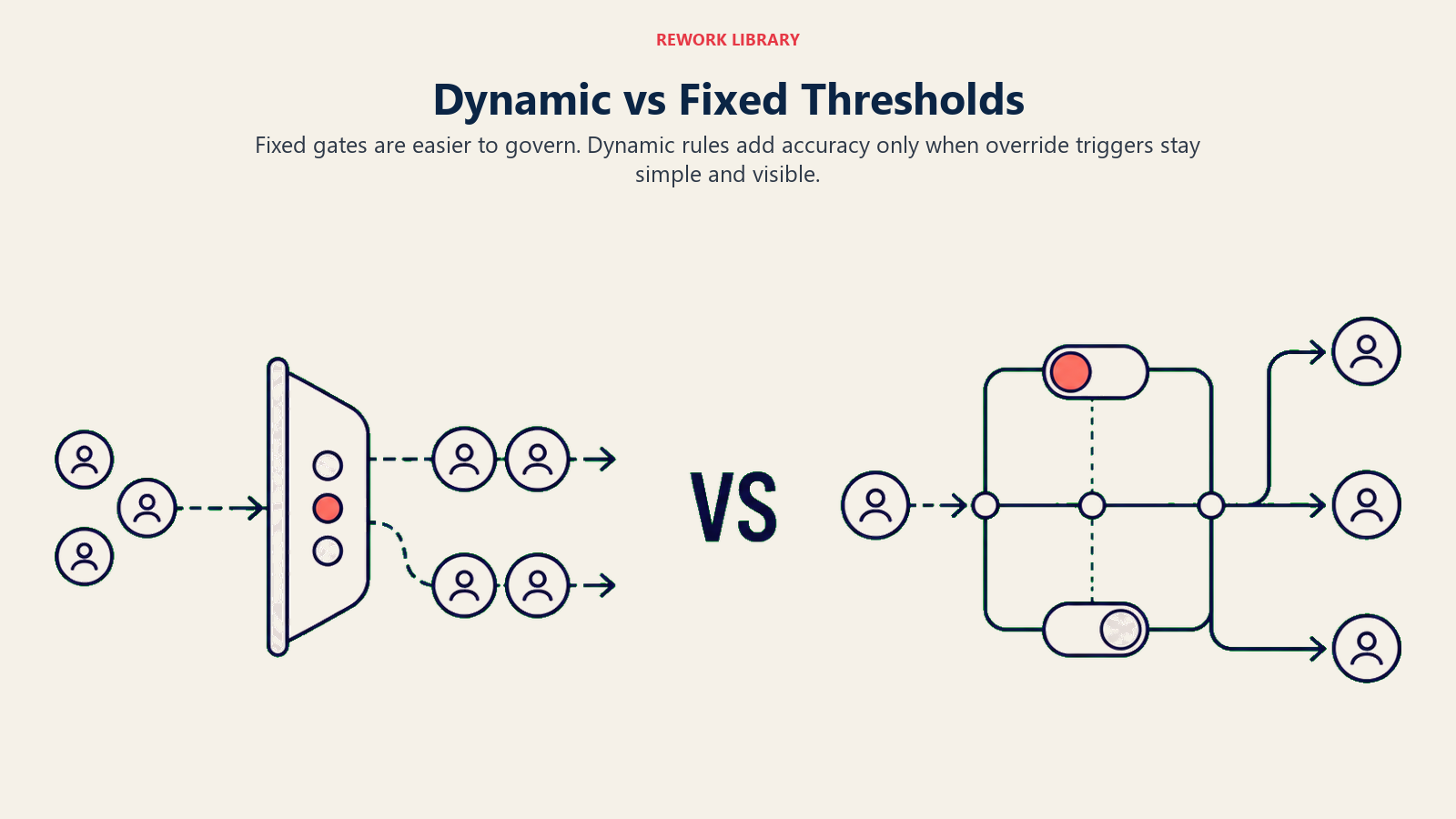 Ein dynamischer oder regelbasierter Schwellenwert lautet: „Score ≥ 65, ODER Score ≥ 45 UND Demo-Anfrage eingereicht."
Dynamische Schwellenwerte sind genauer, aber schwieriger zu verwalten. Sie funktionieren gut, wenn Sie spezifische High-Intent-Aktionen haben (Demo-Anfragen, Preisseiten-Besuche, direkter Chat), die das Score-Gate unabhängig von kumulierten Punkten überschreiben sollen.
Das Risiko ist die Komplexität. Wenn Ihre dynamischen Regeln zu einem Labyrinth aus ODER-Bedingungen und Ausnahmen werden, versteht niemand mehr, wann ein Lead ausgelöst wird. Streitigkeiten darüber, warum bestimmte Leads konvertiert wurden oder nicht, nehmen zu. Die Governance erodiert.
Ein praktischer Mittelweg: Behalten Sie einen festen Schwellenwert als primäres Gate und pflegen Sie nicht mehr als zwei High-Intent-Overrides. „Score ≥ 60, ODER Demo-Anfrage eingereicht, ODER direkter Inbound-Chat von einem Unternehmen, das dem ICP entspricht" ist verständlich. Zehn Override-Bedingungen sind es nicht.
Einigung beider Teams herbeiführen
Das Gespräch über den Schwellenwert scheitert, wenn es als die Zahl von Marketing gerahmt wird, mit der Sales leben muss. Es gelingt, wenn beide Teams verstehen, dass sie gemeinsame Eigentümer eines gemeinsamen KPI sind.
Rahmen Sie es als Service Level Agreement, nicht als Filter. Marketing verpflichtet sich, Leads auf einem bestimmten Qualitätsniveau weiterzuleiten. Sales verpflichtet sich, diese Leads innerhalb eines bestimmten Zeitrahmens zu bearbeiten. Der Schwellenwert definiert die Qualitätsseite dieses Vertrags. Der MQL-zu-SQL-Übergabeprozess definiert die Annahmeseite.
Verankern Sie das Gespräch in der Ablehnungsrate. Fragen Sie Sales: „Mit welcher Ablehnungsrate könnten Sie leben?" Wenn die Antwort 15 % ist, arbeiten Sie rückwärts, um den Schwellenwert zu finden, der basierend auf historischen Daten eine Akzeptanzrate von 85 % erzeugt. Das verschiebt die Debatte. Anstatt darüber zu streiten, was die Zahl sein sollte, lösen Sie ein Problem, an dem beide Teams interessiert sind.
Teilen Sie die Impact-Modellierung. Erstellen Sie vor dem Meeting das +15 / -15-Szenario-Modell. Zeigen Sie beiden Teams, was mit Pipeline-Volumen und Abschlussrate unter jedem Szenario passiert. Entscheidungen, die auf gemeinsamen Daten basieren, sind haltbarer als Entscheidungen, die davon abhängen, wer am lautesten argumentiert.
Dokumentieren Sie die Einigung im gemeinsamen Lead-Scoring-Framework. Sobald Sie sich geeinigt haben, schreiben Sie den Schwellenwert, die Begründung und die Bedingungen auf, die eine Überprüfung auslösen würden. Forresters Forschung zu Scoring-Modell-Fehlermodi identifiziert undokumentierte Schwellenwerte als einen der häufigsten Gründe, warum Scoring-Programme innerhalb von 18 Monaten an Glaubwürdigkeit verlieren. Das institutionelle Gedächtnis darüber, warum der Schwellenwert dort gesetzt ist, wo er ist, verhindert, dass der nächste neue Mitarbeiter ihn sechs Monate später willkürlich ändert.
Eine Schwellenwertänderung testen
Ändern Sie den Schwellenwert nicht global, ohne ihn zu testen. Ein A/B-Pilot reduziert das Risiko unbeabsichtigter Konsequenzen.
So strukturieren Sie den Pilot:
Teilen Sie Ihren Lead-Flow nach Region, Mitarbeiter-Team oder Quellenkanal auf, je nach dem, welche Partition operativ am sinnvollsten ist. Wenden Sie den neuen Schwellenwert auf eine Gruppe an, behalten Sie den bestehenden Schwellenwert für die Kontrollgruppe bei. Laufen Sie mindestens 6–8 Wochen, lang genug, um zumindest eine teilweise Pipeline-Progression der Test-Leads zu sehen.
Was Sie messen sollten:
- MQL-zu-SQL-Konversionsrate in Test vs. Kontrolle
- SQL-Akzeptanzrate (hat Sales mehr oder weniger akzeptiert?)
- Zeit bis zum ersten Kontakt (haben Mitarbeiter schneller mit besser qualifizierten Leads interagiert?)
- MQL-zu-Opportunity-Rate nach 30 und 60 Tagen
- Umsatz beeinflusst durch die Test-Kohorte nach 90 Tagen
Achten Sie auf den Kontrollgruppen-Effekt. Wenn Sales weiß, welche Leads „Test"-Leads sind, könnten sie diese anders behandeln. Versuchen Sie, den Pilot durchzuführen, ohne die Bezeichnung im CRM sichtbar zu machen.
Review-Auslöser: Wann Sie den Schwellenwert überprüfen sollten
Der Schwellenwert, den Sie heute festlegen, wird nicht für immer richtig sein. Bauen Sie explizite Review-Auslöser ein, anstatt auf eine Krise zu warten.
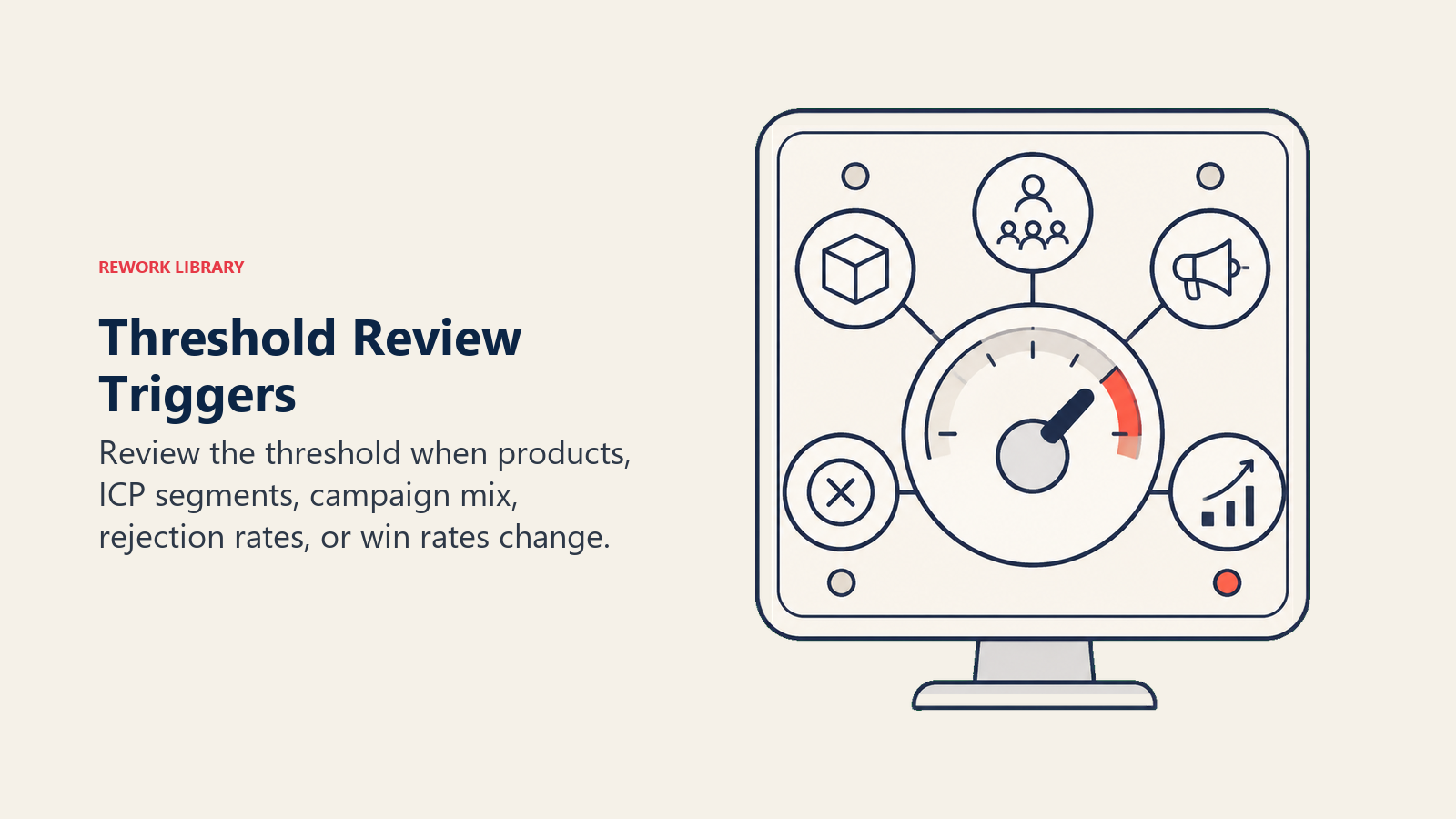 Neuer Produktlaunch: Neue Produktlinien erzeugen neue Verhaltenssignale und neue ICPs. Ihr bestehendes Scoring-Modell erfasst möglicherweise Intent-Signale vom Publikum des neuen Produkts überhaupt nicht.
Neues ICP-Segment: Wenn Sie in eine neue Branche oder Unternehmensgröße expandieren, sind deren Verhaltensmuster unterschiedlich. Den alten Schwellenwert anzuwenden bedeutet, dass Sie sie gegen ein Modell qualifizieren, das auf den Daten von jemand anderem basiert. Überprüfen Sie Ihre Lead-Lifecycle-Stages, um sicherzustellen, dass der Schwellenwert an der richtigen Übergangsstelle für das neue Segment liegt.
Größere Campaign-Änderung: Eine Content-intensive Kampagne generiert andere Verhaltenssignale als eine Demo-Push-Kampagne. Wenn Marketing seinen Channel-Mix deutlich ändert, verändert sich auch die Score-Verteilung in Ihrer Pipeline.
Änderung des Sales-Teams: Neue Mitarbeiter haben unterschiedliche Akzeptanzverhaltensweisen. Ein Team, das gerade fünf Enterprise-Mitarbeiter eingestellt hat, benötigt andere Lead-Qualität als ein Team, das volumenstarkes SMB betreibt.
Anstieg der Ablehnungsrate: Wenn Ablehnungsraten über einen rollierenden 90-Tage-Zeitraum um 10+ Prozentpunkte steigen, ist das ein Modellsignal, kein Personenproblem. Überprüfen Sie den Schwellenwert, bevor Sie eines der Teams beschuldigen. Siehe auch den Artikel zum Lead-Scoring-Modell-Decay für das vollständige Diagnose-Framework.
Rework-Analyse: Basierend auf Branchen-Benchmarks und der Threshold-Setting-Methode operieren die meisten B2B-Teams, die ihren MQL-Schwellenwert an einer Closed-Won-Score-Verteilung verankern, mit einer Ablehnungsrate von 15–25 %, etwa halb so hoch wie die 40–60 % Ablehnungsraten bei Unternehmen, die ihren Schwellenwert erben oder erraten. Die praktische Implikation: Wenn Ihre aktuelle Ablehnungsrate über 35 % liegt, wird eine Schwellenwertkalibrierung auf Basis Ihrer eigenen Closed-Won-Daten die MQL-zu-Pipeline-Konversion in der Regel schneller verbessern als jede Verfeinerung des Scoring-Modells. Reworks CRM- und Pipeline-Tools verfolgen den Score-bei-SQL-Konversion automatisch und geben Teams den Closed-Won-Datensatz, den sie benötigen, um die Threshold-Setting-Methode ohne manuelle CRM-Exporte durchzuführen. Aktuelle Plan-Details finden Sie unter rework.com/pricing.
Der Schwellenwert als gemeinsame Infrastruktur
Der MQL-Schwellenwert ist weder die Einstellung von Marketing noch die Präferenz von Sales. Er ist Infrastruktur, auf die beide Teams angewiesen sind.
Wenn er korrekt kalibriert ist, weiß Marketing, wie „gut" aussieht. Sales weiß, was zu erwarten ist. Beide Teams können auf dieselbe Zahl zeigen, wenn die Pipeline gesund ist, und dieselbe Zahl diagnostizieren, wenn sie es nicht ist. Streitigkeiten über Lead-Qualität werden zu Gesprächen über Schwellenwerte statt zu Anschuldigungen über Einsatz.
Das ist der eigentliche Wert, wenn man das richtig macht. Nicht die optimierte Konversionsrate (obwohl die auch wichtig ist). Es ist, dass beide Teams von einer gemeinsamen Definition dessen arbeiten, was qualifiziert bedeutet. Und wenn Sie das haben, wird der Rest der Marketing-Sales-Alignment-Arbeit erheblich einfacher.
Häufig gestellte Fragen zu MQL-zu-SQL-Schwellenwerten
Wie lege ich den MQL-zu-SQL-Schwellenwert fest?
Beginnen Sie mit Ihren Closed-Won-Daten der letzten 12–18 Monate. Exportieren Sie jeden Deal, der als gewonnen abgeschlossen wurde, und plotten Sie dann den Lead-Score zum Zeitpunkt der SQL-Konversion, nicht den final angereicherten Score, sondern den Score bei der Übergabe. Suchen Sie nach dem Wendepunkt in der Verteilung, wo der Prozentsatz der gewonnenen Deals pro Score-Band stark ansteigt. Setzen Sie den Schwellenwert nahe am unteren Rand des Hochkonzentrationsbandes. Das ist die Threshold-Setting-Methode, und sie produziert eine vertretbare, datenbasierte Zahl statt einer runden Schätzung.
Warum funktioniert ein Schwellenwert von 100 nicht immer?
Ein Schwellenwert von 100 setzt voraus, dass maximaler Score maximaler Bereitschaft entspricht. Aber die meisten Lead-Scoring-Modelle vergeben Punkte für eine Bandbreite von Verhaltensweisen, von denen einige (E-Mail-Opens, ein einzelner Content-Download, Besuch einer Low-Intent-Seite) schwache Prädiktoren für den Abschluss sind. Ein Lead, der 100 Punkte langsam durch Low-Signal-Aktionen sammelt, kann weniger vertriebsbereit sein als ein Lead mit 70 Punkten, der die Preisseite zweimal besucht und eine Demo angefragt hat. Der Schwellenwert sollte dort kalibriert werden, wo Ihre Closed-Won-Deals tatsächlich clustern, nicht am maximalen Punktestand.
Was ist das richtige MQL-Ablehnungsraten-Ziel?
Die meisten aufeinander abgestimmten Teams zielen auf eine MQL-Ablehnungsrate von 15–25 %. Eine Ablehnungsrate unter 15 % könnte bedeuten, dass Ihr Schwellenwert zu hoch ist, Sales erhält sehr wenige Leads und Marketing überqualifiziert möglicherweise. Eine Rate über 35 % ist ein starkes Signal, dass der Schwellenwert zu niedrig ist oder das Scoring-Modell verfallen ist, was bedeutet, dass Leads Sales erreichen, bevor sie das entsprechen, was Sales als qualifiziert erkennt. SiriusDecisions-Benchmark-Daten setzen die durchschnittliche fehlausgerichtete Organisation bei 40–60 % Ablehnung, was weitgehend verschwendeter Sales-Kapazität entspricht.
Wie oft sollte der MQL-Schwellenwert überprüft werden?
Mindestens quartalsweise. Explizite Review-Auslöser sollten umfassen: einen neuen Produktlaunch, eine Änderung im Ziel-ICP-Segment, eine größere Campaign-Mix-Änderung, erhebliche Änderungen im Mitarbeiter-Team oder einen Anstieg der Ablehnungsrate um 10+ Prozentpunkte über einen rollierenden 90-Tage-Zeitraum. Teams, die warten, bis eine Krise sichtbar wird, meistens ein Pipeline-Gap-Gespräch bei einem quartalsweisen Business Review, stellen typischerweise fest, dass der Schwellenwert seit sechs oder mehr Monaten falsch war, bevor das Problem sichtbar wurde.
Sollten verschiedene Segmente unterschiedliche Schwellenwerte haben?
Ja, in den meisten Fällen. Enterprise-Leads haben oft langsamere Verhaltenssignale als SMB-Leads. Outbound-gestützte Leads haben ein anderes Intent-Profil als reine Inbound-Leads. Erweiterungs-Leads von bestehenden Kunden haben komprimierte Kaufzyklen. Ein einheitlicher Schwellenwert für alle Segmente qualifiziert systematisch eine Gruppe über und eine andere unter. Beginnen Sie mit Ihrem volumenreichsten Segment, legen Sie einen kalibrierten Schwellenwert fest und modellieren Sie dann separate Schwellenwerte für jedes größere Segment mit derselben Closed-Won-Analysemethode.
Können wir einen A/B-Test für Schwellenwertänderungen durchführen?
Ja, und das ist der sicherste Weg, den Schwellenwert ohne Pipeline-Störung zu ändern. Teilen Sie den Lead-Flow nach Region, Mitarbeiter-Team oder Quellenkanal auf. Wenden Sie den neuen Schwellenwert auf eine Gruppe an und behalten Sie den bestehenden Schwellenwert für die Kontrollgruppe bei. Laufen Sie 6–8 Wochen. Messen Sie MQL-zu-SQL-Konversionsrate, SQL-Akzeptanzrate, Zeit bis zum ersten Kontakt und MQL-zu-Opportunity-Rate nach 30 und 60 Tagen. Vermeiden Sie es, die Testbezeichnung im CRM sichtbar zu machen, um zu verhindern, dass Mitarbeiter Test-Leads anders behandeln.
Was ist der Unterschied zwischen einem festen und einem dynamischen Schwellenwert?
Ein fester Schwellenwert ist ein einzelnes Score-Gate: „Score ≥ 65 = SQL." Ein dynamischer Schwellenwert fügt bedingte Regeln hinzu: „Score ≥ 65, ODER Score ≥ 45 UND Demo-Anfrage eingereicht." Dynamische Schwellenwerte sind genauer, aber schwieriger zu verwalten. Der empfohlene Mittelweg ist ein fester Schwellenwert als primäres Gate mit nicht mehr als zwei High-Intent-Override-Bedingungen. Mehr als zwei Override-Bedingungen erzeugen ein Governance-Labyrinth, in dem niemand zuverlässig vorhersagen kann, welche Leads ausgelöst werden, was Model-Streitigkeiten schwieriger zu lösen macht.
Mehr erfahren

Principal Solution Architect
On this page
- Was der Schwellenwert tatsächlich steuert
- Einen ersten Schwellenwert festlegen: Die Threshold-Setting-Methode
- Der Volume-Quality-Tradeoff
- Schwellenwert nach Segment
- Dynamische vs. feste Schwellenwerte
- Einigung beider Teams herbeiführen
- Eine Schwellenwertänderung testen
- Review-Auslöser: Wann Sie den Schwellenwert überprüfen sollten
- Der Schwellenwert als gemeinsame Infrastruktur
- Mehr erfahren