SPIN Selling: The 4 Question Types Explained
Turn this article into takeaways for your work.


Each assistant summarizes the article only for you and suggests best practices for your work.
SPIN selling is one of the few sales frameworks built on actual research rather than gut instinct. Neil Rackham and his team at Huthwaite spent 12 years analyzing real sales calls to figure out what separates winning reps from losing ones. What they found became the foundation for consultative selling as we know it today.
What Is SPIN Selling?
SPIN selling is a consultative sales methodology developed by Neil Rackham and published in his 1988 book of the same name. It's based on Huthwaite's analysis of more than 35,000 sales calls across 23 countries and 12 years of field research. The research showed that top performers in complex B2B sales asked fundamentally different questions than average reps.
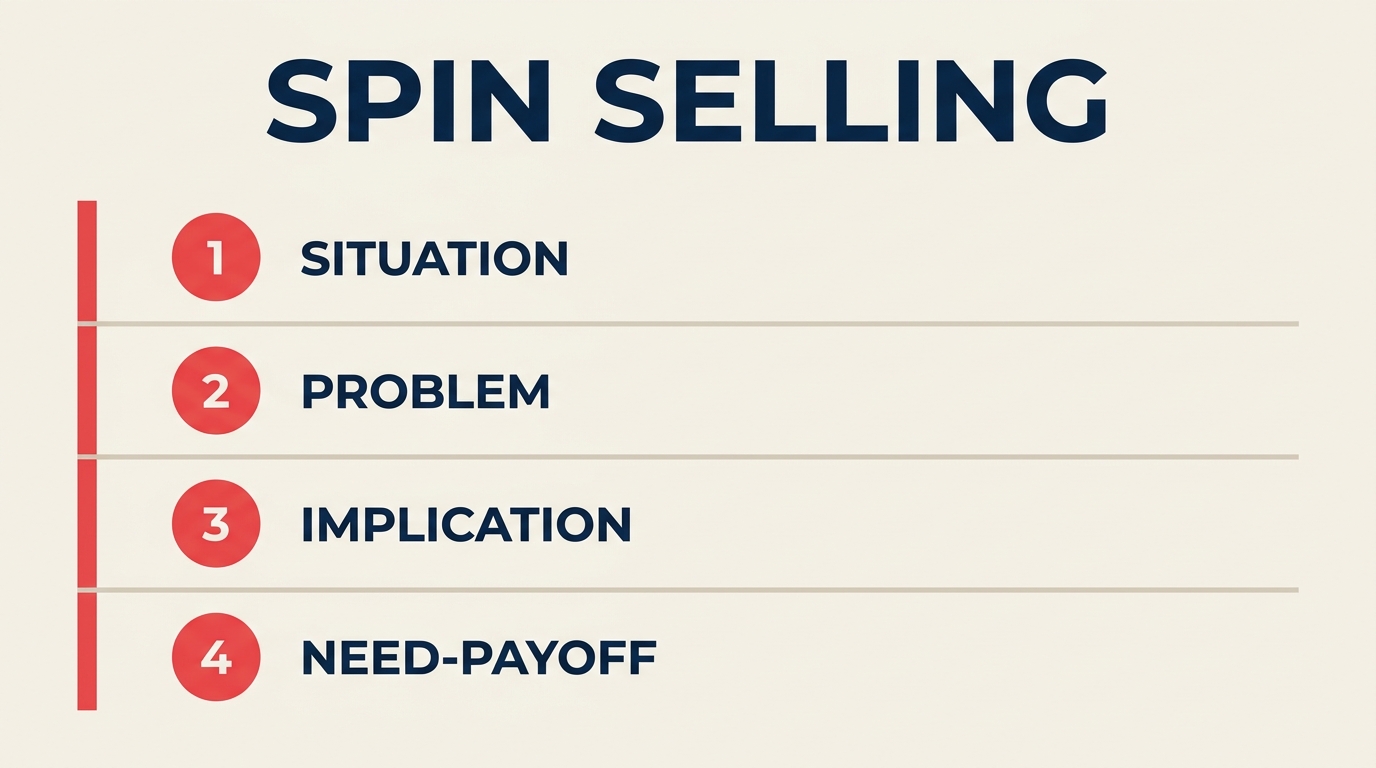
SPIN is an acronym for the four question types that high performers used consistently:
- Situation questions
- Problem questions
- Implication questions
- Need-payoff questions
The methodology challenges the traditional "pitch and present" approach to selling. Instead of leading with your product, you lead with questions that help buyers understand their own problems, feel the weight of those problems, and articulate what a solution would be worth to them.
Key Facts
- SPIN Selling was published by Neil Rackham in 1988 and remains one of the best-selling sales books of all time.
- The research behind SPIN analyzed approximately 35,000 sales interactions across 12 years, making it one of the most rigorous studies ever conducted on sales behavior (Huthwaite International, 1988).
- Research from the Huthwaite study found that in large, complex sales, top performers asked more than twice as many Implication and Need-payoff questions as average performers, while asking fewer Situation questions.
SPIN selling works especially well in complex B2B sales with longer cycles, multiple stakeholders, and higher deal values. It pairs naturally with qualification frameworks like BANT and MEDDIC, which focus on whether a deal is worth pursuing, while SPIN guides how to pursue it.
The 4 SPIN Question Types
SPIN questions progress from context to pain, consequence, and buyer-owned value.
The four question types work as a sequence. You don't pepper prospects with random questions. You move through the types in order, with each building on the answers from the previous one.
| Question Type | Purpose | Example Questions |
|---|---|---|
| Situation | Gather facts about the buyer's current state, processes, and context | "How does your team currently manage the sales pipeline?" / "How many reps are in your team, and what tools do they use?" |
| Problem | Uncover pain points, frustrations, and challenges the buyer faces | "What problems does that process cause?" / "Where do things tend to break down in your current workflow?" |
| Implication | Explore the downstream consequences and costs of those problems | "If that bottleneck keeps slowing your team down, what impact does it have on quarterly targets?" / "How much time per week does that workaround cost each rep?" |
| Need-payoff | Invite the buyer to articulate the value of solving the problem | "If you could eliminate that manual step, how much time would your team save?" / "What would it mean for revenue if your reps spent 80% of their time selling instead of on admin?" |
The logic here is powerful. Situation and Problem questions develop the buyer's awareness of a problem. Implication questions amplify the pain until it feels urgent. And Need-payoff questions shift the buyer from passive listener to active solver, because now they're the one describing the value of a solution.
Rackham's research found that average reps spent too much time on Situation questions (gathering context that didn't advance the sale) and skipped Implication and Need-payoff almost entirely. Top performers did the opposite.
The 4 Stages of a SPIN Sales Call
The SPIN call structure guides the seller from opening through investigation, capability connection, and commitment.
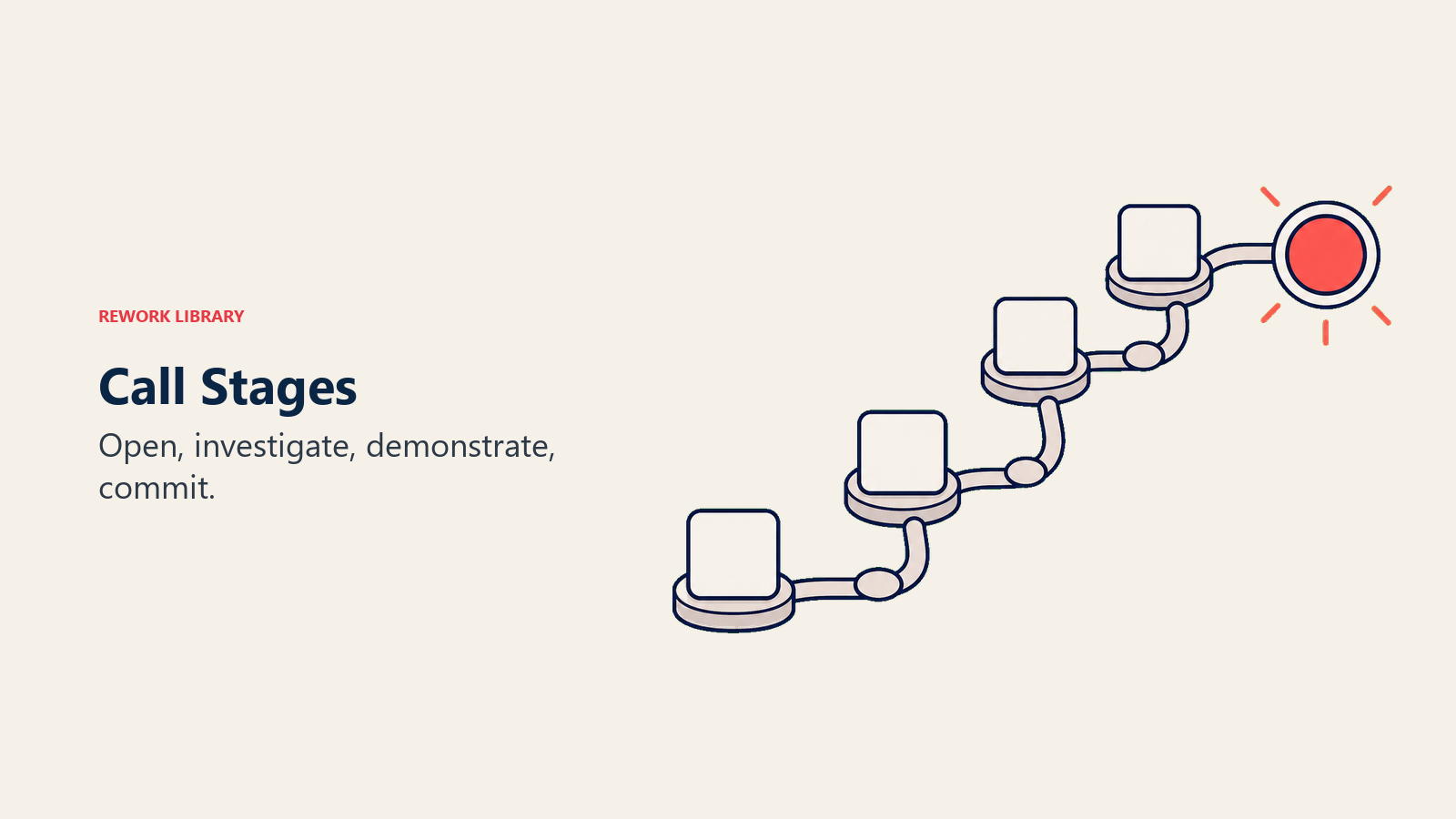
A SPIN sales call isn't just a list of questions. It follows a deliberate structure. Each stage has a specific goal and naturally flows into the next.
Opening
The opening sets tone and earns the right to ask questions. You're not pitching here. You're establishing context, explaining why you're on the call, and getting permission to explore the buyer's situation. Good openers get quickly to the point, establish credibility briefly, and shift into questioning mode.
Avoid starting with a long product overview. Buyers who hear a pitch before they've expressed a need are resistant, not receptive.
Investigating
This is where SPIN questions live. You work through Situation, Problem, Implication, and Need-payoff in sequence, listening carefully and following threads. The investigation phase is the core of the call.
A common mistake is rushing through investigation to get to the demo. Don't. Time spent investigating pays back multiples when you finally do demonstrate capability, because you know exactly what matters to this buyer.
Demonstrating Capability
Once the buyer has articulated their needs (through your Need-payoff questions), you show how your solution addresses those specific needs. You're not presenting features. You're connecting capabilities to the needs the buyer has already said are important.
Rackham distinguished between features (what something is), advantages (how it works), and benefits (how it meets an explicit need the buyer expressed). In complex sales, benefits drive decisions. Features and advantages land flat.
Obtaining Commitment
The closing stage in SPIN isn't about pressure tactics. It's about advancing the sale to the next logical step. The right commitment depends on where you are in the sales cycle. It might be scheduling a demo with additional stakeholders, agreeing to a pilot, or signing a contract.
If the buyer isn't ready to commit, a well-run SPIN call surfaces the remaining objections clearly, so you know what still needs to be resolved.
SPIN Selling vs Other Methodologies
SPIN isn't the only approach, and it's not always the right one. Here's how it compares to three other frameworks you'll encounter in complex B2B sales.
| Methodology | Core Focus | Best For | Key Difference from SPIN |
|---|---|---|---|
| SPIN Selling | Uncovering and amplifying buyer needs through questions | Complex B2B, consultative sales, longer cycles | Questioning sequence; buyer articulates their own need |
| BANT | Qualifying whether an opportunity is worth pursuing | Initial lead qualification, transactional sales | Budget/Authority/Need/Timeline gate, not a conversation guide |
| MEDDIC | Rigorous enterprise deal validation across 6 dimensions | Enterprise sales, 6-figure deals, multi-stakeholder | Qualification depth at deal level, not call-level conversation |
| Challenger | Teaching, tailoring, and taking control of the sale | Customers who don't know they have a problem | Rep-led insight delivery vs. SPIN's buyer-led discovery |
SPIN and BANT work well together. Use BANT to confirm an opportunity is worth pursuing, then use SPIN to run your discovery conversations. Similarly, SPIN discovery feeds directly into MEDDIC qualification: your Situation questions surface the metrics and pain data you need to complete the MEDDIC framework.
Challenger Sale takes a different stance. Instead of asking questions to discover needs, Challenger reps lead with insight and teach buyers something new about their business. SPIN and Challenger aren't mutually exclusive. Some reps blend both.
How to Use SPIN Selling
Knowing the four question types is one thing. Applying them consistently in live conversations takes deliberate practice. Here's how to build a SPIN-based approach into your sales process.
Step 1: Prepare Your Situation Questions (and Keep Them Short)
Situation questions gather background: company size, current tools, team structure, existing processes. They're necessary but not differentiating. Prospects find too many Situation questions tedious, and Rackham's research confirmed that top performers asked fewer of them.
Prepare the three to five Situation questions you genuinely need. Research what you can in advance using LinkedIn, the company's website, and any prior call notes. Every question you can answer before the call is one less you need to ask on it.
Step 2: Uncover Real Problems
Problem questions move from context to challenge. You're not interrogating. You're curious. Ask about friction, frustration, and failure modes in their current approach.
Start broad: "What's working well about your current process? Where do things get complicated?" Then get specific based on their answer. Listen for problems they mention in passing. Buyers often undersell their pain because they're used to it. Your job is to draw it out.
Step 3: Build Implication Through Connected Questions
Implication questions turn a problem into a pain. You're exploring consequences: what does this cost, who else is affected, what opportunities are missed because of it.
But don't manufacture urgency that isn't there. The implications need to be real to this buyer's business. Ask: "How does that affect your team's quota attainment?" or "What does that mean for customer retention when you can't respond fast enough?" When implications are genuine, buyers feel them viscerally.
Step 4: Let the Buyer State the Need-Payoff
This step is where most reps stumble. They're so eager to pitch that they answer their own Need-payoff questions: "So you'd want a solution that automates that, right?"
Don't. Ask instead: "If that manual process were gone, what would change for your team?" Let them describe the value. A buyer who says "We'd get back 10 hours a week per rep, and that's probably worth an extra $400K in revenue" has just made your pitch for you. That statement carries far more weight than anything you could say.
Step 5: Connect Capabilities to Expressed Needs
Only after the buyer has articulated what they need do you introduce your solution's relevant capabilities. And you connect each one specifically to what they said, not to a generic product narrative.
"You mentioned that the manual reporting step costs each rep about 5 hours a week. Here's exactly how our platform handles that..."
This is the difference between selling features and delivering benefits.
SPIN Selling Examples
Here's a worked SPIN sequence for a B2B software sale targeting a VP of Sales at a 50-person company.
The scenario: Your platform automates sales activity tracking and pipeline reporting. You're selling to Sarah, VP of Sales.
Situation questions:
- "Can you walk me through how your reps currently update the pipeline? Do they log activities in the CRM manually?"
- "How often does your team review pipeline data in leadership meetings?"
Problem questions:
- "Where do you typically see data accuracy issues in the pipeline?"
- "How often do you get into a pipeline review and find deals that have gone quiet?"
Implication questions:
- "When pipeline data is stale, how does that affect your forecast calls with the CEO?"
- "If your reps are spending 30-45 minutes a day on manual data entry, what does that cost you in actual selling time across the team?"
Need-payoff questions:
- "If pipeline data was updated automatically and you could trust it going into every board meeting, how would that change how you run forecasting?"
- "What would it be worth to give each of your 50 reps back five hours of selling time per week?"
Sarah does the math herself: 50 reps, 5 hours each, at a quota of $1M per rep annually. That's roughly $120K in recovered capacity per rep, per year. The software becomes an obvious investment before you've shown a single feature.
Common Mistakes and Best Practices
Mistake: Too many Situation questions
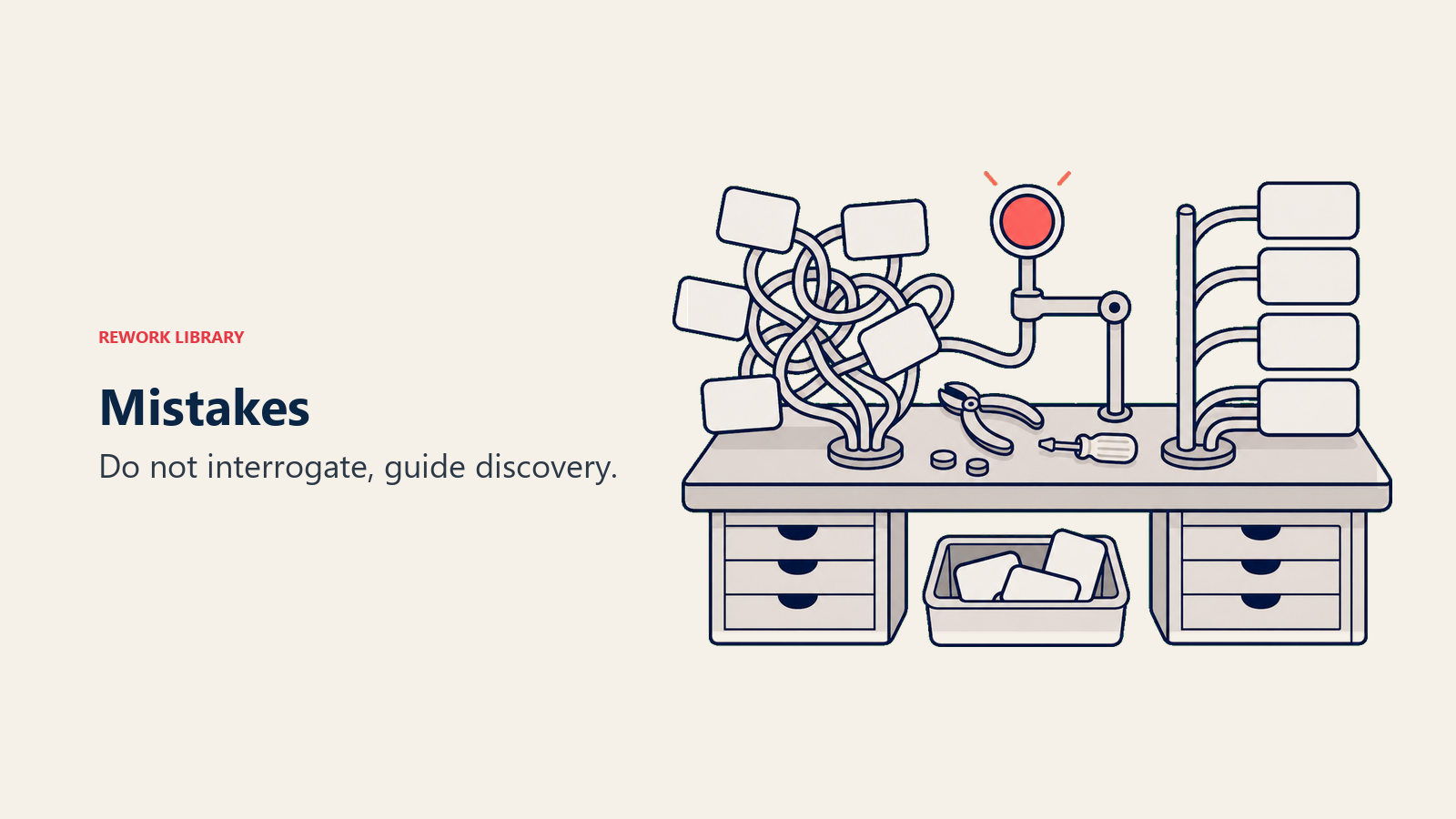
Reps load up on context questions because they feel safe. But buyers read them as lack of preparation. Cap your Situation questions, prepare them in advance, and get to Problem questions faster.
Mistake: Skipping Implication questions
This is where most value is created and where most reps fall short. If you move straight from "here's your problem" to "here's our solution," you skip the step that makes the problem feel urgent. Build Implication before you pitch.
Mistake: Answering your own Need-payoff questions
Leading the witness defeats the purpose. When the buyer states the value in their own words, it sticks. When you state it, they discount it. Ask, then listen.
Mistake: Using SPIN as a rigid script
The four types are a sequence, not a checklist. Real conversations jump around. A good rep uses SPIN as a mental map, not a script. If the buyer jumps to Problem before you've finished Situation, follow them.
Best practice: Record and review your calls
The only way to see your own question patterns is to listen back. How many Situation questions are you asking? Are you asking Implication questions at all? Call review reveals gaps that in-the-moment awareness won't.
Best practice: Connect SPIN to your qualification framework
The information you gather in SPIN discovery should feed directly into your opportunity qualification process. If you're using MEDDIC, your Problem and Implication questions surface the pain data. Your Situation questions build the metrics picture. Run them together, not as separate conversations.
Where SPIN Fits in Your Pipeline
SPIN Selling gives your discovery calls structure and your pipeline conversations substance. But it's one piece of a larger system.
Use SPIN within the context of a managed sales pipeline: qualify with BANT or MEDDIC to confirm the deal is worth pursuing, run SPIN conversations to understand the buyer's world deeply, track deal progression to keep opportunities moving, and build the qualification evidence you need to forecast confidently.
The reps who use SPIN well don't ask more questions. They ask better ones. And they let the answers do the selling.

Head of Enterprise Solutions
On this page
- What Is SPIN Selling?
- The 4 SPIN Question Types
- The 4 Stages of a SPIN Sales Call
- SPIN Selling vs Other Methodologies
- How to Use SPIN Selling
- Step 1: Prepare Your Situation Questions (and Keep Them Short)
- Step 2: Uncover Real Problems
- Step 3: Build Implication Through Connected Questions
- Step 4: Let the Buyer State the Need-Payoff
- Step 5: Connect Capabilities to Expressed Needs
- SPIN Selling Examples
- Common Mistakes and Best Practices
- Where SPIN Fits in Your Pipeline