Job Description Best Practices for Modern Hiring Teams
Turn this article into takeaways for your work.


Each assistant summarizes the article only for you and suggests best practices for your work.
Most hiring managers have written dozens of job descriptions. And most of those descriptions share the same problems: vague requirements, a wall of bullet points, corporate-speak that tells candidates nothing useful, and a salary range that's either missing or laughably wide.
The result is predictable. You get a high applicant volume but low qualified-candidate yield. You spend hours screening. Your time-to-fill stretches out. And the person who eventually takes the role has a 40% chance of leaving within the first year because what they were hired to do turned out to be different from what the JD described.
Getting job descriptions right isn't a writing exercise. It's a strategic hiring decision that affects candidate quality, offer acceptance rates, and early retention.
What a Job Description Actually Does
Before jumping to structure, it's worth being clear on what a JD is supposed to accomplish.

A job description has three jobs. First, it filters: it should help the right candidates self-select in and the wrong ones self-select out. Second, it sells: for qualified candidates who find your posting, it needs to make a compelling case for why they'd want this role at your company over a dozen other options. Third, it anchors: it sets expectations that carry through the interview process, the offer, and the first 90 days on the job.
Most JDs are written to accomplish the first job only, and they do it poorly (usually by over-specifying requirements). The second and third jobs are almost always neglected.
The Structure That Works
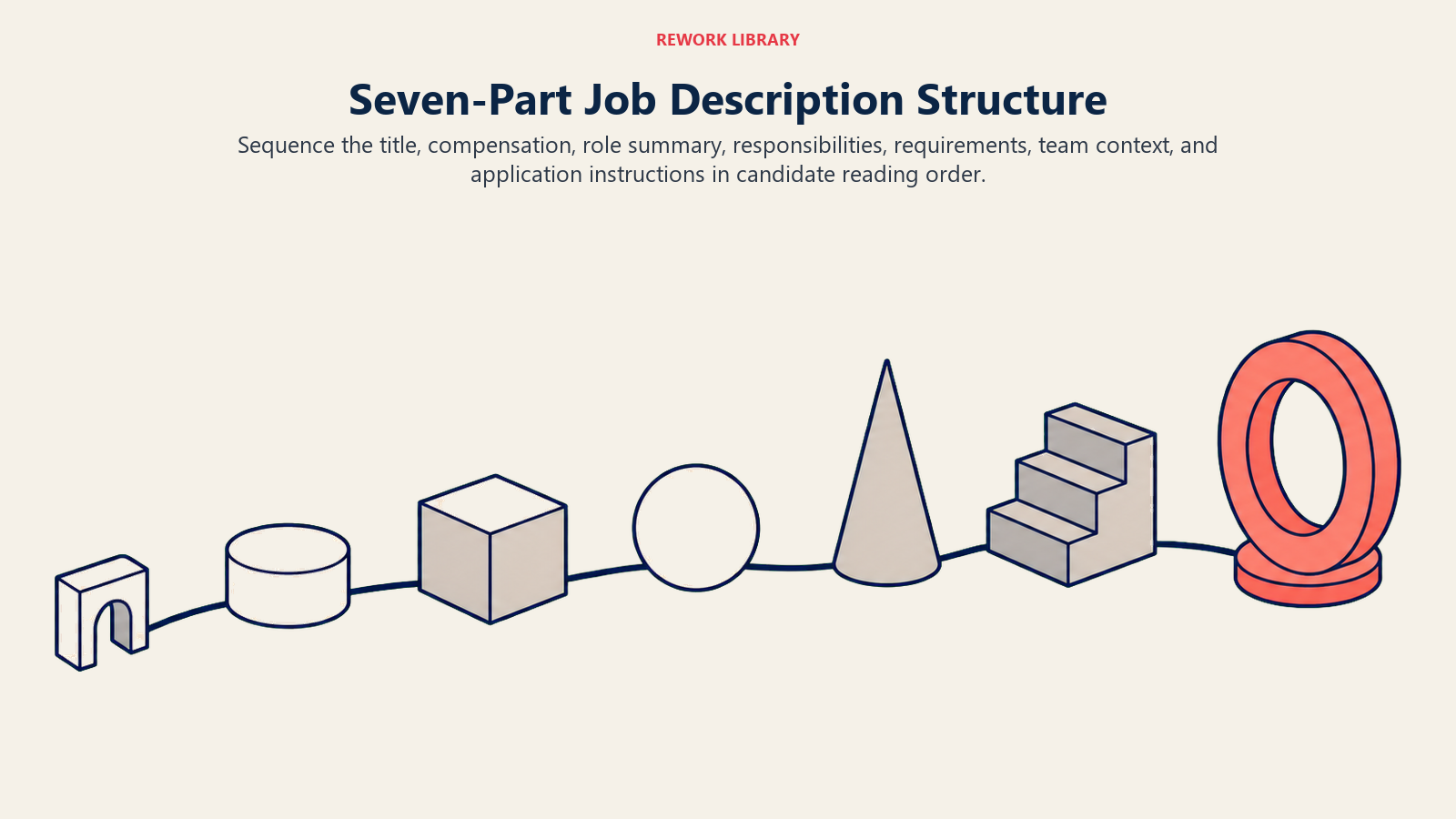
A good job description follows a clear sequence. Not every section needs to be long. But the sequence matters because candidates read in a specific order: title and salary first, then what the role does, then what you need, then who you are as a company.
1. Job Title
Use the title your industry uses, not the title your company uses internally. "Revenue Growth Specialist" might be your internal title, but candidates are searching for "Account Executive" or "Sales Manager." If your internal title is unusual, match it to the market-standard title in the posting and clarify the internal title in the body.
Avoid inflation. "Director of Coffee" for a barista role, or "Ninja," "Guru," and "Rockstar" as qualifiers, signal an immature hiring culture. Senior candidates who are actually qualified will pass.
2. Compensation and Location
Compensation transparency has become a competitive requirement, not just a nice-to-have. States including California, Colorado, New York, and Washington now legally require salary ranges in job postings. Beyond legal compliance, postings with clear compensation ranges get significantly more qualified applicants.
The range you post should reflect what you'll actually pay. A $60,000-$200,000 "range" is not a range. It's a signal that you don't know what the role is worth, or that you plan to low-ball strong candidates who applied before realizing the ceiling was closer to $65,000.
Be equally clear about location: fully remote, hybrid (with frequency), or on-site. Candidates who filter by location will drop off immediately if this is unclear, which wastes both their time and yours.
3. Role Summary (2-4 Sentences)
This is the hardest section to write well. It should answer: why does this role exist, what does success look like in 12 months, and why would a strong candidate want it?
Bad example: "We are looking for a motivated self-starter to join our growing team and contribute to our success."
Better example: "We're hiring a Senior Account Executive to own the full sales cycle for mid-market accounts in North America. You'll carry a $1.2M quota, work a defined ICP, and have full support from an SDR and a pre-sales engineer. Most reps hit their targets within the first two quarters."
The better version tells candidates what they'd actually do, what the structure looks like, and gives a concrete signal about performance expectations.
4. Responsibilities (5-8 Bullets)
Keep this section shorter than you think it needs to be. Long lists of responsibilities signal one of two things: the role is actually three roles packed into one, or the hiring manager hasn't thought clearly about what this person will actually spend their time on.
Each bullet should describe an outcome, not an activity. "Manage the team's Slack channel and ensure timely responses" is an activity. "Own customer escalation response and drive resolution within 48 hours" is closer to an outcome.
Lead with the three or four things the role will spend 80% of its time on. Put the incidental or occasional responsibilities at the bottom.
5. Requirements: Must-Have vs. Nice-to-Have
This is where most JDs damage themselves. Years of experience and degree requirements are the two biggest offenders.
Years of experience is a poor proxy for ability. What you actually care about is whether someone can do the job. "5+ years of experience in SaaS sales" might exclude a 3-year rep who has closed more enterprise deals than most 7-year reps.
Degree requirements similarly exclude capable candidates without adding predictive value in most roles. If you don't genuinely need a specific degree for a specific reason (a licensed profession, a highly technical field), drop it.
A useful practice: separate requirements into "Must-Have" and "Nice-to-Have" sections. The must-have list should be short, usually 4-6 items that are genuinely disqualifying if absent. The nice-to-have list signals what would accelerate success without being a gate.
A long must-have list with 15+ items tells candidates your team can't prioritize. And research from LinkedIn consistently shows that women apply to roles only when they meet nearly all requirements, while men apply when they meet about 60%. An inflated requirements list disproportionately reduces the diversity of your applicant pool.
6. Company and Team Context (Brief)
Candidates already know what your company does before they apply, they Googled you. What they don't know is what the team culture is actually like, how decisions get made, and what the career path looks like.
Keep this section honest and specific. "We're a fast-paced startup where everyone wears multiple hats" is not useful information. "This role reports to the VP of Sales, collaborates daily with Marketing and Customer Success, and the team is currently 6 AEs with plans to double by Q4" is.
7. Application Instructions
Tell candidates exactly what you want from them. If you want a resume plus a cover letter, say that. If you want a work sample, specify what kind. If the application process has multiple stages, give a high-level overview so candidates know what they're committing to.
Vague applications ("apply below to be considered") get high volume and low signal. Clear instructions filter for candidates who read carefully and follow through.
Language and Tone
Write for the Candidate, Not the Lawyer
Many JDs are written by HR teams to minimize legal exposure, not to attract great candidates. The result is passive, hedged language that makes the role sound bureaucratic.
Compare: "The ideal candidate will be responsible for facilitating cross-functional collaboration between relevant stakeholders" versus "You'll run the weekly product-marketing sync and own the roadmap communication to the sales team."
Second-person language ("you will," "you'll") makes the description feel direct and human. First-person company language ("we're building," "our team") signals culture.
Cut Clichés
"Dynamic," "passionate," "results-driven," "team player," "fast-paced environment", these phrases appear in so many JDs that they've become invisible. They take up space that could be used for actual information.
If you find yourself writing a cliché, stop and ask what you actually mean. "Results-driven" usually means you want someone who hits targets. Say that. "Team player" usually means the role requires close collaboration. Name the collaborators.
Inclusive Language Basics
Avoid gendered language ("he," "she," masculine-coded adjectives like "dominant" or "aggressive"). Use "they" or restructure sentences to be neutral.
Watch for unnecessarily exclusive requirements like "must be able to lift 50 lbs" in an office role, or culture-fit language that inadvertently signals a homogeneous workplace.
Several free tools (Textio, Gender Decoder) can flag problematic language. They're worth running before you post.
ATS Optimization Without Over-Optimizing
Most mid-to-large companies route applications through an Applicant Tracking System. Candidates who've researched the role often include keywords from your JD in their resume specifically to pass the initial ATS filter. That's fine. But it means your JD needs to include the terms that qualified candidates would use.
Use the job title candidates would search for. Include relevant skills and tools by name (if someone needs to be proficient in Salesforce, say "Salesforce," not "CRM tools"). Match the terminology your industry uses.
But don't stuff your JD with keywords to game the ATS at the expense of readability. Your best candidates are evaluating your culture based on how you write. A keyword-optimized but unreadable JD is a culture signal.
Compensation Disclosure: The Full Picture
Beyond base salary, candidates increasingly want to understand total compensation. If your benefits are a genuine competitive advantage, describe them specifically. "Competitive benefits" tells candidates nothing. "Full medical, dental, and vision for you and dependents, 401k with 4% match, and 20 days PTO" tells candidates something useful.
Equity is particularly important to communicate clearly for startup roles. A grant of "2,000 options" tells a candidate almost nothing. "0.1% of the company with a 4-year vest and 1-year cliff, at our most recent valuation of $X" gives them enough to evaluate the offer.
If you can't share equity details in the JD, say "equity details shared during offer stage" so candidates know it's part of the package without you committing to specifics prematurely.
After You Post: Tracking What's Working
A job description is a hypothesis. You're assuming certain language will attract certain candidates. Track whether the hypothesis holds.
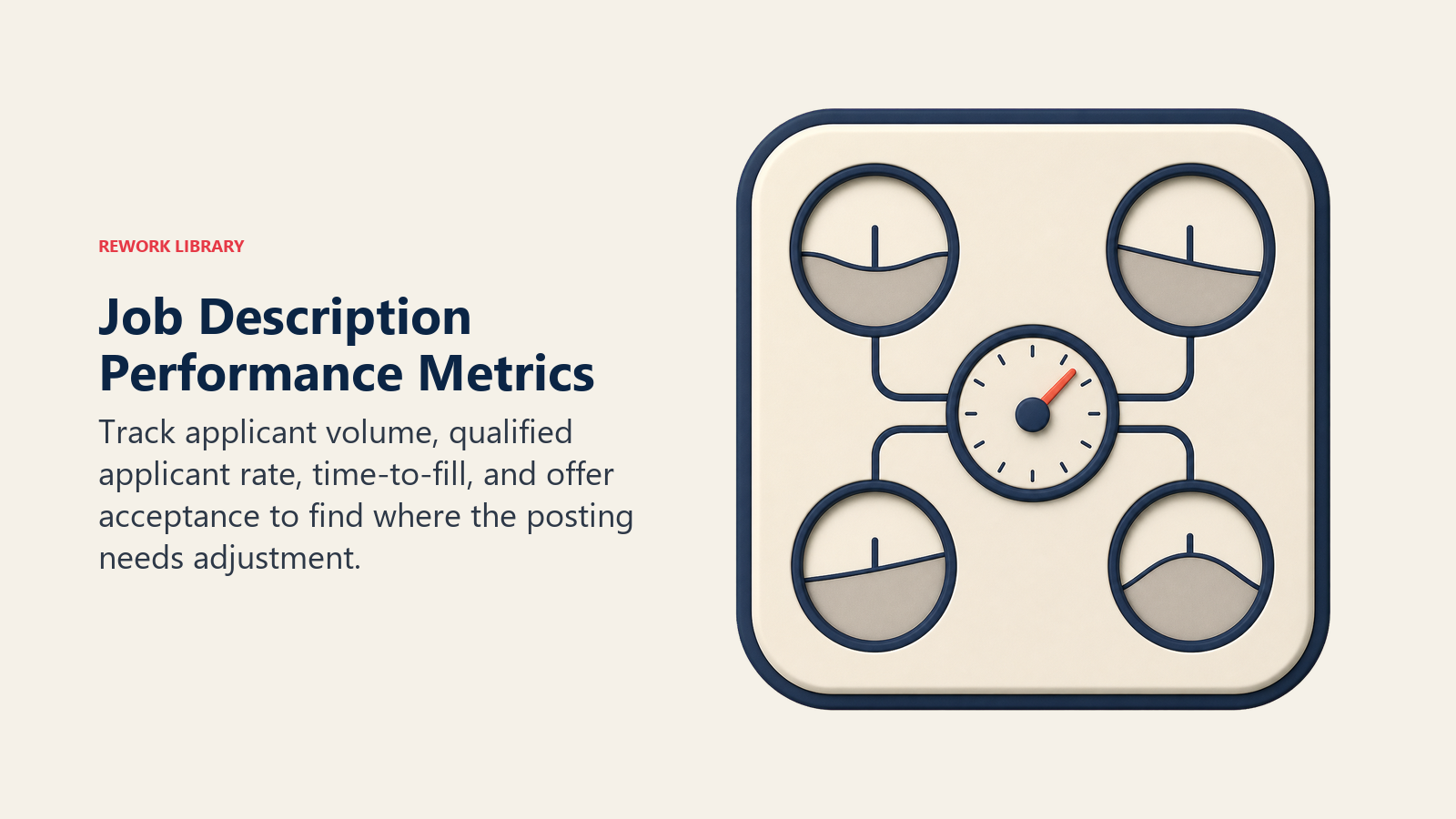
Key metrics to watch: applicant volume (is it in a reasonable range for this role type?), qualified applicant rate (what percentage pass the first resume screen?), time-to-fill, and offer acceptance rate.
If you're getting high volume but low qualified yield, your requirements are too broad or your role summary is drawing the wrong audience. If you're getting low volume and high qualified yield, your requirements may be too restrictive or your posting isn't visible enough.
If offer acceptance is low, the gap is usually between what candidates expected from the JD and what they found during the interview. That's an alignment problem worth fixing in the description.
Common Mistakes to Fix Before You Post
Requirement inflation. Cut any requirement that isn't genuinely disqualifying. If you'd consider candidates without it, move it to nice-to-have or remove it.
Salary omission. In most markets, this now actively hurts your applicant quality. Post the range.
Passive voice overuse. "Responsibilities will include the management of..." becomes "You'll manage..."
Generic company description. Candidates don't need to know you're "committed to innovation." They need to know what the team is like and what success looks like.
Missing success criteria. Tell candidates what good performance looks like in the first 6-12 months. This is the single change that most improves new hire alignment and early retention.
Internal Alignment Before You Post
A job description should be reviewed by at least three people before posting: the hiring manager (who knows the role), someone on the immediate team (who knows the day-to-day reality), and HR or recruiting (who knows the market and legal requirements).

Misalignment between these three groups is the most common cause of JD problems. The hiring manager wants a "player-coach." The team thinks the role is mostly individual contributor. HR knows the comp band won't attract a true player-coach in this market. These conflicts need to surface before the JD goes live, not mid-process.
Use your JD as an internal alignment document first. If three stakeholders can't agree on what the role is, you're not ready to post it.
Related Resources
- Account Executive Job Description Template - Example of a well-structured sales JD
- Sales Manager Job Description Template - Senior role template with comp structure
- HR Manager Job Description Template - Internal hiring team template
Role templates that show these principles applied to jobs that are harder to scope:
- Chief Revenue Officer (CRO) Job Description Template - An executive JD where scope, not a task list, does the work
- Channel Sales Manager Job Description Template - Writing for a role measured on partner revenue rather than headcount
- Business Intelligence Analyst Job Description Template - Separating analyst work from data engineering in the requirements
- Compensation and Benefits Manager Job Description Template - A JD for the person who will own your pay bands
- Compliance Manager Job Description Template - Scoping a role whose duties change completely by industry
- Community Manager Job Description Template - Avoiding the social media manager mix-up in the posting
- Data Architect Job Description Template - Writing a posting for a title that means three different jobs
- General Counsel Job Description Template - Scoping your first in-house legal hire against outside counsel
- Implementation Manager Job Description Template - Naming the handoffs a role owns when the boundaries are contested
- Learning and Development Manager Job Description Template - Hiring for measurable programs rather than workshop delivery
- Logistics Manager Job Description Template - Separating logistics scope from supply chain scope in the requirements
- Partnerships Manager Job Description Template - Saying which of the four partner types the role actually covers
- People Operations Manager Job Description Template - Telling a rebranded HR role apart from a genuinely systems-led one before you post
- Procurement Manager Job Description Template - Scoping direct against indirect spend so the posting matches the actual job
- Renewals Manager Job Description Template - Writing for a commercial event that sits between success and sales
- Security Analyst Job Description Template - Naming which of the three security analyst jobs you are hiring for
- Supply Chain Analyst Job Description Template - Keeping an analyst posting from quietly describing a manager role
- VP of Engineering Job Description Template - Deciding between a VP of Engineering, a CTO, and a director before you write the JD
- Bookkeeper Job Description Template - Drawing the bookkeeper against accountant line before the posting sets the wrong pay band
- Demand Planner Job Description Template - Writing for a forecasting role that two different federal wage anchors describe
- Facilities Manager Job Description Template - Naming which of the three facilities jobs (single-site, multi-site, or plant) you are posting
- Help Desk Technician Job Description Template - Setting the L1 against L2 tier line in writing instead of leaving it to the first week
- HRIS Analyst Job Description Template - A posting where the HR anchor and the systems anchor sit about thirty thousand dollars apart
- VP of Marketing Job Description Template - Testing whether you need a VP of Marketing, a marketing manager, or a CMO
- Industrial Engineer Job Description Template - Naming which of the four industrial engineering specialties a posting actually covers
- Internal Auditor Job Description Template - Writing the reporting line into the posting, because independence is the job
- IT Manager Job Description Template - A title whose federal median is a ceiling reference rather than the usual floor
- Manufacturing Engineer Job Description Template - Making the posting state the plant, the volume profile and the regulatory regime
- Network Engineer Job Description Template - One title straddling a shrinking occupation and a growing one, about $35,000 apart
- Office Manager Job Description Template - Deciding whether the role manages a function or executes tasks before you set the band
- Paralegal Job Description Template - Hiring into an occupation projected to add no jobs at all while opening about 40,800 roles a year
- Payroll Manager Job Description Template - Pricing a title that sits between a shrinking clerical occupation and a management one that never names it
- Quality Engineer Job Description Template - Saying which of the two quality engineer jobs you mean before the wrong candidate pool applies
- Release Manager Job Description Template - Deciding whether continuous delivery has already absorbed the role before you write the posting
- Risk Manager Job Description Template - Separating risk from compliance and audit, three jobs the federal pay data prices far apart
- Sales Analyst Job Description Template - Telling a reporting analyst apart from a decision-support one before you set the band
- Solutions Architect Job Description Template - One title covering three jobs, and no federal wage series that names any of them
- Systems Administrator Job Description Template - Hiring into an occupation the federal data projects to shrink, and what to hire for instead
- Tax Accountant Job Description Template - Writing the busy season into the posting, and choosing between a CPA and an enrolled agent
- Training Manager Job Description Template - Deciding between a training manager and an L and D manager when one occupation code covers both
- Warehouse Manager Job Description Template - A management posting where a degree requirement filters out the strongest candidates
- Sourcing Strategy: Active, Passive, and Referral - Where to post once your JD is ready
- Interview Loop Design for Signal - Designing the process your JD feeds into
- Recruiter Metrics: Time and Quality - Measuring JD effectiveness through the funnel
- Awesome Talent Acquisition Resources - Curated tools and frameworks for hiring teams

Senior Operations & Growth Strategist
On this page
- What a Job Description Actually Does
- The Structure That Works
- 1. Job Title
- 2. Compensation and Location
- 3. Role Summary (2-4 Sentences)
- 4. Responsibilities (5-8 Bullets)
- 5. Requirements: Must-Have vs. Nice-to-Have
- 6. Company and Team Context (Brief)
- 7. Application Instructions
- Language and Tone
- Write for the Candidate, Not the Lawyer
- Cut Clichés
- Inclusive Language Basics
- ATS Optimization Without Over-Optimizing
- Compensation Disclosure: The Full Picture
- After You Post: Tracking What's Working
- Common Mistakes to Fix Before You Post
- Internal Alignment Before You Post
- Related Resources