More in
AI Team Readiness Guide
Workforce Planning for AI Roles
thg 6 12, 2026
Building an AI-First Culture
thg 6 12, 2026
Building Collaborative AI Teams
thg 6 12, 2026 · Currently reading
How to Audit Your Sales Team's AI Readiness
thg 4 14, 2026
Building an AI Skills Matrix for Your Department
thg 4 14, 2026
90-Day Plan: From AI-Curious to AI-Fluent
thg 4 14, 2026
AI Tools Training Guide for Non-Technical Teams
thg 4 14, 2026
Hiring vs Upskilling: Decision Framework for Directors
thg 4 14, 2026
Setting Up an AI Champions Program in Your Department
thg 4 14, 2026
Measuring AI Adoption ROI Across Your Team
thg 4 14, 2026
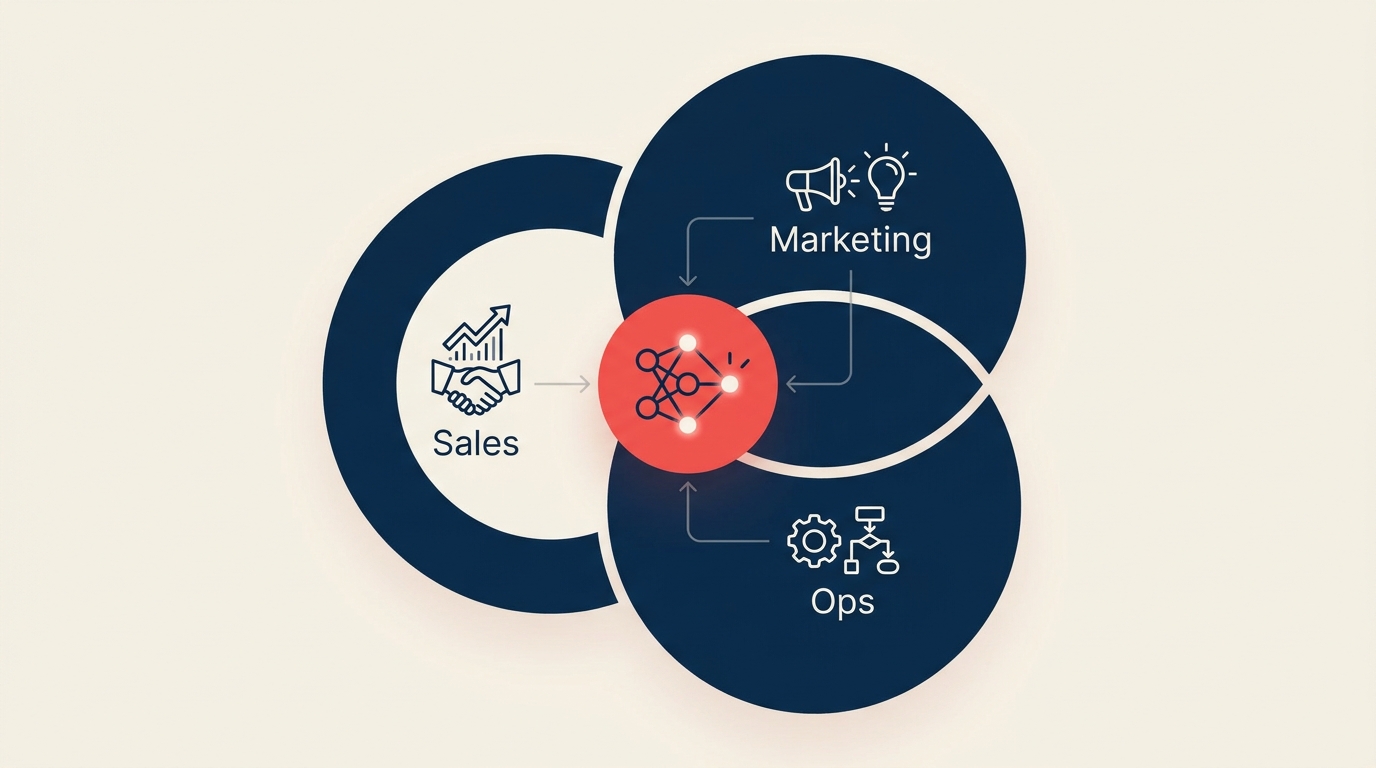
Building Collaborative AI Teams: How to Get Sales, Marketing, and Ops Working Better Together with AI
The Head of Marketing at a 180-person SaaS company had a problem. Her team had been using AI for content generation and campaign analysis for six months. Meanwhile, the sales team had started using AI for prospect research and call prep. RevOps was using AI for forecasting.
None of these teams talked to each other about AI. Three different tool sets. Three different prompt libraries. Three different approaches to what data could go into AI tools. And a growing set of problems caused by the gaps between them.
Marketing was creating positioning AI models that didn't match the language the sales team was trained on. Sales was producing prospect research that duplicated work the marketing team had already done with better data. RevOps was running forecast models that didn't account for campaign pipeline signals that marketing already had.
The tools were working. The collaboration wasn't.
This is the next problem after you've built basic AI adoption within individual teams: how do you get those teams working together effectively with AI rather than just in parallel?
Why AI Amplifies Collaboration Failures
Most collaboration problems between functions predate AI. Sales and marketing misalignment, for example, is famously persistent. What AI does is amplify whatever collaboration patterns already exist.
If teams already share data and workflows well, AI speeds up that collaboration. AI tools can pass context, generate content, and analyze data across systems faster than humans can. Good collaboration gets better.
If teams operate in silos with minimal data sharing and poor handoff processes, AI locks in those silos and makes them worse. Each team builds AI workflows that work inside their own context but don't connect to anything outside it. The AI makes each team faster individually while making cross-functional work harder to coordinate.
The implication for directors: before you invest heavily in building AI capability within individual teams, invest in the collaboration infrastructure that will let those capabilities compound. You'll get far more from AI that's connected across functions than from three separate AI workflows that never talk to each other.
The Three Collaboration Layers
Effective cross-functional AI collaboration happens at three levels simultaneously.
Layer 1: Shared data and context
The most basic collaboration failure in AI is when different functions have access to different data and don't share it. Marketing has behavioral data from campaigns. Sales has call notes and qualification data from prospects. Customer success has renewal signals and product usage data. Each team's AI tools can only use the data those tools can access.
When you connect these data sources (even partially), the AI outputs improve significantly. A sales rep asking AI to prepare for a call with a prospect gets much better prep material when AI can see that the prospect attended a webinar last week, downloaded a pricing page, and had a previous opportunity that was lost to a competitor 18 months ago.
This data layer work isn't an AI project. It's a CRM and integration project that AI benefits from. The cross-functional AI collaboration frameworks guide covers the technical integration patterns. The strategic point is: shared data should be the first cross-functional AI investment, before joint tools or shared workflows.
Layer 2: Shared tools for boundary-spanning workflows
Some workflows naturally involve multiple functions. The marketing-to-sales handoff. The customer success-to-product feedback loop. The ops-to-finance reporting cycle.
These boundary-spanning workflows are where AI collaboration tools produce the most visible value, and they're also where the most friction exists because they require two or more teams to agree on a shared process.
The best approach: pick the one highest-friction cross-functional handoff and solve it first, fully, before moving to others. Don't try to AI-enable five cross-functional workflows simultaneously.
For most mid-market B2B companies, the marketing-to-sales lead handoff is the right starting point. AI can enrich leads at handoff, generate context for the receiving sales rep, score leads based on behavior signals, and route them to the right rep. But this requires marketing and sales to agree on what "ready to hand off" means, what data travels with the lead, and how the handoff quality gets measured.
Work through those agreements with people in the room before writing a single automation. The AI is easy. The alignment is the hard part.
Layer 3: Shared learning and practice
The least visible layer and often the most impactful over time. When different functions share what they're learning about AI (what prompts work, what workflows produce the best results, what tools are worth the investment), the whole organization gets smarter faster than any individual team does alone.
This is what structured AI champions programs are built for when they span multiple functions. A monthly cross-functional AI show-and-tell where each team shares one workflow improvement takes 30 minutes and compounds significantly over six months.
Governance: The Part Most Teams Skip
The biggest practical barrier to cross-functional AI collaboration is governance, specifically the question of who decides what tools are approved and what data can go into them.
When each team manages its own AI tools independently, you get three outcomes that compound over time. Tool sprawl: 15 different AI tools doing similar things with different data, different vendor contracts, different security reviews, and no integration. Data governance chaos: no one is sure which tools have access to what customer data, which creates real privacy and security risk. Shadow IT: individual contributors are making tool decisions that IT and legal haven't reviewed, because there's no structured way to get new tools approved quickly.
The fix is lightweight, not heavy. A central AI governance function doesn't mean a bureaucratic approval committee. It means:
An approved tools list updated quarterly. A short list (6-12 tools) of AI tools that have passed basic security and data handling review. Teams can request additions. New tools get reviewed against a simple checklist (data storage, privacy compliance, vendor stability) and added or declined within two weeks.
Clear data handling categories. Decide once what kinds of data can go into AI tools and which can't. Customer PII typically can't go into consumer AI tools without data processing agreements. Aggregated metrics typically can. Internal strategy documents are a judgment call. Write this down. It saves hours of one-off decisions.
A designated owner. Usually in IT or RevOps. Their job isn't to block AI use. It's to make AI use faster and safer by handling the governance work so individual teams don't have to.
This governance structure is lightweight enough to put in place in two weeks and prevents most of the cross-functional AI friction before it starts. The AI governance policy guide covers how to draft the actual policy document.
Building Shared Prompts and Workflows
One of the highest-leverage cross-functional AI investments is a shared prompt library: a documented collection of prompts that work for common cross-functional tasks.
This sounds simple and is often dismissed as low priority. But a shared prompt library solves several problems at once. It means the sales rep writing their call prep doesn't spend 20 minutes rewriting a prompt that the RevOps team already has working. It means the marketing team's content brief AI prompts are informed by the sales team's language from customer calls. It means when a new employee joins, they have a starting point for AI use in their role immediately rather than spending weeks figuring it out.
Shared prompt libraries work best when they're organized by use case (prospecting, content creation, data analysis, meeting prep) rather than by team. Cross-team organization encourages people to look outside their function for prompts that might work for them.
Maintain the library in the same tool everyone uses for internal documentation. Google Docs, Notion, Confluence, whatever is already the system of record. Don't create a new system for prompt management. The goal is ease of access, not comprehensiveness.
Running Cross-Functional AI Projects
When you want to build something that spans two or more teams, the project setup matters as much as the AI implementation.
Agree on the problem before agreeing on the solution. Bring the leads of each involved function into the same room (virtual or physical) and get explicit agreement on what problem you're solving. "We want to use AI" is not a problem statement. "Our MQL-to-SQL conversion rate is 22% and industry benchmark is 38%, and we think the gap is in lead context at handoff" is a problem statement.
Assign a single cross-functional owner. Every cross-functional project needs one person who is accountable for outcomes, not consensus among three people who are each partially responsible. This person doesn't need to be the most technical person on the project. They need to be the person with enough organizational credibility to get decisions made across functions.
Set a 6-week test horizon. Long cross-functional projects die in planning. Short projects with defined endpoints produce results that create momentum for the next project. Set a 6-week or 8-week horizon with defined success criteria before you start. Use the AI pilot program process as your template.
Budget for change management, not just the tool. Cross-functional AI projects require behavior change in multiple teams simultaneously. Budget explicitly for training, documentation, and the 1:1 coaching sessions that move the reluctant people along. Tools are typically 20-30% of the real investment. Change management is the rest.
Measuring Cross-Functional AI Outcomes
The measuring AI adoption ROI process applies here, but cross-functional projects have a specific measurement challenge: who owns the outcome?
If a marketing-to-sales AI handoff improvement drives a 20% increase in win rate, do sales or marketing get credit? In most organizations, neither team would claim full ownership, and both would have valid arguments about contribution.
The answer isn't to argue about attribution. It's to measure the cross-functional metric (win rate from MQL, not just MQL volume or win rate in isolation) and report it to both teams' leadership simultaneously. When the success metric is inherently cross-functional, the incentive to collaborate becomes stronger.
Build at least one cross-functional metric into the scorecard for every cross-functional AI project. It keeps the teams oriented toward the same outcome rather than optimizing their own local metrics at the expense of the shared goal.
The Skills Gap That Stops Cross-Functional Collaboration
The technical barriers to cross-functional AI collaboration are usually smaller than the skills barriers. The workforce planning guide for AI roles covers this in detail. But for cross-functional collaboration specifically, one skill gap comes up consistently: system thinking.
Most individual contributors are good at optimizing within their own workflow. They struggle to see how their workflow connects to someone else's and where the integration points create opportunities for AI. This is a systems-thinking skill, not a technical skill.
Training for this isn't complex. A two-hour workshop where each function maps their workflows visually, then the group finds the 3-5 highest-friction integration points, produces more useful output than most AI training programs. Then you can direct AI tool investments specifically at those integration points rather than scattering them across each function independently.
The companies that build the most effective collaborative AI teams aren't the ones that gave everyone AI tools. They're the ones that invested in understanding how their functions connect before automating anything. The AI is the easy part. The connection architecture is what determines whether that AI produces isolated efficiency or genuine organizational leverage.

Co-Founder & CMO, Rework