Rework Pricing Explained: What Each Plan Actually Includes in 2026
Turn this article into takeaways for your work.


Each assistant summarizes the article only for you and suggests best practices for your work.
SaaS pricing pages are written by marketers, not buyers. The feature lists are long, the tier names are vague, and the one number you actually need ("what will I pay for 25 seats?") is buried behind a "contact sales" button. That's not useful to anyone comparing vendors or presenting a budget to a CFO.
This article skips the marketing copy. You'll get real prices, honest plan limits, a clear comparison at three team sizes, and an honest take on where Rework isn't the cheapest option.
Five Engines, Two Areas
Rework sells engines, which are bundles of apps, in two areas: Revenue OS and Work OS. Every engine includes 5 seats of each seat type it uses, and extra seats come in blocks of 5. You pick an edition (Standard, Advanced or Enterprise), a plan size based on monthly volume, and monthly or yearly billing. Yearly billing is about 15% cheaper.
| Engine | Area | What it covers |
|---|---|---|
| Sales Engine | Revenue OS | CRM + sales pipeline + Commerce (orders) |
| Marketing Engine | Revenue OS | Omnichannel inbox (Prospect) + lead capture, scoring and distribution (Lead) + Ads Manager |
| Revenue Engine | Revenue OS | Everything in the Marketing and Sales Engines together |
| Process Engine | Work OS | Workflows + BPM + requests + task service |
| Project Engine | Work OS | Project and task management + workflows + requests |
Prices below are for the Standard edition at the base (1×) plan size. See rework.com/pricing for current details.
Sales Engine Pricing
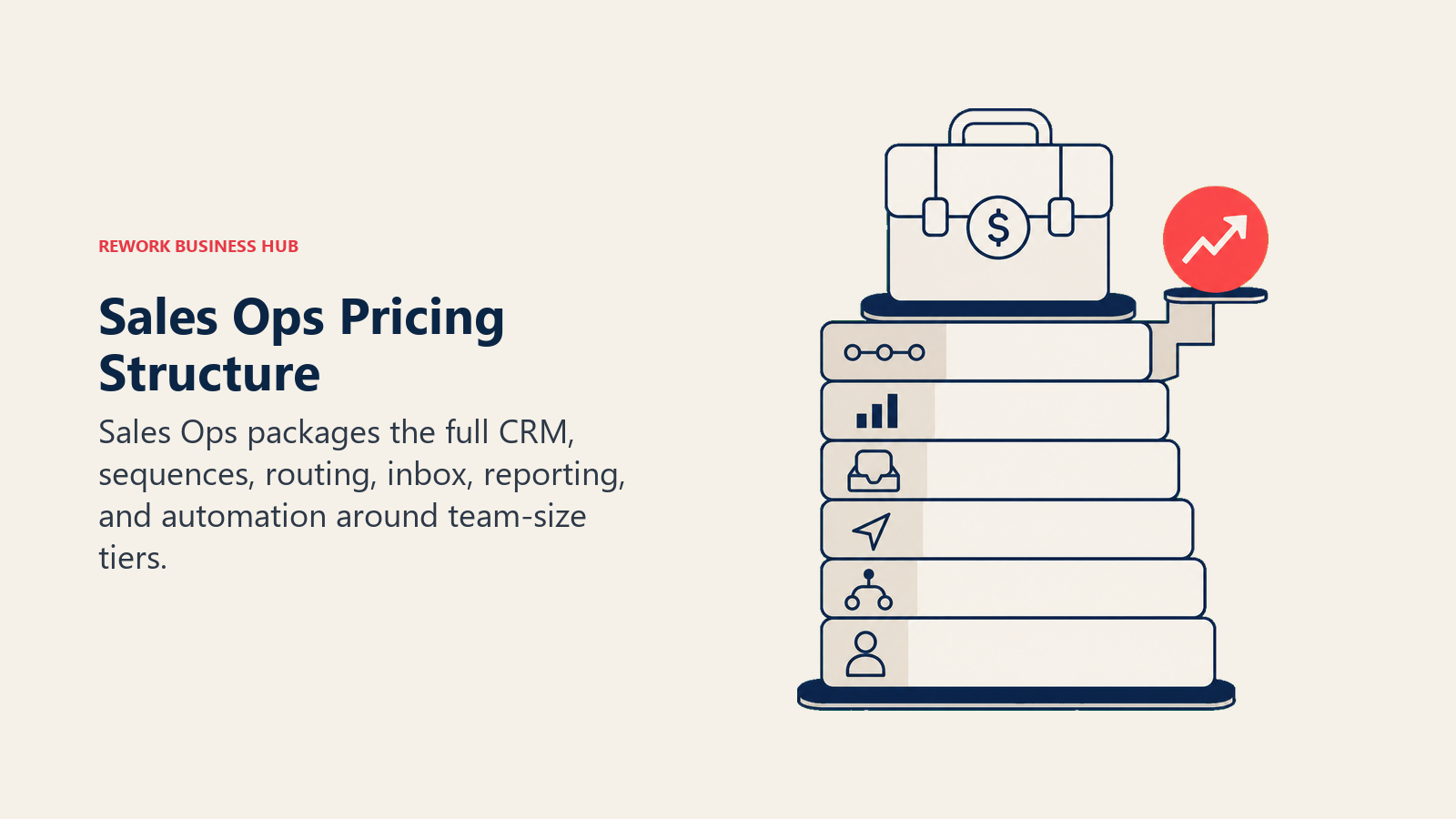
The Sales Engine is the CRM product: pipeline, deals, contacts, accounts, custom reporting and Commerce for orders. If you also want the omnichannel inbox (WhatsApp, Messenger, Instagram DM, Telegram, live chat and more) and lead capture on the same record, look at the Revenue Engine below.
| Billing | Price | Seats included | Extra seats |
|---|---|---|---|
| Yearly | $69/month ($828/year) | 5 sales seats | $21/month per block of 5 |
| Monthly | $80/month | 5 sales seats | $25/month per block of 5 |
Seat math: Sales Engine
| Seats | Calculation (billed yearly) | Annual cost |
|---|---|---|
| 5 | $69/mo base | $828 |
| 10 | $69 + 1 x $21 = $90/mo | $1,080 |
| 25 | $69 + 4 x $21 = $153/mo | $1,836 |
| 50 | $69 + 9 x $21 = $258/mo | $3,096 |
| 100 | Advanced edition: $89 + 19 x $28 = $621/mo | $7,452 |
Who it fits: Sales teams of 5 to 100 that need a CRM and pipeline without buying multiple products. The Standard edition covers up to 50 seats; above that you move to Advanced.
Marketing Engine Pricing
The Marketing Engine covers the lead lifecycle without the full CRM pipeline: the omnichannel inbox, lead capture, scoring and distribution, and Ads Manager (free with Lead). Good for marketing-led teams that capture, score, and distribute leads but don't manage deals inside the same tool.
| Billing | Price | Seats included | Extra seats |
|---|---|---|---|
| Yearly | $99/month ($1,188/year) | 5 marketing seats | $21/month per block of 5 |
| Monthly | $115/month | 5 marketing seats | $25/month per block of 5 |
Seat math: Marketing Engine
| Seats | Calculation (billed yearly) | Annual cost |
|---|---|---|
| 5 | $99/mo base | $1,188 |
| 10 | $99 + 1 x $21 = $120/mo | $1,440 |
| 25 | $99 + 4 x $21 = $183/mo | $2,196 |
| 50 | $99 + 9 x $21 = $288/mo | $3,456 |
| 100 | Advanced edition: $129 + 19 x $28 = $661/mo | $7,932 |
Who it fits: Marketing and pre-sales teams of 5 to 50 focused on lead capture, scoring, and handoff to a separate CRM or sales team.
Revenue Engine Pricing
The Revenue Engine puts the Marketing and Sales Engines together: CRM, omnichannel inbox, lead capture and Ads Manager on one record. It costs $159/month billed yearly ($1,908/year) or $190/month month to month, with 5 marketing seats and 5 sales seats included. That's less than buying the two engines separately ($99 + $69 = $168/month on yearly billing). Extra marketing and sales seats are added separately, at $21/month per block of 5 each on yearly billing.
Who it fits: Teams where marketing and sales work the same leads and conversations and want one system from first message to closed deal.
Process and Project Engine Pricing
The Process Engine and the Project Engine are the work operations products. The Process Engine runs approvals, BPM, requests and repeatable workflows; the Project Engine runs projects, tasks and delivery. Both are priced the same.
| Billing | Price | Seats included | Extra seats |
|---|---|---|---|
| Yearly | $99/month ($1,188/year) | 5 work seats | $13/month per block of 5 |
| Monthly | $120/month | 5 work seats | $15/month per block of 5 |
Seat math: Process or Project Engine
| Seats | Calculation (billed yearly) | Annual cost |
|---|---|---|
| 5 | $99/mo base | $1,188 |
| 10 | $99 + 1 x $13 = $112/mo | $1,344 |
| 25 | $99 + 4 x $13 = $151/mo | $1,812 |
| 50 | $99 + 9 x $13 = $216/mo | $2,592 |
| 100 | Advanced edition: $129 + 19 x $17 = $452/mo | $5,424 |
Who it fits: Cross-functional teams of 5 to 100 that need shared task management and workflow automation without a dedicated project management tool.
What's Included at Every Tier
A few things don't change regardless of engine or edition:
- Existing records are never charged: the plan size counts only new records each month (for example, 300 new deals a month on the Sales Engine at 1×)
- A busy month never blocks work: that month is billed at the plan size that covers it, with no surcharge
- Standard TLS encryption at rest and in transit
- 2FA support
- Import from CSV, Salesforce export, HubSpot export
- Mobile app (iOS and Android)
- Email + chat + phone support on all plans
Not paying for stored contacts is genuinely useful. HubSpot famously charges based on marketing contacts, so if you're storing a large prospect database, Rework's model, which only counts new records, avoids the overage trap.
What's Not Included (Honest List)
This matters more than the feature lists.
Standard edition limits:
- Up to 50 seats and 10 teams across the account. Past that, you're on Advanced.
- Up to 20 custom fields per object, 10,000 automation runs and 10,000 API calls a month.
- Agent Flows, SSO, audit logs and org-chart permissions start at the Advanced edition.
Things Rework doesn't do:
- Deep marketing automation (email nurture sequences are included, but campaign orchestration at the HubSpot Marketing Hub level is not)
- Custom objects on the Standard edition (custom fields on standard objects only; custom objects come with Advanced and Enterprise)
- Dedicated ticketing with SLA tiers and CSAT surveys (the inbox handles support conversations, but it's not a ticketing system like Zendesk)
How the Formula Works
For any engine:
monthly_total = engine_price + extra_blocks x block_price
extra_blocks  = ceil(max(0, seats - 5) / 5)
annual_cost   = monthly_total (yearly billing) x 12
At 5 seats or fewer, the engine price covers everything. No block math applies.
On yearly billing, a block of 5 extra seats costs $21/month for sales or marketing seats and $13/month for work seats. Seats only come in blocks of 5, so 6 seats cost the same as 10.
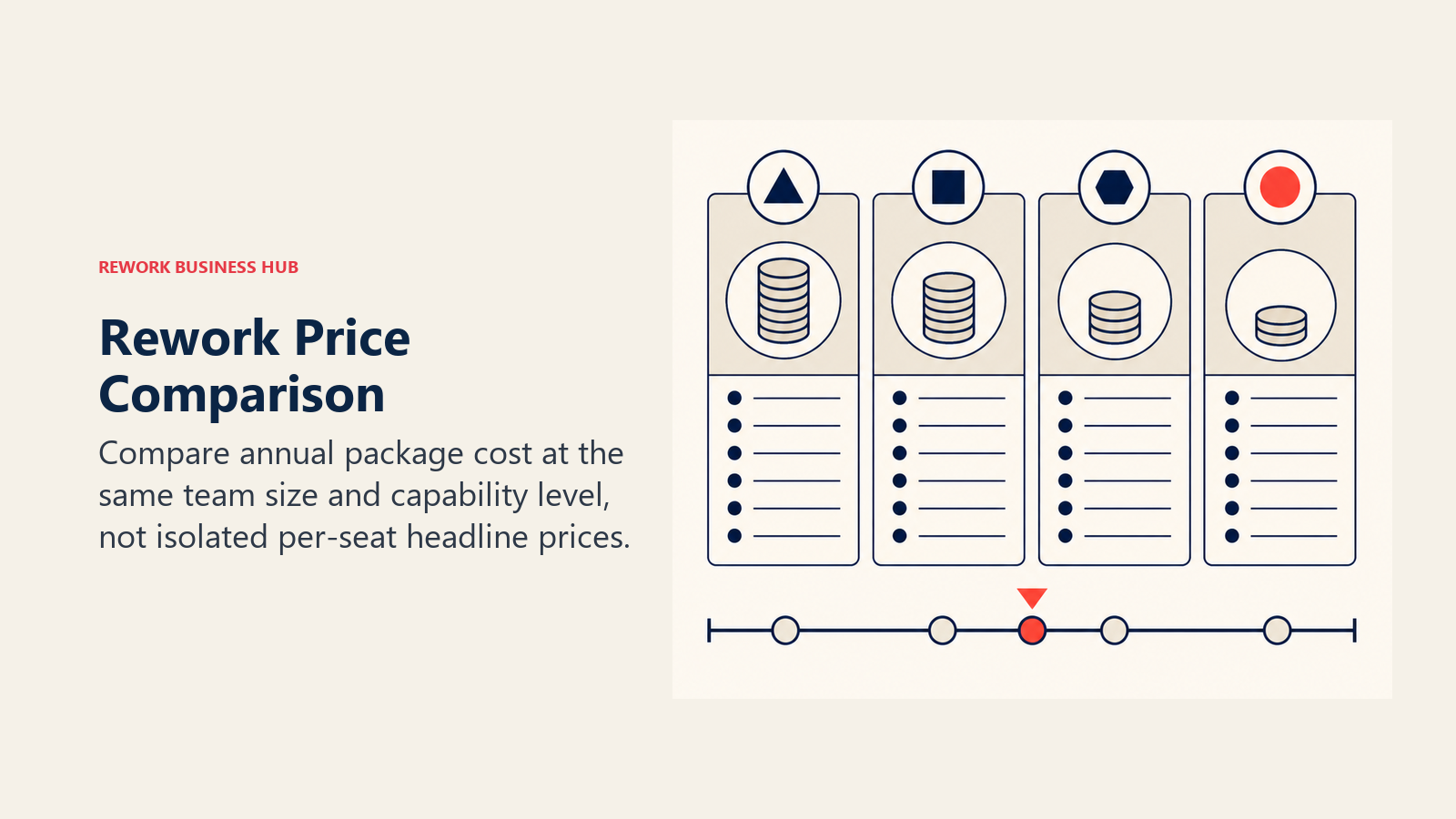
How Rework Compares on Price at 25 Seats
Yearly billing, 25 seats, comparable tier:
| Platform | Closest tier | Annual cost (25 seats) |
|---|---|---|
| Rework Sales Engine | Standard ($69/mo + 4 blocks of 5 seats at $21/mo, billed yearly) | $1,836 |
| HubSpot Sales Hub | Professional ($100/user/mo) | $30,000 |
| Salesforce Sales Cloud | Professional ($80/user/mo) | $24,000 |
| Pipedrive | Professional ($49/user/mo) | $14,700 |
Rework is significantly cheaper than HubSpot and Salesforce at this team size. But cheaper isn't always better. HubSpot Professional includes marketing automation that Rework doesn't match, and Salesforce's reporting and customization depth is genuinely superior for large, complex orgs. If you're evaluating on raw CRM functionality at a growth-stage company, Rework's price-to-feature ratio is hard to beat. If you need a combined sales and marketing platform with deep campaign reporting, HubSpot's higher per-seat price may consolidate two tool budgets into one.
For a fuller side-by-side, see Rework vs HubSpot CRM.
Who Rework Is Not For
Every Rework engine starts at 5 seats, and the cheapest, the Sales Engine, is $69/month billed yearly. That means:
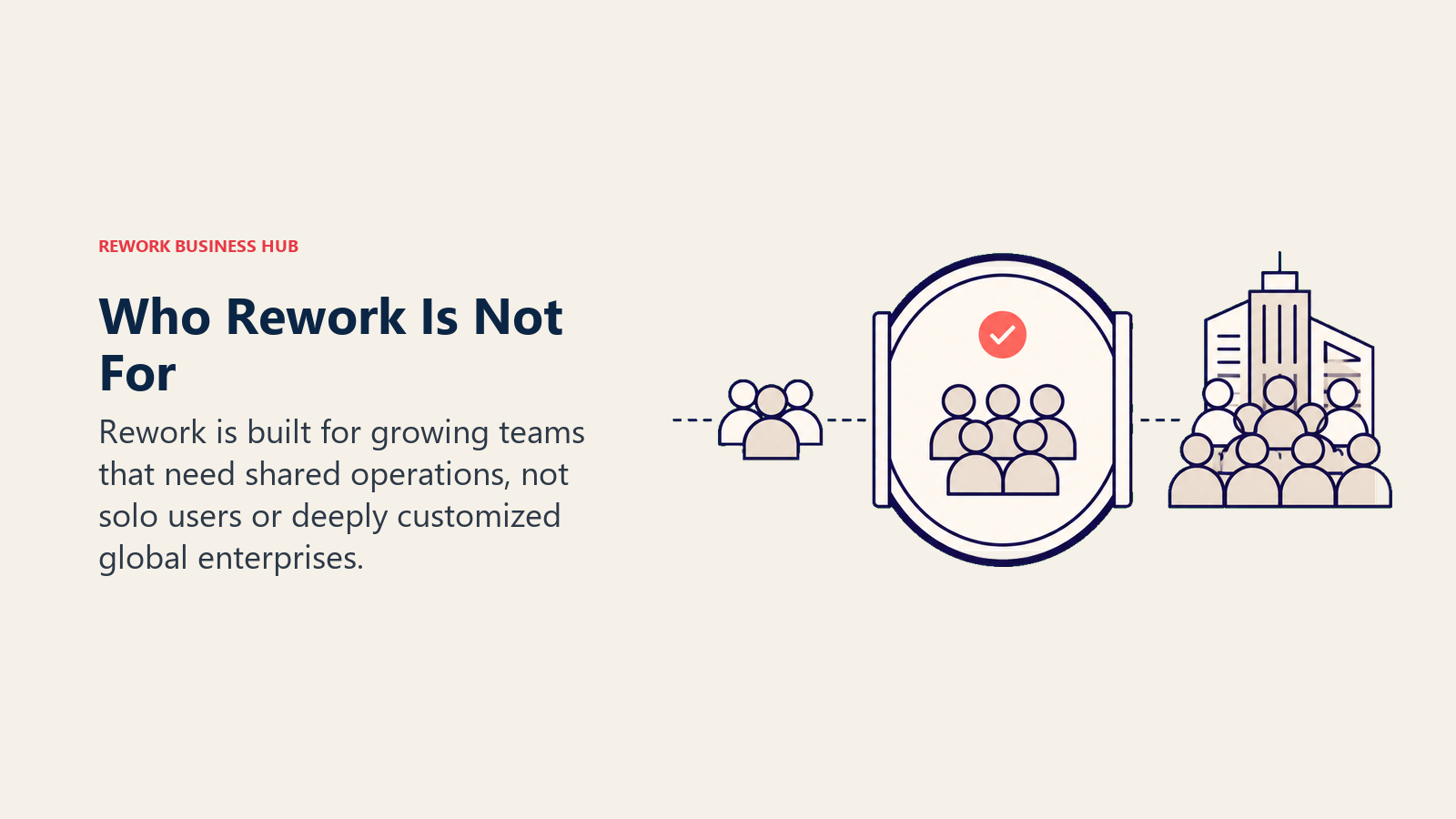
- Solo founders or 1-person sales teams: A spreadsheet (Google Sheets, Notion) gives you everything you need for free. CRM becomes the right answer once you're hiring your third agent.
- 2-person teams: Borderline. Free tools work fine here. Consider Rework's 14-day free trial if you're already feeling coordination pain between two reps.
- Enterprise teams (500+ seats) with deep compliance requirements: Rework doesn't offer HIPAA, FedRAMP, or custom data residency. Salesforce and HubSpot Enterprise have mature compliance programs.
The sweet spot is 5 to 100 users where team coordination gaps (who owns which lead, which conversation was responded to, which deal is stuck) cost real revenue. That's where CRM earns its keep.
Questions to Ask Before Signing
When you get to contract stage, these items are often negotiable:
- Grace period on contract start: If your team won't be fully onboarded for 30 to 60 days, negotiate that the yearly billing clock starts at go-live, not contract signature.
- Seat lock-in: If you think you'll add 10 seats in Q3, lock in the current seat-block rate now.
- Data export rights: Confirm in writing that you own your data and can export a full CSV at any time without restriction.
What to Do Next
If you're in early evaluation: start the 14-day free trial and run 2 to 3 actual deals through the pipeline to see if the interface fits your team's workflow before committing a budget.
If you're comparing the Sales Engine against HubSpot or Salesforce: run the seat math at your actual team size (include RevOps, CS, and any executives who'll want dashboard access), and compare total annual cost, not just the headline seat rate.
If you want a full picture of what you'll actually pay over 12 months, including implementation and integration costs, read The Real TCO of a CRM before you sign anything.
Learn More

On this page
- Five Engines, Two Areas
- Sales Engine Pricing
- Seat math: Sales Engine
- Marketing Engine Pricing
- Seat math: Marketing Engine
- Revenue Engine Pricing
- Process and Project Engine Pricing
- Seat math: Process or Project Engine
- What's Included at Every Tier
- What's Not Included (Honest List)
- How the Formula Works
- How Rework Compares on Price at 25 Seats
- Who Rework Is Not For
- Questions to Ask Before Signing
- What to Do Next
- Learn More