Best Planful Alternatives in 2026: 13 FP&A Platforms for Planning, Close and Consolidation

Turn this article into takeaways for your work.


Each assistant summarizes the article only for you and suggests best practices for your work.
Planful earns its name honestly as a Financial Performance Management platform, not just a budgeting tool. Planning, close, consolidation and reporting live in one system, the vendor counts more than 1,500 customers including Etsy, Five Guys and Del Monte, and it's been doing this since long before its 2018 rebrand from Host Analytics. If you want the closest peers doing the same job, start with Prophix, Vena, Workday Adaptive Planning, Limelight and Centage below. If your gap is bigger than finance alone, Anaplan, OneStream, Board and Pigment cover enterprise-scale connected planning. And if you've decided Planful is more platform than you need, Datarails, Cube, Jirav and Float are the lighter paths.
So why does a Planful account still end up on a shortlist of alternatives? The vendor publishes no pricing page with figures at all, not even a tier name, so there is no starting point to budget against before a sales call. The quote that eventually arrives is scoped to a platform fee plus user licenses plus which modules you deploy, since FP&A, consolidation, reporting and analytics are priced separately, which makes the total genuinely hard to predict until scoping is done. There's no free trial, so nothing about the product can be pressure-tested before budget is committed. And some finance teams, especially smaller ones without a dedicated Planful administrator, find the structured model heavier than the department-level agility they actually need. For the full 15-tool category view, start with the Best FP&A Software 2026 roundup.
Key Facts
- 50% of finance teams take 6 or more business days to close the books, and 27% take more than a week, per Ledge's 2025 month-end close benchmarking study of 100 finance professionals, reported by CFO.com. Close speed, not just budgeting, is the other half of what Planful and its peers are actually selling.
- 96% of FP&A professionals still use spreadsheets for planning and 93% use them for reporting on a daily or weekly basis, according to the 2025 AFP FP&A Benchmarking Survey of 362 practitioners. Staying Excel-native, the path Datarails and Cube take below, is not a fringe choice.
- 71% of FP&A teams already own an EPM tool, yet 85% still use spreadsheets alongside it and 57% use spreadsheets specifically to bypass it, per the Association for Financial Professionals. Owning a structured platform like Planful doesn't automatically end the workbook habit.
- Cloud-based planning, budgeting and forecasting is the technology CFOs rate most important for managing costs, chosen by 43% of respondents, per Deloitte's Q1 2026 CFO Signals survey of 200 North American CFOs. This is a budget-committee priority this year, not a nice-to-have request.
- 51% of CFOs rank improving financial forecast accuracy among their top five priorities, according to a Gartner survey of more than 200 finance chiefs reported by CFO.com. Forecast quality, not just close speed, is what's driving a lot of these evaluations too.
Why FP&A Teams Start Evaluating Planful Alternatives
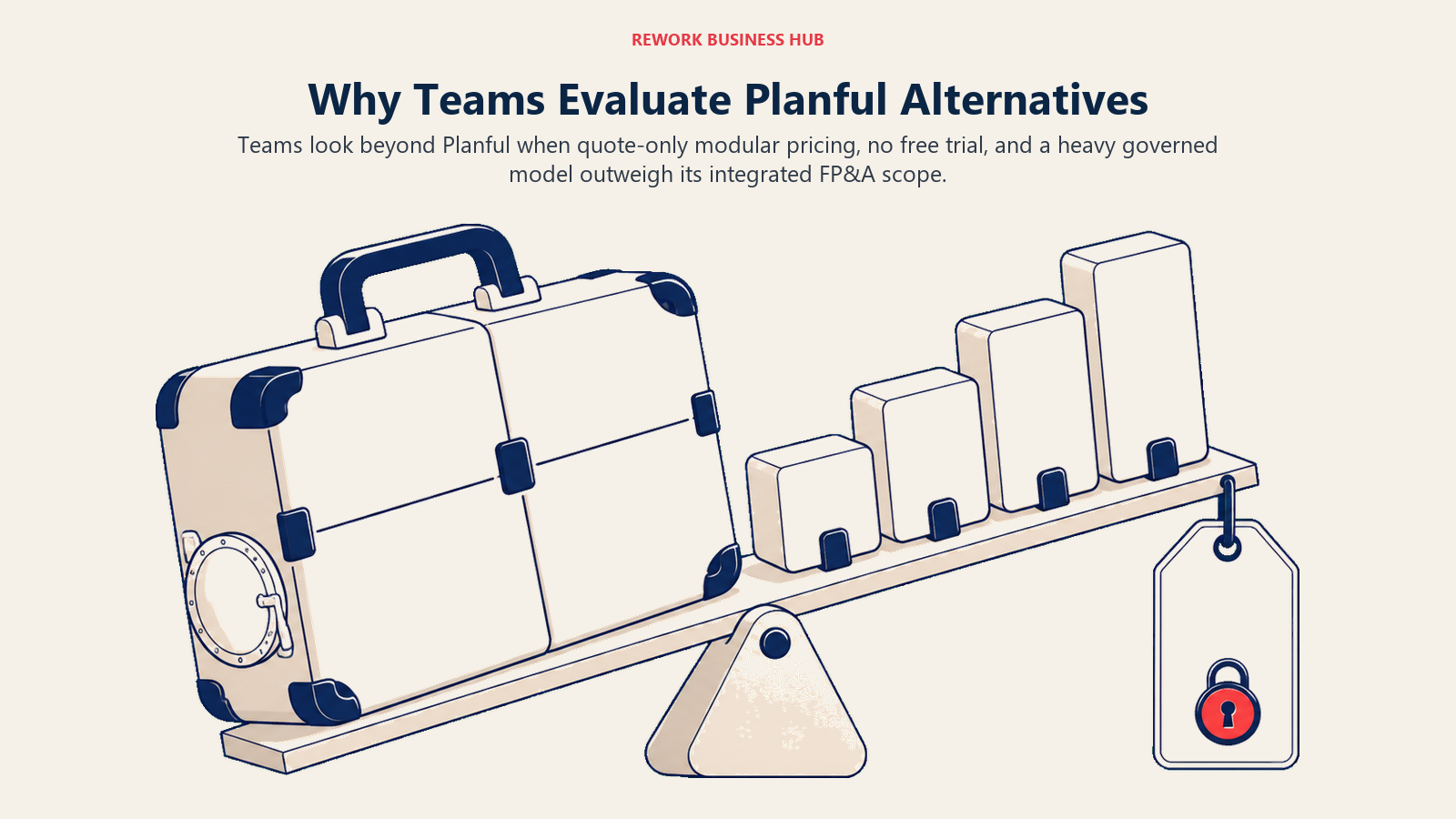
Teams start looking beyond Planful when quote-only modular pricing, no trial, and a heavy governed model outweigh the benefit of keeping planning, close, and consolidation together.
| Reason | What it looks like in practice | Who feels it most |
|---|---|---|
| No pricing page with any figures | Even a ballpark for 20 users requires a sales call before you can build a business case | Teams that need a number before they can get budget approval |
| Quote scoped to platform fee plus modules | FP&A, consolidation, reporting and analytics are priced separately, so the total keeps growing as scoping continues | Companies trying to compare total cost of ownership across vendors |
| No free trial | Every step of evaluation runs through a demo instead of hands-on use | Teams that want to pressure-test the interface before committing budget |
| Structured model feels heavier than needed | The platform is built for governed, multi-module deployments, which can outweigh a smaller team's actual job | Lean finance teams without a dedicated Planful administrator |
| Module costs compound after year one | Adding consolidation, reporting or analytics modules increases the recurring bill past the original scope | Companies scaling from one department to company-wide planning |
Quick Comparison Table
| Tool | Best For | Starting Price | Key Strength | Key Limitation |
|---|---|---|---|---|
| Prophix | Mid-market teams wanting agentic close and reconciliation | No published price (quote) | Autonomous AI aimed specifically at close and reconciliation | No pricing signal published anywhere |
| Vena | Teams that want Excel as the actual working interface | No published price; Professional and Complete tiers | Genuine Excel-native database (CubeFLEX) plus Power BI and Teams ties | Cost climbs with Power User and Contributor licensing plus add-ons |
| Workday Adaptive Planning | Teams that want to try before they buy | "Pricing varies"; 30-day free trial | Only vendor here offering a published free trial | 4.5-month average deployment even at large companies |
| Limelight | Teams that want to leave Excel and say so out loud | No published price; Starter and Unlimited tiers | Explicit anti-Excel positioning, 800+ pre-built connectors | No figures published on either tier |
| Centage | Teams that want a real number to budget against | $1,750/month (Core), billed annually | Only vendor in this guide with named monthly pricing | Built for $25M to $500M revenue companies only |
| Anaplan | Enterprise cross-functional connected planning | No published price (quote) | One engine holds finance, sales and supply chain models at once | A materially bigger project than a Planful deployment |
| OneStream | Enterprise unified close, consolidation, planning and reporting | No published price (quote) | Closest enterprise-scale answer to Planful's own "one platform" pitch | No pricing, no free trial, and new private-equity ownership since April 2026 |
| Board | Industry-specific enterprise planning | Quote per solution area | Named builds for retail, manufacturing, CPG and financial services | Total cost scales with how many solution areas you activate |
| Pigment | Fastest vendor-reported agentic scenario modeling | No published price; Explorer, Contributor, Editor licenses | Vendor-reported dramatic planning-cycle compression | Customer base skews toward larger enterprise |
| Datarails | Small teams wanting Excel-native with governance | No published price; tiers capped at 2, 5 or 15 users | Full Excel interface, data consolidated from 600+ sources | Seat caps make it a poor fit past a lean finance team |
| Cube | Teams that work in both Excel and Google Sheets | No published price; Bronze, Silver, Gold tiers | Works natively in both Excel and Sheets, not just one | Zero published figures, not even a tier-scoped range |
| Jirav | Small companies buying through an accounting firm | Firm plans from $50/month; direct business plans from $10,000/year | Purpose-built for CFO advisory delivery through accounting firms | The $50 rate is the firm plan, not the direct license |
| Float | Teams that only need cash visibility, not full FP&A | $130/month (Essentials), $105/month billed annually | Only tool here with fully self-serve published pricing | Cash-flow forecasting only, not budgeting or consolidation |
The Four Paths Out of a Planful Evaluation
Almost nobody evaluating Planful alternatives is starting from a blank slate. You already decided planning, close and consolidation belong together, or you wouldn't have bought Planful in the first place. What the evaluation usually resolves is one of four different questions.
| Path | What you've decided | Tools covered here |
|---|---|---|
| Stay a mid-market peer | The combined planning-plus-close idea is right, but this vendor's pricing, UI or Microsoft fit isn't | Prophix, Vena, Workday Adaptive Planning, Limelight, Centage |
| Move up to enterprise | Finance alone isn't the whole problem; sales, supply chain or multiple business units need the same system | Anaplan, OneStream, Board, Pigment |
| Move to a spreadsheet-native tool | Excel or Sheets should be the actual interface, not a export destination | Datarails, Cube |
| Move to something lighter | Planful's structured, multi-module platform is more than a smaller team or narrower job needs | Jirav, Float |
If you're deciding between the two Excel-native options specifically, the Vena vs Datarails comparison and the Cube vs Datarails comparison both work through that choice directly. Read the section below that matches your answer, or read straight through if you're still deciding.
1. Prophix: An Autonomous Finance Platform for the Mid-Market
Prophix One calls itself "the first autonomous finance platform for the mid-market," and of everyone on this list, it's the closest peer to Planful's own core promise: planning, close and consolidation with multi-currency and multi-GAAP support, unified under one platform rather than bolted-on modules. Where the two diverge is emphasis, Prophix leans harder into agentic AI for specific close tasks, while Planful spreads its Analyst, Planner and Help assistants across the whole planning cycle.
Methodology and fit. The platform's AI targets automated budget collection and account reconciliation specifically, with AI-powered matching for GL and intercompany transactions, alongside reporting with drill-down analytics. Prophix reports more than 3,000 customers across construction, healthcare, higher education, manufacturing and professional services, an explicitly mid-market spread that overlaps closely with Planful's own buyer profile. It also keeps Power BI and MS365 integration for teams on a Microsoft-adjacent stack.
| Pros | Cons |
|---|---|
| Closest direct peer to Planful's planning-plus-close-plus-consolidation pitch | No pricing signal published anywhere, same opacity problem as Planful |
| Agentic AI targets close and reconciliation specifically, not just planning | Vendor claims like "shave days off close" need validating in a proof of concept |
| Retains Power BI and MS365 integration for Microsoft-adjacent teams | Fewer named AI sub-capabilities listed publicly than some AI-native challengers |
Pricing. The pricing page carries educational cost content and a "book a call" call to action, with no tiers or figures published, the same quote-only pattern as Planful itself.
Best for: Teams that like everything about Planful's combined planning-close-consolidation model but want a fresh vendor relationship or stronger Microsoft-adjacent integration.
2. Vena: Excel as the Actual Interface
Vena makes a different bet than Planful entirely. Instead of a structured, module-based platform, it built CubeFLEX, a real database, underneath a genuinely Excel-native interface, so planners keep the formulas and mental model they already know. The Microsoft ties run deep: native Power BI dashboards, Teams collaboration and support for Dynamics 365, and they got deeper in March 2026 when Vena completed its acquisition of Acterys, a Power BI-based operational planning platform (Vena newsroom).
Methodology and fit. If your real objection to Planful was learning a new structured UI rather than the price or the module stack, Vena answers that directly by keeping Excel as the working surface, not a companion export. It serves companies from smaller finance teams up through large enterprise, with pricing tiered by user role, Power User, Contributor and View Only, rather than company size.
| Pros | Cons |
|---|---|
| Genuinely Excel-native, not an Excel export bolted onto a web app | No published pricing, only two tier names, Professional and Complete |
| Deep native ties to Power BI, Teams and Dynamics 365 | Several capabilities sit behind "additional cost" even on paid tiers |
| Acterys acquisition adds a proprietary Power BI write-back engine | Implementation and template build are a real project, same as Planful's own setup |
Pricing. No figures published anywhere. Two tiers by name only, Professional (marked most popular) and Complete, with Vena Insights, the Sandbox Environment, Expert Managed Services and export APIs available at additional cost on Professional. For the full field of Vena alternatives, not just its fit against Planful, see the Best Vena Alternatives guide.
Best for: Teams whose real complaint about Planful was the interface itself, not the concept of a unified planning-and-close platform.
3. Workday Adaptive Planning: The Only Free Trial on This List
Workday Adaptive Planning is an Enterprise Performance Management platform that sits alongside Workday HCM and Workday Financial Management as a complementary planning layer. For teams frustrated specifically by Planful's lack of any hands-on trial, this is the one alternative that answers that objection directly: a published 30-day free trial, no obligation, confirmed on the vendor's own pricing page.
Methodology and fit. The platform covers financial planning, workforce planning (headcount, talent, capacity) and operational planning, plus close and consolidation, with AI backed by what the vendor calls human-in-the-loop governance. It states it serves "organizations of all sizes," but featured logos like KeyBank, AWS, Southwest Airlines and ExxonMobil, plus its own reported average deployment time of 4.5 months even at large companies, point toward an enterprise-weighted reality once you're past the trial.
| Pros | Cons |
|---|---|
| The only alternative here with a published, no-obligation free trial | 4.5-month average deployment even at large companies is a real time commitment |
| Workforce planning is a first-class module, not a manual add-on | Value case weakens if you're not in or moving toward the Workday ecosystem |
| Sits naturally alongside Workday HCM and Financial Management | "Pricing varies" language still means you start from zero information after the trial |
Pricing. The vendor's pricing page lists "Pricing varies" for both Workday Adaptive Planning and its separately quoted Close and Consolidation add-on, alongside the 30-day free trial and a request-a-quote flow.
Best for: Teams that want to test drive the actual product before committing budget, or that are already running Workday for HR or financials. The Best Workday Adaptive Planning Alternatives guide covers the reverse direction if Workday itself becomes the incumbent you're shortlisting away from, and the Anaplan vs Workday Adaptive Planning comparison works through that specific choice.
4. Limelight: "Leave Excel Behind," Said Out Loud
Limelight states the anti-spreadsheet case as its actual tagline: "Budget 3x Faster. Finally Leave Excel Behind." Where Planful's pitch is a structured platform that still lets Excel coexist as an export format, Limelight is more direct about wanting the workbook gone entirely.
Methodology and fit. The platform structures accounts, departments, entities, drivers and assumptions into one connected model, with updates propagating automatically across every plan. Limelight AI layers trend analysis and narrative generation on top, and the vendor lists more than 800 pre-built connectors. Target customers skew mid-to-enterprise across six named verticals: non-profit, healthcare, SaaS, manufacturing, professional services and insurance.
| Pros | Cons |
|---|---|
| States leaving Excel as the explicit selling point, not a soft implication | No published pricing on either tier |
| Limelight AI bakes narrative generation into the standard workflow | Newer AI feature set than more established mid-market specialists |
| 800+ pre-built connectors, among the broadest integration claims here | "Familiar Excel-like experience" language means the grid interface still persists somewhat |
Pricing. Two tiers by name only, Starter (up to 5 users) and Unlimited (unlimited users), with no figures published for either.
Best for: Teams whose Planful evaluation ended with wanting the spreadsheet gone entirely, said plainly, not just governed better.
5. Centage: The Only Number You Can Budget Against
Centage positions itself as FP&A software that "frees you from spreadsheet chaos," built for companies that have outgrown manual budgeting but don't need Planful's enterprise-adjacent complexity. It's the only vendor in this entire guide, Planful included, that publishes an actual dollar figure rather than a tier name.
Methodology and fit. The platform automates budgeting and consolidation across departments, locations and entities, runs rolling forecasts against live data connections, and includes a built-in personnel and workforce planning module. Centage's stated ICP is specific: $25M to $500M in annual revenue, typically run by a 2 to 10 person finance team, a notably smaller buyer than Planful's own 1,500+ customer base. The vendor claims it compresses a 6-week budgeting cycle to 2 weeks and deploys in 4 to 6 weeks without IT. For a wider view of this size band, the budgeting and forecasting software roundup covers more options.
| Pros | Cons |
|---|---|
| The only named dollar figures in this guide, so you can budget without a sales call | Revenue ceiling is real; north of roughly $500M it stops fitting |
| Built-in personnel and workforce planning module out of the box | Narrower integration list (QuickBooks, NetSuite, Sage Intacct, ADP, UKG) than larger vendors |
| Finance-owned deployment claimed at 4 to 6 weeks, no IT required | Smaller peer group than Prophix or Planful in terms of consolidation depth |
Pricing. Three published tiers, all billed annually: Core at $1,750/month, Strategic at $2,500/month, Performance at $3,500/month. The vendor also states mid-market companies typically invest $18,000 to $40,000 annually, in line with those monthly figures.
Best for: Smaller finance teams for whom Planful's platform-fee-plus-modules pricing was always going to be more product, and more cost, than the job actually required.
6. Anaplan: Connected Planning Beyond Finance
Anaplan calls itself "decision infrastructure for agentic enterprises," combining a proprietary deterministic calculation engine with connected data and role-based AI agents. The vendor reports that 48% of the Fortune 50 use the platform, framing the honest reason to leave Planful for Anaplan: not a better close, but the fact that the same engine can hold sales, supply chain and workforce models simultaneously.
Methodology and fit. Where Planful unifies planning, close, consolidation and reporting for finance, Anaplan's calculation engine spans role-based AI agents across multiple business functions, generating forward-looking scenarios through what the vendor calls a proprietary business data ontology. This is not a finance-department upgrade, it's a bet that finance planning was never the whole problem.
| Pros | Cons |
|---|---|
| Calculation engine built to hold cross-functional models (sales, supply chain, workforce) at once | Nothing published; every conversation starts at contact-sales, same as Planful |
| Role-based AI agents span multiple business functions, not just FP&A | A cross-functional rollout is a materially bigger project than a finance-only Planful deployment |
| Deep enterprise reference base, including nearly half the Fortune 50 | Budget the change-management time, not just the license cost, into the decision |
Pricing. No figures published anywhere. anaplan.com/pricing resolves to a contact-sales form.
Best for: Organizations where the real gap Planful exposed wasn't finance planning specifically, it's that sales, supply chain or workforce all plan separately from finance and from each other. If Anaplan itself becomes the incumbent you're evaluating away from, the Anaplan alternatives guide covers that comparison directly.
7. OneStream: The Closest Enterprise-Scale Answer to Planful's Own Pitch
OneStream calls itself "the AI operating system for modern Finance," unifying financial close, consolidation, planning and reporting within a single interface, the same combination Planful sells, but built for organizations several sizes larger. The vendor states it's "trusted by 1,900+ of the world's leading Finance teams," with logos like UPS, Nasdaq, Costco, Capital One, KLM and Toyota.
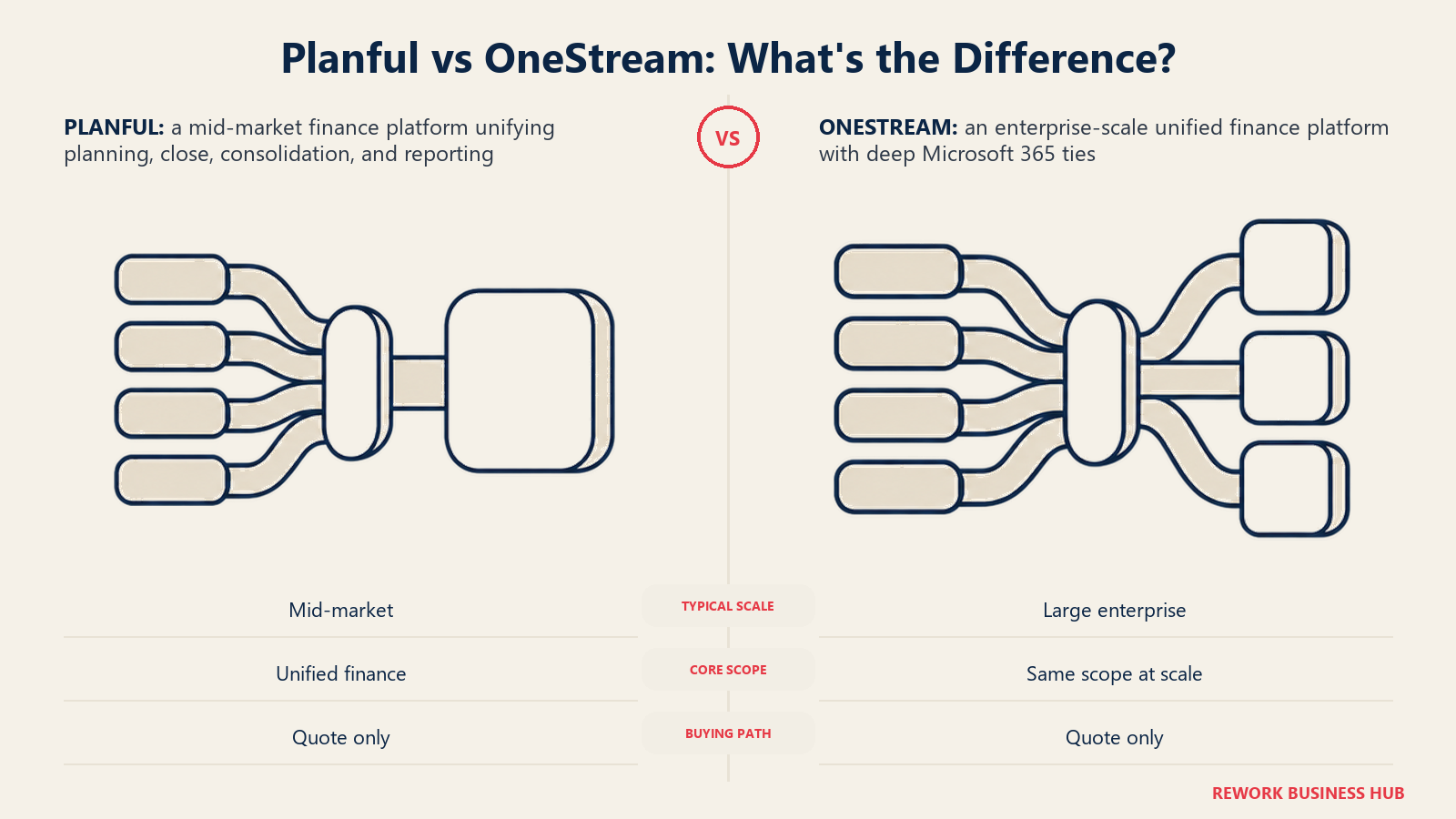
Methodology and fit. OneStream's AI features center on what it calls Agentic Finance, governed AI agents for finance questions and calculations, plus automated forecasting, scenario modeling and risk detection. The platform is deeply embedded in Microsoft 365, and OneStream was named Microsoft's 2025 Americas Partner of the Year. One fact worth knowing before you shortlist it: OneStream is now privately held. Hg completed a $6.4 billion take-private acquisition on April 1, 2026, at $24.00 per share, with General Atlantic and Tidemark as minority investors, and the Class A shares stopped trading on Nasdaq (OneStream newsroom). Tom Shea stayed on as CEO and the leadership team remained in place, so the roadmap has continuity, but the quarterly public financials that used to give buyers an independent read on the company are gone.
| Pros | Cons |
|---|---|
| The closest enterprise-scale match to Planful's own "planning, close, consolidation, reporting" pitch | No pricing page found; quote-only from the first conversation, same as Planful |
| Deep Microsoft 365 embedding, named Microsoft's 2025 Americas Partner of the Year | No free trial either, so it doesn't solve Planful's hands-on-testing gap |
| Enterprise reference base spans logistics, retail, finance and manufacturing at real scale | Pending Hg acquisition adds a governance and ownership variable to a multi-year contract decision |
Pricing. No standalone pricing page with figures exists on onestream.com; third-party listing sites mark it "Contact vendor." Treat it as enterprise quote-only, in line with a large-account sales motion.
Best for: Companies that want Planful's exact combination of planning, close and consolidation, but at a scale several times larger than Planful's own core mid-market buyer, and who are comfortable signing a multi-year commitment with a vendor that no longer publishes quarterly financials.
8. Board: Industry-Specific Enterprise Planning
Board calls itself "the enterprise planning platform with AI for confident decisions," built around what it terms Continuous Planning, a single system connecting financial and operational planning rather than reconciling them after the fact. It's the most industry-specific platform in this guide, with named configurations for retail, manufacturing, CPG and financial services.
Methodology and fit. Board's persona-based agents, an FP&A Agent, Controller Agent, Merchandiser Agent and Supply Chain Agent, are each scoped to a specific role rather than one generic assistant. The vendor reports recognition as a Leader in the 2025 Gartner Magic Quadrant for Financial Planning Software, a vendor-cited claim worth verifying against the current report. Customer logos, Volkswagen, Kimberly-Clark, Mitsubishi, Kraft Heinz, BASF, Burberry, are large, established enterprises well past Planful's typical buyer size.
| Pros | Cons |
|---|---|
| Industry-specific builds (retail, manufacturing, CPG) go deeper than a generic tool | No pricing signal anywhere; quoting happens per solution area |
| Persona-based agents map to specific roles rather than one shared assistant | Total cost depends on how many solution areas you activate |
| Independent analyst recognition gives procurement a reference point | Depth matters less if your business doesn't match a named vertical |
Pricing. "When it comes to planning, one size doesn't fit all," per the vendor's own pricing page, which routes to a custom quote request per solution area rather than any published figure.
Best for: Enterprises in retail, manufacturing, CPG or financial services that want planning software built around their industry's specific processes, a step up from what Planful's generic module structure offers.
9. Pigment: Agentic Business Planning at Scale
Pigment positions itself as an "integrated business planning platform powered by agentic AI," built around three named agents, Modeler, Analyst and a Planner agent the vendor describes as coming soon, on an elastic-scaling engine it calls Graphite. The pitch is "one shared reality" across Finance, Sales, HR and Supply Chain, a wider net than Planful's finance-centered platform casts.
Methodology and fit. The Modeler Agent converts natural-language descriptions into governed financial models, and the Analyst Agent proactively scans metrics to flag anomalies. Pigment cites planning-cycle compression worth validating in your own proof of concept: one customer cutting strategic planning from two weeks to a day, another compressing a P&L update from 8 days to 4 minutes. Customer references, Unilever, Siemens, Danone, Figma, Carta, Anthropic, skew toward larger, modern technology and consumer companies than Planful's typical account.
| Pros | Cons |
|---|---|
| Named scenario simulation as a first-class agent, not a manual what-if copy | No pricing signal at all; every figure routes through a Customer Success Manager |
| Vendor-reported planning-cycle compression is the most dramatic claim in this guide | Customer roster skews larger enterprise than Planful's own core buyer |
| MCP Server connects the platform to Claude and other AI systems | Planner Agent is still coming soon, not fully shipped |
Pricing. No public price. Licensing is documented as three types, Explorer, Contributor and Editor, with actual pricing handled through a Customer Success Manager rather than a self-serve page. For the full field, the Best Pigment Alternatives guide covers who else competes on this axis.
Best for: Fast-scaling companies whose planning needs now span Finance, Sales and HR at once, past what Planful's finance-focused platform was built to cover.
The nine platforms above all keep Planful's core idea, a structured model as the primary working surface. The next two flip that: Excel or Google Sheets stays the interface, and the platform becomes the governance layer underneath it instead of a parallel system to learn.
10. Datarails: Excel-Native, With a Governance Layer Instead of a Module Stack
Datarails makes the opposite bet from Planful. Instead of moving the model into a structured platform, its FinanceOS product keeps Excel as the entire working surface, consolidating data from over 600 sources into a governed, AI-ready layer: "stay in Excel, and every number is connected, governed, and AI-ready."
Methodology and fit. FinanceOS handles consolidation with intercompany eliminations, budgeting and forecasting, close workflows and cash flow visibility, all surfaced through Excel rather than a separate web app like Planful's. It serves companies from small teams up to several thousand employees, but its three named tiers are scoped by user count, not company size: 2, 5 or 15 named users, a much smaller ceiling than the multi-department deployments Planful is built for.
| Pros | Cons |
|---|---|
| Full Excel interface, no new platform UI to learn on top of governed data | Named seat caps (2, 5, 15) restrict it to a small, centralized finance team |
| Consolidation with intercompany eliminations included even at the entry tier | No published price at any tier; every quote requires a call |
| Broad connector library, 600+ sources | Less suited to the company-wide, multi-module deployment Planful supports |
Pricing. Three tiers by name and seat/integration limit only, no figures: FP&A Professional (2 users, 1 integration), FP&A Premium (5 users, 2 integrations), FP&A Expert (15 users, 3 integrations). For the full field of who competes with Datarails specifically, see the Best Datarails Alternatives guide.
Best for: Small, centralized finance teams who never wanted Planful's structured module approach in the first place and would rather keep Excel as the actual product.
11. Cube: Excel and Google Sheets, Both Natively
Cube extends the Excel-native bet one step further by supporting Google Sheets natively too, calling itself an "agentic FP&A platform" organized into four named agent teams, Data Managers for reconciliation, Analysts for variance analysis, Planners for forecasting, and Business Partners for reporting.
Methodology and fit. The core promise, "your model stays yours, Cube keeps every cell current and traceable," is a different pitch than Planful's structured, module-based platform, since Cube's governance sits alongside the spreadsheet you already use rather than replacing it. Customer references lean mid-to-enterprise, with heavy emphasis on audit trails across retail, software, healthcare, nonprofit and financial services logos.
| Pros | Cons |
|---|---|
| Native support for both Excel and Google Sheets, not locked to one like most on this list | Zero published pricing, not even a tier-scoped range |
| Four distinct agent teams mapped to specific FP&A tasks rather than one generic assistant | Younger governance framework than Planful's much longer track record |
| Strong audit-trail messaging that maps answers back to source transactions | "Get quote" is the only option on every tier |
Pricing. Three tiers by name only, Bronze, Silver, Gold, each behind a "Get quote" button with no published figures as of August 2026. For a direct field comparison, the Best Cube Alternatives guide covers who else competes on this specific spreadsheet-native axis.
Best for: Teams that want the Excel-native comfort of a Datarails-style approach, but sit on Google Workspace or run a mixed Excel-and-Sheets organization.
The last two platforms are for a different conversation entirely: teams that looked at Planful's full planning-close-consolidation scope and decided they need something considerably smaller, either because the company is younger, or because an accounting firm or outsourced CFO is running the process rather than an in-house team.
12. Jirav: FP&A Built for Accounting-Firm Delivery
Jirav positions itself as "the leading, all-in-one forecasting, budgeting, reporting, and dashboarding solution, purpose-built for accounting and finance heroes," with an explicit dual focus: direct small and midsize companies, and accounting firms delivering CFO advisory services to many clients at once. That second audience has no real equivalent among the enterprise-facing tools above.
Methodology and fit. The platform covers annual planning and budgeting, rolling and mid-to-long-range forecasting, and financial packages built for monthly close delivery. Jirav publishes named pricing on two separate lists, and it's important to read the right one: Controller Essentials from $50/month and CFO Enterprise from $150/month are the accounting-firm plans (up to 15 client admin and editor users, unlimited read-only viewers), while a company buying direct starts at Starter $10,000/year and Pro $15,000/year, with Enterprise on request. Budget off the list that matches how you plan to buy.
| Pros | Cons |
|---|---|
| Purpose-built for CFO advisory delivery through accounting firms, a distinct niche | Published $50 and $150 figures are wholesale accounting-firm plans, easy to misread as a corporate price |
| Direct corporate messaging exists too, for small and midsize companies buying in-house | Far lighter consolidation and multi-entity depth than Planful, Prophix or OneStream |
| Scenario planning "based on board or leadership input, in a flash," per the vendor | Less suited to a company already running multi-department, multi-module planning |
Pricing. Named accounting-firm wholesale tiers starting at $50/month (Controller Essentials) and $150/month (CFO Enterprise); a direct corporate license is a separate conversation with sales, not represented by those published figures.
Best for: Small companies working with an outsourced CFO or accounting firm, or firms themselves building an FP&A advisory practice, neither of which Planful's platform is built to serve.
13. Float: Cash Visibility Without the Full FP&A Suite
Float is the lightest option in this guide by a wide margin, and it says so plainly: "Short-term cash flow management software," positioned as "the cash decision layer between accounting and reporting" rather than a Planful replacement in the full sense. It only works layered on top of Xero or QuickBooks Online (Sage Intacct is coming soon), and the vendor reports "8,000+ finance teams" using it.
Methodology and fit. Float runs a 13-week rolling forecast for short-term, day-to-day decisions alongside a monthly forecast extending up to three years for board conversations, with scenario planning that lets a team "toggle income and costs on or off, model what-if scenarios, and price new hires before you commit." What it does not do is budgeting, consolidation or close, the actual core of Planful's product. This is the right answer only when cash visibility, not full FP&A, is really the unmet need.
| Pros | Cons |
|---|---|
| Only tool in this entire guide with fully self-serve, published pricing | Cash-flow forecasting only, no budgeting, consolidation or close workflow |
| Live sync with Xero and QuickBooks Online, no separate data model to maintain | Requires an underlying accounting platform; it's a layer, not a system of record |
| Named monthly and annual pricing across three tiers, easy to budget against | Wrong tool entirely if the real Planful complaint was about consolidation or close speed |
Pricing. Essentials at $130/month, or $105/month billed annually. Growth at $265/month, or $215/month annually. Scale at $389/month, or $315/month annually, covering up to 5 entities, with each additional entity at $78/month, or $63/month annually. Prices are shown in USD alongside GBP, EUR and AUD, and exclude VAT.
Best for: Teams that started evaluating Planful for the whole planning-close-consolidation stack, then realized what they actually needed was reliable cash visibility on top of Xero or QuickBooks.
Stage Fit Matrix
| Tool | Startup 0-50 | Growth 50-250 | Mid-Market 250-1,000 | Enterprise 1,000+ |
|---|---|---|---|---|
| Prophix | Weak | Moderate | Strong | Moderate |
| Vena | Weak | Moderate | Strong | Moderate |
| Workday Adaptive Planning | Weak | Weak | Moderate | Strong |
| Limelight | Weak | Moderate | Strong | Moderate |
| Centage | Weak | Strong | Strong | Weak |
| Anaplan | Weak | Weak | Weak | Strong |
| OneStream | Weak | Weak | Weak | Strong |
| Board | Weak | Weak | Weak | Strong |
| Pigment | Weak | Weak | Moderate | Strong |
| Datarails | Strong | Strong | Strong | Weak |
| Cube | Moderate | Strong | Strong | Moderate |
| Jirav | Strong | Strong | Moderate | Weak |
| Float | Strong | Moderate | Weak | Weak |
Sizing and Persona Table
| Tool | Headcount sweet spot | Primary buyer | Secondary buyer |
|---|---|---|---|
| Prophix | 100 to 2,000 | CFO / Finance Director | Controller |
| Vena | 150 to 3,000 | VP of Finance / Controller | CFO |
| Workday Adaptive Planning | 500 to 10,000+ | CFO | VP of HR / CHRO |
| Limelight | 150 to 2,000 | VP of Finance | Controller |
| Centage | 100 to 1,000 ($25M-$500M revenue) | Controller | CFO |
| Anaplan | 1,000 to 50,000+ | CFO / VP of Strategy | VP of Sales Ops / Supply Chain |
| OneStream | 1,000 to 50,000+ | CFO / VP of Finance | Corporate Controller |
| Board | 1,000 to 20,000+ | CFO | VP of Supply Chain / Merchandising |
| Pigment | 500 to 10,000+ | CFO | VP of RevOps / CHRO |
| Datarails | 10 to 500 (2 to 15 named FP&A users) | Controller / Finance Manager | CFO |
| Cube | 100 to 2,000 | FP&A Director | CFO |
| Jirav | 10 to 500, or accounting firms serving many clients | Controller / Outsourced CFO | Accounting Firm Partner |
| Float | 5 to 250 | Finance Manager / Bookkeeper | Outsourced Advisor |
How to Choose: Decision Framework
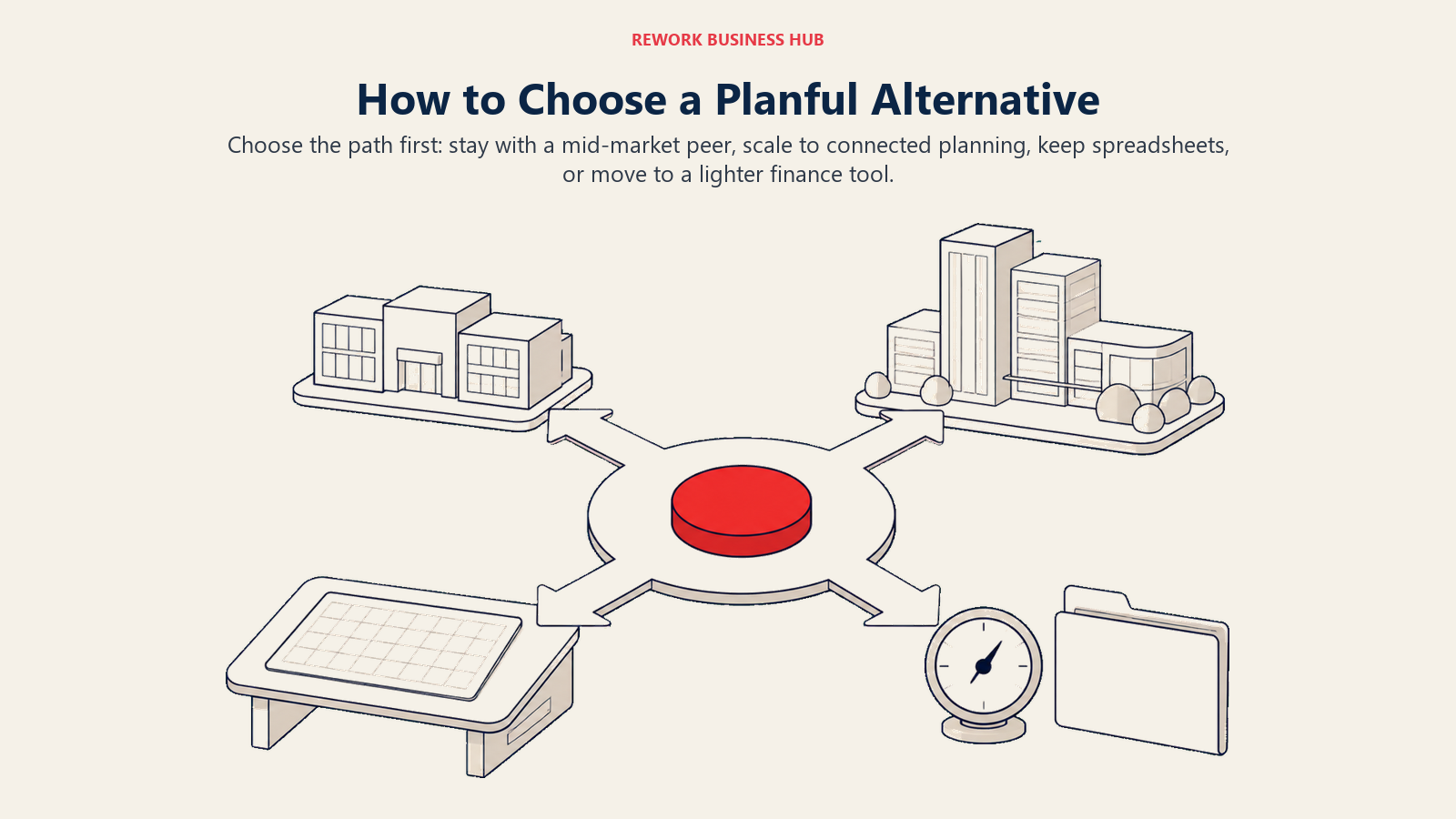
Planful alternatives split into four buying paths: mid-market suites, enterprise connected planning, spreadsheet-native tools, and lighter finance products. Choose the path before comparing vendors.
| If you need... | Choose |
|---|---|
| The closest peer to Planful's own planning-plus-close-plus-consolidation model | Prophix |
| Excel as the literal working interface, with Power BI and Teams ties | Vena |
| To actually try the product before committing budget | Workday Adaptive Planning |
| A vendor that says "leave Excel behind" out loud and means it | Limelight |
| A named dollar figure you can budget against instead of another "contact sales" | Centage |
| Connected planning spanning finance, sales, supply chain and workforce | Anaplan |
| Planful's exact scope (planning, close, consolidation, reporting) at enterprise scale | OneStream |
| Industry-specific enterprise planning built for retail, manufacturing, CPG or financial services | Board |
| The fastest vendor-reported agentic scenario modeling across Finance, Sales and HR | Pigment |
| To keep Excel as the interface, with governance and 600+ connectors instead of a module stack | Datarails |
| The same spreadsheet-native comfort, but on Google Sheets too | Cube |
| FP&A delivered through an accounting firm or outsourced CFO relationship | Jirav |
| Cash visibility on top of Xero or QuickBooks, not the full planning-and-close stack | Float |
Frequently Asked Questions about Planful Alternatives
How much does Planful actually cost?
Planful publishes no pricing page with figures at all. The quote is scoped to a platform fee, per-user licenses, and which modules you deploy, since FP&A, consolidation, reporting and analytics are priced separately, so the total depends entirely on scoping. There's no free trial either, so every real number comes from a sales conversation.
Which Planful alternative has the most transparent pricing?
Centage, by a wide margin. It publishes three named monthly tiers billed annually, Core at $1,750, Strategic at $2,500, Performance at $3,500. Every other platform in this guide, Planful included, is quote-only.
Does any Planful alternative offer a free trial?
Workday Adaptive Planning is the only one in this guide with a published free trial, 30 days with no obligation, confirmed on the vendor's own pricing page. Every other alternative here, and Planful itself, requires a sales conversation before you can touch the product.
What's the cheapest way to move off Planful?
It depends what you actually need. Float is the lightest and cheapest self-serve option if cash visibility is the real job, starting at $130 a month billed monthly. Jirav publishes figures for both routes, accounting-firm plans from $50 a month and direct business plans from $10,000 a year, so confirm which pricing model applies before treating either number as your budget line.
Should we stay on a structured platform or move to Excel-native?
Stay on a structured platform, closer to what Planful already gives you, if the combined planning-close-consolidation model is right and only the vendor relationship or pricing needs to change; Prophix, Vena, Limelight and Centage are the closest peers. Move to Excel-native if the workbook itself was never the problem and a new platform UI feels like unnecessary overhead; Datarails and Cube keep Excel or Google Sheets as the actual interface.
Which Planful alternative fits best if we're already invested in Microsoft?
Vena and Prophix both lean into Microsoft-adjacency. Vena is built around Excel with native Power BI and Teams ties, plus Dynamics 365 as a connected ERP. Prophix keeps Power BI and MS365 integration alongside its own governed platform. Workday Adaptive Planning fits better if your HR system is also moving to Workday rather than staying Microsoft-native.
Is OneStream, Anaplan, Board or Pigment overkill for a company just leaving Planful?
Usually, yes, if planning, close and consolidation for finance alone was the whole job, which is exactly what Planful already handles. These four make sense when the evaluation reveals a bigger gap: sales, supply chain, workforce or multiple business units all need to plan on the same system, not finance alone.
Is OneStream a stable choice now that it is privately held again?
Yes, with one caveat about disclosure rather than stability. Hg completed a $6.4 billion take-private acquisition of OneStream on April 1, 2026, a private-equity buyout rather than a shutdown, 21 months after the July 2024 IPO. Tom Shea remained CEO and the leadership team stayed in place, so the product keeps operating and adding customers. What changed is that OneStream no longer files quarterly financials, so ask for direct customer references instead of relying on public growth numbers.
What to Do Next
Pick your path before you book a single demo. If Planful's combined planning-close-consolidation model is right and only the vendor, price or Microsoft fit needs to change, shortlist two from Prophix, Vena, Workday Adaptive Planning, Limelight and Centage, and use Workday Adaptive Planning's free trial as your one chance to actually touch a product before committing. If Planful exposed a bigger gap, that sales, supply chain or workforce planning never lived on the same system as finance, start enterprise conversations with Anaplan, OneStream, Board or Pigment, and budget the change-management timeline as seriously as the license cost. If the workbook itself was never the problem, shortlist Datarails or Cube and run a real pilot with your own chart of accounts loaded, not a canned demo dataset. And if this whole evaluation started because Planful felt like more platform than a smaller team needs, look at Jirav or Float before signing anything bigger. Whichever path you take, get the per-user rate at your exact headcount, what's gated behind each module, and the year-two renewal number in writing before you sign, since almost none of these vendors publish a figure you can budget against without asking first.
Camellia covers FP&A, financial operations and finance tooling for B2B teams.

Principal Product Marketing Strategist
On this page
- Key Facts
- Why FP&A Teams Start Evaluating Planful Alternatives
- Quick Comparison Table
- The Four Paths Out of a Planful Evaluation
- 1. Prophix: An Autonomous Finance Platform for the Mid-Market
- 2. Vena: Excel as the Actual Interface
- 3. Workday Adaptive Planning: The Only Free Trial on This List
- 4. Limelight: "Leave Excel Behind," Said Out Loud
- 5. Centage: The Only Number You Can Budget Against
- 6. Anaplan: Connected Planning Beyond Finance
- 7. OneStream: The Closest Enterprise-Scale Answer to Planful's Own Pitch
- 8. Board: Industry-Specific Enterprise Planning
- 9. Pigment: Agentic Business Planning at Scale
- 10. Datarails: Excel-Native, With a Governance Layer Instead of a Module Stack
- 11. Cube: Excel and Google Sheets, Both Natively
- 12. Jirav: FP&A Built for Accounting-Firm Delivery
- 13. Float: Cash Visibility Without the Full FP&A Suite
- Stage Fit Matrix
- Sizing and Persona Table
- How to Choose: Decision Framework
- What to Do Next