Best AI Agents for Small Business in 2026: 10 Agents Ranked by Setup Time and Real Cost
Turn this article into takeaways for your work.


Each assistant summarizes the article only for you and suggests best practices for your work.
The best AI agents for a small business in 2026 are Tidio's Lyro or Gorgias for answering customers, Goodcall or Rosie for the phone, BILL AI for chasing invoices, Docyt for bookkeeping admin, and Lindy or Zapier Agents when the job is too small or too custom to justify a dedicated product. Every entry below was graded on time to a real first result and whether an owner with no IT staff can run it day to day, priced at the volume a small team actually generates, not the enterprise numbers most "best AI agent" roundups quietly assume.
An AI agent is not the same thing as an AI tool. A tool drafts something for a person to send, like ChatGPT writing an email a human still reviews. An agent plans a short sequence of steps and takes them itself, answering the chat, booking the slot, sending the reminder, with a person checking in only at the edges. If general assistive software like ChatGPT, Canva, or Grammarly is what you're actually after, see best AI tools for small business instead. And this guide covers finished products built for one job, not the platforms you assemble an agent on yourself: for the general-purpose builders ranked purely on what a non-engineer can construct, see best no-code AI agent builders.
Key Facts
- Small businesses adopt AI at a lower rate than larger peers, 43% at companies with 2-9 employees versus 59% at 100-249 employees, per the U.S. Chamber of Commerce Foundation's Main Street AI Monitor, which tracks with why setup effort matters more at this size than anywhere else.
- 92% of small businesses already using AI say it saves them time and improves efficiency, per the Reimagine Main Street small business AI survey.
- 91% of small and medium businesses using AI report revenue increases, and 75% are already investing in it, according to Salesforce's Small and Medium Business Trends Report.
- 59% of small businesses are now carrying invoices overdue by 30 or more days, up from 47% a year earlier, and the average business is owed $17,700 in overdue payments, per Intuit QuickBooks' 2026 Small Business Late Payments Report.
- Gartner predicts over 40% of agentic AI projects will be canceled by the end of 2027, citing unclear value and weak risk controls, a warning worth taking seriously before a five-person business signs a year of AI billing.
- 49% of leaders scaled back AI agent deployments because running costs outweighed the benefits, per KPMG's Global AI Pulse, Q2 2026, the exact failure mode a small business feels fastest since there's no budget buffer to absorb a surprise bill.
Quick Comparison Table
| Agent | Best For | Starting Price | Key Strength | Key Limitation |
|---|---|---|---|---|
| Tidio (Lyro) | Fastest, cheapest real chat agent to test | Free (50 conversations/mo); real use from $49.17/mo | Live answering real questions the same day | Free and Starter both cap at 50 conversations/mo |
| Chatbase | A custom-trained agent without an engineer | Free (Q&A only); Standard $120/mo for real actions | API and integrations from the Standard tier | Hobby and Free tiers only answer, they don't act |
| Gorgias | Small online stores on Shopify or BigCommerce | $10/mo + $0.90-$1.00 per resolution | Order and return data in every reply | Can bill twice: once as a ticket, once as a resolution |
| Goodcall | Predictable phone-answering cost by customer | $79/mo (100 unique callers/mo) | Unlimited minutes, billed by caller not by the clock | 3 plans cap out at 500 unique callers before Enterprise |
| Rosie | Home service contractors (HVAC, plumbing, cleaning) | $49/mo (message-taking only); $149/mo for real booking | Purpose-built for trades that live on inbound calls | Real appointment booking needs the Scale plan, not Professional |
| BILL AI | Chasing invoices and paying bills, in one place | $49/user/mo (Essentials) | Real, published per-seat pricing plus automated AR reminders | Deeper ERP integrations gated to the Enterprise tier |
| Docyt | Multi-location bookkeeping and close automation | $299/mo (up to 200 transactions) | Per-location close, reconciliation, and reporting | Each location needs its own subscription |
| Lindy | Delegating a whole job function fast, no engineer | $29.99/mo/user (3,000 credits) | Template-driven AI "employee," working in under an hour | Credit pool burns fast on voice or research-heavy tasks |
| Zapier Agents | Cheapest way to test whether an agent helps at all | Free (400 activities/mo) | Built on 9,000+ app connectors you may already use | Bills separately from your existing Zap task pool |
| HubSpot Breeze | An agent bundled into a CRM you already need | $90/seat/mo (Professional) + $1,500 one-time setup | No new vendor if you're already buying the CRM underneath it | The setup fee and seat price only pay off once you need the CRM anyway |
Agent, Tool, or Builder: Get This Right First
Most of the wasted budget in this category doesn't come from picking the wrong vendor. It comes from buying the wrong category of thing. A small business owner who wants a chat window that answers "are you open Saturday" doesn't need the same purchase as one who wants to hand off an entire job function.
| An AI tool | A single-purpose AI agent | A general-purpose agent builder | |
|---|---|---|---|
| What it does | Drafts something for a person to send or use | Plans and finishes one specific job on its own | Lets you configure an agent for whichever job you point it at |
| Example here | ChatGPT drafting a reply for you to send | Tidio's Lyro resolving a chat without a human touching it | Lindy assembling a custom "employee" from your instructions |
| Best small-business fit | Occasional, low-stakes writing and research | One clear, recurring, genuinely painful job | Several small jobs, or a job no packaged product covers yet |
| Read more | See the intro above | This guide | See the intro above |
One Job or a General Builder? The Real First Decision
Once you know you want an agent, not just a smarter chat window, the next decision matters more than which vendor's logo you pick: do you buy a product built for exactly your job, or a general builder like Lindy or Zapier Agents that you configure yourself?
A single-purpose product wins on time to value. Tidio's Lyro or Goodcall are answering real customers within hours of setup because someone else already built the job-specific logic; you're filling in your own hours, FAQ, and calendar, not designing a workflow from scratch. That's worth real money at this size, because the owner configuring the tool is usually also the person who'd otherwise be answering the phone themselves.
A general builder wins when your job doesn't map cleanly to a packaged product, or when you want to test two or three small automations before committing separate budget to each. Best AI agent platforms covers the full landscape, including the managed enterprise suites and code frameworks a small business almost never needs. For a business under 20 people, the realistic choice is almost always between a job-specific product and a no-code builder, not the enterprise layer above either one.
Setup Effort and Real Cost at Small Scale
Enterprise pricing pages assume volume a five-to-twenty-person business doesn't have. Modeled against a realistic small-business month (a few hundred customer conversations, a couple hundred calls, a few dozen overdue invoices), the real numbers look different from the headline "starting at" price.
| Job | Agent | Plan That Actually Fits Small Volume | Real Monthly Cost | Non-Technical Owner Can Run It? |
|---|---|---|---|---|
| Answering customers (general) | Tidio (Lyro) | Growth, once you're past the 50-conversation free cap | $49.17-$300/mo | Yes, script-tag setup, live same day |
| Custom Q&A agent | Chatbase | Standard, for real tool-calling and integrations | $120/mo | Yes, but Standard is where real setup begins |
| Ecommerce support | Gorgias | Starter plan plus resolutions at real volume | $100-$150/mo | Yes, if your store is already on Shopify |
| Phone answering | Goodcall | Starter, 100 unique callers/mo | $79/mo | Yes, configure "skills" through forms |
| Phone answering (trades) | Rosie | Scale, for real appointment booking | $149/mo | Yes, but Professional alone won't book jobs |
| Chasing invoices | BILL AI | Essentials, 1-2 users | $49-$98/mo | Yes, per-seat and clearly priced |
| Bookkeeping admin | Docyt | Impact, single location | $299/mo | Mostly, White Glove onboarding included |
| Delegating a job function | Lindy | Plus, 1-3 users | $30-$90/mo | Yes, under an hour to a first working agent |
| Testing automation cheaply | Zapier Agents | Free, then Pro | $0-$33/mo | Yes, if you already know Zapier |
| CRM-bundled agent | HubSpot Breeze | Professional, 1 seat | $90/mo ongoing, plus a $1,500 setup fee once | Needs more hand-holding; budget the onboarding fee |
The pattern that matters most: a single-purpose product is usually cheaper AND faster to a first result than a general builder configured to do the same one job, but only once you're past the free tier's usage cap, which most small businesses hit within the first real week of use.
Answering Customers: Chat and Support
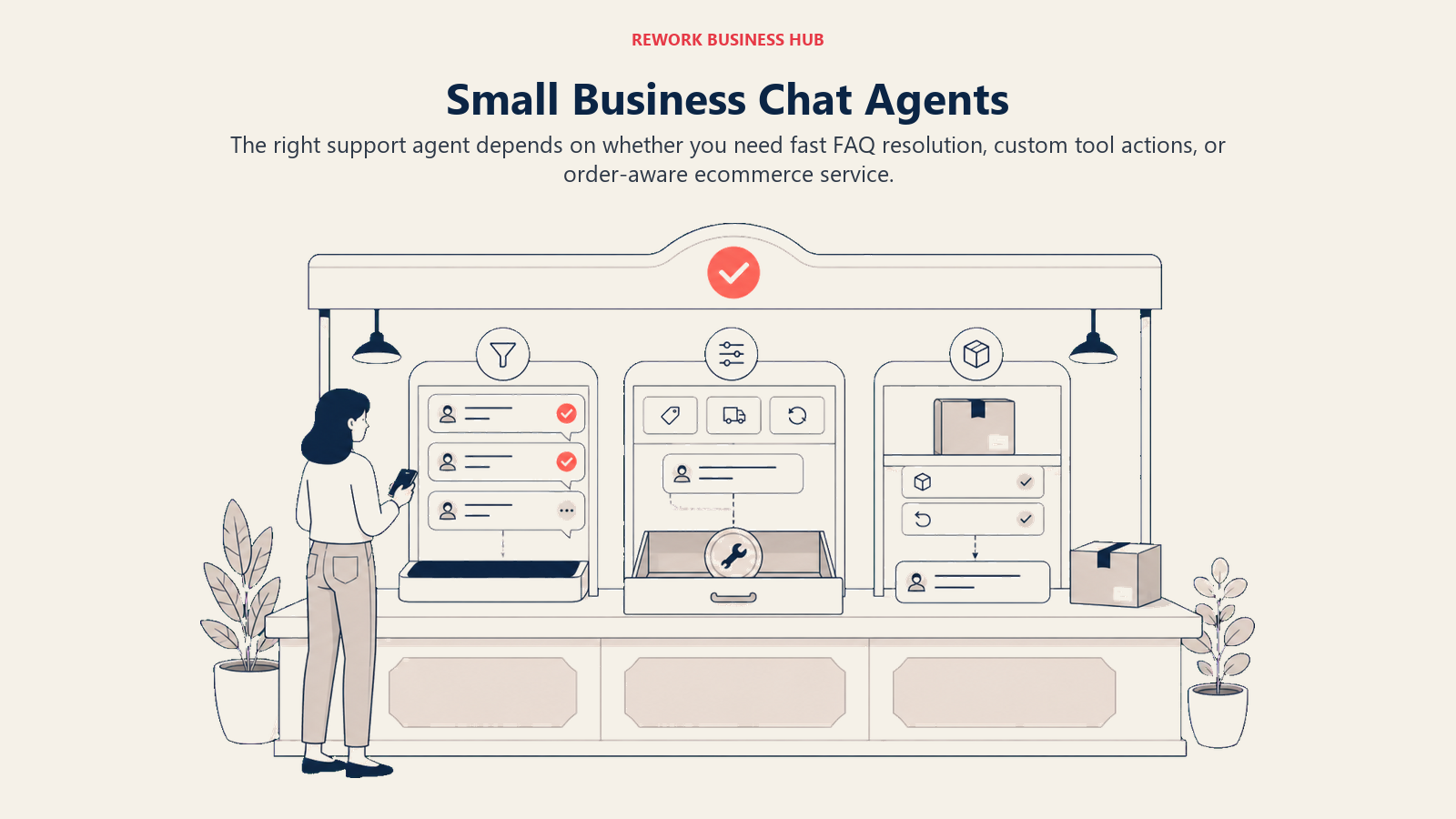
Customer-support agents split into three practical jobs for a small business: resolving routine questions quickly, taking actions through connected tools, and answering with live order context.
1. Tidio (Lyro): The Cheapest Real Agent to Test the Category
Tidio's whole pitch is speed: install a script tag, let Lyro scrape your existing help content, and it's answering real customer questions the same day. For an owner who has never bought an AI agent before and isn't sure the category is worth the money, that's about as low-risk as this list gets.
The honest catch shows up fast. Free and Starter both cap at 50 Lyro conversations a month, which a live site burns through in days, not weeks. Real volume means jumping to Plus at $300/mo and up, a large step from the Starter price that a lot of buyers don't see coming.
| What you get | What you don't |
|---|---|
| Live, working AI agent the same day you install the script | Free and Starter both cap at 50 Lyro conversations/mo |
| Premium tier offers a vendor-guaranteed 50% resolution rate | Real volume requires Plus at $300/mo plus usage |
| Lyro also sellable as a standalone add-on from $32.50/mo | Guaranteed resolution rate only applies at the custom Premium tier |
Pricing: Free (50 Lyro conversations/mo); Starter $24.17/mo billed annually (still 50 conversations/mo); Growth from $49.17/mo billed annually; Plus from $300/mo plus usage; Premium custom (3,000+ conversations/mo, guaranteed 50% resolution rate). See tidio.com/pricing.
Best for: A small business testing whether a real AI agent is worth the money, before committing real budget.
2. Chatbase: A Custom Agent Without an Engineer, Once You're Past Hobby
Chatbase's pitch is a custom-trained agent built from your own website, docs, or files, live within minutes and without writing code. The honest line most reviews blur: the Free and Hobby tiers are genuinely just question-answering, not an agent. Real agentic behavior, the kind that looks something up or triggers a workflow instead of just describing one, needs the Standard tier and its API and third-party integrations (including Zendesk and Stripe).
That makes Chatbase a two-stage decision for a small business. Start on Hobby to see if the drafted answers are actually good. Only upgrade to Standard once you know you want it taking real action, not just chatting.
| What you get | What you don't |
|---|---|
| Live, custom-trained agent in minutes, no engineering needed | Free and Hobby tiers are Q&A only, no real action-taking |
| API access and integrations (Zendesk, Stripe, and more) from Standard | Extra agents beyond the plan cost $300/yr each |
| Usage-based credits scale predictably with conversation volume | Auto-recharge credits run $40 per 1,000 messages when you run out |
Pricing: Free (50 messages/mo); Hobby $32/mo (700 messages/mo); Standard $120/mo (4,000 messages/mo, API and integrations); Pro $400/mo (15,000 messages/mo). See chatbase.co/pricing.
Best for: Founders who want a custom-trained agent fast and are prepared to pay for the Standard tier once they want it to act, not just answer.
3. Gorgias: Built for a Small Online Store, Not a General Helpdesk
Gorgias solves one specific problem well: a Shopify or BigCommerce store whose support volume is mostly "where's my order" and "can I return this." The AI Agent pulls real order status, shipping estimates, and return eligibility into every reply instead of a generic scripted response, which is a meaningfully easier problem than open-ended support and shows in the resolution quality.
The detail worth knowing before you buy: a resolved AI conversation counts as a billable ticket against your plan's allowance and gets charged the per-resolution fee on top. That double-count can push a busy month's bill past what the sticker price suggests, so model your real monthly ticket volume before committing.
| What you get | What you don't |
|---|---|
| Order, shipping, and return data in every automated reply | Can bill twice: once as a ticket, once as an AI resolution |
| Real published entry pricing, not a demo-gated quote | English-first; broader language support varies |
| About a week to connect your store and set macro rules | Not a fit outside Shopify or BigCommerce |
Pricing: Plans from $10/mo (Starter) up to $900+/mo at higher tiers, plus $0.90 to $1.00 per AI resolution. See gorgias.com/pricing.
Best for: A small ecommerce store on Shopify or BigCommerce whose support tickets are mostly order and return questions.
Booking Appointments and Answering the Phone
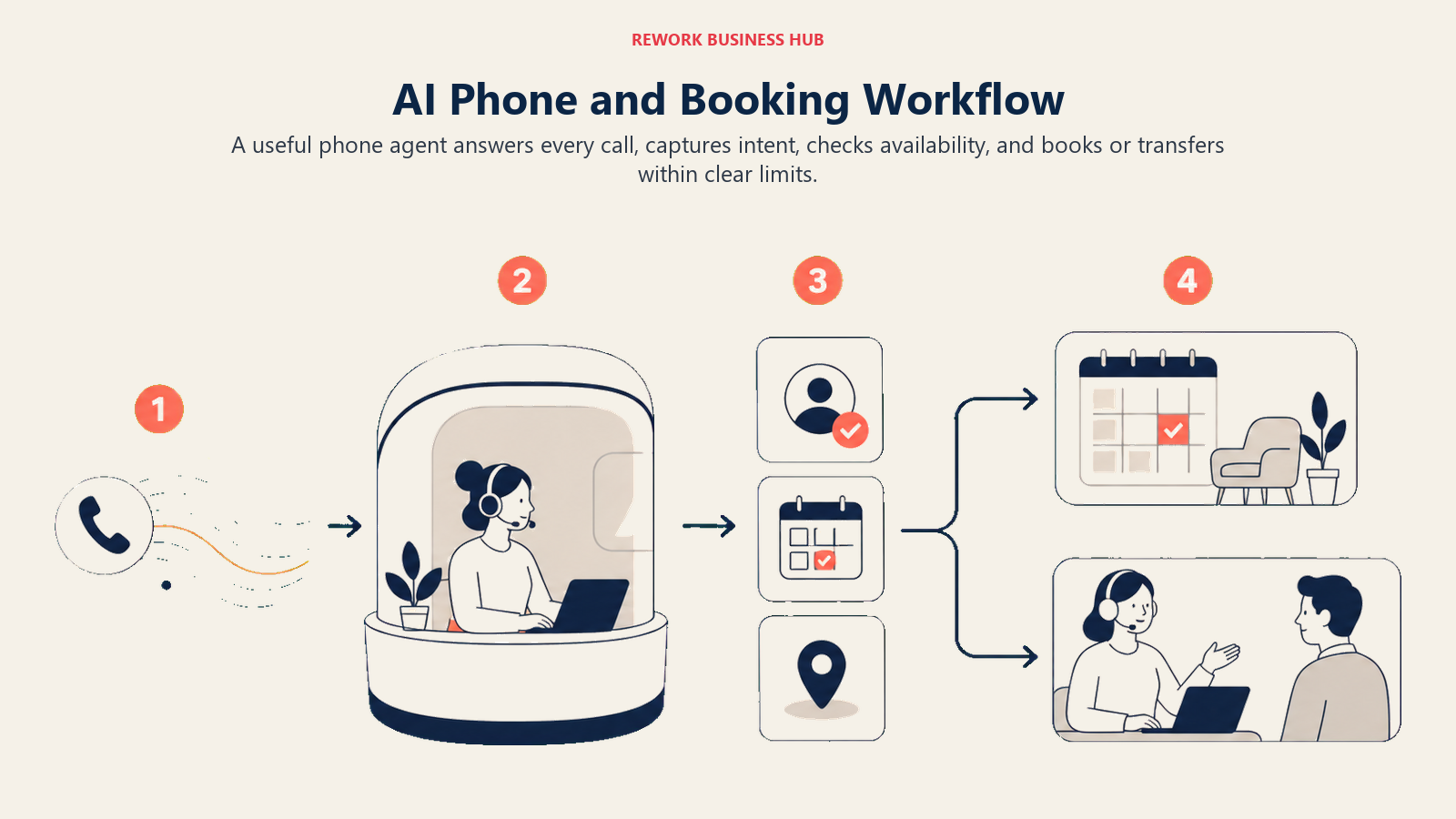
Every U.S. small business research firm agrees on one thing: a call that goes unanswered rarely comes back on its own. Rather than lean on the widely recycled "62% of calls go unanswered" figure (it traces to a single 2016 study of 85 businesses and doesn't hold up as a verified 2026 number), the honest version is simpler: a missed call is a missed booking, and the two products below exist specifically to make sure a small business never has to choose between answering the phone and doing the job.
4. Goodcall: Predictable Billing by Customer, Not by the Minute
Goodcall's structural bet is that a small business shouldn't have to watch a per-minute meter. Every plan bundles unlimited minutes; instead, you pay by unique customers served each month, capped at 100, 250, or 500 depending on tier, with a flat $0.50 for each additional caller past the cap. For a business with repeat callers (a clinic, a salon, a local shop), that's a genuinely easier bill to predict than a per-minute or per-resolution model.
Setup runs through configurable "skills," logic flows an owner builds through forms rather than code, connected to your calendar and CRM. The Starter plan includes one logic flow and three team members, enough for a single front-desk job like booking and basic FAQ; Growth and Scale add more flows and seats as the business does.
| What you get | What you don't |
|---|---|
| Unlimited minutes on every plan; billed by unique caller instead | No published free trial on the vendor's own pricing page |
| Configurable "skills" through forms, no code required | Higher tiers needed once you're past 250-500 unique callers/mo |
| Calendar and CRM connections built into setup | Enterprise tier required for custom integrations |
Pricing: Starter $79/mo (100 unique customers/mo); Growth $129/mo (250); Scale $249/mo (500); each roughly 15% cheaper billed annually; $0.50 per additional caller past the cap; Enterprise custom. See goodcall.com/pricing.
Best for: A small business with repeat callers (clinics, salons, local services) that wants a flat, predictable phone-answering bill.
5. Rosie: Built Specifically for Home Service Contractors
Rosie's positioning is narrower than Goodcall's, and that's the point: it's built for HVAC, plumbing, electrical, and cleaning businesses that live on inbound calls and same-day bookings. Every plan runs 24/7, handles simultaneous calls, and answers in English and Spanish, which matters more in the trades than in most other small-business categories.
The tier structure has a real gap worth knowing before you buy. Professional at $49/mo only takes messages; it does not book an appointment directly onto your calendar. Real scheduling, warm transfers, and live call handoffs need the Scale plan at $149/mo, which is the realistic entry price for a contractor who actually wants Rosie booking jobs, not just logging who called.
| What you get | What you don't |
|---|---|
| Purpose-built for trades, not a general-purpose receptionist | Professional plan is message-taking only, no real booking |
| Direct calendar booking and warm transfers on the Scale plan | Overage pricing past the minute cap isn't published on Rosie's own page |
| Zapier integration and native mobile apps included on every tier | Inbound calls only; it doesn't place outbound follow-up calls |
Pricing: Professional $49/mo (250 min/mo, message-taking only); Scale $149/mo (1,000 min/mo, real appointment booking); Growth $299/mo (2,000 min/mo, custom agent training, white-glove onboarding); 7-day free trial. See heyrosie.com/pricing.
Best for: HVAC, plumbing, electrical, and cleaning contractors who need real appointment booking, not just message-taking, from day one.
For call volume beyond what either of these two are built for, best AI voice agents covers the developer-grade and enterprise contact-center layer above this. If you'd rather build the reminder logic yourself on a platform you already run, the AI Appointment Reminder Agent blueprint covers the same job from the build side.
Getting Paid and Keeping the Books
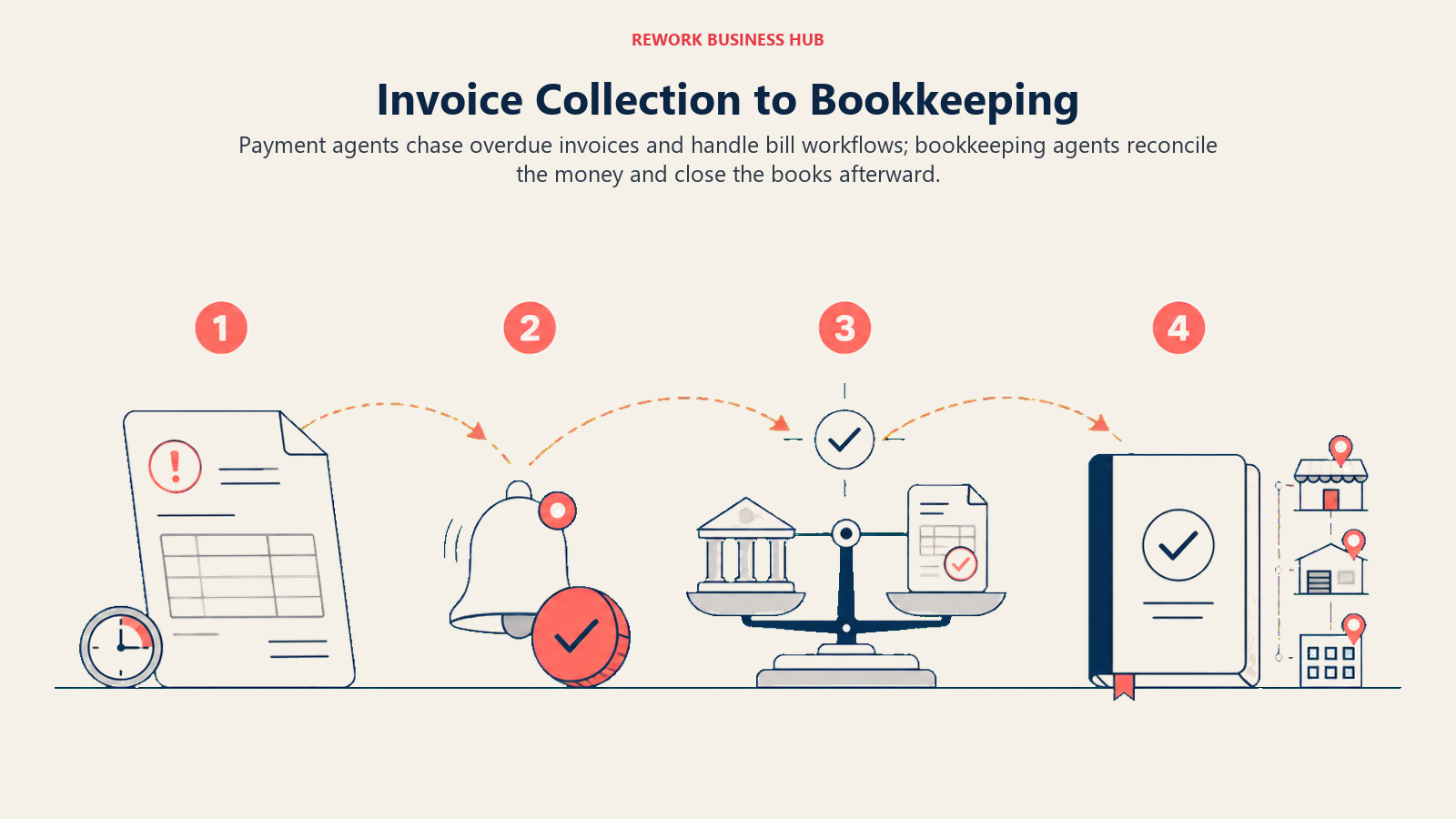
Cash flow, not demand, is what actually kills a small business, and 59% of small businesses are now carrying invoices overdue by 30 days or more, up from 47% a year earlier, with the average business owed $17,700 at any given time. The two agents below split the job in two: one chases the money you're owed, the other keeps the books it lands in straight.
6. BILL AI: Chasing Invoices Without the Awkward Call
BILL is the rare accounting-adjacent vendor on this list with a real, per-seat price published on its own pricing page. On the accounts-payable side, the Invoice Coding Agent reads and codes a bill automatically, and the W-9 Agent emails vendors directly to collect tax forms without a human chasing them down. On the accounts-receivable side, the same platform sets automated payment reminders and auto-pay rules, which is the actual mechanism behind "chasing invoices" without a founder picking up the phone to ask a client to pay.
The honest limitation is the tier gate: deeper ERP integrations (NetSuite, Sage Intacct) sit behind the custom-priced Enterprise tier, and a small AP or AR team on Essentials or Team gets touchless invoice entry and reminders, not a full close.
| What you get | What you don't |
|---|---|
| Real, published per-seat pricing, verified on BILL's own page | NetSuite and Sage Intacct integrations require the Enterprise tier |
| Automated AR payment reminders and auto-pay, not just AP | AP/AR-only scope; no reconciliation or close-checklist layer |
| Invoice Coding Agent and W-9 Agent included from the entry tier | Corporate and Enterprise pricing scales with feature depth, not just seats |
Pricing: Essentials $49/user/mo; Team $65/user/mo (adds two-way QuickBooks and Xero sync); Corporate $89/user/mo; Enterprise custom. Spend & Expense is free. See bill.com/pricing.
Best for: A small business owner who wants overdue invoices chased and bills paid from the same login, without a bookkeeper on staff yet.
If you'd rather design the reminder cadence yourself than buy a packaged product, the AI Collections AR Agent blueprint covers exactly this job from the build side.
7. Docyt: Bookkeeping Admin Off an Owner's Plate
Docyt's angle fits a specific, common small-business shape: a business running the same books across more than one location, a franchise, a small hotel group, a multi-location service business, where a general bookkeeping tool built for one entity starts to strain. Its AI, branded HpAI, runs revenue reconciliation, bill pay and expenses, month-end close, and reporting, synced bidirectionally with QuickBooks Online, and White Glove onboarding pairs every account with a real bookkeeping expert during setup.
The tradeoff is structural, not just a pricing detail: each location needs its own Docyt subscription, so a business running three locations is paying for three subscriptions, and the jump between transaction-volume tiers adds up for a busier operator.
| What you get | What you don't |
|---|---|
| Purpose-built per-location close, reconciliation, and reporting | Each location needs its own subscription, no bundled multi-entity plan |
| Bidirectional QuickBooks Online sync with real published pricing | Confirmed integration is QuickBooks Online; other ledgers not confirmed |
| White Glove onboarding and a dedicated bookkeeping expert included | Costs climb quickly for a growing multi-location business |
Pricing: Impact $299/mo (up to 200 transactions); Advanced $499/mo (500); Advanced Plus $799/mo (1,000); Enterprise $999+/mo, custom above that. See docyt.com/pricing-plans.
Best for: A multi-location small business (or the bookkeeping firm managing several client locations) already on QuickBooks Online.
Inbox Triage and Delegating a Whole Job
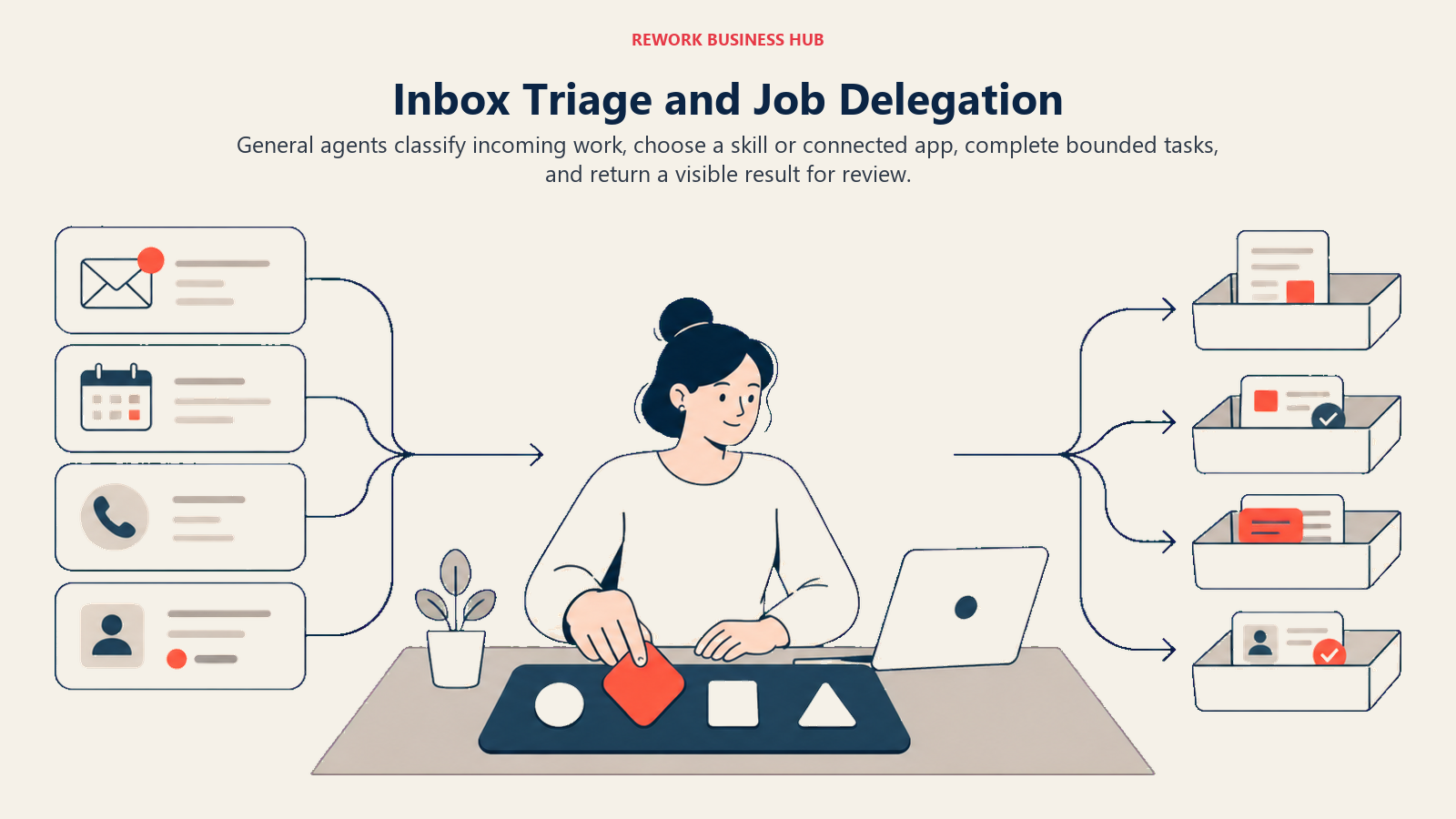
General-purpose agents earn their keep when they can classify an incoming request, select the right connected skill, and return completed work instead of another draft to manage.
8. Lindy: The Fastest General-Purpose Agent for a Solo Owner
Lindy's pitch is that an agent should feel like hiring someone, not configuring software. Describe the job, pick from more than 40 prebuilt skills (inbox triage, scheduling, call screening, lead research), and Lindy assembles an AI "employee" that runs on a schedule or trigger, the fastest path on this whole list from a blank page to real work for an owner who hasn't automated anything before.
The catch is pricing shape, not amount: there's no published free tier, and the credit allowance burns faster on voice or research-heavy tasks than on plain text replies. A five-person team on Plus is already at $150/month before anyone's confirmed the output is trustworthy unsupervised, so start with one job and one user, not a team rollout.
| What you get | What you don't |
|---|---|
| Fast, template-driven setup for non-technical owners | No free tier on the current pricing page |
| 40+ prebuilt skills covering common small-business jobs | Credits scale with task complexity, hard to predict up front |
| Working agent in under an hour for a single, well-scoped job | Per-user credit pricing adds up fast across a whole team |
Pricing: Plus $29.99/mo/user (3,000 credits); Pro $99.99/mo/user (15,000 credits); Max $199.99/mo/user (35,000 credits); Enterprise custom. See lindy.ai/pricing.
Best for: A solo owner or very small team delegating one whole job function today, before deciding whether to expand to more.
For the inbox-specific version of this job, the AI Reply Agent blueprint covers the build-it-yourself route if a packaged product doesn't fit your exact rules.
9. Zapier Agents: The Cheapest Way to Test Whether an Agent Helps at All
Zapier's bet is that the fastest way to a working agent is giving it access to the automation platform a lot of small businesses already run. Zapier Agents sits on top of core Zapier, letting an agent reason over a task and call any of its 9,000-plus app integrations as a tool, rather than following one fixed trigger-then-action sequence every time. For a business already using Zapier to connect a form to a spreadsheet, this is the lowest-friction way to find out whether reasoning on top of that automation is worth paying for.
The billing detail that catches people: Agents run on their own activity meter, separate from your existing Zap task pool, so a team already paying for a high Zap tier can be surprised by a second line item.
| What you get | What you don't |
|---|---|
| Free tier (400 activities/mo) genuinely tests real usage | Bills separately from your existing Zap task subscription |
| 9,000+ app integrations available as agent tools | Not built for deep custom or branching logic |
| No-code, natural-language agent building | Best value assumes you're already a Zapier user |
Pricing: Free (400 activities/month); Pro roughly $33/month billed annually (1,500 activities/month); Enterprise custom. Core Zapier plans (separate): Free (100 tasks/month), Professional from $19.99/month annual. See zapier.com/pricing.
Best for: A small business already living inside Zapier that wants to test agent reasoning without adopting a whole new platform.
Already Growing Into a CRM
10. HubSpot Breeze: The Bundled Option, With a Real Setup Fee to Budget For
HubSpot's bet with Breeze is that an AI agent works best sitting on top of a CRM that already holds your contact and deal data, rather than as a standalone chat tool. That makes it a genuinely different kind of buy than everything else on this list: you're not choosing Breeze on its own, you're deciding whether you need HubSpot's CRM underneath it, and letting Breeze come along for the ride.
The Customer Agent, which resolves support conversations automatically, requires the Professional Hub at $90/seat/month (annual), and runs on HubSpot's credit system: 50 credits per resolved conversation, roughly $0.45 each once you're buying more credits at the annual rate. The detail most reviews skip: Professional carries a one-time $1,500 onboarding fee on top of the seat price, real money for a small business modeling its first year of cost.
| What you get | What you don't |
|---|---|
| AI agents that act directly on CRM data you already have | Full agents require the Professional tier, not Starter |
| No new vendor if you already need HubSpot as your CRM | A one-time $1,500 Professional onboarding fee, easy to miss |
| Credit-based pricing ties cost to conversations actually resolved | Overkill if you don't already need a CRM this size |
Pricing: Starter $7/seat/mo (annual, basics only); Professional $90/seat/mo (annual) plus a one-time $1,500 onboarding fee, Customer Agent included at 50 credits per resolved conversation (about $0.45 each at $9/1,000 credits); Enterprise from $150/seat/mo. See hubspot.com/pricing/service.
Best for: A small business already planning to buy HubSpot as its CRM, getting an AI agent on the same data as a byproduct, not a business shopping for an agent first.
Jobs Not to Automate First
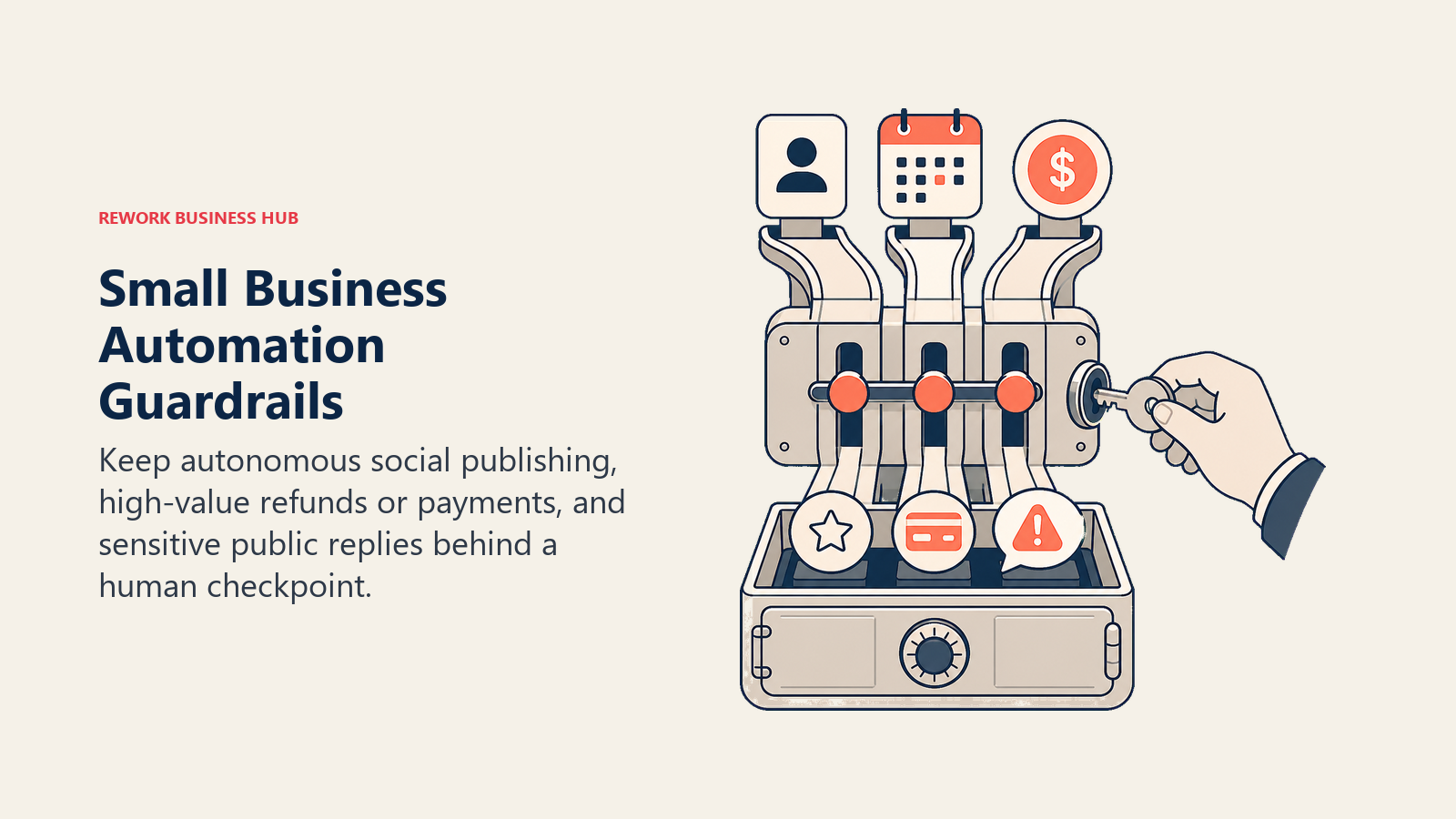
Not every job on a small business owner's list is ready for full autonomy in 2026, and pretending otherwise is how a five-person team ends up part of the 49% who scaled back an agent over cost or trust. A few honest warnings, based on what the tools in this exact collection actually verified, not marketing copy:
| Job | Why It's Tempting | Why to Wait | What to Do Instead |
|---|---|---|---|
| Autonomous social media posting | Frees up a weekly chore nobody enjoys | Best AI agents for social media found Ocoya and Postwise both market "agent" or "autopilot" language, but neither publishes or replies without a human still approving the calendar | Use them, or a general assistive tool, to draft; keep a person clicking publish. The AI Social Media Agent blueprint covers building the approval step yourself |
| Unlimited refund or payment approval | Removes an approval bottleneck instantly | One bad autonomous call becomes a chargeback, a churned customer, or worse at small scale, where there's no fraud team to catch it | Set a dollar threshold the agent can clear alone (Gorgias and BILL AI both support this); route anything above it to a person |
| Review replies during a reputational or safety complaint | A fast public response looks responsive | An angry, legal-sounding, or health and safety complaint needs a human voice and judgment, not a templated tone | Auto-draft a reply, human sends it, for anything that reads as high-stakes rather than routine |
| A general marketing "Agent" tier priced like enterprise software | The demo looks genuinely powerful | Jasper's Content Pipelines and Agents feature is real, but it sits behind a custom-quoted Business plan with a 12-month minimum commitment, which fails every setup-effort and TCO test in this guide for a business this size | Start with the assistive Pro tier ($59/mo) covered in AI tools for small business; revisit a true agent tier once volume and budget justify a year-long commitment |
How to Choose: Decision Framework
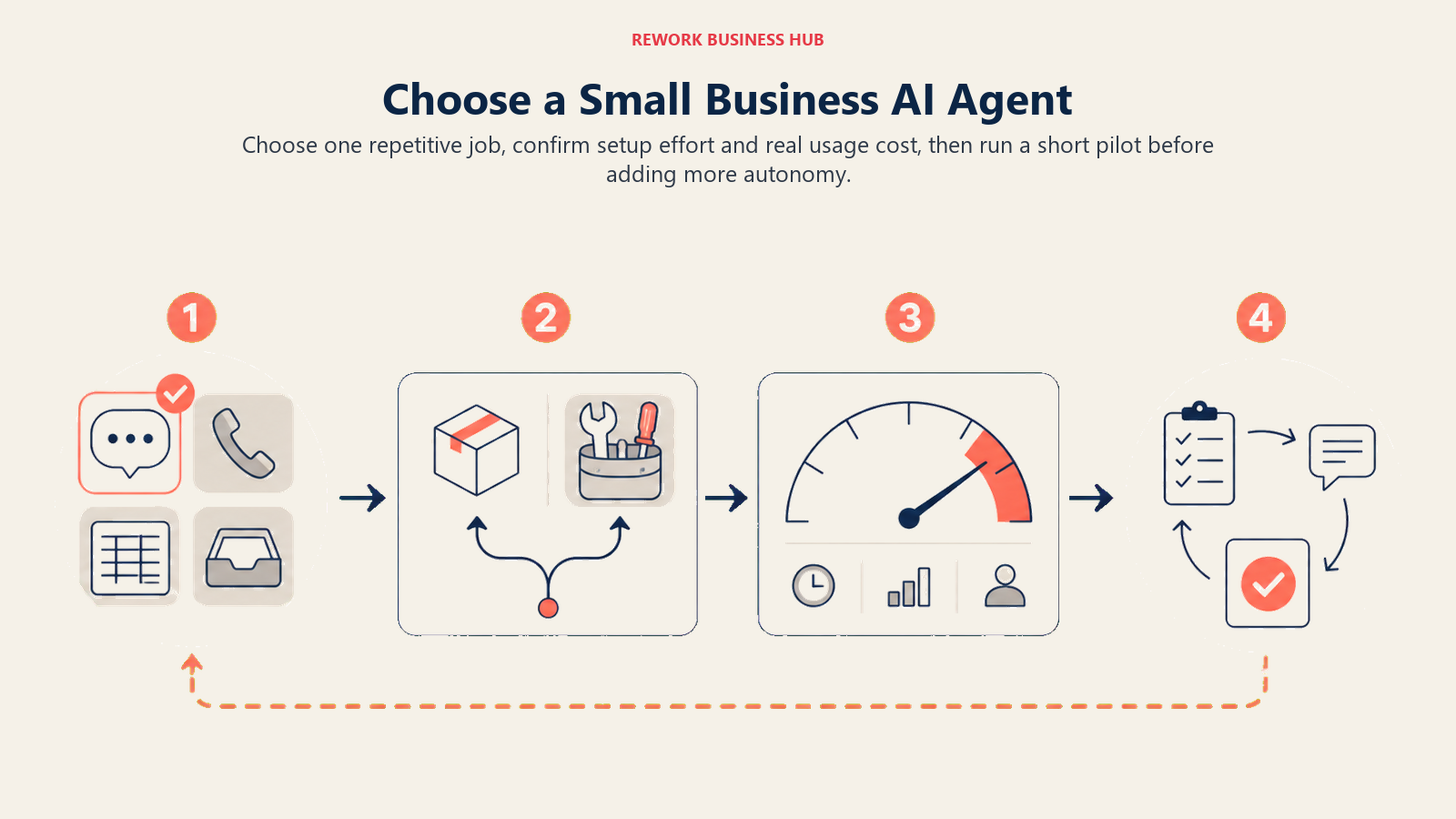
Pick one repetitive job first, then choose between a packaged agent and a general builder based on setup effort, real usage cost, and how much control you need.
| If you need... | Pick... | Why |
|---|---|---|
| The cheapest way to test a chat agent | Tidio (Lyro) | Free tier, live the same day, no engineer required |
| A custom-trained agent with real tool-calling | Chatbase | Standard tier adds actions and third-party integrations |
| Order-aware support for an online store | Gorgias | Order, shipping, and return data in every reply |
| Predictable phone-answering cost regardless of call length | Goodcall | Billed by unique caller, not by the minute |
| A receptionist purpose-built for trades and home services | Rosie | Purpose-built for HVAC, plumbing, electrical, cleaning |
| To chase overdue invoices without the awkward call | BILL AI | Automated AR reminders plus AP on one platform |
| Multi-location bookkeeping and close automation | Docyt | Per-location close, reconciliation, and reporting |
| To delegate a whole job function fast, with no engineer | Lindy | Template-driven "AI employee," working in under an hour |
| The cheapest real test of whether an agent helps at all | Zapier Agents | Free tier, built on tools you may already run |
| An agent bundled into a CRM you already need | HubSpot Breeze | No new vendor, if you already need the CRM underneath it |
Frequently Asked Questions about AI Agents for Small Business
What's the difference between an AI agent and an AI tool for a small business?
A tool assists a person who stays in the loop for every step, like ChatGPT drafting an email you still send yourself. An agent plans a short sequence of steps and completes them on its own, like Tidio's Lyro resolving a customer chat without anyone typing a reply. If you mostly need drafting help rather than a system that acts on its own, the assistive tools covered earlier are the better starting point.
Should a small business buy a single-purpose agent or a general-purpose builder like Lindy?
Start with a single-purpose product (Tidio, Gorgias, Goodcall, Rosie, BILL AI, Docyt) if your job matches what it was built for; it's faster to a first result and doesn't require you to design the logic yourself. Reach for a general builder like Lindy or Zapier Agents when your job doesn't map to a packaged product, or when you want to test two or three small automations before buying separate tools for each.
How much does an AI agent actually cost for a small business?
Real entry pricing at small volume runs from free (Zapier Agents, Tidio's free tier) to roughly $50-$150 a month for most single-purpose products once you're past the free tier's usage cap. Bundled options like HubSpot Breeze add a one-time setup fee (around $1,500 at the Professional tier) on top of the ongoing seat price, which is easy to miss when comparing headline numbers.
Can a small business owner set up an AI agent without hiring an IT person?
Yes, for every product in this guide. Tidio, Chatbase, Gorgias, Goodcall, Rosie, and Lindy are all built for setup through forms, scripts, or plain-language instructions, not code. Docyt and HubSpot Breeze lean more on vendor-assisted onboarding (White Glove onboarding and a paid setup fee, respectively), which is still no-code but does take more calendar time than the others.
Is HubSpot Breeze a good first AI agent for a small business?
Only if you already need HubSpot as your CRM. Breeze's real agent features require the $90/seat/month Professional tier plus a one-time $1,500 onboarding fee, which is a lot to pay just to get an AI agent; it makes sense once the CRM underneath it is something you'd be buying anyway.
Should a small business let an AI agent post on social media by itself?
Not yet, for autonomous publishing specifically. Tools marketed with "agent" or "autopilot" language, including Ocoya and Postwise, still route every post through a human-approved calendar rather than publishing on their own (see the jobs-not-to-automate table above). Use them to draft content and keep a person clicking publish.
Is BILL AI or Docyt the better fit for a small business's books?
They solve different problems. BILL AI is built for accounts payable and receivable, coding bills, collecting vendor tax forms, and chasing overdue customer invoices. Docyt is built for the fuller bookkeeping close, categorization, reconciliation, and reporting, especially across more than one location. A single-location business chasing invoices wants BILL AI first; a multi-location business drowning in monthly close wants Docyt.
What should a small business avoid automating first?
Autonomous social posting, unlimited refund or payment approval, and public replies to a reputational or safety complaint. All three are covered by capable tools, but each still needs a human checkpoint at small scale, where one bad autonomous decision costs more, proportionally, than it would at a larger company with a team to catch it.
How do I test an AI agent before committing to a year of billing?
Every product in this guide has either a genuine free tier (Tidio, Chatbase, Zapier Agents) or a short free trial (Rosie's 7 days). Run the free or lowest tier for two to four weeks on your real volume, not a demo script, and check whether it actually finishes the job correctly without you rescuing it, before upgrading to the tier that unlocks real usage.
What to Do Next
Pick the one job costing you the most hours or the most missed revenue this month, not the one with the flashiest demo, and try that single product's free tier or lowest paid plan for two to four weeks before signing anything annual. If it's customers going unanswered, start with Tidio or Gorgias depending on whether you sell online. If it's the phone, start with Goodcall or Rosie depending on whether you're a repeat-customer business or a trades contractor. If it's cash flow, start with BILL AI. And if none of the ten products here quite fit the specific job you have in mind, AI agents for small business walks through eight more use cases and links a full build blueprint for each, in case the right answer is designing the agent yourself rather than buying one off the shelf.

Principal Product Marketing Strategist
On this page
- Key Facts
- Quick Comparison Table
- Agent, Tool, or Builder: Get This Right First
- One Job or a General Builder? The Real First Decision
- Setup Effort and Real Cost at Small Scale
- Answering Customers: Chat and Support
- 1. Tidio (Lyro): The Cheapest Real Agent to Test the Category
- 2. Chatbase: A Custom Agent Without an Engineer, Once You're Past Hobby
- 3. Gorgias: Built for a Small Online Store, Not a General Helpdesk
- Booking Appointments and Answering the Phone
- 4. Goodcall: Predictable Billing by Customer, Not by the Minute
- 5. Rosie: Built Specifically for Home Service Contractors
- Getting Paid and Keeping the Books
- 6. BILL AI: Chasing Invoices Without the Awkward Call
- 7. Docyt: Bookkeeping Admin Off an Owner's Plate
- Inbox Triage and Delegating a Whole Job
- 8. Lindy: The Fastest General-Purpose Agent for a Solo Owner
- 9. Zapier Agents: The Cheapest Way to Test Whether an Agent Helps at All
- Already Growing Into a CRM
- 10. HubSpot Breeze: The Bundled Option, With a Real Setup Fee to Budget For
- Jobs Not to Automate First
- How to Choose: Decision Framework
- What to Do Next