Best AI Agents for Social Media in 2026: 13 Platforms Graded on Real Autonomy

Turn this article into takeaways for your work.


Each assistant summarizes the article only for you and suggests best practices for your work.
If you need a product that genuinely decides what to post and when, without you clicking approve first, only two of the thirteen tools in this guide do that by default: Predis.ai and Vista Social. Sprout Social and Sprinklr have both built real agent infrastructure underneath their platforms, but each keeps a human approval gate in front of anything that goes out publicly, by design. Everyone else here, including category leaders like Hootsuite, Buffer, and Later, is an excellent scheduler with an AI caption writer bolted on top, which is a different product than an agent, even when the marketing copy blurs the line. Every tool below was evaluated on that distinction first (does it decide, or does it just execute what a human already decided).
This guide is the agentic half of a pair. If what you actually want is AI that drafts captions, suggests hashtags, and helps a person move faster, our Best AI Tools for Social Media roundup covers that assistive layer, tools like Canva, ChatGPT, and Opus Clip live there, not here. This guide covers the narrower category that can run multi-step work on its own: planning a posting cadence, watching for a trend, drafting and publishing a reply, and escalating what it shouldn't touch, without a person executing every step. If none of the 13 products here fit your exact workflow, our AI Social Media Agent build blueprint walks through assembling a custom one instead of buying off the shelf.
Updated August 2026: What Changed
- Sprout Social is rolling agentic capability into its platform under an engine it calls Trellis, marketed as "agentic AI." Its own materials still say these systems "require human oversight and intervention" for anything customer-facing, an honest limit worth taking at face value rather than the marketing headline.
- Sprinklr shipped its Spring '26 release with Autonomous Evaluation, a testing and validation layer for AI agent behavior before it goes live, aimed at the enterprise governance question every brand asks before it lets an agent act in public.
- Predis.ai and Vista Social both now default to acting without a review step unless you turn approval on. That's real autonomy, not just faster drafting, and it's the clearest evidence in this category that "agent" and "assistant" are not the same purchase.
- Taplio added Connection Requests in May 2026, letting the tool send automated DMs to people who engage with your posts, capped at 50 requests a day "by design" to avoid spam, an explicit vendor acknowledgment of the risk.
- X (Twitter) access got more expensive across the category. Metricool now charges $10/month per connected X account as of July 2026 (accounts connected earlier keep a grandfathered $5/month rate), a concrete example of the platform-API-cost problem covered below.
Key Facts
- AI agents jumped from roughly 12% to about 66% task success on OSWorld, a benchmark of real computer-based tasks, over the past year, and still fail close to 1 in 3 attempts, per Stanford's 2026 AI Index Report.
- 51% of organizations already run AI agents in production (63% among mid-sized companies), and most restrict them to read-only access or require human approval before any write or delete action, per LangChain's State of AI Agents survey.
- CMOs now put 15.3% of the marketing budget toward AI, but only 30% say their team is actually ready to scale it, per Gartner's 2026 CMO Spend Survey.
- Nearly a third of consumers say they're less likely to choose a brand once they realize its ads are AI-generated, per Hootsuite's 2026 Social Trends report, the exact audience an unsupervised posting agent would be talking to.
- 84% of consumers say a brand's response speed shapes how they judge it during a crisis, and 64% expect that response to happen publicly on the same platform, per Sprout Social's Q2 2026 Pulse Survey, the tension at the center of the brand-safety question this guide keeps coming back to.
Quick Comparison Table
| Tool | Best For | Autonomy Level | Starting Price | Key Limitation |
|---|---|---|---|---|
| Sprout Social | Enterprise social intelligence with a human-gated agent layer | Assistant plus (drafts and flags, human sends) | $99/seat/mo, or $79/seat/mo annual (Essentials) | AI Assist for replies is locked to the $399/seat/mo Advanced tier |
| Sprinklr | Enterprise CX teams standardizing agents across every channel | Agent, gated by admin policy | Custom, demo-gated, no public price | Social-specific autonomy is strongest in customer care and ad moderation, not original posting |
| Predis.ai | Real autopilot on a small-team budget | Agent (publishes without review by default) | $19/mo, or $230/yr (Core) | Auto Posting itself only unlocks on the Rise tier and above |
| Vista Social | Autonomous public replies without enterprise pricing | Agent (auto-replies to comments and DMs) | $79/mo, or $758/yr (Professional) | Deeper automation for lead capture needs the $149/mo Advanced tier |
| Taplio | LinkedIn personal-brand growth with automated outreach | Agent, gated (Pro tier only, capped) | $39/mo, or $32/mo annual (Starter) | Automated DMs and replies require the $199/mo Pro tier |
| Lately | Brand-voice content engine at enterprise scale | Agent, gated (Enterprise tier only) | $19/mo, or $14/mo annual (Starter) | "100% automation" publishing is confirmed only on custom Enterprise pricing |
| Hootsuite | Governance and approvals for a large distributed team | Assistant only | $99/user/mo, billed annually (Standard) | Wisdom drafts and recommends; a human still publishes every post |
| Buffer | The simplest AI-assisted scheduler, genuinely free to start | Assistant only | Free, or $5/channel/mo (Essentials) | AI Assistant is text-only, no image or video generation |
| Later | Visual-first Instagram and TikTok planning | Assistant only | $18.75/mo annual (Starter) | AI credits capped even on the top Scale tier (100/month) |
| Metricool | Scheduling plus paid-ads analytics in one dashboard | Assistant only | Free, or $20/mo annual (Starter) | X/Twitter access is now a $10/month per-account add-on |
| Publer | Cheapest real scheduler with an AI upsell | Assistant only | Free, or from $5/account/mo (Professional) | Unlimited Genie AI Assist requires the higher Business tier |
| Ocoya | Turning a URL or product feed into ready content | Assistant only | $15/mo, or $12/mo annual (Bronze) | Smaller support and review base than the category leaders |
| Postwise | AI-drafted growth content for X (Twitter) specifically | Assistant only, despite "autopilot" branding | $37/mo, or $29.60/mo annual (Basic) | No confirmed autonomous publishing; you still batch-schedule what it drafts |
Scheduler or Agent? Grading Real Autonomy
The honest answer for most of this category is "scheduler," not "agent." An AI tool assists: it drafts a caption, suggests a time slot, or scores a clip, and a person still reviews and clicks publish. An agent decides and acts across multiple steps on its own. That's a narrow bar, and only a few products here clear it without a human executing the last step.
| Tool | Does It Decide What to Post? | Does It Act Without Approval by Default? | Verdict |
|---|---|---|---|
| Predis.ai | Yes, generates a month of content from your brand kit | Yes, Auto Posting ships live unless you turn review on | Genuine agent |
| Vista Social | No (posting stays on your calendar) | Yes, for comment and DM replies | Genuine agent, for engagement only |
| Sprinklr | Yes, within configured parameters | Configurable per workflow: fully autonomous, semi-autonomous, or AI-assisted | Agent, but admin-gated |
| Taplio | No (posting stays manual) | Yes, for capped connection-request DMs and comment replies (Pro only) | Agent, but feature-gated and capped |
| Lately | Yes, from your own top-performing content patterns | Yes, on Enterprise only ("100% automation") | Agent, but tier-gated |
| Sprout Social | Partially, flags emerging narratives and drafts variants | No, a human sends every post and reply | Assistant, with real monitoring depth |
| Hootsuite, Buffer, Later, Metricool, Publer, Ocoya, Postwise | No | No | Assistant only |
Platform Coverage and API Limits
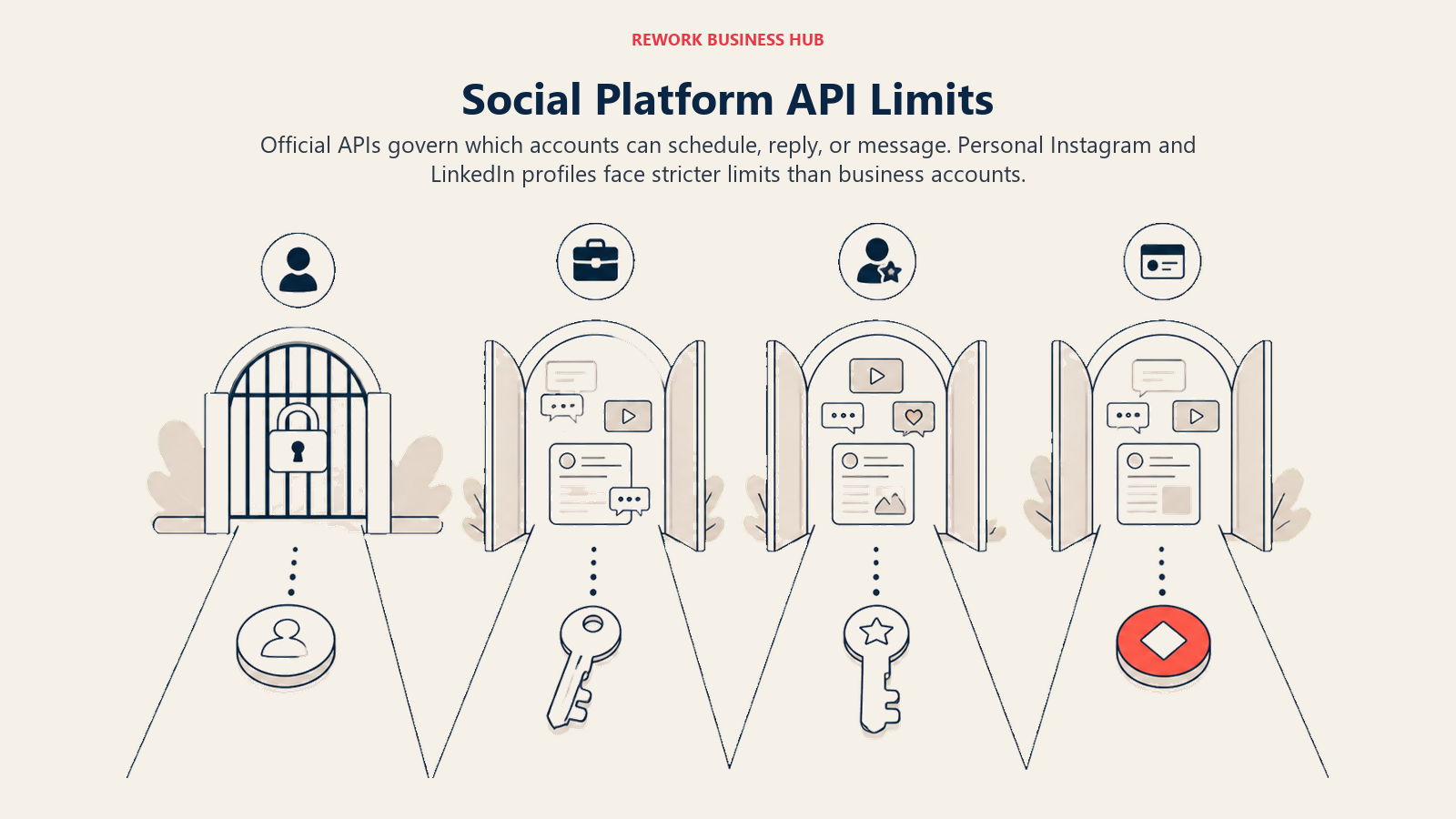
Two structural facts shape every tool's real coverage, regardless of vendor. Meta's Graph API only supports Instagram and Facebook Business or Creator accounts, so no third-party tool can schedule from a personal Instagram profile. And LinkedIn has no official public scheduling API for personal profiles at all, which means any tool that posts or messages from a personal LinkedIn account, Taplio included, operates in a space LinkedIn's own developer terms don't formally sanction.
| Tool | Core Platforms | Known Access Limit |
|---|---|---|
| Sprout Social | Instagram, Facebook, X, LinkedIn, TikTok, YouTube, Pinterest | Broad official coverage; still bound by Meta's business-account-only rule |
| Sprinklr | Enterprise channel list spanning social, messaging, chat, and voice | Exact channel access is provisioned per contract; confirm your list before buying |
| Predis.ai | Instagram, Facebook, X, LinkedIn, TikTok, YouTube Shorts, Pinterest | Auto Posting (true autopilot) is gated to Rise tier and above |
| Vista Social | Instagram, Facebook, X, LinkedIn, TikTok, YouTube, Pinterest, Google Business Profile | Autopilot replies depend on each platform's own messaging-API permissions |
| Taplio | LinkedIn only | Personal-profile automation sits outside LinkedIn's documented developer terms |
| Lately | LinkedIn, X, Facebook, Instagram, YouTube | Direct publish/automation confirmed only on Growth tier and above |
| Hootsuite | Instagram, Facebook, X, LinkedIn, TikTok, YouTube, Pinterest | Standard tier caps at 10 connected social accounts |
| Buffer | Instagram, Facebook, X, LinkedIn, TikTok, Pinterest, YouTube Shorts | Pricing is per channel, so broad coverage gets expensive at scale |
| Later | Instagram, Facebook, TikTok, LinkedIn, Pinterest, YouTube, Threads, Snapchat, X | Auto Publish works on most networks; some require a push-notification tap first |
| Metricool | Instagram, Facebook, X, LinkedIn, TikTok, YouTube, Pinterest | X access now costs $10/month per connected account |
| Publer | Instagram, Facebook, X, LinkedIn, TikTok, Pinterest, YouTube | Full automation depth requires moving past the free tier |
| Ocoya | Instagram, Facebook, X, LinkedIn, TikTok, Pinterest, YouTube | Connected profile count scales with plan tier (5 to 150 profiles) |
| Postwise | X (Twitter), with limited LinkedIn support | Single-network focus; not a fit if you need broad cross-platform coverage |
Automated Engagement and the Brand-Safety Question
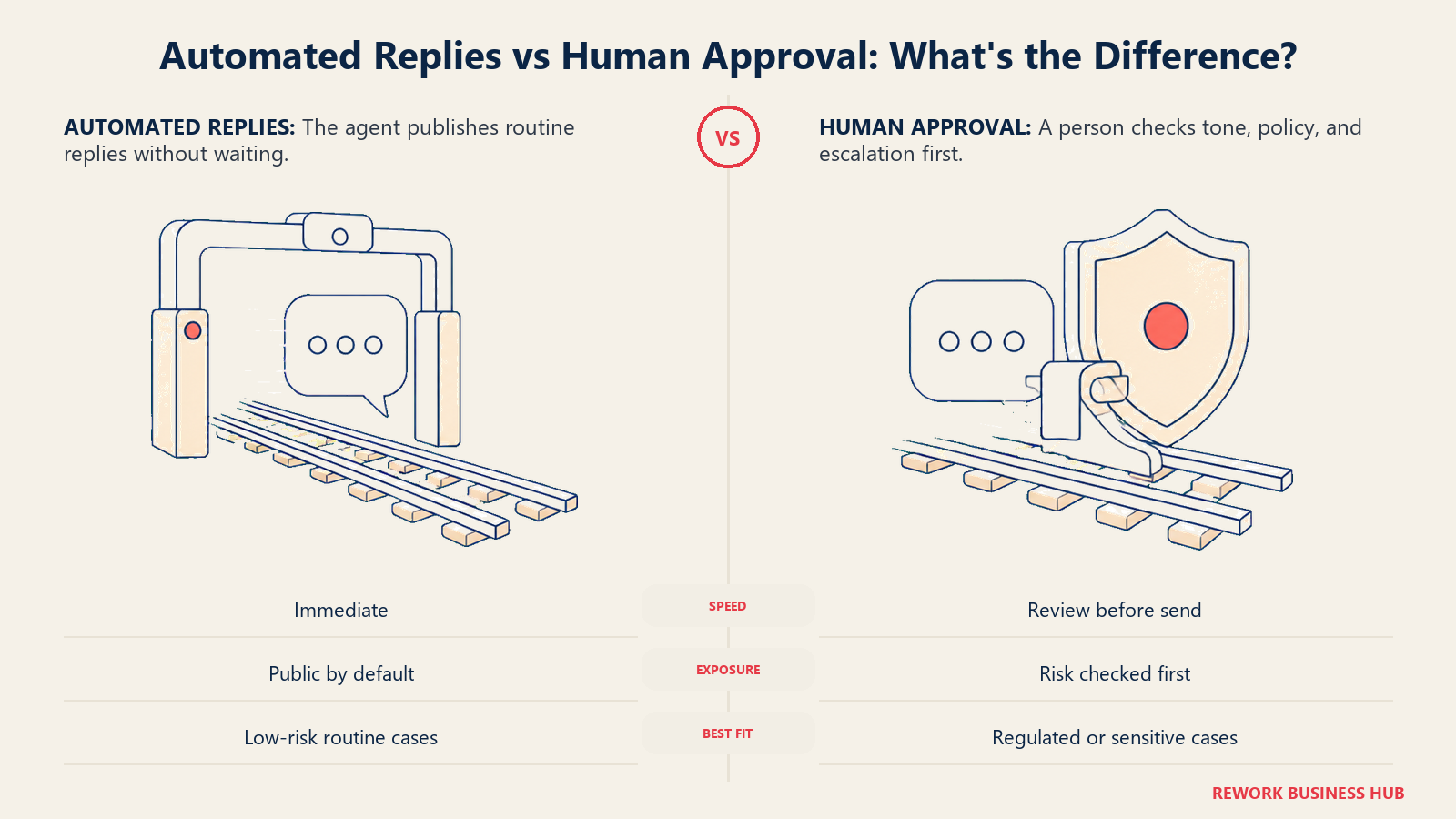
This is the part of the category that actually carries risk. A scheduler publishing the wrong caption is a mistake. An agent replying to a customer in public, on your brand's account, in real time, is a mistake with an audience. Grade any tool here on whether a human can see and stop a reply before it posts, not just on how fast it responds.
| Tool | Auto-Replies or Auto-DMs Publicly? | Approval Gate | Brand-Safety Note |
|---|---|---|---|
| Vista Social | Yes, comments and DMs on autopilot | Optional, configurable per automation rule | Pair this with a written "do not say" list before enabling for a regulated brand |
| Taplio | Yes, auto-reply to comments plus capped connection-request DMs (Pro only) | Requests capped at 50/day "by design" | The bigger exposure is platform-policy risk from automating a personal profile, not just tone |
| Sprinklr | Yes, built for social customer care and ad-comment moderation at scale | Configurable: fully autonomous, semi-autonomous, or AI-assisted per workflow | The only platform here with a dedicated pre-launch agent-testing layer (Autonomous Evaluation) |
| Predis.ai | No public replies; autopilot covers original posts only | Optional review, off by default | The real exposure is an off-brand post going live unreviewed, not a bad reply |
| Sprout Social | No autonomous public replies; AI Assist drafts, a person sends | Human-in-the-loop by design | Sprout's own materials call for human oversight on anything customer-facing, worth taking at face value |
| Lately | No public auto-replies; automation covers original-post scheduling only | Not applicable to engagement | Risk is limited to publishing cadence, not live conversation |
| Hootsuite, Buffer, Later, Metricool, Publer, Ocoya, Postwise | No | Every reply is human-typed or human-approved | Lowest brand-safety exposure in this list, simply because no agent acts publicly unsupervised |
How to Choose an AI Agent for Social Media
Most teams shopping this category compare feature lists before answering the question that actually determines fit: how much of the decision are you willing to hand over? Answer these three questions first.
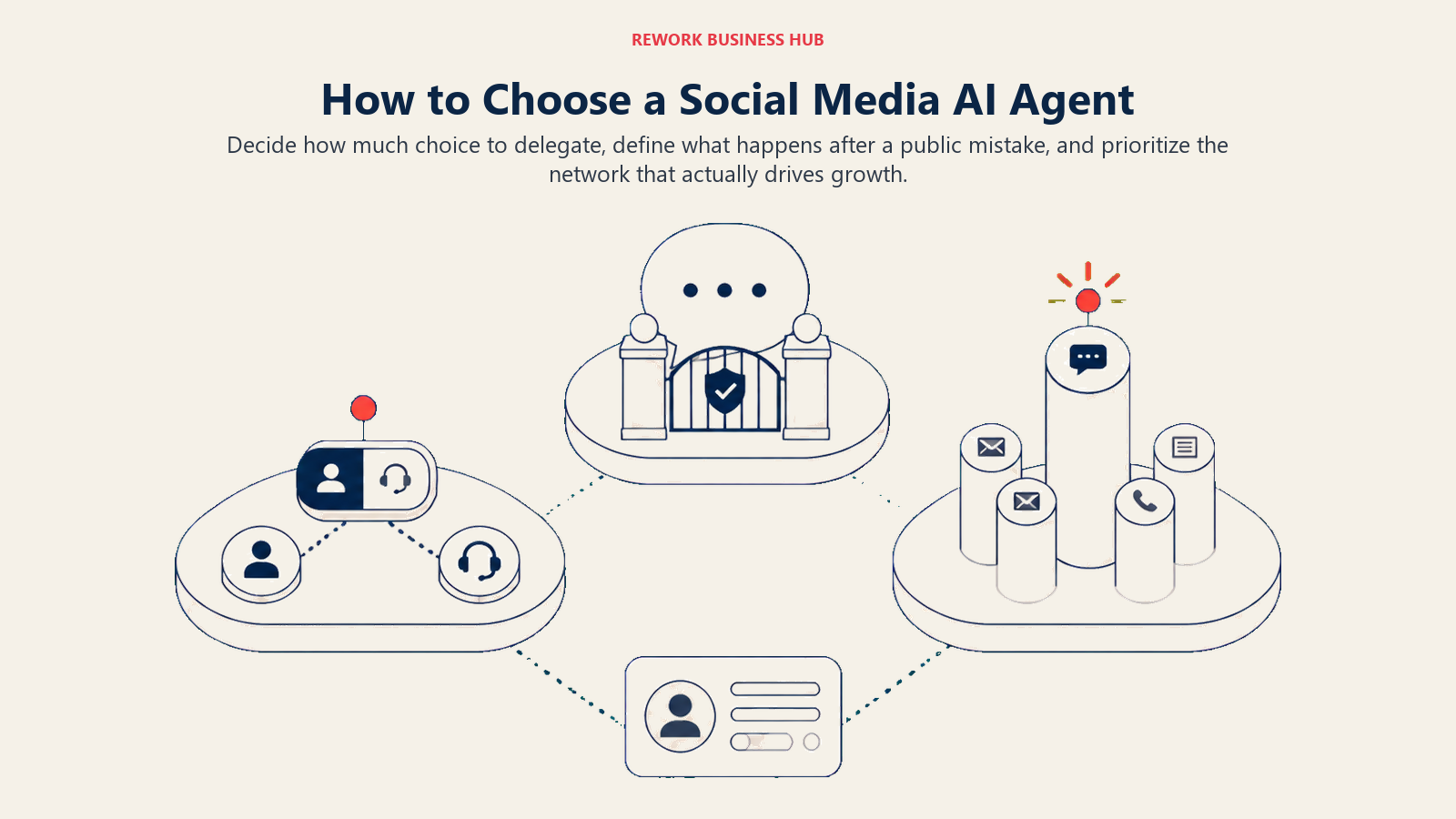
- Do you need it to decide, or just to execute faster? If a person will always choose what gets posted, you want a scheduler with strong AI drafting (Hootsuite, Buffer, Later), not an agent, and you'll pay less for it.
- What happens the moment it's wrong in public? A miscaptioned post is embarrassing. An autonomous reply to an angry customer is a screenshot waiting to happen. Weigh Vista Social's, Taplio's, or Sprinklr's automated engagement against your brand's actual risk tolerance, not against how impressive the demo looked.
- Which platform actually carries your growth? A LinkedIn-only or X-only agent (Taplio, Postwise) can go deeper on one network than a generalist ever will. A generalist (Sprout Social, Hootsuite, Vista Social) is the right call once you're managing five or more channels at once.
If you're earlier in the funnel and still deciding which layer of agent platform you need before narrowing to social specifically, no-code, enterprise, or developer framework, start with our Best AI Agent Platforms guide first.
Framework: By What You Actually Need
| If your team needs... | Look at... | Why |
|---|---|---|
| Real autopilot on a tight budget | Predis.ai | Publishes on its own schedule by default, the cheapest genuine agent here |
| Autonomous public replies without enterprise pricing | Vista Social | Autopilot comment and DM replies starting at $79/month |
| LinkedIn-specific growth with automated outreach | Taplio | Built around one profile's growth, with capped automated engagement |
| Enterprise CX-grade agent infrastructure across every channel | Sprinklr | Broadest autonomous-action architecture, with a formal agent-testing layer |
| Deep social intelligence with a human-gated agent layer | Sprout Social | Trellis flags issues and drafts at scale; a person still hits send |
| A brand-voice-trained content engine at real scale | Lately | Learns from your own top-performing content; full automation is Enterprise-only |
| Governance and multi-approver workflows for a large team | Hootsuite or Sprout Social Advanced | Both handle review chains before anything publishes |
| The simplest, cheapest AI-assisted scheduler | Buffer or Publer | Genuinely usable free tiers, no autonomy to manage |
| Visual-first Instagram or TikTok planning | Later | Strongest grid preview, AI captions layered on top |
| Scheduling plus paid-ads analytics in one dashboard | Metricool | Combines organic and paid performance most tools split apart |
| Turning a URL or product feed into ready content fast | Ocoya | Multilingual AI copywriting bundled with scheduling |
| Growing a personal brand on X specifically | Postwise | AI-drafted threads and hooks purpose-built for one platform |
Sizing and Persona Table
| Tool | Ideal Team Size | Primary Buyer Persona |
|---|---|---|
| Sprout Social | 20-2,000 employees | VP Marketing, Head of Social, Social Intelligence Lead |
| Sprinklr | 1,000-50,000+ employees | Enterprise CX Director, VP Customer Experience |
| Predis.ai | 1-50 employees | Solo Marketer, Small Business Owner, Agency Account Lead |
| Vista Social | 5-200 employees, agency-friendly | Agency Owner, Marketing Manager |
| Taplio | 1-20 employees | Founder, Executive Personal Brand, B2B Sales Leader |
| Lately | 100-5,000+ employees | Enterprise Content Director, Demand Gen Lead |
| Hootsuite | 50-5,000+ employees | Social Media Director, Enterprise Marketing Ops |
| Buffer | 1-50 employees | Solo Marketer, Small Business Owner |
| Later | 1-100 employees | Social Media Manager, Instagram/TikTok-first Brand |
| Metricool | 1-100 employees, agency-friendly | Freelancer, Agency, Small Marketing Team |
| Publer | 1-50 employees | Solo Marketer, Small Agency |
| Ocoya | 5-100 employees | E-commerce Marketer, Growth Marketer |
| Postwise | 1-10 employees | Solo Creator, Founder Building a Personal Brand on X |
1. Sprout Social: The Deepest Intelligence Layer, Still Human-Gated by Design
Sprout Social's pitch in 2026 centers on Trellis, the proprietary engine it markets as agentic AI. In practice, that means Sprout's system continuously parses engagement and sentiment data, flags emerging narratives or potential backlash before they compound, and drafts post or reply variants at scale for a person to review. Sprout's own materials are explicit that these systems still require human oversight and intervention, which is a more honest position than most vendors take, even if it means Sprout isn't the most autonomous product on this list.
The tiering is deliberate: AI-generated alt text ships free on Standard, "Enhance Post by AI Assist" unlocks at Professional, and "Enhance Reply by AI Assist" plus sentiment analysis are reserved for Advanced. That's a real jump in price for the reply-drafting capability most teams actually want.
| What you get | What you don't |
|---|---|
| Predictive intelligence that flags shifts in industry narratives early | No autonomous public replies at any tier; a human always sends |
| Unified inbox spanning DMs, comments, and reviews | Reply-drafting AI Assist requires the $399/seat/mo Advanced tier |
| Best-in-class social listening and competitor benchmarking | Entry Essentials tier ($99/seat/mo) has no AI Assist features at all |
Best for: Mid-market to enterprise teams that want deep social intelligence and are comfortable with a human-in-the-loop agent, not full autonomy.
2. Sprinklr: Enterprise Agent Infrastructure for Social Customer Care
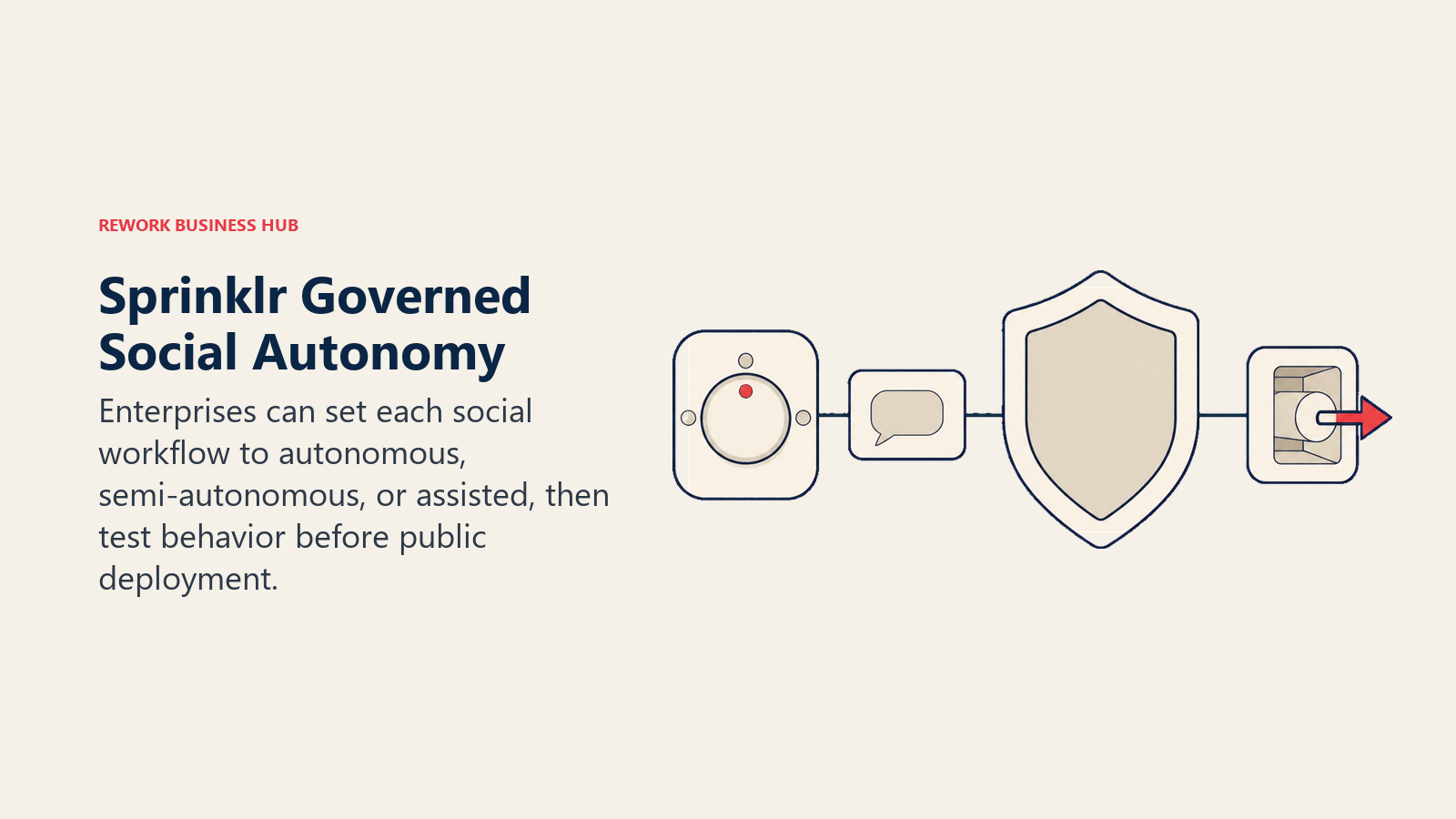
Sprinklr is built as a Unified-CXM platform first, with social media management as one of several channels its AI Agent Platform operates across, alongside chat, voice, messaging, and email. Its Spring '26 release added Autonomous Evaluation, giving CX teams explainable, test-backed validation of agent behavior before it goes live, and an AI+ Studio for bulk testing and monitoring. That governance layer is the real differentiator: Sprinklr explicitly supports fully autonomous, semi-autonomous, and AI-assisted workflows, configured per use case rather than forced into one autonomy setting.
For social specifically, the clearest documented autonomous actions sit in social customer service and ad-comment moderation rather than original post publishing, so treat Sprinklr as the strongest agent architecture for handling public conversations at scale, not as a content-calendar replacement. If Sprinklr's price point is more than your team needs but you still want enterprise-grade agent governance, our Best Enterprise AI Agent Platforms guide covers the wider field.
| What you get | What you don't |
|---|---|
| Configurable autonomy (fully autonomous, semi-autonomous, or assisted) per workflow | No public self-serve pricing; every deal requires a demo and quote |
| A dedicated pre-launch testing layer (Autonomous Evaluation) for agent behavior | Social-specific publishing autonomy is less documented than its customer-care agents |
| Single platform spanning social, chat, voice, and messaging agents | Overkill and overpriced for a team that only needs social scheduling |
Pricing: Custom, demo-gated; no public tiers or self-serve pricing as of 2026.
Best for: Large enterprises already running (or evaluating) Sprinklr for customer experience that want their social agents governed by the same platform.
3. Predis.ai: The Clearest Real Autopilot on a Small-Team Budget
Predis.ai is the most honestly agentic product in this guide at a self-serve price. Its Autopilot feature learns your brand voice and visual kit from your website or past posts, generates a month of content, and publishes it on schedule without you logging in, by default. Review is available (you can edit, approve, or route content to a teammate first), but it's opt-in, not required, which makes Predis the rare product here where the AI genuinely decides and executes unless you actively intervene.
That default-on autonomy is exactly why it needs a clear brand-voice and banned-topics list before you turn it on for a real account, not after.
| What you get | What you don't |
|---|---|
| Autopilot decides content and publishes on schedule without mandatory review | Auto Posting itself is locked out of the entry Core tier |
| Learns brand voice and visual kit from your existing site or posts | No autonomous public replies, only original-post autonomy |
| Optional approval workflow if you want a human checkpoint | Credit-based system can run tight on the Core tier's 1,300 credits/month |
Pricing: Core $19/mo ($230/yr), Rise $40/mo ($474/yr), Enterprise+ $212/mo ($2,540/yr); Auto Posting requires Rise or above.
Best for: Small teams and solo marketers who want genuine autopilot without an enterprise sales process, and who are disciplined about setting guardrails before turning review off.
4. Vista Social: Autopilot Replies Without Enterprise Pricing
Vista Social's differentiator is its "Ask Vista" command layer, and the feature that actually matters for this guide is DM and comment automation: the platform can respond to every comment and DM on autopilot, a genuine autonomous public-facing action, not just a drafted suggestion. Posting itself still runs on a human-built calendar, so Vista Social's autonomy is concentrated specifically in engagement, which is also where the brand-safety stakes are highest.
Higher tiers add lead-collection automation and, at Scale, escalation paths and expanded AI training, exactly the kind of guardrail a regulated brand should confirm exists before enabling public auto-replies.
| What you get | What you don't |
|---|---|
| Autopilot replies to comments and DMs, a genuine agentic action | Original posting still runs on a human-set calendar, not autonomous |
| Escalation and "Premium AI Training" available at the Scale tier | Advanced DM automation with lead collection needs the $149/mo tier |
| Generous AI credit allowances even on the entry Professional tier | Newer brand with a smaller third-party review base than Hootsuite or Sprout |
Best for: Teams that want real automated engagement without Sprinklr-level enterprise pricing, provided they set escalation rules first.
5. Taplio: LinkedIn Growth With Capped Automated Outreach
Taplio is built around one job: growing a single LinkedIn profile, usually a founder's or executive's. Its AI drafts posts and comments in your voice, and its May 2026 Connection Requests feature crossed into genuine agent territory by sending automated DMs to people who engage with your posts, with an "Intent Orchestrator" that spaces requests out to mimic natural behavior. The vendor caps this at 50 requests a day "by design," an explicit acknowledgment that unrestrained automation here would look like spam or trip LinkedIn's own limits.
That last point matters beyond brand voice: automating outreach from a personal LinkedIn profile operates outside LinkedIn's documented developer terms, a real account-risk tradeoff worth understanding before you turn it on.
| What you get | What you don't |
|---|---|
| Automated connection-request DMs and comment replies (Pro tier) | Automation is capped at 50 requests/day and gated to the $199/mo Pro plan |
| AI drafting trained on your own voice and top-performing posts | No AI credits at all on the entry Starter tier |
| Built specifically for LinkedIn, deeper than any generalist tool | Single-platform only; no cross-network coverage |
Pricing: Starter $39/mo or $32/mo annual, Growth $69/mo or $49/mo annual, Pro $199/mo or $149/mo annual.
Best for: Founders, executives, and B2B sales leaders building a personal brand on LinkedIn who want automated engagement, not just drafting help.
6. Lately: A Brand-Voice Content Engine With Enterprise-Only Automation
Lately's core product is content repurposing: upload a podcast, webinar, or long-form post, and its AI extracts and generates dozens of social posts trained on your brand's specific voice and, notably, on what has actually performed well for you before. That's a meaningfully different approach from a generic caption writer, since the model is tuned to your own engagement data rather than a general style.
The Starter tier only generates drafts for manual scheduling. Real autonomy shows up at Growth, which adds AI-optimized scheduling and direct publishing, and fully at Enterprise, where Lately's own pricing page describes "100% automation" for scheduling and publishing. Treat that top-tier claim as opaque until you've seen a contract, since Enterprise pricing is custom.
| What you get | What you don't |
|---|---|
| Content generation trained on your own top-performing posts, not generic AI | Starter tier only generates drafts; no direct publishing |
| Direct scheduling and publishing at Growth and Enterprise | "100% automation" is confirmed only on custom Enterprise pricing |
| Enterprise tier adds governance and dialect adaptation for global brands | Growth tier jumps to $239/mo, a steep step up from Starter's $19/mo |
Pricing: Starter $19/mo or $14/mo annual, Growth $239/mo or $199/mo annual, Enterprise custom.
Best for: Enterprise content and demand-gen teams sitting on a library of long-form content (podcasts, webinars, blogs) they want repurposed at scale in a consistent brand voice.
7. Hootsuite: The Governance Standard, Honestly Not an Agent
Hootsuite remains the default choice for large organizations that need strict approval chains and multi-account management, and its 2026 positioning leans on Wisdom, an AI teammate built into every tier that drafts posts, recommends timing, and (on Professional and above) forecasts social trends up to 90 days ahead. What Hootsuite does not do, and says so implicitly through its own product design, is publish autonomously: the basic workflow is still a queue where a person writes or approves the post, picks the time, and Hootsuite executes it.
That's not a knock. For a regulated brand or a large distributed team, a scheduler with strong governance and no autonomous public action is often the safer, more defensible choice than an agent.
| What you get | What you don't |
|---|---|
| Wisdom AI drafting and trend forecasting on every paid tier | No autonomous publishing or replying at any tier |
| Deep approval workflows built for large-org governance | Per-user pricing climbs fast; Standard caps at 10 social accounts |
| Strong analytics and competitor benchmarking on Advanced | Content generation is solid, not best-in-class next to specialized tools |
Pricing: Standard $99/user/mo, Professional $199/user/mo, Advanced $399/user/mo, Enterprise custom (billed annually).
Best for: Large marketing teams and agencies that need governance and multi-account control first, and want AI drafting included without buying autonomy they don't want.
8. Buffer: The Simplest AI-Assisted Scheduler, Genuinely Free to Start
Buffer's bet is that AI assistance shouldn't be a premium upsell. Its AI Assistant, which handles rewrites, tone shifts, and reply suggestions, ships on the free plan with limited use and unlocks unlimited replies on paid tiers. It's text-only: no image, video, or autonomous action of any kind, which keeps Buffer's scope narrow but predictable, and genuinely easy to trust for a small team that doesn't want to think about guardrails at all.
| What you get | What you don't |
|---|---|
| Genuinely usable free tier (3 channels, AI Assistant included) | AI Assistant is text-only; no image or video generation |
| Simple per-channel pricing, easy to forecast at scale | No autonomous posting or replying at any tier |
| Approval workflows available on the Team plan | Fewer analytics and listening features than Sprout or Hootsuite |
Pricing: Free (3 channels), Essentials $5/channel/mo, Team $10/channel/mo; annual billing available at a discount.
Best for: Small teams and solo marketers who want AI-assisted scheduling with zero autonomy to manage, and no per-seat pricing.
9. Later: Visual-First Planning With Credit-Gated AI Captions
Later built its reputation on Instagram-first visual planning, and its AI layer (Caption Writer and Ideas) follows the same logic: generate captions and content ideas tied to the grid you're already building. Publishing itself uses Auto Publish on most networks once you've scheduled a post, or a push-notification approval tap on networks that require it, so human scheduling decisions stay central to the workflow. There's no version of Later that decides what to post on its own.
| What you get | What you don't |
|---|---|
| Strong visual content calendar and Instagram grid preview | AI credits are capped even on the top Scale tier (100/month) |
| Supports 9 networks including TikTok, Threads, and Snapchat | No autonomous posting or replying at any tier |
| Growth tier's feature-to-price ratio is competitive | No permanent free plan, only a 14-day trial |
Best for: Visual-first brands, especially Instagram- and TikTok-heavy teams, that want AI captioning layered onto a strong content calendar, not autonomy.
10. Metricool: Scheduling Plus Paid-Ads Analytics, AI-Assisted Only
Metricool's differentiator is combining organic scheduling with paid-advertising analytics in one dashboard, letting a team see both without stitching tools together. Its AI features are modest by design: caption assistance and, on Advanced and Custom plans, AI-powered scheduling that suggests optimal posting times. There's no autonomous posting or reply feature; every AI output here is a suggestion a person acts on.
Worth flagging directly: X (Twitter) access moved to a paid add-on ($10/month per connected account) in July 2026, with accounts connected before that date grandfathered at $5/month, a real cost most budgets built on older pricing screenshots will miss.
| What you get | What you don't |
|---|---|
| Organic and paid ad performance in one dashboard | No autonomous posting, replying, or engagement of any kind |
| AI-suggested posting times on Advanced and Custom plans | X/Twitter now costs $10/month per connected account |
| Priced per brand, not per seat, good for agencies | AI caption credits are limited (20/brand/month) on the Starter tier |
Pricing: Free (1 brand), Starter around $25/mo or $20/mo annual (up to 10 brands), Advanced around $67/mo or $53/mo annual (up to 15 brands), Custom for more; confirm current tiers at metricool.com/prices before budgeting.
Best for: Freelancers, agencies, and small marketing teams that want organic scheduling and paid-ads reporting together without paying for autonomy they won't use.
11. Publer: The Cheapest Real Scheduler With an AI Upsell
Publer's model mirrors Buffer's: a genuinely usable free tier, then an affordable paid tier that adds unlimited scheduling and AI drafting through its Genie AI Assist feature. Genie generates captions and rewrites on request; it does not post or reply on its own at any tier. Full unlimited AI usage is reserved for Publer's higher Business tier, so budget for that jump if AI drafting is a daily habit for your team rather than an occasional assist.
| What you get | What you don't |
|---|---|
| Genuinely free tier before you need to pay anything | No autonomous posting or replying at any tier |
| Affordable entry to unlimited scheduling and AI drafting | Unlimited Genie AI Assist is gated to the Business tier |
| Broad network coverage for the price | Smaller analytics and listening depth than enterprise tools |
Pricing: Free, with paid plans from $5/account/mo (Professional); Genie AI Assist becomes unlimited on the Business tier. Confirm current tier names and limits at publer.com/pricing before purchasing, as this cluster's pricing pages change often.
Best for: Solo marketers and small agencies that want the lowest-cost real scheduler with AI drafting as a cheap add-on, not a core feature.
12. Ocoya: Content Generation Bundled With Scheduling
Ocoya's pitch is generating and scheduling in one motion: multilingual AI copywriting, image generation, and e-commerce integrations bundled with a standard scheduling calendar. It's a solid fit for teams that want to turn a product feed or campaign brief into ready posts quickly, but it has no autonomous posting or engagement feature. Everything Ocoya's AI produces still routes through a human-scheduled calendar.
| What you get | What you don't |
|---|---|
| Multilingual AI copywriting bundled with scheduling | No autonomous posting or replying at any tier |
| E-commerce integrations for product-driven content | Smaller company with a thinner review base than Hootsuite or Buffer |
| Credit-based tiers scale from solo use to agency scale | Higher tiers (Gold, Diamond) needed for meaningful team seats |
Best for: E-commerce and growth marketers who want AI content generation and scheduling in one affordable tool, without needing autonomy.
13. Postwise: AI-Drafted Growth Content for X, Not Confirmed Autopilot
Postwise markets itself heavily around "autopilot" language for X (Twitter) growth, and plenty of third-party reviews repeat that framing. What Postwise's own site actually describes is a draft-then-schedule workflow: its GhostWriter AI produces post and thread variants in your voice, and you batch-schedule them across a content calendar. That's genuinely useful for a solo creator who wants to write less, but it's not confirmed autonomous publishing or replying, the "autopilot" name is more aspirational than literal based on what the vendor's own pages describe.
| What you get | What you don't |
|---|---|
| AI-drafted posts and threads in your voice, fast | No confirmed autonomous publishing or reply feature |
| Custom AI voice training on Basic tier and above | Single-platform focus (X, with limited LinkedIn) |
| Unlimited AI generation and accounts on the top tier | "Autopilot" branding overstates what's actually automated |
Best for: Solo creators and founders building a personal brand on X who want AI-drafted content, understanding that a human still hits schedule.
AI Agent Buying Mistakes to Avoid
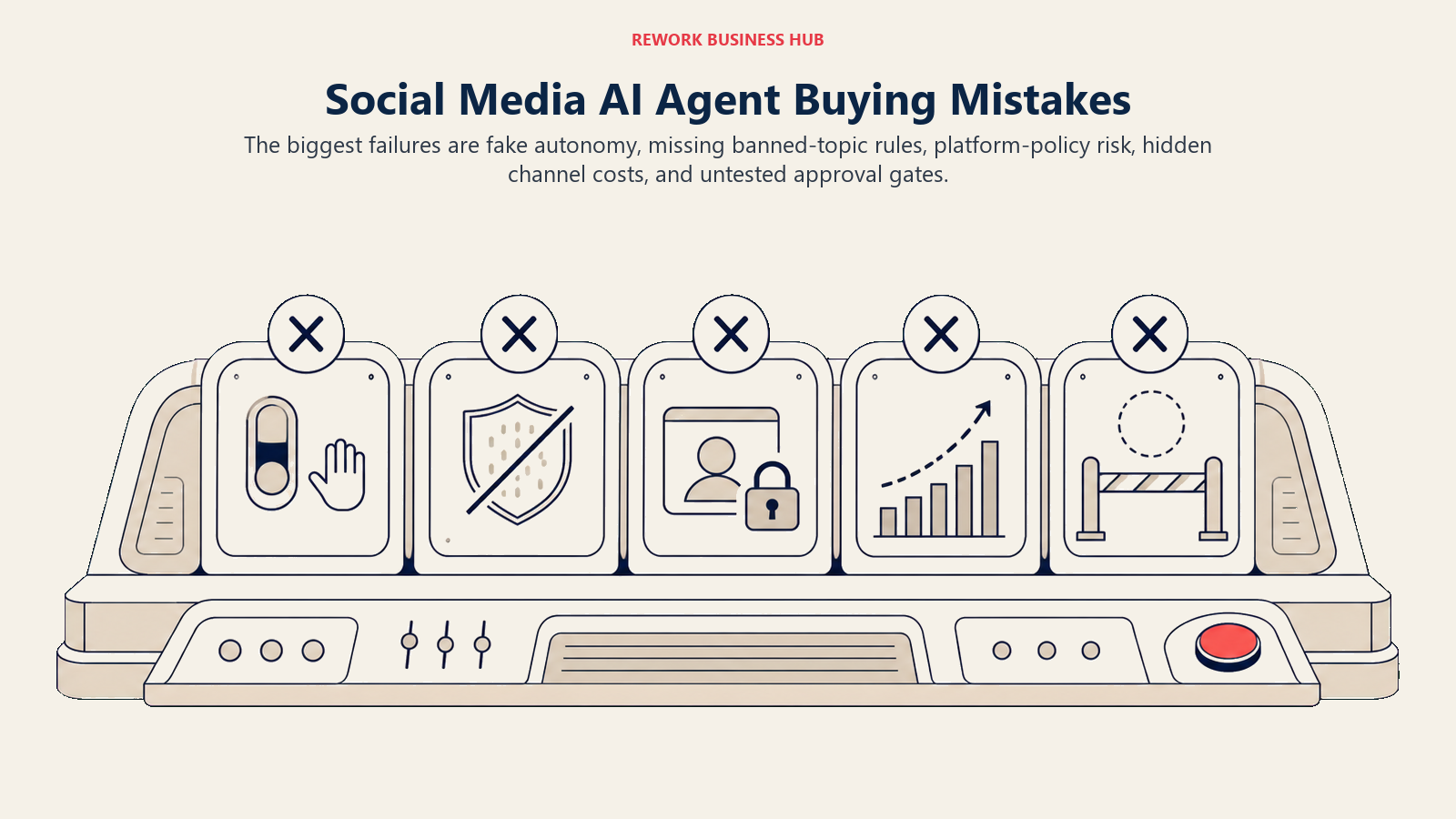
Most teams evaluating this category for the first time make the same handful of mistakes, largely because "AI agent" has become marketing shorthand faster than the products themselves have caught up.
| Mistake | What It Looks Like | What to Do Instead |
|---|---|---|
| Buying "AI agent" marketing at face value | Assuming a tool decides and acts because the homepage says "agent" | Check whether it publishes or replies without a click; most on this list still need one |
| Turning on autopilot without a "do not say" list | Predis.ai or Vista Social going live off-brand because nobody defined guardrails first | Write the brand-voice and banned-topics list before autopilot goes live, not after |
| Automating a personal profile without reading platform terms | Taplio- or Postwise-style automation flagged by the network | Understand the account-risk tradeoff before automating outreach from a real person's profile |
| Ignoring per-channel or per-credit cost at scale | Budgeting for the entry tier, then hit by X add-on fees or credit overages | Price out your full channel list and expected volume, not just the cheapest tier |
| Skipping the approval workflow for a regulated brand | Turning on auto-reply at a bank, health system, or public company with no review step | Confirm and test an approval gate before any customer-facing automation goes live |
| Treating trend detection as fully automatic | Expecting the tool to tell you exactly what to post next, unsupervised | Use trend and sentiment signals (Sprout Social, Hootsuite) as an early warning a person still acts on |
| Not re-verifying pricing before renewal | Budgeting off a review site's numbers from months ago | Re-check the vendor's own pricing page; this category changes tiers often |
Decision Framework
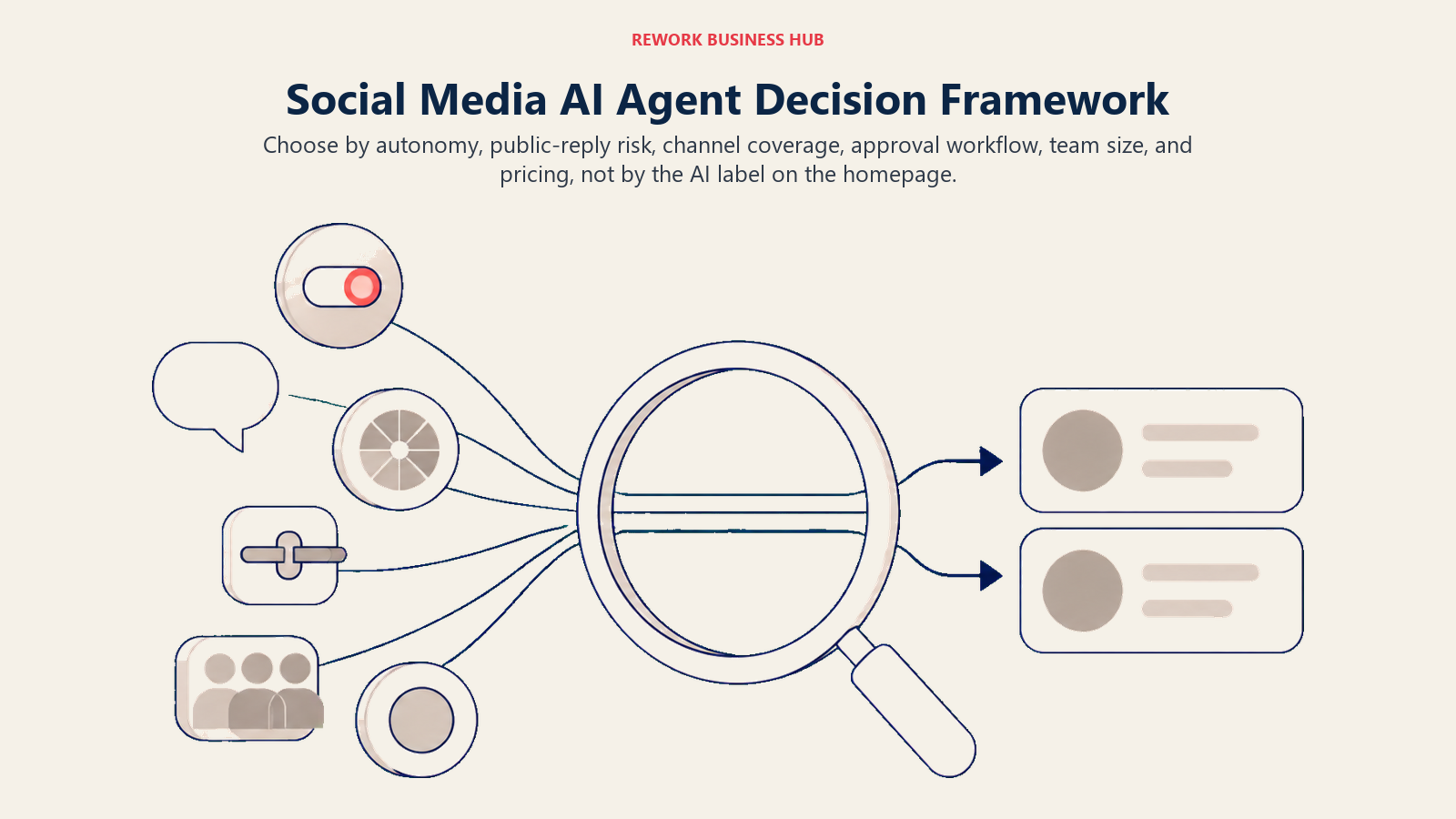
Use this framework to match autonomy, channel reach, and public risk to the team that will operate the agent.
| If you need... | Pick... | Why |
|---|---|---|
| The most autonomous product you can self-serve buy today | Predis.ai | Publishes on its own schedule by default, no enterprise sales call required |
| Autonomous public replies without enterprise pricing | Vista Social | Autopilot comment and DM replies from $79/month |
| Enterprise-grade agent infrastructure across every CX channel | Sprinklr | Broadest autonomous-action architecture, with a formal agent-testing layer |
| Deep analytics with a human-gated agent layer | Sprout Social | Trellis flags and drafts at scale; a person still approves |
| LinkedIn-specific personal-brand automation | Taplio | Built around one profile's growth, with capped automated outreach |
| Brand-voice content at enterprise scale | Lately | Learns from your own top posts; full automation on Enterprise |
| Governance for a large distributed team | Hootsuite | Strongest approval workflows and multi-account governance |
| The simplest free AI-assisted scheduler | Buffer | Genuinely usable free tier, AI Assistant included |
| Visual-first Instagram and TikTok planning | Later | Best grid preview, AI captions layered on |
| Scheduling plus paid-ads analytics together | Metricool | Organic and paid performance in one dashboard |
| The cheapest real scheduler with an AI upsell | Publer | Free tier plus low-cost Genie AI Assist |
| Turning a URL or feed into ready content fast | Ocoya | Multilingual AI copy generation bundled with scheduling |
| Growing a personal brand on X specifically | Postwise | AI-drafted threads and hooks purpose-built for one platform |
What to Do Next
Pick one workflow, not a whole platform migration, and test it for two weeks before committing to an annual plan. If you're deciding whether to automate publishing, run Predis.ai's or Lately's autopilot on one low-stakes channel first and watch what it actually posts before trusting it with your primary account. If you're deciding whether to automate replies, start Vista Social's or Taplio's automation on a narrow rule set, one FAQ-style question, say, rather than opening it to every comment on day one. And if you're not sure your team is ready for any of this yet, our AI Social Media Agent build blueprint and AI Community Moderation Agent blueprint are good next reads: both map out exactly where the human handoff belongs before you turn autonomy on.

Principal Product Marketing Strategist
On this page
- Updated August 2026: What Changed
- Key Facts
- Quick Comparison Table
- Scheduler or Agent? Grading Real Autonomy
- Platform Coverage and API Limits
- Automated Engagement and the Brand-Safety Question
- How to Choose an AI Agent for Social Media
- Framework: By What You Actually Need
- Sizing and Persona Table
- 1. Sprout Social: The Deepest Intelligence Layer, Still Human-Gated by Design
- 2. Sprinklr: Enterprise Agent Infrastructure for Social Customer Care
- 3. Predis.ai: The Clearest Real Autopilot on a Small-Team Budget
- 4. Vista Social: Autopilot Replies Without Enterprise Pricing
- 5. Taplio: LinkedIn Growth With Capped Automated Outreach
- 6. Lately: A Brand-Voice Content Engine With Enterprise-Only Automation
- 7. Hootsuite: The Governance Standard, Honestly Not an Agent
- 8. Buffer: The Simplest AI-Assisted Scheduler, Genuinely Free to Start
- 9. Later: Visual-First Planning With Credit-Gated AI Captions
- 10. Metricool: Scheduling Plus Paid-Ads Analytics, AI-Assisted Only
- 11. Publer: The Cheapest Real Scheduler With an AI Upsell
- 12. Ocoya: Content Generation Bundled With Scheduling
- 13. Postwise: AI-Drafted Growth Content for X, Not Confirmed Autopilot
- AI Agent Buying Mistakes to Avoid
- Decision Framework
- What to Do Next