Best AI Agents for Procurement in 2026: 14 Agents for Intake, Sourcing, and Autonomous Negotiation
Turn this article into takeaways for your work.


Each assistant summarizes the article only for you and suggests best practices for your work.
If your real bottleneck is the intake form nobody fills in, Zip and Levelpath lead on turning a request into the easiest way to buy something, not the slowest. If it's sourcing events and supplier negotiation, Keelvar and Pactum ship the most credible autonomous capability in the category, though "autonomous" deserves a more careful read than the marketing suggests (more on that below). If it's spend data you can't yet trust, Sievo owns that job outright, and GEP SMART, Ivalua, SAP Ariba, and Coupa each fold a wide agent bench into the source-to-pay suite you may already run. This guide ranks 14 real agents against the same plan-act-observe bar covered in best AI agent platforms: genuine multi-step agentic capability, not a copilot wearing agent branding.
Procurement sits between two guides covering adjacent ground, and the line matters for where you click next. Best AI agents for supply chain covers demand planning, inventory, and freight, including Keelvar's logistics-sourcing use cases specifically; this guide covers Keelvar's core job instead, indirect and direct sourcing across categories. Best AI agents for finance picks up the moment a purchase order becomes an invoice: accounts payable, three-way matching, and the close. What's ranked below sits in between: intake and request triage, supplier discovery and onboarding, sourcing events and negotiation, contract and PO creation, spend classification, and supplier risk monitoring, real purchasable products, not a framework for building your own. If you'd rather design a narrower agent in-house, AI procurement agent, AI vendor management agent, and AI contract review agent are the vendor-neutral build-side blueprints for exactly this scope. For the underlying definition, what is an AI agent covers the loop every product below runs some version of.
Updated August 2026: What Changed
- Keelvar launched Kai, an AI orchestrator that builds sourcing events from a plain-language request, in November 2025, and now reports that 85% of sourcing activity across its customer base is automated.
- SAP is rolling out 11 new Joule agents across Ariba and Fieldglass through 2026 (five in June, six in September), and is running the Joule Agent Runtime free for existing Ariba and Fieldglass customers through December 31, 2026.
- Coupa introduced Coupa Compose and Coupa Catalyst at its Inspire 2026 event: an "agentic-as-a-service" platform with a no-code Navi Agent Studio, plus a forward-deployed-engineer service to implement agentic workflows, alongside a new outcome-based pricing option.
- Ivalua launched IVA Studio in June 2026, moving its Intelligent Virtual Agent from a set of point agents into what it describes as a single, fully agentic system spanning the entire source-to-pay process, with Model Context Protocol support.
- Fairmarkit launched Total Agentic Sourcing, extending its five-agent workflow from tail spend into strategic spend inside the same environment, with direct integrations to SAP Ariba, SAP S/4HANA, Coupa, Oracle, and ServiceNow.
- Levelpath extended its platform with invoice automation in December 2025, pushing its agent layer past sourcing and into the receipt-to-payment side of the process.
Key Facts
- Gartner projects AI agents will intermediate more than $15 trillion in B2B spending by 2028, with 90% of B2B buying agent-intermediated by that point (Gartner).
- Gartner separately projects that only 40% of procurement teams will have implemented at least one AI agent by 2028, a slower ramp than headline "autonomous negotiation" claims suggest for today (Gartner).
- In Deloitte's 2025 Global Chief Procurement Officer Survey of over 250 CPOs across 40 countries, "Digital Masters" (top-quartile technology adopters) reported an average 3.2x return on their GenAI investment, versus roughly 1.5x for followers (Deloitte).
- McKinsey's analysis of AI-driven procurement puts the realistic efficiency gain at 25% to 40%, concentrated in the intake, triage, and sourcing-prep work that eats a buyer's week before any negotiation even starts (McKinsey).
- CIPS, the Chartered Institute of Procurement & Supply, notes that tail spend, the long tail of small, off-contract purchases, can span up to 80% of an organization's suppliers or transactions while accounting for as little as 10% to 20% of total spend value (CIPS).
Quick Comparison Table
Fourteen real agents, grouped by the job they're built around first.
| Class | Agent | Best For | Starting Price | Key Strength | Key Limitation |
|---|---|---|---|---|---|
| Sourcing/Negotiation | Keelvar | High-volume RFQs, e-auctions, tail-to-strategic sourcing | Not published; enterprise quote | Only vendor Gartner names in both Advanced Sourcing Optimization and Autonomous Sourcing | No self-serve tier; ISO-certified but no SOC 2 stated |
| Sourcing/Negotiation | Pactum | Post-sourcing and tactical negotiation at Global 2000 scale | Not published; platform fee plus value-share (reported) | Negotiates 24/7 across time zones with a full audit trail | Narrow scope: negotiation only, not a full source-to-pay system |
| Sourcing/Negotiation | Fairmarkit | Autonomous sourcing across tail AND strategic spend together | Not published; scaled to spend under management | Five-agent workflow from intake through award, native to SAP, Oracle, Coupa | No published pricing floor to budget against early |
| Sourcing/Negotiation | Arkestro | Adding predictive pricing on top of Coupa or SAP Ariba | Not published; priced on addressable spend routed through it | Works alongside your existing source-to-pay system instead of replacing it | Not a system of record; still needs Coupa or Ariba underneath |
| Sourcing/Negotiation | Globality | Services and professional-spend RFPs specifically | Not published | Category-trained NLP models built for B2B sourcing, not a generic LLM wrapper | Narrower category coverage than a full source-to-pay suite |
| Intake Orchestration | Zip | The intake front door across every requesting department | Not published; roughly $40K-$200K+/yr (reported) | 6M+ approvals and 31M intake questions already orchestrated on the platform | Sits on top of, doesn't replace, your ERP or P2P system |
| Intake Orchestration | Levelpath | Mid-market to enterprise teams replacing a legacy S2P UX | Not published | Hyperbridge reasoning engine plus a no-code Orchestration Studio | Newer platform; thinner partner ecosystem than Coupa or SAP |
| Intake Orchestration | Omnea | Teams wanting one agentic layer from request through PO | Not published; framed as results-based | Explicit no-training-on-customer-data policy, SOC 2 Type II | Payment, invoice matching, and renewals often still sit in other tools |
| Intake Orchestration | Focal Point | Orchestrating on top of an existing Coupa or Oracle deployment | Not published | No-code workflow builder plus automated supplier data enrichment | Least public technical and security detail of any vendor on this list |
| Full S2P Suite | Coupa | Enterprises wanting agents inside a BSM system they already run | Not published; outcome-based option introduced, rates undisclosed | 20+ Navi agents, a no-code Agent Studio, a network of $10T in spend data | No self-serve pricing signal at all, even directionally |
| Full S2P Suite | SAP Ariba | Existing SAP customers wanting agents inside S/4HANA | Not published; Joule Agent Runtime free through December 31, 2026 | Reasons directly over live SAP records, no separate integration layer | Several 2026 agents are still mid-rollout, not fully GA yet |
| Full S2P Suite | Ivalua | Enterprises wanting one agent (IVA) across the full S2P process | Not published | 30+ embedded agents, MCP support, ISO 27001, SOC 1/2, and FedRAMP-ready | No pricing signal at all, not even a reported range |
| Full S2P Suite | GEP SMART | Enterprises wanting Gartner-Leader S2P plus supply chain, unified | Not published | MINERVA engine claims 95%+ spend classification accuracy | No pricing signal; compliance detail sits behind GEP's Trust Center |
| Spend Analytics | Sievo | $1B+ revenue enterprises that need trustworthy spend data first | Not published | 94% classification accuracy and 98% coverage, offered as a guarantee | Not a sourcing or negotiation tool; it feeds the other 13 |
Which Procurement Job Each Agent Actually Owns
Naming a vendor isn't the same as answering which job it owns. Here's the map.
| Procurement Job | Agents That Cover It Today |
|---|---|
| Intake and request triage | Zip, Omnea, Levelpath, Focal Point, SAP Ariba, GEP SMART, Fairmarkit |
| Supplier discovery and onboarding | Fairmarkit, Globality, Omnea, Levelpath, GEP SMART |
| Sourcing events and negotiation | Keelvar, Pactum, Arkestro, Globality, Fairmarkit, GEP SMART, SAP Ariba |
| Contract and PO creation | SAP Ariba, GEP SMART, Levelpath, Ivalua, Coupa |
| Spend classification and analysis | Sievo, GEP SMART, Ivalua |
| Supplier risk and compliance monitoring | Omnea, Levelpath, GEP SMART, Fairmarkit |
| Tail-spend management | Fairmarkit, Keelvar, Arkestro, Pactum |
Three of these seven jobs already have a vendor-neutral build blueprint if buying isn't the right call yet: AI Procurement Agent (intake, PO routing, and policy exceptions), AI Vendor Management Agent (contracts, renewals, and spend risk), and AI Contract Review Agent (flagging risky clauses before a human approves). Spend classification and analysis is the job with the fewest dedicated vendors, which lines up with the table above: it's a harder, less glamorous problem than sourcing, and most vendors would rather ship a negotiation headline than a classification-accuracy number.
The Autonomous Negotiation Reality Check
"Autonomous negotiation" is the phrase that sells this category, and it deserves more scrutiny than a vendor homepage gives it. Every product in this guide that touches negotiation, Keelvar, Pactum, Arkestro, Globality, and GEP SMART's Negotiation Agent, describes some version of an AI system that talks to suppliers and reaches terms without a human drafting the counteroffer. That part is real. What it is not, in almost every documented case, is a system independently negotiating a novel, high-stakes contract with a brand-new supplier and committing your company to it.
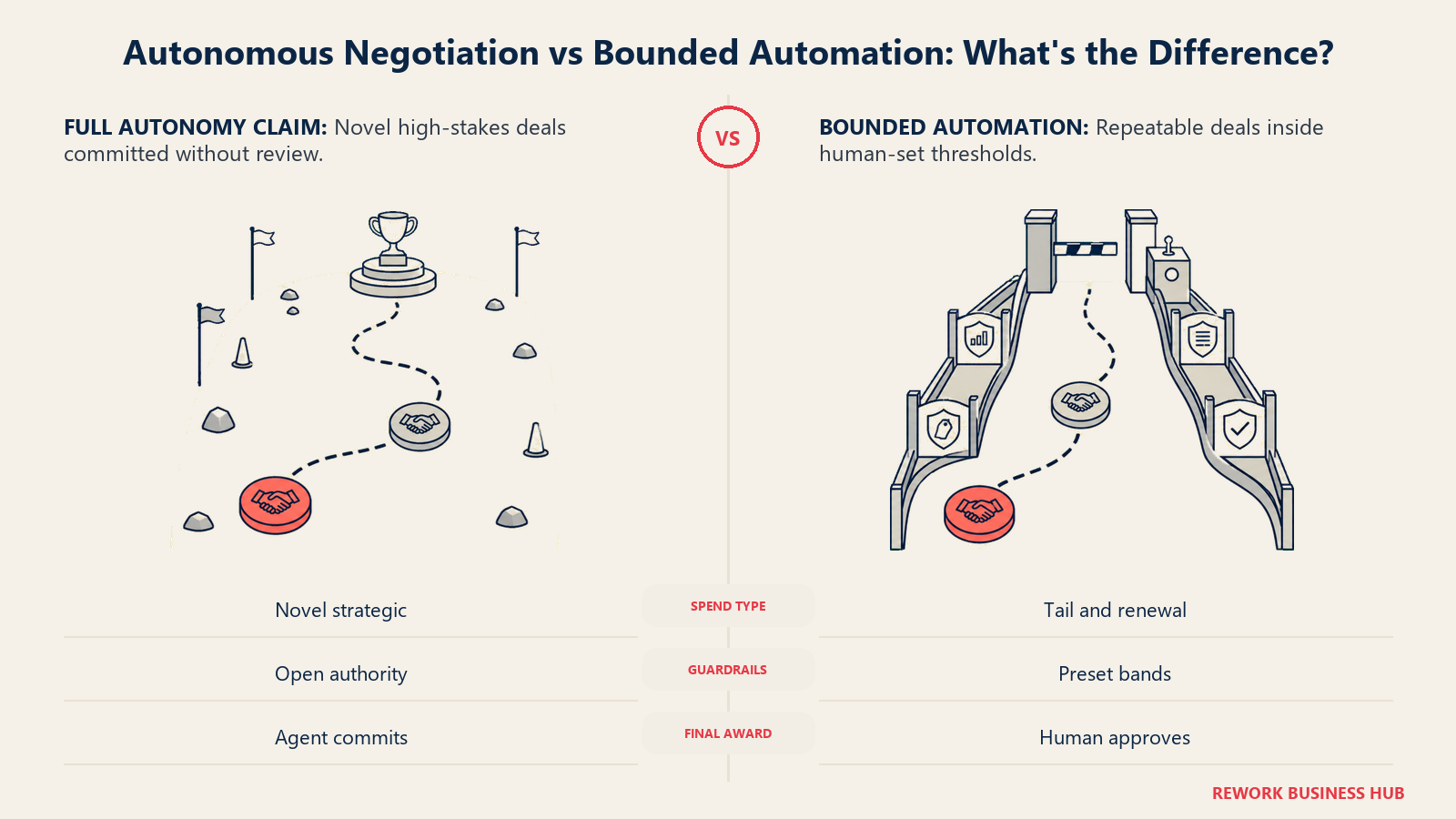
Look at what the case studies actually describe. Pactum's own product pages are organized around post-sourcing negotiation (refining terms after a human-run RFP already picked the shortlist), tactical sourcing (short-cycle, lower-stakes categories), and requisitions negotiation (sole-source purchases inside a policy). Its headline Walmart result, a 35-day payment term extension with 68% supplier agreement, is a payment-terms optimization on existing relationships, not a from-scratch strategic negotiation. Keelvar's negotiation runs inside a traffic-light feedback mechanism and pre-set award parameters a human defines before the event starts; the 85% of sourcing activity the company reports as automated is concentrated in the repeatable, rules-bound tail and tactical categories autonomous sourcing was built for, not one-off strategic sourcing events. Arkestro is explicit that it generates a suggested price and counteroffer, with a human still approving the award.
The pattern holds across the category: agents run the repeatable, lower-risk, well-bounded negotiations, tail spend, renewals inside a pre-approved price band, standard terms against a known playbook, and a person still signs off on anything novel, above a threshold, or involving a new supplier. That's not a knock on the technology. It's the shape every credible agent category takes once you check the fine print instead of the headline: Gartner itself projects that only 40% of procurement teams will have implemented even one AI agent by 2028 (cited above), a narrower and slower ramp than "autonomous negotiation" implies for right now. Budget for what these agents demonstrably do in 2026: clearing the tail, extending renewals, and drafting the first counteroffer, not replacing your senior sourcing lead's next strategic RFP.
What to Require Before an Agent Commits Company Money
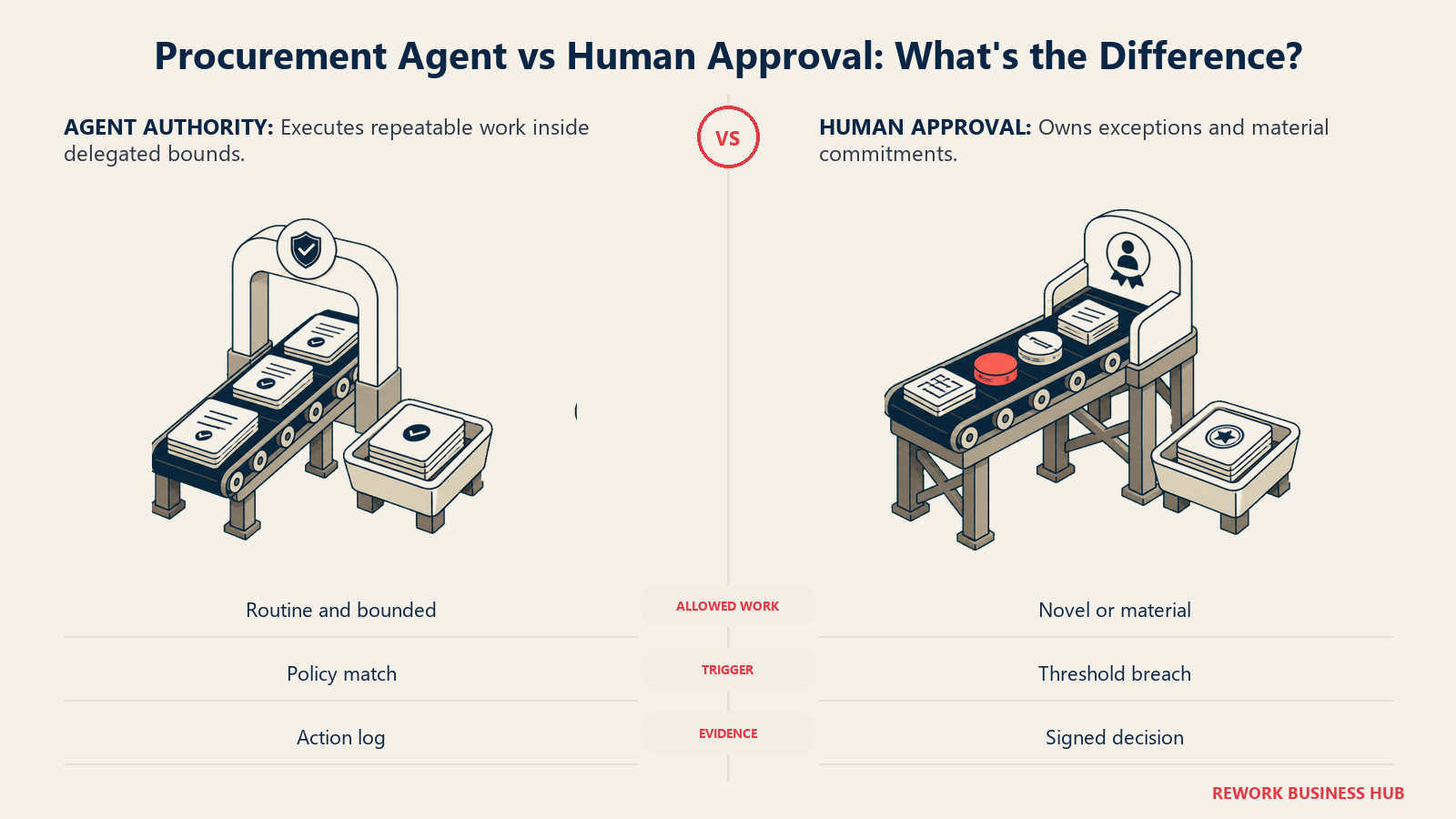
An agent that mis-drafts a marketing email is a minor edit. An agent that commits your company to a bad price, onboards an unvetted supplier, or creates a PO against the wrong budget line is a real financial and control failure. None of that risk changes because software replaced a person; if anything it matters more, since an agent can act faster than a human approver can watch.
| Task | An agent can typically do this autonomously | This should stay a human decision |
|---|---|---|
| Tail-spend RFQs within a preset category and dollar ceiling | Yes, end to end for repeatable buys | Awarding to a brand-new, unvetted supplier |
| Renewal negotiation within pre-approved price and term bands | Yes | Accepting a price increase or term change outside the band |
| Intake triage and routing to the right approver | Yes, classify and route automatically | Waiving a required approval step |
| Bid comparison and award recommendation | Yes, rank and recommend | Final sign-off above a delegated dollar threshold |
| Standard contract drafting from an approved template | Yes, produce the first draft | Approving a nonstandard clause or a deviation from the playbook |
| Supplier risk monitoring and flagging | Yes, continuously | Deciding to suspend or offboard a supplier relationship |
| PO creation against an approved requisition and budget line | Yes | Creating a PO against an exception, an over-budget request, or a new vendor |
What Each Vendor Actually Has on Its Own Trust Page
| Agent | Independent Security/Compliance Attestation |
|---|---|
| Keelvar | ISO 27001, ISO 27701 |
| Pactum | SOC 2 Type II |
| Fairmarkit | Ask Fairmarkit for its attestation |
| Arkestro | States SOC 2 certification; report type not specified publicly |
| Globality | Ask Globality for its attestation |
| Zip | Ask Zip for its attestation |
| Levelpath | SOC 1 Type II, SOC 2 Type II, GDPR compliant |
| Omnea | SOC 2 Type II, GDPR compliant |
| Focal Point | Ask Focal Point for its attestation |
| Coupa | Confirm with Coupa's trust center |
| SAP Ariba | Inherits SAP's enterprise compliance program; no agent-specific attestation published separately |
| Ivalua | ISO 27001, SOC 1 and SOC 2 attestation, TISAX Level 2, FedRAMP-compliant environment |
| GEP SMART | References a GEP Trust Center; SOC 2, SOX, HIPAA, and ISO 27001 cited across different deployment contexts |
| Sievo | Ask Sievo for its attestation |
If this purchase has to clear a formal security or procurement review before anyone can sign, best enterprise AI agent platforms covers the certifications and governance questions that review typically raises. And if your concern is broader than any single procurement agent, watching what every agent across your stack actually did, not just the ones touching spend, best AI agent observability tools covers the monitoring layer that sits above individual vendors.
ERP and P2P Integration Depth
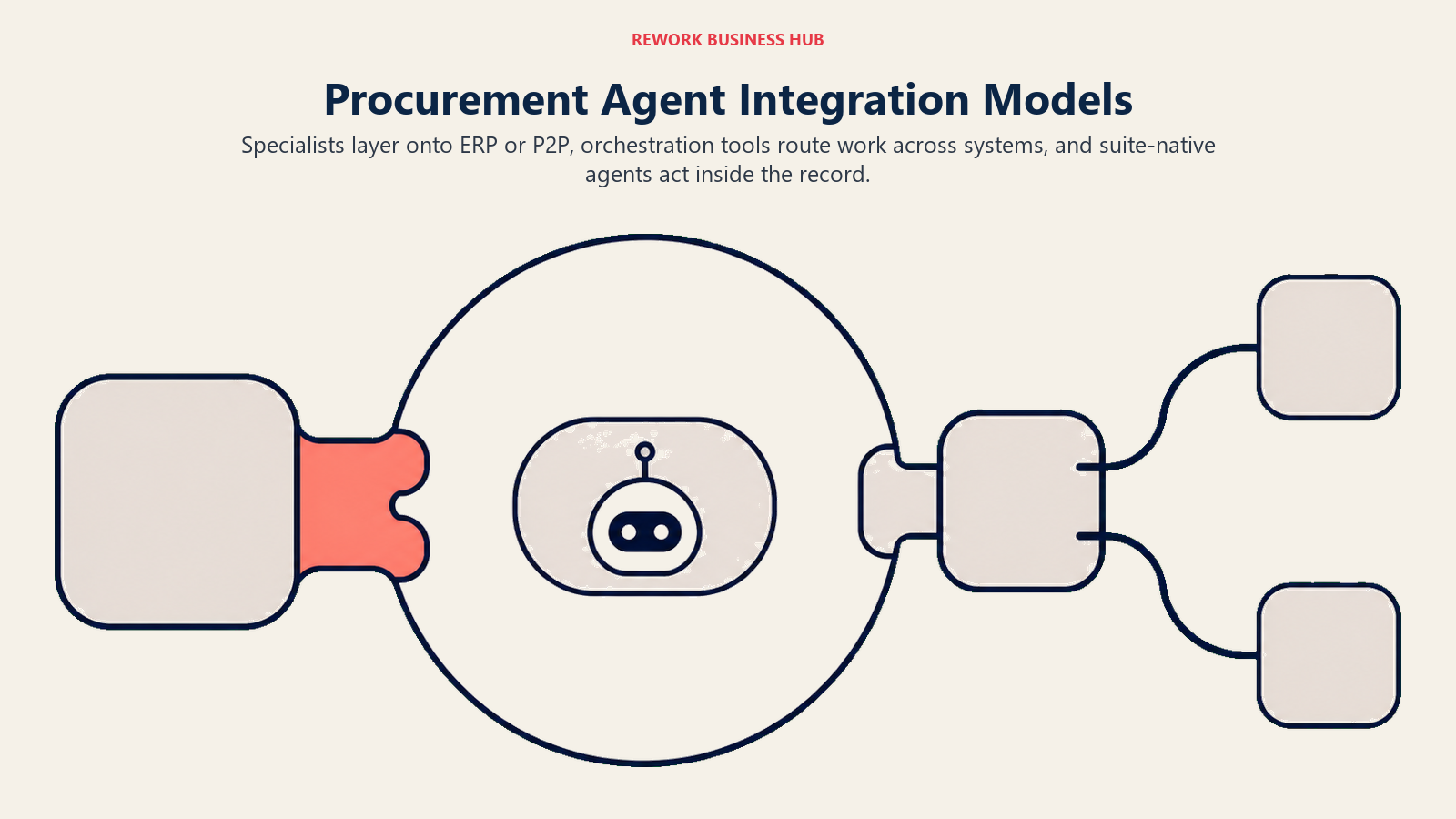
An agent is only as useful as the system it reads from and writes back to. Some names below plug into whichever ERP or P2P stack you already run; others (Coupa, SAP Ariba) are the system of record themselves.
| Agent | ERP/P2P It Grounds Against | Integration Depth |
|---|---|---|
| Keelvar | Works alongside existing P2P/ERP; exports awards downstream | Sourcing-layer only; doesn't replace your P2P system |
| Pactum | SAP Ariba, Coupa, SAP S/4HANA | Native connectors into the P2P systems it negotiates for |
| Fairmarkit | SAP Ariba, SAP S/4HANA, Coupa, Oracle, ServiceNow | Bi-directional API sync; sits above whichever P2P you run |
| Arkestro | Coupa, SAP Ariba | Add-on layer, explicitly designed to sit alongside rather than replace |
| Globality | Enterprise systems via integration; specifics not detailed publicly | Not itemized beyond general ERP/P2P integration claims |
| Zip | Broad connector ecosystem across an existing tech stack | Orchestration layer; final PO or payment often executes elsewhere |
| Levelpath | ERP-agnostic via its Hyperbridge reasoning layer | Positions itself as the front end; your ERP stays the system of record |
| Omnea | Pushes approved PO data directly to accounting systems | Covers intake through PO; payment and invoice matching often stay external |
| Focal Point | Coupa and Oracle named directly as integration targets | Orchestration layered on top of an existing S2P deployment |
| Coupa | Is the P2P/BSM system of record itself | Deepest possible on its own network; agents act inside Coupa directly |
| SAP Ariba | Native (SAP S/4HANA, SAP Business Network) | Deepest possible; Joule agents reason directly over live SAP records |
| Ivalua | Certified SAP Plug and Play connector, used daily by 80% of its customer base | Deep native connector plus a platform-wide agent (IVA) |
| GEP SMART | ERP-agnostic by design; built to sit above whichever ERP the org runs | Broad but generalized; depth varies by which ERP is underneath |
| Sievo | Pulls from ERPs and 100M+ enriched supplier records for classification | Analytics layer; doesn't write back into the P2P system |
Sizing and Persona
| Agent | Ideal Org Size | Primary Buyer |
|---|---|---|
| Keelvar | 500-50,000+ employees, high sourcing-event volume | VP Procurement, Head of Sourcing, Category Director |
| Pactum | 1,000-50,000+ employees (Global 2000 skew) | CPO, VP Procurement, Head of Supplier Management |
| Fairmarkit | 500-50,000+ employees | Director of Sourcing, Tail-Spend Program Owner |
| Arkestro | 200-10,000 employees already running Coupa or SAP Ariba | Procurement Operations Lead, Category Manager |
| Globality | 1,000-50,000+ employees, services-heavy spend | CPO, Head of Indirect or Services Procurement |
| Zip | 200-10,000 employees | Head of Procurement, Business/IT Operations Lead |
| Levelpath | 500-20,000 employees | CPO, VP Procurement, Procurement Operations |
| Omnea | 200-5,000 employees | Head of Procurement, Finance Operations Lead |
| Focal Point | 500-10,000 employees, existing Coupa or Oracle users | Procurement Operations Director |
| Coupa | 1,000-100,000+ employees | CPO, VP Procurement, Procurement IT |
| SAP Ariba | 1,000-100,000+ employees, existing SAP customers | CPO, SAP Program Owner |
| Ivalua | 1,000-100,000+ employees | CPO, VP Procurement, Procurement Technology Lead |
| GEP SMART | 1,000-100,000+ employees | CPO, VP Procurement, Supply Chain Leader |
| Sievo | $1B+ revenue enterprises | Head of Spend Analytics, Procurement Data Lead |
1. Keelvar: Autonomous Sourcing and Negotiation at Scale
Keelvar built its reputation on Sourcing Optimizer, which evaluates complex, multi-variable bid data (price, capacity, risk, ESG, lead time) and can model billions of award-scenario combinations in seconds. In 2026, the story is Kai, an AI orchestrator launched in November 2025 that lets a buyer describe a sourcing need in plain language; Kai classifies the spend category, picks the sourcing approach, invites suppliers, and runs the event, with a traffic-light feedback mechanism the company says drives 8% to 12% additional savings per negotiation round.
Keelvar is the only vendor Gartner names in both Advanced Sourcing Optimization and Autonomous Sourcing in its 2026 Market Guide for Sourcing Applications, and the company reports that 85% of sourcing activity across its customer base is now automated, concentrated in the repeatable tail and tactical categories this technology fits best (see the negotiation reality check above before assuming that covers strategic sourcing too). Keelvar holds ISO 27001 and ISO 27701 certification, though it doesn't state SOC 2 on its public site.
| What you get | What you don't |
|---|---|
| Only vendor Gartner names in both Sourcing Optimization and Autonomous Sourcing | No self-serve tier; expect an enterprise sales process |
| Kai orchestrates intake-to-event setup from a plain-language request | ISO-certified, but no SOC 2 attestation stated publicly |
| Covers transport, MRO, direct/indirect materials, and services in one platform | Negotiation is bounded by human-set parameters, not fully unsupervised |
Pricing: Not published; enterprise quote. See keelvar.com.
Best for: Procurement teams running high volumes of repeatable RFQs, e-auctions, or spot buys across categories who want most of that volume automated end to end.
2. Pactum: The Negotiation-Only Specialist
Pactum does one job and does it deeply: autonomous supplier negotiation, running 24/7 across time zones with a complete audit trail of every offer and counteroffer. Its three named agents split the work by stage: a Post-Sourcing Negotiation Agent that refines terms after a human-run RFP, a Tactical Sourcing Agent for shorter-cycle categories, and a Requisitions Negotiation Agent for sole-source purchases inside policy. It connects natively into SAP Ariba, Coupa, and SAP S/4HANA rather than replacing any of them.
Pactum counts more than 60 Global 2000 enterprises as customers, including Walmart, Suez, Honeywell, and Bristol Myers Squibb, and reports a Walmart deployment covering over $1 billion in negotiated spend, with an average 3% cost gain and a 35-day payment-term extension accepted by 68% of suppliers. Treat those as the vendor's own case-study figures rather than an independently audited result. Pactum holds SOC 2 Type II certification.
| What you get | What you don't |
|---|---|
| Purpose-built negotiation agents with a full offer/counteroffer audit trail | Narrow scope: negotiation only, not sourcing setup or a full S2P system |
| Native connectors into SAP Ariba, Coupa, and SAP S/4HANA | No self-serve pricing; expect a platform fee plus a value-share component |
| SOC 2 Type II certified, with reported results at real enterprise scale | Reported savings and term figures are vendor case studies, not audited |
Pricing: Not published; reportedly a platform access fee combined with a value-share tied to documented savings. See pactum.com.
Best for: Large enterprises that already run a sourcing and P2P stack and want a specialized negotiation layer on top, rather than a full replacement system.
3. Fairmarkit: Total Agentic Sourcing Across Tail and Strategic Spend
Fairmarkit's pitch is unusual in this category: one platform for both ends of the spend spectrum, from a $500 tactical buy to a $500 million contract, powered by five specialized agents (Intake, Supplier Discovery, RFx Execution, Evaluation, and Performance & Compliance) working under an assistant the company calls KIT. Its 2026 Total Agentic Sourcing launch extended that reach from tail spend specifically into strategic sourcing inside the same environment, with native integrations to SAP Ariba, SAP S/4HANA, Coupa, Oracle, and ServiceNow.
Fairmarkit reports 11% average identified savings, an 86% reduction in cycle time from intake through award, and a 300% increase in sourcing events handled per buyer, drawn from its own customer base, which includes Boeing, BP, Goodyear, Walgreens, ServiceNow, and Snowflake. The company doesn't publish pricing or a public security/compliance attestation.
| What you get | What you don't |
|---|---|
| Five-agent workflow spanning intake through award, tail and strategic spend together | No published pricing; expect a quote scaled to spend under management |
| Native integrations across SAP, Oracle, Coupa, and ServiceNow | Ask Fairmarkit for its security/compliance attestation |
| Enterprise customer base with reported cycle-time and savings gains | Reported figures are vendor-published, not independently audited |
Pricing: Not published; custom, based on spend under management, sourcing-event volume, modules, and ERP integrations. See fairmarkit.com.
Best for: Sourcing teams that want tail spend and strategic categories automated inside one environment instead of two separate tools.
4. Arkestro: Predictive Pricing Layered on Top of Coupa or SAP Ariba
Arkestro takes a genuinely different shape than most of this list: rather than a system of record, it's a predictive procurement layer that runs alongside Coupa or SAP Ariba, combining behavioral science, game theory, and predictive machine learning to generate suggested pricing, automate RFP creation, and recommend supplier awards. Its commercial model is built around addressable spend routed through the platform rather than per-seat pricing.
The company reports 18.8% average savings across all spend categories and 60% faster negotiation cycle times, with customer examples including a construction-materials company completing sourcing events in 13 days and a plastics manufacturer reporting $3.5 million in commodity resin savings. Arkestro holds SOC 2 certification and maintains a dedicated trust center, though the specific report type isn't stated on its public pages.
| What you get | What you don't |
|---|---|
| Predictive pricing and negotiation recommendations layered on your existing S2P stack | Not a system of record; still requires Coupa or SAP Ariba underneath |
| SOC 2 certified with a dedicated trust center | Report type (Type I vs. Type II) not specified publicly |
| Reported 18.8% average savings and 60% faster cycle times | Figures are vendor-reported case studies, not independently audited |
Pricing: Not published; priced on the volume of addressable spend routed through the platform, with services and onboarding quoted separately. See arkestro.com.
Best for: Procurement teams already running Coupa or SAP Ariba that want a predictive negotiation layer without swapping their system of record.
5. Globality: Autonomous Sourcing for Services Spend
Globality specializes in a category most of this list treats as an afterthought: professional and services spend, RFPs for consulting, staffing, marketing, and similar categories that don't fit a catalog. Its AI assistant, Glo, uses natural-language models trained specifically on B2B commercial sourcing data (not a general-purpose LLM) to define requirements, identify qualified suppliers from a database covering more than 7,000 offerings, analyze proposals, and support negotiation and award decisions, including diversity and inclusion goals in supplier selection.
Globality's own materials cite a Bristol Myers Squibb deployment that cut a typical RFP cycle from six months to 27 days and enabled 10 times more sourcing events without added headcount, alongside a reported 20% average cost savings. Pricing and public security certifications aren't disclosed on its site.
| What you get | What you don't |
|---|---|
| Category-trained models built specifically for B2B services sourcing | No published pricing or public security/compliance attestation |
| Vendor database spanning 7,000+ service offerings with D&I criteria built in | Narrower category focus than a full source-to-pay suite |
| Reported enterprise case study (Bristol Myers Squibb) with specific cycle-time gains | Case-study figures are vendor-published, not independently verified |
Pricing: Not published. See globality.com.
Best for: Enterprises whose hardest sourcing problem is services and professional spend rather than materials or goods.
6. Zip: The Intake-to-Procure Category Leader
Zip's whole premise is that sourcing and negotiation tools are useless if nobody submits a request before they buy, so it built the intake front door instead: a single, no-code-configurable entry point that routes any purchase request across departments, plus Vendor Management, an Integration Ecosystem, Spend Insights, and an embedded AI Procurement Concierge. It doesn't replace your ERP or P2P system; it orchestrates the process that feeds it.
Zip reports more than 6 million approvals, 1.2 million vendors, and 31 million intake questions answered on its platform to date, with customers including Lyft, Snowflake, Northwestern Mutual, Reddit, Sephora, and Canva. Zip doesn't publish pricing; third-party contract data from Vendr puts typical annual spend in the $40,000 to $200,000-plus range depending on requisition volume, user count, and features, which is a reported figure, not a vendor-confirmed rate card.
| What you get | What you don't |
|---|---|
| Purpose-built intake front door with no-code workflow customization | Sits on top of, doesn't replace, your ERP or P2P system |
| Reported platform scale: 6M+ approvals, 31M intake questions answered | No published pricing; reported contracts run roughly $40K-$200K+/yr |
| Strong customer base across tech, finance, and retail | Ask Zip for its security/compliance attestation |
Pricing: Not published; reported annual contracts commonly run $40,000 to $200,000+ depending on requisition volume and seats (Vendr, third-party data). See zip.com.
Best for: Organizations whose actual bottleneck is getting a request submitted and routed correctly before sourcing or negotiation ever starts.
7. Levelpath: AI-Native Procurement Built Around Hyperbridge
Levelpath, founded in 2022 and backed by more than $100 million in funding including a Series B led by Battery Ventures, built its platform around seven functional areas: Intake & Orchestration, Sourcing, Supplier Management, Contract Management, Project Pipeline, Risk Management, and, since December 2025, Invoice Automation. The technical core is Hyperbridge, a reasoning engine the company describes as enriching enterprise data with contextual intelligence, paired with a no-code Orchestration Studio for building multi-step workflows.
Customer-reported results include Qualtrics cutting cycle times by 46%, alongside deployments at Ace Hardware (15,000+ employees), Zendesk (5,600+ suppliers managed), and Western Union (10,000+ contracts managed). Levelpath holds SOC 1 Type II and SOC 2 Type II certification and states GDPR compliance.
| What you get | What you don't |
|---|---|
| Seven-function platform spanning intake through invoice automation | No published pricing; expect an enterprise sales process |
| Hyperbridge reasoning engine plus a no-code Orchestration Studio | Newer entrant with a thinner partner ecosystem than Coupa or SAP |
| SOC 1 Type II and SOC 2 Type II certified, GDPR compliant | Reported cycle-time gains (Qualtrics: 46%) are customer case studies |
Pricing: Not published. See levelpath.com.
Best for: Mid-market to enterprise procurement teams replacing a legacy source-to-pay system's interface and workflow logic wholesale.
8. Omnea: The Agentic Operating System for Intake to Pay
Omnea frames itself as an "agentic operating system" for procurement rather than a single tool, covering conversational intake through Teams or Slack, duplicate-supplier detection, negotiation briefings that combine usage data and pricing benchmarks, continuous supplier risk monitoring (including Dow Jones sanctions screening), and contract review against a legal playbook. Approved requests push PO data directly into accounting systems, though payment and invoice matching often stay in other tools.
Customer-reported results include the Adecco Group cutting cycle time from 23 days to 4 (an 80% reduction), Proofpoint reducing software-request turnaround by 38%, and TeamViewer attributing a 4-point EBIT increase to its intelligent intake rollout. Omnea holds SOC 2 Type II certification, states GDPR compliance, and explicitly says it doesn't train models on customer data.
| What you get | What you don't |
|---|---|
| Agentic layer spanning intake, sourcing support, risk, and contract review | Payment and invoice matching typically remain in other tools |
| SOC 2 Type II certified, GDPR compliant, explicit no-training-on-customer-data policy | No published pricing; framed as results-based rather than per-seat |
| Reported customer results (Adecco: 80% faster cycle time; TeamViewer: +4pt EBIT) | Figures are customer case studies, not independently audited |
Pricing: Not published; framed as a results-based model rather than flat per-agent fees. See omnea.co.
Best for: Mid-market teams that want one agentic layer from request intake through PO creation, with strict data-privacy guarantees.
9. Focal Point: Orchestration on Top of Coupa or Oracle
Focal Point, based in Atlanta, doesn't try to replace the S2P system you already run; it orchestrates the workflows on top of it, with named integrations into Coupa and Oracle. Its agentic AI features include automated supplier data enrichment (ownership, financials, OFAC and W-9 verification, and frameworks like Porter's Five Forces and Kraljic), predictive intake forms that pre-fill suggested suppliers and approvers, savings and opportunity forecasting, and real-time third-party risk dashboards, built through a no-code, drag-and-drop workflow interface.
Focal Point's public materials describe its capabilities and enterprise customer logos in detail but don't disclose pricing, customer-result percentages, or named security certifications, only general language about "enterprise-grade safeguards" and per-client data separation. That makes it the least transparent vendor on this list; ask directly for a SOC 2 or ISO 27001 report before you evaluate it against peers that publish one.
| What you get | What you don't |
|---|---|
| No-code orchestration layer built specifically for Coupa and Oracle users | No published pricing, customer-result figures, or named security certification |
| Automated supplier data enrichment against real compliance sources (OFAC, W-9) | Least amount of public technical detail of any vendor in this guide |
| Predictive intake forms and real-time third-party risk dashboards | Requires a direct sales conversation to verify basic claims |
Pricing: Not published. See getfocalpoint.com.
Best for: Teams already committed to Coupa or Oracle as their system of record that want an orchestration and workflow layer on top, not a replacement.
10. Coupa: Agentic-as-a-Service Across a $10 Trillion Spend Graph
Coupa enters its 20th year in 2026 as one of the category's established Business Spend Management incumbents, and its 2026 answer to agentic AI is Coupa Compose: an "agentic-as-a-service" environment built around Navi Agent Studio (a no-code interface for building custom agents, generally available since May 2026), Smart Intake & Orchestration, and Navi Connect for agent-to-agent and ERP communication (arriving September 2026). More than 20 named Navi agents already ship for sourcing-event creation, bid comparison, risk detection, and opportunity analysis, drawing on a claimed $10 trillion in spend data across 10 million-plus buyers and suppliers on Coupa's network.
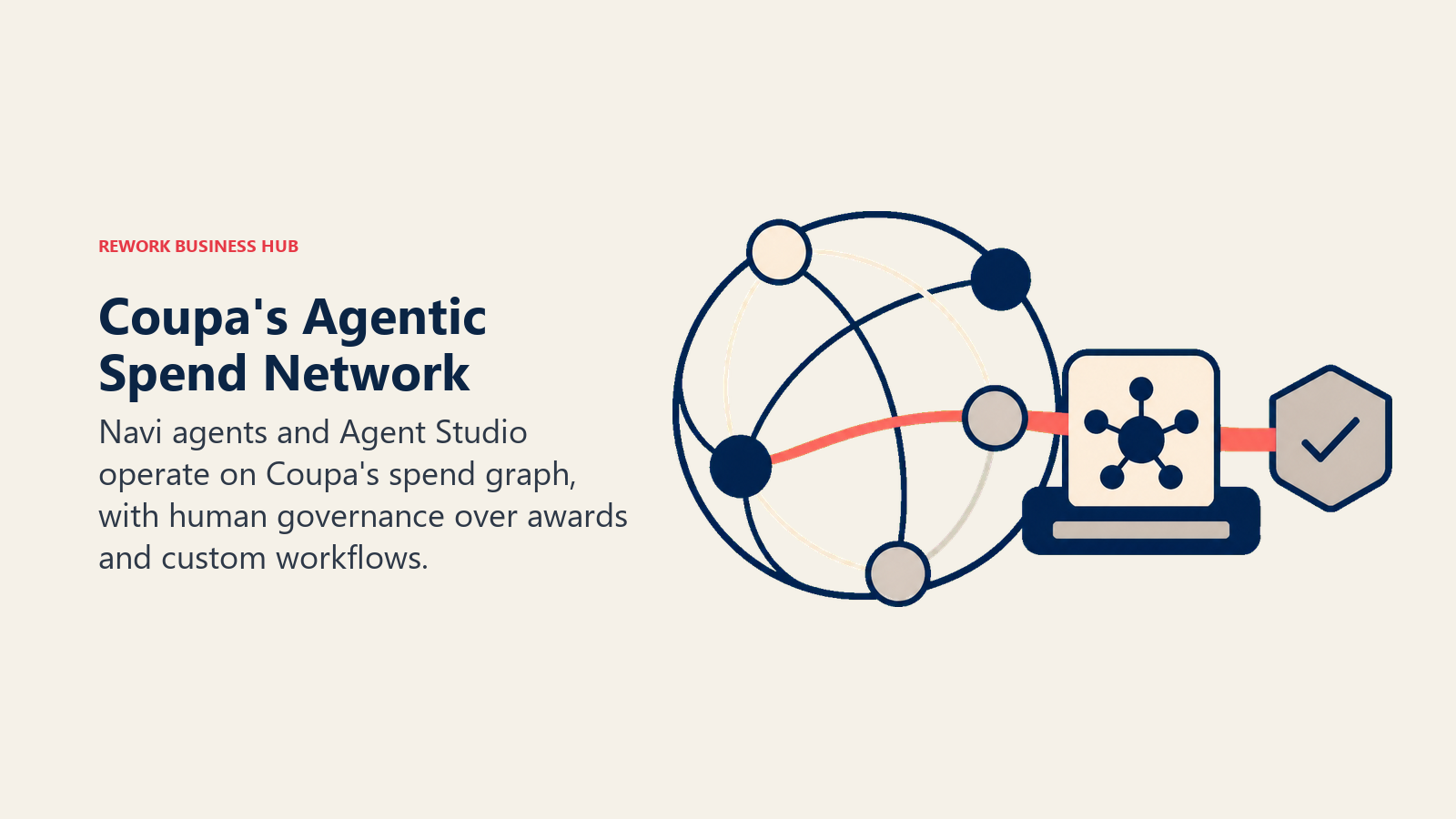
Coupa Catalyst pairs that platform with forward-deployed engineers and business consultants to implement agentic workflows and manage the organizational change that comes with them, and Coupa introduced an outcome-based pricing option in 2026, though specific rates remain undisclosed. Coupa has never published self-serve pricing; every deployment is a custom, modular quote based on selected modules, transaction volume, and user count.
| What you get | What you don't |
|---|---|
| 20+ named Navi agents plus a no-code Agent Studio to build more | No self-serve pricing signal at all, even directionally |
| Network effect from $10T in spend data across 10M+ buyers and suppliers | Public security/compliance attestation not confirmed in materials reviewed |
| Coupa Catalyst pairs the platform with implementation engineers | New outcome-based pricing option has no published rate structure yet |
Pricing: Not published; fully custom, modular quote. Outcome-based pricing introduced in 2026 with undisclosed rates. See coupa.com.
Best for: Large enterprises already running Coupa as their BSM system of record that want to build and orchestrate agents natively rather than bolt on a separate vendor.
11. SAP Ariba: Joule Agents Native to S/4HANA
SAP's approach is structural: rather than a separate agent product, Joule agents are built directly into SAP Ariba and Fieldglass, reasoning over live records with no integration layer in between. Eleven agents are landing across 2026, including a Bid Analysis Agent (comparing supplier bids on total cost, GA Q1 2026), an Intake Management Agent (conversational intake via chat, email, and Teams, applying policy checks and spend categorization at the point of request, GA June 2026), and a Contracts Agent (natural-language contract drafting tied to downstream terms and dates, also GA June 2026).
The most consequential fact for budgeting isn't a feature, it's pricing: SAP is running the Joule Agent Runtime free through December 31, 2026 for existing Ariba and Fieldglass customers, a real zero-incremental-cost window to pilot workflows before deciding whether to expand. Beyond that window, SAP doesn't publish agent pricing; cost depends on modules and licensed users, quoted per account.
| What you get | What you don't |
|---|---|
| Joule agents reason directly over live SAP Ariba/Fieldglass records | Several 2026 agents are still mid-rollout, not fully GA at time of writing |
| Joule Agent Runtime free through December 31, 2026 for existing customers | No published pricing beyond the free window; cost depends on modules and users |
| 11 agents landing across intake, sourcing, contracts, and services through 2026 | Best value only if you're already committed to SAP Ariba as your platform |
Pricing: Not published; based on modules and licensed users, quoted per account. Joule Agent Runtime is free through December 31, 2026. See sap.com.
Best for: Existing SAP Ariba or Fieldglass customers who want agent capability reasoning directly over records they already have, without adding a new vendor.
12. Ivalua: IVA Studio and a Fully Agentic S2P
Ivalua's Intelligent Virtual Agent, relaunched in June 2026 as IVA Studio, is designed to execute any source-to-pay process from day one rather than requiring per-workflow configuration: more than 30 out-of-the-box agents cover spend analysis, sourcing optimization, contract extraction, supplier risk, and invoice matching, built on a skills framework similar to those used by frontier AI labs, with Model Context Protocol support and the option to run Ivalua's own models or a customer's. Permissions are inherited from the invoking user, so IVA can't exceed what a human's own access already allows, with a complete audit trail for every action.
Ivalua is recognized as a Gartner Leader for source-to-pay, states it's trusted by more than 500 "world's most admired brands," and holds ISO 27001 certification (assessed by Schellman), SOC 1 and SOC 2 attestation reports, TISAX Level 2 certification for automotive customers, and a FedRAMP-compliant environment for the US public sector, one of the more thoroughly documented compliance postures on this list. Pricing is not published anywhere in its materials.
| What you get | What you don't |
|---|---|
| 30+ embedded agents unified under IVA Studio, MCP support, LLM-agnostic | No pricing signal at all, not even a reported range |
| ISO 27001, SOC 1/2, TISAX Level 2, and a FedRAMP-compliant environment | Enterprise-only; no self-serve or mid-market entry point |
| Permissions strictly inherited from the invoking user, with full audit trails | Gartner Leader recognition doesn't substitute for your own pilot data |
Pricing: Not published. See ivalua.com.
Best for: Enterprises wanting one agent unifying the entire source-to-pay process, with the most thoroughly documented compliance posture in this category.
13. GEP SMART: MINERVA-Powered Quantum Intelligence
GEP Quantum Intelligence, live since 2023, is what GEP calls the first AI-native, agentic platform spanning both procurement and supply chain in one codebase, powered by its MINERVA AI engine. Named agents cover the full lifecycle: an Intake Agent for triage, a Strategic RFP Creator and Negotiation Agent for sourcing, Extraction/Digitization and Authoring/Redlining agents for contracts, Data Harmonization and Risk/Compliance agents for supplier management, and Intake/Reconciliation/Anomaly Detection agents on the procure-to-pay side.
GEP reports its MINERVA engine achieves more than 95% spend classification accuracy while processing thousands of transactions simultaneously, a specific, checkable claim most competitors on this list don't publish at all. The platform is live at 100+ enterprise customers, is a Leader in Gartner's 2026 Source-to-Pay Magic Quadrant, and is ranked #1 in Source-to-Contract and Source-to-Pay by The Hackett Group. Compliance detail (SOC 2, SOX, HIPAA, and ISO 27001 are each referenced for different deployment contexts) sits behind GEP's own Trust Center rather than a single public page.
| What you get | What you don't |
|---|---|
| Coordinated agent network across sourcing, contracts, supplier management, and P2P | No pricing signal; every engagement starts as a sales conversation |
| MINERVA reports 95%+ spend classification accuracy, a rare published figure | Full compliance detail requires visiting GEP's Trust Center directly |
| Gartner Leader (2026 S2P Magic Quadrant) and Hackett Group #1 ranking | Live at 100+ customers is meaningful scale, but still enterprise-only |
Pricing: Not published. See gep.com.
Best for: Enterprises wanting procurement and supply-chain agents unified on one platform, with a genuinely rare published classification-accuracy figure to check.
14. Sievo: The Spend Classification Specialist
Sievo doesn't source, negotiate, or create a single PO, and that's precisely its value: every other agent in this guide depends on spend data being classified correctly, and Sievo is the vendor that treats that as the entire product rather than a supporting feature. Its AI extracts, normalizes, and classifies spend data pulled from ERPs and more than 100 million enriched supplier records, surfacing duplicate suppliers and materials sourced from different vendors under different names, with a self-service GenAI assistant for ad hoc analysis on top.
Sievo backs its classification with a specific, contractual figure rather than a marketing range: 94% classification accuracy and 98% classification coverage, offered as a guarantee rather than a benchmark claim. The company has been ranked #1 in Spend Analytics by Spend Matters twice, and is built for enterprises with $1 billion or more in revenue. Pricing isn't published, and public security/compliance certification isn't confirmed on its site.
| What you get | What you don't |
|---|---|
| 94% classification accuracy and 98% coverage, offered as a guarantee | Not a sourcing, negotiation, or PO-creation tool on its own |
| Built specifically for $1B+ revenue enterprises with complex, messy spend data | No published pricing; ask Sievo for its security/compliance attestation |
| Ranked #1 Spend Analytics by Spend Matters, twice | Value depends on pairing it with a sourcing or S2P agent elsewhere on this list |
Pricing: Not published. See sievo.com.
Best for: Large enterprises whose spend data is too messy to trust any sourcing recommendation or savings number built on top of it.
Vendor Claims vs. What's Actually Verified
Every savings, accuracy, or automation figure in this guide is the vendor's own claim unless marked otherwise, and none of it is independently audited. Treat it the way you'd treat a sales rep's ROI slide: directionally useful, not something to cite to your board without your own pilot data behind it.
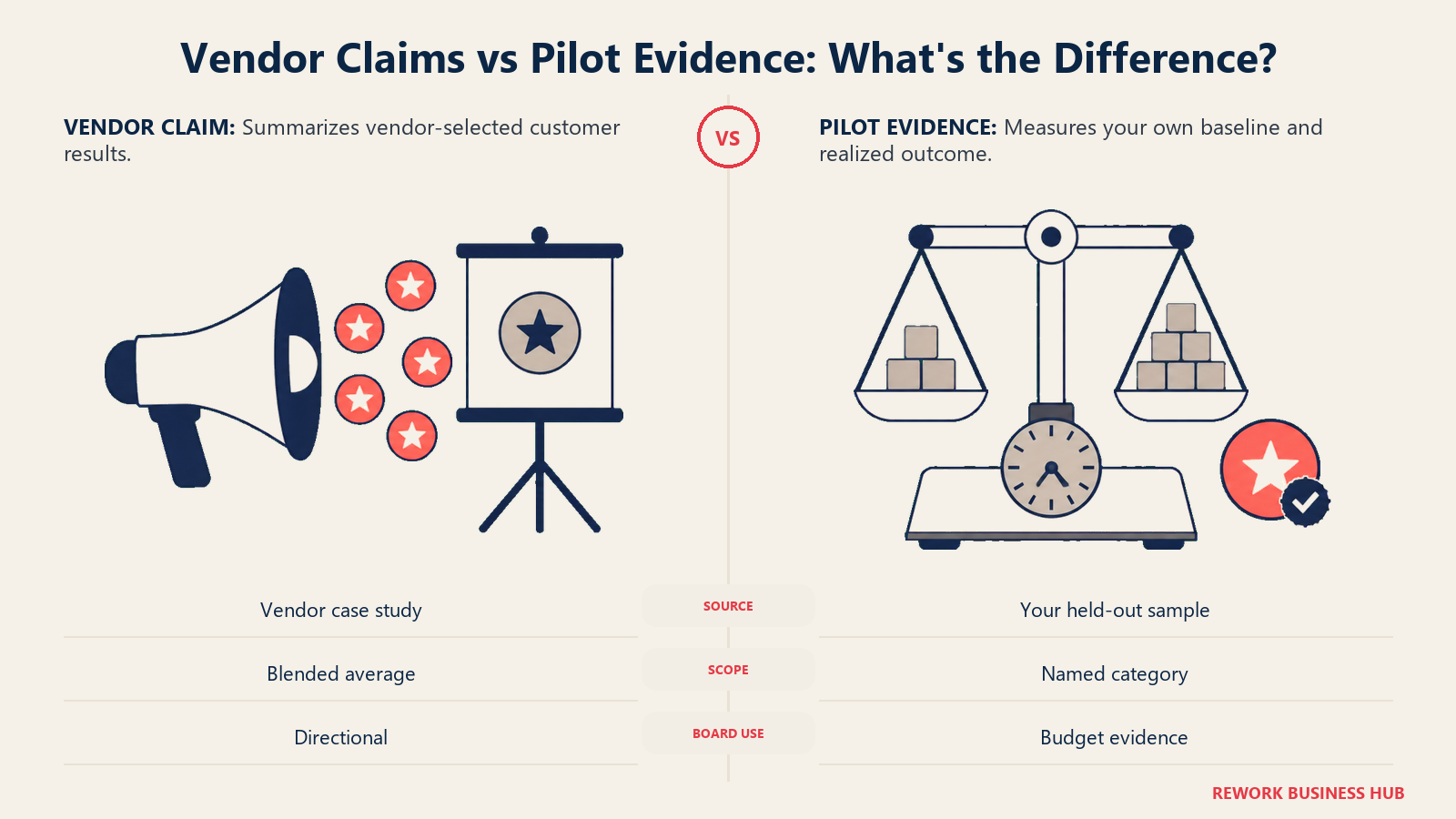
| Vendor Claim | What's Actually Verified | How to Test It Yourself |
|---|---|---|
| Keelvar: 85% of sourcing activity automated across its customer base | Vendor's own website; no independent audit named | Ask for your specific category's automation rate, not the blended average |
| Pactum: $1B+ negotiated at Walmart, 3% average cost gains, 68% supplier agreement on a 35-day term extension | Vendor case study; not independently published by Walmart | Ask which spend categories are included and over what time period |
| Fairmarkit: 11% average identified savings, 86% cycle-time reduction, 300% more events per buyer | Vendor's own homepage; methodology and sample size undisclosed | Pilot on one category and measure your own cycle time before and after |
| Arkestro: 18.8% average savings, 60% faster cycle times | Vendor's own site, blended across an unspecified customer set | Ask for the savings definition (identified vs. realized) before citing it internally |
| Globality: Bristol Myers Squibb RFP cycle cut from 6 months to 27 days, 20% average savings | Vendor case study on its own innovation blog | Ask for a reference call with the named customer, not just the write-up |
| GEP: MINERVA achieves more than 95% spend classification accuracy | Vendor's own blog post; no third-party benchmark cited | Run a held-out sample of your own spend data through a pilot before trusting it at scale |
| Sievo: 94% classification accuracy and 98% classification coverage | Vendor's own site, presented as a contractual guarantee | Ask what happens contractually if your data misses the guaranteed threshold |
How to Choose: Decision Framework
Start with the procurement job you need to improve, then verify the agent's authority, data quality, and fit with your system of record.
| If you need... | Pick... | Why |
|---|---|---|
| To fix the intake bottleneck before anything else | Zip or Levelpath | Both are built around the request front door, not the sourcing event |
| The most credible autonomous sourcing and negotiation capability | Keelvar | Only vendor Gartner names in both Advanced Sourcing Optimization and Autonomous Sourcing |
| A negotiation-only layer on top of a system you already run | Pactum or Arkestro | Both plug into SAP Ariba or Coupa rather than replacing them |
| Autonomous sourcing across tail AND strategic spend in one environment | Fairmarkit | Five-agent workflow spans a $500 buy to a $500M contract |
| Spend data you can actually trust before acting on it | Sievo | A published classification-accuracy guarantee, not a side feature |
| One agent across the entire source-to-pay process | Ivalua or GEP SMART | Both ship 30+ agents natively embedded in a Gartner-recognized S2P suite |
| Agents that reason directly over the ERP you already run | SAP Ariba | Joule agents work natively inside S/4HANA, and the runtime is free through 2026 |
| The broadest incumbent agent bench inside an existing BSM system | Coupa | 20+ Navi agents, a no-code Agent Studio, and a network of $10T in spend data |
| Services and professional-spend RFPs specifically | Globality | Category-trained models built for B2B services sourcing, not generic prompts |
| A results-based agentic layer with strict data-privacy guarantees | Omnea | SOC 2 Type II certified, with an explicit no-training-on-customer-data policy |
| To orchestrate on top of a Coupa or Oracle deployment you're not replacing | Focal Point | Built to sit above an existing S2P system rather than compete with it |
Frequently Asked Questions about AI Agents for Procurement
What's the difference between an AI agent for procurement and an AI tool for procurement?
An AI tool assists a person who stays in the loop for every step, drafting a message or summarizing a contract clause. An AI agent plans a sequence of steps and executes them with limited supervision: triaging an intake request, running a sourcing event, negotiating within a pre-approved band, or drafting a PO, checking in with a human only at the boundaries you define.
Can AI agents really negotiate with suppliers on their own?
Within limits, yes, and it's real in 2026, not a roadmap promise. What actually ships is negotiation bounded by a human-set price ceiling, term range, or category: tail spend, renewals, and standard terms. None of the vendors in this guide autonomously commit a company to a novel, high-stakes contract with a brand-new supplier without a human approving the final award. See the Autonomous Negotiation Reality Check above before budgeting for more than that.
Which procurement process should a team automate first?
Intake. Nearly every vendor in this guide, and the research behind it, points to the request form as the actual bottleneck, not the negotiation. If nobody submits a request before they buy, sourcing and spend-classification tools have nothing accurate to work from. That's also why Zip, Levelpath, and Omnea lead with intake specifically rather than starting with sourcing.
How much do AI agents for procurement cost in 2026?
Almost nothing in this category is published. None of the 14 agents ranked here list a self-serve price; all require a sales conversation. Reported (not vendor-confirmed) third-party contract data puts intake-orchestration platforms like Zip in the $40,000 to $200,000-plus per year range depending on requisition volume and seats, and full source-to-pay suites (Coupa, SAP Ariba, Ivalua, GEP SMART) commonly run into six or seven figures once modules, users, and services are included.
What should a procurement team require before letting an agent create a purchase order or approve a supplier?
A configurable dollar and risk threshold that forces human sign-off, a queryable audit trail of every agent action, segregation of duties between the agent that recommends and the person who approves, and current, named security attestation (SOC 2 Type II or ISO 27001) rather than a trust page written in prose with no report behind it.
Is spend classification accuracy actually important, or is it a vanity metric?
It's foundational. Every savings number, every supplier risk score, and every sourcing recommendation in this category sits on top of correctly classified spend data. Sievo and GEP SMART are the only two vendors here that publish a specific classification-accuracy figure (94%+ and 95%+, respectively); most others don't state one at all, which is worth asking about before trusting their analysis.
We're already on Coupa, SAP Ariba, or another S2P suite. Should we still evaluate a standalone agent?
Check what your existing suite already ships first. Coupa's Navi agents, SAP's Joule agents, and Ivalua's IVA all reason directly over records you already have, with no new integration layer, usually the lower-friction path. Standalone specialists like Keelvar, Pactum, Fairmarkit, or Arkestro still win when your suite's native agent is thin on a specific job (negotiation depth, tail-spend coverage) or still mid-rollout, which several of the ERP-native agents here were as of August 2026.
Do procurement AI agents replace category managers or sourcing professionals?
No, and none of the credible vendors in this guide claim they do for anything strategic. They clear the repeatable volume, tail spend, routine renewals, intake triage, so a category manager spends more time on supplier relationships and the strategic negotiations that actually need judgment.
Which of these agents fits a smaller procurement team versus a large enterprise?
Nearly the entire category skews enterprise. Arkestro and Omnea are the most realistic fits for a leaner, mid-market team (roughly 200 to 5,000 employees), since both are designed to layer onto an existing system rather than replace it. Keelvar, Pactum, Coupa, SAP Ariba, Ivalua, GEP SMART, and Sievo are built and priced for large enterprises, typically 1,000+ employees or, for Sievo specifically, $1 billion or more in revenue.
How do I verify a procurement vendor's SOC 2 or ISO 27001 claim myself?
Go to the vendor's own trust or security page (many host one on SafeBase or a similar platform) and ask for the actual report. SOC 1 Type II or SOC 2 Type II means an outside auditor tested controls over months, not a point-in-time review, and an ISO 27001 certificate names an accredited certification body. A page that only says "enterprise-grade security" without naming a report or auditor isn't the same claim.
What to Do Next
Don't start with a sourcing-event demo. Pull last quarter's procurement data and count how many purchases happened with no requisition at all; that number is your real starting point, not a vendor's negotiation-savings slide. If intake is broken, fix that first with Zip, Levelpath, or Omnea before shopping for a negotiation agent with nothing accurate to negotiate over. If intake already works and the bottleneck is genuinely the tail, Keelvar or Fairmarkit are the more useful next call. Either way, run the approval-threshold checklist above, segregation of duties, an audit trail, a named SOC 2 or ISO 27001 report, before anyone signs, since retrofitting governance onto an agent that already has PO-creation rights is a far harder conversation than asking for it up front. If your next bottleneck sits downstream, once the PO becomes an invoice, best AI agents for finance is the natural next read.

Principal Product Marketing Strategist
On this page
- Updated August 2026: What Changed
- Key Facts
- Quick Comparison Table
- Which Procurement Job Each Agent Actually Owns
- The Autonomous Negotiation Reality Check
- What to Require Before an Agent Commits Company Money
- What Each Vendor Actually Has on Its Own Trust Page
- ERP and P2P Integration Depth
- Sizing and Persona
- 1. Keelvar: Autonomous Sourcing and Negotiation at Scale
- 2. Pactum: The Negotiation-Only Specialist
- 3. Fairmarkit: Total Agentic Sourcing Across Tail and Strategic Spend
- 4. Arkestro: Predictive Pricing Layered on Top of Coupa or SAP Ariba
- 5. Globality: Autonomous Sourcing for Services Spend
- 6. Zip: The Intake-to-Procure Category Leader
- 7. Levelpath: AI-Native Procurement Built Around Hyperbridge
- 8. Omnea: The Agentic Operating System for Intake to Pay
- 9. Focal Point: Orchestration on Top of Coupa or Oracle
- 10. Coupa: Agentic-as-a-Service Across a $10 Trillion Spend Graph
- 11. SAP Ariba: Joule Agents Native to S/4HANA
- 12. Ivalua: IVA Studio and a Fully Agentic S2P
- 13. GEP SMART: MINERVA-Powered Quantum Intelligence
- 14. Sievo: The Spend Classification Specialist
- Vendor Claims vs. What's Actually Verified
- How to Choose: Decision Framework
- What to Do Next