Best AI Agents for Insurance in 2026: 10 Tools for Carriers, MGAs, and Brokers
Turn this article into takeaways for your work.


Each assistant summarizes the article only for you and suggests best practices for your work.
"Insurance agent" means two different things, and if you found this guide, you almost certainly mean the software, not the person who sold you your policy: a system that plans a sequence of steps, calls your core system or a document store as a tool, and acts on a claim, a submission, or a policy change with a human checking in at defined points rather than at every click. Roots Automation's Bevaya platform covers the widest span of that work today, spanning underwriting, claims, and policy servicing. Guidewire and Duck Creek now ship agents natively inside the core systems most P&C carriers already run. Sixfold and Federato lead the underwriting-specific field for carriers who want a point solution instead of a platform. This guide checks 10 of them against what they actually automate, whether a human still has to sign off before a denial goes out, and what they cost.
Insurance is the one vertical in this collection where the interesting question isn't "does the agent work." Most of them do; carriers have run machine learning risk models for a decade. The interesting question is whether the agent's output can be explained to a state regulator on demand, and whether your core system will even let it touch the record in the first place. That's the lens this guide uses instead of a generic feature comparison. If you want the assistive side of this category, software that speeds up a human adjuster or underwriter without acting on their behalf, see best AI tools for insurance claims processing. This guide covers products built to plan and act, not just assist, a distinction covered in more depth in what is an AI agent.
What Changed in 2026
- The two biggest core-system vendors shipped their own agent layers. Guidewire launched its Qusar release with a built-in Agentic Framework on August 3, 2026, and Duck Creek launched an insurance-native Agentic AI Platform on April 28, 2026. Neither existed a year ago as a packaged product.
- Roots Automation rebranded to Bevaya on May 28, 2026, repositioning from a document-AI vendor into what it calls an AI Agent platform spanning underwriting, claims, and policy servicing.
- Verisk connected its underwriting and claims data directly to Claude. In May 2026 it shipped two Model Context Protocol connectors with Anthropic, a concrete example of the agent-calls-a-tool pattern this whole category depends on.
- The NAIC's AI Systems Evaluation Tool moved from proposal to active pilot. Twelve states are running it from March through September 2026, with a revised version headed toward a vote at the NAIC's Fall 2026 National Meeting.
- AI-edited claim documents became a fraud problem serious enough that insurers are pricing the risk of AI itself. Verisk's ISO subsidiary is separately exploring new liability exclusions specifically for agentic AI risk.
Key Facts
- The NAIC's Model Bulletin on the Use of Artificial Intelligence Systems by Insurers, adopted in December 2023, has been adopted by roughly half of US states, per Quarles & Brady's tracking of state adoption; California, Colorado, New York, and Texas separately regulate insurer AI use under their own frameworks.
- The NAIC's AI Systems Evaluation Tool, a structured examiner questionnaire covering governance, bias testing, and documentation, is piloting across 12 states from March through September 2026, with adoption expected at the NAIC's November 2026 Fall National Meeting, per Fenwick's regulatory summary.
- California's Physicians Make Decisions Act (SB 1120), in effect since January 1, 2025, bars health insurers from denying, delaying, or modifying medically necessary care based wholly or partly on an automated tool; only a licensed physician or an equivalently qualified clinician can make that call, per the bill text on the California Legislature's site.
- Insurance fraud costs the United States an estimated $308.6 billion a year, per the Coalition Against Insurance Fraud's economic impact report, the backdrop for why fraud-detection agents get bought first in this category.
- 98% of insurers agree that AI-powered editing tools are fueling a rise in digital insurance fraud, and 99% say they've already encountered manipulated or AI-altered claim documentation, per Verisk's 2026 State of Insurance Fraud study.
What Makes This an Agent, Not Just Insurance Software
Carriers have used predictive models in underwriting and claims for years. That's not what this list is about. An AI tool assists a human who stays in the loop for every step, like scoring a submission or flagging a photo as likely fraud. An AI agent plans a sequence of actions, calls your core system or a data source as a tool to execute them, observes what comes back, and decides the next step, with a human checking in at defined boundaries rather than at every click. Only 16% of what companies call an "AI agent" in production actually plans, observes, and adapts on its own, per Menlo Ventures' State of Generative AI in the Enterprise report; the rest is fixed-sequence automation wearing agent branding. Insurance is not immune to that relabeling, so every product below was checked for a real multi-step, tool-calling architecture before it made this list. Gradient AI, Tractable, CCC Intelligent Solutions, and EvolutionIQ, all strong products, didn't make the cut here because their public materials describe scoring, computer-vision estimation, or human-in-the-loop recommendation rather than an agent that plans and acts; they're covered instead in the assistive-tools roundup linked above. For the broader mechanics of the plan-act-observe loop, see what is an AI agent, and for how this category compares to general-purpose agent platforms, see best AI agent platforms in 2026.
Quick Comparison Table
| Agent | Best For | Starting Price | Key Strength | Key Limitation |
|---|---|---|---|---|
| Roots Automation (Bevaya) | One platform across underwriting, claims, and servicing | Custom (demo) | Widest single-platform job coverage, 115+ production deployments | No public pricing, full sales cycle |
| Guidewire AI (Qusar) | Carriers already running Guidewire Cloud Platform | Custom (demo) | No integration layer between agent and ClaimCenter/PolicyCenter data | Guidewire-only, not usable outside that ecosystem |
| Duck Creek AI | Carriers already running Duck Creek OnDemand | Custom (demo) | Underwriting Workbench and FNOL agents designed as a matched pair | Duck Creek-only, not usable outside that ecosystem |
| Sapiens | Mid-market and international carriers on Sapiens core | Custom (demo) | Native add-on across policy, underwriting, claims, and finance | Sapiens-only; incremental, not a standalone AI platform |
| Sixfold | Underwriting agent trained on your own risk appetite | Custom (demo) | Learns each carrier's guidelines, not a generic score | Underwriting only, no claims or fraud coverage |
| Federato | Submission-level decisions tied to portfolio strategy | Custom (demo) | Full data provenance behind every generated quote | Underwriting only, quote-only pricing tier undisclosed |
| Akur8 | Pricing agents you can defend in a rate filing | Custom (demo) | Transparent, explainable models built for regulatory scrutiny | Pricing and actuarial workflow only |
| Shift Technology | Fraud detection and claims decisioning at scale | Custom (demo) | Agentic claims assessment plus a fraud-scenario library | Broad scope means a longer implementation |
| Verisk AI | Agent-ready access to underwriting and claims data | Custom (bundled) | Data and orchestration layer, including Claude/MCP connectors | Not a packaged agent product on its own |
| Indico Data | Composable agents for documents plus broker communication | Custom (demo) | Named agent for broker communications, unusual in this category | Requires assembling agents per workflow via the canvas |
The Regulatory Constraint You Can't Automate Around
Every other software category on this site gets evaluated mainly on speed and cost. Insurance agents get evaluated on those too, plus a third axis that overrides them both: can you explain the decision to a regulator. That's not a compliance footnote here, it's the requirement that eliminates half the field before a demo even starts.
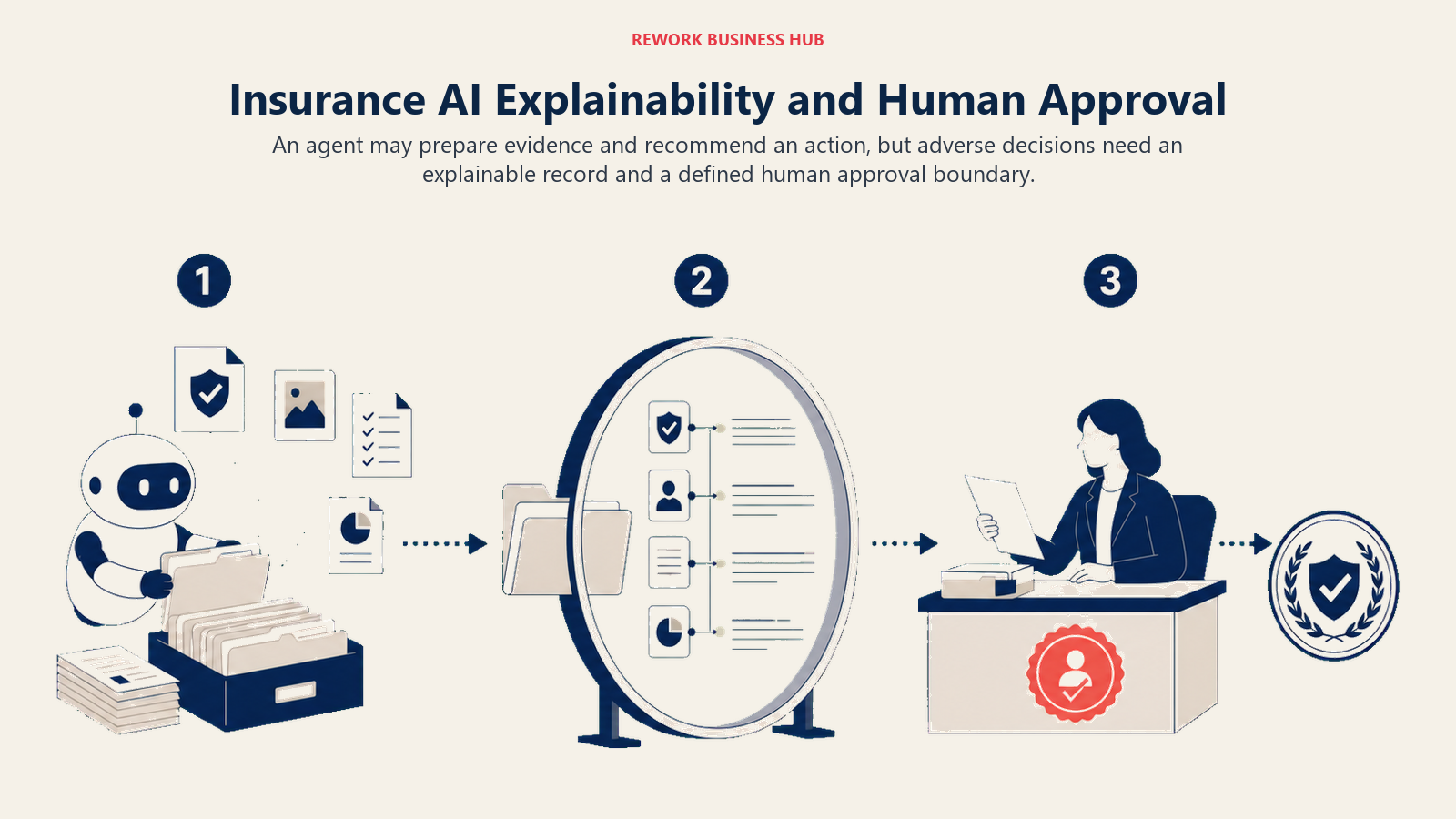
The NAIC's Model Bulletin on the Use of Artificial Intelligence Systems by Insurers, adopted in December 2023, is the starting point. It doesn't ban AI in underwriting or claims. It requires that decisions made or supported by AI comply with all existing insurance law, which in practice means a written AI governance program, documented bias testing, and the ability to give a specific, plain-language reason when an AI-informed decision produces an adverse outcome for a policyholder, per NAIC's own artificial intelligence resource page. Roughly half of US states have adopted the bulletin or a close variant, per Quarles & Brady's tracking, and California, Colorado, New York, and Texas separately regulate insurer AI use under their own pre-existing frameworks rather than the bulletin itself.
2026 adds real teeth to that requirement. The NAIC's AI Systems Evaluation Tool, a structured examiner questionnaire covering governance, bias testing, vendor oversight, and documentation, is piloting across California, Colorado, Connecticut, Florida, Iowa, Louisiana, Maryland, Pennsylvania, Rhode Island, Vermont, Virginia, and Wisconsin from March through September 2026, per Fenwick's regulatory summary. A revised version goes back out for public comment this fall, with adoption expected at the NAIC's November 2026 national meeting. Once that happens, the agent vendor you picked this year becomes part of your own exam answers, not just a line on an invoice.
Health insurance shows where this heads once regulators stop accepting "the model recommended it" as an answer on its own. California's Physicians Make Decisions Act (SB 1120), in effect since January 1, 2025, bars insurers from denying, delaying, or modifying medically necessary care based wholly or partly on an automated decision-making tool: only a licensed physician or an equivalently qualified clinician can make that call, per the bill text and Reed Smith's analysis. Indiana and Maryland passed comparable disclosure and review requirements for health insurers in 2026. None of that is P&C law yet, but it's the clearest signal available for where claims and underwriting denial rules are trending: the agent can prep the file, flag the risk, and draft the recommendation. It shouldn't be the one that says no. Build that assumption into your rollout regardless of line of business, because adding a human-in-the-loop checkpoint after an examiner asks for one is a far worse conversation than designing it in from the start.
Before signing with any vendor in this list, ask for the things a sales deck won't hand you unprompted:
| Ask for... | Why it matters | Red flag if they can't produce it |
|---|---|---|
| A plain-language explanation for one real, individual adverse decision the agent influenced | This is the literal NAIC bulletin requirement | "The model is proprietary" as the only answer offered |
| Their own bias-testing results, not a description of the process | Regulators want evidence, not a description of intent | Testing is described only in marketing language |
| The specific point where a human sign-off is required, not optional | Determines your real liability exposure | "Full autonomy" pitched as a selling point with no override step |
| Which states' versions of the bulletin they've already been evaluated against | Adoption and enforcement vary by state | Vendor can't name a single state exam, audit, or filing |
| A sample audit-trail export, not a description of one | You'll eventually have to hand this to an examiner | Audit log is described as "coming soon" or admin-view only |
The Legacy Core-System Gate
Before evaluating a single agent's intelligence, answer a duller question first: can it actually read and write to your system of record. Guidewire (used by more than 570 insurers across 40 countries, per the company) and Duck Creek anchor the enterprise P&C core-system market, with Sapiens strong in mid-market and international books. An agent that can't cleanly integrate with whichever of those, or another core system, already holds your policy, claims, and billing data doesn't save time. It adds a reconciliation problem on top of the one you already had.
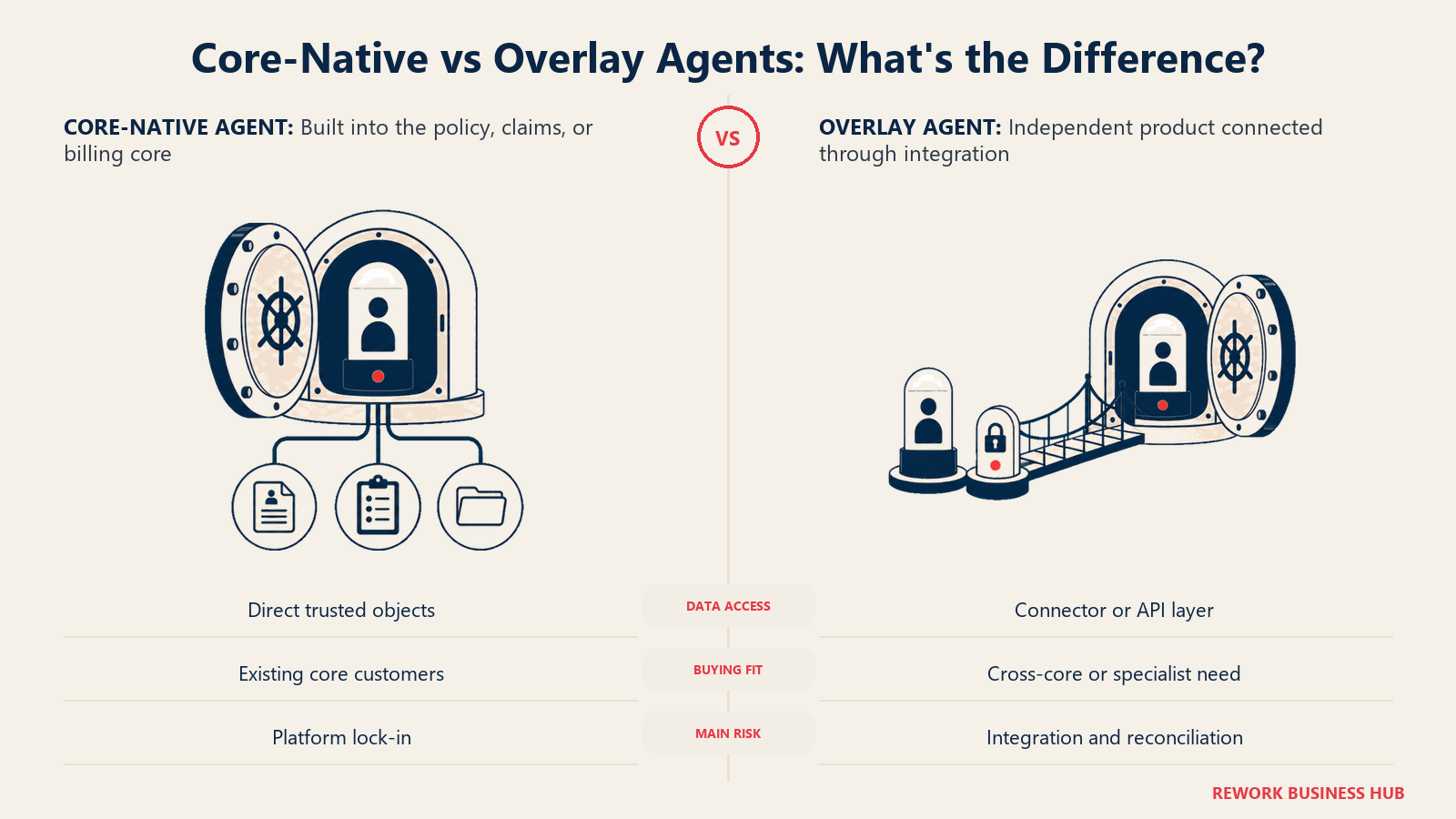
That's why the two biggest core-system vendors spent 2026 shipping their own agent layers instead of leaving the category entirely to point vendors. Guidewire's Qusar release and Duck Creek's Agentic AI Platform both launched this year specifically so existing customers wouldn't have to bolt on a third-party agent and build a custom integration to make it useful. Sapiens took the same incremental path: native add-ons rather than a standalone AI product, on the stated logic that agents coordinate poorly when the systems underneath them are fragmented. If you're already licensed on one of these three, that's usually the first agent worth pricing out, before a specialist point solution.
Point agents solve the same problem by integrating into those core systems rather than replacing them, though how well they do that varies and is worth verifying by name rather than assuming.
| Agent | Deployment Model | Verified Core-System Integration |
|---|---|---|
| Guidewire AI (Qusar) | Native to Guidewire Cloud Platform | Guidewire-only, by design |
| Duck Creek AI | Native to Duck Creek OnDemand | Duck Creek-only, by design |
| Sapiens | Native add-on to Sapiens core | Sapiens-only, by design |
| Roots Automation (Bevaya) | Core-system-independent overlay | Guidewire-validated document accelerator for ClaimCenter specifically |
| Shift Technology | Core-system-independent overlay | Documented partnership with Duck Creek for fraud and subrogation |
| Sixfold | Core-system-independent overlay | Not independently confirmed; ask Sixfold for your specific core-system version |
| Federato | Core-system-independent overlay | Not independently confirmed; ask Federato for your specific core-system version |
| Akur8 | Sits upstream of claims/policy systems (pricing engine) | Connects via API or file exchange, not a named core-system certification |
| Verisk AI | Data and API layer, including MCP | Not core-system specific by design; connects via API |
| Indico Data | Core-system-independent overlay | Not independently confirmed; ask Indico for your specific core-system version |
Where Each Agent Fits the Job
Carriers, MGAs, and brokers are rarely buying one job. Use this to see where each agent's coverage actually starts and stops before you narrow a shortlist.
| Agent | Claims Intake / FNOL | Claims Triage / Adjudication | Underwriting Intake / Risk | Policy Servicing | Fraud Detection | Broker / Agency |
|---|---|---|---|---|---|---|
| Roots Automation (Bevaya) | Strong | Strong | Strong | Strong | Partial | Strong |
| Guidewire AI (Qusar) | Strong | Strong | Partial | Strong | - | - |
| Duck Creek AI | Strong | Partial | Strong | - | Partial | Partial |
| Sapiens | Strong | Strong | Strong | Partial | Strong | - |
| Sixfold | - | - | Strong | - | - | - |
| Federato | - | - | Strong | - | - | Partial |
| Akur8 | - | - | Strong (pricing) | - | - | - |
| Shift Technology | - | Strong | Partial | - | Strong | - |
| Verisk AI | Partial | Partial | Strong | - | Partial | - |
| Indico Data | Strong | Partial | Strong | - | - | Strong |
1. Roots Automation (Bevaya): The Widest Agent Coverage Across Underwriting, Claims, and Servicing
Roots Automation rebranded its flagship product to Bevaya on May 28, 2026, and the rebrand reflects a real shift, not just a new logo: it's positioned as an AI Agent platform built exclusively for insurance, not a document-AI vendor with agent features bolted on. Bevaya's agents read, analyze, and recommend across underwriting, claims, and policy servicing, including submission triage and clearance, coverage analysis, rating, and next-step recommendations, at what the company reports as 98%+ accuracy.
The platform runs on InsurGPT, an ensemble of models trained on more than 300 million proprietary insurance documents, and ships pre-built agents for document-heavy work: submission intake, loss runs, first notice of loss (FNOL) setup, and certificates of insurance, the same general pattern covered in how to build an AI document processing agent, just tuned to insurance-specific forms. A visual Workflow Canvas, human-in-the-loop review, confidence scoring, and a full audit trail on every action are built in rather than added later, which matters directly for the regulatory section above. The company reports 115+ production deployments including 3 of the top 5 P&C carriers, 3 of the top 10 brokers, and 3 of the top 20 TPAs, with a 74 Net Promoter Score.
| What you get | What you don't |
|---|---|
| One agent platform spanning underwriting, claims, and servicing | No published pricing; full sales and scoping process |
| Built-in audit trail and confidence scoring on every agent action | Newer brand despite years of prior Roots track record |
| Guidewire-validated document accelerator for ClaimCenter | Best value depends on real document and submission volume |
Pricing: Custom, demo required, not published. See bevaya.ai.
Best for: Carriers, brokers, and TPAs that want one agent platform spanning underwriting intake, claims triage, and policy servicing instead of stitching together point tools.
2. Guidewire AI (Qusar): Agents Built Into the Core System Most P&C Carriers Already Run
Guidewire's Qusar release, announced August 3, 2026, introduced an Agentic Framework that lets insurers build, deploy, and manage AI agents with secure, real-time access to policy, claims, and billing data already inside Guidewire Cloud Platform. Three pre-built agents ship with it: Claim Summarization, which gives adjusters a summary so they can focus on complex resolutions instead of manual note review; Policy Change, an embedded assistant helping underwriters and customer service staff process endorsements faster, the policy-servicing counterpart to the broader best AI agents for customer service category; and Agentic First Notice of Loss, a conversational voice agent that guides claimants through initial claim reporting while capturing structured details, the same conversational-intake job covered from the contact-center side in best AI agents for call centers.
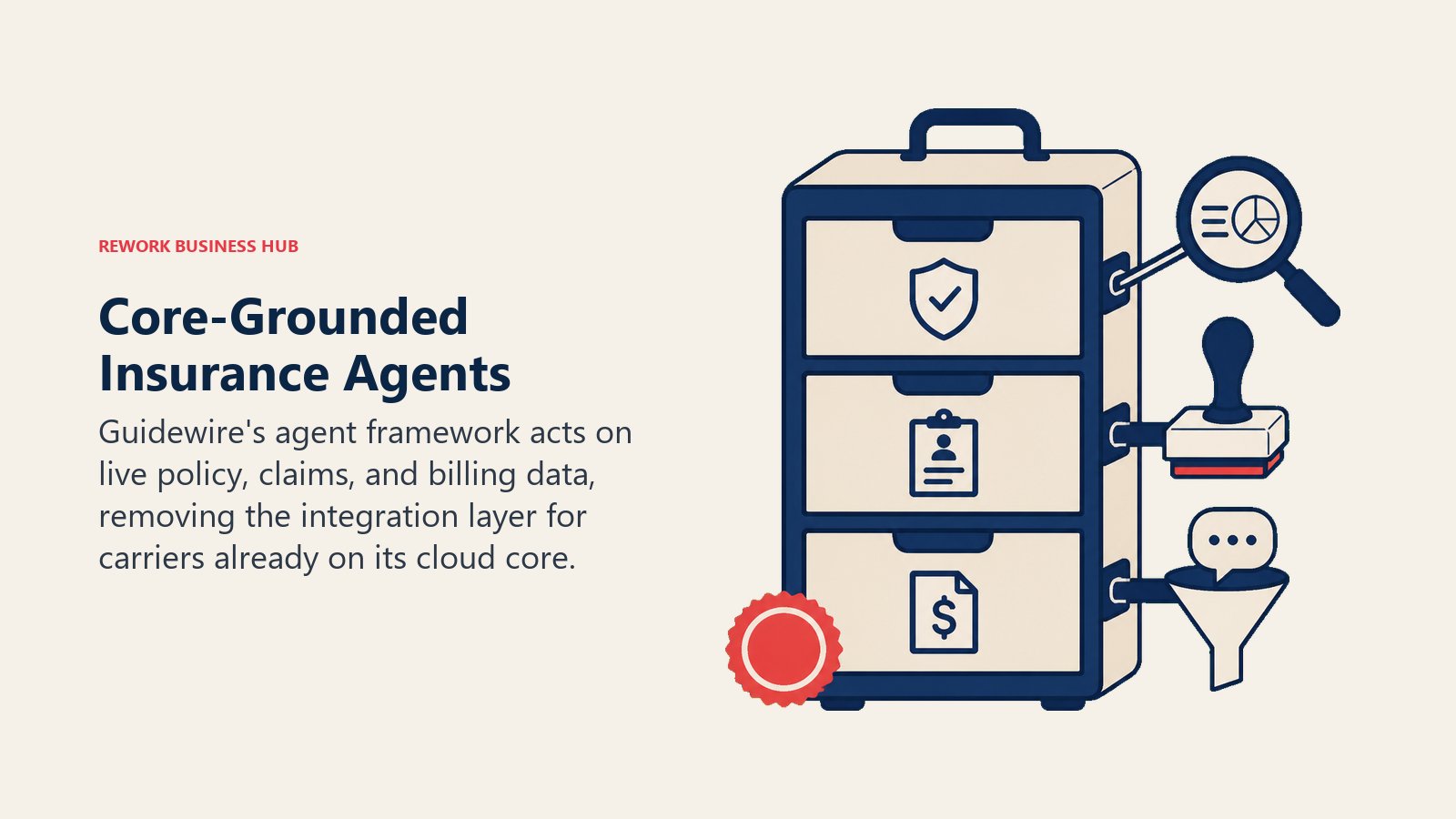
The advantage is structural: no integration layer sits between the agent and the same ClaimCenter or PolicyCenter data your team already works in, which is exactly the gap that makes point-solution agents harder to justify for a Guidewire shop. The Automobile Club of Southern California's CIO reported the claims-summarization agent is already improving adjuster efficiency. The tradeoff is equally structural: this is a framework for your own team to build and govern agents on Guidewire's data, closer to a platform capability than a single packaged product, so plan for your Guidewire admin and development resources to own the rollout.
| What you get | What you don't |
|---|---|
| No integration layer between the agent and live Guidewire data | Only useful if you're already on Guidewire Cloud Platform |
| Three pre-built agents covering claims, policy change, and FNOL | A framework to build on, not a single turnkey product |
| Real customer-reported efficiency gains from an early adopter | No published pricing separate from Guidewire licensing |
Pricing: Not published; bundled into Guidewire Cloud Platform licensing, which is itself custom-quoted. See guidewire.com.
Best for: Carriers already running Guidewire ClaimCenter or PolicyCenter that want agents grounded in that data without a new integration project.
3. Duck Creek AI: Purpose-Built Agents for the Underwriting-to-Claims Handoff
Duck Creek launched its insurance-native Agentic AI Platform on April 28, 2026, designed specifically to deploy, orchestrate, and govern AI agents across the insurance lifecycle rather than as a single-purpose bot. Two applications shipped alongside it: the Agentic Underwriting Workbench, which automates data gathering, intake, and triage to prioritize high-value submissions and deliver decision-ready files; and Agentic First Notice of Loss, which captures, validates, and routes claims across multiple channels, including early fraud detection, and was co-developed with Google Cloud on Gemini models.
The platform's technical design is worth noting for the regulatory questions above: Duck Creek describes it as combining core-system data, insurance domain models, and neuro-symbolic reasoning, deterministic rules layered with probabilistic AI, specifically to keep agent decisions inside the constraints insurance workflows already operate under, rather than a pure LLM guessing at the right answer. Duck Creek, citing Boston Consulting Group research, projects up to $80 billion in annual impact from agentic AI across the US P&C market.
| What you get | What you don't |
|---|---|
| Underwriting Workbench and FNOL agents designed as a matched pair | Duck Creek-only; no standalone deployment outside that ecosystem |
| Neuro-symbolic design built to respect insurance workflow constraints | Younger platform, launched April 2026, than the core system itself |
| FNOL agent co-built with Google Cloud on Gemini models | No published pricing separate from Duck Creek licensing |
Pricing: Custom, not published. See duckcreek.com.
Best for: Duck Creek-standardized carriers that want underwriting and FNOL agents designed together for their existing lifecycle rather than bolted on afterward.
4. Sapiens: Incremental Agents for Carriers Already Standardized on Sapiens Core
Sapiens took a different path than Guidewire or Duck Creek: rather than launching a separate branded AI platform, it ships agentic capability as native add-ons across policy, underwriting, claims, reinsurance, decisioning, and finance and compliance (the finance side overlaps with the broader best AI agents for finance category), directly inside the core system carriers already run. On the claims side, an agent can receive a claim, assess the damage, check for fraud signals, route complex cases to an adjuster, and authorize straightforward settlements automatically. On the underwriting side, agents continuously read risk signals from historical claims data, environmental risk models, economic indicators, and telematics or IoT inputs rather than waiting for a periodic manual review.
Sapiens' own stated logic for the incremental approach is worth taking seriously as a buying consideration, not just a marketing line: agentic AI works best inside a unified platform, and if your systems remain fragmented, agents struggle to coordinate work across them. That's a real argument for carriers already on Sapiens core, and a real argument against bolting a separate best-of-breed agent onto a fragmented stack. It's a weaker fit for carriers not already standardized on Sapiens, since there's no lightweight way to adopt just the agent layer.
| What you get | What you don't |
|---|---|
| Agent capability across policy, underwriting, claims, and finance in one core | Sapiens-only; not adoptable without the underlying core system |
| Claims agent that assesses, checks fraud, and routes in one pass | Incremental rollout, not a distinct standalone AI product to evaluate alone |
| Strong fit for mid-market and international carriers already on Sapiens | No published pricing; scoped through the core-system contract |
Pricing: Custom, not published. See sapiens.com.
Best for: Mid-market and international carriers already running Sapiens core that want incremental agent capability without adopting a separate AI vendor.
5. Sixfold: An Underwriting Agent With Institutional Memory for Life and P&C
Sixfold's underwriting agent does something most scoring tools don't: it ingests each insurer's own underwriting guidelines and prior decisions, learns that carrier's specific risk appetite, and then runs risk assessment on new submissions with a 0-to-5 score backed by cited supporting evidence, rather than applying one generic model across every customer, the underwriting-specific version of the pattern in how to build an AI risk monitoring agent. In mid-2026 it added straight-through quote-and-bind capability for well-understood risks, moving from advisory scoring toward genuine agentic action on the submission itself, as reported by The Insurer.
The Life & Health product works differently but on the same principle: it summarizes medical records and prescription histories and surfaces impairments and mortality factors aligned to the insurer's own risk appetite, cutting the manual chart review that eats up a life underwriter's day. The company reports processing-time reductions of 50% to 97%, hit-ratio gains of at least 15%, and gross written premium per underwriter up to 30% higher, across 1.5 million submissions since its 2023 founding, with customers representing $270 billion in gross written premium including Zurich, Guardian, Axis, and New York Life.
| What you get | What you don't |
|---|---|
| Learns each carrier's own guidelines rather than a generic score | Underwriting only; no claims, servicing, or fraud coverage |
| Separate, purpose-built workflow for Life & Health medical review | Vendor-reported efficiency figures, not yet independently audited |
| Straight-through quote-and-bind capability for well-understood risk | No published pricing; demo-gated |
Pricing: Custom, demo required, not published. See sixfold.ai.
Best for: Life, health, and P&C underwriting teams that want an agent trained on their own historical decisions rather than a generic industry-wide risk model.
6. Federato: Agentic RiskOps for Portfolio-Aware Underwriting Decisions
Federato's RiskOps platform starts from a different question than most underwriting agents: not "is this submission a good risk," but "does this submission fit the portfolio we're actually trying to build." Its agentic layer scores incoming submissions for appetite fit and winnability, handles data extraction automatically so underwriters skip manual digging, and produces a first-draft quote, with full visibility into how the number was reached, tying every recommendation back to portfolio-level strategy rather than evaluating each file in isolation.
That provenance detail matters more than it might sound: an underwriter, or a regulator, can trace exactly which submission data and portfolio rules produced a given quote, which is a meaningfully different posture than a black-box score. Federato reports a 15% increase in hit ratio from the platform. The company raised $100 million in a Series D round in November 2025, bringing total funding to $180 million, a signal of durability for what's typically a multi-year, core-adjacent deployment.
| What you get | What you don't |
|---|---|
| Submission decisions tied to portfolio-wide risk appetite, not evaluated alone | Underwriting only; no claims or servicing coverage |
| Full data provenance behind every generated quote | No pricing published anywhere on the public site |
| Well-funded (Series D, $180M total) for a multi-year deployment | Demo and sales-call required before any specifics |
Pricing: Custom, demo and quote only, not published. See federato.ai.
Best for: Underwriting teams that want submission-level agent output tied back to portfolio-level risk appetite, not just a faster individual quote.
7. Akur8: Transparent Pricing Agents Built for a Regulator to Read
Akur8's core product has always been transparent machine learning pricing: structured, explainable rating models instead of an opaque black box, used by more than 300 insurance companies in 40-plus countries, including AXA, Generali, Munich Re, and MAPFRE. In 2026 the company began embedding agentic AI directly into that platform, automating manual steps of the actuarial workflow itself, like data preparation, model iteration, and filing documentation, while keeping the underlying pricing model transparent enough to defend in front of a rate regulator.
That transparency-first design is the whole differentiator in a category worried about explainability: most vendors are retrofitting audit trails onto opaque models because a regulator asked for one, while Akur8's pitch is that the model was built to be read from day one. A January 2026 acquisition of Matrisk added LLM-based extraction from public regulatory filings, feeding structured competitive and regulatory data into the same transparent pricing engine rather than a separate tool.
| What you get | What you don't |
|---|---|
| Transparent, explainable pricing models built for regulatory scrutiny | Pricing and actuarial workflow only, not claims or underwriting intake |
| Agentic automation of the manual steps around the pricing model itself | No pricing information published anywhere found |
| Proven at real scale: 300+ insurers across 40+ countries | Best fit is actuarial teams specifically, not general underwriting ops |
Pricing: Not published. Custom, contact Akur8 for a quote. See akur8.com.
Best for: Actuarial and pricing teams that want agentic automation without giving up a model they can defend in a rate filing.
8. Shift Technology: Agentic Fraud Detection and Claims Decisioning at Scale
Shift Technology's Shift Claims applies agentic AI across the claims lifecycle: it assesses incoming claims for coverage exclusions, liability, and exposure, classifies and prioritizes cases, guides claim handlers when a human decision is still required, and automates the routine processing steps around all of it. Early adopters, including AXA Switzerland, report (per the company's own announcement) 3% lower claims losses, 30% faster claims handling, a 60% overall automation rate, and better than 99% accuracy in claims assessment.
On the fraud side specifically, the broader Shift platform scores claims against an evolving library of hundreds of fraud scenarios across structured claims data alongside scanned documents, images, and video, and the company is working with the ICA and EXL on a national motor-insurance fraud detection platform, the same scoring-and-routing pattern covered generally in how to build an AI fraud detection agent. Shift also appears in our assistive AI tools for insurance claims roundup for its broader claims-decisioning product; this entry covers its newer agentic claims layer specifically, where the platform plans and prioritizes rather than only scoring.
| What you get | What you don't |
|---|---|
| Agentic claims assessment, prioritization, and automation in one layer | Broad scope means a longer implementation than a narrow point tool |
| Fraud-scenario library spanning documents, images, and video | Custom enterprise pricing with no published tiers |
| National-scale fraud-bureau partnerships (ICA, EXL) | Best suited to insurers ready to commit across more than one function |
Pricing: Custom, enterprise-only, demo required. See shift-technology.com.
Best for: Large insurers and fraud bureaus that want one agent spanning claims assessment, prioritization, and fraud scoring instead of separate point tools.
9. Verisk AI: The Data and Orchestration Layer Underneath Other Agents
Verisk's place on this list is different from the other nine: it's less a single packaged agent product and more the data and orchestration infrastructure that other insurers' agents, and other vendors' agents, increasingly call as a tool. Verisk brings generative and agentic AI to underwriting, claims, and catastrophe modeling through products like its Commercial Underwriting Assistant and XactAI for claims, converting unstructured documents into usable data across the underwriting-to-claims chain.
In May 2026, Verisk shipped two Model Context Protocol connectors with Anthropic, letting Claude-based workflows call Verisk's underwriting and claims data directly while keeping retrieved data inside the client's own session, a concrete, working example of the agent-calls-a-tool pattern this entire category depends on. In its own carrier survey, Verisk found 70% of respondents have already moved AI into full production for underwriting use cases. Worth flagging for buyers: Verisk, through its ISO subsidiary, is separately exploring new liability exclusions specifically for agentic AI risk, a sign the industry is still pricing the risk of the very category this article covers.
| What you get | What you don't |
|---|---|
| Underwriting and claims data reachable as a tool by other agents, including via MCP | Not a packaged, standalone agent product like the rest of this list |
| Broad coverage across underwriting, claims, and catastrophe modeling | Custom pricing, typically bundled into existing Verisk subscriptions |
| Deepest data foundation in the category, decades of industry data | Best value depends on already using or planning to use Verisk data |
Pricing: Custom, bundled into or alongside existing Verisk data subscriptions; not published as a standalone rate. See verisk.com.
Best for: Carriers and vendors that want agent-ready access to Verisk's underwriting and claims data, including through Claude and MCP, rather than a single vertical point agent.
10. Indico Data: Purpose-Built Agents for Submission, Claims, and Broker Communication
Indico Data's Agentic Decisioning Platform ships five named agent types working together rather than one monolithic agent: Extraction and Classification, Summarization, Validation, Data Enrichment, and Web Research, orchestrated through a visual Agent Workflow Canvas and customizable through Agent Builder. Instead of one end-to-end claims agent, Indico's agents chain together for specific jobs: submission triage, loss-run summarization, bordereaux reconciliation, claims FNOL processing, and, notably for the broker side of this list, broker communications processing, a job most other vendors here don't name specifically.
The company reports more than an 80% reduction in manual processing time, a 4x increase in submission handling capacity, and 85% faster underwriting and claims turnaround among adopters. A March 2026 partnership with Coherent extended the platform from document intake specifically into underwriting orchestration, broadening its footprint into the workflow that follows a submission rather than stopping at extraction.
| What you get | What you don't |
|---|---|
| Composable agents for submission, claims, and broker communication | Requires assembling agents per workflow via the canvas, not one-click |
| Named broker-communication agent, unusual specificity in this category | No published pricing; custom demo and scoping |
| Reported 80%+ processing-time cut and 4x submission capacity | Figures are vendor-reported early-adopter results |
Pricing: Custom, demo required, not published. See indicodata.ai.
Best for: Carriers, MGAs, and brokers that need composable agents for document-heavy submission and claims work, including the broker-communication layer other platforms on this list don't name specifically.
How to Choose: Decision Framework
| If you need... | Pick... | Why |
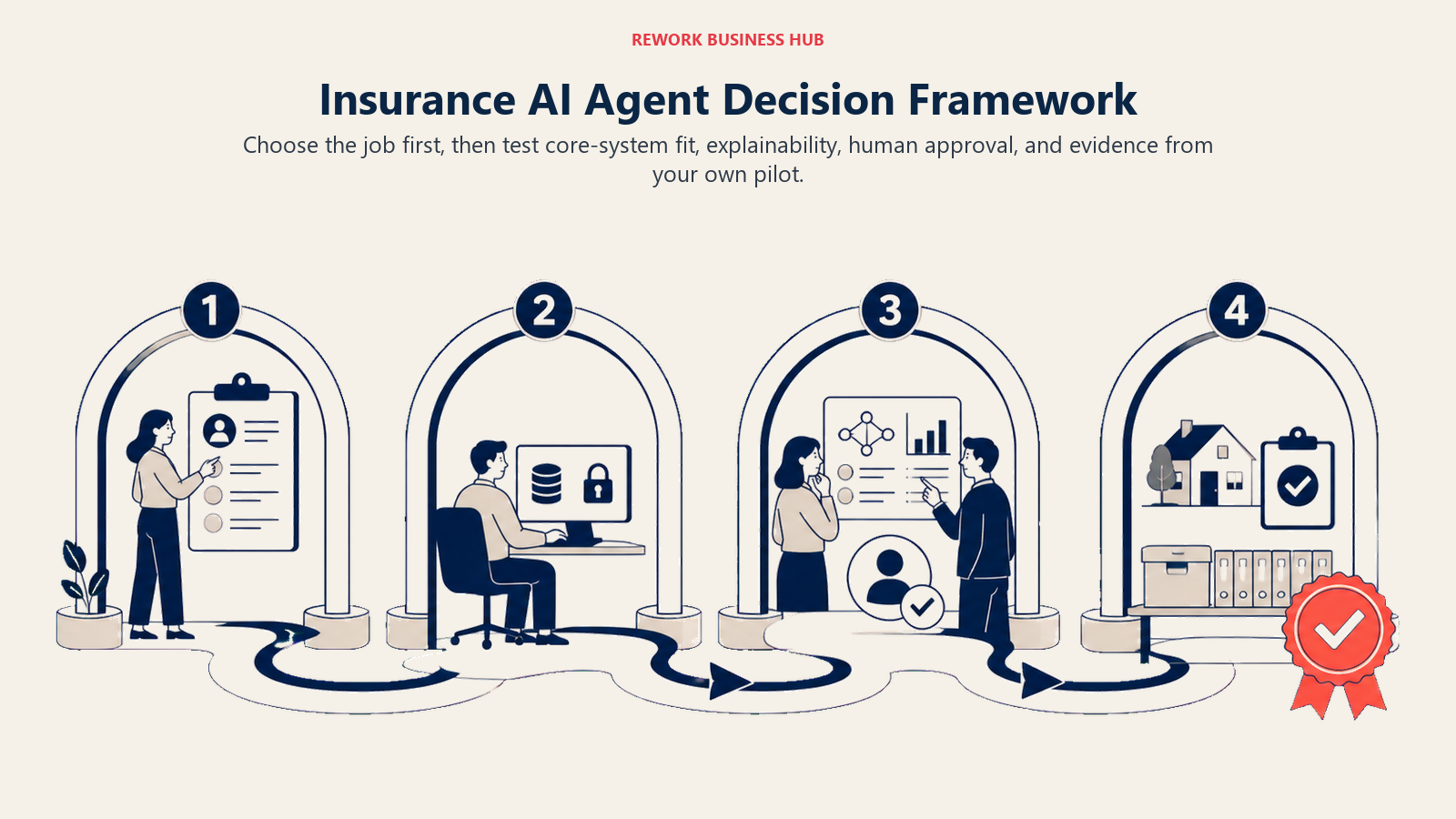
The vendor table only becomes useful after the buyer defines the job and governance boundary.
 |---|---|---|
| One agent platform spanning underwriting, claims, and policy servicing | Roots Automation (Bevaya) | Widest single-platform coverage, 115+ production deployments |
| Agents grounded natively in Guidewire data | Guidewire AI (Qusar) | No integration layer between the agent and ClaimCenter/PolicyCenter |
| A purpose-built underwriting-to-claims agent pair | Duck Creek AI | Underwriting Workbench and Agentic FNOL designed together |
| Incremental agent capability on a Sapiens core | Sapiens | Native add-on across the core, no separate AI vendor to integrate |
| An underwriting agent trained on your own risk appetite | Sixfold | Learns each carrier's guidelines rather than a generic score |
| Submission-level agent output tied to portfolio strategy | Federato | RiskOps ties underwriting actions to portfolio-wide appetite |
| Agentic pricing you can still defend in a rate filing | Akur8 | Transparent ML models built for regulatory scrutiny |
| Agentic fraud detection at national or enterprise scale | Shift Technology | Fraud scoring plus claims decisioning in one agent layer |
| Agent-ready access to underwriting and claims data itself | Verisk AI | Data and orchestration layer, including Claude/MCP connectors |
| Composable agents for documents plus broker communication | Indico Data | Named broker-communication agent, unusual in this category |
|---|---|---|
| One agent platform spanning underwriting, claims, and policy servicing | Roots Automation (Bevaya) | Widest single-platform coverage, 115+ production deployments |
| Agents grounded natively in Guidewire data | Guidewire AI (Qusar) | No integration layer between the agent and ClaimCenter/PolicyCenter |
| A purpose-built underwriting-to-claims agent pair | Duck Creek AI | Underwriting Workbench and Agentic FNOL designed together |
| Incremental agent capability on a Sapiens core | Sapiens | Native add-on across the core, no separate AI vendor to integrate |
| An underwriting agent trained on your own risk appetite | Sixfold | Learns each carrier's guidelines rather than a generic score |
| Submission-level agent output tied to portfolio strategy | Federato | RiskOps ties underwriting actions to portfolio-wide appetite |
| Agentic pricing you can still defend in a rate filing | Akur8 | Transparent ML models built for regulatory scrutiny |
| Agentic fraud detection at national or enterprise scale | Shift Technology | Fraud scoring plus claims decisioning in one agent layer |
| Agent-ready access to underwriting and claims data itself | Verisk AI | Data and orchestration layer, including Claude/MCP connectors |
| Composable agents for documents plus broker communication | Indico Data | Named broker-communication agent, unusual in this category |
Vendor Numbers vs. What to Verify Yourself
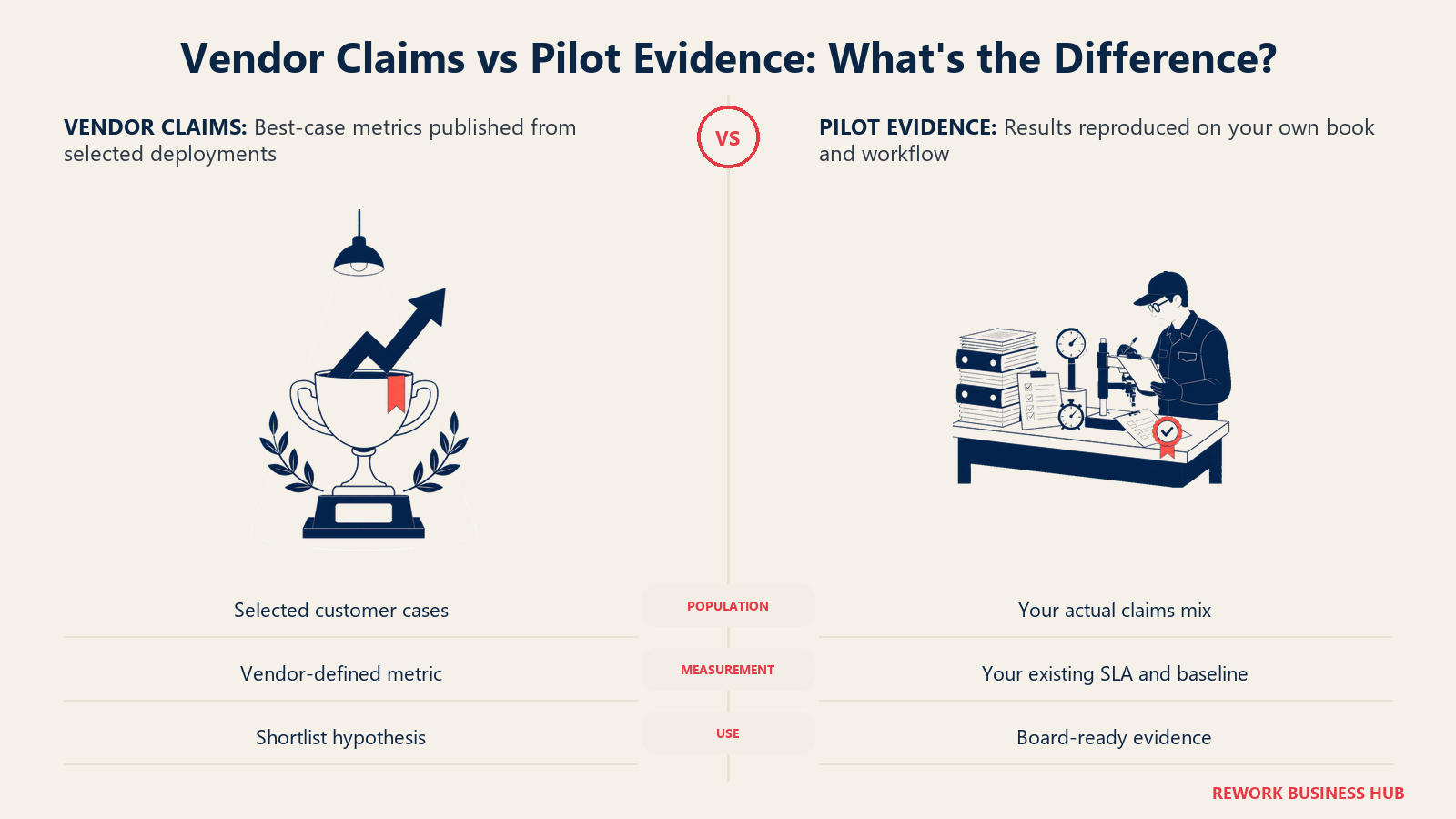
Every vendor in this article reports a good number. That's expected; they're selling software. What's worth separating is a controlled, independently audited result from an internal before-and-after comparison a vendor ran on its own early customers. Almost every figure above, Sixfold's 50% to 97% processing-time cut, Shift's 60% automation rate, Indico's 80%-plus processing-time reduction, Bevaya's 98%-plus accuracy, comes from vendor-published materials, not a third-party audit. That doesn't make the numbers false. It means you should treat them as a ceiling your own pilot needs to clear, not a figure you put in a board deck without your own data behind it.
| Vendor claim | What it likely measures | What to verify in your own pilot |
|---|---|---|
| "X% straight-through processing" | Cases the agent closed with zero human touch | What share of your actual mix is that simple; complex claims pull the real number down |
| "X% faster cycle time" | Time from intake to a specific milestone, often the vendor's best-fit use case | Whether the clock starts and stops at the same points your SLA already tracks |
| "X% accuracy" | Agreement with a labeled test set, frequently vendor-curated | Accuracy against your own historical claims or submissions, not a generic benchmark |
| "Reduces losses or leakage by X%" | Results from a single early-adopter's book of business | Whether your loss mix (line, geography, severity) resembles that customer's |
| "98%+ document accuracy" | Extraction accuracy on document types the model was trained on | Performance on your specific forms, especially older or nonstandard ones |
Framework: By Carrier Type and Buying Motion
| Profile | Buying Signal | Best Fits |
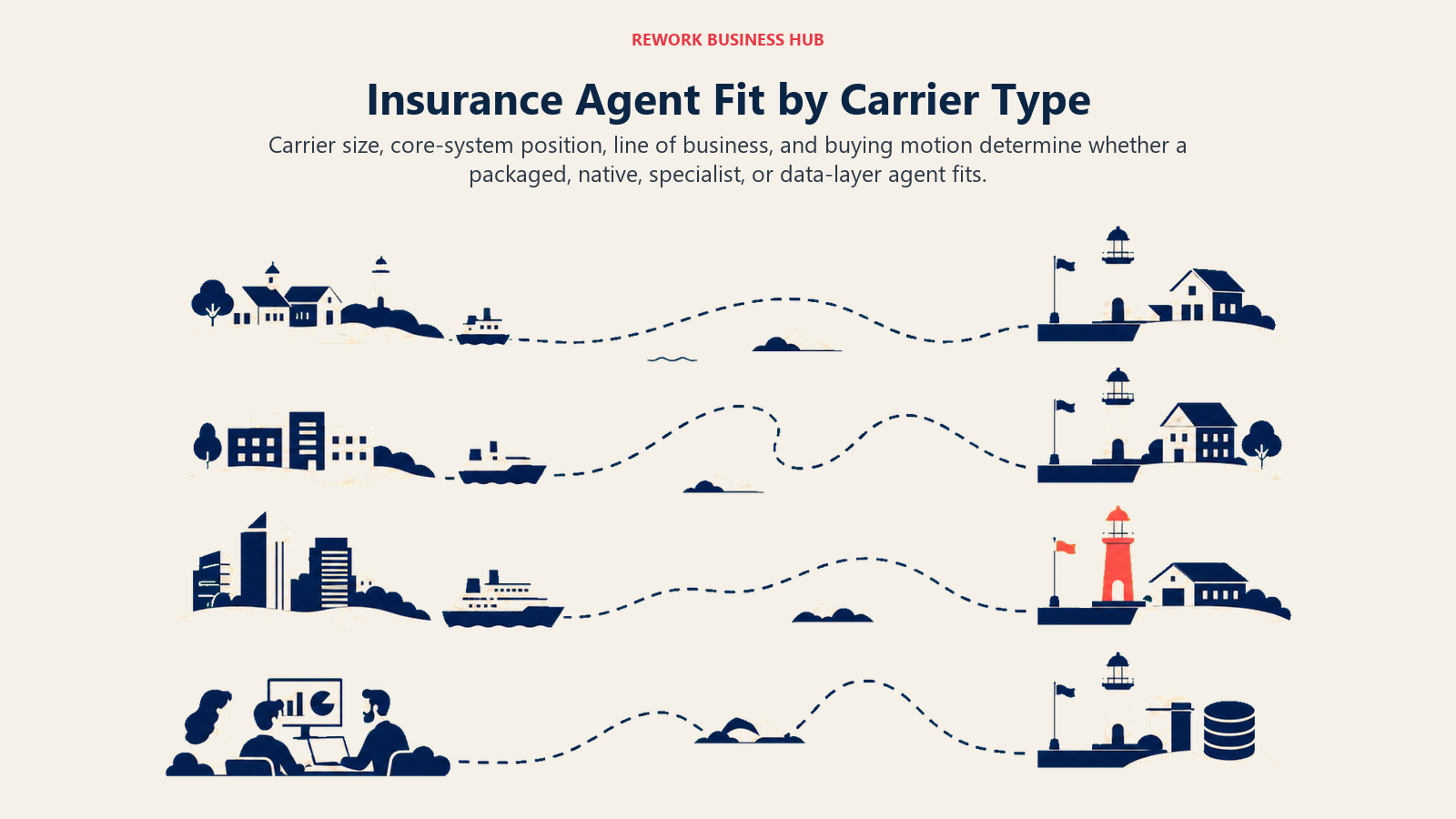
The framework maps six carrier and broker profiles to different agent buying motions.
 |---|---|---|
| Small regional carrier or MGA, no dedicated AI or data team | Wants a packaged agent, not a build project | Sixfold, Akur8, Indico Data |
| Mid-size P&C carrier already on Guidewire, Duck Creek, or Sapiens | Wants agents grounded in the core system already licensed | Guidewire AI, Duck Creek AI, Sapiens |
| Large national or multi-line carrier with a dedicated SIU | Fraud and claims decisioning at scale is the priority | Shift Technology, Roots Automation (Bevaya) |
| Life and health underwriting specialist | Needs medical-record and mortality-signal summarization | Sixfold |
| Broker, MGA, or agency, not a risk-bearing carrier | Submission triage and broker-communication automation | Indico Data, Federato, Roots Automation (Bevaya) |
| Data or analytics team feeding other vendors' agents | Wants underwriting and claims data as an API or MCP layer | Verisk AI |
|---|---|---|
| Small regional carrier or MGA, no dedicated AI or data team | Wants a packaged agent, not a build project | Sixfold, Akur8, Indico Data |
| Mid-size P&C carrier already on Guidewire, Duck Creek, or Sapiens | Wants agents grounded in the core system already licensed | Guidewire AI, Duck Creek AI, Sapiens |
| Large national or multi-line carrier with a dedicated SIU | Fraud and claims decisioning at scale is the priority | Shift Technology, Roots Automation (Bevaya) |
| Life and health underwriting specialist | Needs medical-record and mortality-signal summarization | Sixfold |
| Broker, MGA, or agency, not a risk-bearing carrier | Submission triage and broker-communication automation | Indico Data, Federato, Roots Automation (Bevaya) |
| Data or analytics team feeding other vendors' agents | Wants underwriting and claims data as an API or MCP layer | Verisk AI |
Frequently Asked Questions about AI Agents for Insurance
What's the difference between an AI agent and an AI tool for insurance?
An AI tool assists a human who stays in the loop for every step, like scoring a submission or flagging a suspicious photo. An AI agent plans a sequence of actions, calls your core system or a data source as a tool to carry them out, observes the result, and decides the next step, with a human checking in at defined boundaries rather than every click. Products like Gradient AI, Tractable, and EvolutionIQ are strong assistive tools but aren't included in this list because their public materials describe scoring or recommendation rather than a multi-step agent architecture.
Is it legal for an insurer to use an AI agent to deny a claim?
It depends on the line of business and state. The NAIC's Model Bulletin, adopted by roughly half of US states, requires insurers to be able to explain any adverse decision AI contributed to, but doesn't ban AI-informed denials outright for most lines. Health insurance already has harder rules in some states: California's SB 1120 bars AI from being the sole basis for denying medically necessary care, requiring a licensed physician's sign-off instead. Treat "a human must approve the final denial" as the safe default across every line, not just where it's already mandated.
Do these agents replace claims adjusters or underwriters?
No vendor in this list is built or marketed to fully replace that judgment call. Every product here either keeps a human sign-off point by design (Bevaya, Sapiens, Shift Claims) or focuses on the parts of the job that were pure administrative work anyway, like data extraction, submission triage, or document summarization, freeing adjusters and underwriters for the complex cases that actually need their judgment.
How much do AI agents for insurance cost in 2026?
Every vendor in this article uses custom, quote-only pricing with no public rate card, a pattern that holds across the entire category as of 2026. Deal size typically scales with claim or submission volume, lines of business covered, and how deeply the agent integrates with your core system. Budget for a scoped demo and a multi-month evaluation rather than a same-day signup for any product on this list.
Which agent works best if we're already on Guidewire, Duck Creek, or Sapiens?
Start with that vendor's own agent layer before evaluating a point solution. Guidewire's Qusar release, Duck Creek's Agentic AI Platform, and Sapiens' native agent add-ons all ground their agents directly in data you already store there, removing an integration project a third-party agent would otherwise require.
Can a small regional carrier or MGA afford this category?
Every product here uses enterprise, demo-gated pricing, but the sales-cycle friction varies. Sixfold, Akur8, and Indico Data are built as packaged products a smaller carrier or MGA can adopt without a core-system replacement project, which makes them a more realistic starting point than a platform-level deployment like Bevaya or a core-native agent tied to an existing Guidewire or Duck Creek contract.
How is this different from the AI tools for insurance claims roundup?
That guide covers assistive software that helps a human do claims work faster: computer-vision damage estimation, adjuster guidance, document extraction. This guide covers products built to plan a sequence of actions and act on a claim, submission, or policy change with less step-by-step supervision. Some vendors, like Shift Technology, appear in both because they ship both an assistive product and a newer agentic layer; each entry covers the relevant side.
What should we demand from a vendor before signing?
A plain-language explanation for one real adverse decision the agent influenced, the vendor's own bias-testing results rather than a description of their process, the specific point where human sign-off is mandatory, which states' versions of the NAIC bulletin they've already been evaluated against, and a sample audit-trail export rather than a description of one. If a vendor can't produce any of these, treat it as a real gap, not an oversight.
What to Do Next
Before you run a single demo, write down the six jobs from the matrix above and mark which ones you actually need this year, not eventually. Then confirm your core system (Guidewire, Duck Creek, Sapiens, or something else) before you fall in love with any vendor's roadmap, since that answer alone eliminates half this list either way. Shortlist two products, one core-native and one point solution if you're on Guidewire, Duck Creek, or Sapiens, and run both through the same 20 to 30 real historical claims or submissions rather than a vendor-picked demo set. Ask each for the evidence checklist from the regulatory section above before you sign anything, not after. The agent that survives your own data and your own compliance team's questions is the one worth budgeting for, not the one with the best demo.

Principal Product Marketing Strategist
On this page
- What Changed in 2026
- Key Facts
- What Makes This an Agent, Not Just Insurance Software
- Quick Comparison Table
- The Regulatory Constraint You Can't Automate Around
- The Legacy Core-System Gate
- Where Each Agent Fits the Job
- 1. Roots Automation (Bevaya): The Widest Agent Coverage Across Underwriting, Claims, and Servicing
- 2. Guidewire AI (Qusar): Agents Built Into the Core System Most P&C Carriers Already Run
- 3. Duck Creek AI: Purpose-Built Agents for the Underwriting-to-Claims Handoff
- 4. Sapiens: Incremental Agents for Carriers Already Standardized on Sapiens Core
- 5. Sixfold: An Underwriting Agent With Institutional Memory for Life and P&C
- 6. Federato: Agentic RiskOps for Portfolio-Aware Underwriting Decisions
- 7. Akur8: Transparent Pricing Agents Built for a Regulator to Read
- 8. Shift Technology: Agentic Fraud Detection and Claims Decisioning at Scale
- 9. Verisk AI: The Data and Orchestration Layer Underneath Other Agents
- 10. Indico Data: Purpose-Built Agents for Submission, Claims, and Broker Communication
- How to Choose: Decision Framework
- Vendor Numbers vs. What to Verify Yourself
- Framework: By Carrier Type and Buying Motion
- What to Do Next