Best AI Agents for Content Marketing in 2026: 12 Tools That Actually Run the Pipeline
Turn this article into takeaways for your work.


Each assistant summarizes the article only for you and suggests best practices for your work.
AirOps and Byword go furthest toward running the whole content pipeline end to end, Jasper and Writer lead for teams that need brand voice enforced across a big team, and Frase, MarketMuse, and Surfer AI cover the research and refresh layer that any of the others still need. This guide ranks 12 real AI agents for content marketing, evaluated on how much of the pipeline each one actually owns: brief, research, draft, brand-voice edit, internal linking, publishing, and refresh, not just the drafting step every tool claims.
An AI agent for content marketing is different from an AI writing assistant in one specific way: an assistant drafts a paragraph and waits for you to do everything else, while an agent chains several of those steps together and calls tools (a knowledge base, a CMS API, a SERP dataset) to move a piece of content further down the pipeline on its own. That distinction matters because the honest answer for most teams is not "which agent replaces my writers," it's "which agent removes the most manual handoffs while I keep an editor in the loop." This list is organized around that question, not around which tool can technically generate the most words per minute.
Key Facts
- 76% of enterprise AI use cases were purchased from a vendor rather than built in-house in 2025, up from 53% in 2024, and marketing platforms alone captured $660 million of 2025's $7.3 billion in departmental AI spend, per Menlo Ventures' State of Generative AI in the Enterprise.
- 94% of marketers say they plan to use AI in their content creation process in 2026, per HubSpot's marketing statistics research.
- 57% of organizations now have AI agents running in production, up from 51% the year before, and human review remains the top evaluation method for agent output at 59.8% of teams, used especially for nuanced or high-stakes situations, per LangChain's State of Agent Engineering survey.
- Google's spam policies explicitly define "scaled content abuse" as using generative AI or similar tools "to generate many pages without adding value for users," and state that sites built around it can be excluded from Search entirely, per Google Search Central's spam policies.
- Content cited inside AI-generated answers runs roughly 25.7% "fresher" on average than the organic search results sitting next to them, per Ahrefs' research on content decay, which is part of why refresh and decay detection now show up as agent features, not just audits. What assistants actually reward is laid out in How to Get Cited in AI Answers.
- Organizational AI adoption reached 88% in 2026, per the Stanford HAI AI Index Report, which is the scale problem this whole category exists to manage: everyone is producing more content with AI, and quality control did not automatically scale with it.
Quick Comparison Table
| Agent | Best For | Starting Price | Key Strength | Key Limitation |
|---|---|---|---|---|
| AirOps | Teams building a full SEO content pipeline in one platform | Free tier; paid from about $199/mo (reported) | Workflow builder covers brief through CMS publish | Cost jumps steeply between the entry and mid tiers |
| Jasper | Marketing teams wanting a governed, brand-voice pipeline | $59/mo (Pro, annual) | Widest brand recognition, Agents and Content Pipelines on Business | Core Pro plan is single-seat; real pipeline depth needs Business |
| Writer | Enterprise teams needing style guide enforcement at scale | Reported $39/seat/mo, $29 billed annually (up to 5 seats); Enterprise custom | Knowledge Graph grounding plus an enforced style guide | Self-serve pricing is barely public; mostly a sales-led buy |
| Byword | Agencies and publishers running high-volume SEO posts | $99/mo (Starter, 25 articles) | Keyword-to-published-post autopilot with internal links and WordPress push | Thin on brand voice nuance and editorial control |
| Copy.ai | GTM teams running content inside a broader workflow tool | $29/mo (Chat, 5 seats) | Workflows extend past blog content into wider GTM automation | Workflow-credit tiers jump to four figures fast |
| Surfer AI | Teams wanting research, draft, and on-page SEO in one flow | $49/mo (Discovery, annual) | Internal linking and SERP-backed drafting native to the product | Full pipeline needs Pro; per-article overage adds up |
| Frase | Lean in-house teams that live or die on the brief | $39/mo (Starter, annual) | Fastest brief-to-outline step of any tool on this list | Drafting and brand voice control are thinner than dedicated writers |
| MarketMuse | Enterprise teams planning topical authority across a library | Custom, demo-gated | Portfolio-level content decay and gap detection | No public pricing since its 2024 acquisition |
| Typeface | Large enterprises needing brand-consistent content and creative together | Custom, quote-based | Purpose-built agents spanning text and visual brand assets | No self-serve tier at any price point |
| Contentful AI Actions | Teams that want the agent inside the CMS, not bolted on | Custom (platform plus module) | Runs inside the publishing workflow itself | Pending Salesforce acquisition; pricing needs a sales call |
| Sanity Agent Actions | Engineering-led teams building custom agent workflows | Free (1,000 AI credits/mo); Growth $15/seat/mo | API-native, credit-metered, developer-first | Requires developer effort; not a marketer-facing UI |
| Rankability | Agencies managing many client sites on one plan | $99/mo (Starter, 10,000 credits) | Unlimited clients and users on every tier | Lighter on brand voice and native publishing than on SEO depth |
How Far Past "Generate a Draft" Each Agent Actually Goes
Every vendor in this category will tell you it does content "end to end." Almost none of them mean the same thing by that phrase, and the gap between "drafts a good paragraph" and "runs the pipeline" is exactly where a buying decision should live. Before you shortlist anything, it's worth reading what an AI agent actually is: the short version is that a tool assists a human at every step, while an agent plans a sequence, calls a tool (a CMS, a knowledge base, a SERP API) to act on it, and only checks in with a human at set boundaries. Judged against that bar, most "content AI" products are still assistants wearing agent branding for a handful of steps, not the whole run.
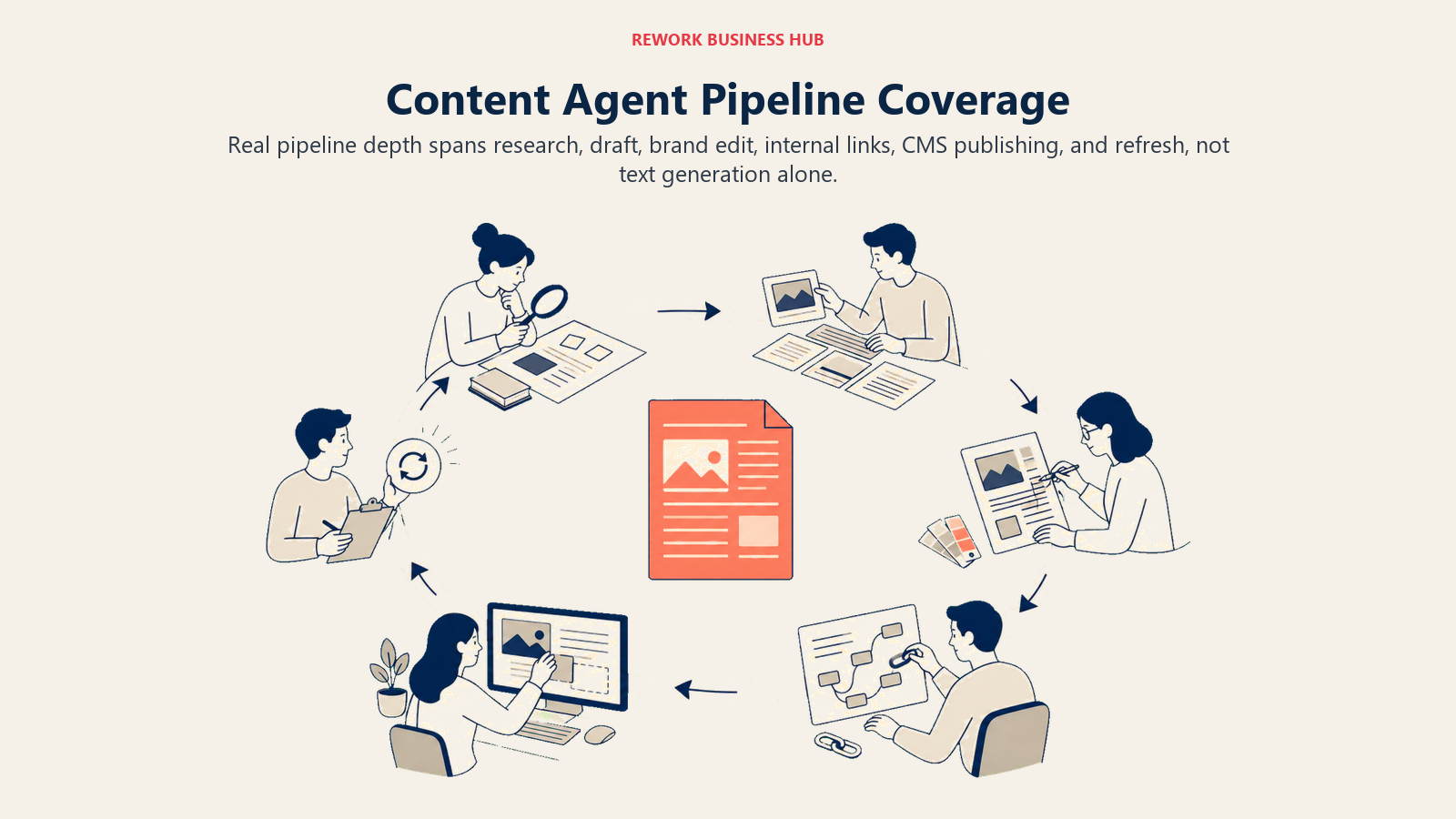
The table below scores each of the 12 agents against six real pipeline stages: brief and research, drafting, brand-voice editing, internal linking, publishing into a CMS, and refresh or decay detection on content that already exists. "Yes" means the capability is a named, dedicated feature. "Partial" means the capability exists in a lighter or adjacent form. A dash means the vendor does not offer it as a core feature.
| Agent | Brief and Research | Draft | Brand Voice / Edit | Internal Linking | Publish / CMS | Refresh / Decay |
|---|---|---|---|---|---|---|
| AirOps | Yes | Yes | Yes | - | Yes | - |
| Jasper | Partial | Yes | Yes | - | Partial (API) | - |
| Writer | Yes | Yes | Yes | - | Partial | - |
| Copy.ai | Partial | Yes | Partial | - | Partial | - |
| Byword | Partial | Yes | Yes | Yes | Yes | - |
| Typeface | Partial | Yes | Yes | - | Partial | - |
| Frase | Yes | Yes | Partial | - | - | Yes |
| MarketMuse | Yes | Partial | - | - | - | Yes |
| Surfer AI | Yes | Yes | Partial | Yes | Partial | Partial |
| Contentful AI Actions | - | Partial | Yes | - | Yes | Partial |
| Sanity Agent Actions | Partial | Yes | Partial | - | Yes | Partial |
| Rankability | Yes | Yes | Partial | - | - | Yes |
Read across a row and the pattern holds everywhere: nobody covers all six stages well. AirOps and Byword come closest to a real brief-to-publish chain. Writer and Jasper are strongest on the brand-voice governance layer that a fast-moving pipeline still needs. Frase, MarketMuse, Surfer AI, and Rankability specialize in the research and refresh bookends most drafting-first tools skip. The practical conclusion: most teams end up running two of these together (a governance-and-drafting agent plus a research-or-refresh specialist) rather than expecting one subscription to close every gap. If you'd rather build that connective layer yourself instead of buying a packaged agent, the Content Drafting Agent blueprint walks through designing that first-draft step from scratch, and the AI SEO Content Brief Agent blueprint does the same for the research stage.
How to Choose: What Actually Matters Before You Buy
Three questions narrow this list faster than a feature comparison does.
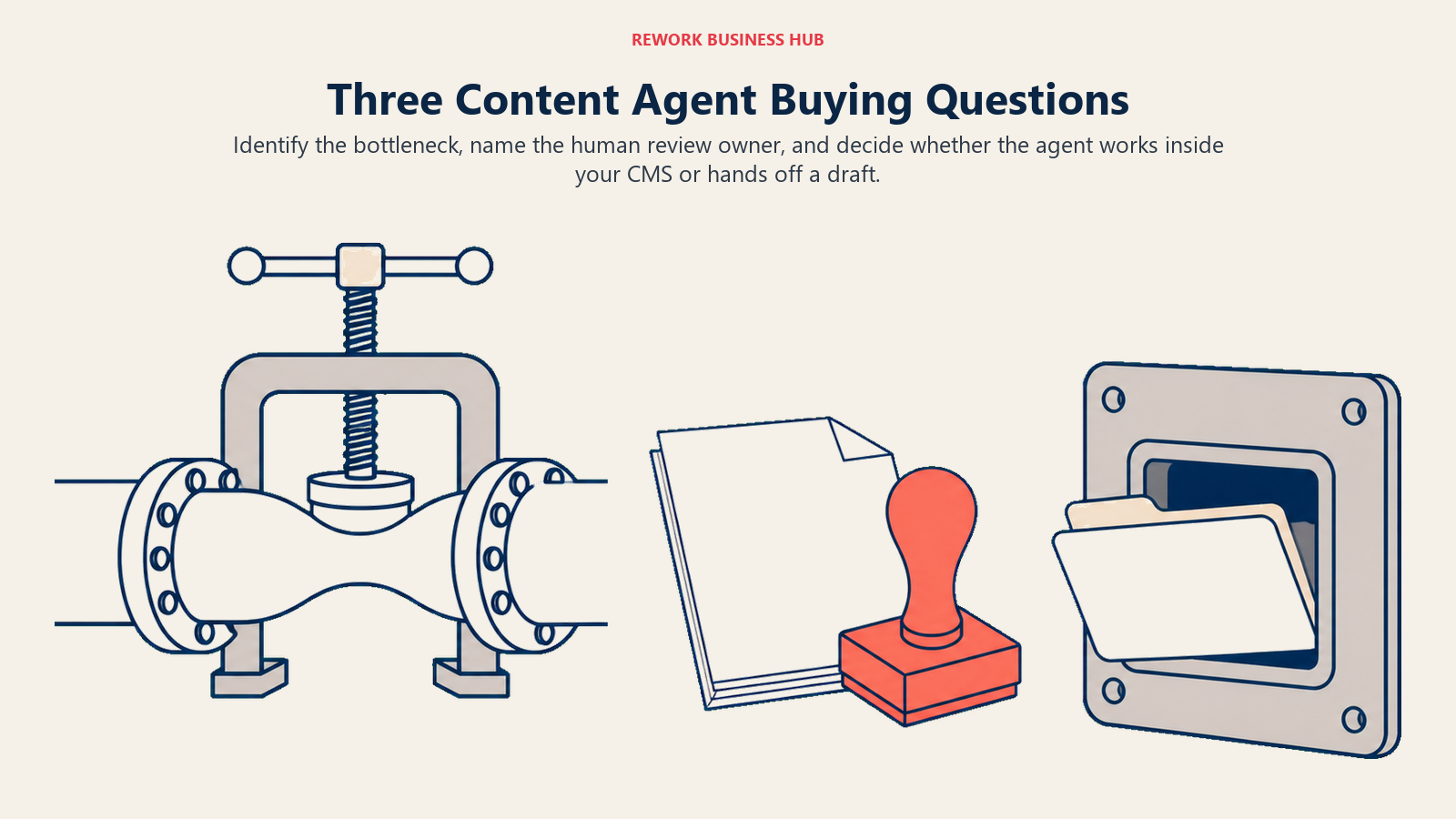
- Which pipeline stage is actually your bottleneck? If writers stare at a blank page, you need the research-and-brief layer (Frase, MarketMuse). If briefs exist but nothing gets published without a manual copy-paste into your CMS, you need the publish layer (AirOps, Byword, Contentful AI Actions, Sanity Agent Actions). If drafts exist but read off-brand by the time five different people have used the tool, you need the brand-voice layer (Writer, Jasper, Typeface).
- Who owns the editorial review gate? Every agent in this list still needs a human checking output before it goes live, and that's not a caveat, it's a design requirement. LangChain's survey data found human review is the most-used evaluation method across agent deployments generally, and teams that skip it on content specifically are the ones that end up in a correction cycle after publishing. Decide who that person is before you buy, not after the first bad batch ships.
- Does the tool live inside your CMS, or does it hand you a document to move yourself? Contentful AI Actions and Sanity Agent Actions run inside the publishing system itself. AirOps and Byword push directly to WordPress, Webflow, or Shopify. Jasper, Writer, Copy.ai, Frase, MarketMuse, and Rankability hand you a draft or a brief that still needs a human (or a separate integration) to get it published. Neither model is wrong, but the second one quietly reintroduces the manual handoff you were trying to remove.
Framework: By What's Actually Broken
| Your Bottleneck | What You Need | Best Fits |
|---|---|---|
| Blank-page problem, no research foundation | Brief and SERP research built in | Frase, MarketMuse, Rankability |
| Drafts exist but sound off-brand across writers | Enforced brand voice and style guide | Writer, Jasper, Typeface |
| Content gets drafted but publishing is manual | Native CMS publishing | AirOps, Byword, Contentful AI Actions, Sanity Agent Actions |
| High-volume SEO content, agency managing many sites | Batch production with unlimited clients | Byword, Rankability |
| Old content quietly losing traffic | Decay detection and refresh signals | Frase, MarketMuse, Rankability |
| Content sits alongside broader GTM or sales workflows | Workflow platform beyond just blog posts | Copy.ai, AirOps |
| Engineering team wants to build custom logic on top | API-native, developer-first agent actions | Sanity Agent Actions, Contentful AI Actions |
Sizing and Persona Table
| Agent | Ideal Team Size | Primary Buyer Persona |
|---|---|---|
| AirOps | 10-200 employees | Head of Content, SEO Director, Growth Marketer |
| Jasper | 5-500 employees | VP Marketing, Content Marketing Manager |
| Writer | 200-5,000+ employees | CMO, Head of Brand, Content Ops Lead |
| Byword | 1-50 employees (agency-heavy) | Agency Owner, Programmatic SEO Operator |
| Copy.ai | 20-1,000 employees | Head of GTM, Marketing Ops, Content Marketing Manager |
| Surfer AI | 5-200 employees | SEO Manager, Content Lead |
| Frase | 1-100 employees | Solo SEO, Content Marketing Manager |
| MarketMuse | 50-5,000+ employees | Head of Content Strategy, Enterprise SEO Lead |
| Typeface | 500-10,000+ employees | CMO, Head of Brand, Enterprise Marketing Director |
| Contentful AI Actions | 100-5,000+ employees | Head of Content Ops, Platform/DevRel Lead |
| Sanity Agent Actions | 10-500 employees (engineering-led) | Engineering Lead, Content Platform Owner |
| Rankability | 1-50 employees (agency-heavy) | Agency Owner, SEO Consultant |
1. AirOps: The Most Complete Content Pipeline in One Product
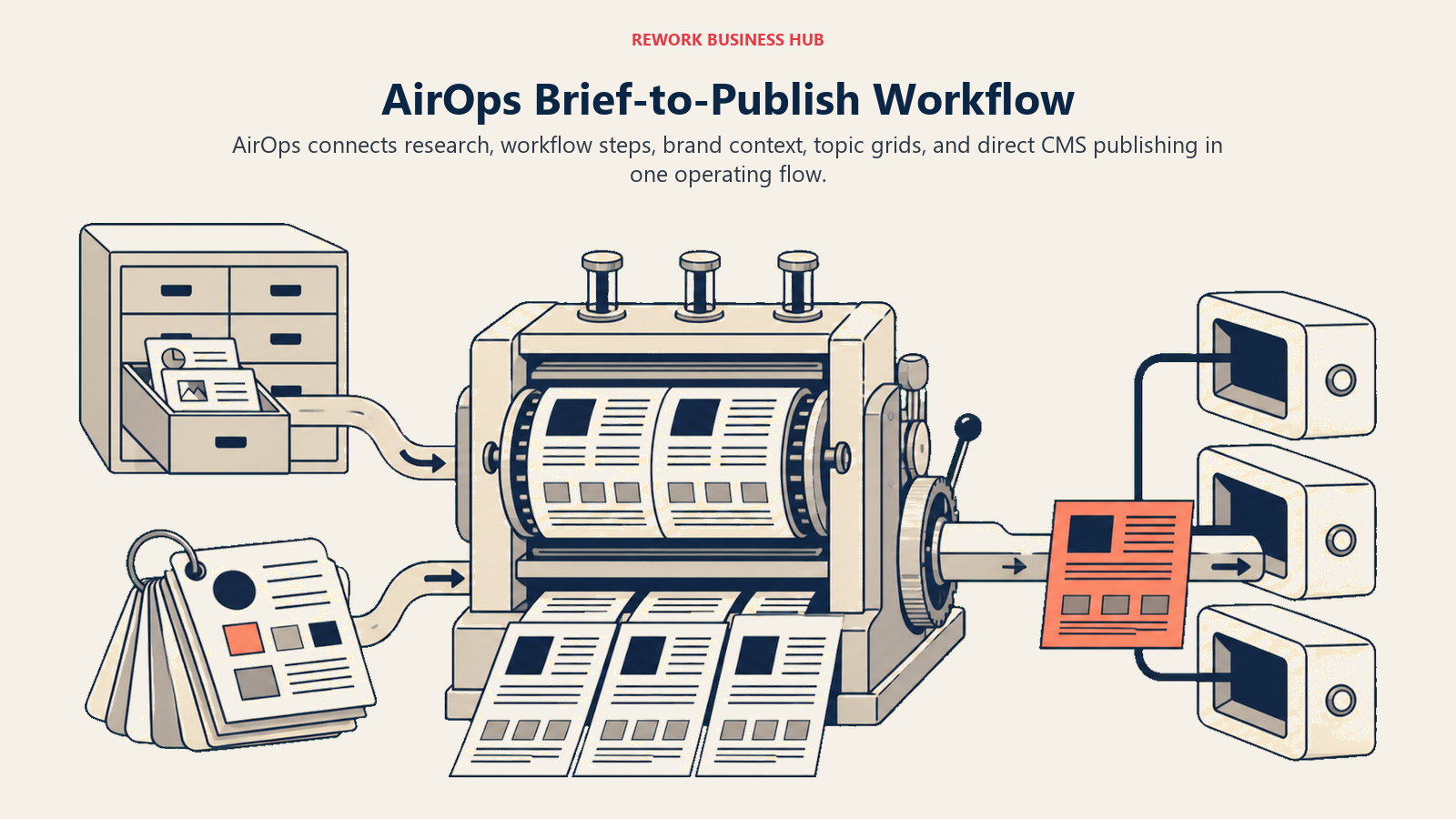
AirOps is built around the idea that content production is a workflow, not a text box. Its Workflow Builder lets you chain research, drafting, and formatting steps visually, Grids apply that workflow across a spreadsheet of topics at once, Brand Kits hold your voice and style rules, and Knowledge Bases ground output in your own product and customer data instead of generic web knowledge. CMS integrations push finished content directly into WordPress, Webflow, or Shopify, which closes the loop that most of the tools on this list leave open.
The catch is cost curve, not capability. AirOps' free Insights tier covers 1,000 tasks a month, but the jump to a paid Solo or Pro plan (reported around $199 to $2,000 a month depending on tier and task volume) is steep for a team not yet publishing at real volume. Confirm current numbers at airops.com/pricing before budgeting.
| What you get | What you don't |
|---|---|
| Brief-to-publish workflow in one visual builder | Exact Solo/Pro dollar pricing not published in a static, checkable form |
| Native CMS publishing (WordPress, Webflow, Shopify) | Steep cost jump between entry and mid tiers |
| Grids apply one workflow across many topics at once | Best suited to teams already publishing at volume, not a first agent |
Pricing: Free (Insights, 1,000 tasks/mo); Solo and Pro tiers reported at roughly $199/mo (20,000 tasks) and $1,999-$2,000/mo (75,000 tasks), with overage of about $6-$9 per 1,000 tasks depending on plan, per ColdIQ's AirOps pricing breakdown (reported; verify current numbers at airops.com/pricing); Enterprise custom.
Best for: Content or SEO teams that want brief, draft, brand voice, and CMS publish handled inside one workflow tool instead of stitched together.
2. Jasper: Brand-Governed Content Pipelines at Marketing-Team Scale
Jasper's own product language calls its automation layer "Content Pipelines," which is a fair description: on the Business plan, Agents handle research, drafting, and even generative engine optimization tasks in sequence, Jasper Grid applies that at scale across many pieces, and a no-code Custom AI Agent builder lets a marketing ops person configure new automations without an engineer. Brand Voice, Knowledge assets, and Audiences keep output aligned to how the company actually talks, which is Jasper's strongest and most established feature regardless of plan.
The honest limit is where that pipeline depth lives. The $59-69/month Pro plan is genuinely useful for a single marketer drafting on-brand content, but Agents for complex workflows, the Custom AI Agent builder, and API access all sit behind the custom-priced Business plan with a 12-month minimum commitment, which is a different buying conversation than the sticker price suggests.
| What you get | What you don't |
|---|---|
| Content Pipelines and Agents automate research through drafting | Real pipeline automation is a Business-plan feature, not Pro |
| Brand Voice is the most mature version of this feature in the category | Business plan requires a 12-month minimum commitment |
| No-code Custom AI Agent builder for marketing ops to configure | Not a native CMS publisher; output still needs to move elsewhere |
Pricing: Pro $69/mo monthly or $59/mo annual (1 seat, 2 Brand Voices); Business custom, reported by multiple trackers to start around $900/mo for smaller teams needing dedicated support, minimum 12-month term.
Best for: Marketing teams that want a recognized, governed platform where brand voice and multi-step agent workflows live in the same product.
3. Writer: Enterprise Style Guide Enforcement, Not Just Generation
Writer's whole design center is grounding and governance rather than raw generation speed. Its Knowledge Graph connects agents to a company's actual product docs, brand assets, and prior content so drafts start from real information instead of a generic prompt, and its Style Guide enforces terminology, tone, and formatting rules automatically across every piece an agent or a human produces. For regulated industries or large brand teams where one off-voice paragraph becomes a compliance problem, that enforcement layer is the reason Writer gets shortlisted over cheaper drafting tools.
Pricing is where Writer asks for patience. Per Vendr's aggregated buyer-contract data, a Team tier runs roughly $18-25 per seat per month annually, while Enterprise deployments typically fall between $75,000 and $250,000 a year, with large enterprise contracts reaching $500,000 or more. The median tracked contract value was $28,910 a year. Confirm current terms at writer.com/pricing directly.
| What you get | What you don't |
|---|---|
| Knowledge Graph grounds every draft in real company data | Self-serve pricing is barely public; expect a sales conversation |
| Style Guide enforces tone and terminology automatically | Enterprise contracts commonly run into six figures annually |
| Built for governance-heavy industries and large brand teams | Not the fastest or cheapest way to get a first draft out |
Pricing: Reported (Vendr aggregated buyer data, updated February 2026): Team about $18-25/seat/mo (annual); Enterprise custom, typically $75K-$250K/year for mid-market, $500K+ for large enterprise, median contract $28,910/year. Verify current terms at writer.com/pricing.
Best for: Enterprise and regulated-industry teams where consistent brand voice and terminology matter more than drafting speed.
4. Byword: The Narrowest, Most Literal Keyword-to-Published-Post Pipeline
Byword does one job and does it with fewer steps than anything else on this list: put in a keyword, get a structured 1,500-2,500-word article out, optionally pushed straight into WordPress with internal links and auto-indexing already handled. Custom brand-voice training and support for 47 languages round out the feature set. For programmatic SEO operators and agencies publishing across many sites, that narrow focus is exactly the point, and it's the only tool on this list where internal linking ships as a confirmed, named feature rather than an assumption.
The tradeoff is depth. Byword is not the tool for a brand that needs nuanced editorial judgment on every piece; it's built for volume, and the editorial review gate has to be a deliberate step your team adds on top, not something Byword does for you.
| What you get | What you don't |
|---|---|
| Keyword-to-published-post autopilot with internal links | Editorial depth and nuance are thinner than a governance-first tool |
| CMS publishing and auto-indexing included, not an add-on | Brand voice training exists but isn't Byword's core strength |
| 47-language support and batch generation for scaled operators | Pricier than it looks for a single blogger publishing occasionally |
Pricing: Starter $99/mo (25 articles) up to Scale $999/mo (300 articles), with a mid-tier reported around $299/mo (80 articles) per Byword's plan comparison pages; 5 free article credits on signup, no card required.
Best for: Agencies and publishers running 25 to 300+ SEO articles a month who want the CMS push handled automatically.
5. Copy.ai: GTM Workflows That Extend Past Blog Content
Copy.ai repositioned itself from a writing assistant into what it now calls a GTM AI platform, and its Workflows feature is the agentic layer: multi-step automations that can research a lead, draft outreach copy, or produce content assets, chained together rather than run as one-off prompts. That's a meaningfully different pitch from a pure content tool, since the same workflow infrastructure that drafts a blog outline can also touch sales and lifecycle content, useful for teams that don't want a separate tool per content type.
The catch is how pricing scales. The $29/month Chat plan is genuinely useful for a small team, but real workflow automation starts at the Growth tier, billed at $1,000/month annually for 75 seats and 20,000 workflow credits, climbing to $3,000/month at the Scale tier. That's built for a GTM org spending across many workflows, not a standalone content team with a modest budget.
| What you get | What you don't |
|---|---|
| Workflows chain research, drafting, and GTM tasks together | Real automation starts at $1,000/mo (Growth), not the $29 entry tier |
| Same platform can serve content, sales, and lifecycle use cases | Not a dedicated content-brand-voice tool the way Jasper or Writer is |
| Unlimited words in chat even on the cheapest paid plan | Workflow credits, not seats, are the real constraint at scale |
Pricing: Chat $29/mo ($24/mo annual, 5 seats); Growth $1,000/mo annual (75 seats, 20K workflow credits); Expansion $2,000/mo annual (150 seats, 45K credits); Scale $3,000/mo annual (200 seats, 75K credits); Enterprise custom.
Best for: GTM and marketing ops teams that want content generation living inside a broader workflow-automation platform, not a standalone writing tool.
6. Surfer AI: Research, Draft, and Internal Linking in One SEO-Native Flow
Surfer's Content Editor built its reputation as the category benchmark for scoring a draft against what's actually ranking, and Surfer AI extends that into a genuine mini-pipeline: it researches the SERP, drafts a full article, and on the Pro tier and above adds internal linking and content ideas as native features rather than a manual afterthought, before you push it live. That combination (real SERP grounding plus internal linking inside the same product) is rare enough on this list to call out specifically.
The honest gap is that the full flow needs the $182/month Pro tier to feel complete; Discovery and Standard are closer to a scoring and light-drafting tool, and generating a full AI article beyond your plan's allocation costs $29 per article on top. It's also not a keyword-research or backlink platform on its own, so most teams still pair it with Ahrefs or Semrush for that earlier layer.
| What you get | What you don't |
|---|---|
| SERP research, drafting, and internal linking in one flow | Full pipeline (internal linking, brand workspaces) needs Pro or above |
| Category-benchmark scoring most competitors get compared against | $29 per article once you exceed your plan's AI article allocation |
| Daily-refreshed AI-prompt tracking on higher tiers | Not a keyword-research or backlink tool by itself |
Pricing: Discovery $49/mo, Standard $99/mo, Pro $182/mo, Peace of Mind $299/mo (all annual billing), Enterprise from $999/mo; Surfer AI full-article generation runs $29/article beyond plan allocation.
Best for: SEO-led content teams that want research, drafting, and on-page optimization, including internal linking, in one native workflow.
7. Frase: The Brief and Refresh Specialist
Frase's core value has always been compressing the research step: point it at a target keyword and it pulls competitor content, structures a brief in minutes, and generates a first draft without a writer starting from a blank page. In 2026, Frase folded AI-search visibility tracking (Content Guard, GEO monitoring across ChatGPT, Google AI, Perplexity, Claude, and Gemini depending on tier) into every plan, and its audit-pages feature is built specifically to flag existing content that's losing ground, which makes it one of the few tools here that treats refresh as a first-class job, not an afterthought.
What Frase is not is a brand-voice or publishing platform. Drafting exists, but it's thinner than a dedicated writing tool, and there's no native CMS push. Most teams pair Frase with a separate drafting or publishing layer once the brief and refresh signal exist.
| What you get | What you don't |
|---|---|
| Fastest brief-to-outline step of any tool on this list | Drafting and brand-voice control are secondary to the research layer |
| Content Guard folds AI-search visibility tracking into every plan | No native CMS publishing; output still needs to move elsewhere |
| Audit pages flag decaying content before traffic drops further | Extra seats cost $29/mo each beyond the plan default |
Pricing: Starter $39/mo annual ($49 monthly, 10 articles), Professional $103/mo annual ($129 monthly, 40 articles, 3 seats), Scale $239/mo annual ($299 monthly, 100 articles, 5 seats); Enterprise custom.
Best for: Lean in-house content or SEO teams whose real bottleneck is research and briefs, plus catching content before it decays further.
8. MarketMuse: Portfolio-Level Planning and Decay Detection
MarketMuse operates one level above every brief-and-draft tool on this list: instead of optimizing one article, it models topic clusters across an entire content library, scores existing inventory for authority gaps, and recommends what to write next based on where competitors hold share of voice you don't. For enterprise content teams planning a year of coverage rather than one week's posts, that portfolio view (and the decay tracking that comes with it) is genuinely hard to replicate with a briefs-only tool.
The honest catch is that pricing has been pulled entirely off the public web following a 2024 acquisition. The Optimize, Research, and Strategy tiers still cited across review sites (historically around $99, $249, and $499 a month) are outdated; every tier now routes to a demo request.
| What you get | What you don't |
|---|---|
| Portfolio-level topic modeling and content-gap detection | No public pricing since 2024; every tier requires a demo |
| Built-in decay and authority-gap tracking across a whole library | Not a drafting or brand-voice tool at its core |
| Up to 20 content briefs and 10,000 tracked topics on top tier | Slower to value than a single-article drafting tool |
Pricing: Free, Optimize, Research, and Strategy tiers exist, but marketmuse.com/pricing shows no public dollar figures as of August 2026; historical pre-acquisition estimates (reported, not current) ran roughly $99-$499/mo. Book a demo for a current quote.
Best for: Enterprise content teams planning topical authority and catching decay across dozens or hundreds of existing pages, not a single article at a time.
9. Typeface: Enterprise Brand Content and Creative at Scale
Typeface, founded by Adobe's former CTO and backed by a Google Cloud partnership, builds purpose-built agents that run marketing and creative workflows together rather than treating text and visual content as separate tools. That's the real differentiator versus a text-only pipeline agent: the same brand-governed system that drafts a campaign's copy can also generate on-brand visual assets, aimed at large enterprises that need both moving in lockstep across many channels at once.
Worth a direct note since Typeface's name shows up twice in this collection's coverage: this is the flagship enterprise content and creative agent platform, a separate product line from Pencil, the lower-cost, self-serve performance-ad tool Typeface acquired that's covered in our Facebook and Instagram ads roundup. The platform profiled here has no self-serve tier at all; every path leads to a demo request, and setup typically runs 6-16 weeks including brand-guideline ingestion and channel integration.
| What you get | What you don't |
|---|---|
| Purpose-built agents spanning both text and visual brand content | No self-serve pricing tier at any level; sales-led only |
| Google Cloud partnership for enterprise-scale deployment | 6-16 week typical setup, not a same-week first draft |
| Built for brand consistency across many channels at once | Overkill and inaccessible for teams under enterprise scale |
Pricing: Custom, quote-based; typeface.ai publishes no pricing and routes every path to "get a demo" or "contact sales."
Best for: Large enterprises that need text and visual brand content generated and governed together, not a text-only pipeline.
10. Contentful AI Actions: The Agent That Lives Inside Your CMS
Contentful's AI Actions module takes a different approach than every drafting-first tool on this list: instead of producing content elsewhere and asking you to move it, AI Actions runs inside the content management workflow itself, using Variables and External References to give generation tasks context awareness (brand tone, locale, even third-party data from a source like Shopify). Pre-built templates cover translation, SEO optimization, alt-text generation, and grammar correction, connecting directly to models from Amazon Bedrock and OpenAI without leaving the CMS interface.
Two things to know before shortlisting it. First, Contentful is mid-acquisition: Salesforce signed a definitive agreement to acquire Contentful, expected to close in Salesforce's fiscal Q3 2027, which is worth factoring into any long-term platform bet made today. Second, confirm a specific dollar figure for either the base platform or the AI Actions module with Contentful; treat this as a sales-led purchase and get current numbers before budgeting.
| What you get | What you don't |
|---|---|
| Agent actions run natively inside the publishing workflow | No verifiable public price for the platform or the AI Actions module |
| Context-aware generation (brand tone, locale, external data) | Pending Salesforce acquisition adds roadmap uncertainty |
| Pre-built templates for translation, SEO, alt text, and grammar | Not a research or brief-generation tool; assumes content strategy exists elsewhere |
Pricing: Confirm current pricing with Contentful; contentful.com/products/ai describes the feature set but requires a sales conversation for pricing on both the base platform and the AI Actions module.
Best for: Teams already on or evaluating Contentful who want AI actions running inside the CMS rather than as a separate drafting tool.
11. Sanity Agent Actions: The Developer-First, API-Native Agent Layer
Sanity took the opposite path from most vendors on this list: instead of a marketer-facing dashboard, its Content Agent and Agent Actions ship as an API-native layer (document creation, transformation, web search, and structured GROQ queries) that engineering teams wire into whatever workflow they're building. That makes it the most flexible option here for a team that wants to build a genuinely custom pipeline rather than adopt a vendor's fixed one, at the cost of needing developer time to make it useful.
Pricing is transparent and metered by credit rather than seat: every plan, including the free tier, includes Content Agent access, with AI queries costing 4 credits and actions costing 2 credits each. That's straightforward to reason about for a technical buyer, less so for a marketing leader evaluating it without engineering support.
| What you get | What you don't |
|---|---|
| API-native agent actions any team can wire into a custom pipeline | Requires developer effort; no ready-made marketer UI for pipeline building |
| Transparent, published credit pricing on every tier including free | Not built for brand-voice governance the way Writer or Jasper is |
| Content Agent ships even on the $0 Free plan (1,000 AI credits/mo) | Growth plan's 1,000 AI credits/mo can run out fast under real use |
Best for: Engineering-led teams that want to build a custom content agent workflow on a documented API rather than adopt a fixed vendor pipeline.
12. Rankability: The Agency Budget Pipeline
Rankability is built specifically for agencies juggling many client sites on one bill: every plan includes the full platform, unlimited clients, and unlimited users, with tiers differing only by monthly credits consumed across rank tracking, keyword research, content creation, and site audits. Its Serena AI writer generates optimized content for use cases like local business pages, ecommerce category descriptions, and SaaS comparison articles, tied directly into the same optimizer and audit tooling rather than operating as a bolted-on feature.
The tradeoff for that agency-friendly, credit-pooled structure is depth in the areas this list cares about most: brand-voice enforcement is lighter than a dedicated tool like Writer or Jasper, and there's no native CMS publishing step, so content still needs a manual or separately-tooled push to go live.
| What you get | What you don't |
|---|---|
| Unlimited clients and users on every tier, agency-first pricing | No native CMS publishing; content still needs a manual push |
| Serena AI writer tied into the same optimizer and audit tools | Brand-voice control is lighter than Writer, Jasper, or Typeface |
| Track, Research, Create, Audit, and Promote in one credit pool | Credits, not a flat seat price, mean heavy agencies scale fast |
Pricing: Starter $99/mo (10,000 credits), Growth $199/mo (30,000 credits), Scale $399/mo (75,000 credits), Agency $799/mo (200,000 credits); all tiers include unlimited clients and users.
Best for: Agencies running SEO content across many client sites who want one credit pool instead of per-client subscriptions.
The Quality Risk at Volume (and What Google Actually Says)
None of the honest advantages above change one fact: pipeline depth makes it easier to publish more, and publishing more without proportional editorial oversight is exactly the failure mode Google built policy around. Google's spam policies are specific on this point, defining "scaled content abuse" as using "generative AI tools or similar tools to generate many pages without adding value for users," with sites built around that pattern subject to exclusion from Search entirely. That's not a theoretical risk aimed at obviously spammy sites; it's a description of what an unsupervised agent pipeline produces by default once brief-to-publish has no human checkpoint.
The data backs up why the checkpoint matters more than the tool. In LangChain's survey of agent deployments broadly, human review remains the single most-used evaluation method at 59.8% of teams, specifically because nuanced or high-stakes output still needs a person to catch what an agent's own evaluation loop misses. Content marketing is squarely that kind of high-stakes output: factual claims, pricing, compliance language, and brand tone all carry real cost when an agent gets them wrong at scale instead of one draft at a time. If you're scaling output and want the editorial rigor to scale with it rather than lag behind, the AI Content Operator pattern for SaaS SEO and the human-in-the-loop design guide for AI agents both cover how to build that checkpoint into a pipeline rather than bolt it on after a bad batch ships. None of the 12 agents above remove the need for that gate. The ones worth buying are the ones that make the gate easier to staff, not the ones that quietly make it easier to skip.
How to Choose: Decision Framework
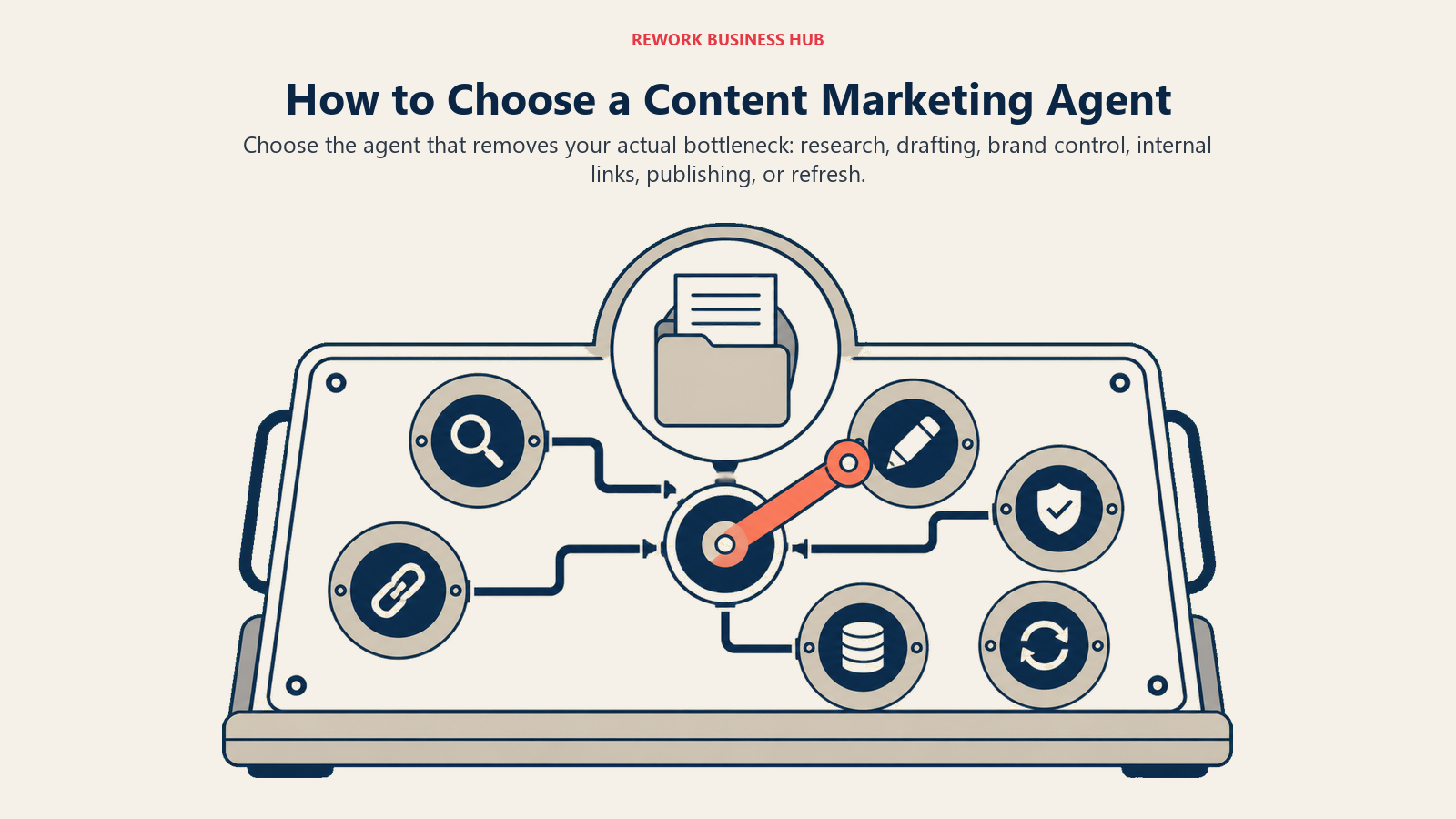
Choose the agent that removes your actual bottleneck: research, drafting, brand control, internal links, publishing, or refresh.
| If you need... | Pick... | Why |
|---|---|---|
| The most complete brief-to-publish pipeline in one product | AirOps | Workflow builder, brand kit, and CMS publish all live together |
| Brand voice enforced across a whole marketing team | Jasper or Writer | Both built their category reputation on voice and style governance |
| High-volume SEO articles pushed straight to WordPress | Byword | Keyword-to-published-post with internal links built in |
| Content living inside a broader GTM workflow, not standalone | Copy.ai | Workflows extend past blog posts into sales and lifecycle content |
| SERP research, drafting, and internal linking in one flow | Surfer AI | Native internal linking is rare enough to be the deciding factor |
| The fastest brief before a writer opens a blank doc | Frase | Purpose-built for compressing the research step specifically |
| Portfolio-level planning across a large existing library | MarketMuse | Topic modeling and decay detection at the library level, not per article |
| Text and visual brand content governed together at enterprise scale | Typeface | Purpose-built agents spanning copy and creative in one system |
| An agent that runs inside your CMS instead of beside it | Contentful AI Actions or Sanity Agent Actions | Both are native to the publishing system, not bolted onto it |
| An agency managing many client sites on one bill | Rankability | Unlimited clients and users on every tier, credit-pooled |
What to Do Next
Pick the single pipeline stage that actually costs your team the most time this month, not the tool with the longest feature list, and run one real piece of content through a 30-day trial of the agent built for that specific stage. If publishing is the bottleneck, trial AirOps or Byword against your own CMS. If brand voice keeps slipping across writers, trial Jasper or Writer against your actual style guide, not a demo script. Whichever you pick, staff the editorial review gate before you staff the agent: decide who signs off on facts, pricing, and tone before the first piece goes live, not after. For the broader agent-versus-platform decision this list sits inside, best AI agent platforms in 2026 covers the no-code, managed, and framework layers these content-specific agents are often built on top of, and best no-code AI agent builders is worth a look if none of these 12 fit and you'd rather assemble your own pipeline from parts.

Principal Product Marketing Strategist
On this page
- Key Facts
- Quick Comparison Table
- How Far Past "Generate a Draft" Each Agent Actually Goes
- How to Choose: What Actually Matters Before You Buy
- Framework: By What's Actually Broken
- Sizing and Persona Table
- 1. AirOps: The Most Complete Content Pipeline in One Product
- 2. Jasper: Brand-Governed Content Pipelines at Marketing-Team Scale
- 3. Writer: Enterprise Style Guide Enforcement, Not Just Generation
- 4. Byword: The Narrowest, Most Literal Keyword-to-Published-Post Pipeline
- 5. Copy.ai: GTM Workflows That Extend Past Blog Content
- 6. Surfer AI: Research, Draft, and Internal Linking in One SEO-Native Flow
- 7. Frase: The Brief and Refresh Specialist
- 8. MarketMuse: Portfolio-Level Planning and Decay Detection
- 9. Typeface: Enterprise Brand Content and Creative at Scale
- 10. Contentful AI Actions: The Agent That Lives Inside Your CMS
- 11. Sanity Agent Actions: The Developer-First, API-Native Agent Layer
- 12. Rankability: The Agency Budget Pipeline
- The Quality Risk at Volume (and What Google Actually Says)
- How to Choose: Decision Framework
- What to Do Next