AI Customer Success Manager para SaaS B2B: como a IA muda a proporção entre CSM e ARR
Turn this article into takeaways for your work.


Each assistant summarizes the article only for you and suggests best practices for your work.
O modelo clássico de contratação de CS (customer success) está se esgotando. Durante muito tempo, a regra prática era um CSM (customer success manager) para cada $1-1,5M de ARR (annual recurring revenue). Essa proporção fazia sentido quando os CSMs faziam sobretudo trabalho reativo: responder a escalações de suporte, conduzir quarterly business reviews e tocar conversas de renovação na memória e no relacionamento. A proporção funcionava porque os CSMs não faziam tanta coisa de forma proativa. Eles faziam triagem.
O problema é que SaaS é, cada vez mais, um jogo de retenção. O NRR (net revenue retention) é a métrica que separa bons negócios SaaS dos excelentes. Empresas com NRR acima de 110% crescem mesmo sem adicionar novos clientes. E o NRR vive em CS.
Você não consegue contratar o seu caminho até um NRR competitivo. Em escala, é preciso que os CSMs façam substancialmente mais trabalho proativo por conta do que o modelo tradicional permite. A IA não elimina o CSM. Mas muda o que um CSM consegue carregar. Essa mudança faz parte de um movimento maior, o de como a IA remodela o modelo operacional de SaaS.
O que é o AI Customer Success Manager Agent
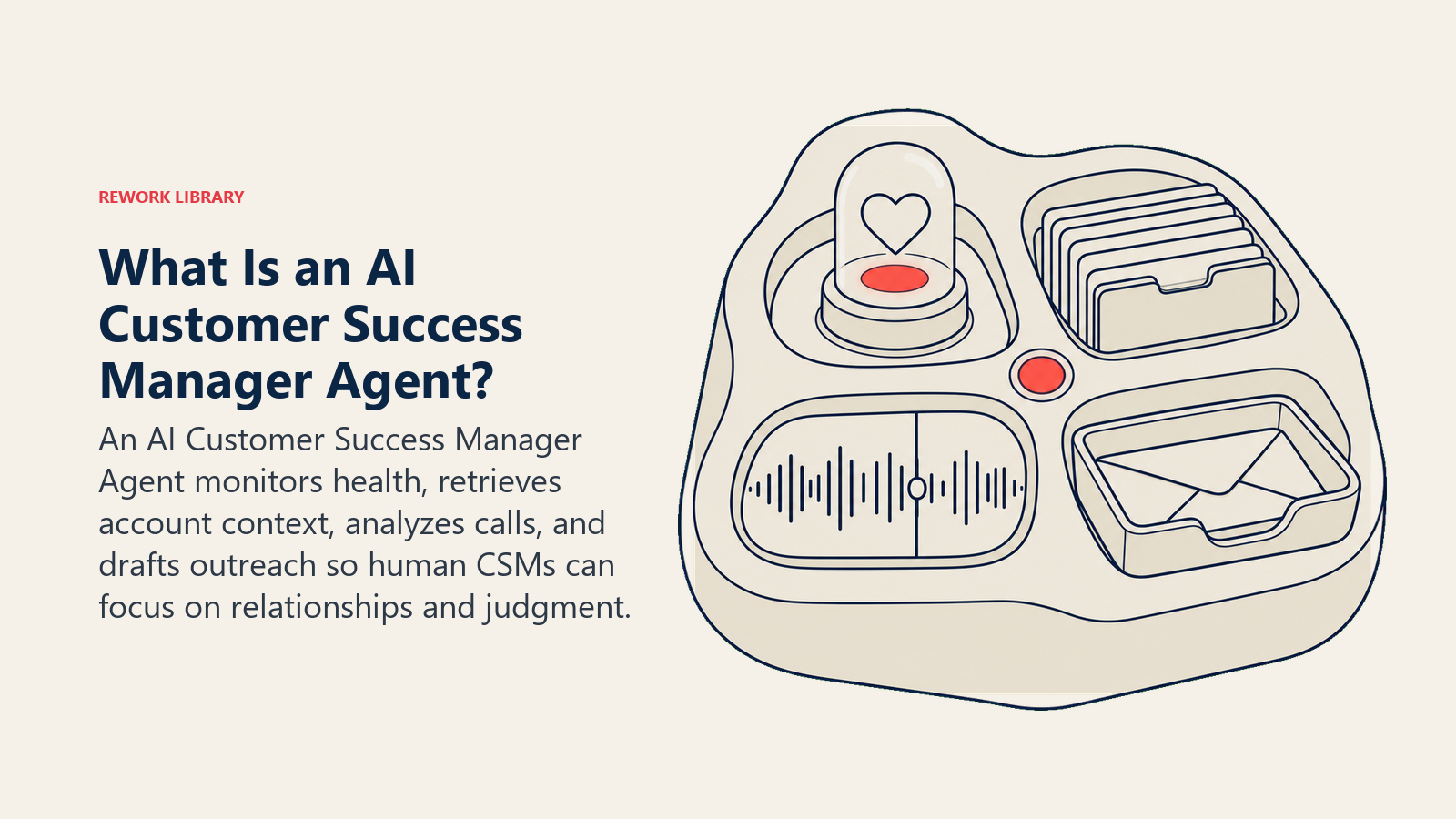
No ACE Framework, o AI Customer Success Manager é um agente de Nível 3 construído sobre quatro padrões:
Key Facts: AI em Customer Success
- Empresas SaaS que implementam modelos preditivos de churn orientados por IA veem, em média, uma melhora de 12-18% no Net Revenue Retention nos primeiros 12 meses (pesquisa de NRR da culta.ai, 2025)
- Empresas com movimentos de expansão dedicados alcançam um NRR 15-25% maior do que as que dependem apenas de expansão orgânica, e a IA é o mecanismo que torna escaláveis os movimentos sistemáticos de expansão em grandes carteiras de contas (Benchmarkit 2025 SaaS Performance Metrics)
- 85% dos líderes de atendimento e sucesso do cliente estão pilotando ou explorando IA em interações voltadas ao cliente em 2025-2026, o que faz do CS assistido por IA uma base operacional, e não um diferencial, em até 18 meses (Gartner, 2025)
- Anomaly Agent para health score (monitorar os dados de uso em busca de desvios em relação à linha de base)
- RAG Assistant para histórico de contas (trazer o contexto relevante do CRM, das chamadas e do histórico de suporte)
- Meeting Intelligence para análise de QBR (quarterly business review), transcrevendo as chamadas com clientes e extraindo compromissos, sinais e riscos
- Workflow Copilot para outreach (redigir conversas de renovação, propostas de expansão e save plays)
Cada padrão cuida de uma parte específica do trabalho do CSM. Juntos, eles mudam a economia do que é uma carteira de CSM. CSMs assistidos por IA em empresas SaaS bem instrumentadas gerenciam carteiras de $2-3M de ARR. Isso é um aumento de cerca de 2x em relação ao modelo tradicional, sem queda correspondente nos resultados dos clientes. Em alguns casos, há melhora, porque a IA revela sinais de risco que passariam despercebidos no trabalho manual.
Padrão 1: Anomaly Agent para health score
O health score é a base do AI CSM porque mostra ao time onde o comportamento do cliente mudou de forma relevante.
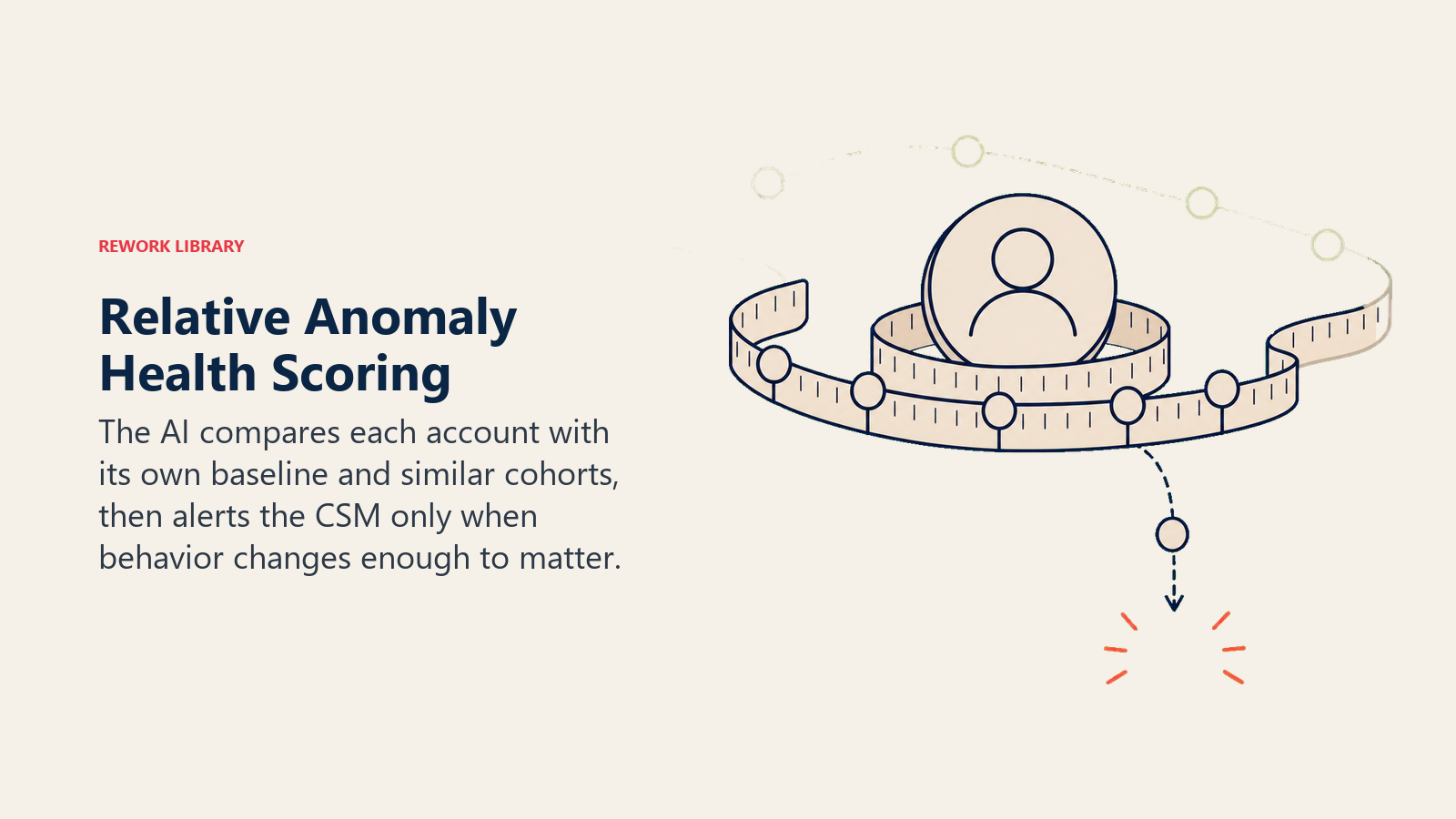
O uso mais fundamental da IA em CS é o health score, e o padrão certo é o Anomaly Agent.
A abordagem ingênua de health score é definir limites absolutos: "se os logins caírem abaixo de X por semana, marque como em risco". Isso gera falsos positivos demais. Cada cliente tem padrões de uso diferentes conforme o tamanho, a estrutura de equipe e o workflow. Uma conta de 10 licenças com três logins por semana não é igual a uma conta de 200 licenças com três logins por semana. Tratar as duas do mesmo jeito gera alertas que os times de CS aprendem rápido a ignorar.
O padrão Anomaly Agent é mais inteligente. Ele faz o Ingest de um fluxo contínuo de dados de uso, faz o Analyze de cada conta contra a própria linha de base histórica e contra benchmarks de coorte (contas de tamanho, idade e plano semelhantes), faz o Predict de quando o desvio do comportamento esperado ultrapassa um limite relevante e faz o Execute de um alerta para o CSM responsável.
As palavras-chave são "anomalia relativa" em vez de "limite absoluto". Uma conta cujos logins caíram 40% em relação à própria média de noventa dias é uma anomalia que merece investigação. Uma conta com poucos logins que sempre teve poucos logins não é uma anomalia. É o padrão dela.
A Gainsight AI implementa isso com o que chama de health score orientado por Copilot, em que o modelo é treinado com os dados históricos do próprio cliente e calibrado com os resultados de churn que ele de fato observou. A ChurnZero usa uma abordagem parecida, com mais ênfase em alertas em tempo real. A Planhat é especialmente forte para times de CS que querem controle granular sobre a composição e a ponderação do health score.
Os sinais que o Anomaly Agent monitora em um contexto SaaS são específicos do modelo de assinatura:
Profundidade de uso do produto. Não apenas logins, mas quais funcionalidades estão em uso. Um cliente que usava oito funcionalidades no terceiro mês e agora usa quatro está mostrando comportamento de contração. Uma conta cuja atividade de integração caiu a zero é um risco de churn, qualquer que seja a frequência de login.
Uso de API vs. limites do contrato. Em produtos voltados a desenvolvedores, o volume de chamadas de API é um sinal mais confiável do que os logins na interface. A queda no uso de API quase sempre é um sinal negativo.
Utilização de licenças. Contas com 40% de utilização das licenças contratadas são candidatas a downsell na renovação. Contas com 95% de utilização são candidatas a expansão. Ambos são sinais.
Amplitude de integrações. Contas com mais integrações conectadas são mais "grudentas". Uma conta que desconecta uma integração-chave mostra um sinal que vale investigar.
Mas saber quem está em risco é só metade do problema. O problema mais difícil é dar aos CSMs o contexto de que precisam para agir com inteligência quando um alerta dispara.
Padrão 2: RAG Assistant para histórico de contas
Todo CSM herda contas cujo onboarding ele não fez o onboarding. Essa é uma das fontes mais constantes de risco de retenção em organizações de CS em SaaS. Um CSM que assume uma carteira de cinquenta contas precisa de duas a três semanas de revisão manual para entender o que aconteceu em cada uma: histórico de onboarding, problemas passados, conversas de expansão, discussões de renovação, anotações do CSM, escalações de suporte.
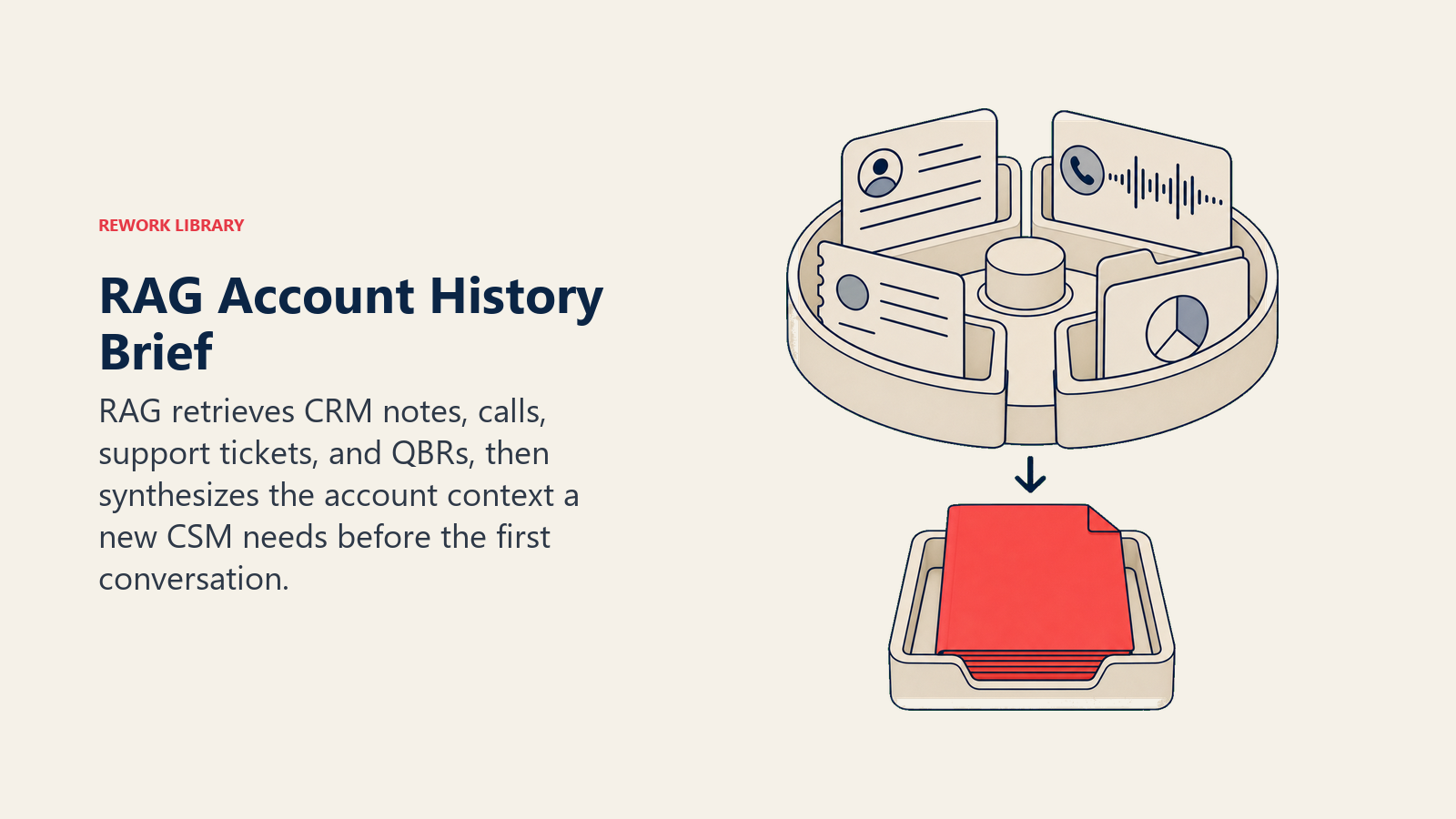
É tempo que o novo CSM não tem, e as contas não recebem a atenção devida durante a transição.
O padrão RAG Assistant muda isso. Quando um CSM recebe uma conta nova ou assume uma existente, o RAG Assistant consulta a base de conhecimento (notas do CRM, transcrições de chamadas, histórico de tickets de suporte, documentos de QBR) e gera um resumo da conta: o que ela comprou, quais problemas já teve, quais expansões foram discutidas, como é o histórico de renovações e quaisquer alertas deixados nas anotações do CSM anterior.
O que antes levava duas semanas de leitura manual leva vinte minutos com o apoio da IA. O CSM revisa o resumo, faz perguntas de acompanhamento ("quais foram as principais preocupações levantadas no último QBR?") e entra na primeira chamada com contexto.
Gong e Chorus.ai fornecem a camada de transcrição de chamadas que alimenta esse padrão. Gainsight e Planhat agregam os dados de CRM e de produto. O RAG Assistant conecta essas fontes e as torna consultáveis pelo CSM, em vez de obrigá-lo a navegar por quatro ferramentas diferentes.
Ter o contexto à mão é necessário. Mas registrar o que é dito nas conversas de maior alavancagem é a próxima lacuna.
Padrão 3: Meeting Intelligence para análise de QBR
As Quarterly Business Reviews estão entre as interações com clientes de maior alavancagem que um CSM conduz. São também aquelas em que as informações mais acionáveis são trocadas e perdidas com mais regularidade.
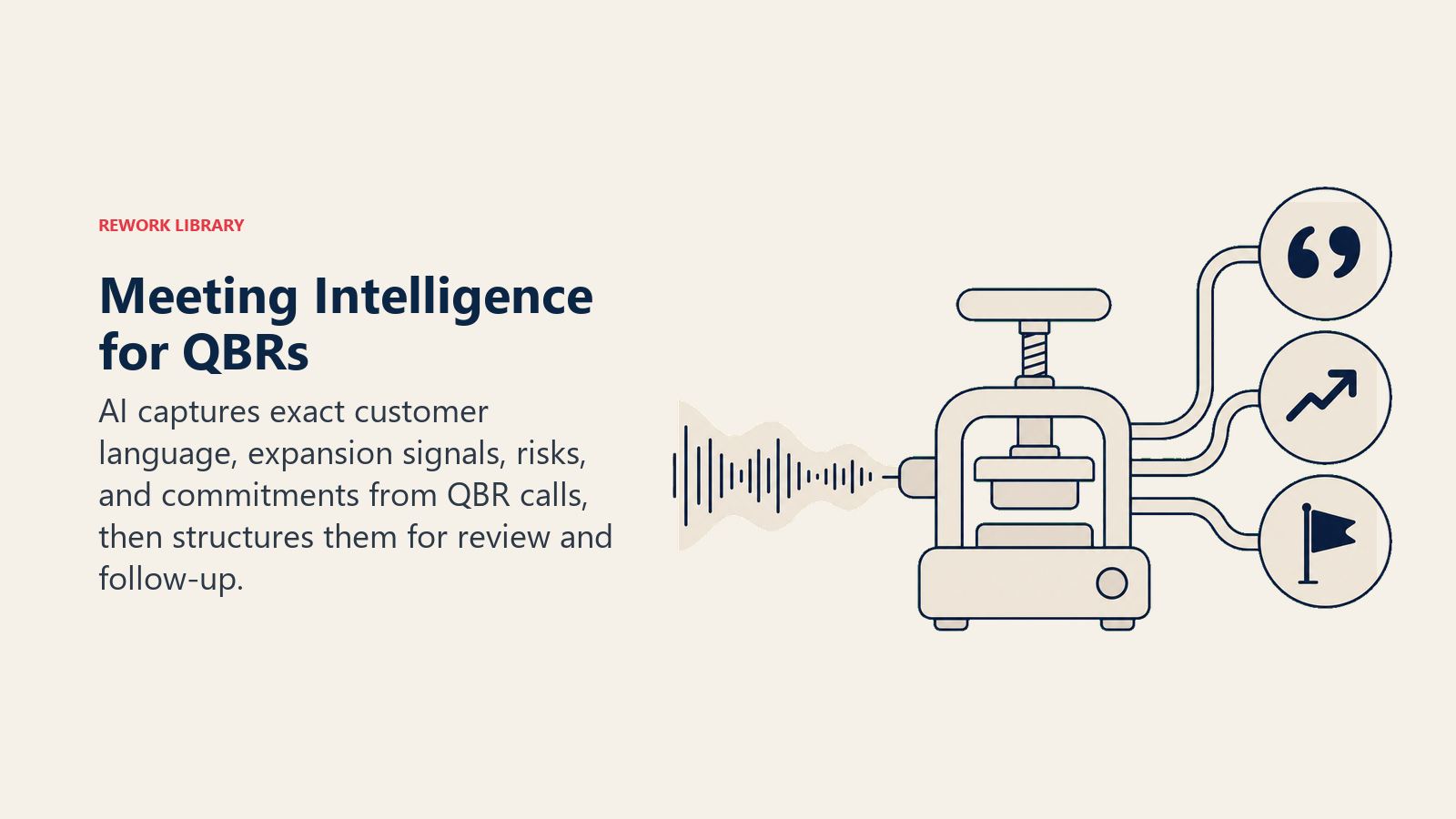
Uma chamada de QBR produz uma transcrição com compromissos, objeções, sinais de expansão e alertas de risco espalhados ao longo de uma conversa de quarenta a sessenta minutos. O CSM faz anotações durante a chamada, mas anotações feitas durante uma conversa são incompletas por natureza. Não dá para ouvir e escrever ao mesmo tempo com fidelidade total.
O padrão Meeting Intelligence faz o Ingest da gravação do QBR, faz o Analyze para extrair os compromissos assumidos, as objeções levantadas, as oportunidades de expansão mencionadas e os sinais de risco presentes, e faz o Generate de um resumo estruturado que atualiza automaticamente o registro da conta no CRM. O CSM revisa o resultado em vez de escrever anotações depois da chamada.
Três coisas que isso captura e que as anotações manuais costumam perder:
A linguagem exata. Quando um cliente diz "os relatórios ainda não atendem às expectativas que definimos no onboarding", essa frase específica pesa mais do que "o cliente mencionou preocupações com relatórios". A IA captura a linguagem. O CSM a usa no follow-up.
Sinais implícitos de expansão. "Vamos contratar mais quinze AEs no próximo trimestre" é um sinal de expansão. Um CSM que anota manualmente pode registrar isso como contexto. O padrão Meeting Intelligence o sinaliza como oportunidade e cria uma tarefa de acompanhamento.
Acompanhamento de compromissos. Se o CSM se comprometeu a enviar um documento comparativo específico até sexta-feira, a IA registra esse compromisso e cria uma tarefa no CRM. Chega de follow-ups perdidos por não terem sido anotados.
O quarto padrão é o que converte toda essa inteligência em ação.
Padrão 4: Workflow Copilot para outreach
O quarto padrão é o que os CSMs sentem de forma mais imediata. Escrever outreach de CS é um trabalho repetitivo: as conversas de renovação seguem estruturas previsíveis, os save plays de contas em risco têm padrões reconhecíveis e as propostas de expansão cobrem terreno parecido de uma conta para outra.
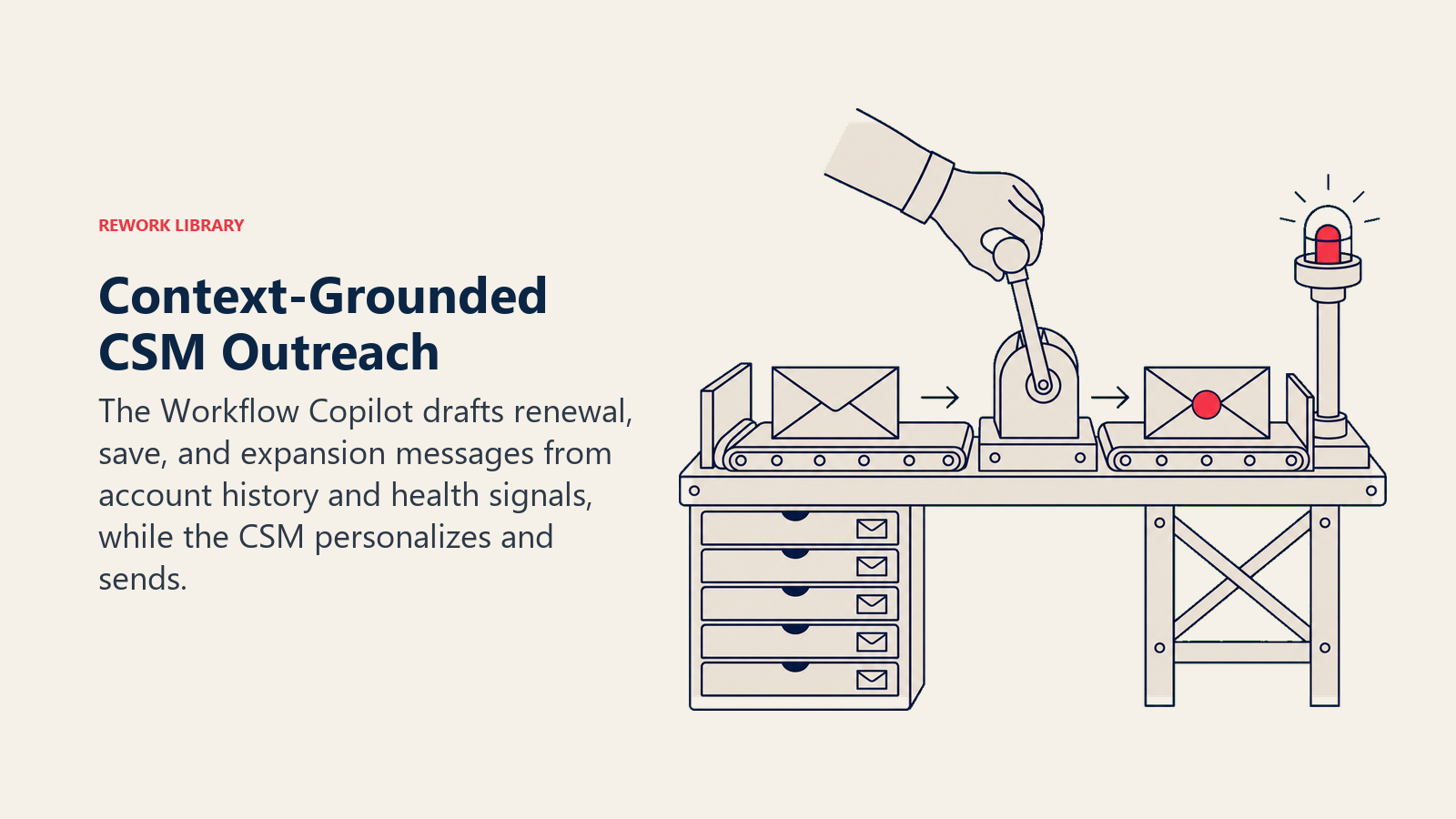
O padrão Workflow Copilot redige essas comunicações com base no contexto da conta vindo da camada RAG e nos sinais de saúde do Anomaly Agent. O CSM revisa, personaliza e envia. Ele não começa de um e-mail em branco.
O nível de qualidade aqui é importante. O outreach de CSM redigido por IA precisa soar como se viesse de uma pessoa que realmente conhece a conta, e não de um template. O Workflow Copilot se apoia no histórico da conta, nos e-mails anteriores do próprio CSM e nos sinais específicos que dispararam o contato para produzir um rascunho personalizado para a situação da conta. Um template do tipo "você foi marcado como em risco" que todo cliente reconhece destrói o relacionamento. Um e-mail como "notei que o seu uso de API caiu bastante depois da mudança na estrutura da sua equipe no mês passado e quis saber como posso ajudar" mostra que alguém está prestando atenção.
Quando os quatro padrões rodam juntos, o efeito se acumula de maneiras que mudam o dimensionamento dos times de CS.
O 4-Pattern CSM Stack
O 4-Pattern CSM Stack é a arquitetura canônica do AI Customer Success Manager: Anomaly Agent (monitoramento contínuo de saúde que detecta desvios em relação às linhas de base comportamentais específicas de cada conta), RAG Assistant (síntese do histórico da conta, que reduz o onboarding de uma nova conta de duas semanas para vinte minutos), Meeting Intelligence (análise de QBRs e chamadas que captura a linguagem exata, os sinais de expansão e o acompanhamento de compromissos) e Workflow Copilot (redação de outreach baseada no contexto da conta e em sinais de saúde específicos). Os padrões compartilham dados: o sinal de risco de churn do Anomaly Agent informa o que o RAG Assistant traz à tona, o que por sua vez informa o que o Workflow Copilot redige. O efeito composto aparece quando os quatro rodam juntos, porque o CSM recebe um briefing completo e rico em contexto em cada ponto de intervenção, em vez de ter de montar as informações a partir de quatro ferramentas separadas.
Sinais específicos de SaaS que o AI CSM monitora
Produtos SaaS geram uma telemetria que as plataformas de CS tradicionais não conseguem inferir apenas de reuniões e anotações de conta.
Os sinais disponíveis em CS de SaaS diferem dos de CS B2B fora de SaaS. Produtos SaaS geram telemetria comportamental contínua. Serviços tradicionais ou produtos com licença perpétua não geram.
O conjunto de sinais específicos de SaaS inclui:
- Profundidade de adoção de funcionalidades ao longo do tempo (os clientes usam mais do produto no mês doze do que no mês três, ou menos?)
- Amplitude de colaboração (quantos usuários da conta estão ativos, em relação às licenças contratadas?)
- Integração ao workflow (os clientes usam o produto como sistema central ou como ferramenta periférica?)
- Comportamento de upgrade (aceitaram uma oferta de add-on de funcionalidade? rejeitaram uma proposta de expansão de licenças?)
- Padrão de interação com o suporte (o volume de tickets está aumentando e quais são as categorias? Problemas técnicos são diferentes de dúvidas do tipo "como eu faço", que muitas vezes indicam lacunas de onboarding)
Esses sinais não estão disponíveis para ferramentas de CS fora de SaaS e não são bem aproveitados por sistemas de CRM genéricos. É por isso que plataformas de CS especializadas, como Gainsight, ChurnZero e Planhat, oferecem valor distinto: elas foram criadas para ingerir e analisar dados de telemetria de produto específicos de SaaS, e não apenas a atividade do CRM.
A implicação no desenho da organização: a proporção CSM-ARR muda
A implicação para o dimensionamento depende de qual parte do trabalho do CSM a IA absorve e de qual trabalho de relacionamento ainda exige julgamento humano.
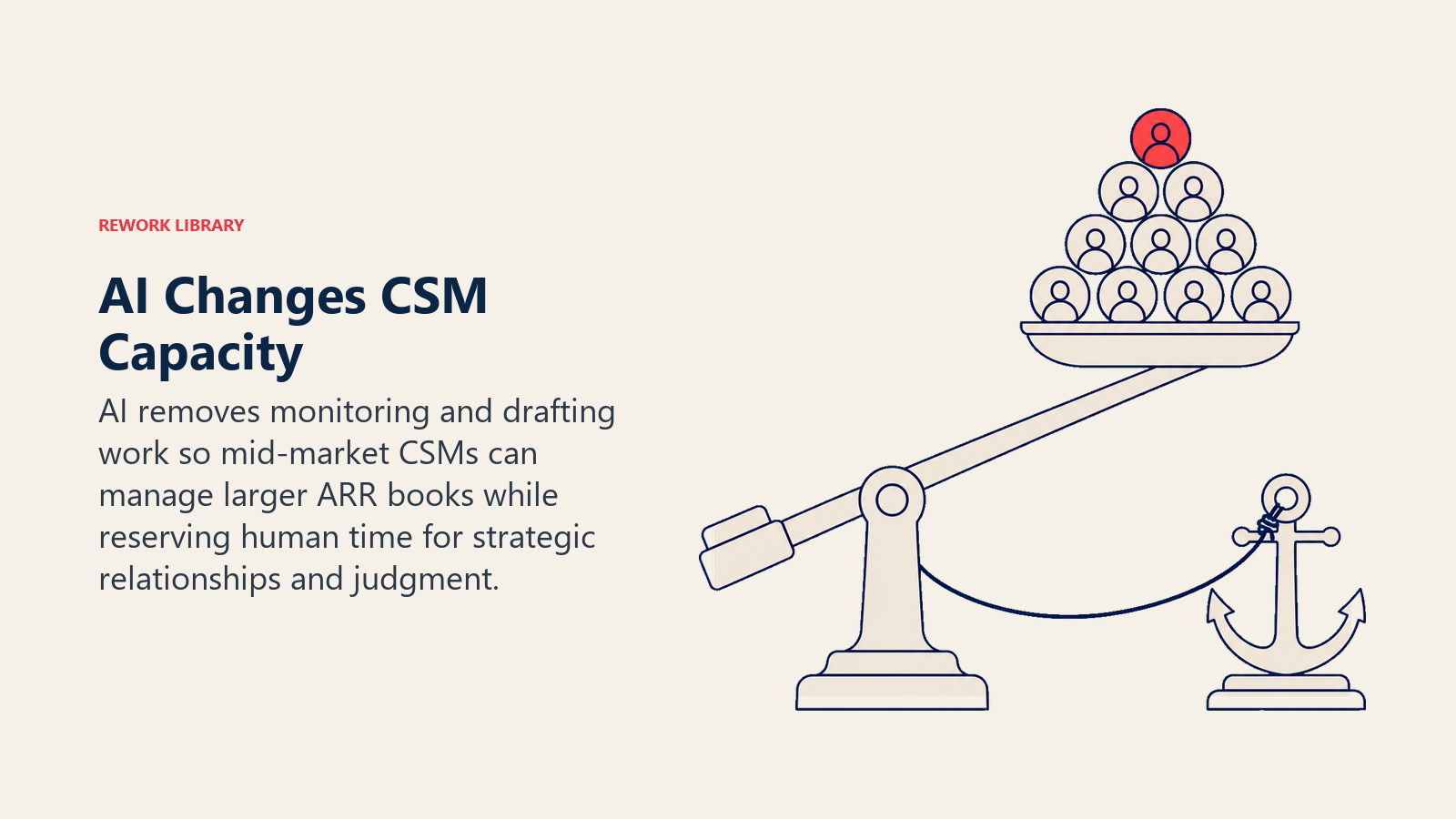
Se um CSM tradicionalmente gerenciava $1-1,5M de ARR em uma empresa SaaS, qual é o número certo com um AI CSM Agent em operação?
A resposta honesta é: depende da complexidade das contas. Contas enterprise com ACV (annual contract value) acima de $100K exigem uma gestão de relacionamento humana substancial, independentemente da ferramenta de IA. A IA reduz o trabalho administrativo e de monitoramento, não o trabalho estratégico. Um CSM que gerencia cinco contas de $200K ainda precisa estar profundamente engajado com cada uma delas.
Nas contas mid-market ($20-100K de ACV), a assistência da IA tem o maior impacto. O Anomaly Agent revela os sinais de risco que, de outro modo, exigiriam que o CSM revisasse manualmente os dados de uso de cada conta toda semana. O RAG Assistant elimina o tempo de pesquisa sobre a conta. O Workflow Copilot reduz o esforço de escrita. Um CSM experiente que gerencie esse segmento com apoio de IA consegue tocar $2,5-3M de ARR com folga.
Nas contas SMB (ACV abaixo de $20K), o movimento de CS é majoritariamente digital: monitoramento automatizado de health score, alertas automáticos de risco e outreach redigido por IA que segue para um CSM de baixo toque revisar. O tempo do CSM humano fica reservado para save plays em contas em risco e conversas de expansão em contas de alta utilização.
A implicação orçamentária para o CCO (chief customer officer): em vez de contratar um CSM a cada $1-1,5M de crescimento de ARR, você contrata um a cada $2-3M. Sobre uma base de $20M de ARR, essa é a diferença entre 13-20 CSMs e 7-10 CSMs. A pesquisa da McKinsey sobre NRR em tecnologia B2B conclui que empresas com NRR no quartil superior chegam à lucratividade mais rápido e conquistam múltiplos de valuation mais altos, o que faz do investimento em CS uma contribuição direta ao valor da empresa. A economia de custos financia o investimento na plataforma de IA, e ainda sobra.
As melhores empresas hoje geram mais de 50% do novo ARR a partir de upsells, e as maiores, acima de $100M de ARR, obtêm 67% do novo ARR com expansão, e não com aquisição de novos clientes. Essa mudança faz da função de CSM um motor de receita primário, e não apenas uma função de retenção. Contas enterprise com ACV acima de $100K têm em média 118% de NRR; o mid-market fica em 108%; o SMB, em 97%. A diferença entre essas faixas se deve em grande parte à qualidade e à proatividade do trabalho de CS em cada segmento. (Optifai NRR Benchmarks, 939 empresas, 2025)
Rework Analysis: O redesenho do papel de CSM que funciona não é "os CSMs fazem o mesmo trabalho mais rápido". É "os CSMs se concentram exclusivamente nas decisões e nos relacionamentos que a IA não consegue assumir". Exemplos específicos: os CSMs deixam de conferir dashboards de uso (a IA faz isso), deixam de escrever os primeiros rascunhos do conteúdo dos slides de QBR (a IA faz isso) e deixam de agendar check-ins de memória (o Workflow Copilot cria as tarefas). O que os CSMs passam a fazer mais: o telefonema depois da saída inesperada de um champion, a conversa de relacionamento com executivos que a IA sinalizou como devida e o julgamento sobre se um save play deve incluir flexibilidade comercial. Essa mudança do trabalho administrativo para o trabalho relacional é o que leva o NRR da mediana ao quartil superior.
Por onde começar
A primeira implementação certa para a maioria dos times de CS em SaaS é o health score com o Anomaly Agent. Ela exige dados de uso do produto enviados para uma plataforma de CS, uma base de resultados históricos de churn para calibrar e um processo para os CSMs responderem aos alertas. A pesquisa de atendimento ao cliente da Gartner de 2025 mostra que 85% dos líderes de atendimento e suporte estão pilotando ou explorando IA em interações voltadas ao cliente, o que faz de 2025-2026 a janela crítica para acertar a implementação antes que os concorrentes normalizem essa capacidade.
O erro comum é dar peso demais aos dashboards de health score e peso de menos aos workflows de resposta dos CSMs. Um health score que ninguém age a tempo não reduz o churn. O sistema só funciona quando o alerta dispara uma intervenção definida dentro de uma janela de tempo definida.
Para a mecânica específica dos modelos de previsão de churn, das categorias de sinais e do desenho de save plays, IA para previsão de churn em modelos de assinatura cobre o lado da previsão em detalhes. Para workflows de IA específicos de QBR, AI QBR Prep para Customer Success em SaaS traz a implementação tática. E, para o modelo de health score em si, Health Scoring com IA para clientes SaaS apresenta a lógica de ponderação de sinais que separa health scores significativos de health scores decorativos.
| Função do CSM | Abordagem tradicional | Abordagem assistida por IA | Impacto no tempo |
|---|---|---|---|
| Monitoramento de saúde da conta | Revisão manual semanal dos dashboards de uso | O Anomaly Agent sinaliza desvios automaticamente, 24/7 | Elimina 30-40% do tempo administrativo semanal do CSM |
| Onboarding de novas contas | 2-3 semanas para revisar o histórico | O RAG Assistant gera o resumo da conta em 20 minutos | Redução de 95% no tempo |
| Preparação de QBR | 3-5 horas por deck de QBR | O Meeting Intelligence extrai sinais e o Copilot redige os slides | Redução de 2-3 horas por QBR |
| Outreach de CS | Redação de e-mail do zero | O Workflow Copilot redige a partir do contexto da conta e dos sinais de saúde | Redução de 60-80% no tempo de escrita |
| Identificação de expansão | Detecção ad hoc na renovação | O Anomaly Agent sinaliza os sinais 60-90 dias antes da renovação | Identificação 2-3 meses mais cedo |
Fonte: benchmarks de Gainsight, ChurnZero, Planhat (2024-2025)
Perguntas Frequentes
O que é o AI Customer Success Manager Agent em SaaS?
O AI CSM Agent é um agente de Nível 3 do ACE Framework construído sobre quatro padrões: o Anomaly Agent (monitoramento contínuo de saúde que detecta desvios em relação às linhas de base comportamentais específicas de cada conta), o RAG Assistant (síntese do histórico da conta), o Meeting Intelligence (análise de QBRs e chamadas) e o Workflow Copilot (redação de outreach orientada por contexto). Juntos, formam o 4-Pattern CSM Stack. CSMs assistidos por IA em empresas SaaS bem instrumentadas gerenciam carteiras de $2-3M de ARR, contra $1-1,5M dos CSMs tradicionais, sem queda nos resultados dos clientes.
Como o AI CSM melhora o NRR?
Empresas SaaS que implantam modelos preditivos de churn orientados por IA veem, em média, uma melhora de 12-18% no NRR em 12 meses. O mecanismo: o Anomaly Agent revela contas em risco 60-90 dias antes da renovação, dando aos CSMs tempo para intervenções substantivas em vez de tentativas de última hora de reverter a situação. As taxas de sucesso de save plays a 90 dias da renovação ficam em 25-40%; a 30 dias, caem para 10-20%. Empresas com movimentos de expansão apoiados por IA também identificam sinais de upsell de forma proativa, o que contribui para um NRR 15-25% maior do que o de times que dependem de expansão orgânica.
O que é o 4-Pattern CSM Stack?
O 4-Pattern CSM Stack é a arquitetura canônica do AI CSM: Anomaly Agent, RAG Assistant, Meeting Intelligence e Workflow Copilot rodando juntos e compartilhando contexto. O sinal de risco de churn do Anomaly Agent informa o que o RAG Assistant mostra ao CSM. O contexto da conta trazido pelo RAG Assistant informa o que o Workflow Copilot redige. Os padrões se potencializam: cada um fica mais preciso e mais útil por ter acesso aos resultados dos outros.
O que acontece com o papel do CSM quando a IA assume o monitoramento de saúde?
Os CSMs deixam o trabalho administrativo (conferir dashboards de uso, escrever primeiros rascunhos, agendar check-ins de memória) e passam para o trabalho de relacionamento e julgamento (o telefonema depois da saída de um champion, a conversa com executivos que a IA sinalizou, a decisão sobre se um save play precisa de flexibilidade comercial). As melhores empresas hoje geram mais de 50% do novo ARR a partir de upsells, o que significa que a função de CSM é um dos principais motores de receita. A IA dá aos CSMs capacidade para ter mais conversas de expansão, e não menos.
Quais benchmarks de NRR os times de CS em SaaS devem buscar?
O NRR mediano do SaaS B2B é de 106%, e os melhores do quartil superior passam de 120%. Contas enterprise têm em média 118% de NRR; o mid-market fica em 108%; o SMB, em 97%. A diferença entre a mediana e o quartil superior se deve em grande parte à proatividade de CS e à qualidade do movimento de expansão. Empresas que adotam CS por exceção (em que a IA sinaliza as contas e os CSMs agem sobre os alertas) relatam taxas de retenção 25-40% maiores e um ROI de 3-5x sobre o headcount de CS, em comparação com abordagens de monitoramento manual.
Que sinais o AI CSM monitora especificamente em SaaS?
Profundidade de adoção de funcionalidades ao longo do tempo (uso de mais ou menos capacidades do produto do que em meses anteriores), amplitude de colaboração (quantas licenças contratadas são usadas ativamente), profundidade de integração ao workflow (sistema central vs. ferramenta periférica), comportamento de upgrade e downsell em interações comerciais passadas, e volume e categorias de tickets de suporte (aumento de problemas técnicos vs. aumento de dúvidas do tipo "como eu faço", que indicam lacunas de onboarding). Esses sinais são específicos da telemetria de produto SaaS e não são revelados por sistemas de CRM genéricos.
Related:

Co-Founder, Rework.com
On this page
- O que é o AI Customer Success Manager Agent
- Padrão 1: Anomaly Agent para health score
- Padrão 2: RAG Assistant para histórico de contas
- Padrão 3: Meeting Intelligence para análise de QBR
- Padrão 4: Workflow Copilot para outreach
- O 4-Pattern CSM Stack
- Sinais específicos de SaaS que o AI CSM monitora
- A implicação no desenho da organização: a proporção CSM-ARR muda
- Por onde começar