Writing Competencies That Connect: A Natural Approach
Turn this article into takeaways for your work.


Each assistant summarizes the article only for you and suggests best practices for your work.
Moving Beyond Bullet Points
Traditional competency frameworks often read like technical manuals - full of bullet points, rigid structures, and formal language that feels distant from real workplace experiences. But what if competencies could tell a story? What if they could engage readers, spark recognition, and inspire genuine development rather than mere compliance?
This guide shows you how to write competencies that flow naturally, connect emotionally, and still deliver comprehensive information. Think of it as having a conversation with a colleague about what excellence looks like, rather than reading a policy document.
Understanding What Makes a Competency Engaging
Starting with the Human Element
When you think about someone who excels at strategic thinking, you don't picture a list of behaviors - you see a person in action. Maybe it's that colleague who always seems to anticipate market changes before they happen, or the leader who connects seemingly unrelated dots to spot opportunities others miss. This is where your competency description should begin - with the human experience.
Consider how strategic thinkers actually work. They're the ones who pause during rushed meetings to ask, "But what happens next quarter?" They're sketching scenarios on whiteboards while others are still discussing yesterday's problems. They read industry reports for fun and can't help but see patterns everywhere. This vivid, relatable imagery helps readers recognize the competency in themselves and others.
The Power of Progressive Storytelling
Every competency exists on a journey from beginner to master. Instead of presenting this as discrete levels with bullet points, imagine it as a professional growth story. Someone starting their career might focus on understanding their immediate environment and making connections within their team. As they grow, their lens widens - they begin seeing how their department connects to others, how industry trends affect their work, how global events ripple through to their daily decisions.
This progression feels natural because it mirrors real career development. Readers can locate themselves within this narrative and see their path forward, making the competency framework a development tool rather than just an assessment rubric.
Creating Flow and Connection
Opening with Purpose and Relevance
Your opening paragraph should immediately answer the question every reader has: "Why should I care about this?" Don't start with a definition - start with impact. For instance:
"Imagine walking into a crisis situation where everyone else sees chaos, but you see patterns and possibilities. While others are paralyzed by complexity, you're already mapping out three potential solutions and their likely outcomes. This is what exceptional problem-solving looks like in practice - not just fixing what's broken, but transforming challenges into opportunities for innovation and growth."
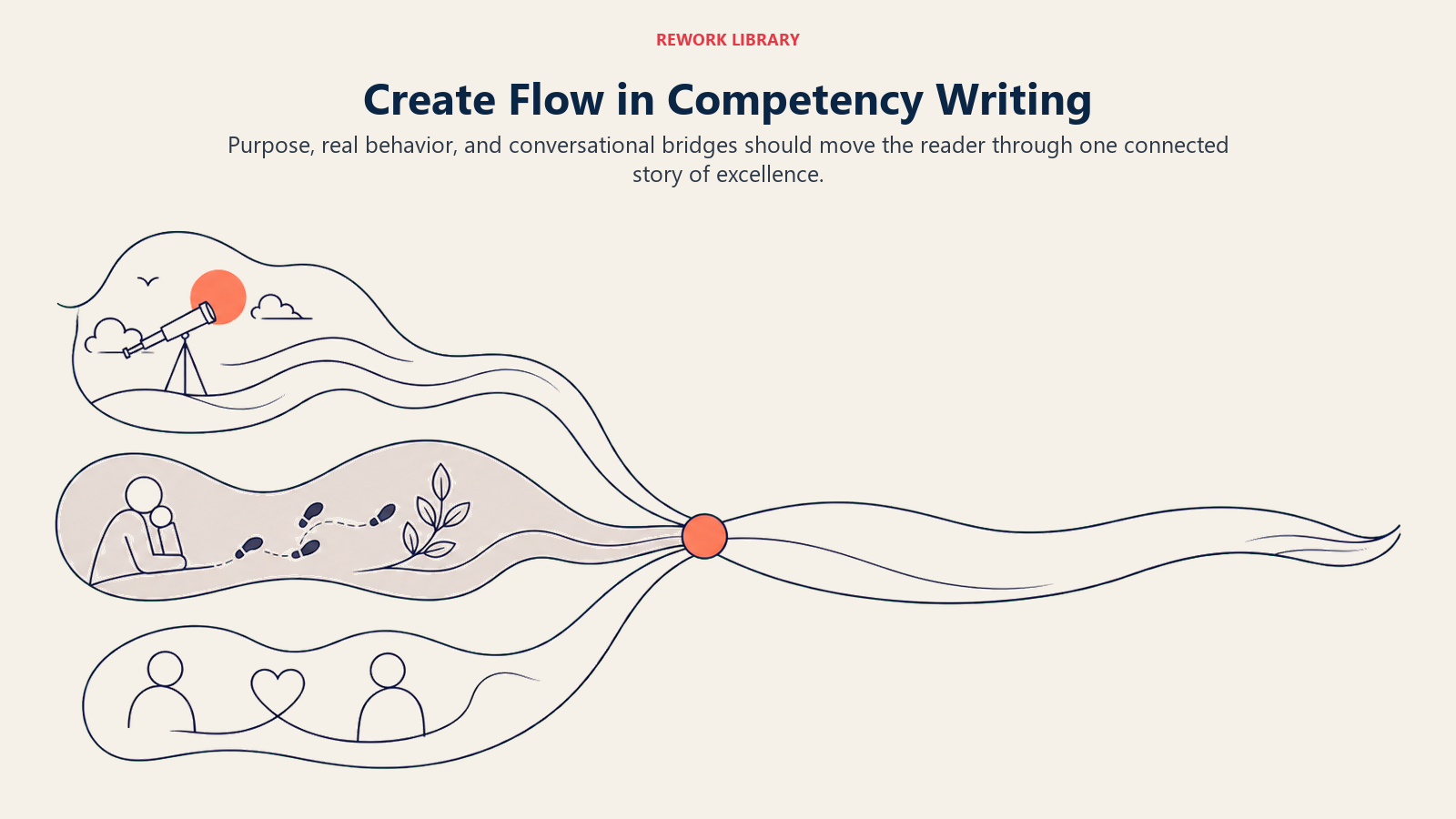
This approach draws readers in by helping them visualize success and understand the real-world value of the competency.
Weaving in the Technical Without Losing the Human
Of course, competencies need substance - specific behaviors, measurable outcomes, clear expectations. The key is integrating these elements naturally into your narrative. Instead of listing "Analyzes data to identify trends," you might write:
"Strategic thinkers have developed an almost instinctive habit of scanning their environment for signals. They pull insights from customer feedback, competitor moves, and market data, but they do more than just collect information. They connect these diverse inputs into coherent patterns, seeing relationships that others miss. When they present their findings, colleagues often wonder, 'How did you see that?' The answer lies in their systematic yet intuitive approach to making sense of complexity."
Notice how this paragraph includes the technical skill (data analysis) but embeds it within a story of how the skill manifests in real work situations.
Using Conversational Bridges
Transitions between sections should feel like natural progressions in a conversation, not abrupt topic changes. Use phrases that guide readers smoothly:
- "This naturally leads to the question of how..."
- "You might be wondering how this looks in practice..."
- "Of course, developing this capability doesn't happen overnight..."
- "What makes this particularly powerful is..."
These bridges maintain engagement while moving through different aspects of the competency.
Structuring for Natural Reading
The Three-Act Competency Story
Think of each competency description as having three acts:
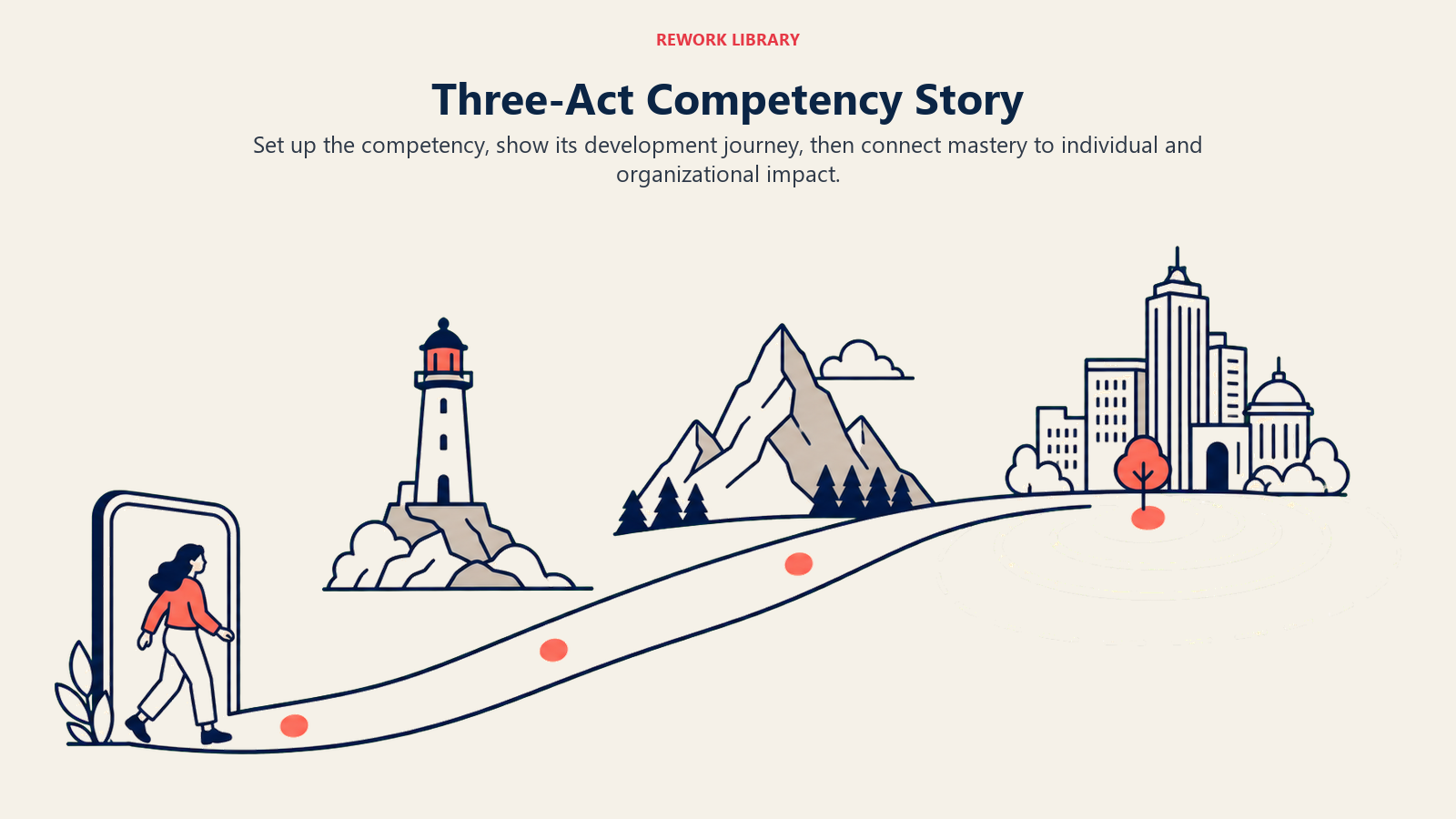
Act 1: The Setup (Understanding the Competency) Begin by painting a picture of what excellence looks like. Use scenarios, analogies, or brief stories that help readers immediately grasp why this competency matters. This section should create recognition and aspiration.
Act 2: The Journey (Development and Application) Explore how this competency develops over time and manifests in different contexts. Show the progression from foundational skills to mastery, but do it through narrative examples rather than level descriptions. Include challenges people face and how they overcome them.
Act 3: The Impact (Results and Integration) Conclude by connecting the competency to broader outcomes - for individuals, teams, and organizations. Show how mastery in this area creates ripple effects and integrates with other capabilities.
Maintaining Rhythm and Pace
Vary your sentence lengths to create natural rhythm. Short sentences create emphasis. Longer sentences allow you to explore nuance and build complex ideas that mirror the sophisticated thinking you're describing in many competencies. Questions can break up text and engage readers directly. "Have you ever noticed how some people just seem to know what's coming next?"
Use paragraphs of different lengths too. Some ideas need space to breathe and develop fully, while others are powerful in their brevity.
A single line can make a point stand out.
Writing Development Strategies That Inspire Action
Making Development Feel Achievable
Instead of presenting a list of development activities, create a narrative around the development journey:
"Developing strategic thinking often begins with a simple shift in perspective. Start by dedicating just 15 minutes each week to reading about trends outside your immediate field. You might feel like this is taking time away from 'real work,' but you'll soon notice connections forming. That article about retail transformation suddenly sparks an idea for your manufacturing process. The documentary about sports psychology offers insights for team management.
As this practice becomes natural, you'll find yourself asking different questions in meetings. Instead of 'How do we fix this?' you'll wonder 'What's this telling us about where we're headed?' Colleagues will start seeking your input on planning initiatives because you bring a perspective they hadn't considered."
This approach makes development feel like a natural evolution rather than a daunting checklist.
Creating Personal Connection Points
Help readers see themselves in the development process:
"You know that feeling when you finally see the solution to a problem that's been nagging at you? That 'aha' moment often comes not from working harder on the problem, but from stepping back and approaching it differently. This is what developing systems thinking feels like - gradually, you start seeing connections everywhere. The morning traffic pattern reminds you of workflow bottlenecks. Your child's Lego construction inspires a new project structure. These moments of insight become more frequent as you train your mind to think systemically."
Integrating Assessment Naturally
Behavioral Indicators as Stories
Rather than listing behavioral indicators, weave them into descriptive passages:
"Watch a master communicator in action and you'll notice subtle but powerful patterns. They enter a room and immediately read the energy - are people energized or exhausted? Defensive or open? They adjust their approach accordingly, perhaps starting with a light comment to ease tension or diving straight into substance when the group is ready for depth.
During discussions, they lean forward when others speak, their body language saying 'I'm fully here with you.' They ask questions that show they've not just heard but understood - 'So if I'm following correctly, your main concern is not the timeline but the resource allocation?' When they present ideas, they use language that resonates with their audience, translating technical concepts for executives or strategic vision for technical teams."
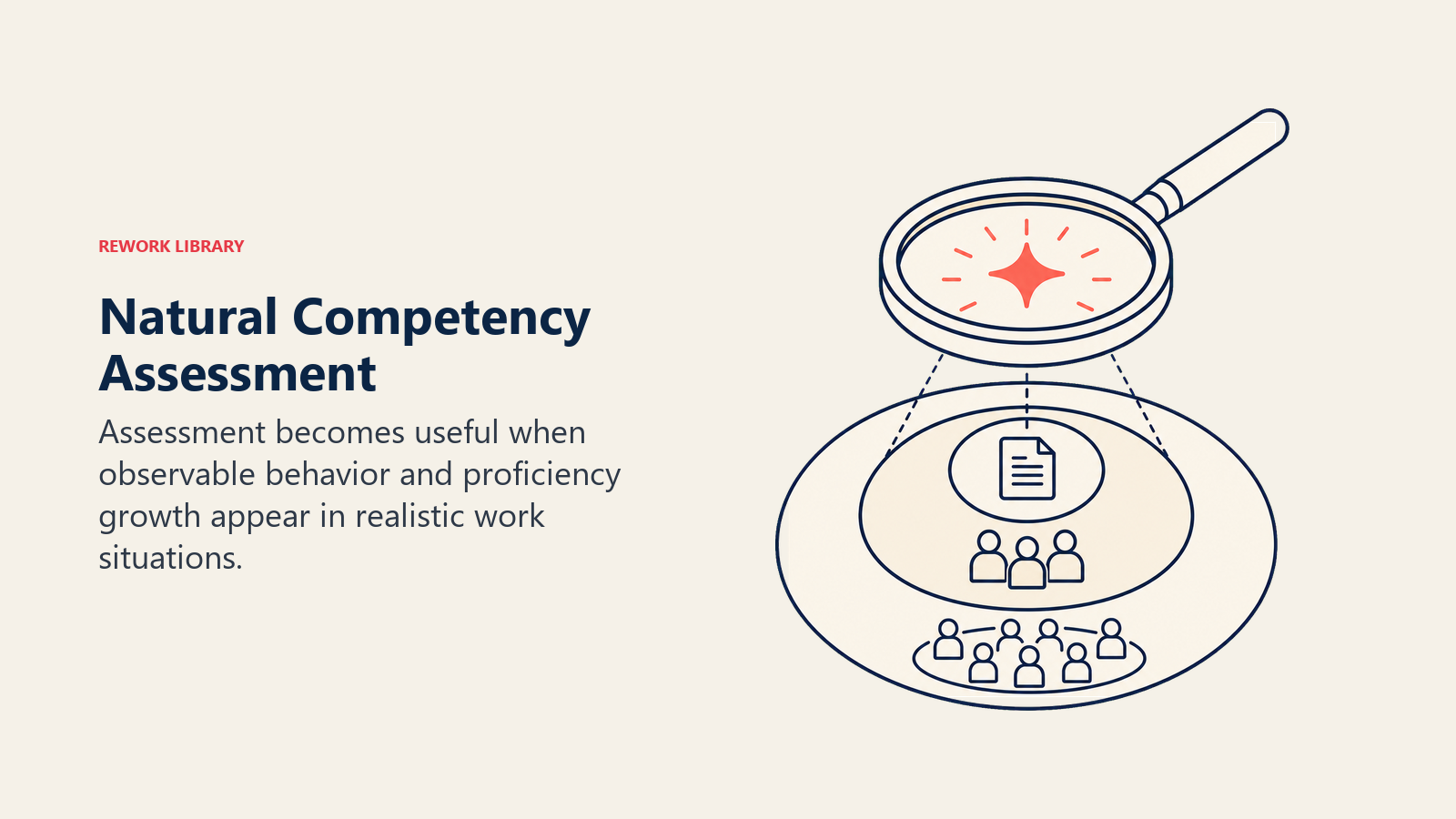
This narrative approach helps readers recognize behaviors in context rather than checking boxes on a list.
Making Proficiency Levels Feel Like Growth
Instead of rigid level descriptions, show progression as a natural evolution:
"Early in your career, strategic thinking might mean successfully planning your own projects with an eye toward future implications. You're beginning to see beyond immediate tasks to consider downstream effects and dependencies. This is valuable and necessary foundation-building.
As you grow, your strategic lens widens. You're not just planning your own work but considering how it fits into team and department objectives. You start noticing patterns - why certain projects succeed while others struggle, how market changes affect your group's priorities. You begin contributing strategic insights in planning sessions, offering perspectives others haven't considered.
With experience and continued development, strategic thinking becomes second nature. You're simultaneously operating at multiple levels - executing today while shaping tomorrow. You see opportunities where others see obstacles. Your strategic insights influence not just projects but organizational direction. You've become someone others turn to when they need to understand 'the big picture.'"
Connecting to Real-World Impact
Using Case Studies as Teaching Stories
Instead of formal case study sections, integrate brief stories throughout:
"Consider how Netflix transformed from a DVD-by-mail service to a streaming giant. This wasn't just strategic planning - it was strategic thinking in action. Leadership saw beyond the successful DVD business to recognize that technology would eventually make physical media obsolete. They had the courage to cannibalize their own business before competitors could do it for them. This kind of strategic thinking - seeing inevitable futures and acting boldly despite current success - separates truly strategic thinkers from those who simply plan well."
Showing Organizational Value
Connect individual competency to organizational success through narrative:
"Organizations with strong strategic thinkers at all levels don't just adapt to change - they create it. These companies seem to have a sixth sense for market shifts, customer needs, and emerging opportunities. But it's not magic - it's the cumulative effect of employees who think beyond their immediate responsibilities, who connect dots across silos, who ask 'what if' and 'why not' regularly. When strategic thinking becomes embedded in culture, the organization develops an almost predictive capability, moving into new spaces while competitors are still analyzing the old ones."
Crafting Your Competency Narrative
Finding Your Voice
While maintaining professionalism, let personality shine through. If you're writing about creativity and innovation, let the language itself be creative. If you're describing analytical thinking, the prose can be more structured and logical. Match the tone to the competency while keeping it conversational and engaging.
Testing for Natural Flow
Read your competency descriptions aloud. Do they sound like something you'd actually say to a colleague? Are there places where you stumble or where the language feels forced? These are signals to revise for more natural expression.
Balancing Comprehensiveness with Readability
You still need to cover all essential elements of a competency - definition, importance, behaviors, development strategies, and assessment. The key is integrating these elements so seamlessly that readers absorb the information without feeling like they're reading a technical manual.
Think of it like a well-crafted novel that teaches you about a historical period. You finish the book having learned a great deal, but it never felt like studying. That's the goal for competency writing - education through engagement.
Examples of Natural Competency Writing
Opening Example: Problem Solving
"Every organization has that person - the one everyone turns to when things go sideways. Not because they have all the answers, but because they have an uncanny ability to find them. They see problems not as roadblocks but as puzzles waiting to be solved. While others are still describing what's wrong, they're already sketching out potential solutions on the nearest whiteboard.
This is problem-solving excellence in action. It's not about being the smartest person in the room - it's about approaching challenges with curiosity rather than frustration, methodology rather than panic, and creativity rather than rigid thinking."
Development Journey Example: Leadership
"Leadership often begins quietly, almost invisibly. You might not even recognize it at first - you're simply the person who speaks up when the team seems stuck, or who naturally starts coordinating when everyone else is waiting for direction. These small acts of leadership, repeated over time, build the foundation for greater influence.
As you grow more comfortable with these informal leadership moments, you begin seeking them out. You volunteer to lead project teams, mentor newer colleagues, or facilitate difficult discussions. Each experience teaches you something new about motivating others, managing conflict, or driving results through people rather than despite them.
Eventually, leadership becomes less about specific actions and more about a way of being. You find yourself automatically thinking about team dynamics, individual motivations, and organizational culture. You lead even when you're not 'in charge,' influencing through expertise, relationships, and vision rather than position."
Integration Example: Collaboration
"Watch any high-performing team and you'll notice something interesting - the best ideas rarely come from one person. Instead, they emerge from a kind of creative collision where different perspectives merge, clash, and ultimately synthesize into something none of the individuals could have created alone. This is the magic of true collaboration.
But collaboration isn't just about working nicely with others. It requires a sophisticated set of skills: knowing when to lead and when to follow, when to push your ideas and when to build on others', when to seek consensus and when to respectfully disagree. Great collaborators make everyone around them better, not by doing their work for them, but by creating conditions where everyone can contribute their best."
Measuring Success in Natural Competency Writing
Your competency descriptions succeed when:
- Readers recognize themselves and others in the descriptions
- People feel inspired to develop rather than obligated to comply
- The text flows naturally without feeling like a checklist
- Complex concepts become accessible without being oversimplified
- Readers finish with clear understanding of both what and how
- The competency feels relevant to real work, not theoretical ideals
Final Thoughts: Making Competencies Human
The shift from traditional to natural competency writing isn't just about style - it's about effectiveness. When competencies read like stories rather than specifications, they become tools for genuine development rather than mere compliance documents. They inspire rather than require, guide rather than dictate, and ultimately create more meaningful engagement with professional growth.
Remember, behind every competency is a human capability that manifests in real situations with real impact. Your writing should honor that humanity while still providing the structure and clarity organizations need. It's a balance, certainly, but one that creates competency frameworks that people actually want to read, understand, and use.
The next time you sit down to write a competency, don't start with a definition. Start with a person. Picture them excelling, struggling, growing. Tell their story, and in doing so, you'll create a competency description that resonates with every reader's own professional journey.

Co-Founder, Rework.com
On this page
- Moving Beyond Bullet Points
- Understanding What Makes a Competency Engaging
- Starting with the Human Element
- The Power of Progressive Storytelling
- Creating Flow and Connection
- Opening with Purpose and Relevance
- Weaving in the Technical Without Losing the Human
- Using Conversational Bridges
- Structuring for Natural Reading
- The Three-Act Competency Story
- Maintaining Rhythm and Pace
- Writing Development Strategies That Inspire Action
- Making Development Feel Achievable
- Creating Personal Connection Points
- Integrating Assessment Naturally
- Behavioral Indicators as Stories
- Making Proficiency Levels Feel Like Growth
- Connecting to Real-World Impact
- Using Case Studies as Teaching Stories
- Showing Organizational Value
- Crafting Your Competency Narrative
- Finding Your Voice
- Testing for Natural Flow
- Balancing Comprehensiveness with Readability
- Examples of Natural Competency Writing
- Opening Example: Problem Solving
- Development Journey Example: Leadership
- Integration Example: Collaboration
- Measuring Success in Natural Competency Writing
- Final Thoughts: Making Competencies Human