Competency Classification Framework
Turn this article into takeaways for your work.


Each assistant summarizes the article only for you and suggests best practices for your work.
Overview
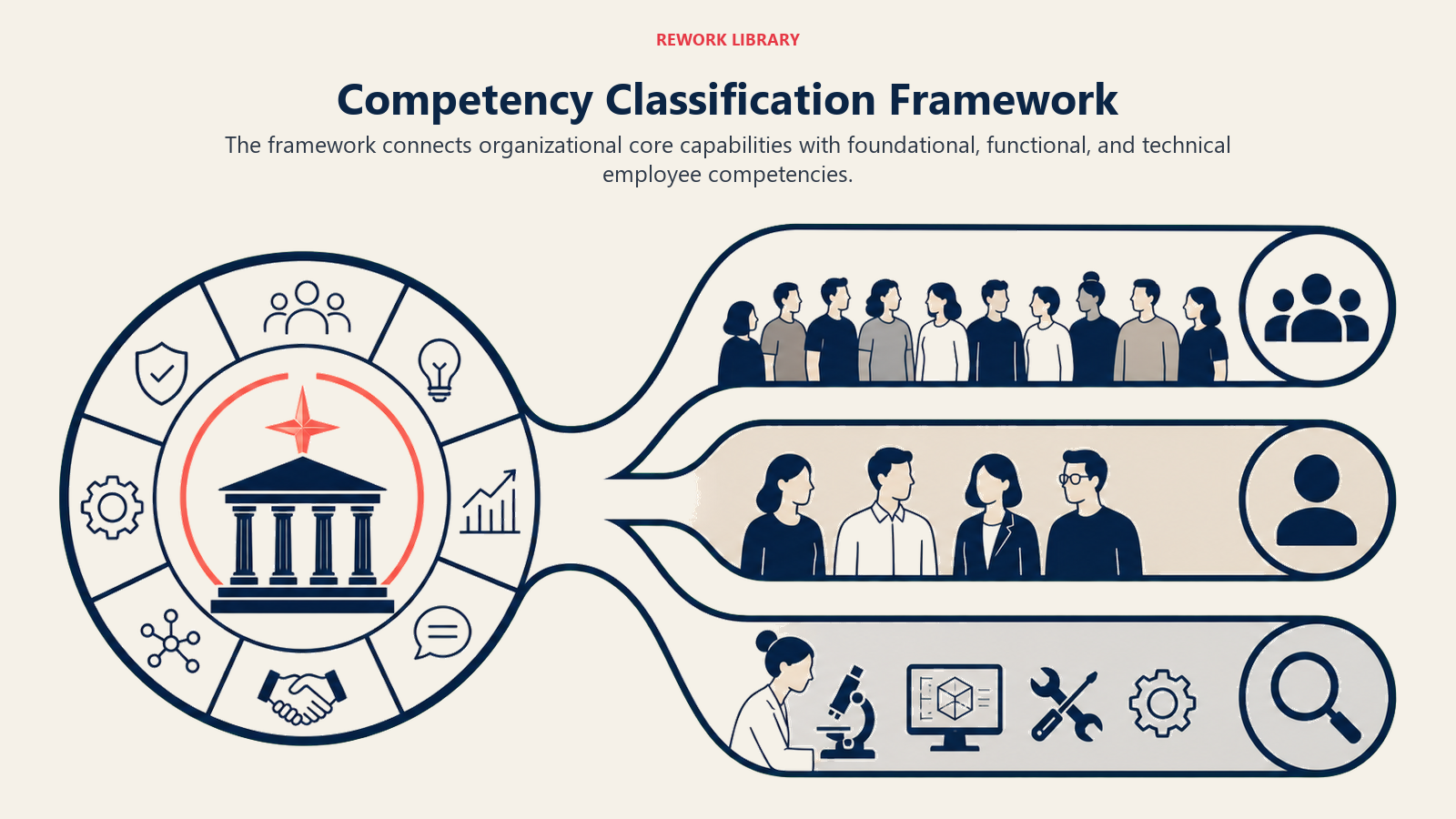
This framework provides a three-tier classification system for organizing competencies in a business context, combining organizational strategic capabilities with individual employee competencies.
Structure
The model links strategic organizational capabilities to three employee competency types with progressively narrower workforce scope and deeper specialization.
Part A: Organizational Core Competencies
Strategic capabilities that create competitive advantage for the organization. These are unique combinations of resources, processes, and skills that distinguish a company in the marketplace.
Part B: Employee Competency Model
1. FOUNDATIONAL COMPETENCIES
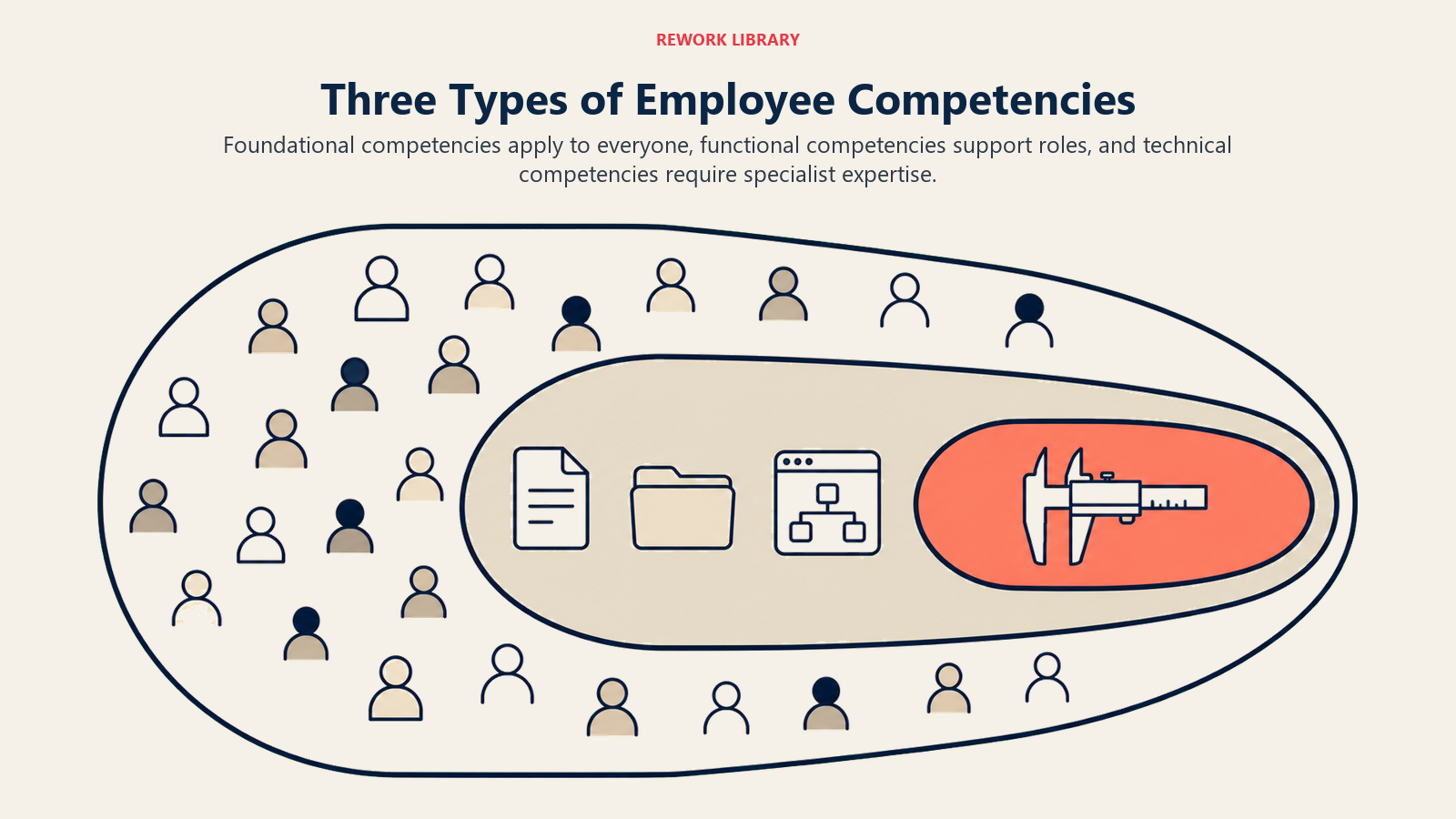
Definition: Fundamental competencies required for ALL employees regardless of position, level, or department. These reflect organizational culture and values.
Characteristics:
- Universal application (100% workforce)
- Entry-level to CEO
- Culture & value-driven
- Foundation for all other competencies
Examples:
- Communication
- Teamwork & Collaboration
- Integrity & Ethics
- Customer Focus
- Continuous Learning
- Adaptability
- Digital Literacy
- Results Orientation
2. FUNCTIONAL COMPETENCIES
Definition: Role-based competencies required for specific functions, levels, or responsibilities. These enable effective performance in particular organizational roles.
Characteristics:
- Role/level dependent
- Transferable across industries
- Process & approach focused
- "HOW" work gets done
Examples:
- Leadership (managers+)
- Strategic Planning (senior+)
- Project Management (project roles)
- Coaching & Development (supervisors+)
- Business Acumen (professional+)
- Change Management (leaders)
- Negotiation (sales/procurement)
3. TECHNICAL COMPETENCIES
Definition: Specialized competencies requiring specific expertise, knowledge, or skills unique to particular industries, functions, or technologies.
Characteristics:
- Industry/function specific
- Requires specialized training
- Tool & expertise focused
- "WHAT" you work with
Examples:
- Programming Languages (IT)
- Financial Modeling (Finance)
- Legal Compliance (Legal)
- Marketing Automation (Marketing)
- Supply Chain Systems (Operations)
- Clinical Procedures (Healthcare)
- Engineering Design (Engineering)
Quick Reference Test
| Question | FOUNDATIONAL | FUNCTIONAL | TECHNICAL |
|---|---|---|---|
| Does everyone need it? | YES | Some | Few |
| New hire Day 1? | YES | Maybe | Rarely |
| Transferable to other companies? | YES | YES | Sometimes |
| Transferable to other industries? | YES | Mostly | Rarely |
| Requires specialized training? | NO | Some | YES |
| Reflects company values? | YES | Partially | NO |
Organizational Core Competencies Examples
Operational Excellence
- Superior Quality & Reliability
- Speed & Agility
- Cost Leadership
- Supply Chain Mastery
- Process Innovation
Customer & Market
- Customer Experience Excellence
- Brand Power & Trust
- Market Responsiveness
- Channel Excellence
- Customer Insight & Analytics
Innovation & Technology
- R&D & Technical Innovation
- Digital Platform Capabilities
- Data & AI Capabilities
- Technology Integration
- Rapid Prototyping & Testing
Organizational Capabilities
- Talent Development & Culture
- Knowledge Management
- Partnership & Ecosystem Building
- Global/Local Balance
- Change & Transformation Capability
Implementation Guidelines
- Start with organizational core competencies to establish strategic direction
- Define foundational competencies that support your organizational culture
- Map functional competencies to key roles and career paths
- Identify technical competencies for specialized positions
- Create clear linkages between organizational and individual competencies
Key Success Factors
- Ensure organizational core competencies are truly differentiating
- Keep foundational competencies list focused (8-10 maximum)
- Regularly review and update technical competencies
- Create clear behavioral indicators for each competency
- Link competencies to business outcomes and performance metrics