Bahasa Indonesia
Negotiation & Closing Techniques: Win-Win Automotive Deal Structuring - Panduan 2026
Turn this article into takeaways for your work.


Each assistant summarizes the article only for you and suggests best practices for your work.
Negotiation tidak dimulai ketika Anda duduk untuk membahas numbers. Ini dimulai saat Anda meet the customer. Setiap question yang Anda tanyakan selama needs assessment, setiap feature yang Anda demonstrate selama presentation, setiap moment dari test drive adalah membangun foundation untuk successful negotiation. Pada saat Anda membicarakan price dan payment, deal seharusnya terasa seperti natural progression, bukan battle.
Best negotiators dalam automotive retail bukan hardest closers atau most aggressive discounters. Mereka adalah orang-orang yang telah membangun enough value sepanjang process sehingga customers ingin membeli, memahami mengapa vehicle worth the price, dan merasa good tentang deal bahkan ketika mereka tidak mendapatkan setiap dollar off yang mereka initially demanded.
Research menunjukkan bahwa dealerships yang leveraging connected workflows melihat hingga 15% higher back-end profit dan greater customer satisfaction. Success di 2026 didefinisikan oleh adaptability dan relentless focus pada customer experience.
Pre-Negotiation Foundation: Setting Up the Close
Sebelum Anda ever menyebutkan numbers, Anda memerlukan tiga hal di tempat: trust, value, dan urgency.
Trust datang dari mendengarkan lebih banyak daripada berbicara, menjawab questions dengan jujur, dan memperlakukan customer seperti intelligent adult daripada mark. Jika customer tidak trust Anda, mereka akan fight Anda pada every number karena mereka assume Anda trying untuk take advantage dari mereka.
Value datang dari connecting vehicle features ke stated needs mereka, demonstrating differentiation dari competitors, dan membantu mereka imagine life mereka dengan vehicle ini. Jika mereka tidak perceive value beyond sticker price, price menjadi only negotiating point.
Urgency datang dari incentive deadlines, inventory reality, atau competitive pressure. Bukan manufactured false urgency, tetapi real reasons mengapa acting today makes more sense daripada waiting. Tanpa urgency, customers akan selalu memilih "let me think about it" over committing.
Selama needs assessment, Anda established wants, needs, dan budget mereka. Selama presentation, Anda showed mereka bagaimana vehicle ini meets needs tersebut better dari alternatives. Selama test drive, Anda created emotional connection. Sekarang Anda transitioning ke negotiation dengan sebagian besar heavy lifting sudah selesai.
Transition seharusnya assumptive: "Great, let's go inside and work up some numbers. Do you prefer coffee or water?"
Bukan "Are you ready to talk numbers?" Itu mengundang hesitation. Anda assuming mereka ready karena Anda telah earned assumption itu melalui process.
Negotiation Principles: Psychology Specific to Automotive
Automotive negotiation memiliki unique psychological dynamics. Customers mengharapkan negotiation. Mereka telah dikondisikan oleh decades dari dealer tactics untuk percaya mereka seharusnya never accept first offer. Bahkan customers yang hate negotiating akan push back secara reflexively karena itu the game.
Ini berarti Anda perlu build dalam negotiation room sambil maintaining defensible positions. Anda tidak dapat start di absolute best price Anda karena customers akan push back anyway. Namun Anda juga tidak dapat start sangat high sehingga Anda kehilangan credibility.
Anchoring matters. First number yang disebutkan dalam negotiation menjadi reference point untuk semuanya. Jika Anda start dengan MSRP dan work down, customer's perception adalah bahwa mereka winning concessions. Jika customer starts dengan unrealistic lowball dan Anda work up dari sana, Anda fighting uphill.
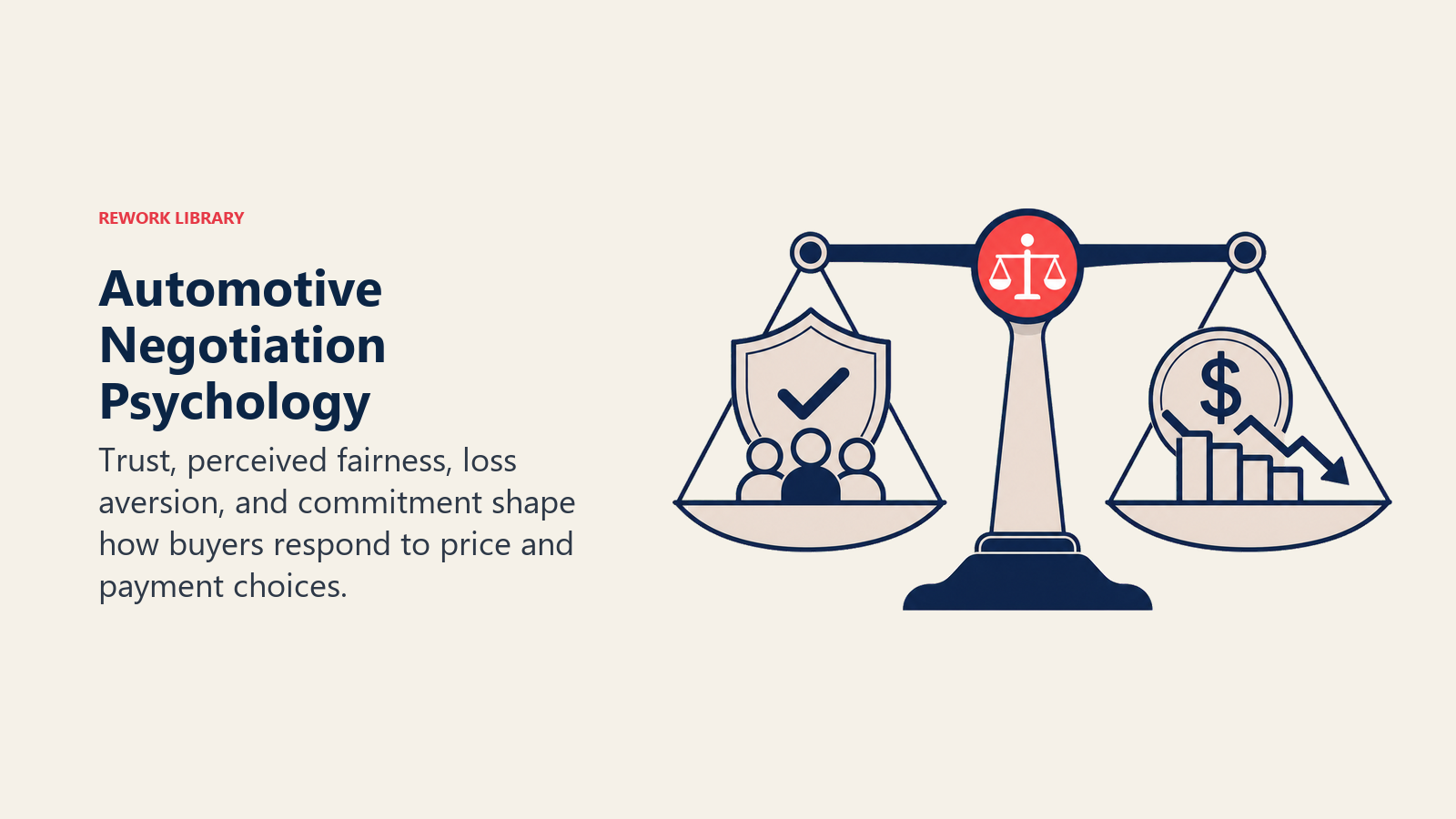
Control anchor dengan presenting payment daripada price: "Based on the vehicle you drove, with your trade and down payment, your monthly investment would be $465 for 60 months. How does that work with your budget?"
Payment terasa more manageable daripada total price. Dan ini focuses conversation pada what actually matters, cash flow, daripada abstract negotiation over price.
Power dari silence adalah underutilized. Setelah Anda present numbers, stop talking. Orang pertama untuk speak biasanya loses. Customers akan often negotiate against themselves jika Anda give them space: "I was hoping for closer to $425... but I guess $465 isn't terrible if it includes the extended warranty."
Memahami psychological principles seperti reciprocity, social proof, dan scarcity dapat significantly improve closing effectiveness. Research menunjukkan people often buy pada emotion dan justify dengan logic. Concession strategy matters. Setiap concession harus smaller dari yang last one. Jika first concession Anda adalah $50 per month, second Anda harus $30, third Anda harus $20. Ini signals Anda approaching your limit. Jika Anda give consistent $50 concessions, customers akan push untuk more karena mereka tidak melihat end. Principles ini critical untuk gross profit optimization.
Dan setiap concession harus require reciprocal commitment: "If I can get the payment to $440, are you prepared to move forward today?"
Ini prevents endless negotiation loops di mana Anda keep giving dan mereka keep asking untuk more.
Trial Closes: Testing Readiness Throughout the Process
Trial closes adalah questions yang test customer's readiness untuk buy tanpa forcing commitment. Mereka get customer saying yes repeatedly, yang builds momentum toward final close.
Selama presentation: "Can you see yourself pulling into your driveway in this vehicle?"
Setelah test drive: "How did that compare to what you're currently driving?"
Ketika discussing features: "Is this the kind of technology you were looking for?"
Ini bukan final close. Mereka temperature checks yang tell Anda whether Anda building enthusiasm atau losing them.
"If I could" close adalah trial close yang sets up final close: "If I could get you the payment you're looking for, is this the vehicle you want?" atau "If I could structure this to include the extended warranty without increasing your payment, would you move forward today?"
Ini isolates objections dan gets conditional commitment. Jika mereka say yes, Anda tahu only remaining obstacle adalah specific condition yang Anda mentioned. Jika mereka hedge, there's another concern Anda perlu uncover.
Alternative choice trial closes assume sale dan offer options: "Do you prefer the black or the silver?" "Would you rather take delivery today or would Monday work better?" Ini work karena mereka frame decision sebagai which option, bukan whether to buy.
Assumptive language throughout adalah subtle namun powerful. Anda tidak asking "Do you want to buy this car?" Anda asking "Which color do you prefer?" Buying decision assumed. Only question adalah details.
Payment-Based Selling: The Modern Approach
Sebagian besar customers tidak memiliki $35.000 sitting dalam checking account. Mereka memiliki monthly budgets dengan room untuk car payment. Ini berarti payment-based selling aligns dengan bagaimana customers actually berpikir tentang affordability.
Start dengan payment discovery, bukan price discussion: "What monthly payment would be comfortable for you?"
Jika mereka say $400, Anda working backward dari itu untuk determine vehicle apa dan structure fits. Jika vehicle yang mereka inginkan requires $475, Anda bridging $75 gap melalui term adjustment, down payment, atau vehicle selection.
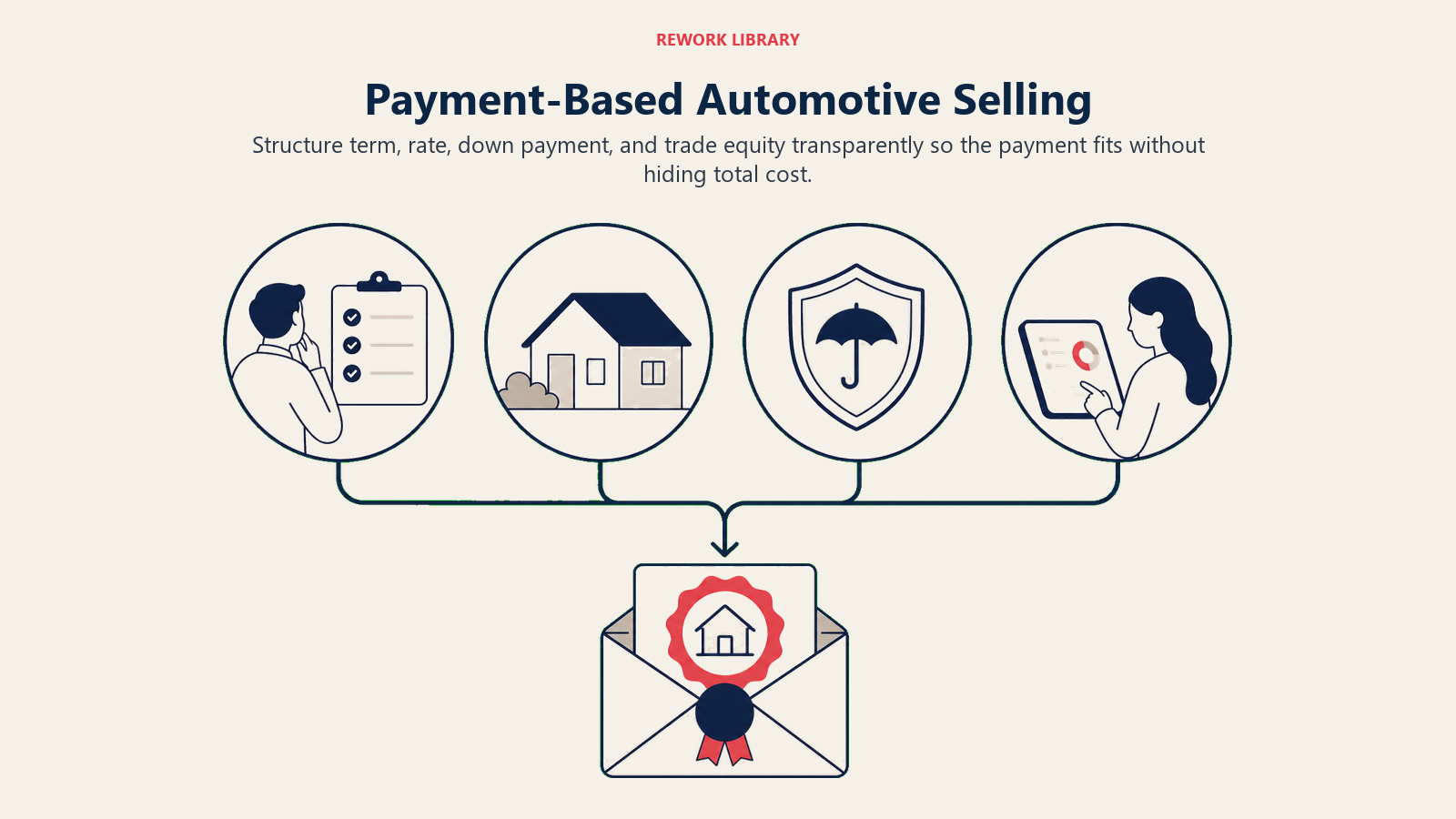
Show variables: "Your payment is determined by four things: vehicle price, interest rate, loan term, and down payment. The vehicle price is $32,000. You qualify for 6.9% APR. If we do 60 months with $3,000 down including your trade, your payment is $475. To get to $400, we could extend to 72 months, which brings it to $425, and if you could add another $1,000 down, we'd be at $405. Which direction makes more sense for you?"
Anda giving them control atas how to adjust variables untuk reach target mereka. Mereka participating dalam solving problem daripada fighting Anda over one number.
Payment focus juga depersonalizes negotiation. Anda tidak arguing tentang whether dealer's price fair. Anda working together untuk structure payment yang fits budget mereka. Collaborative framing ini improves customer satisfaction bahkan ketika mereka tidak get massive discounts.
Be careful tentang term extension sebagai default solution. Stretching dari 60 ke 72 atau 84 months reduces payment, namun ini juga means customer pays significantly more dalam interest dan stays underwater longer. Use term extension strategically, namun juga educate customers tentang total cost: "Extending from 60 to 72 months saves you $50 per month, but it costs you an extra $1,800 in interest over the life of the loan. Some customers prefer the lower payment, others prefer paying it off faster. What's more important to you?" Memahami finance source management membantu Anda structure optimal terms.
Honesty ini builds trust dan positions Anda sebagai advisor, bukan just salesperson.
Handling Counter-Offers: Back-and-Forth Strategy
Sebagian besar negotiations involve setidaknya 2-3 rounds dari offers dan counter-offers. Bagaimana Anda handle rounds ini determines whether Anda maintain gross atau give it all away.
Ketika customer makes counter-offer, jangan react emotionally atau dismissively. "I appreciate you telling me what you're looking for. Let me take this to my manager and see what we can do."
Ini accomplishes beberapa hal. Ini buys Anda time untuk strategize. Ini introduces manager sebagai another layer dari authority. Dan ini signals bahwa Anda advocating untuk mereka, bukan opposing them.
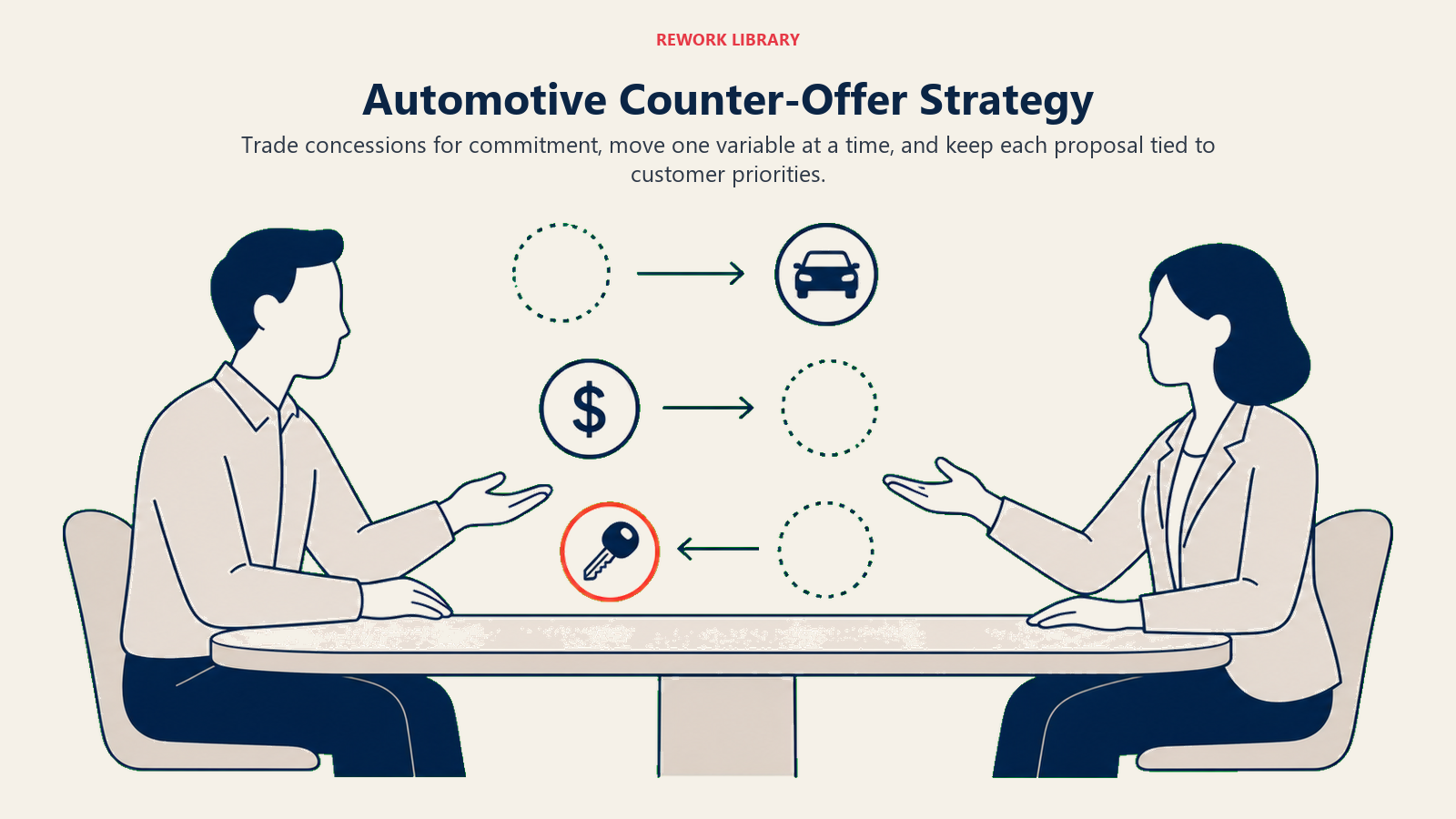
Ketika Anda return dengan counter, frame it sebagai genuine effort, bukan insult: "I went to bat for you with my manager. Here's where we're at. We can't hit $400, but we can do $440 if you can move forward today. That's a significant concession on our part, and it's contingent on closing the deal now."
Urgency dan contingency important. Anda tidak offering $440 forever. Anda offering it today jika mereka commit.
Jika mereka counter again, Anda memiliki decision: do Anda have room untuk move further, atau is this your line dalam sand?
Jika Anda have room, make smaller concession: "Let me go back one more time. This is my last trip to the manager, so if there's anything else you need to know or any other concerns, tell me now."
Jika Anda at your limit, be clear: "I understand you're looking for $425. I respect that. But we're at $440, and that's genuinely as low as we can go while still being profitable on this deal. You're getting a fair price on the vehicle, a strong value on your trade, and we've included the floor mats and first oil change. The question is whether this deal makes sense for you at $440. What do you think?"
Honesty ini disarming. Sebagian besar customers tidak expect salesperson untuk say "this is as low as we can go" dan mean it. Ketika Anda say it dengan confidence dan clarity, it carries weight.
Closing Techniques: Specific Closes for Automotive
Closing adalah asking untuk sale. Anda telah built value, addressed concerns, negotiated fairly, dan sekarang Anda perlu ask untuk commitment.
Summary close recaps semuanya Anda telah agreed on: "So just to summarize, you're getting the 2026 Honda CR-V EX with the Technology Package in black, which has all the safety features and technology you were looking for. We're giving you $14,000 for your trade, your payment is $440 per month for 72 months, and we're including floor mats and your first three oil changes. Delivery is this Saturday. Does that all sound right?"
Close ini works karena Anda reviewing agreement, bukan asking untuk new decision. Mereka telah already mentally agreed ke setiap piece. Anda just confirming.
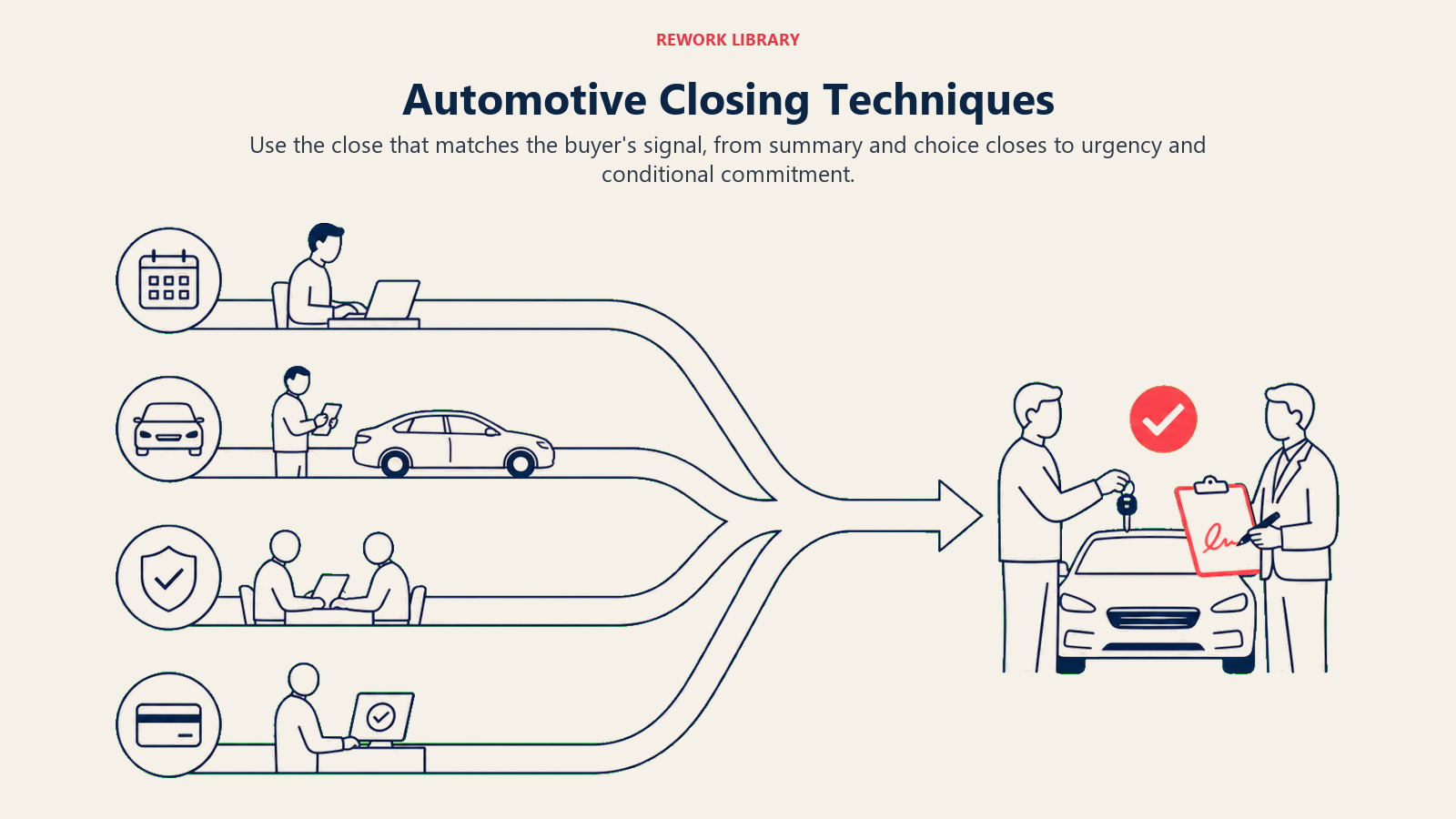
Urgency close leverages real deadlines: "I want to make sure you're aware that the manufacturer incentive we've included in this deal expires on the 31st, which is this Friday. If you're serious about this vehicle, moving forward this week saves you $1,500 compared to waiting until next week. Does that timing work for you?"
Ini works ketika urgency real. Manufactured urgency damages trust.
Alternative choice close offers dua options: "Would you prefer to take delivery today or would Saturday morning work better?" Anda tidak asking if they want to buy. Anda asking when they want to take delivery. Close assumed.
Puppy dog close leverages possession: "Here's what I'd like to suggest. Take delivery today, drive it for a couple days, show your spouse, experience it in your daily routine. If for any reason you're not completely satisfied, bring it back within 72 hours and we'll unwind the deal. Fair enough?"
Ini works karena once vehicle dalam garage mereka dan mereka telah driving it, emotional connection makes returning it extremely difficult.
Similar situation close uses social proof: "I had a customer last month in almost the exact same situation. They were torn between this and the Toyota RAV4. They chose the CR-V and called me two weeks later to say it was the right decision. The driving dynamics and technology were the difference makers. I think you're going to feel the same way."
Ini reassures mereka bahwa others made same decision dan were happy.
Overcoming Final Hesitation: Last-Minute Cold Feet
Bahkan setelah Anda telah negotiated, agreed pada numbers, dan asked untuk sale, beberapa customers hesitate. Mereka about to commit ke 72-month loan pada vehicle yang costs lebih dari some people's houses. Fear natural.
"Let me think about it" pada stage ini bukan tentang thinking. Ini tentang fear. Address it directly: "I understand. This is a big decision. Let me ask you something, what's really holding you back right now? Is it the vehicle, the numbers, or just the nerves of making a commitment?"
Sebagian besar will admit it's nerves. "That's completely normal. But let me ask you this: if you walk out to think about it, what specifically will be different tomorrow or next week? You've driven the vehicle. You've seen the numbers. You've confirmed it fits your needs and budget. The only thing that will change is that you'll overthink it and talk yourself out of something you genuinely want."
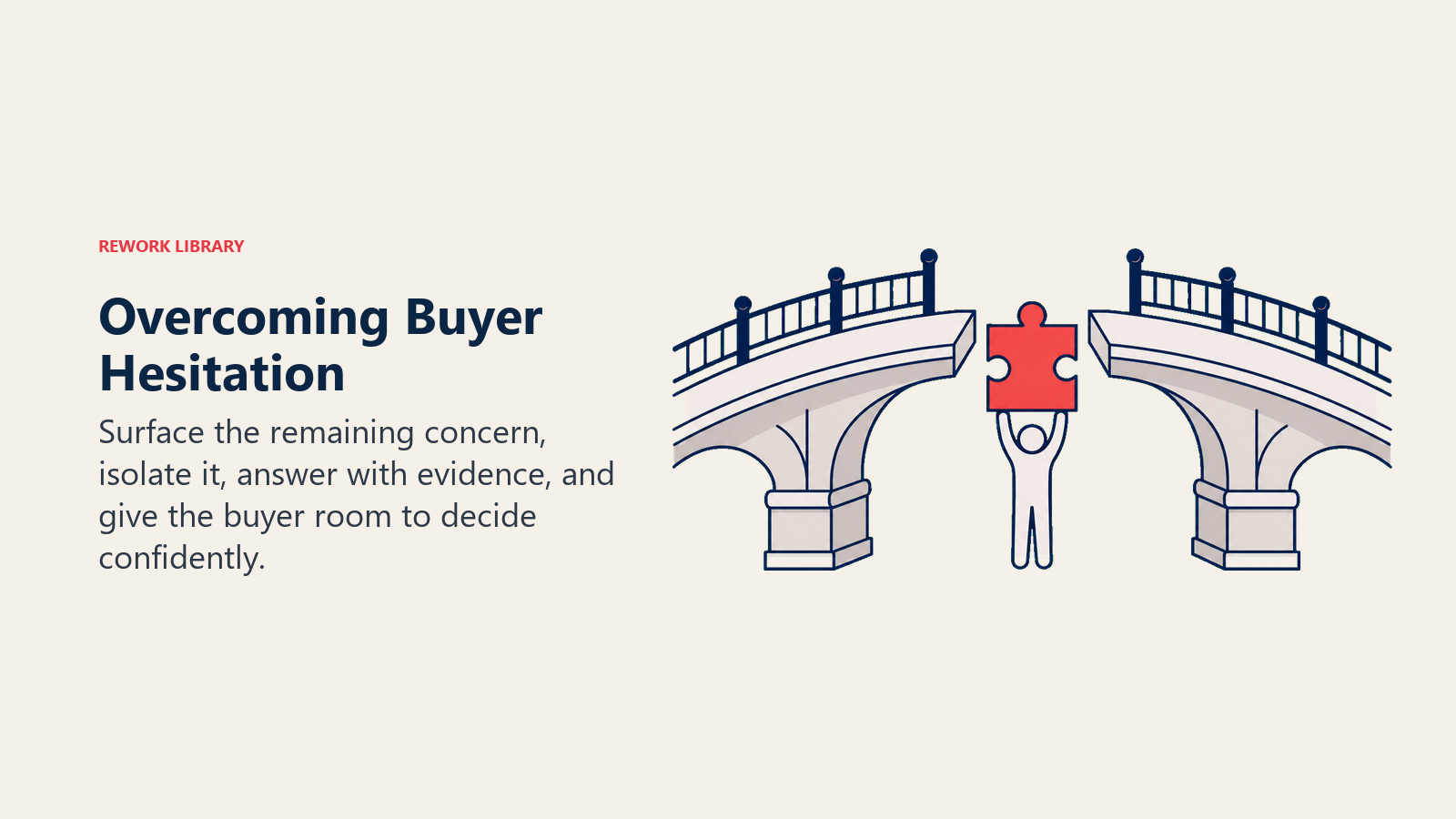
Direct approach ini works dengan customers yang respect honesty.
"I want to shop around" pada late stage ini biasanya tentang validation, bukan genuine comparison: "I completely understand. You want to make sure you're getting a fair deal. That's smart. But you've already driven the competitor vehicles, right? How did they compare?"
Mereka akan usually admit vehicle ini was better. "So you've already done the comparison and chosen this one. Now you're going back to see if you can get it cheaper somewhere else. That's fair. But keep in mind that a few hundred dollars difference over a 72-month loan is about $5 per month. If another dealer can beat our price by $1,000, that's $15 per month. Is it worth starting this whole process over to save $15 per month when you've already found the right vehicle here?"
Ini reframes shopping impulse sebagai minor financial consideration versus significant time dan effort.
F&I Hand-Off: Maintaining Momentum
Once customer commits, jangan lose momentum antara sales desk dan F&I. F&I manager adalah di mana dealerships make significant backend gross melalui financing, extended warranties, dan ancillary products. Namun customers mentally exhausted pada point ini.
Set F&I expectations: "Great, let's get you over to our Finance Manager, Sarah. She'll handle the final paperwork and go over some optional protection products that might make sense for you. The whole process takes about 30 minutes. Sound good?"
Pre-sell F&I products: "One thing I'd recommend looking at with Sarah is the extended warranty. Given that you plan to keep this vehicle for 7-8 years, having coverage beyond the factory warranty can save you thousands if anything major goes wrong. It's optional, but definitely worth considering."
Ini prepares mereka untuk F&I pitch tanpa feeling ambushed.
Stay engaged: "I'm going to grab you those floor mats while Sarah gets your paperwork ready. Congratulations on the new vehicle!"
Ini maintains positive energy dan signals bahwa Anda akan still be available post-sale.
Lost Deal Recovery: When They Walk
Tidak every negotiation ends dalam sale. Ketika customers walk away, response Anda determines whether mereka gone forever atau mereka come back dalam few days.
Jangan burn bridges: "I understand. If this isn't the right time or the right deal, I respect that. But I want you to have my direct number. If you have any questions or if circumstances change, call me directly."
Follow up professionally: "I wanted to reach out and thank you for coming in yesterday. I know we couldn't quite get to where you needed to be on the numbers. I've talked to my manager, and if you're still interested in the CR-V, I think I can get us closer to $425. Would it be worth another conversation?" Strong post-sale follow-up process dapat recover deals dan build relationships.
Ini reopens negotiation tanpa desperation.
Learn dari losses: Review what happened. Was it price? Product? Trust? Process? Lost deals adalah learning opportunities yang make Anda better at closing future deals. Track insights ini melalui automotive CRM implementation untuk continuous improvement.
Negotiation is Collaborative Problem Solving
Best automotive negotiators tidak view customers sebagai opponents dalam zero-sum game. Mereka view negotiation sebagai collaborative problem solving. Customer wants vehicle yang meets needs mereka di price yang mereka can afford. Anda want sell vehicle di profit yang sustains business Anda. Overlap antara kedua goals tersebut adalah di mana deals happen.
Ketika Anda build value sepanjang process, use trial closes untuk maintain momentum, negotiate dengan honesty dan strategy, dan close dengan confidence, Anda maximize both gross profit dan customer satisfaction. Itu win-win yang creates long-term customer relationships dan makes automotive retail sustainable.
Sebagai McKinsey research confirms, putting customer experience di center dari automotive sales adalah new key untuk success. Goal bukan extract every possible dollar dari every customer. Ini structure profitable deals di mana customers feel good tentang purchase mereka, recommend Anda ke friends, dan come back dalam tiga tahun untuk buy again. Itu difference antara being closer dan being professional. Continue learning dengan desking and deal structure, one-price selling strategy, objection handling in automotive, trade-in appraisal process, dan vehicle delivery experience.

Senior Implementation Consultant
On this page
- Pre-Negotiation Foundation: Setting Up the Close
- Negotiation Principles: Psychology Specific to Automotive
- Trial Closes: Testing Readiness Throughout the Process
- Payment-Based Selling: The Modern Approach
- Handling Counter-Offers: Back-and-Forth Strategy
- Closing Techniques: Specific Closes for Automotive
- Overcoming Final Hesitation: Last-Minute Cold Feet
- F&I Hand-Off: Maintaining Momentum
- Lost Deal Recovery: When They Walk
- Negotiation is Collaborative Problem Solving