Your First 30/60/90 Days as a New SE
Turn this article into takeaways for your work.


Each assistant summarizes the article only for you and suggests best practices for your work.
Key Facts for New Sales Engineers
- The average sales engineer takes 4–6 months to fully ramp, but the first 90 days set whether you become a demo-button-pusher or a deal-influencing partner.
- Top-quartile SEs influence 30–50% of pipeline ARR by month 6, per SE compensation surveys (Consensus, Vivun).
- 70% of new SEs come from technical backgrounds. The hardest gap to close is rarely product knowledge. It's deal mechanics.
- Vivun's State of Presales: SEs who pre-prep with their AE before every call influence 2.3x more deals than SEs who only show up to demo.
- Benchmark for week 4: one solo demo delivered, one AE actively requesting you on their next call.
The 30/60/90 SE Ramp Loop
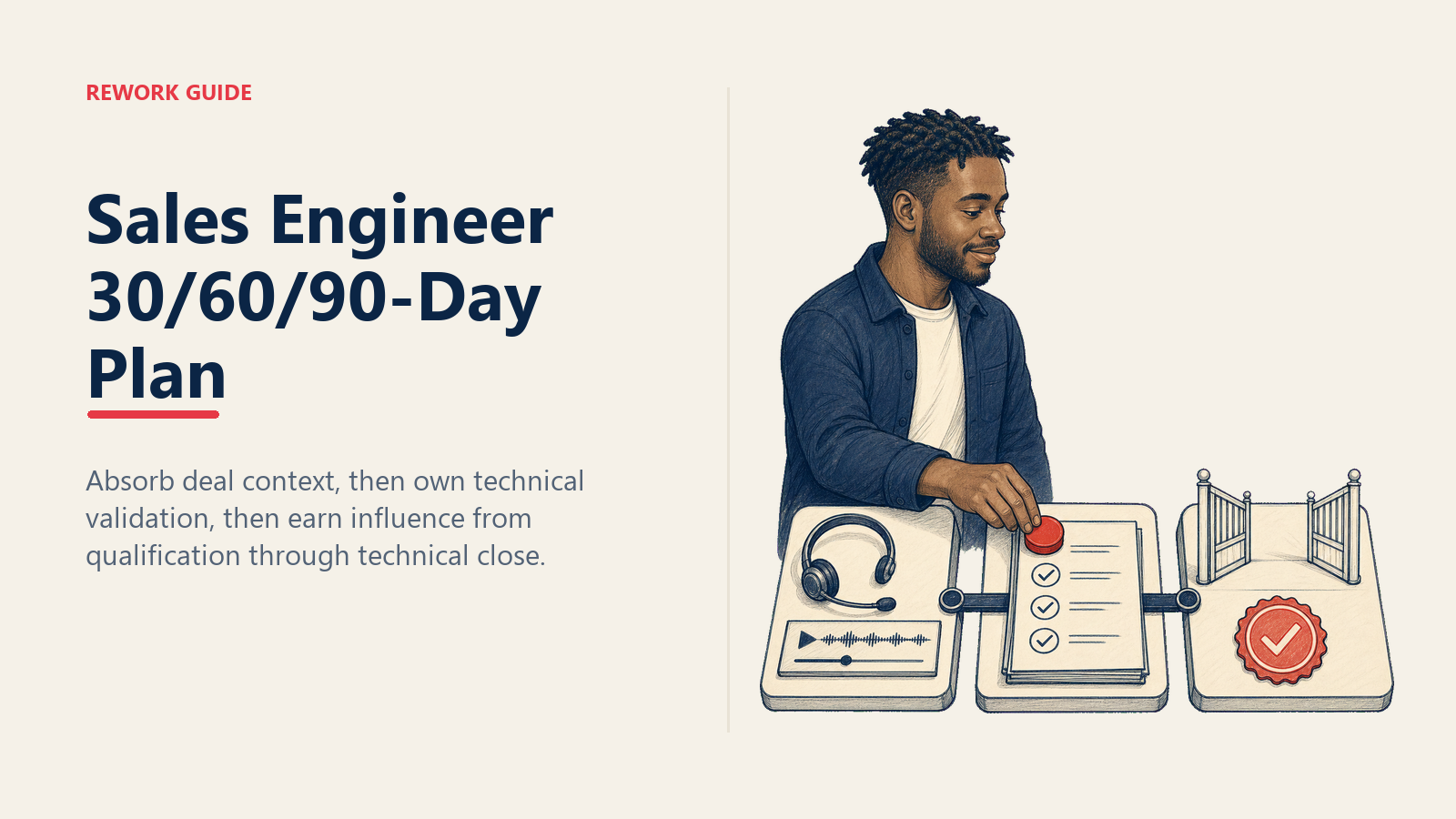
A simple sequence: Absorb, then Own, then Influence. Days 1–30 you absorb (shadow, memorize the demo, learn how your team talks about deals). Days 31–60 you own (lead technical discovery, run a POC end-to-end, write your first RFP response). Days 61–90 you influence (get pulled into deals at qualification, drive technical close, contribute to enablement). Skipping straight to "influence" before you've shadowed eight calls is how new SEs become demo-button-pushers stuck on the wrong half of the pipeline.
It's Sunday night. You start your new SE role tomorrow. You spent the last four years writing production code or fielding L3 support tickets. You know the product cold. You've read the source, you can recite every feature flag.
On Wednesday afternoon, you'll be in a Zoom room with three buyers and your AE, and someone will ask a question you've answered a hundred times in support tickets. You'll freeze. Because "the docs say X" isn't an answer that closes deals.
Here's what nobody tells engineers when they pivot: the product knowledge you spent years building is the smallest part of this job. The first 90 days aren't about learning the product. They're about learning how your AEs run deals, how your buyers actually buy, and how to translate technical capability into a business outcome a CFO will sign for.
Why the First 90 Days Are Different for SEs
Most ramp guides treat sales engineering like a regular sales role with extra technical content. That misleads new SEs in two ways.
First, you're not ramping into a quota you control. You're ramping into a partnership. Your AE owns the deal. You own the technical credibility inside the deal. Treat ramp as a solo project and you'll show up to your first call and find the AE has a completely different game plan than the one you rehearsed.
Second, the skills that got you hired (deep product knowledge, debugging instincts, architectural thinking) aren't the skills that close your first deal. Those skills are reading a buyer's body language, knowing when to stop talking, recognizing which of seven features maps to this buyer's pain, and resisting the urge to answer every question completely.
When I switched from engineering to SE work, the hardest adjustment was the discipline of not answering questions in full. An engineer's reflex is to give the complete picture. An SE's reflex is: "What's the smallest answer that moves the deal forward?" Different muscles. The second takes about 60 days of practice.
Days 1–30: Master the Demo and the Deal Context
Your job in the first 30 days is to become useful, not impressive. Useful means you can run the standard demo cold, you understand how your team talks about deals, and you've watched enough live calls to know what good looks like.
Memorize the standard demo. Most teams have a 25–35 minute core demo covering three or four workflows that matter to most buyers. Find the recording your top SE made, watch it three times, then deliver it back to a teammate without notes. If you can't do this by end of week 2, push everything else back. The demo is your floor.
Shadow at least 8 AE calls. The mix: 3 discovery, 3 demos, 2 technical validation. After each, write down: What did the AE do that I wouldn't have thought to do? What question did the buyer ask that I would have answered wrong? What did the AE not say that I would have blurted out?
Learn how your AEs talk about deals. Every team has a deal language: MEDDIC, BANT, MEDDPICC, Sandler, or something internal. Sit in pipeline reviews. Read the deal review template. When an AE says "this one's a champion-deficit deal," you should know what that means by week 3. Demo design that maps to buyer pain only works if you understand the deal context the demo sits inside.
Understand your top 3 ICPs. Not the marketing personas. The actual buyers your AEs closed in the last two quarters. Pull the last 10 closed-won deals in your segment and answer: What did each buyer say their pain was? What was the trigger event? Which competitor did they evaluate, and why did they pick us?
Run your first solo demo to a friendly audience. End of week 4, deliver the standard demo to two AEs and your manager. They'll ask hard questions on purpose. You'll fumble some. That's the point. Fumble in front of friendlies before you fumble in front of a buyer.
One thing you should NOT do in the first 30 days: change the demo. New SEs sometimes show up with strong opinions about what's wrong with the standard pitch. Hold those opinions. Earn the right to change the demo by closing a deal first.
Days 31–60: Own Discovery and Technical Validation
By day 31, you've watched enough calls. Now you start owning real surface area.
Lead the technical portion of discovery. Your AE qualifies commercially. You qualify technically: current stack, integration requirements, security posture, scale needs, deployment model. If you don't know how to do this without sounding like an interrogation, read Technical Discovery That Surfaces Real Fit before your next call.
Scope and run your first POC end-to-end. This is the single biggest leveling-up moment in the first 90 days. A POC isn't "we set up a sandbox and let the buyer poke around." A POC is defined success criteria, agreed timeline, named exit conditions, and a closing conversation when it's over. New SEs build POCs that prove the product works. Senior SEs build POCs that prove this buyer's specific outcome.
Write the scoping doc before any code gets written. Three sections: (1) what does success look like, in the buyer's words, (2) timeline and who's involved on both sides, (3) what happens at the end. If the buyer won't commit to step 3, it isn't a POC. It's free consulting.
Write your first RFP or security questionnaire response. Short answers, precise language, never claim a capability you can't back up with a feature link or doc reference. Save your responses. By month 6, you'll have an answer library that turns RFPs around in two days instead of two weeks.
Build your pattern library. Every buyer objection you hear, write it down. By day 60, you should have at least 20. For each, draft a 30-second response and pressure-test it with your AE. This is the muscle memory that lets you handle questions in the room instead of saying "I'll get back to you."
Start pre-call prep with your AE. Fifteen minutes before every external call, align on the goal, the one thing you need the buyer to commit to, the two questions you expect, and topics you're deliberately not bringing up. If your AE doesn't have time for prep, that's a relationship problem to solve, not a reason to skip prep.
Days 61–90: Influence the Full Pipeline
At day 60 you're useful. At day 90 you should be specifically requested.
Get pulled into deals at qualification, not just at the demo. This is the inflection point that separates SEs from technical demo resources. If your AE only loops you in once a buyer says "can we see the product," you're a feature-shower. If your AE loops you in at qualification to assess technical fit, you're a partner.
How do you cause this? Make it easy. Tell your AEs: "If you're qualifying a deal and think there might be a technical wrinkle, send me the discovery notes and I'll write you a 5-line read on whether we should proceed." Do that five times and AEs will start looping you in automatically.
Drive technical close on at least one deal. Technical close isn't "the buyer agreed the product works." It's the buyer's technical evaluator explicitly telling the AE there are no technical blockers to signing. You initiate that meeting: "Before we move to commercial terms, can we get 20 minutes with your technical lead?" This single move shortens deal cycles by weeks. Most deals stall in legal because a technical issue surfaces late. Driving technical close pulls those issues forward.
Contribute to enablement. By day 75, record a teardown of one of your demos, write an internal FAQ, or coach a newer SE through their first POC scoping.
Start measuring your own deal-influence numbers. Not your AE's quota. Yours: deals you've been named on, POCs you've scoped (and their conversion rate), technical close meetings you've driven. Read Sales Engineer Metrics That Matter for the metrics that predict SE career growth versus the vanity ones.
The AE-SE Working Agreement
The highest-leverage conversation in your first 30 days isn't with your manager. It's with each AE you'll partner with. New SEs skip it because it feels awkward. Senior SEs make it a ritual: a 30-minute conversation in your second week covering four things.
1. Who owns what. "You drive the agenda; I jump in on technical questions. If a buyer asks pricing, I redirect to you. If they ask implementation timeline, I'll answer with a range and you commit to specifics."
2. Pre-call prep. "Can we block 15 minutes before every external call? I'll come prepped with the discovery notes; you tell me the deal context I might not know."
3. Escalation paths. "When I get a question I can't answer in the room, what's our handoff? Take it offline for 24 hours? Bring in our solution architect?"
4. Credit and visibility. "When we close a deal, how do you want me to talk about it internally? In quarterly reviews, what does it look like for me to call out your contribution?"
That last one matters more than new SEs realize. Treating the AE as a competitor for credit is the fastest way to ruin the partnership. Make their wins look earned, not lucky, and they'll do the same for you.
Common Pitfalls
Over-explaining technical detail. When a buyer asks "how does your sync work," the engineering instinct is to walk through the architecture. The SE answer is in the buyer's frame: "Bi-directional, runs every 5 minutes, scoped to specific objects. Is there a scenario you're worried about?"
The feature firehose. Demoing every feature instead of the 3 or 4 that map to this buyer's pain. If you've done discovery well, walk in with a list of "show these, skip these" and the discipline to skip them.
Ignoring AE deal context. Running a great demo into a deal already lost on price or timing. Before any demo, know the close date, the budget signal, the decision-maker, and the competitor.
"I'll get back to you" for questions you should answer in the room. Buyers interpret it as uncertainty or stalling. For routine questions you're unsure about, give your best answer with a confidence flag: "I'm 80% sure it's X, let me confirm."
Building POCs that prove the product works. They already think it probably works. The POC needs to prove their specific outcome.
Bonding at the expense of authority. If your AE is more senior, the temptation is to defer on everything. But the buyer expects the SE to be the technical authority. Defer on commercial questions; be the unmistakable expert on technical ones.
Your 30/60/90 Self-Assessment
End of Day 30:
- Delivered the standard demo solo to a friendly internal audience
- Shadowed at least 8 AE calls across discovery, demo, and technical validation
- Can name the top 3 ICPs and the typical pain trigger for each
- Understand the team's deal qualification framework (MEDDIC, BANT, etc.)
- Established a working agreement with at least 2 AEs
End of Day 60:
- Led technical discovery on at least 3 deals
- Scoped and ran 1 POC end-to-end (won or lost cleanly, both count)
- Wrote at least 1 RFP or security questionnaire response
- Pattern library has at least 20 objections with drafted answers
- Pre-call prep with AEs is a ritual, not an exception
End of Day 90:
- Pulled into at least 1 deal at the qualification stage
- Drove technical close on at least 1 deal
- Contributed to enablement (teardown, FAQ, or coached a peer)
- Measuring my own deal-influence numbers
- At least 2 AEs are specifically requesting me on their deals
If you can't honestly check most of these, flag it in your next 1:1. The fix is usually obvious once you name the gap.
How Rework Supports New SE Ramp
New SEs juggle three streams at once: deal context from AEs, technical notes from buyers, and a pattern library that lives nowhere useful. Most end up with deal notes in a CRM they can't easily search, POC scoping in Google Docs, and a personal Notion they never reopen.
Rework CRM lets you and your AE share the same deal record, so every call note, technical question, and objection is logged in one place and you walk into the next call already up to speed. Rework Work Ops tracks POC scoping, RFP responses, and your pattern library as searchable tasks tied back to the deal. Work Ops runs on the Project Engine from $99/month billed yearly and CRM on the Sales Engine from $69/month billed yearly, each with 5 seats included.
What Comes After Day 90
Your first 90 days were about getting credible. The next 90 are about getting picked. AEs talk to each other. The SEs who get the best deals are the ones the best AEs are quietly fighting over. That reputation isn't won by being the smartest technical person in the room. It's won by being the most reliable partner in the deal.
For what the day-to-day looks like once you're past ramp, read A Day in the Life of a Sales Engineer. If you're an AE inheriting a new SE, share this guide with them in week one and book the working-agreement conversation for week two.
The SEs who become deal-influencing partners aren't the ones who knew the product best on day one. They're the ones who spent 90 days learning how deals actually move, and built the muscle to move them.

Principal Product Marketing Strategist
On this page
- The 30/60/90 SE Ramp Loop
- Why the First 90 Days Are Different for SEs
- Days 1–30: Master the Demo and the Deal Context
- Days 31–60: Own Discovery and Technical Validation
- Days 61–90: Influence the Full Pipeline
- The AE-SE Working Agreement
- Common Pitfalls
- Your 30/60/90 Self-Assessment
- How Rework Supports New SE Ramp
- What Comes After Day 90