More in
Noticias de AI en el Trabajo
OpenAI Abrio la Publicidad en ChatGPT a Pequenas Empresas con Cualquier Presupuesto
jun. 6, 2026
La AI Esta en Todas Partes en el Trabajo. Solo 1 de Cada 10 Dice que Transformo el Empleo
jun. 6, 2026
El Momento de $10.5B del Vibe Coding: AI Ahora Inicia la Mayoria de los Nuevos Desarrollos de Software
jun. 6, 2026
Los Agentes de AI Tienen Ahora Mas Acceso al Sistema que sus Empleados. Pocos Estan Asegurados
jun. 5, 2026
¿Deberia Construir su AI o Comprarla? Observe lo que Compraron los Gigantes.
jun. 5, 2026
Uber Limita el Gasto de AI por Empleado a $1,500 por Puesto Tras un Descontrol Presupuestario
jun. 5, 2026
La Orden Ejecutiva de AI de Trump es Desregulatoria. Su Riesgo de Cumplimiento No Cambio
jun. 4, 2026
La AI Empujo a 220 Unicornios por Debajo de $1B. Las Empresas Pre-ChatGPT Enfrentan un Ajuste de Cuentas
jun. 4, 2026
Los Precios por Token Cayeron un 67% Este Ano. Su Factura de AI Sigue Subiendo
jun. 3, 2026
Las Pequenas Empresas que Usan AI Reportan Mayores Ingresos y Jornadas Laborales Mas Cortas
jun. 3, 2026
El 72% de los CEOs son ahora el principal responsable de la decisión en AI. Sus juntas les piden que aceleren. El re-ancla para CEOs en 2026
Turn this article into takeaways for your work.


Each assistant summarizes the article only for you and suggests best practices for your work.
Los Chief Executive Officers ahora son dueños de la decisión de AI, y esa responsabilidad se duplicó en un solo año. Pero las juntas que los supervisan no esperan con paciencia los resultados. Están empujando más rápido de lo que la mayoría de las estrategias puede absorber.
Esa tensión es el principal desafío de liderazgo de 2026.
Qué encontró BCG realmente
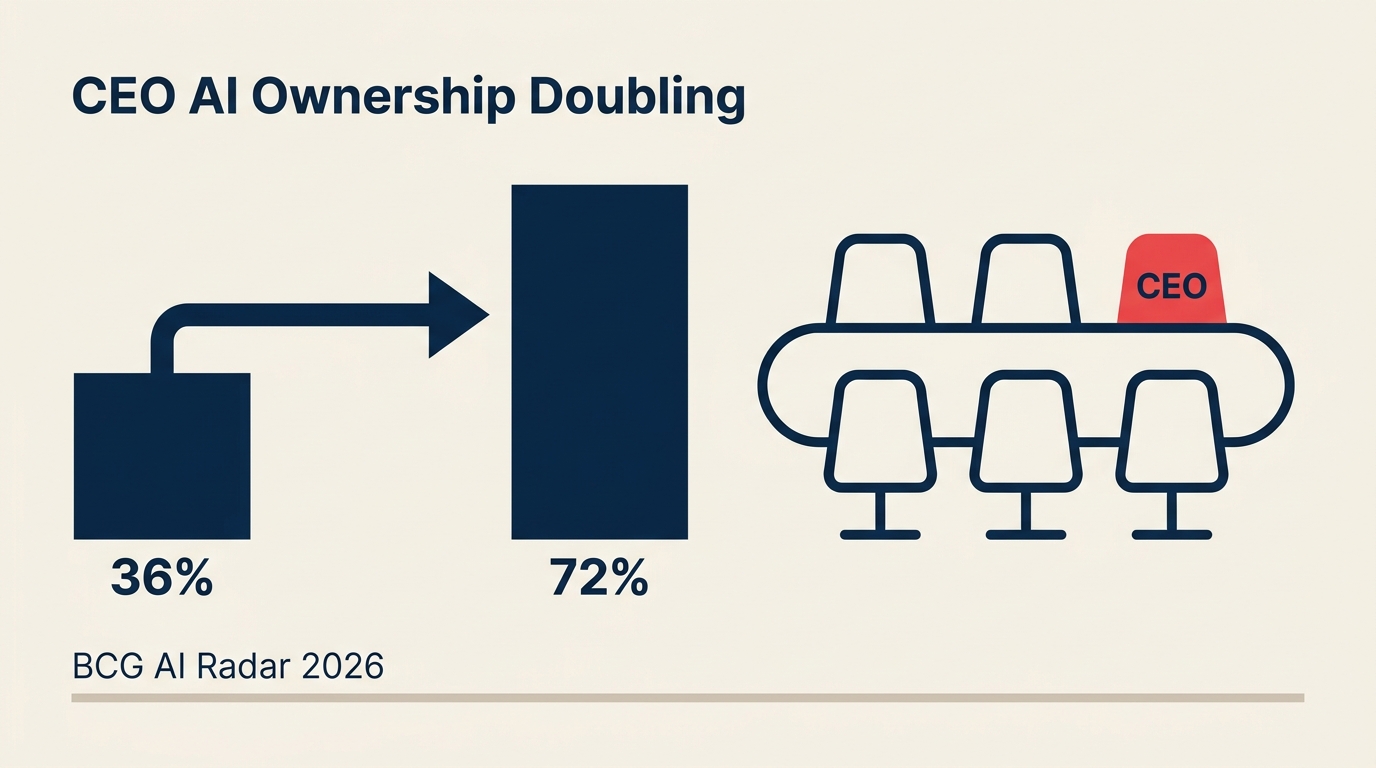
Según el AI Radar 2026 de BCG, una encuesta a más de 1.250 ejecutivos publicada en mayo de 2026, casi tres de cada cuatro Chief Executive Officers (CEOs) se identifican ahora como el principal responsable de la decisión sobre inteligencia artificial (AI) en sus empresas. Esa proporción se duplicó aproximadamente respecto al año anterior. El informe completo AI Radar de BCG documenta un cambio decisivo: AI ya no es una pregunta tecnológica delegada al Chief Technology Officer (CTO) o al Chief Information Officer (CIO). Es una pregunta de estrategia de negocio que descansa en el escritorio del CEO.
Las señales de inversión son igualmente claras. Casi todas las empresas encuestadas dijeron que planean seguir financiando iniciativas de AI incluso cuando no se puede demostrar un retorno sobre la inversión (ROI) inmediato. Aproximadamente nueve de cada diez CEOs afirmaron esperar que los AI agents, específicamente los que toman acciones autónomas, produzcan un ROI medible antes de finales de 2026. Muchas organizaciones ya han comprometido más del 30% de su presupuesto anual de AI específicamente a capacidades de AI agéntica. Y cuatro de cada cinco CEOs reportaron sentirse más optimistas sobre el rendimiento financiero de AI que hace doce meses.
Las apuestas personales también son altas. La mitad de los CEOs encuestados dijo creer que su puesto está en riesgo si AI no produce resultados. Es una admisión llamativa de una población no conocida por señalar públicamente su vulnerabilidad profesional.
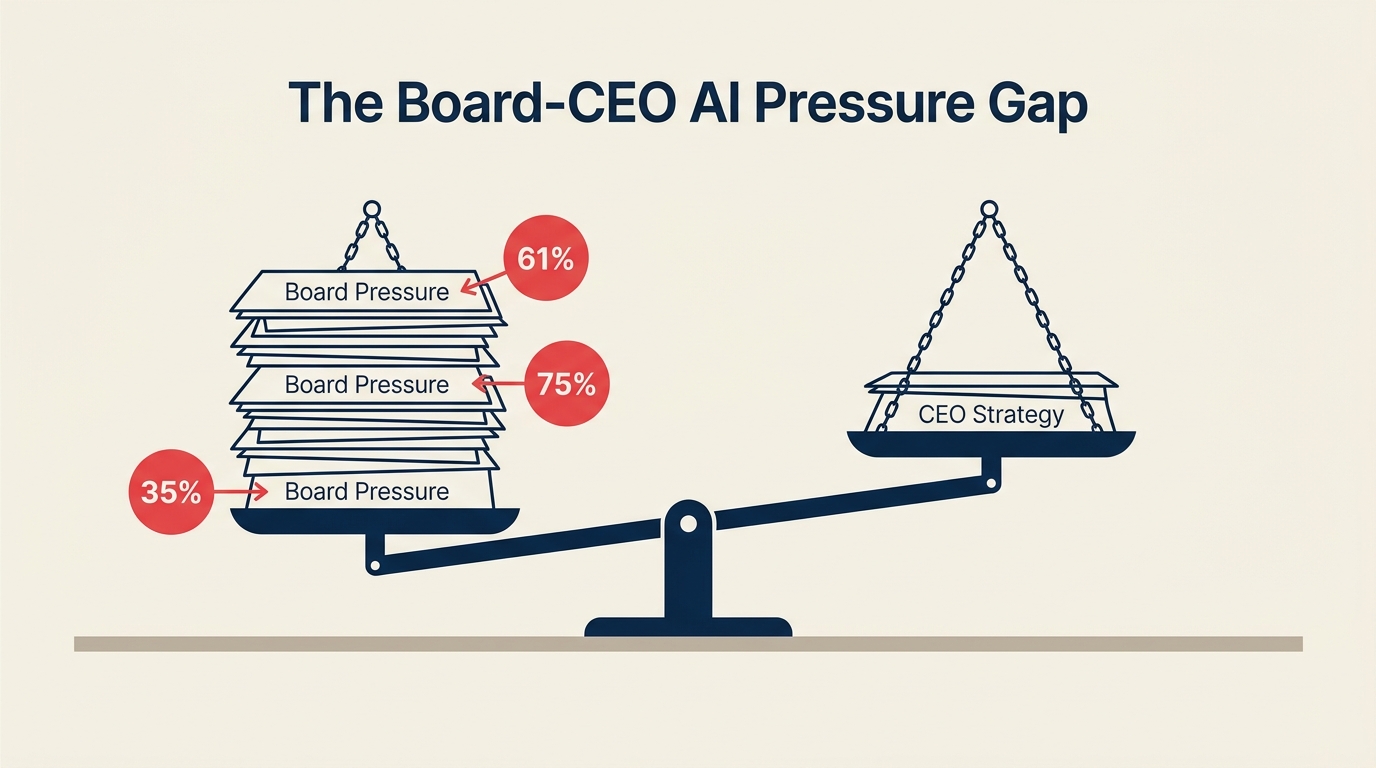
Un comunicado de prensa complementario de BCG del 4 de mayo de 2026 añadió un matiz a nivel de junta. El 61% de los CEOs dijo que sus juntas se mueven más rápido de lo que la estrategia de transformación justifica. El 35% dijo que las juntas sobreestiman la capacidad de AI para sustituir el juicio y las capacidades humanas. Y aproximadamente el 75% de los miembros de junta reportaron confianza en su propia comprensión de AI, una cifra que los CEOs en su mayoría cuestionan.
Datos clave
- El 72% de los CEOs ahora son dueños de la decisión de AI en su empresa, frente a aproximadamente la mitad de esa proporción hace un año. (BCG AI Radar 2026)
- El 61% de los CEOs dice que sus juntas están acelerando la transformación de AI más rápido de lo que la preparación organizacional respalda. (BCG, 4 de mayo de 2026)
- Aproximadamente el 90% de los CEOs espera que la AI agéntica produzca un ROI medible dentro de 2026. (BCG AI Radar 2026)
Por qué la decisión recae ahora en el CEO (y no en el CTO o el CIO)
Hace tres años, una junta que preguntara "¿cuál es nuestra estrategia de AI?" escuchaba al CTO. Hace dos años, el CIO podría haber intervenido. Hoy, la respuesta se espera del CEO, y con buenas razones.
AI no se comporta como las anteriores olas de tecnología empresarial. Los despliegues de ERP tenían cronogramas de proyecto definidos, contratos con proveedores y planes de gestión del cambio de IT. La adopción de AI es diferente. Ocurre en todas las funciones simultáneamente, impulsada tanto por la adopción ascendente (empleados que usan herramientas de AI de forma independiente) como por la urgencia descendente (juntas e inversores que exigen visibilidad sobre el aprovechamiento de AI). El único ejecutivo que se sitúa en la intersección de ambas presiones es el CEO.
También hay una razón práctica: las decisiones de AI ahora tienen consecuencias en los ingresos que atraviesan las líneas organizativas. Cuando una empresa decide desplegar AI agents en el ciclo de ventas, esa decisión toca el Pipeline del CRO, la infraestructura de datos del CTO, la tolerancia al riesgo del CFO y los estándares de experiencia del cliente del CMO. Ningún líder funcional puede tomar esa decisión por su cuenta. El CEO tiene que hacerlo.
Las empresas donde los CEOs han asumido la responsabilidad también se mueven de manera diferente. Tratan AI no como una actualización de IT, sino como una plataforma de capacidades que cambia cómo compite el negocio. Ese enfoque requiere un nivel de integración estratégica que los líderes funcionales no están en posición de ejecutar solos.
Si su estrategia de inversión en AI vive principalmente en la hoja de ruta del CTO, los datos de BCG sugieren que ya se ha quedado atrás respecto a los CEOs que la tratan como una decisión competitiva a nivel de junta.
El patrón de presión de la junta que la mayoría de los CEOs no nombra
Los datos del comunicado de BCG del 4 de mayo describen un tipo específico de fricción organizacional, y la mayoría de los CEOs todavía no han encontrado palabras para nombrarlo.
Por un lado: las juntas están genuinamente energizadas por el relato de AI. Las expectativas de los inversores, los benchmarks competitivos y la cobertura mediática han amplificado la sensación de que las empresas deben moverse rápido o perder terreno. Cuando aproximadamente el 75% de los miembros de junta dice que comprende bien AI, lo dicen sinceramente. Pero la confianza a menudo se basa en lo que han leído, no en lo que han visto desplegado dentro de una empresa.
Por otro lado: el 35% de los CEOs dice que las juntas sobreestiman la capacidad de AI para reemplazar el juicio humano. No es escepticismo sobre el potencial de AI. Es una queja precisa: las juntas creen que pueden sustituir AI por personas más rápido de lo que la realidad operativa admite.
La fricción que esto genera es real. Una CEO que sabe que su empresa necesita 18 meses para integrar adecuadamente AI agents en las operaciones con clientes enfrenta una junta que espera un resultado visible en dos trimestres. Ninguna de las dos partes está equivocada en lo que quiere. Están desalineadas en lo que se puede construir en ese plazo.
Esta brecha rara vez se nombra en las reuniones de junta porque los CEOs no quieren parecer rezagados. Y las juntas no quieren parecer desinformadas. Así que la presión fluye en una sola dirección, el CEO la absorbe, y el plan de transformación se estira silenciosamente para acomodar las apariencias en lugar de la preparación operacional.
La brecha de gobernanza de AI agéntica que ya es visible en las implementaciones empresariales es en parte un producto derivado de esta dinámica. Cuando la velocidad es la métrica rectora, los marcos de gobernanza se quedan para después.
El re-ancla del CEO: un manual de 4 partes
Este es el marco al que apuntan los datos de BCG pero que no nombran explícitamente. Los CEOs que absorben la presión de la junta sin una estructura para gestionarla cometen el mismo error: reaccionan a la urgencia en lugar de anclar la conversación. Aquí está el re-ancla.
1. Re-anclar el objetivo
Antes de su próxima presentación ante la junta sobre AI, defina para qué es realmente la inversión en términos de resultados para el cliente. No "estamos desplegando AI agents", sino "estamos reduciendo el tiempo desde el Lead hasta la primera demo en un 40% en el tercer trimestre". La junta quiere saber que AI está funcionando. Ofrézcale un resultado de negocio específico que seguir, no un hito tecnológico. Esto también le protege: cuando el objetivo es claro, puede argumentar que moverse más rápido lo rompería.
2. Re-anclar las atribuciones de decisión
Mapee qué decisiones de AI pertenecen al nivel del CEO, cuáles pueden delegarse a líderes funcionales y cuáles requieren el aval de la junta antes de comprometerse. Los datos de BCG muestran que los CEOs han asumido la responsabilidad de la decisión de AI de manera amplia. Pero "responsabilidad" sin estructura significa que cada pregunta de AI escala hasta la cima. Construya un marco de atribuciones de decisión de una página: las apuestas estratégicas van al CEO, las decisiones de capacidades van al CTO o al CIO, y los compromisos presupuestarios por encima de un umbral van a la junta. Escríbalo. Hágalo circular. Reduce el ruido y hace legible su autoridad.
3. Re-anclar las métricas
Defina qué significa el ROI en los términos específicos de su empresa antes de que la junta lo defina por usted. "ROI de AI" es una frase vaga. ¿Significa reducción de plantilla? ¿Ingresos por vendedor? ¿Mejora de la retención de clientes? ¿Compresión del tiempo de ciclo? Si no lo define usted, lo definirá la junta. Y lo definirán usando el benchmark que leyeron más recientemente. Los CEOs que son más optimistas sobre el ROI de AI que hace un año son los que han hecho sus propias métricas lo suficientemente concretas como para defenderlas.
Para orientarse en la construcción de un marco de medición, el manual de AI agents para empresas cubre cómo las empresas líderes están instrumentando las implementaciones de AI agents para una atribución clara al negocio.
4. Re-anclar la cadencia de comunicación
Establezca un ritmo regular de reporte del avance de AI en el que la junta pueda confiar. Mensual o trimestral, según la estructura de su junta. El formato importa tanto como la frecuencia. Comience con los resultados del negocio (qué mejoró), continúe con el estado de las capacidades (qué desplegamos y qué hace), y luego señale los riesgos (qué necesita atención de gobernanza). No espere a que la junta pida actualizaciones. Ofrézcale una visión estructurada de forma proactiva y mantendrá el control del relato.
El análisis de la brecha de preparación del liderazgo ofrece un encuadre adicional sobre cómo los CEOs pueden construir alineación interna antes de que la alineación con la junta se vuelva imposible.
Preguntas frecuentes
¿Qué es el BCG AI Radar 2026?
El AI Radar de BCG es un informe de investigación anual que encuesta a más de 1.250 ejecutivos sobre estrategia de AI, inversión y preparación organizacional. La edición 2026, publicada en mayo, se centra en el traslado de la responsabilidad de decisión de AI al nivel del CEO, las tendencias de inversión en AI agéntica y la creciente tensión entre las expectativas de la junta y las realidades operativas.
¿Por qué los CEOs están asumiendo la toma de decisiones de AI en lugar de los líderes técnicos?
AI ha cruzado un umbral en el que sus consecuencias son principalmente estratégicas y financieras, no solo técnicas. Cuando las decisiones de AI afectan simultáneamente las operaciones de ingresos, la experiencia del cliente, el posicionamiento competitivo y la estructura de la fuerza laboral, ningún líder funcional tiene la autoridad transversal para tomarlas. El CEO es el único ejecutivo cuyo mandato abarca el impacto completo. Los datos de BCG muestran que este cambio ocurrió rápidamente: la propiedad del CEO sobre las decisiones de AI se duplicó aproximadamente en un solo año.
¿Cómo debe responder un CEO cuando la junta está impulsando AI más rápido de lo que la estrategia está lista?
La respuesta más efectiva es anclar, no resistir. Lleve una definición concreta de cómo es el éxito en términos de negocio, un marco claro de atribuciones de decisión que muestre a la junta dónde encaja su aportación, y una cadencia regular de reporte que les dé visibilidad sin necesidad de que ellos la exijan. Las juntas tienden a presionar más cuando sienten que les falta visibilidad. Un CEO que ofrece actualizaciones estructuradas y orientadas a resultados generalmente puede reducir la urgencia sin parecer defensivo respecto al ritmo.
Qué deben hacer los CEOs esta semana
- Defina su ROI de AI por escrito antes de su próxima reunión de junta. Un párrafo. Resultado de negocio específico, plazo específico, medición específica. Envíelo al presidente de la junta antes de la reunión, no durante ella.
- Identifique las tres decisiones de AI actualmente con atribución ambigua. Elija las iniciativas de AI donde no está claro si el CEO, el CTO o la junta son la autoridad final. Resuelva esas ambigüedades por escrito esta semana. La ambigüedad es lo que crea el ciclo de presión que describen los datos de BCG.
- Verifique si sus compromisos de AI agéntica tienen gobernanza establecida. Si su empresa ha comprometido más del 30% del presupuesto de AI a sistemas agénticos, como sugieren los datos de BCG como algo típico, confirme que cada implementación tiene un responsable definido, una clasificación de consecuencias y una cadencia de revisión. Si no la tiene, esa es una conversación con la junta que debe iniciar usted en lugar de responder.
Más información

Co-Founder, Rework.com
On this page
- Qué encontró BCG realmente
- Por qué la decisión recae ahora en el CEO (y no en el CTO o el CIO)
- El patrón de presión de la junta que la mayoría de los CEOs no nombra
- El re-ancla del CEO: un manual de 4 partes
- 1. Re-anclar el objetivo
- 2. Re-anclar las atribuciones de decisión
- 3. Re-anclar las métricas
- 4. Re-anclar la cadencia de comunicación
- Preguntas frecuentes
- Qué deben hacer los CEOs esta semana
- Más información