Best AI Agents for Data Engineering in 2026: 12 Agents for Pipelines, Migrations, and Data Quality
Turn this article into takeaways for your work.


Each assistant summarizes the article only for you and suggests best practices for your work.
If you need an AI agent that works on your actual data platform, not one that only answers questions about it, dbt Labs leads for teams that want inline SQL generation and full-task delegation from one vendor, Monte Carlo and Anomalo lead for catching data that's wrong but still looks right, Datafold leads for the legacy-SQL-to-dbt migration that pays for itself fastest, and Databricks and Snowflake lead for teams who want the agent living inside the platform they already run production pipelines on. This guide ranks 12 of them against one question before any feature list: does it catch a pipeline that quietly produces the wrong number, or only one that stops running entirely.
This is the buy side: real products you adopt, not a blueprint you design yourself. This also isn't best AI agents for data analysis, which answers a business question against the warehouse and hands a person a number; this guide covers agents that do the underlying platform work of building, moving, testing, and fixing the data pipelines that number depends on. It's also not best AI coding agents, which ships general software: a data engineering agent needs to read a schema, a lineage graph, and a set of tests before it touches anything, context a general repo-focused coding agent doesn't have. The same plan-act-observe bar that best AI agent platforms applies across every category on this site applies here too, and it rules out a few names you might expect to see below.
What Changed in 2026
- dbt Labs shipped dbt Core v2.0 and the Fusion engine on June 1, 2026, alongside the completed Fivetran-dbt Labs merger. Fusion is a Rust-built engine with SQL comprehension and state-aware orchestration built in, and it now ships alongside a full agent layer, not just the inline dbt Copilot, per dbt Labs' developer documentation.
- Ascend.io, an early "agentic data engineering" pioneer, wound down operations in 2026. Its homepage now carries a note thanking customers as the company closes, a reminder that this category is consolidating as fast as it's growing, not a straight line up and to the right. Source: ascend.io.
- Snowflake's Cortex Code (CoCo) became the fastest-growing product in the company's history, reaching more than 7,100 accounts by Snowflake Summit 2026 after launching in February, paired with Openflow's wider general availability across AWS, Azure, and Google Cloud, per SiliconANGLE's Summit coverage.
- Databricks put its data engineering agent, Genie Code, into the free tier. Databricks Free Edition now bundles Genie Code, Lakebase, serverless GPUs, and Lakeflow Designer for anyone signing up, not just paying customers, per Databricks' own product blog.
- Coalesce Copilot reached general availability on December 9, 2025, adding an agentic chat layer that drafts transformation logic from a description, a capability the company says cuts build time by 80% (a vendor claim, not independently measured), per Coalesce's own product page.
- dbt Labs' 2026 State of Analytics Engineering report found a real gap between AI-assisted coding and AI-assisted pipeline management. 72% of data teams now prioritize AI-assisted coding, but only 24% prioritize AI-assisted pipeline management, testing, and observability, a mismatch the report calls "acceleration without stabilization" and the reason this guide grades on catching errors, not just generating code. Source: dbt Labs, via PR Newswire.
Key Facts
- Pipeline execution faults (missed schedules, failed tasks, broken permissions) are the single largest root cause of data quality incidents at 26.2%, ahead of legitimate real-world data shifts at 20%, per Monte Carlo's analysis of incidents flagged across its platform.
- 71% of data professionals name incorrect or hallucinated outputs reaching stakeholders as their top AI concern, exactly the failure mode a loud crash never produces, per dbt Labs' 2026 State of Analytics Engineering report of 363 practitioners.
- Trust in data rose to the top organizational priority faster than any other measure in the same report, from 66% of respondents in 2025 to 83% in 2026, the steepest single-year jump the survey has recorded.
- Gartner expects more than 40% of agentic AI projects to be canceled by the end of 2027, citing unclear business value and inadequate risk controls as the leading causes, per Gartner's newsroom.
- Quality, not latency or cost, is the single biggest barrier keeping agents out of production, cited by about a third of the 1,340 practitioners LangChain surveyed for its State of Agent Engineering report.
- A Fortune 500 manufacturer used an AI migration agent to move more than 400 legacy stored procedures, including one 300,000-character procedure, from Azure Synapse to Snowflake and dbt in 3 months instead of an estimated 12, at roughly 75% lower cost than the next-best alternative, per Datafold's case study.
Quick Comparison Table
| Agent | Best For | Starting Price | Key Strength | Key Limitation |
|---|---|---|---|---|
| dbt Labs (Copilot + Wizard) | Teams standardizing on dbt for both code-gen and full tasks | Free; Starter $100/user/mo (Copilot bundled) | Both inline assist and full-lifecycle agent tiers in one platform | Wizard/Agents still in Preview as of 2026 |
| Monte Carlo | Mid-market to enterprise observability with deep root cause | Quote-based, credit consumption (Start tier: 10 users) | Fleet of agents (Troubleshooting, Monitoring, Operations) on every tier | Nothing published without a sales call |
| Anomalo | Catching wrong-but-plausible values, not just broken tables | Quote-based, no free tier | Unsupervised ML checks values, not just table metadata | Zero published pricing anywhere |
| Metaplane (Datadog) | A real free start for table-level monitoring | Free (10 tables); Pro usage-based per table | Genuine perpetual free tier, now backed by Datadog | Pro's per-table rate isn't published |
| Sifflet | Lineage-aware impact analysis with an emerging fix agent | Quote-based (Entry: up to 500 assets) | Sentinel plus early-access Sage & Forge fix suggestions | Sage & Forge is early access, not GA |
| Datafold | A legacy-SQL-to-dbt migration project | Quote-based, contact sales only | Migration Agent plus data-diff validates its own output | No public pricing at all, not even tiers |
| Prophecy | Visual Spark/SQL pipelines with AI-drafted logic and docs | Free (Starter); Professional $150/user/mo | Transform and Documentation agents in one low-code canvas | Per-seat cost climbs fast past a few users |
| Coalesce | Warehouse-native transforms with AI logic and lineage | Free (Developer); Starter $150/user/mo | Copilot generates logic, surfaces lineage, writes docs together | 80% build-time claim is vendor-reported |
| Databricks (Genie Code) | Teams already running production pipelines on Databricks | Free tier included; otherwise DBU consumption | Compiles to real, inspectable Spark Declarative Pipeline code | No flat price; tied to compute already budgeted |
| Snowflake (Cortex Code) | Teams already running production pipelines on Snowflake | Consumption-based Snowflake credits | Fastest-growing product in Snowflake's history, pairs with Openflow | No flat rate; needs the Service Consumption Table |
| Airbyte | Fast AI-assisted connector building with an open-source path | Free (Core, self-hosted); Standard from $10/mo | AI Connector Builder drafts a new connector from API docs | Connector Builder AI Assist is still Beta |
| Bruin | A small team wanting one open-source-rooted stack | Free (CLI, MIT license); Cloud pay-as-you-go | Ingestion, transforms, quality, and lineage in one open CLI | Youngest, smallest vendor, thinnest published pricing |
What Actually Catches a Silent Error
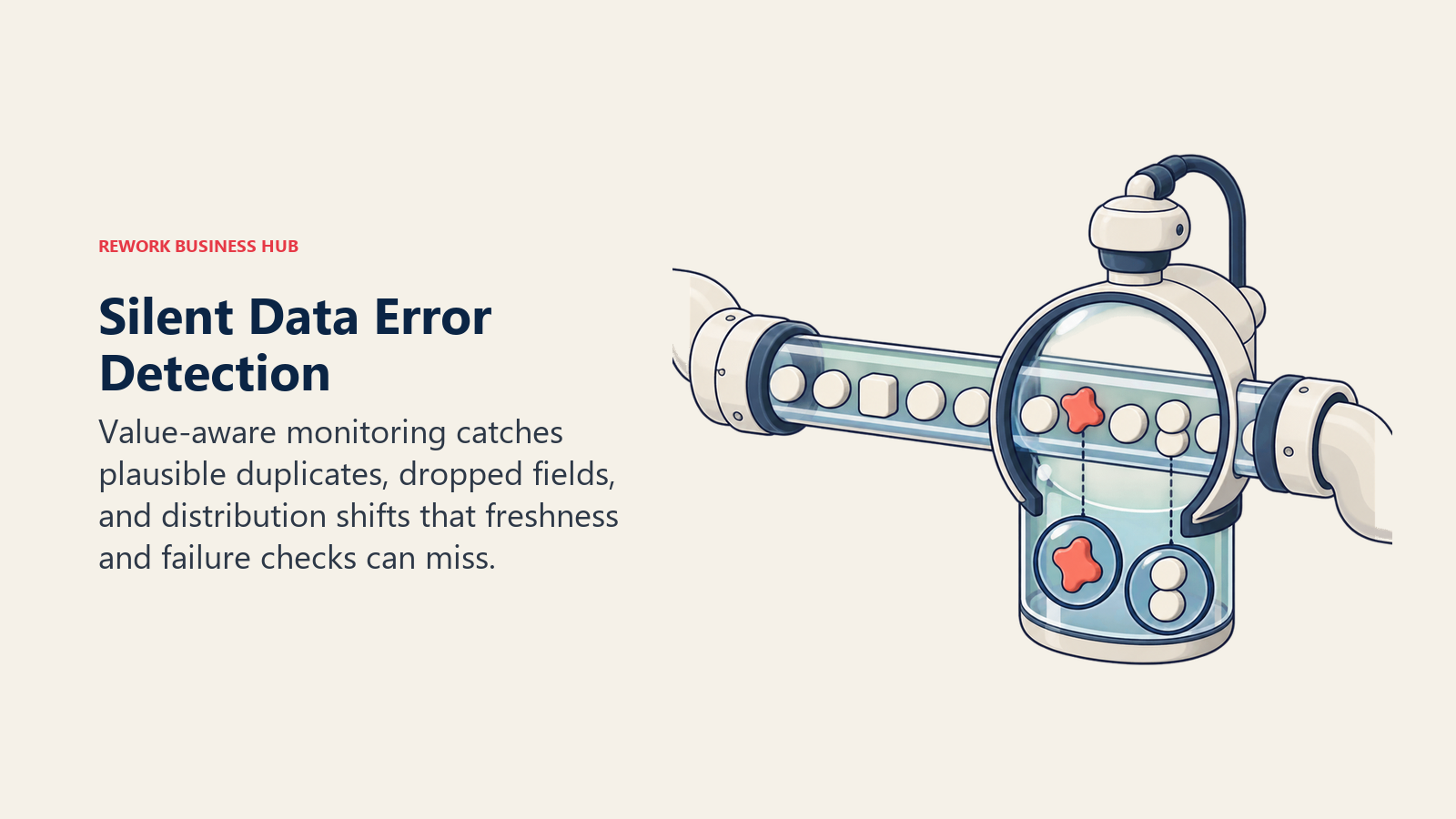
A pipeline that crashes tells you something is wrong the moment it happens. A pipeline that finishes on schedule and hands a dashboard the wrong number tells you nothing, until someone downstream notices, and by then a board deck or a customer bill may already be built on it. Before ranking anything, every product below was checked against a specific question: does it catch a value that's wrong but plausible, or only a table that stopped updating.
| Product | Named Mechanism | What It's Actually Grounded In | Verdict |
|---|---|---|---|
| dbt Labs | dbt Wizard / dbt Agents | Project lineage, tests, contracts, and metric definitions before drafting a change | Catches contract and test violations; still Preview |
| Monte Carlo | Troubleshooting Agent | Freshness, volume, schema, and distribution signals correlated across lineage | Built for silent and loud alike; deepest root-cause depth here |
| Anomalo | Unsupervised data quality ML | Learned normal value distributions per column, not just table metadata | Purpose-built for wrong-but-plausible values |
| Metaplane | Column lineage plus custom SQL monitors | Freshness, volume, schema, and rules you define per table | Solid on loud breaks; value-level checks thinner than Anomalo or Monte Carlo |
| Sifflet | Sentinel / Sage & Forge (early access) | Metric monitors plus lineage-aware impact analysis | Sentinel suggests monitors; diagnosis and fix agents still early access |
| Datafold | Migration Agent plus data-diff | Row-by-row comparison against the legacy system, not a sample | Purpose-built to catch mismatches during a migration, not ongoing monitoring |
| Prophecy | Transform and Documentation agents | Drafts pipeline logic and explains what shipped from a description | Assistive generation; quality checks live in a separate module |
| Coalesce | Coalesce Copilot | Generates transformation logic and surfaces lineage from workspace metadata | Assistive generation with lineage visibility, not an autonomous monitor |
| Databricks | Genie Code | Plans and drafts pipeline code and job graphs, debugs failures in Lakeflow | Strong on authoring and failure debugging; value-quality checks are a separate feature |
| Snowflake | Cortex Code | Builds and troubleshoots pipelines and Openflow integration flows | Strong on authoring and troubleshooting, not a dedicated anomaly detector |
| Airbyte | AI Connector Builder (Beta) | Drafts connector configuration from API documentation | Assistive connector authoring, not a data quality agent |
| Bruin | AI Data Analyst | Answers questions over live data with citations | Conversational and assistive, not built to autonomously monitor for silent errors |
Why a Silent Error Costs More Than a Loud Failure
Loud failures are the easy case: a table stops updating, a job exits with a code, a freshness check fires. Basic metadata monitoring catches almost all of them, and Monte Carlo's own platform data backs that up: pipeline execution faults (missed schedules, failed tasks, broken permissions) account for 26.2% of the incidents it flags, the single biggest category, and metadata checks alone catch most of it.
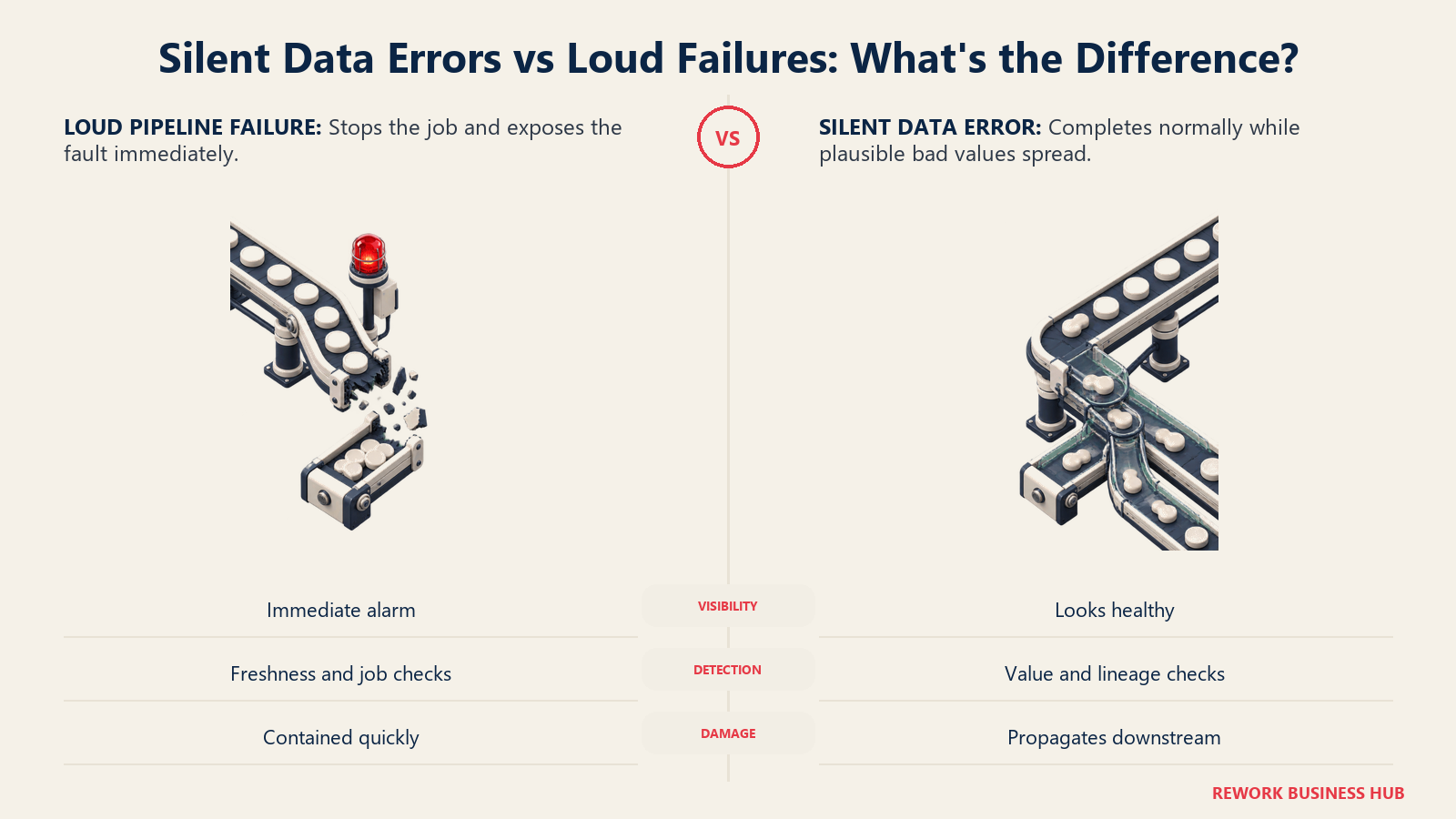
Silent issues are the harder case, and they're the reason a data quality agent earns its budget. A silent issue affects a subset of rows while the table's overall metrics look completely normal: a currency conversion error touching one region's 5% of records, a source system that quietly drops a field, a join that starts double-counting after an upstream schema change nobody flagged. These can sit in production for weeks or months before a business user happens to notice a number that doesn't feel right, and by the time they do, every decision made from that data in the interim is now in question. That's a trust problem, not just a data problem, and it's precisely what the 71% of data professionals in dbt Labs' 2026 survey are worried about when they name incorrect or hallucinated outputs reaching stakeholders as their top concern.
This is why the mechanism matters more than the marketing. An anomaly detection feature that only checks whether a table arrived on time is a loud-failure catcher wearing a data-quality label. A product like Anomalo, built around unsupervised learning on the values inside a table rather than just its metadata, or Monte Carlo's Troubleshooting Agent, which correlates freshness, volume, schema, and distribution signals against lineage before naming a root cause, is doing the harder job. Ask any vendor on this list for a real example of a wrong-but-plausible value it caught, not a pipeline it flagged as late, before you believe the pitch.
How to Choose: Three Questions Before You Buy
Evaluate the product against three operating questions before comparing features or vendor claims.
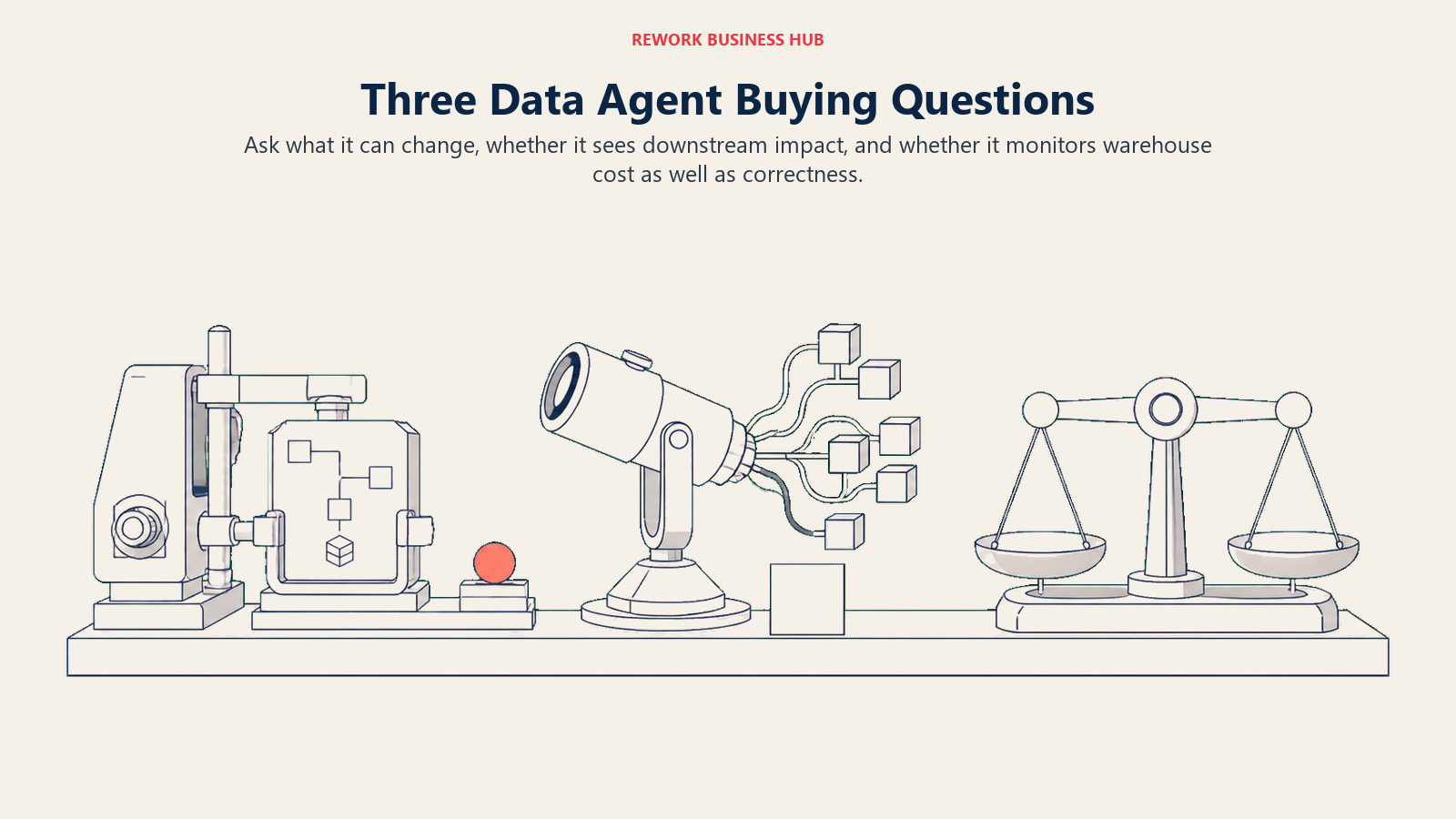
1. Does it open a pull request, or only suggest a fix?
An agent that drafts a change inside its own tool for a person to review is a different purchase than one that only tells you something is wrong and leaves the fix to a human or a separate ticket. Neither is wrong, but they solve different problems, and confusing the two is how a team ends up disappointed with an otherwise good product.
| Product | What It Can Draft or Touch | Still Needs a Human To |
|---|---|---|
| dbt Labs (Wizard) | Drafts edits across every file a change touches, grounded in the project graph | Review and merge; Preview status means no unsupervised production merges yet |
| Datafold | Generates translated dbt models and validates them against the legacy system | Review and promote the migrated models to production |
| Coalesce / Prophecy | Draft transformation logic inside the tool's own visual build | Promote the build to a production run |
| Databricks / Snowflake | Draft pipeline or integration code inside the IDE, notebook, or Openflow canvas | Commit and deploy the code |
| Airbyte | Drafts a new connector's configuration from API documentation | Test and publish the connector |
| Monte Carlo / Anomalo / Metaplane / Sifflet | Diagnose, correlate, and alert on root cause | Decide and execute the fix; none of these rewrite your pipeline code today |
2. Can it see downstream impact before it changes a model?
An agent that edits a model without a lineage view doesn't just risk breaking that model; it risks breaking every dashboard, report, and downstream table built on top of it, with no warning. dbt Wizard reads the project's lineage, tests, and contracts before it drafts a change. Monte Carlo and Sifflet build lineage-aware impact analysis into their root-cause work by design. Coalesce surfaces lineage alongside whatever Copilot generates. Metaplane includes column-level lineage at its Pro tier. Anomalo, by contrast, is stronger on per-table value checks than on cross-table impact analysis, worth knowing if lineage is the specific gap you're closing. If an agent can't answer "what breaks downstream" before it writes, that's the question to ask before it touches anything in production.
3. Does it watch warehouse cost, or only pipeline correctness?
Cost governance for AI and data spend is no longer a side conversation; 98% of organizations now manage AI spend as part of their FinOps practice, according to the FinOps Foundation's own 2026 data, up sharply from prior years. Few of the agents in this guide watch warehouse spend as a first-class signal the way they watch freshness or schema. Metaplane names "Cost & Performance Monitoring" directly as a Pro-tier feature. Monte Carlo adds cost attribution at the Enterprise tier. Databricks and Snowflake tie agent usage to the same DBU or credit consumption you already track, which makes cost visible but not necessarily managed. If warehouse cost is the problem you're actually trying to solve, treat it as a separate evaluation from data quality rather than assuming any agent here handles both.
1. dbt Labs: Both an Inline Assistant and a Full-Task Agent
dbt Labs now ships two distinct AI layers rather than one blurry "AI feature." dbt Copilot is the inline assistant: single-click generation of SQL, documentation, tests, and semantic models inside dbt Studio, Canvas, and Insights, a person still drafts the ask and reviews the output. dbt Wizard (part of the broader dbt Agents layer) is different: describe a change, such as renaming a model, adding a metric, or migrating a stored procedure, and the agent reads the project's lineage, tests, and contracts, then drafts the edits across every file that needs to move. Both sit on top of the Fusion engine, a Rust-built rewrite that added SQL comprehension and state-aware orchestration to dbt Core v2.0 after the Fivetran-dbt Labs merger closed on June 1, 2026.
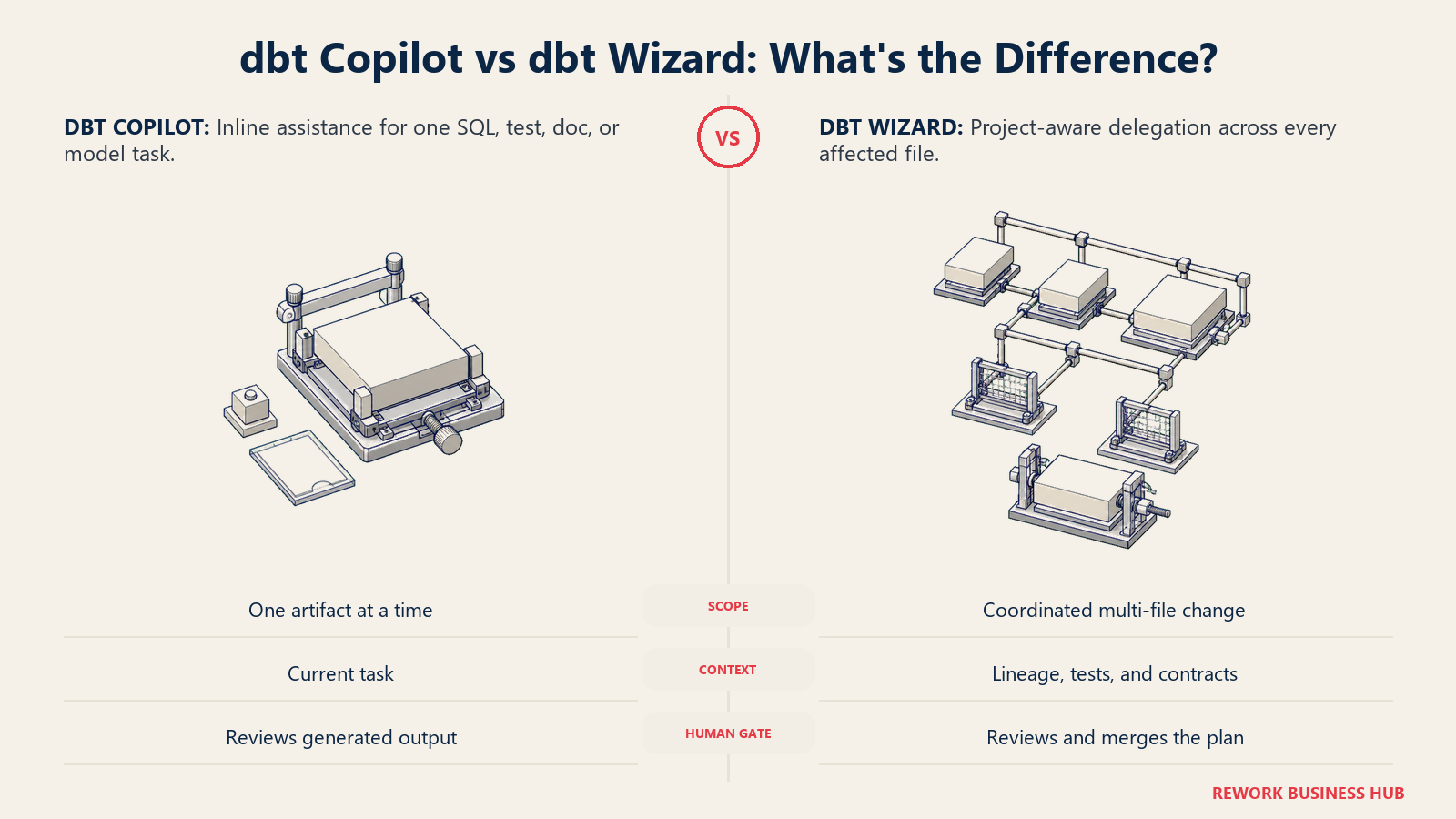
The honest caveat is maturity: the fuller Wizard/Agents capability is available in Preview for platform customers with Copilot enabled, not a fully general release, so treat any unsupervised production merge as a future capability rather than a today one.
| What you get | What you don't |
|---|---|
| Inline assist and full-task delegation from one vendor and one project graph | Wizard/Agents capability is still Preview, not GA |
| Grounded in real lineage, tests, and contracts before drafting a change | Copilot requires Starter or above; not on the free Developer tier |
| Fusion engine (free, open-source) now core to dbt Core v2.0 | Enterprise seat costs climb fast past the 5-seat Starter tier |
Pricing: Developer (free, 1 seat, 3,000 models/mo); Starter $100/user/month (5 seats, 15,000 models/mo, Copilot included); Enterprise and Enterprise+ (custom, billed annually, adds advanced Copilot access, Canvas, Insights, and Mesh). See dbt's pricing page.
Best for: Teams already on or moving to dbt who want both inline code generation and full-task delegation, including migration work, from a single vendor.
2. Monte Carlo: The Deepest Root-Cause Analysis on This List
Monte Carlo built its category around a "fleet of agents," a Troubleshooting Agent, a Monitoring Agent, and an Operations Agent, included on every pricing tier rather than gated behind an upsell. The Troubleshooting Agent's real job is correlating freshness, volume, schema, and distribution signals against lineage to name a root cause, a customer-quoted capability the company says "does in minutes what used to take hours." That root-cause depth is backed by Monte Carlo's own platform telemetry: pipeline execution faults are the single largest category of incidents it flags, at 26.2%.
Pricing runs on a credit-consumption model across four tiers (Start, Scale, Enterprise, Business Critical), and nothing is published without a quote, though the tier structure itself (user counts, monitor limits, API call caps) is public.
| What you get | What you don't |
|---|---|
| Full fleet of AI agents included on every tier, not an add-on | Nothing priced without a sales conversation |
| Deepest root-cause and lineage correlation of any product here | Credit-consumption model takes real modeling to budget |
| Cost attribution and multi-workspace support at Enterprise | Overkill for a small team monitoring a handful of tables |
Pricing: Quote-based, credit-consumption model across Start (up to 10 users, 1,000 monitors), Scale, Enterprise, and Business Critical tiers (all unlimited users and monitors, escalating API caps). See Monte Carlo's pricing page.
Best for: Mid-market to enterprise data teams that want observability and agentic root-cause analysis as one platform and can absorb a sales cycle to get there.
3. Anomalo: Built for Values You Didn't Think to Check
Anomalo's pitch is specific: most data quality tools check metadata (did the table arrive, did the row count look normal), while Anomalo's unsupervised machine learning checks the values inside the table itself, learning what a normal distribution looks like per column so it can flag a value that's wrong without anyone writing a rule for it first. That's the closest thing on this list to a purpose-built answer to the silent-error problem this guide opens with.
Anomalo doesn't publish pricing anywhere, not a tier list, not a starting number. It's sold through a sales-led motion with no self-serve signup, though it is available through the AWS, Azure, and Google Cloud marketplaces, which lets committed cloud spend count toward the cost for buyers already inside one of those programs.
| What you get | What you don't |
|---|---|
| Unsupervised checks on actual data values, not just table metadata | Zero published pricing, not even a ballpark range |
| Marketplace billing (AWS, Azure, GCP) for buyers with committed cloud spend | No free tier and no self-serve signup |
| Purpose-built for retail, consumer goods, and other high-volume verticals | Real sales cycle before you see a number |
Pricing: Not published. Sales-led and quote-based; no free plan, free trial available. (Reported as sales-led with no published rates, per TrustRadius and Data Stack Index.) See Anomalo.
Best for: Enterprises that want unsupervised detection of wrong-but-plausible values, not just broken tables, and can work through a sales process to get pricing.
4. Metaplane (Datadog): The Real Free Way to Start
Metaplane, now part of Datadog following its acquisition, still runs its own pricing page with a genuine perpetual free tier: 10 monitored tables and 4 users, with alerting to Slack, email, or Microsoft Teams, no expiration and no credit card trap. That makes it one of the only products in this entire guide a team can actually start using today without a sales call.
The Pro tier adds column-level lineage, Data CI/CD, cost and performance monitoring, and custom SQL monitors, priced per monitored table on a usage basis, though Metaplane doesn't publish the exact per-table rate on its own site. Enterprise adds unlimited tables, SSO, PrivateLink, and premium support.
| What you get | What you don't |
|---|---|
| Genuine perpetual free tier (10 tables, 4 users) to try before buying | Pro's exact per-table rate isn't published anywhere |
| Column lineage and Data CI/CD bundled into Pro | Root-cause agent depth is thinner than Monte Carlo or Sifflet |
| Now backed by Datadog's platform and distribution | Best value likely requires already being a Datadog customer |
Pricing: Free ($0, 10 tables, 4 users); Pro (usage-based, priced per monitored table, exact rate not published); Enterprise (custom). See Metaplane's pricing page.
Best for: Teams that want a genuine, no-cost starting point for table-level monitoring, especially ones already inside the Datadog ecosystem.
5. Sifflet: Lineage-Aware Impact Analysis With a Fix Agent on the Way
Sifflet bundles core observability, a data catalog, and business-aware lineage and impact analysis into every tier, with a named agent, Sentinel, that suggests monitoring coverage automatically rather than requiring a team to configure every check by hand. The more ambitious piece is still arriving: Sage and Forge, in early access on the Growth and Enterprise tiers, extend that into issue diagnosis and fix suggestions, the same territory Monte Carlo's Troubleshooting Agent already occupies at general availability.
Nothing here is priced without a conversation, even the entry tier, though teams with existing Snowflake spend commitments can apply that credit toward Sifflet in Enterprise deals.
| What you get | What you don't |
|---|---|
| Lineage and impact analysis bundled from the entry tier | Nothing priced without a sales call, even Entry |
| Sentinel automatically suggests monitoring coverage | Sage & Forge (diagnosis and fix) is early access, not GA |
| Snowflake credits can offset Enterprise-tier cost | Younger, smaller vendor than Monte Carlo in this category |
Pricing: Quote-based across Entry (up to 500 assets), Growth (up to 1,000 assets), and Enterprise (1,000+ assets) tiers. See Sifflet's pricing page.
Best for: Teams that want lineage-aware impact analysis today and are comfortable adopting an early-access fix-suggestion agent as it matures.
6. Datafold: The Clearest Migration ROI Case on This List
Datafold's Migration Agent (DMA) does two things together: it uses an LLM to translate legacy code (stored procedures, other SQL dialects) into modern, modular dbt models, and it validates that translation with Datafold's own data-diff technology, comparing frozen snapshots of the legacy and new systems row by row until parity is confirmed rather than assumed. That validation loop is the real differentiator: the agent isn't asking you to trust its translation, it's proving the output matches before you ship it.
The evidence is concrete. A Fortune 500 manufacturer used DMA to migrate more than 400 stored procedures, including one single procedure containing 300,000 characters of code that DMA's "Slicer" decomposed into roughly 400 individual dbt models, from Azure Synapse to Snowflake and dbt. The project finished in 3 months against a 12-month estimate, at roughly 75% lower cost, eliminating hundreds of thousands of dollars in ongoing third-party maintenance in the process.
| What you get | What you don't |
|---|---|
| The strongest documented migration case study in this guide | Zero public pricing, not even indicative tiers |
| Validates its own translation with row-by-row data-diff, not just trust | Best suited to migration-shaped projects, thinner as daily monitoring |
| Handles genuinely large, tangled legacy procedures (300,000+ characters) | Requires a sales conversation before you see a number |
Pricing: Not published; the pricing page redirects directly to a contact form. See Datafold.
Best for: Teams with a specific legacy-SQL-to-dbt or warehouse migration project, where the ROI case is stronger than anywhere else in this guide.
7. Prophecy: A Visual Canvas With AI-Drafted Logic and Documentation
Prophecy's core product is a low-code visual builder for Spark and SQL pipelines that compiles down to real, version-controlled code rather than a black box. On top of that, a Transform agent drafts pipeline logic from a plain description and a Documentation agent explains what a pipeline actually does, together covering two of the harder jobs in this guide (SQL and dbt-adjacent generation, plus documentation) in one product.
Pricing is more transparent than most of this list: a free Starter tier with embedded DuckDB processing, a per-seat Professional tier, and, unusually for this category, a flat Enterprise Express rate for up to 20 users instead of only "contact sales."
| What you get | What you don't |
|---|---|
| Transform and Documentation agents in one visual, code-backed canvas | Professional's per-seat cost stacks fast past a handful of users |
| Enterprise Express gives an actual flat monthly number, not just a quote | Better fit for Spark-centric shops than pure SQL/dbt teams |
| Supports Databricks, Snowflake, and BigQuery from the Professional tier | Custom AI skills and private LLM integration are Enterprise-only |
Pricing: Starter (free, 20 credits/mo); Professional $150/user/month, billed monthly (50 credits/user/mo); Enterprise Express $4,000/month, billed annually (up to 20 users, 5,000 credits/year); Enterprise (custom). See Prophecy's pricing page.
Best for: Teams building on Databricks, Snowflake, or BigQuery that want a visual canvas with AI-assisted transform logic and documentation, not a pure-code workflow.
8. Coalesce: AI-Generated Transforms With Lineage and Docs Together
Coalesce built its reputation as a warehouse-native (originally Snowflake-first) transformation builder with a visual, governed development model. Coalesce Copilot, generally available since December 9, 2025, adds an agentic chat layer on top: describe what you want built, and Copilot generates the transformation logic while surfacing the most relevant objects already in the environment, then can walk through the logic, surface lineage, and generate documentation for what it built. The company's own claim is an 80% cut in build time, a vendor number worth verifying against your own pipelines rather than taking at face value.
Pricing follows a "people plus actions" model: free for a single developer, then per-seat pricing with a monthly action allowance that scales up through Enterprise.
| What you get | What you don't |
|---|---|
| Copilot generates logic, surfaces lineage, and writes docs from one request | 80% build-time figure is Coalesce's own claim, not independently verified |
| Free Developer tier for a single user before any commitment | Starter's per-seat cost adds up past 4 users before Enterprise pricing helps |
| Transform and Quality included even on the free tier | Strongest fit is warehouse-native teams, not a general pipeline tool |
Pricing: Developer (free, 1 user, 2,000 actions/mo); Starter $150/user/month billed annually (4 users, 15,000 actions/mo); Enterprise and Business Critical (custom). See Coalesce's pricing page.
Best for: Teams standardized on a cloud warehouse that want AI-generated transformation logic with lineage and documentation built in, not bolted on afterward.
9. Databricks: Genie Code Inside Lakeflow
Genie Code is Databricks' data engineering agent, and it's worth being precise about the name: it is a different product from "Databricks Genie," the conversational analytics agent covered in our data analysis guide. Genie Code lives inside Lakeflow, where it can draft production-ready pipelines in Python or SQL from a natural-language description, sequence job graphs with triggers and dependencies, and debug failures directly in the Pipeline Editor. Lakeflow Designer pairs a no-code visual canvas with the same engine, compiling every flow down to real Spark Declarative Pipeline code so there's no black-box translation gap between what you see and what runs.
The access story improved sharply in 2026: Databricks Free Edition now bundles Genie Code, Lakebase, serverless GPUs, and Lakeflow Designer for any signup, not only paying customers, though production usage still runs on the same consumption-based DBU pricing as the rest of the platform.
| What you get | What you don't |
|---|---|
| Compiles to real, inspectable Spark Declarative Pipeline code | No flat price; cost is a function of DBU consumption |
| Now included in Databricks Free Edition for any signup | Adds nothing if your pipelines don't already live on the Lakehouse |
| Debugs failures directly inside the same pipeline editor | Distinct from "Databricks Genie" (data analysis); easy to conflate the two |
Pricing: Free within Databricks Free Edition; otherwise metered through standard consumption-based DBU pricing, no separate flat rate. See Databricks pricing.
Best for: Teams already running production pipelines on Databricks who want natural-language pipeline authoring and debugging without leaving the platform.
10. Snowflake: Cortex Code and Openflow
Cortex Code, nicknamed CoCo, is Snowflake's coding agent for data engineers building pipelines, applications, and AI workflows on the platform, and like Databricks, it's worth distinguishing from Cortex Analyst, the business-question agent covered in the data analysis guide. CoCo launched in February 2026 and became the fastest-growing product in Snowflake's history by Summit in June, with over 7,100 accounts using it, available from the desktop, mobile, Slack, Excel, VS Code, and even Claude Code. Paired with Openflow, Snowflake's managed data integration service built on Apache NiFi that reached wider general availability across all three major clouds at the same event, CoCo can build and troubleshoot integration pipelines faster on the ingestion side, not just the transform side.
Like Databricks, there's no flat number to quote: Snowflake bills in consumption-based credits, and the company doesn't publish a per-credit rate on its general pricing page, pointing buyers to a Service Consumption Table or a sales conversation instead.
| What you get | What you don't |
|---|---|
| Fastest-growing product in Snowflake's history, a real adoption signal | No flat rate; budgeting needs the Service Consumption Table |
| Pairs with Openflow for the ingestion and CDC side, not just transforms | Distinct from Cortex Analyst (data analysis); easy to conflate the two |
| Works from desktop, mobile, Slack, Excel, VS Code, and Claude Code | Adds nothing outside the Snowflake ecosystem |
Pricing: Consumption-based Snowflake credits across Standard, Enterprise, and Business Critical editions; exact per-credit rate requires the Service Consumption Table or a sales conversation. See Snowflake pricing.
Best for: Teams already on Snowflake who want an AI agent for the pipeline and integration side specifically, not the question-answering side.
11. Airbyte: AI-Assisted Connector Building With an Open-Source Floor
Airbyte's core product is data replication (ELT), and its most useful AI feature for a data engineer is the AI Connector Builder: point it at an API's documentation and its AI Assistant, currently in Beta, pre-populates the connector's configuration, discovers available data streams, and sets up cursor-based incremental sync, cutting a task that normally takes hours down to minutes. Airbyte also ships a separate product called Airbyte Agents, billed in Agent Operations (AOs) covering search, read, act, and reason actions, but that product positions Airbyte as infrastructure other agents call for data access, not itself an agent that runs your pipelines, worth knowing so you don't buy it expecting the wrong thing.
Airbyte Core, the open-source engine, remains free and self-hosted with no vendor lock-in, which sets a real floor under the whole category.
| What you get | What you don't |
|---|---|
| AI Connector Builder drafts a new connector from API docs in minutes | AI Assist for the Connector Builder is still Beta |
| Genuinely free, self-hosted open-source Core with no lock-in | Airbyte Agents (AOs) is adjacent agent infrastructure, not a pipeline agent |
| Managed cloud tiers scale from a real $10/month entry point | Full capacity-based Pro pricing isn't a single published number |
Pricing: Core (open-source, always free); Standard from $10/month (volume-based); Pro (capacity-based); Enterprise Flex (custom). See Airbyte's pricing page.
Best for: Teams that need to stand up new source connectors fast and want AI to draft the boilerplate, on a platform with a genuine free path if you self-host.
12. Bruin: One Open-Source Stack Instead of Five Subscriptions
Bruin's pitch is consolidation: one CLI and cloud platform covering ingestion, SQL and Python pipelines, automated quality checks, and column-level lineage, positioned to replace a stack of separate tools (an ELT product, dbt, an orchestrator, a BI tool, and a chat interface bolted on top) with one open-source-rooted product. An AI Data Analyst layer sits on top, reachable from Slack, Microsoft Teams, Google Chat, WhatsApp, Discord, Telegram, or email, answering questions over live data with citations back to the query that produced them.
The open-source CLI is genuinely free and MIT-licensed, self-hostable anywhere a binary runs. The managed cloud platform gives new signups $100 of credit and 50 AI tasks a month before moving to pay-as-you-go, though Bruin doesn't publish an exact per-unit cloud rate on its own site.
| What you get | What you don't |
|---|---|
| Genuinely free, self-hostable open-source CLI with no lock-in | Youngest and smallest company on this list |
| Ingestion, transforms, quality, and lineage consolidated in one tool | Cloud pay-as-you-go rate isn't published on Bruin's own site |
| AI Data Analyst reachable from whatever chat tool the team already uses | That analyst layer is conversational and assistive, closer to a data-analysis agent |
Pricing: CLI (free, open-source, MIT license); Cloud (free tier with $100 credit and 50 AI tasks/mo, then pay-as-you-go, exact rate not published); Enterprise available. See Bruin.
Best for: Smaller data teams that want one open-source-rooted stack instead of five separate subscriptions and are comfortable being an early adopter.
Buying Mistakes to Avoid
| Mistake | What It Looks Like | What to Do Instead |
|---|---|---|
| Buying "agent" branding without checking what it catches | Paying for a monitor that only flags a table that stopped updating | Ask for a real example of a wrong-but-plausible value it caught, not just a late pipeline |
| Trusting a build-time or migration-time claim with no named case | Accepting "80% faster" with no customer, no before-and-after numbers | Ask for a named reference case with a real timeline and outcome |
| Skipping lineage before letting an agent touch a model | An agent renames or drops a column with no view of what breaks downstream | Confirm the agent reads lineage before it writes, not after something breaks |
| Assuming a generation agent and a quality agent are the same purchase | Buying a code-drafting tool and expecting it to also monitor for silent errors | Most vendors here do one job well; pair a generation agent with a monitoring agent |
| Ignoring credit or DBU consumption until the first invoice | Budgeting a flat number for a tool that bills per credit, token, or compute second | Model a realistic pipeline volume and query load before committing |
| Rolling a Preview or early-access agent straight into production | Letting an unsupervised agent edit models with no review gate | Pilot on a non-critical pipeline first and require a human merge |
| Confusing an assistive connector builder with an autonomous pipeline agent | Expecting an AI Connector Builder to run the whole pipeline end to end | Match the product to the job: drafting a config isn't the same as operating a pipeline |
Decision Framework
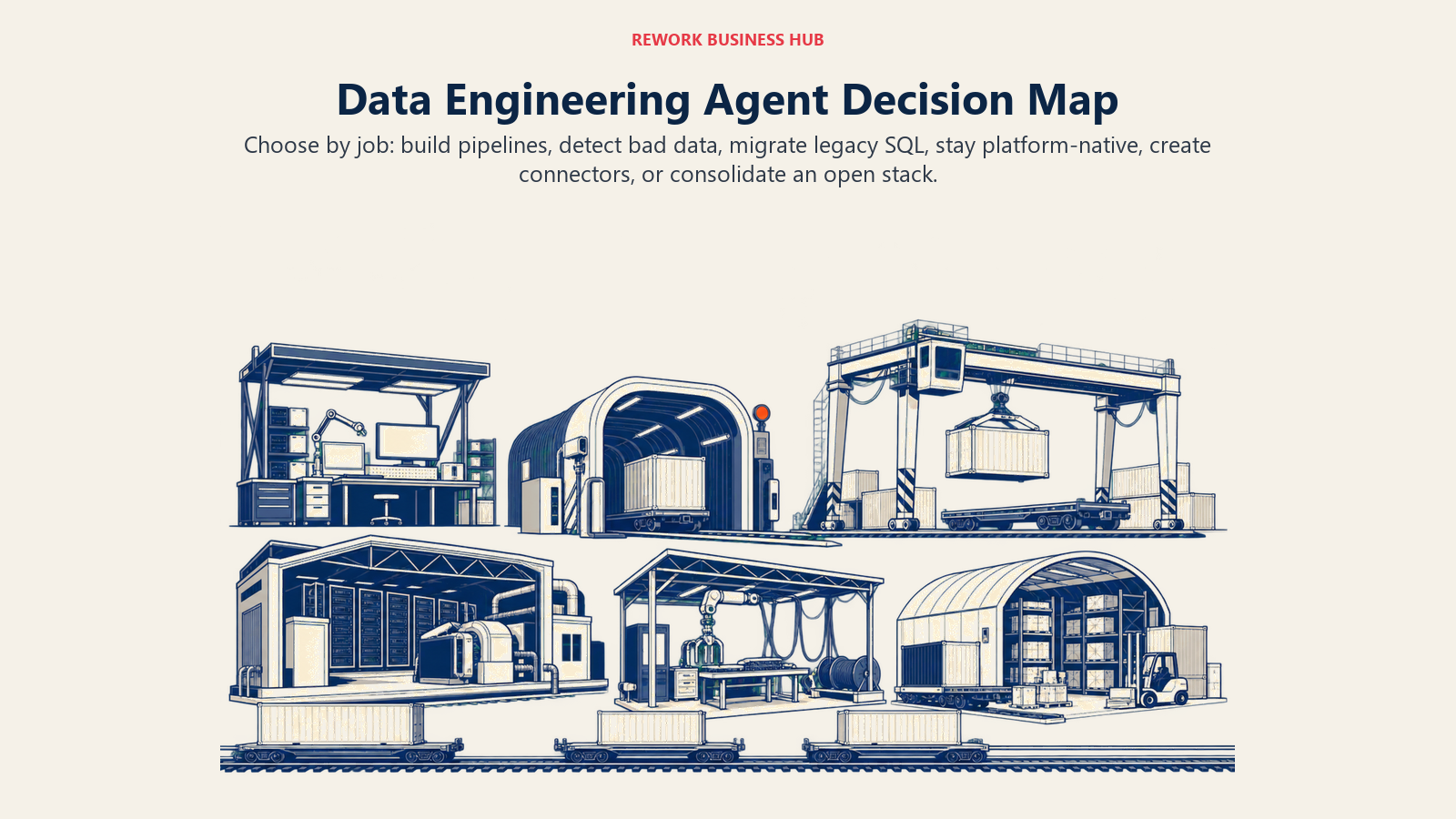
Start with the platform job you need solved, then choose the agent built for generation, quality, migration, or native execution.
| If you need... | Pick... | Why |
|---|---|---|
| Inline SQL generation and full-task delegation from one vendor | dbt Labs | Copilot and Wizard cover both jobs on one project graph |
| The deepest root-cause analysis across a large, complex environment | Monte Carlo | Fleet of agents included on every tier, strongest lineage correlation |
| Unsupervised detection of wrong-but-plausible values | Anomalo | Checks values inside the table, not just table-level metadata |
| A real free tier to start monitoring today | Metaplane | Genuine perpetual free tier, no sales call required |
| Lineage-aware impact analysis with a fix agent on the roadmap | Sifflet | Sentinel plus early-access Sage & Forge diagnosis and fixes |
| A legacy-SQL-to-dbt migration project | Datafold | The strongest documented ROI case study in this guide |
| A visual canvas with AI-drafted logic and documentation | Prophecy | Transform and Documentation agents in one code-backed builder |
| AI-generated transforms plus lineage and docs on a warehouse-native tool | Coalesce | Copilot ties generation, lineage, and documentation together |
| Natural-language pipeline authoring already inside Databricks | Databricks (Genie Code) | Compiles to real Spark code inside Lakeflow, now free to start |
| Natural-language pipeline and integration authoring inside Snowflake | Snowflake (Cortex Code) | Fastest-growing Snowflake product in company history, pairs with Openflow |
| Fast AI-assisted connector building with a real open-source option | Airbyte | AI Connector Builder plus a genuinely free, self-hosted Core |
| One open-source-rooted stack instead of five subscriptions | Bruin | Ingestion, transforms, quality, and lineage consolidated in one CLI |
What to Do Next
Start with the job actually blocking you, not a category tour. If you're carrying a specific legacy-to-dbt or warehouse migration, look at Datafold first: the ROI case is the clearest of anything in this guide, and the data-diff validation means you're not just trusting an LLM's translation. If the real pain is data you can't trust, not pipelines that crash, start with Monte Carlo or Anomalo and ask each one directly for an example of a wrong-but-plausible value it caught, not a late table it flagged. And if your team is already standardized on dbt, Databricks, or Snowflake, check that platform's own agent (dbt Wizard, Genie Code, Cortex Code) before adding a new vendor; the lineage and permissions work is already done there.
Whichever you pick, pilot it on a non-critical pipeline first, confirm what it can actually touch versus only suggest, and require a human merge until you've seen it catch something real. If procurement or a security review is the next hurdle, best enterprise AI agent platforms covers what that review actually checks. And if what you're really building is the incident-response half of this job rather than buying a finished product, the AI DevOps Agent blueprint and Reporting Agent blueprint are vendor-neutral starting points for designing one yourself.

Principal Product Marketing Strategist
On this page
- What Changed in 2026
- Key Facts
- Quick Comparison Table
- What Actually Catches a Silent Error
- Why a Silent Error Costs More Than a Loud Failure
- How to Choose: Three Questions Before You Buy
- 1. Does it open a pull request, or only suggest a fix?
- 2. Can it see downstream impact before it changes a model?
- 3. Does it watch warehouse cost, or only pipeline correctness?
- 1. dbt Labs: Both an Inline Assistant and a Full-Task Agent
- 2. Monte Carlo: The Deepest Root-Cause Analysis on This List
- 3. Anomalo: Built for Values You Didn't Think to Check
- 4. Metaplane (Datadog): The Real Free Way to Start
- 5. Sifflet: Lineage-Aware Impact Analysis With a Fix Agent on the Way
- 6. Datafold: The Clearest Migration ROI Case on This List
- 7. Prophecy: A Visual Canvas With AI-Drafted Logic and Documentation
- 8. Coalesce: AI-Generated Transforms With Lineage and Docs Together
- 9. Databricks: Genie Code Inside Lakeflow
- 10. Snowflake: Cortex Code and Openflow
- 11. Airbyte: AI-Assisted Connector Building With an Open-Source Floor
- 12. Bruin: One Open-Source Stack Instead of Five Subscriptions
- Buying Mistakes to Avoid
- Decision Framework
- What to Do Next