Best AI Agents for Cold Email in 2026: 10 Agents That Write, Send, and Follow Up
Turn this article into takeaways for your work.


Each assistant summarizes the article only for you and suggests best practices for your work.
The best AI agents for cold email are Artisan's Ava and AiSDR's Ami AI if you want a fully autonomous BDR handling research through booked meetings, Salesforge's Agent Frank or Instantly's AI Sales Agent if you want that agent bundled with its own sending infrastructure, and Smartlead or Lemlist if a human is still running the sequence and you just want AI doing the research and the replies. This guide covers 10 agents that genuinely research a prospect, write the message, send it, and decide what happens next on their own, not just draft a subject line for a rep to approve.
That distinction matters because "AI agent" gets stretched to cover almost anything with a chat box bolted on; the broader best AI agent platforms guide covers the full category if cold email isn't your only use case. An agent here runs multiple steps without a person doing each one by hand: research the account, write the message, send it, read the reply, decide whether to follow up or hand off to a human. That's a different job from finding and qualifying leads before outreach even starts, and a different legal problem from emailing people who already opted in, which is email marketing work, not cold outbound. And none of it matters if the message never reaches an inbox: every product below lives or dies on deliverability infrastructure, domains, mailboxes, authentication, warmup, before a single word of AI-written copy counts for anything, which is why that gets its own section before the rankings start.
Key Facts
- Gmail requires SPF, DKIM, and DMARC, plus a spam complaint rate under 0.30%, from anyone sending more than 5,000 messages a day, and rejects non-compliant bulk mail rather than just filtering it, per Google's email sender guidelines.
- Outlook.com adopted the same 5,000-message daily threshold and authentication requirement on May 5, 2025, initially routing failing messages to junk before moving to outright rejection, per Microsoft's sender policies.
- The average cold email reply rate sits at 3.43% in 2026, with top-quartile senders above 5.5% and elite campaigns above 10.7%, and 58% of all replies come from the first email in a sequence, not the follow-ups, per Instantly's 2026 Cold Email Benchmark Report.
- The AI SDR software market is projected to grow from $4.39 billion in 2025 to $5.81 billion in 2026, a 32.3% jump, and reach $17.58 billion by 2030, per Research and Markets.
- Hybrid pods that pair a human rep with an AI agent convert roughly 38% of booked meetings versus about 11% for fully autonomous AI-only setups, and generate 2.3 times more revenue despite booking fewer meetings overall, per Laxis' State of AI Sales Agents 2026 report.
Quick Comparison Table
| Agent | Best For | Starting Price | Key Strength | Key Limitation |
|---|---|---|---|---|
| Artisan (Ava) | Teams replacing manual prospecting with a fully autonomous BDR | Quote-gated (Team/Scale/Enterprise) | Runs research through meeting booking with no per-step human input | No public pricing; per-lead economics only appear after a sales call |
| AiSDR (Ami AI) | Small teams wanting a transparent, self-serve AI SDR | $250/mo (Solo) | Real self-serve pricing; replies handled in 5 to 10 minutes | Contact volume is capped tightly until the $2,500/mo Scale tier |
| Salesforge (Agent Frank) | Teams that want the agent and its sending infrastructure from one vendor | $499/mo (billed quarterly) | Bundled with Mailforge, Warmforge, and Infraforge deliverability infrastructure | Per-contact rate ($0.25) adds up fast past 2,000 contacts a month |
| Instantly (AI Sales Agent) | Teams that already trust Instantly's deliverability and want an agent layered on | $37.60/mo (Growth, annual; $47/mo monthly) | Deepest deliverability track record, plus three named agents | Agent access is split across separate credit and bundle plans |
| Smartlead (SmartAgents) | Agencies running many client inboxes that now want AI on top | $39/mo (Base) | Unlimited mailboxes on every tier | SmartAgents pricing isn't broken out; thinner track record than the core sender |
| Lemlist (lemAgent) | Teams wanting AI research bundled free into a multichannel sender | $55/mo (Email plan, annual) | lemAgent ships on every plan at no extra cost | Depth trails purpose-built AI SDR products |
| Amplemarket (AI Agents / Duo) | Teams wanting autonomous research tied to intent signals | $600/mo (Startup, annual) | Duo suite covers copy, voice, and inbox replies in one product | Duo Voice and Duo Inbox sit behind quote-gated Growth and Elite tiers |
| Apollo (Sequences + AI Agents) | Teams that already run their database and sequences in Apollo | $49/user/mo (Basic, annual) | Agent layer plugs into the database and sequencer you already pay for | Agent features and deliverability fixes are newer than the core product |
| Outreach (Amplify agents) | Enterprise orgs standardizing agentic workflows revenue-wide | ~$100-140/user/mo (quote-based) | Named agent roster tied to forecasting and pipeline data | Consumption-based AI credits on top of seats make cost hard to predict |
| Salesloft (AI Email Agents) | Enterprise teams already committed to Salesloft/Clari | ~$125-165/user/mo (quote-based) | AI Email Agents sit inside a mature cadence and coaching platform | Pricing and the agent roadmap are both opaque post-Clari merger |
Deliverability Infrastructure: Why This Decides Everything
Before you compare a single feature, understand the plumbing. SPF (a DNS record listing which servers are allowed to send mail for your domain), DKIM (a digital signature proving a message wasn't altered in transit), and DMARC (the policy telling Gmail and Outlook what to do when SPF or DKIM fails) used to be optional hygiene. Since Google's 2024 bulk sender rules and Microsoft's matching May 2025 policy on Outlook.com, they're the entry ticket: send more than 5,000 messages a day without all three configured, and Gmail rejects the mail outright rather than filtering it into spam.
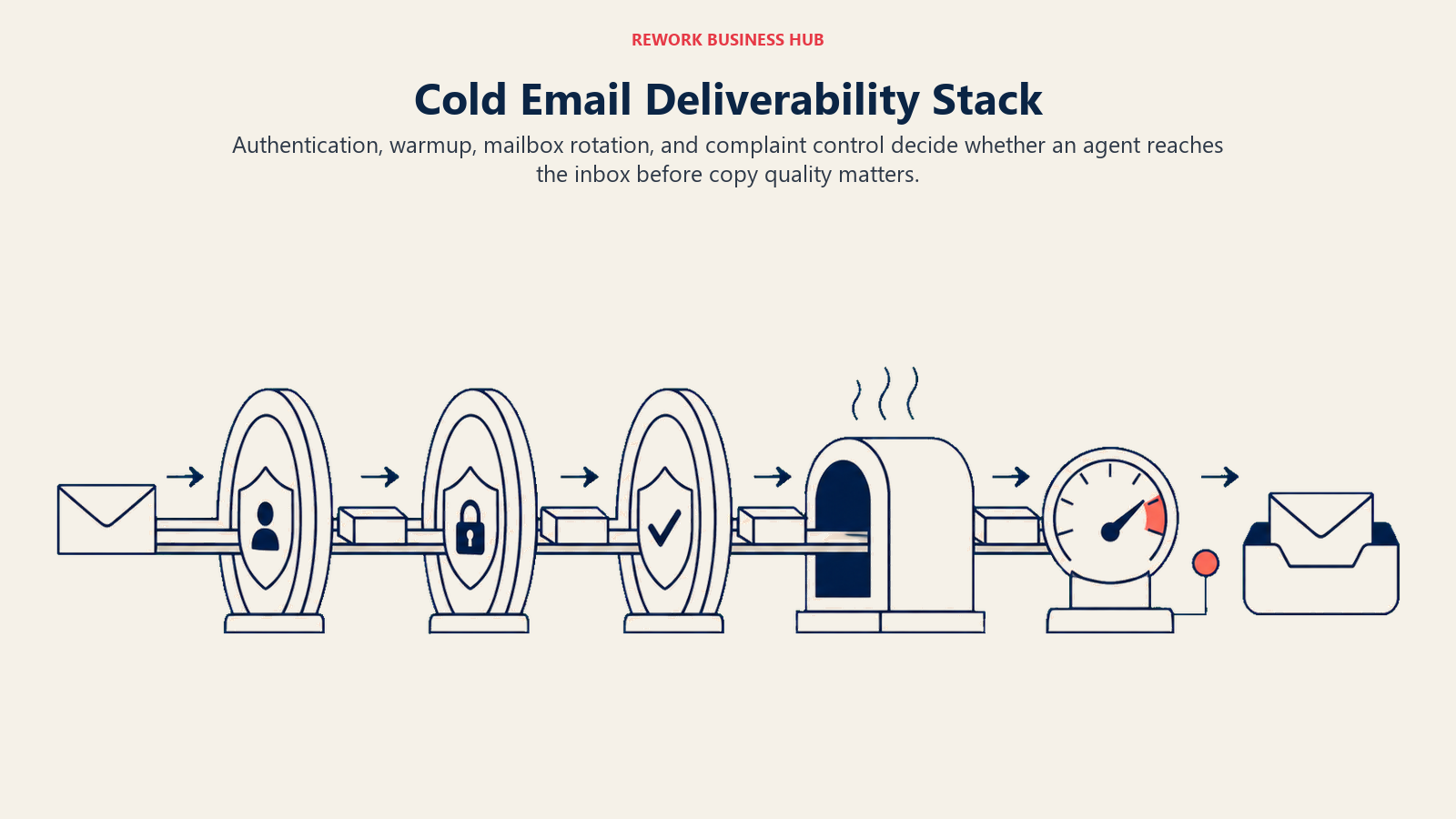
That rule reshaped the whole category. Before 2024, a single domain blasting thousands of emails from one mailbox was survivable. Now the entire industry runs on "warmup," a new mailbox sending a small, slowly increasing volume to build sender reputation before it carries real campaign traffic, plus dozens of rotating mailboxes across several domains instead of one domain sending everything. That's why "unlimited mailboxes" is the headline feature on Instantly, Smartlead, and Lemlist's pricing pages instead of send volume: volume without that discipline burns a domain's reputation within weeks, and a burned domain doesn't recover quickly.
The 10 agents below split into two camps on this. Some bundle deliverability infrastructure directly into the agent, so buying the agent means buying the plumbing too. Others assume you already own domains, mailboxes, and warmup, and layer an agent on top of infrastructure you manage yourself, the way Woodpecker positions itself: a sending and warmup tool other agents connect to over MCP and API rather than an agent in its own right.
| Agent | Brings its own sending infrastructure? | Warmup included? | What you still need to own |
|---|---|---|---|
| Artisan (Ava) | No; sends under your reps' names on your company domain | Not stated on the pricing page | Your domain authentication and reputation |
| AiSDR (Ami AI) | Partial; provisions 3 to 18 mailboxes depending on plan | Included as part of mailbox provisioning | Domains beyond the plan's included count |
| Salesforge (Agent Frank) | Yes, via Mailforge (mailboxes) and Infraforge (private infrastructure) | Yes, unlimited via Warmforge | Domain registration itself |
| Instantly (AI Sales Agent) | Yes; unlimited email accounts, plus dedicated IP pools at the Agency tier | Yes, unlimited on every plan | Domain registration and DNS records |
| Smartlead (SmartAgents) | Yes; unlimited mailbox connections on every plan | Yes | Domain registration and DNS records |
| Lemlist (lemAgent) | Partial; senders included per plan | Yes, included on all plans | Domain registration |
| Amplemarket (AI Agents) | Not detailed on the pricing page | Not stated | Confirm directly before buying |
| Apollo (Sequences) | No; connect your own mailboxes | Not a headline feature | Your own warmup and authentication setup |
| Outreach (Amplify) | No; relies on your corporate email (Google Workspace/Microsoft 365) | No | Your IT team's authentication and sending reputation |
| Salesloft (AI Email Agents) | No; relies on your corporate email | No | Your IT team's authentication and sending reputation |
Instantly's own 2026 benchmark data backs this up directly: teams that keep bounce rates below 2% and send consistently see 15% to 20% higher reply rates than teams that don't, and new domains still need 4 to 6 weeks of gradual warmup starting at 5 to 10 emails a day. No agent, however good the writing, changes that math.
Personalization Depth: Real Research vs Mail-Merge Cosplay
Every vendor in this category claims "AI personalization." Most of it is a merge field wearing a costume: {{firstName}}, {{company}}, and a generic opener that doesn't survive a second read. The agents worth paying for do something closer to what a good human researcher would do before a first email: pull a real, specific reason to reach out (a funding round, a hiring push, a product launch, a piece of content the prospect actually published) and write around it.
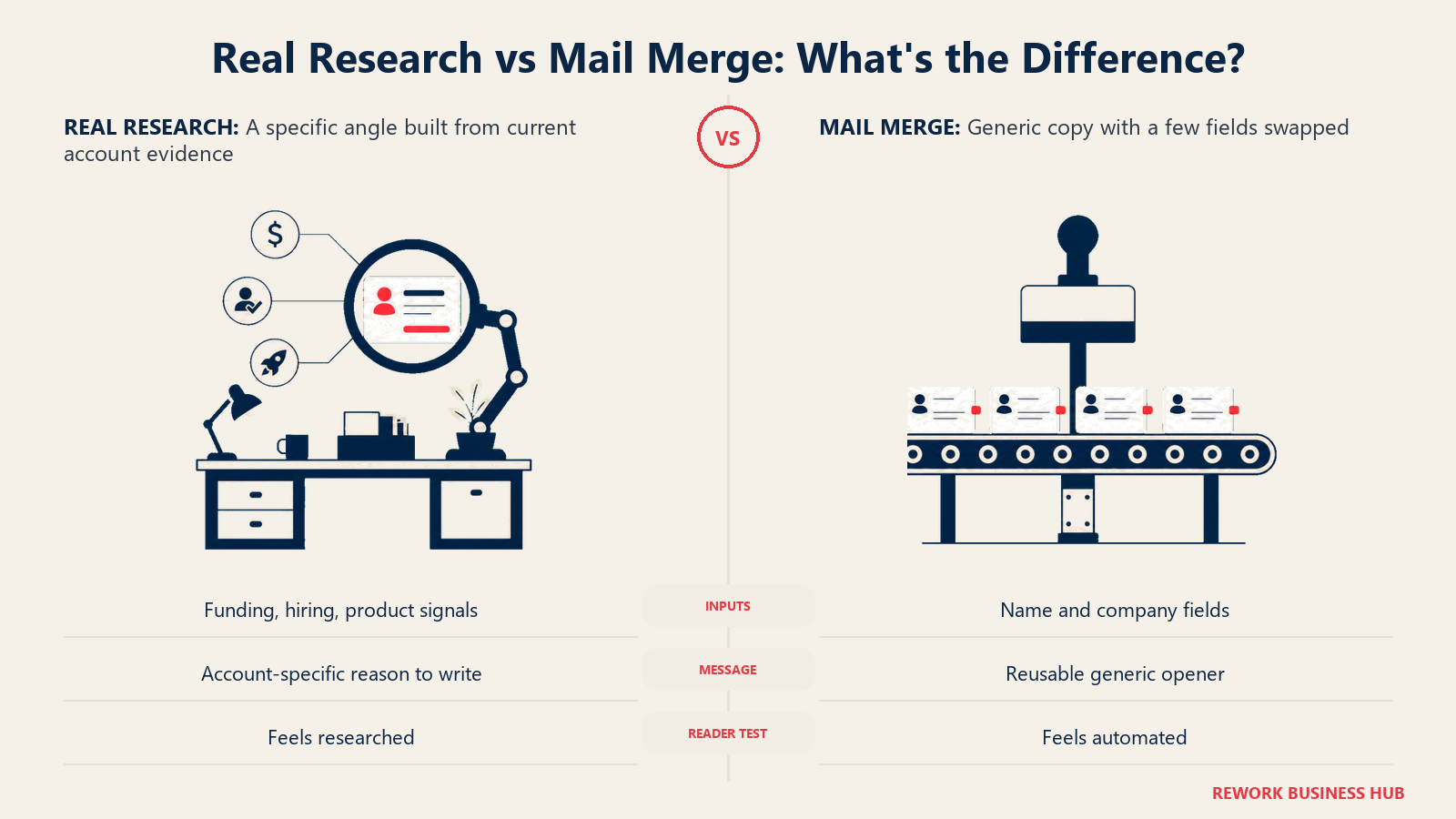
AiSDR's Ami AI is explicit about this: it surfaces the top three data points per lead from company news, hiring signals, and web activity before drafting anything, rather than working off a static template. Artisan's Ava runs a similar account-research pass before it ever sends. That depth is also why the AI SDR agent blueprint is worth reading even if you end up buying rather than building: it lays out exactly which research steps separate a genuinely personalized sequence from a mail-merge job with better grammar, and the guide to AI in BDR and SDR prospecting covers how to structure that research workflow regardless of which vendor runs it.
The stakes are real, not cosmetic. Laxis' 2026 research found hybrid pods (a human plus an AI agent) converting at roughly 38% versus about 11% for fully autonomous AI-only setups, even though the autonomous setups booked more total meetings. The gap is personalization and judgment, not volume: a fully autonomous agent that sends more messages with shallow research books more meetings that go nowhere, while a slower, better-researched approach with a human checking the agent's work converts meaningfully more of what it books.
Automated Reply Handling and Meeting Booking
Sending is the easy half. What separates an agent from a sequencer is what happens after someone replies. AiSDR's Ami AI answers routine replies autonomously within 5 to 10 minutes, or routes them to a human in co-pilot mode when the conversation gets complex, then books confirmed meetings straight to a calendar through Calendly and CRM integrations. Instantly's AI Reply Agent works inside its Unibox to triage and draft responses across every connected mailbox. Amplemarket's Duo Inbox auto-drafts a reply for every prospect email rather than leaving that to a rep. Artisan's Ava and Salesforge's Agent Frank both run reply handling with configurable approval workflows and escalation rules, so a team can start in a supervised mode and open up autonomy as trust builds.
That escalation layer matters more than the marketing copy suggests. A follow-up cadence that stops the moment a human replies, and hands the conversation to a rep instead of continuing to send scripted touches into an active reply thread, is the difference between an agent that looks smart in a demo and one that embarrasses you in front of a warm prospect. If you're structuring the cadence itself, not just picking the vendor, the cold email cadence guide covers sequence length and timing separately from which tool executes it.
The Legal Line: CAN-SPAM, GDPR, and PECR
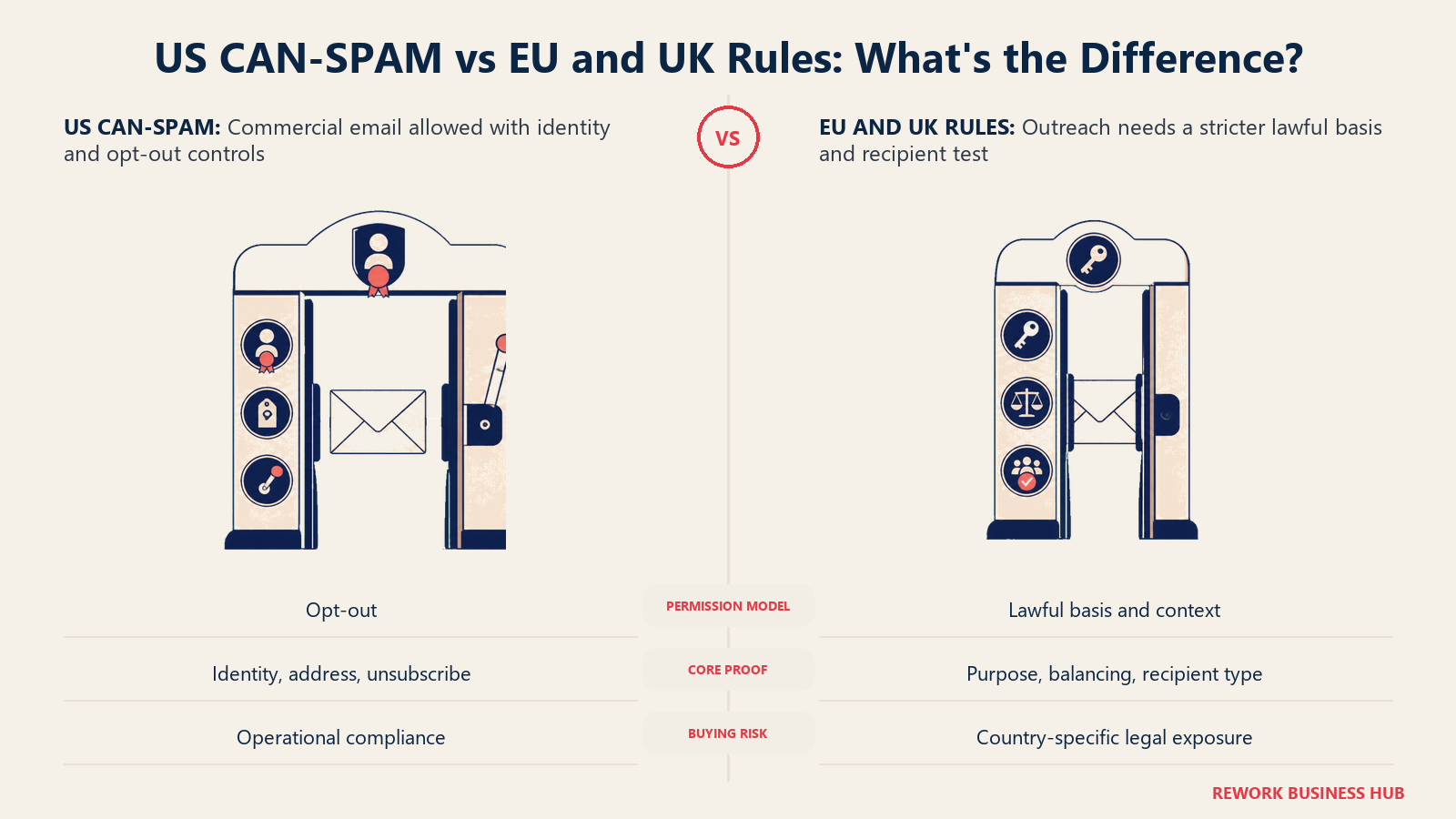
Buying an agent that can send thousands of personalized emails a day doesn't change what's legal to send. The rules differ sharply by where your prospect sits, and this is general information, not legal advice for your specific situation.
| Jurisdiction | Default rule for cold B2B email | What you must do | Where teams get burned |
|---|---|---|---|
| United States (CAN-SPAM Act) | Opt-out based; no prior consent required to send the first email | Valid physical address, honest subject lines and headers, unsubscribe honored within 10 business days | Assuming B2B is exempt. It isn't; CAN-SPAM covers commercial email regardless of who receives it |
| European Union (GDPR + national ePrivacy laws) | Legitimate interest can cover direct marketing, but it isn't automatic | A documented balancing test, a clear opt-out, and checking the national ePrivacy rule where the prospect sits | Treating GDPR as one uniform law; member states implement email marketing rules differently, and some require opt-in |
| United Kingdom (UK GDPR + PECR) | Corporate subscribers (companies, LLPs) aren't covered by PECR's consent rule the way individuals are | A lawful basis under UK GDPR, clear sender identification, and a working opt-out under PECR | Emailing sole traders and partnerships as if they were corporate subscribers; PECR treats them as individuals |
In the US, CAN-SPAM is more permissive than most teams assume: it doesn't require permission before the first email, only honesty about who's sending it and a working way to opt out. GDPR's Recital 47 explicitly allows direct marketing under a legitimate-interest basis, but that basis has to survive a real balancing test against the recipient's rights, and the ePrivacy rules that actually govern unsolicited email vary by EU member state on top of GDPR itself. The UK's PECR draws a line most US teams have never heard of: email sent to a named person at a limited company is treated differently from email sent to a sole trader or an individual, and only the former gets the corporate-subscriber exemption from strict consent. None of the ten agents below enforce this for you. Whoever configures the campaign still owns the compliance decision.
How to Choose: Match the Agent to What's Actually Missing
Most teams shop features before they diagnose the actual bottleneck. Answer this first: is the problem that your emails don't land, that nobody has time to research prospects, or that you already have both solved and just want AI handling the busywork?
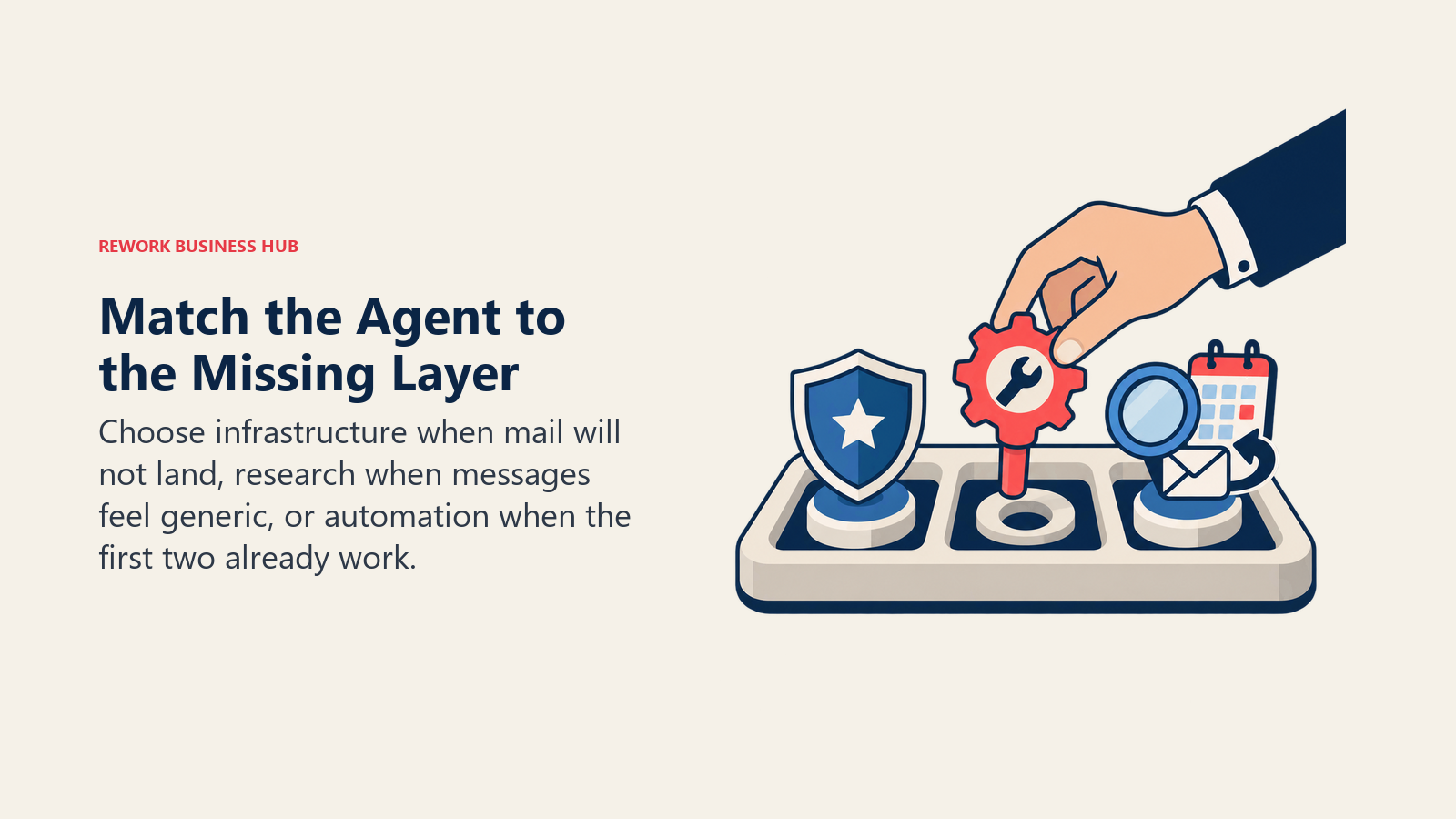
| If your real constraint is... | Start with | Why |
|---|---|---|
| Domain reputation and deliverability, not the writing | Salesforge (Agent Frank) or Instantly (AI Sales Agent) | Both bundle warmup and mailbox infrastructure into the agent itself |
| A human bottleneck on research and first drafts | Artisan (Ava) or AiSDR (Ami AI) | Both run the full research-to-send loop with little to no per-step input |
| Already sending, just want AI added to an existing motion | Smartlead (SmartAgents) or Lemlist (lemAgent) | Layers onto a sender you already trust instead of a full platform switch |
| Timing outreach to real buying signals, not a static list | Amplemarket (AI Agents) | Triggers on intent data (site visits, hiring, funding) instead of a fixed list |
| One database and sequencer for the whole team | Apollo (Sequences + AI Agents) | Agent layer sits on the prospecting tool most teams already pay for |
| Enterprise governance, forecasting, and pipeline tie-in | Outreach (Amplify) or Salesloft (AI Email Agents) | Both tie agentic outbound into the same system that runs forecasting |
Sizing and Persona Table
| Agent | Ideal Team Size | Primary Buyer Persona |
|---|---|---|
| Artisan (Ava) | 5-200 employees | Founder, Head of Sales, VP Sales |
| AiSDR (Ami AI) | 1-30 employees | Founder, solo operator, small BDR team lead |
| Salesforge (Agent Frank) | 5-100 employees | Founder, Head of Growth, Demand Gen lead |
| Instantly (AI Sales Agent) | 1-200 employees | SDR manager, agency owner, growth marketer |
| Smartlead (SmartAgents) | Agencies, 5-100 employees | Agency owner, fractional SDR manager |
| Lemlist (lemAgent) | 1-100 employees | Founder, BDR team lead, growth marketer |
| Amplemarket (AI Agents) | 20-500 employees | Head of Sales Development, RevOps |
| Apollo (Sequences + AI Agents) | 5-200 employees | SDR manager, BDR team lead, founder |
| Outreach (Amplify) | 50-5,000+ employees | VP Sales, RevOps, Sales Enablement Director |
| Salesloft (AI Email Agents) | 50-5,000+ employees | VP Sales, RevOps, Head of Revenue |
1. Artisan (Ava): The Best-Known Fully Autonomous BDR
Artisan built Ava around one bet: replace the busywork of a junior BDR with an agent that runs the entire top-of-funnel motion on its own. Ava researches a prospect, writes the outreach, sends it from a rep's name on your company domain, handles the reply, and books the meeting, with approval workflows and escalation rules available for teams that don't want full autonomy on day one. It's the product that put "AI BDR" into the industry's vocabulary in 2024 and 2025, and the platform underneath the marketing (250M+ B2B contacts, native Salesforce and HubSpot sync) has matured well past the launch buzz.
The catch is pricing. All three tiers, Team (roughly 2,500 leads contacted a month), Scale (roughly 6,000), and Enterprise, are quote-gated. You won't see a number until a sales call, and because Ava sends under your own domain, your existing deliverability setup still carries the weight of whatever volume you buy.
| What you get | What you don't |
|---|---|
| Full research-to-meeting-booking loop with no per-step human input | No public pricing; budget only firms up after a sales call |
| Approval workflows and escalation rules for a gradual handoff | Sends on your domain, so your own authentication and reputation still decide deliverability |
| 250M+ contact database and native Salesforce/HubSpot sync included | Volume tiers (2,500 to 6,000 leads/mo) are the main pricing lever, not features |
Pricing: Team, Scale, and Enterprise tiers, all quote-gated; Artisan does not publish monthly or annual rates.
Best for: Teams that want to hand the entire top-of-funnel motion to an agent and already have, or are willing to build, solid domain-level deliverability.
2. AiSDR (Ami AI): The Most Transparent Pricing of Any Full-Funnel AI SDR
AiSDR's Ami AI agent starts from a conversational setup (describe your ICP in plain English), then researches leads, pulls the top three data points that make a message worth opening (recent funding, a hiring push, a product launch), writes the email and LinkedIn message, sequences them, and either answers replies itself within 5 to 10 minutes or hands them to a rep in co-pilot mode. Confirmed meetings land directly on a calendar through Calendly and CRM integrations.
What sets AiSDR apart from Artisan and Salesforge is that its pricing is public and genuinely self-serve: $250 a month gets a single user 200 AI-researched contacts, three mailboxes, and one LinkedIn seat, month to month, no sales call required. The ceiling is real, though: 200 contacts a month is thin for anything beyond a single-founder motion, and both higher tiers require a quarterly commitment.
| What you get | What you don't |
|---|---|
| Public, self-serve pricing starting at $250/mo, no sales call required | 200 contacts/mo on Solo is thin for anything past a single operator |
| Replies handled autonomously in 5 to 10 minutes, or routed to a human co-pilot | Explore and Scale tiers lock you into a quarterly commitment |
| Deep per-lead research (top 3 signals) baked into every message | Managed-service add-ons ($149 to $2,500/mo) cost extra on top of the plan |
Pricing: Solo $250/mo (200 contacts, month to month); Explore $900/mo (800 contacts, quarterly); Scale $2,500/mo (2,500 contacts, quarterly), 20% off on annual terms.
Best for: Small teams and solo founders who want a real AI SDR without a sales call, and who can live inside a few hundred contacts a month.
3. Salesforge (Agent Frank): The Agent That Ships With Its Own Deliverability Stack
Salesforge splits itself into two products, and the split is instructive. The "Human Path" ($40 to $80/mo billed monthly, with a discount for annual billing) is a conventional sending platform where a rep writes the campaign and Salesforge sends it. Agent Frank, the "AI Path," is the actual agent: it searches a 500M+ contact database, writes and sends outreach in more than 20 languages, and runs in Auto-Pilot or Co-Pilot mode around the clock, for a flat $499 a month covering roughly 2,000 contacts, then $0.25 per contact beyond that.
The part worth paying attention to is what Agent Frank is built on top of. Salesforge also owns Mailforge (bulk mailbox provisioning), Warmforge (free, unlimited warmup using real Google Workspace and Microsoft 365 mailboxes), and Infraforge (dedicated sending infrastructure), and Agent Frank is wired directly into all three. It's the cleanest example in this category of a vendor treating the agent and the deliverability infrastructure as one product instead of bolting AI onto a sender as an afterthought.
| What you get | What you don't |
|---|---|
| Agent Frank plus Mailforge, Warmforge, and Infraforge as one connected stack | $499/mo flat only covers about 2,000 contacts; $0.25/contact after that adds up |
| Auto-Pilot and Co-Pilot modes, 20+ languages, 24/7 operation | Two separate products (Human Path vs Agent Frank) to understand before buying |
| Free, unlimited warmup on real Google Workspace/Microsoft 365 mailboxes | Billed quarterly, a bigger upfront commitment than a monthly plan |
Pricing: Agent Frank $499/mo, billed quarterly, ~2,000 contacts included then $0.25/contact; Human Path sending plans start at $40/mo.
Best for: Teams that don't want to separately vet a sending-infrastructure vendor and an agent vendor, and would rather buy both from one company that built them to work together.
4. Instantly (AI Sales Agent): The Deepest Deliverability Track Record, Now With Three Named Agents
Instantly earned its position in this category the slow way: years of being the default answer to "how do I not get blacklisted while sending cold email at volume," built on unlimited mailboxes and warmup on every plan and a public 2026 benchmark report, the source of this article's reply-rate numbers, that's more transparent than most competitors publish. In 2026 it layered three named agents on top: an AI Sales Agent that runs outbound campaigns, an AI Reply Agent that handles the Unibox, and a Web Researcher Agent that pulls prospect context before a message goes out.
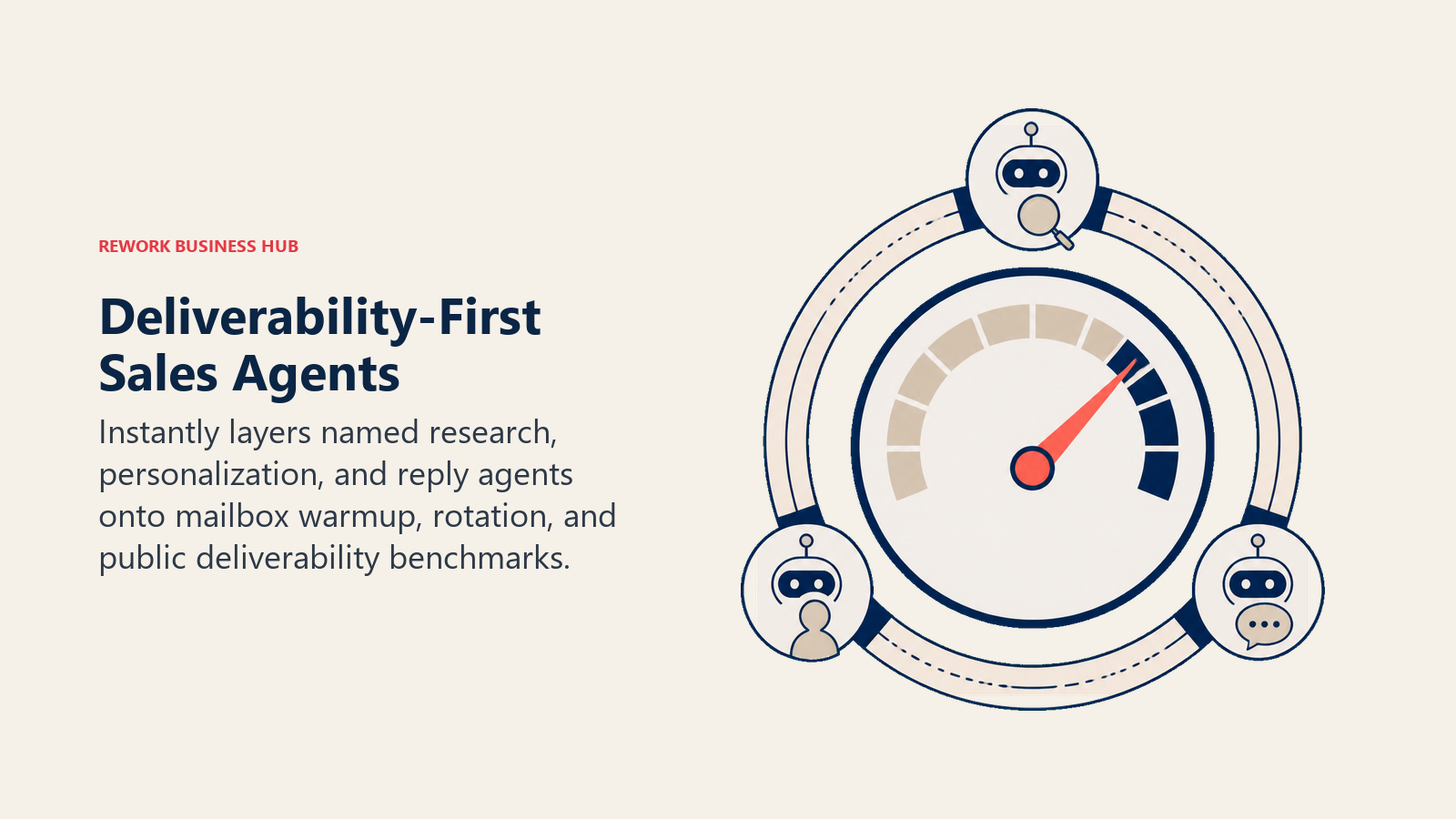
The pricing is genuinely confusing, and worth being upfront about. Instantly sells standalone sending plans (Growth: $47/mo billed monthly, $37.60/mo billed annually), standalone credit plans that unlock the AI Email Writer and Web Researcher agents (the same $47/$37.60 monthly-versus-annual structure), and bundle plans that add the AI Sales Agent and AI Reply Agent on top (Starter: $94/mo monthly, $85/mo annually). None of the three headline prices gets you the full agent roster by itself, so read the tier names carefully, and check whether the number you're looking at is monthly or annual billing, before assuming "Instantly" means one price.
| What you get | What you don't |
|---|---|
| The category's deepest public deliverability benchmark data | Three separate pricing tracks (sending, credits, bundles); easy to buy the wrong one |
| Unlimited mailboxes and warmup on every plan, even the cheapest | Full agent roster (Sales + Reply + Web Researcher) needs the $85/mo bundle, not the $47/mo entry plans |
| Dedicated IP pools at the Agency tier for teams sending real volume | Agent features are newer than the deliverability side, with less of a track record |
Best for: Teams that already treat deliverability as the hard problem and want to add an agent layer without switching sending platforms.
5. Smartlead (SmartAgents): Built for Agencies First, With AI Workflows Layered On
Smartlead's core promise hasn't changed since it became the default agency pick: unlimited mailbox connections on every plan, which matters when you're running cold email for five or ten clients out of one account instead of one company. The 2026 additions, SmartProspect for lead sourcing, SmartDialer for calling, and SmartAgents for AI-driven workflows, push it from "sender with good deliverability" toward a fuller outbound suite.
SmartAgents is genuinely new, and Smartlead doesn't publish a separate price for it on the public pricing page as of August 2026, which makes it harder to evaluate against Salesforge or Instantly's more clearly priced agent tiers. What is clear: real total cost runs well past the advertised $39 to $379 range once mailboxes, domains, and verification credits get added, so budget 3 to 5 times the sticker price for a realistic total.
| What you get | What you don't |
|---|---|
| Unlimited mailboxes on every tier, built for multi-client agency use | SmartAgents pricing isn't broken out separately as of August 2026 |
| SmartProspect and SmartDialer add-ons extend it past pure sending | Advertised pricing rarely reflects real total spend; budget 3 to 5x |
| API access and CRM integration from the Pro tier up | Agent features are newer and less proven than the core sender |
Pricing: Base $39/mo (2,000 contacts); Pro $94/mo; Unlimited Smart $174/mo; Unlimited Prime $379/mo, 17% off annual.
Best for: Agencies running cold email across many client accounts that want AI workflows without leaving a sender they already trust.
6. Lemlist (lemAgent): The Only Agent Here That's Free on Every Plan
Lemlist folded its AI agent, lemAgent, into every plan at no extra cost, a genuinely different pricing philosophy from the rest of this list. lemAgent handles prospect research and lead sourcing, works alongside an AI-based email and phone finder, and feeds a unified inbox that pulls replies from email, LinkedIn, and calling into one place, all starting at $55 a month for a single-workspace Email plan with unlimited users.
The tradeoff is depth. lemAgent is a research and sourcing layer bundled into a multichannel sender, not a purpose-built autonomous BDR the way Ava or Ami AI are, so it won't run the full research-to-booked-meeting loop unassisted the way the dedicated AI SDR products do. Step up to the Multichannel plan for LinkedIn and calling, and pricing switches from flat-per-workspace to per-user, which changes the math fast for a growing team.
| What you get | What you don't |
|---|---|
| lemAgent included free on every plan, not a paid add-on | Research and sourcing depth, not a full autonomous send-to-book loop |
| Unified inbox across email, LinkedIn, and calling replies | Multichannel plan switches to per-user pricing as you grow |
| Deliverability and warmup tools included on all plans | 650M+ lead database access is credit-gated, not included |
Pricing: Email plan $55/mo (annual, unlimited users); Multichannel $87/user/mo (annual); Enterprise custom.
Best for: Teams that want AI research and a unified reply inbox bundled into a sender they're already using for multichannel outbound.
7. Amplemarket (AI Agents / Duo): Autonomous Research Tied to Real-Time Intent Signals
Amplemarket's angle is timing: its AI Agents watch for intent signals (a prospect visiting your site, a competitor's contract expiring, a relevant hiring push) and use them to trigger and personalize outreach automatically, rather than working off a static list. The Duo suite splits the work into Duo Copilot (strategy and workflow), Duo Copywriter (drafting genuinely personalized emails instead of merge-field copy), and, at higher tiers, Duo Voice (AI voice messages) and Duo Inbox (auto-drafted replies to every prospect email).
Only the entry Startup tier has a public price. Growth (which adds Duo Voice) and Elite (which adds Duo Inbox) are both quote-gated, so the features that make Amplemarket look most like a full agent, not just a smarter sender, are the ones you can't price without a sales call.
| What you get | What you don't |
|---|---|
| Intent-signal triggers tie outreach timing to real buying behavior | Duo Voice and Duo Inbox, the most agentic features, are quote-gated |
| Duo Copywriter aims at genuine personalization, not merge fields | Only the Startup tier ($600/mo) has a public price |
| Public Startup pricing is a real, checkable starting point | Deliverability infrastructure isn't detailed on the pricing page |
Pricing: Startup $600/mo (annual, 2 users, 27,000 contacts); Growth and Elite are custom-quoted.
Best for: Teams that want outreach triggered by buying signals instead of a static list, and don't mind a sales call for the deeper agent tiers.
8. Apollo (Sequences + AI Agents): The Agent Layer on the Database You Probably Already Pay For
Apollo's core product has always been the database (210M+ contacts) plus sequencing and a dialer in one subscription, which is why so many outbound teams already have a seat. Through 2025 and 2026 Apollo built an AI Agents layer on top: agents that draft sequence copy, connect and diagnose mailbox deliverability problems, and build lead scores, aimed at automating the workflow steps around the database rather than replacing the sequencer itself.
The honest caveat, echoed across independent reviews, is Apollo's credit system. Mobile numbers cost 8 credits and verified emails cost 1, and active outbound teams routinely report real spend of $150 to $400 per user per month once credits and add-ons stack up, well above the advertised $49 to $119 headline. If you're comparing sequencer platforms rather than agents specifically, our best Apollo alternatives breaks that comparison down directly.
| What you get | What you don't |
|---|---|
| Agent layer sits on top of a database and sequencer most teams already have | Credit system means real cost often runs 2 to 4x the advertised price |
| Agents cover sequence copy, deliverability diagnostics, and lead scoring | Agent features are newer and thinner than Apollo's core prospecting product |
| Free tier is a real starting point, not a stripped demo | Organization tier requires a 3-user minimum |
Pricing: Free tier; Basic $49/user/mo; Professional $79/user/mo; Organization $119/user/mo (3-user minimum), all billed annually.
Best for: Teams that already run their prospect database and sequences in Apollo and want AI handling the workflow around them, not a separate agent vendor.
9. Outreach (Amplify Agents): A Full Named Agent Roster for Enterprise Revenue Teams
Outreach's 2026 rebrand into "Amplify" pairs seat-based platform access with consumption-based AI credits (10,000 to 100,000 credits a month depending on tier), and the agent roster is the most extensive of anything in this guide: an Omni Agent, Research Agent, Personalization Agent, Deal Agent, and Meeting Prep Agent, each tied into the same forecasting and pipeline data Outreach already tracks. For cold email specifically, the Research and Personalization Agents do the account-level work; the rest lean toward managing existing pipeline rather than pure outbound.
Pricing is entirely quote-based. Outreach doesn't publish numbers, and real seat costs cluster around $100 to $140 a month before AI credits and add-on modules, climbing past $160 a month at the Enterprise and Unlimited tiers. If your team is smaller than 20 reps, that's a lot of platform to buy for the cold-email piece alone; the best enterprise AI agent platforms guide is a better starting point if you're evaluating agent governance and procurement across more than just outbound.
| What you get | What you don't |
|---|---|
| The deepest named agent roster in this guide, tied to real pipeline data | Pricing is entirely quote-based; no public number to plan against |
| Built for coordinating agent-driven outbound with existing AE pipeline | Consumption-based AI credits on top of seats make total cost hard to predict |
| Forecasting and deal visibility most pure cold-email tools don't have | Overkill for a team under 20 reps doing cold email alone |
Pricing: Quote-based; real seat costs run roughly $100-140/user/mo before AI credits, higher at Enterprise/Unlimited tiers.
Best for: 20+ person revenue teams that want agentic outbound tied into the same system that runs forecasting and pipeline.
10. Salesloft (AI Email Agents): Cadence Discipline Plus AI, Now Tied to Clari's Forecasting
Salesloft's strength has always been structured, multi-touch cadences with conversation intelligence layered on top, and its December 2025 merger with Clari pushed that toward a "Predictive Revenue System" story. The AI Email Agents feature, part of the broader Rhythm platform, automates outbound email generation and sequencing inside that same structure, positioned as an extension of the team rather than a bolt-on chatbot.
Like Outreach, the honest problem is opacity: pricing is entirely quote-based with no public tiers, real per-seat cost runs roughly $125 to $165 a month before dialer and Conversations add-ons, and typical seat minimums of 10 to 15 exclude smaller teams outright. Salesloft's own marketing claims (322% more pipeline, deals closing 75% faster) are vendor-reported figures from its own materials, worth treating as directional rather than a number to bank a budget on.
| What you get | What you don't |
|---|---|
| AI Email Agents inside a mature cadence and coaching platform | Pricing is unpublished; no public tier to compare against a budget |
| Now tied to Clari's forecasting after the December 2025 merger | Typical 10 to 15 seat minimums exclude small teams |
| Strong conversation intelligence most pure cold-email agents lack | Vendor-reported performance claims (322% more pipeline) aren't independently verified |
Pricing: Quote-based; real per-seat costs run roughly $125-165/user/mo before add-ons, typical 10 to 15 seat minimum.
Best for: Enterprise teams already invested in Salesloft or Clari's forecasting discipline who want AI agents inside that same system rather than a separate cold-email vendor.
Cold Email Buying Mistakes to Avoid
Most of the damage in this category doesn't come from picking the wrong agent. It comes from skipping the infrastructure and legal groundwork underneath whichever agent gets picked.
| Mistake | What It Looks Like | What to Do Instead |
|---|---|---|
| Buying an agent before fixing domain authentication | Turning on autonomous sending on a brand-new domain with no SPF, DKIM, or DMARC | Set up authentication and run 4 to 6 weeks of warmup before any agent sends at volume |
| Confusing "AI-assisted" with "agentic" | Buying a tool that drafts a subject line and assuming it also researches, sends, and follows up | Check whether the product runs multiple steps unattended, or just helps a human do one step |
| Assuming CAN-SPAM means B2B is exempt | Skipping a physical address and unsubscribe link because "this isn't consumer spam" | CAN-SPAM covers commercial email regardless of B2B or B2C; include both by default |
| Treating GDPR as one uniform rule | Applying the same legitimate-interest logic to every European prospect | Check the national ePrivacy implementation where the recipient sits; some require opt-in |
| Chasing volume once reply rates dip | Adding more mailboxes and sending faster when replies slow down | Check spam complaint rate and bounce rate first; volume rarely fixes a reputation problem |
| Buying agency-scale pricing for one brand | Paying for Smartlead's or Amplemarket's multi-client tiers to run one company's outbound | Match the plan to how many domains and brands are actually sending |
| Not re-verifying pricing before renewal | Budgeting off a quote from six months ago in a category that reprices constantly | Re-check the vendor's own pricing page each renewal cycle; 2026 pricing has moved fast |
Decision Framework
Match the actual constraint to the agent built for it.
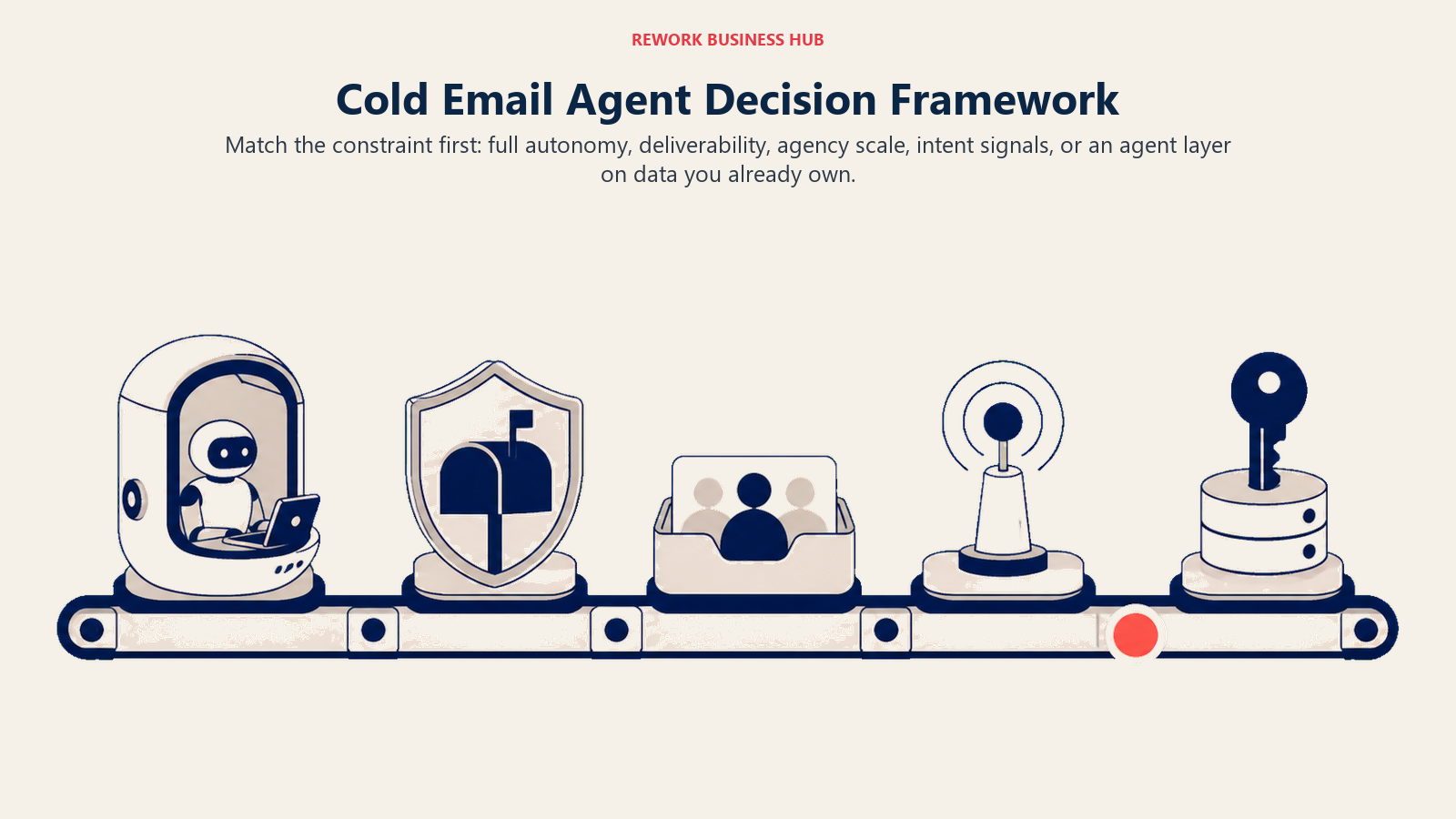
| If you need... | Pick... | Why |
|---|---|---|
| A fully autonomous BDR with no per-step human input | Artisan (Ava) | Runs the entire research-to-meeting loop; the tradeoff is opaque pricing |
| Transparent, self-serve pricing on a full AI SDR | AiSDR (Ami AI) | Public tiers from $250/mo, no sales call required |
| The agent and its deliverability infrastructure from one vendor | Salesforge (Agent Frank) | Bundled with Mailforge, Warmforge, and Infraforge |
| Proven deliverability with an agent layered on top | Instantly (AI Sales Agent) | Deepest public benchmark data in the category |
| Multi-client agency management with AI added on | Smartlead (SmartAgents) | Unlimited mailboxes on every tier, built for agencies |
| A free AI research layer inside a multichannel sender | Lemlist (lemAgent) | Included on every plan, no extra cost |
| Outreach triggered by buying-intent signals | Amplemarket (AI Agents) | Duo suite ties timing to real buying behavior |
| An agent layer on the database you already pay for | Apollo (Sequences + AI Agents) | No new vendor if you already run Apollo |
| Enterprise-wide agentic workflows tied to forecasting | Outreach (Amplify agents) | Deepest named agent roster, tied to pipeline data |
| Cadence discipline plus AI inside a revenue-orchestration platform | Salesloft (AI Email Agents) | Mature coaching and conversation intelligence, now tied to Clari |
What to Do Next
Pick one agent and run it against 200 to 300 real prospects before committing to an annual plan. Check domain authentication (SPF, DKIM, DMARC) and give any new sending domain 4 to 6 weeks of warmup before the agent sends at volume, regardless of which product gets chosen. If deliverability infrastructure is the piece that's missing, start with Salesforge or Instantly, since both bundle it in. If that part is already solved and the research-to-send loop is the actual gap, Artisan and AiSDR are the two purpose-built options to trial first. And for a team that would rather build a narrower agent than buy one of the ten above, best no-code AI agent builders is the place to start, or the build blueprint linked earlier in this guide for a fully custom route.

Principal CRM Strategist
On this page
- Key Facts
- Quick Comparison Table
- Deliverability Infrastructure: Why This Decides Everything
- Personalization Depth: Real Research vs Mail-Merge Cosplay
- Automated Reply Handling and Meeting Booking
- The Legal Line: CAN-SPAM, GDPR, and PECR
- How to Choose: Match the Agent to What's Actually Missing
- Sizing and Persona Table
- 1. Artisan (Ava): The Best-Known Fully Autonomous BDR
- 2. AiSDR (Ami AI): The Most Transparent Pricing of Any Full-Funnel AI SDR
- 3. Salesforge (Agent Frank): The Agent That Ships With Its Own Deliverability Stack
- 4. Instantly (AI Sales Agent): The Deepest Deliverability Track Record, Now With Three Named Agents
- 5. Smartlead (SmartAgents): Built for Agencies First, With AI Workflows Layered On
- 6. Lemlist (lemAgent): The Only Agent Here That's Free on Every Plan
- 7. Amplemarket (AI Agents / Duo): Autonomous Research Tied to Real-Time Intent Signals
- 8. Apollo (Sequences + AI Agents): The Agent Layer on the Database You Probably Already Pay For
- 9. Outreach (Amplify Agents): A Full Named Agent Roster for Enterprise Revenue Teams
- 10. Salesloft (AI Email Agents): Cadence Discipline Plus AI, Now Tied to Clari's Forecasting
- Cold Email Buying Mistakes to Avoid
- Decision Framework
- What to Do Next