More in
Notícias de Sales Tech
Times de Vendas com IA Crescem 2,6x Mais Rápido. O Gartner Diz que os Compradores Ainda Querem um Representante Humano
jun 6, 2026
Aircall Adquiriu a Piper AI para Transformar Cada Ligação de Vendas em Pipeline
jun 6, 2026
Salesforce Acaba de Dar aos Profissionais de Marketing Agentes de IA que Constroem Pipeline de Vendas
jun 6, 2026
Revenue Intelligence Mostrou o Risco. Revenue Execution Age Sobre Ele.
jun 5, 2026
A Meta Colocou um Agente de IA no WhatsApp que Fecha Vendas para Qualquer Empresa
jun 4, 2026
Investidores Aplicaram Mais de $200M em Startups de Vendas com IA: O Sinal para o GTM Stack
jun 4, 2026
AI SDRs Valem a Pena em 2026? Os Dados Indicam: Monte um Time Híbrido
jun 3, 2026
GTM Engineering em 2026: A Contratação de Vendas que Substitui Três Funções
jun 3, 2026
ZoomInfo Fornece Dados Verificados para Seus Agentes de Vendas com IA: O Risco de Depender de um Único Fornecedor
jun 3, 2026
O Salesforce Summer '26 Lança Orquestração Multi-Agente em 15 de Junho. Veja a Auditoria de Sales Ops Antes que Seus Agentes Comecem a Passar Tarefas
jun 2, 2026
Sierra Ultrapassou os $15B Vendendo Agentes de IA para Clientes em Metade da Fortune 50. A Análise de Sales Ops
Turn this article into takeaways for your work.


Each assistant summarizes the article only for you and suggests best practices for your work.
Uma empresa que vende agentes de IA para clientes acaba de ultrapassar uma avaliação de $15,8 bilhões e entrou em mais de 40% da Fortune 50. Se você está em Sales Ops e ainda trata agentes de clientes como uma linha de CX, este é o momento de rever esse pressuposto.
Em 4 de maio de 2026, a Sierra anunciou uma Série E de $950 milhões liderada pela Tiger Global e pela GV do Google, com participação da Benchmark, Sequoia e Greenoaks. O TechCrunch reportou que a rodada elevou a avaliação da Sierra de $10 bilhões (final de 2025) para $15,8 bilhões em menos de oito meses. A empresa agora detém mais de $1 bilhão em caixa e declarou publicamente sua ambição de se tornar "o padrão global" para agentes de experiência do cliente com IA. Seu ARR está em $150 milhões.
Essa taxa de crescimento merece atenção. A Sierra fechou uma rodada de $350 milhões cerca de oito meses antes desta Série E. Em seguida, quase dobrou sua avaliação nesse intervalo. A lista de clientes nomeados inclui Prudential, Cigna, Blue Cross Blue Shield e Rocket Mortgage, o que significa que os setores de saúde, serviços financeiros e hipotecas já estão executando esses agentes em escala. O que mudou não é apenas o tamanho do cheque. É onde esses agentes estão sendo implantados.
O Que a Sierra Realmente Vende (e Por Que $15B)
A Sierra constrói agentes de IA conversacionais que lidam com interações de clientes de ponta a ponta. As implantações iniciais focavam em tarefas como rastreamento de pedidos e redefinições de senha. Mas o produto se expandiu para originação de hipotecas, processamento de sinistros de seguros, gestão de assinaturas e trabalho de ciclo de receita em saúde. Esses não são wrappers de chatbot. São agentes com autoridade de decisão em fluxos de trabalho que antes exigiam profissionais licenciados ou equipes sênior de suporte.
Bret Taylor, cofundador da Sierra e presidente do conselho da OpenAI, descreveu publicamente o mercado de agentes de IA por segmento. Sua visão: os agentes de codificação (empresas como Cursor e Replit) representam a maior fatia do mercado, e os agentes de atendimento ao cliente são o segundo maior. Isso coloca a Sierra no centro de uma categoria que acredita ultrapassará a maioria dos outros segmentos de software empresarial.
O contexto em torno desta captação também importa. A Série E da Sierra fechou na mesma semana de uma joint venture Anthropic-Blackstone de $1,5 bilhão, e pouco antes de uma rodada reportada de $4 bilhões da OpenAI Deployment Company em meados de maio. Um padrão está se formando em todo o stack de IA: o modelo de "empresa de implantação e especialista" é para onde o capital institucional está fluindo. Empresas que dominam uma categoria específica de agentes com confiabilidade empresarial estão comandando múltiplos de avaliação que as plataformas de IA generalistas não têm.
Fatos-Chave
- A Série E da Sierra avalia a empresa em $15,8B, ante $10B no final de 2025, segundo o TechCrunch
- O ARR da Sierra chegou a $150M, com agentes de clientes implantados em mais de 40% da Fortune 50
- Bret Taylor identificou agentes de atendimento ao cliente como a segunda maior categoria de agentes de IA, atrás apenas dos agentes de codificação
Por Que Isso Importa para Sales Ops, Não Apenas para CX
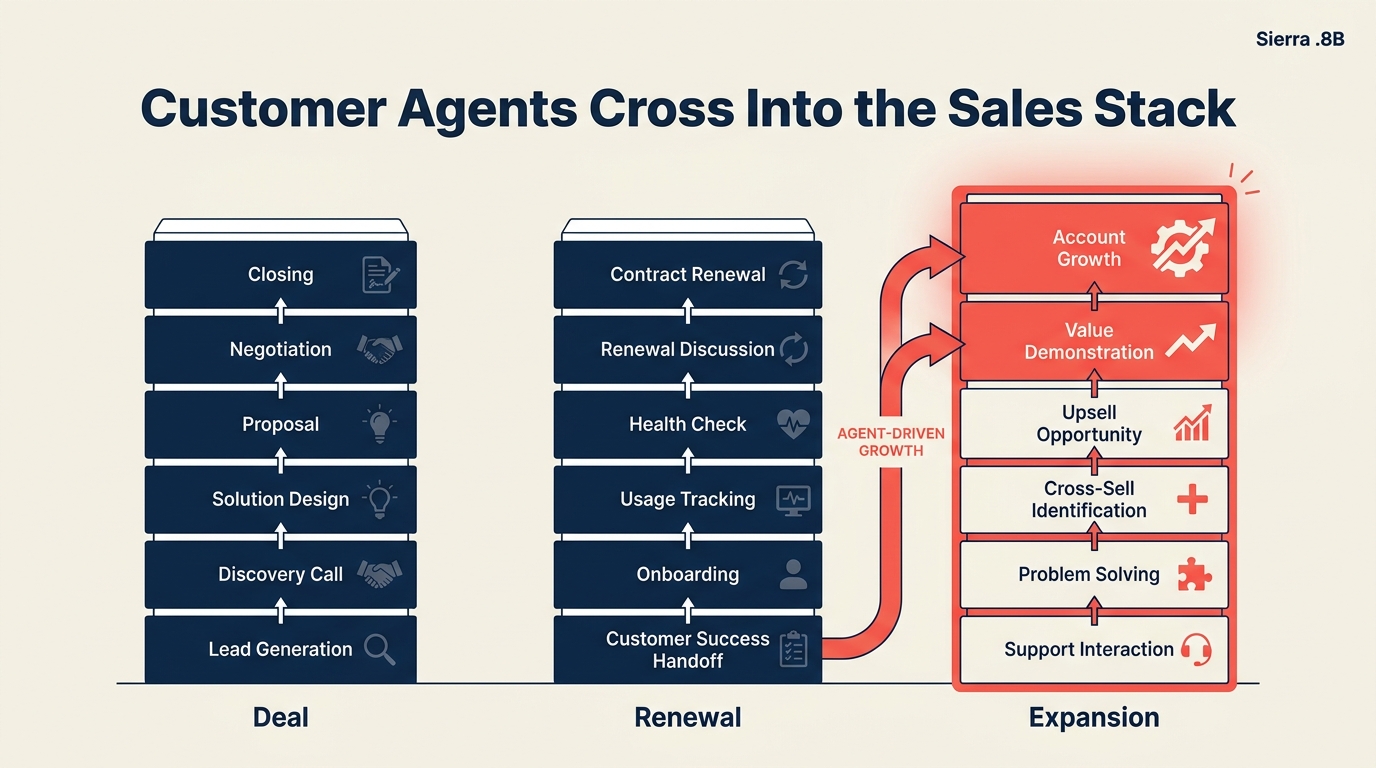
O enquadramento padrão para agentes de clientes é que eles pertencem ao Chief Customer Officer ou ao VP de Suporte. Esse enquadramento fazia sentido quando os agentes lidavam com tickets de nível 1. Ele não se sustenta quando os agentes lidam com originação de hipotecas e gestão de assinaturas, porque esses fluxos estão diretamente dentro da dinâmica de negócio, da dinâmica de renovação e da dinâmica de expansão.
Pense em cada uma dessas três áreas.
No lado dos negócios, um agente de cliente que lida com um trial self-serve ou uma consulta inbound está fazendo trabalho de qualificação. Se a lógica de handoff desse agente não está alinhada com os critérios de limiar da sua equipe de vendas, negócios são descartados ou direcionados incorretamente. O agente é, na prática, o filtro do topo do seu Funnel. Sales Ops é responsável por esse filtro em todas as outras partes do stack. Entender como os agentes de IA operam no pipeline de vendas não é mais contexto opcional.
Nas renovações, os agentes de clientes que lidam com gestão de assinaturas têm acesso a sinais de uso, padrões de reclamação e linguagem de churn que o seu CRM provavelmente não captura. Se o agente não está roteando esses sinais de volta ao registro do negócio antes da conversa de renovação, seus reps entram nas renovações sem informação. É o tipo de lacuna de captura de sinais que a disciplina de higiene de pipeline é projetada para fechar.
Na expansão, um agente de cliente que atende interações de suporte em torno de um produto principal está ao lado de oportunidades de cross-sell que o agente pode não estar treinado para identificar. Isso é um gatilho de expansão perdido cada vez que acontece. A diferença entre um padrão de copiloto e um padrão de agente real está em se o sistema age sobre o que sabe ou apenas o reporta.
Nada disso significa que Sales Ops precisa ser responsável pelo contrato do agente de cliente. Mas significa que Sales Ops precisa ter voz quando o escopo do agente, o roteamento de dados e a lógica de escalação estão sendo projetados.
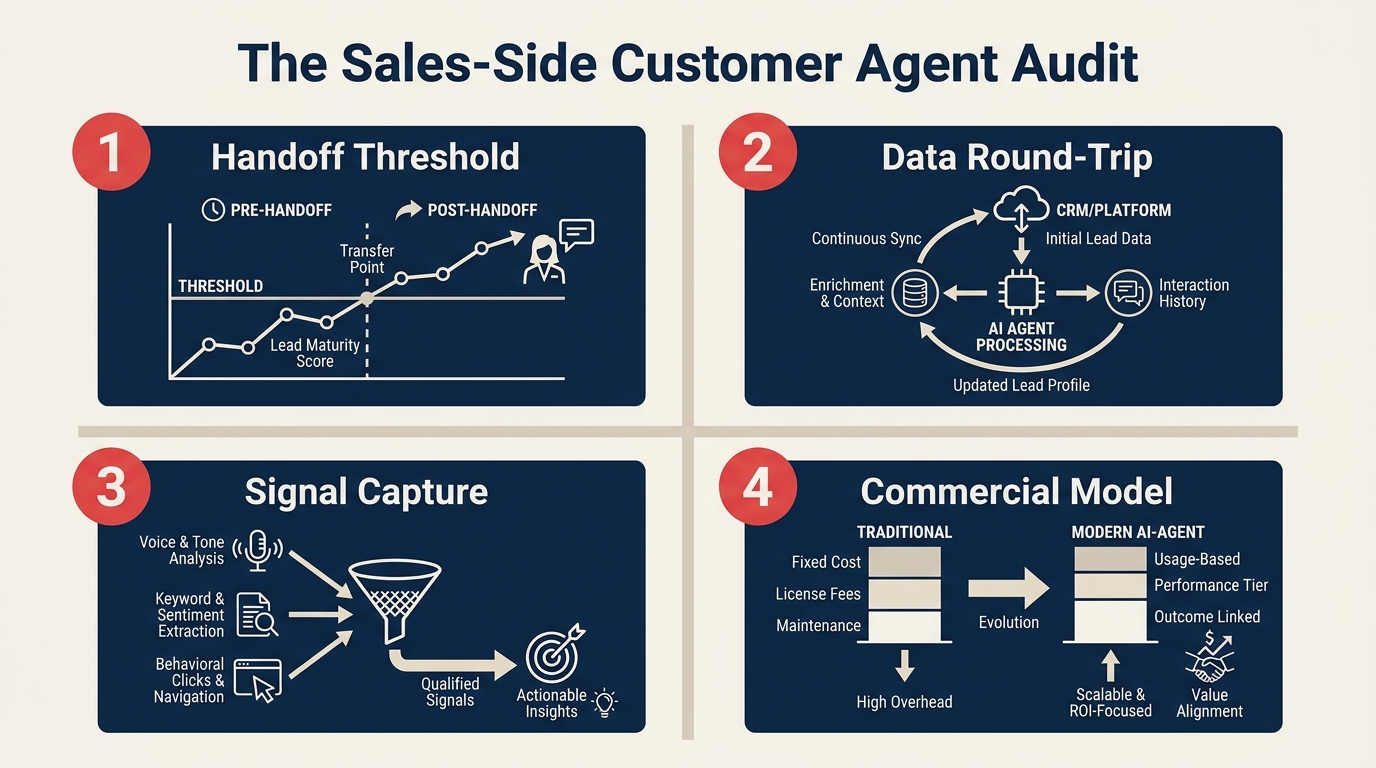
A Auditoria de Agente de Cliente para o Lado de Vendas: 4 Perguntas Antes da Próxima Revisão de Stack
Este é um framework para equipes de Sales Ops que avaliam ou reavaliam implantações de agentes de clientes. Execute estas quatro perguntas antes da sua próxima revisão de RevOps ou de stack.
1. Onde nosso agente de cliente para e nossa dinâmica de vendas começa?
Toda implantação de agente tem um limiar de handoff: o ponto em que o agente escala para um humano. Mas esse limiar geralmente é definido pela equipe de CX com base no volume de suporte, não por Sales Ops com base em sinais de negócio. Se o seu agente está escalando por sinais de frustração, mas não por sinais de intenção (perguntas sobre preços, comparações de funcionalidades, contexto de tamanho da empresa), você está transferindo as conversas erradas na hora errada. Mapeie a lógica de handoff e verifique-a em relação aos seus critérios de qualificação.
2. Quem é responsável pelo round-trip de dados do agente para o CRM?
Os agentes de clientes geram dados de interação, sinais de sentimento e resultados de resolução que quase sempre ficam armazenados na camada de dados da própria plataforma do agente. Esses dados raramente chegam ao registro do CRM onde sua equipe de vendas opera. Antes da próxima revisão de stack, faça uma auditoria de quais sinais gerados por agentes existem, quais são relevantes para vendas (linguagem de churn, menções de upsell, lacunas de produto) e quem é responsável por inseri-los no registro do negócio. Se ninguém for responsável por esse round-trip, ninguém vai fazê-lo. O guia de IA no fluxo de trabalho de RevOps aborda o modelo de propriedade exatamente para esse tipo de captura de sinal entre sistemas.
3. Os sinais de renovação e expansão do agente aparecem dentro do registro do negócio?
Esta pergunta é um subconjunto da pergunta sobre o round-trip de dados, mas é específica o suficiente para merecer seu próprio espaço. Os sinais de renovação (volume crescente de reclamações, solicitações de funcionalidades que indicam necessidade não atendida, tickets de suporte abertos nos 90 dias antes da renovação) geralmente são invisíveis para vendas porque ficam na camada de suporte. Os sinais de expansão (perguntas de uso sobre funcionalidades que o cliente não tem, comparações com capacidades de concorrentes) são igualmente invisíveis. A pergunta não é se o agente captura esses sinais. É se eles chegam ao rep antes da conversa acontecer.
4. O contrato trata os agentes de clientes como headcount ou como plataforma?
Este ponto tem implicações reais de orçamento. Algumas organizações estão comprando capacidade de agente de cliente da mesma forma que compram headcount de suporte: por agente, por conversa ou por resolução. Outras estão comprando como uma licença de plataforma, com precificação de consumo por cima. O modelo escolhido afeta como você mede o ROI, como você prevê o custo e se Sales Ops pode realisticamente instrumentar o agente como parte do stack de vendas. Se o contrato trata o agente como headcount, provavelmente não terá a profundidade de integração necessária. Se tratar como plataforma, deveria ter. Verifique antes de assinar.
O Que Fazer Esta Semana
Esta semana:
- Inclua a implantação atual do agente de cliente na pauta da sua próxima revisão de stack, mesmo que não estivesse planejando discutir isso
- Pergunte ao time de CX ou Suporte quais sinais de escalação acionam um handoff para vendas e se Sales Ops teve participação na definição desses sinais
- Verifique se os dados de interação do agente estão fluindo para o seu CRM e, se sim, quem é responsável pelo mapeamento
- Converse com um rep que lida com leads inbound de fluxos self-serve sobre se os handoffs do agente chegam com contexto ou sem informação
Próximos 30 dias:
- Execute a auditoria de 4 perguntas acima em relação à implantação atual do agente e documente as lacunas
- Identifique um sinal de expansão ou renovação que o agente captura atualmente e que não está chegando ao registro do negócio, depois construa a regra de roteamento para corrigir isso
- Confirme se o modelo do contrato do agente (headcount vs. plataforma) está alinhado com a forma como você quer medir e instrumentá-lo
- Informe seu líder de RevOps sobre o enquadramento de decisão de stack antes que a Sierra ou um concorrente se apresente diretamente ao seu time de procurement
- Revise seu stack de ferramentas e tecnologia de RevOps para mapear onde os dados do agente de cliente se integrariam de forma mais limpa
Perguntas Frequentes
O que é um agente de cliente no modelo da Sierra?
Um agente de cliente é um sistema de IA que lida com interações de clientes de ponta a ponta, sem exigir um humano no loop na maioria dos casos. No modelo da Sierra, isso significa que o agente pode resolver problemas, processar transações e tomar decisões em fluxos de trabalho como sinistros de seguros, solicitações de hipotecas e mudanças de assinatura. É distinto de um chatbot (que roteia para humanos) e de um copiloto (que assiste humanos). O agente age com autoridade, não apenas com assistência.
Por que Sales Ops deve se importar com uma plataforma de agente de cliente usada por equipes de CX?
Porque os agentes de clientes agora operam dentro de três dinâmicas que Sales Ops é responsável: qualificação de negócios via fluxos self-serve, sinais de risco de renovação via interações de suporte e oportunidades de expansão via perguntas de uso do produto. Se os dados do agente não forem roteados para o CRM, esses sinais desaparecem antes que vendas possa agir sobre eles. Isso é um problema de design de stack, e o design de stack fica com Sales Ops e RevOps, não com a equipe de CX.
Qual é o risco de ignorar a camada de agente de cliente durante uma revisão de stack?
O risco prático é que um fornecedor (Sierra ou um concorrente) venda diretamente para o seu time de procurement ou TI, defina a arquitetura de integração sem a participação de Sales Ops e entregue uma implantação de agente onde a lógica de handoff, o roteamento de dados e o modelo comercial otimizam para métricas de CX em vez de métricas de receita. Reconfigurar isso após o go-live é caro. Ter voz no momento do design custa quase nada.
Saiba Mais
- Agentes de IA no Pipeline de Vendas: Hype, Realidade e o Que Realmente Funciona
- Copilotos de IA vs. Agentes de IA: Entender a Diferença Importa
- A Lacuna de Governança: O Que os Líderes Erram Sobre IA no Trabalho
- IA no Fluxo de Trabalho de RevOps
- Ferramentas e Stack de Tecnologia de RevOps
- Próxima Melhor Ação para Cada Negócio Aberto
