More in
Berita Sales Tech
Tim Sales Berbasis AI Tumbuh 2,6x Lebih Cepat. Gartner Menyatakan Pembeli Masih Menginginkan Rep Manusia
Jun 6, 2026
Aircall Mengakuisisi Piper AI untuk Mengubah Setiap Sales Call Menjadi Pipeline
Jun 6, 2026
Salesforce Baru Saja Memberi Pemasar AI Agent yang Membangun Sales Pipeline
Jun 6, 2026
Revenue Intelligence Menunjukkan Risikonya. Revenue Execution Bertindak Atasnya.
Jun 5, 2026
Meta Menempatkan AI Agent di WhatsApp yang Menutup Penjualan untuk Bisnis Mana Pun
Jun 4, 2026
VC Menggelontorkan Lebih dari $200M ke Startup AI Sales: Sinyal GTM Stack
Jun 4, 2026
Apakah AI SDR Sepadan di 2026? Data Menunjukkan Bangun Tim Hibrida
Jun 3, 2026
GTM Engineering di 2026: Rekrutan Sales yang Menggantikan Tiga Peran Sekaligus
Jun 3, 2026
ZoomInfo Memasok Data Terverifikasi ke AI Sales Agent Anda: Pertimbangan Vendor Tunggal
Jun 3, 2026
Salesforce Summer '26 Menghadirkan Multi-Agent Orchestration pada 15 Juni. Inilah Audit Sales Ops Sebelum Agent Anda Mulai Melakukan Handoff
Jun 2, 2026
Bahasa Indonesia
Agentforce Baru Saja Mencapai $1,2 Miliar ARR dalam 14 Bulan: Yang Perlu Diaudit CRO Sebelum Perencanaan Q3
Turn this article into takeaways for your work.


Each assistant summarizes the article only for you and suggests best practices for your work.
Angka yang mengubah percakapan perencanaan Q3 Anda adalah $1,2 miliar. Dan angka itu datang lebih cepat dari yang hampir semua orang perkirakan.
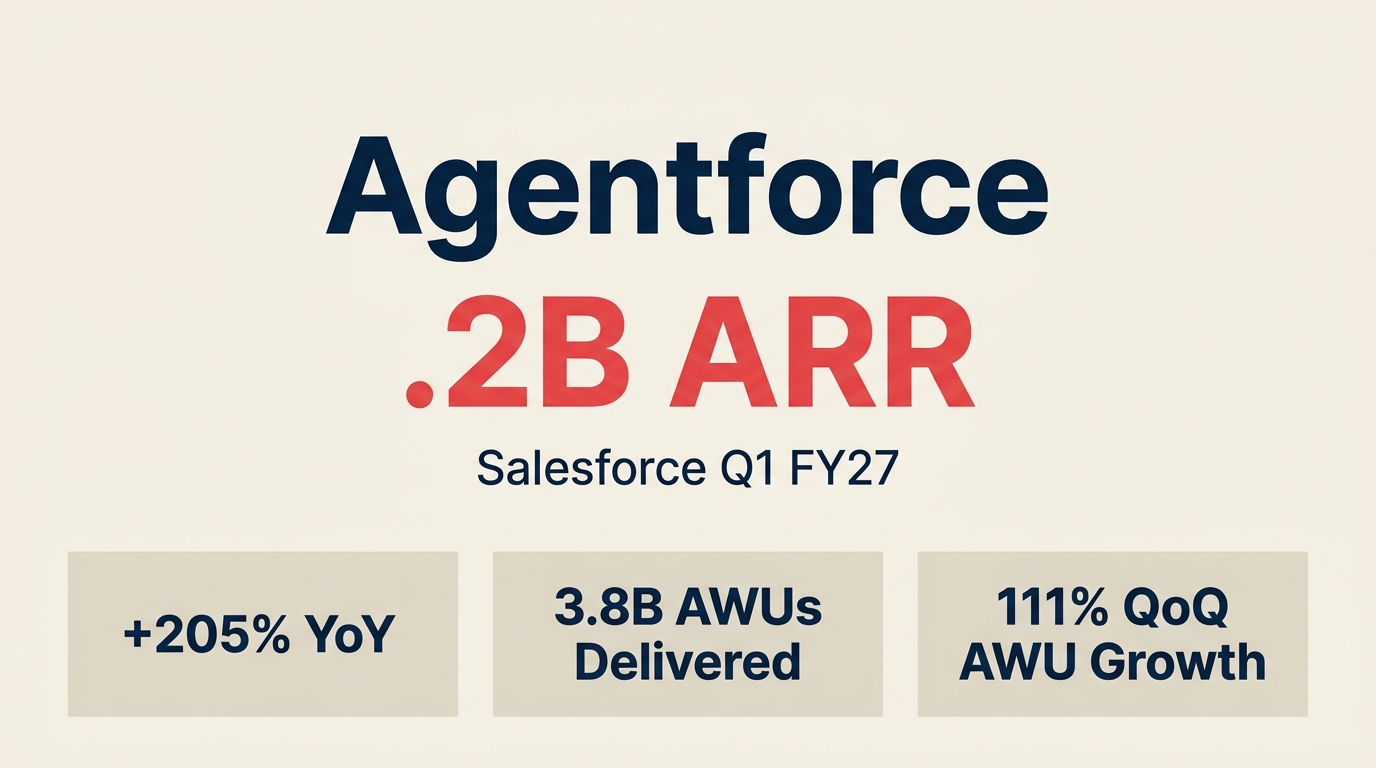
Salesforce mengumumkan hasil kuartal pertama fiskal 2027 pada 27 Mei 2026, dengan ARR (annual recurring revenue, tingkat pendapatan berulang tahunan dari langganan aktif) Agentforce mencapai $1,2 miliar, naik 205% dibandingkan tahun sebelumnya. Platform ini diluncurkan pada September 2024. Mencapai ARR $1,2 miliar dalam 14 bulan menempatkannya dalam kelompok yang langka di antara peluncuran produk perangkat lunak enterprise.
Namun bagi Chief Revenue Officer (CRO) dan pemimpin Sales Ops, judul berita ARR adalah angka terpenting kedua dalam laporan tersebut. Yang pertama adalah 3,8 miliar.
Catatan Singkat: Volume Agentic Work Unit (AWU) Agentforce tumbuh 111% kuartal ke kuartal. Itu bukan metrik penggunaan. Itu sinyal penagihan. CRO yang tidak memiliki model ekonomi unit untuk konsumsi agen AI sebelum perencanaan Q3 akan terkejut dengan apa yang muncul dalam anggaran tumpukan teknologi mereka.
Apa yang Sebenarnya Dilaporkan Salesforce
Hasil Q1 FY27 Salesforce melampaui konsensus analis di semua lini. Total pendapatan mencapai $11,13 miliar (naik 13% tahun ke tahun). Laba per saham non-GAAP sebesar $3,88 melampaui konsensus $3,12 sebesar 24%. Perusahaan mencatat margin operasi non-GAAP sebesar 34,8%, rekor untuk bisnis tersebut. Salesforce menaikkan panduan pendapatan penuh tahun FY27 menjadi $45,9 miliar hingga $46,2 miliar, dengan panduan kuartal kedua ditetapkan pada $11,27 miliar hingga $11,35 miliar (mewakili pertumbuhan 10-11%).
Di dalam angka-angka utama tersebut, metrik platform AI menonjol. Agentforce digabungkan dengan Data 360 mencapai sekitar $3,4 miliar dalam ARR, naik lebih dari 200% tahun ke tahun. Agentforce saja menyumbang $1,2 miliar; Informatica Cloud menyumbang $1,1 miliar. Ini adalah kenaikan yang signifikan dari sekitar $800 juta ARR Agentforce yang dilaporkan sebelumnya di tahun 2026, mewakili kenaikan sekitar 50% dalam satu kuartal.
Angka AWU menceritakan kisah adopsi dalam istilah operasional. 3,8 miliar Agentic Work Unit (AWU, unit yang digunakan Salesforce untuk mengukur penyelesaian tugas agen di seluruh Agentforce dan Slack) telah terkirim hingga saat ini, tumbuh 111% kuartal ke kuartal. Dari sisi data, Data 360 mencerna 52 triliun catatan di Q1 (naik 136% tahun ke tahun), dengan 35 triliun tiba melalui Zero Copy (naik 277% tahun ke tahun). Zero Copy berarti Salesforce membaca data dari gudang data eksternal tanpa memindahkannya, yang mengurangi hambatan bagi pelanggan yang datanya berada di Snowflake, Databricks, atau BigQuery.
Key Facts
- ARR Agentforce: $1,2 miliar, naik 205% tahun ke tahun (pendapatan Q1 FY27 Salesforce, 27 Mei 2026)
- Agentic Work Unit terkirim hingga saat ini: 3,8 miliar, tumbuh 111% kuartal ke kuartal (Salesforce Q1 FY27)
- Catatan Data 360 yang dicerna di Q1: 52 triliun (naik 136% tahun ke tahun), dengan 35 triliun melalui Zero Copy (naik 277% tahun ke tahun) (Salesforce Q1 FY27)
Mengapa Angka AWU Lebih Penting dari Angka ARR
ARR memberi tahu Anda bahwa Salesforce memenangkan deal. Jumlah AWU memberi tahu Anda bahwa deal tersebut benar-benar digunakan dalam produksi, dan dalam skala besar.
Sebagian besar platform perangkat lunak enterprise kesulitan mengubah pendapatan lisensi menjadi penggunaan nyata. Deal yang ditutup bukan berarti alur kerja berubah. Fakta bahwa Agentforce mengantarkan 3,8 miliar work unit dengan pertumbuhan 111% kuartal ke kuartal berarti pelanggan tidak hanya membeli lisensi. Mereka menjalankan agen pada alur kerja nyata dalam volume yang berlipat ganda setiap kuartal.
Hal itu memiliki implikasi langsung pada cara Anda membuat anggaran. Perangkat lunak berbasis seat tradisional memiliki kurva biaya yang dapat diprediksi: Anda membayar per pengguna, menambah seat saat merekrut, mengurangi seat saat memotong. Penagihan agen AI berbasis konsumsi tidak bekerja seperti itu. Pengeluaran AWU Anda tumbuh seiring jumlah alur kerja yang Anda otomatiskan, frekuensi alur kerja tersebut berjalan, dan kompleksitas setiap tugas yang ditangani agen. Satu otomatisasi proses penjualan bisa memicu ratusan AWU per deal.
Jika Anda tidak mengetahui biaya AWU per deal, pengeluaran AI Anda bisa diam-diam berlipat ganda dalam satu kuartal. Itulah yang dimaksud dengan angka pertumbuhan 111% kuartal ke kuartal dalam praktiknya bagi organisasi mana pun yang memiliki Agentforce dalam produksi. Untuk panduan tentang cara menyusun alur kerja penjualan berbasis AI, lihat Apa Itu AI Sales Operator? 4 Pola yang Bekerja Bersama.
Audit CRO 4 Poin
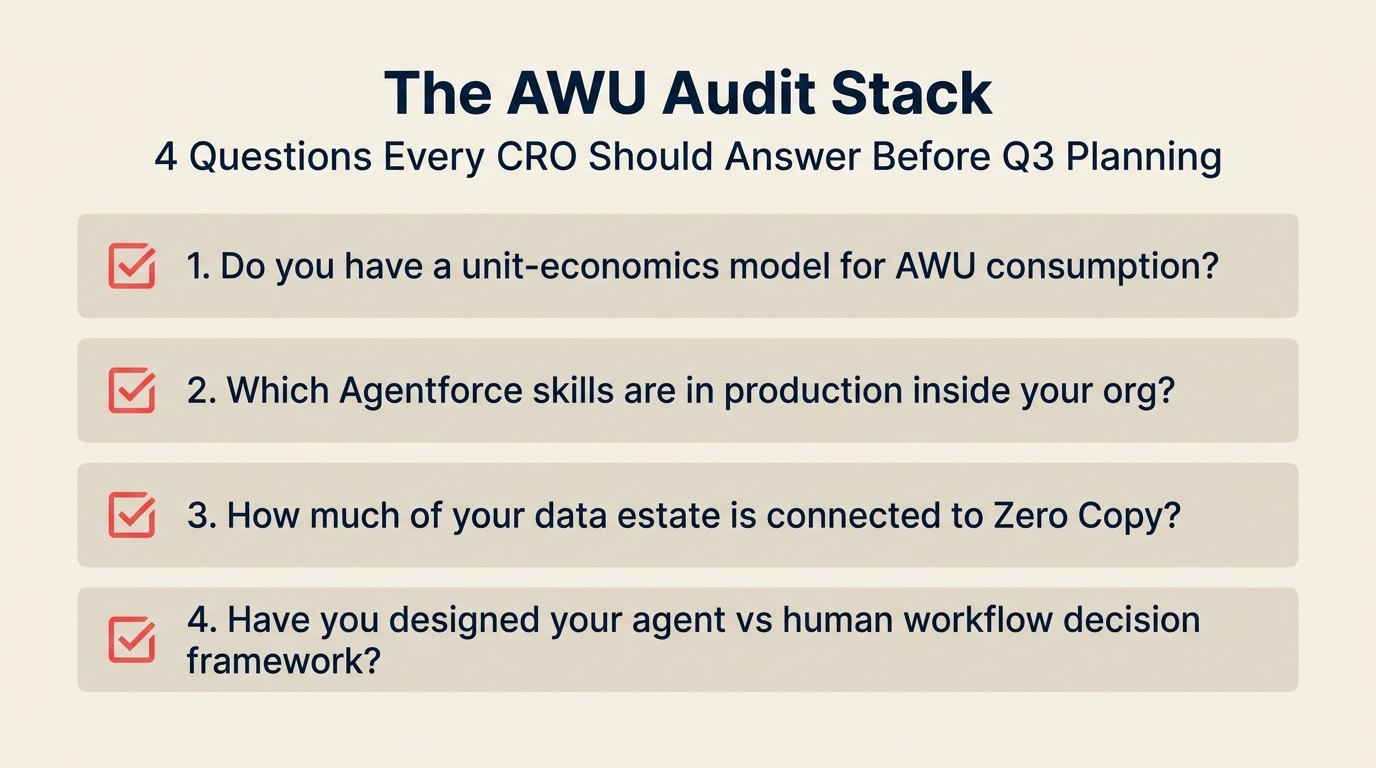
Inilah "AWU Audit Stack": empat pertanyaan yang harus dijawab oleh setiap CRO dan pemimpin Sales Ops sebelum perencanaan Q3 dimulai.
Pertanyaan 1: Apakah Anda memiliki model ekonomi unit untuk konsumsi AWU?
Jika Anda menjalankan Agentforce dalam kapasitas apa pun, minta tim Sales Ops Anda untuk memberikan rincian AWU berdasarkan kasus penggunaan. Berapa banyak AWU yang dikonsumsi siklus deal tipikal? Berapa per prospek terkualifikasi? Per tiket dukungan yang dirutekan melalui Slack? Sebagian besar tim belum memiliki pandangan ini, yang berarti mereka buta terhadap salah satu item yang tumbuh paling cepat dalam anggaran tumpukan teknologi mereka. Tujuannya bukan untuk meminimalkan penggunaan AWU. Tujuannya adalah mengetahui biaya per hasil sehingga Anda dapat membuat pertukaran yang rasional.
Mulai dari sini: tarik konsumsi AWU Anda dalam 30 hari terakhir dari Salesforce dan petakan setiap kelompok penggunaan ke alur kerja tertentu. Kemudian hitung AWU per deal dan AWU per prospek terkualifikasi. Jika Anda masih dalam mode percontohan, gunakan tolok ukur pelanggan referensi Salesforce untuk memproyeksikan biaya volume produksi pada kecepatan deal Anda saat ini.
Pertanyaan 2: Kemampuan Agentforce mana yang benar-benar ada dalam produksi di organisasi Anda?
Adopsi Agentforce tidak merata. Banyak organisasi menutup deal pada 2025, mengonfigurasi beberapa agen, lalu membiarkan platform tidak aktif sementara tim menyelesaikan manajemen perubahan. Tekanan kompetitif sedang bergeser. Jika rekan sejawat Anda menerapkan agen dalam skala besar (dan jumlah 3,8 miliar AWU menunjukkan banyak yang melakukannya), jendela untuk mengejar ketinggalan tanpa kesenjangan kemampuan semakin menyempit.
Audit kasus penggunaan produksi Anda saat ini terhadap pola ROI tertinggi yang diadopsi oleh pelanggan referensi. Tim lapangan dan organisasi customer success Salesforce mempertahankan daftar pola kasus penggunaan berperingkat berdasarkan industri dan jenis deal. Minta daftar itu sebelum sesi perencanaan Q3 Anda. Batasi tiga percontohan terhadap pola teratas. Jika percontohan tidak menunjukkan ROI terukur dalam enam minggu, hentikan dan pindah ke yang berikutnya. Untuk konteks tentang bagaimana tim sales ops terdepan menyusun adopsi AI, lihat Sales Ops AI vs. Operasi Penjualan Tradisional.
Pertanyaan 3: Berapa banyak aset data Anda yang sudah terhubung ke lapisan Zero Copy Salesforce?
Pertumbuhan 277% tahun ke tahun dalam volume Zero Copy adalah sinyal kuat bahwa Salesforce sedang membangun lapisan data, bukan hanya lapisan agen. Zero Copy berarti agen Salesforce dapat beroperasi pada data yang berada di gudang data Anda tanpa mengharuskan Anda menduplikasi atau memigrasikannya. Itu adalah pergeseran arsitektur yang signifikan. Jika data penjualan Anda berada di Snowflake atau Databricks, Anda mungkin sudah memiliki konektivitas Zero Copy lebih banyak dari yang Anda sadari. Dan jika belum, pengaturannya kini memiliki jalur yang lebih singkat dari setahun lalu.
Minta tim Sales Ops atau Data Engineering Anda untuk memetakan sumber data mana yang terhubung saat ini. Kemudian identifikasi dua atau tiga kumpulan data bernilai tinggi (umpan intelijen kompetitif, data penggunaan produk, riwayat tiket dukungan) yang belum terhubung tetapi akan meningkatkan kualitas agen secara bermakna jika terhubung. Lihat AI Lead Scoring di Luar Model Berbasis Aturan untuk contoh bagaimana umpan data real-time mengubah hasil penilaian.
Pertanyaan 4: Apakah Anda telah merancang kerangka kerja keputusan agen vs. manusia?
Pertumbuhan AWU 111% kuartal ke kuartal berarti kasus penggunaan berkembang lebih cepat dari yang dirancang sebagian besar organisasi. Tim sales mungkin memicu work unit agen tanpa memahami implikasi biaya. Tanpa kerangka kerja yang jelas tentang alur kerja mana yang dipimpin agen, mana yang dibantu agen, dan mana yang tetap hanya manusia, Anda berakhir dengan campuran otomatisasi yang tidak konsisten yang tidak mengurangi beban tim sales maupun meningkatkan kualitas deal.
Model tiga tingkat yang praktis: dipimpin agen untuk tugas bervolume tinggi dan kompleksitas rendah (triase Lead, pengayaan data, pengurutan tindak lanjut); dibantu agen untuk tugas kompleksitas sedang di mana penilaian manusia menambah nilai (persiapan panggilan penemuan, coaching deal, ringkasan tinjauan pipeline); hanya manusia untuk interaksi berisiko tinggi dan sensitif hubungan (tinjauan bisnis eksekutif, percakapan pengadaan, negosiasi kontrak). Untuk kerangka kerja tentang menyusun pendekatan berlevel ini, lihat Tinjauan Pipeline yang Mengungkap Risiko Nyata.
Posisi Agentforce vs. Trajektori HubSpot
Ada baiknya menempatkan angka Salesforce dalam konteks kompetitif. HubSpot melaporkan bahwa produk Customer Agent-nya melampaui 9.000 pelanggan di Q1 2026 dan kini menyumbang 53% konsumsi AI credit HubSpot. Itu adalah skala yang berarti bagi perusahaan yang membangun ke pasar menengah, tetapi perbandingan ekonomi unit penting: Salesforce menagih AWU (penyelesaian tugas), sementara HubSpot menagih AI credit (abstraksi penggunaan yang lebih luas).
Kedua model menunjuk ke arah yang sama. AI berdasarkan konsumsi menjadi struktur default untuk teknologi penjualan dalam skala. Pertanyaannya bukan platform mana yang Anda sukai. Pertanyaannya adalah apakah Anda memiliki model keuangan yang memperhitungkan penagihan berbasis konsumsi sebelum angka Q3 Anda ditetapkan.
CRO yang memperlakukan biaya agen AI sebagai item tetap dalam anggaran FY mereka akan salah. Variabelnya adalah seberapa cepat tim Anda benar-benar menggunakan agen. Dan berdasarkan pertumbuhan AWU 111% kuartal ke kuartal, asumsi yang benar adalah: lebih cepat dari yang Anda rencanakan.
Untuk perspektif yang lebih luas tentang bagaimana alat AI mengubah tumpukan teknologi komersial, lihat Akurasi Forecasting: Mencapai Plus-atau-Minus 10% pada Minggu ke-8.
Yang Perlu Dilakukan Minggu Ini
Berikut daftar periksa konkret yang dapat Anda bawa ke tinjauan pipeline atau sesi persiapan QBR berikutnya sebelum perencanaan Q3:
Daftar Periksa Audit AWU untuk CRO dan Sales Ops
- Tarik laporan konsumsi AWU saat ini dari Salesforce (Admin, Pengaturan Org, Penggunaan Agentic). Urutkan berdasarkan alur kerja atau jenis agen.
- Petakan konsumen AWU teratas ke alur kerja penjualan tertentu. Hitung AWU per deal yang ditutup, per SQL yang dihasilkan, per tiket dukungan yang diselesaikan.
- Minta deck tolok ukur pelanggan referensi Salesforce saat ini untuk vertikal industri Anda. Minta CSM atau AE Anda untuk lima pola kasus penggunaan teratas berdasarkan ROI.
- Identifikasi tiga kandidat percontohan teratas Anda untuk Q3. Masing-masing harus memiliki metrik keberhasilan yang jelas (biaya per hasil), batas waktu enam minggu, dan pemilik yang ditunjuk.
- Petakan koneksi gudang data Anda saat ini ke Salesforce Data 360. Identifikasi dua sumber data bernilai tinggi yang belum terhubung melalui Zero Copy.
- Dokumentasikan kerangka kerja keputusan agen vs. manusia Anda. Untuk setiap alur kerja Agentforce yang aktif, klasifikasikan sebagai dipimpin agen, dibantu agen, atau hanya manusia. Tutup alur kerja mana pun yang klasifikasinya tidak jelas.
- Bangun perkiraan konsumsi AWU Q3. Gunakan tingkat AWU Anda saat ini ditambah percontohan baru yang direncanakan. Uji tekanan pada pertumbuhan 2x (yang konservatif relatif terhadap 111% QoQ yang dilaporkan platform).
- Sajikan model ini di QBR perencanaan Q3 Anda sebagai baris biaya konsumsi, bukan biaya langganan tetap.
Organisasi yang memperlakukan AI agentik sebagai kontrak SaaS berbasis seat akan terkejut dengan angka aktual Q3. Mereka yang membangun pemikiran ekonomi unit ke dalam perencanaan mereka sekarang adalah yang akan menggunakan pertumbuhan majemuk platform tersebut untuk keuntungan mereka, bukan melawan anggaran mereka.
FAQ
Berapa ARR Agentforce pada tahun 2026?
Salesforce melaporkan ARR Agentforce sebesar $1,2 miliar dalam rilis pendapatan Q1 FY27-nya pada 27 Mei 2026, mewakili pertumbuhan 205% tahun ke tahun. Produk ini diluncurkan pada September 2024, menjadikannya salah satu penghentian ARR perangkat lunak enterprise tercepat yang pernah ada. Laporan sebelumnya di tahun 2026 menyebutkan sekitar $800 juta ARR, yang berarti platform ini menambahkan sekitar $400 juta ARR dalam sekitar satu kuartal.
Apa itu Agentic Work Unit (AWU)?
Agentic Work Unit adalah metrik penagihan konsumsi Salesforce untuk aktivitas agen AI Agentforce dan Slack. Setiap AWU mewakili penyelesaian tugas diskrit oleh agen AI. Contohnya termasuk merutekan Lead masuk, menyusun email tindak lanjut, meringkas transkrip rapat, atau menarik catatan pengayaan data. Salesforce menagih pelanggan per AWU yang dikonsumsi, yang berarti total biaya tumbuh seiring volume aktivitas agen daripada jumlah pengguna. Per Q1 FY27, 3,8 miliar AWU telah terkirim hingga saat ini, dengan pertumbuhan 111% kuartal ke kuartal.
Bagaimana sales ops harus menganggarkan untuk agen AI berbasis konsumsi pada 2026?
Pergeseran utama dari penetapan harga berbasis seat ke berbasis konsumsi adalah bahwa anggaran AI Anda kini tumbuh seiring volume alur kerja, bukan jumlah karyawan. Langkah penganggaran praktis: (1) tarik konsumsi AWU Anda saat ini dan hitung biaya per deal dan biaya per prospek terkualifikasi; (2) bangun perkiraan penggunaan yang memperhitungkan percontohan baru yang direncanakan untuk Q3 dan Q4; (3) terapkan buffer pertumbuhan 1,5x hingga 2x relatif terhadap konsumsi saat ini, berdasarkan tingkat pertumbuhan 111% kuartal ke kuartal yang diamati di seluruh basis pelanggan Salesforce; (4) pisahkan anggaran AWU Anda dari anggaran lisensi seat dan sajikan keduanya sebagai item baris yang berbeda dalam model perencanaan FY Anda. Organisasi yang memodelkan biaya AI sebagai item tetap akan secara konsisten meremehkan pengeluaran di kuartal dengan pertumbuhan tinggi.
